Archived decisions
Hampshire County Council
Children's Services Policy Review Committee Item 9
17 January 2006
Change for Children Programme
Report of the Director of Children's Services
|
Contact: Colin Hardy, Project Director, ext 7663, e-mail: [email protected]
1. Summary
1.1 This paper identifies the Change for Children programme for Hampshire and builds on a broad vision for future services agreed with partners following consultation in 2005. This is a longer term management of change programme and relates to the Children and Young People's Plan, which will include details of the priorities agreed with partners to improve outcomes for all children and young people.
1.2 Appendix 1 to this report contains an extract from the Children and Young People's Plan setting out the vision and guiding beliefs that will underpin the way in which partners work together in planning and providing services that meet the needs of all children and young people in Hampshire.
1.3 It is intended that this paper will be used to involve all those providing services to children and young people and all stakeholders in confirming the vision for services and the pace and direction of the changes that will be made. Involvement with children and young people, stakeholders and staff will strengthen awareness of the drivers for change, gain support to the changes necessary and promote clarity of purpose.
1.4 This framework for action will be developed into detailed project plans identifying the necessary inputs, outcomes, and timescales and reporting arrangements in order to manage and monitor progress.
1.5 The Change for Children programme proposes a framework for action to promote a single future purpose for children's services: -
To improve outcomes for all children and young people in Hampshire
1.6 This programme supports the Corporate Strategy in maximising life opportunities, building strong and safe communities, improving services and developing councillors and staff by providing the necessary Member leadership for strategy and ensuring management action with partners to improve outcomes for children and young people.
1.7 The approach will also support the County Council in meeting the statutory requirements of the Children Act 2004 by establishing the necessary vision for services and ensuring joint working with partners to improve outcomes for children and young people.
2. Drivers for change
2.1 The drivers for change are set out in Government guidance including
· Every Child Matters,
· The five year strategy for children and learners
· The 10 year child care strategy
· Youth Matters Green Paper
· The National Service Framework for children and for maternity services
· The National Primary and Secondary Strategies,
· The New Relationship with Schools, a new Ofsted framework for school inspections
· The work of the National Workforce Remodelling Team
· The 14-19 White Paper.
· Statutory guidance on the Children Act 2004
· Higher Standards - Better Schools
2.2 Section 10 of the Children Act sets out how partners should cooperate to ensure that all services to children and young people
· Put children and young people at the centre with their full participation in planning services and monitoring outcomes
· Focus on improving outcomes including by ensuring integration at the `front line' with integrated management and unified processes
· Ensure universal and targeted services offer better opportunities for early intervention and prevention.
· Have a common understanding of need and align resources to agreed priorities.
2.3 These issues imply fundamental changes to the way in which services are planned and delivered and achieving change, whilst continuing to deliver safe and effective services, will require the investment of all those working with children and young people.
2.4 The Change for Children programme will result in a coherent network of services that meet the needs of every child in Hampshire. The County Council expects the universal services provided in early years settings, schools and colleges to meet the needs of most children without additional specialised support. Excellence will be maintained and extended to all settings so that the demand for specialised provision is minimised. Those children and young people in Hampshire who are at most risk of not achieving the five outcomes of the Children Act will have access to additional support.
2.5 The most significant contribution that can be made to improving the life chances of children and young people are made within universal services for early years, in schools and for those over aged 16. Good teaching and learning opportunities focused on improving outcomes are essential and support to parents in being active partners in ensuring improvements to health, educational outcomes and good citizenship will be developed.
2.6 Services will move from a position of operating independently with different priorities towards a position where all services, whether they be universal provision for early years and education or those targeted to vulnerable people, adopt a common understanding of need and focus resources on agreed priorities.
2.7 The County Council will provide the necessary political and management leadership with partners to establish jointly agreed strategies and priorities in order to ensure the necessary improvements to outcomes for all children and young people.
2.8 Management and leadership roles will move towards a position of ensuring participation with consumers, managing performance and deploying resources to ensure agreed improvements in all 5 outcomes for all children. Managers will be accountable for the performance of services in improving outcomes and providing the necessary leadership to joint working and integration
2.9 All partners will ensure participation with children and young people in order to develop a shared understanding of need, which will result in resources being focused on agreed priorities and improvements in outcomes being commissioned from services.
2.10 The concept of commissioning as applied to the universal education service is relatively new to those working in schools. In effect the County Council commissions and supports schools, irrespective of whether they have community, foundation or church status, to provide a high quality education that meets the needs of the community they serve and this concept will be extended by joint commissioning to include all forms of service to children and young people.
2.11 Once these changes have been made children, young people, their families and carers will have better access to information about services which meet their needs, will be active partners in improving their life chances and will experience better access to targeted services if they need more support than can be provided by the universal provision for health, early years, at schools and for those over 16 years.
2 Progress to date
3.1 Initial work to implement the Children Act 2004 and to respond to statutory guidance has been focused on building awareness and the capacity to respond to change in 6 key areas.
· Developing a vision for future services with partners and the development of an annual Children and Young People's Plan and a Local Area Agreement to include priorities for improved outcomes
· Communication, Consultation, Participation and evidenced based surveys with staff, stakeholders, consumers of services and with children, young people and their families
· To define service delivery and management arrangements for HCC services and explore opportunities for integration and co-location with partners
· Development of integrated information systems for children's services, including development of the Common Assessment Framework and arrangements for information sharing and developing the role of the lead professional
· Resource analysis to define budgets and assess accommodation opportunities - including the potential for co-location with partners
· Building capacity with partners, including consultation on a broad vision for future services, developing the work of the Children's Services Board and the Children and Young Persons Strategic Partnership, working with Local Strategic Partnerships and others concerned with services to children and families
3 The vision
4.1 The vision for all services to children and young people is based on the UN Convention on the Rights of the Child and builds upon earlier consultation with partners. The vision, guiding beliefs and expectations set out in Rights, Respect and Responsibilities are set out in the Children and Young People's Plan and summarised in appendix 1 to this report.
4.2 The County Council will exercise its leadership in working with partners and with children, young people, their families and carers to ensure that all children's services develop within the framework summarised below.
4.3 This framework will pay due regard to the universal services provided by the NHS, early years centres, schools and post-16 providers and support and develop them in achieving the five outcomes with all children including vulnerable children and young people. Universal and targeted services will combine to provide a coherent whole that meets the need of every child
4.4 The framework will be as relevant to universal services in the way they develop partnerships with the local community as it will be for targeted services to vulnerable children and young people. E.g. in improving health, in developing extended schools, sustaining high quality educational provision for all, raising attainment and engaging parents in teaching and learning opportunities
· Children, young people and families will be at the centre of services, fully engaged in establishing needs, priorities and in monitoring outcomes.
· All Services will work with parents to strengthen family life and to support and developing the abilities of parents to be actively engaged in improving outcomes
· There will be an emphasis on safeguarding, early intervention and upon prevention with clear access to targeted and more specialist services where necessary.
· Services will work to agreed priorities in which improved outcomes are identified and the accountability for making and sustaining improvements is clear.
· Resources will be targeted to agreed priorities to ensure greater equity of outcomes for those who are vulnerable and at risk of less good outcomes
· Services will have a full appreciation of the needs of individuals and local communities through continuous participation with children, young people, their families and stakeholders and by using the best available information and evidence to influence how services develop and are made available.
· Services will be accessible, information will be readily available and there will be choice for those seeking support.
· Integrated service delivery, with local partners working together within unified management arrangements, co-located wherever possible with unified business processes.
· Equity of opportunity and inclusion will be supported
4 Delivering the vision - the change programme
5.1 In order to ensure improved outcomes the County Council will exercise its leadership in working with all partners in 3 main areas.
· Agree a vision for the future and develop services which focus on improving outcomes, in partnership with children, young people, their families and carers
· Put in place management, leadership and governance arrangements with partners to support the changes and ensure the necessary performance management of outcomes This will include ensuring that senior leaders and managers, staff and governors in early years services, schools and post-16 settings, all recognise their responsibilities in meeting the needs of all children and young people and that they are supported and challenged in improving outcomes. These arrangements will support managers in achieving the necessary cultural change to ensure services are integrated and accessible to those who need them
· Ensure that policies, business processes and workforce developments support the delivery of improved outcomes. This will include developing joint commissioning approaches, performance management, implementation of the Common Assessment Framework, sharing information and joint training
5.2 This process will require active engagement with staff, stakeholders and consumers to reflect on the present position, support the pace and direction of change and invest in the necessary change programme, to secure effective local implementation and management of the programme across all universal and targeted services. The change programme will be framed in three phases: -
5.3 By March 2006
· Ensure all staff and stakeholders gain an understanding of the need for change and invest in the vision which defines the scale and nature of change. This process will be a reiterative one in which initial agreement will be reached and further refinements will emerge as progress is made to align resources to jointly agreed priorities.
5.4 Between January and September 2006
· Support people in making the changes to improve outcomes and to ensure better early intervention opportunities by providing the necessary joint training and development opportunities,
· Develop joint commissioning arrangements and ensure resources are focused on agreed priorities to improve outcomes
· Put in place revised service delivery arrangements and develop partnership working with new integrated service arrangements largely in place by September 2006.
· Strengthen performance management arrangements to ensure a focus on improving outcomes for all children and young people
· Publish a Children and Young People's Plan with a focus on the necessary service developments to improve outcomes in priority areas
· Refocus existing services and ensure new service developments support the change for children programme
· Implement initial arrangements for a Common Assessment Framework, develop the role of the lead professional, improve information sharing and develop common recording systems
5.5 From October 2006
· Review progress, consolidate, sustain and develop the future position by a continuous engagement with partners and support for staff
5 Service delivery
6.1 The development of local integrated early intervention services, alongside universal services in the NHS, pre-school settings, schools and post-16 providers that fully subscribe to the Change for Children programme, will be a key factor in delivering better outcomes.
6.2 This programme is designed to increase the life chances of every child. The overwhelming majority of pre-school settings, schools and post-16 providers make very good provision for children and play a key role in enabling them to achieve well in the five outcomes. The challenge is for them to improve their provision for vulnerable groups while maintaining the best possible educational experience for all children. The Change for Children programme is intended to support universal services in improving outcomes and to develop integrated provision targeted at vulnerable children and young people.
6.3 The framework for services will include development of early years services, children's centres, extended schools, youth support services and raising the standard of educational attainment as set out in Government programmes. All services will address the standards to be achieved in the National Service Framework for children and for maternity services working in conjunction with the NHS.
6.4 It is intended that improved outcomes will be jointly commissioned by partners with many services delivered locally within District Council areas organised around natural communities and universal provision for early years and for education in schools. Some very specialist services may operate on a larger scale.
6 Partnership and Governance
7.1 The leadership necessary to ensure better outcomes and to develop an integrated service framework will impact on all partners and will require changes to the culture within which partners work together to agree strategy and focus resources on agreed priorities to improve outcomes.
7.2 The accountabilities of managers will include particular responsibilities to manage performance, ensure improved outcomes and to exercise leadership in working with partners in ensuring full participation with children, young people, their families and carers.
7.3 The development of the necessary partnership and governance arrangements will be based upon the following framework.
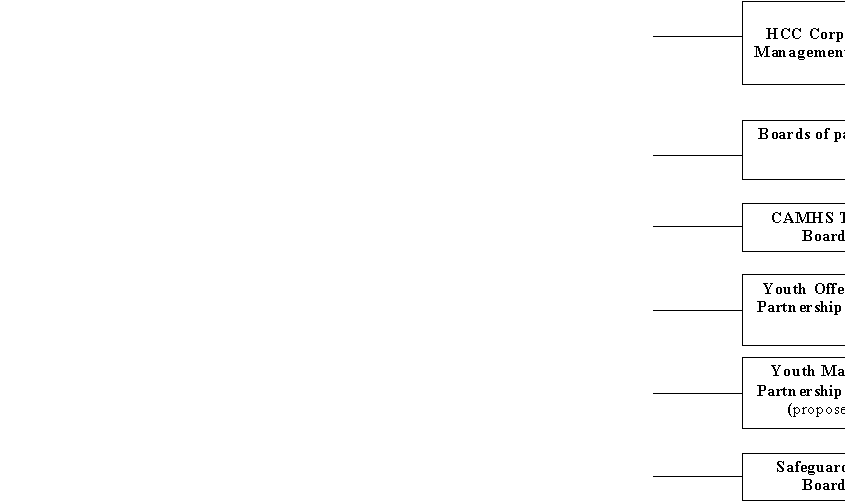
· Children and Young People's Partnership - Standing Conference - to be chaired by the Executive Member for Children's Services, with membership from partner agencies, to identify strategy, establish priorities, agree resources and oversee progress in improving outcomes
· Children and Young People's Partnership - Management Board - chaired by the Director of Children's Services to manage the implementation of agreed strategy and direction through commissioning, focusing resources to priority areas, establishing delivery agreements and performance management arrangements with partners
· Outcome Partnerships and Locality Partnerships will assist both the Standing Conference and the Management Board in managing programme areas with partners and ensuring a local perspective
7 Integrating and focusing policies and business processes
8.1 The Government has set out guidance for the development of unified business processes to support the change for children programme. These include arrangements for information sharing, for publishing a service directory, for implementing a Common Assessment Framework, developing the role of the lead professional and for developing common recording and information systems.
8.2 In addition to developing these areas of joint working with partners, to improve the way in which those in need can access services and how practitioners can better share information, there is a need to ensure the integration of business processes and policies that impact upon how services to children are delivered.
8.3 It will be necessary to review and align a number of existing and developing policy areas to support the change for children programme and the development of a commissioning and performance management approach to improving outcomes, including the following examples.
· Policies for supporting and developing the abilities of parents to be actively engaged in improving outcomes
· Developing Extended Schools
· Early Years services and developing 53 new Children's Centres
· The development of a patient led NHS and meeting the National Standards for Children and for Maternity Services
· Putting in place a Safeguarding Children Board with a broad remit to promote the welfare of children and young people
· Developing the commissioning function of the CAMHS Trust and the delivery of CAMHS services
· Agreeing a joint commissioning approach to Connexions and the Youth Service, including a youth support service and universal careers guidance in partnership with Schools and Colleges
· Supporting changes to business processes and managing the implications for accommodation needs arising from flexible and mobile working and service centre developments, including arrangements with partners for out of hours services
· Commissioning schools, and supporting governors, to improve standards and to raise educational attainment for all children and particularly for children looked after, children from under-achieving ethnic and social groups and children with special needs
· Exclusion policies and arrangements for education other than at school
· Implementation of the Common Assessment Framework, the development of a framework for early intervention and prevention and the development of information systems for children's services
· Fully implementing information sharing agreements with partners, including with primary care practitioners, other health care professionals and all schools - including in the independent sector
8.4 Engagement and consultation with County Council staff and colleagues in partner agencies will focus upon the vision for future services and the implications for all staff. The emerging change programme will have implications for workforce requirements including skill mix, joint training, skills development, recruitment and retention.
8.5 A human resources and organisational development plan will be developed, which reflects the necessary support to managing change and consolidating that change into future workforce policies. The plan will include the necessary organisational development programmes to ensure new ways of working are understood and evident in the practice of staff in working in partnership with other services and with children and young people
8.6 More will be done to align participation with children and young people and to ensure links between communication and consultation activities within the County Council and with partners. As the future shape of children's services is agreed with partners there will be further opportunities to establish joint approaches in supporting the change for children programme.
8.7 This will include broadening the ways in which children, young people and families are involved to ensure full and sustainable participation, particularly for vulnerable and hard to reach children and young people. Participation arrangements will be age appropriate and include a variety of engagement opportunities to encourage and sustain involvement.
8.8 The participation of children, young people, their families and carers will be central to performance management that will focus on improved outcomes. This approach will be underpinned by management information at a local level to support partners in assessing needs, identifying priorities and managing outcomes.
8.9 Government guidance on needs assessment, Annual Performance Assessment and the Joint Area Review provides the framework for this approach. A common data set for management information will be agreed with partners that includes demographic and needs indicators, performance information, educational attainments and service demands to support local partnerships and underpin the development of joint commissioning of improvements to outcomes.
8.10 Evidence based approaches to best practice and to establishing priorities will be crucial in supporting a better outcomes focus to the way in which resources are allocated and performance is managed. Examples of this approach will include (e.g.) allowing the influence of studies which reveal the impact on the life chances of children whose mothers smoked in pregnancy, the impact of the use of alcohol by young people, the impact on learning of family involvement and community deprivation and the impact of non-attendance at school.
8 Managing the Change for Children programme
9.1 The change for children programme, to develop a focus on improved outcomes through targeted and universal services with children and young people fully participating in assessing needs and monitoring outcomes, will initially include targets up to March 2007. A project management approach will be adopted, which is directed and monitored by the Children's Services Management Team.
9.2 A detailed project plan will identify the necessary targets, timescales and reporting arrangements to achieve the outcomes agreed by partners in the following key areas.
· Participation with children and young people
· Workforce issues including the structure for service delivery and organizational development
· Business processes including the Common Assessment Framework and Early Intervention
· Information Systems and Information Sharing
· Children and Young People's Plan and Local Area Agreement
· Development of a performance management framework and information systems
· Service developments and joint commissioning including Youth Matters and Children's Centers
· Partnership and governance including the development of a Local Safeguarding Children board
9 Legal implications
The Change for Children Programme will ensure the County Council is able to meet the statutory requirements of the Children Act 2004.
10 Financial implications
The Change for Children Programme is in its early stages and it is clear that there are strong service aspirations and change challenges for the coming two year budget period. At this early stage, detailed budget implications are not clear and service plans and business cases will be developed and brought to Members over the coming months. As such the Children's Services budget for 2006 to 2008 is aiming to develop a Change for Children investment fund for the coming two years. The revenue budget report elsewhere on this agenda sets out the proposals in more detail.
In the longer term Change for Children is intended to offer a more efficient and effective service through more joint working and early intervention. These efficiencies will offer the opportunity to invest longer term in the service.
12 Impact assessment
Race and equality issues have been considered in the development of this report and no adverse impact has been identified
13 Crime prevention issues
The approach will support the County Council's work with Crime Reduction Partnerships and through community strategies to reduce crime.
14 Views of the Local county Councillor
N/A
Recommendation
1 That the Children's Services Policy and Review Committee note and welcome the Change for Children Programme.
Section 100 D - Local Government Act 1972 - background documents
The following documents discuss facts or matters on which this report, or an important part of it, is based and have been relied upon to a material extent in the preparation of this report.
NB: the list excludes
1. Published works
2. Documents which disclose exempt or confidential information as defined in the Act.
None
Appendix 1 Extract from the Children and Young People's Plan
Vision and beliefs
This vision and beliefs are based on the UN Convention on the Rights of the Child. This sets out the basic rights of each child. The full text can be found on www.unicef.com.
Everyone offering services to children, young people and their families in Hampshire shares a vision that every child and young person:
· has the best possible start in life and develops to their full potential
· receives an excellent education in preparation for a fulfilled life as an adult
· has their achievements celebrated
· is able to grow and develop in safety and free from discrimination of any sort
· receives the highest possible standard of health care
· is listened to and has their views taken into account
· can easily get the information and support they need to help them and their families and carers take responsibility for their own lives
· is treated with respect, and treats others in the same way
1 The interests of children and young people and support to their families and carers must be at the centre of our work at all times.
2 Excellent general education, health and social care services are vitally important for all children and young people.
3 We will actively seek and listen to the views of children, young people and their families and carers. We will involve them in the development and management of services to meet their needs.
4 The safety of children and young people is paramount. We will always take action to secure the safety of a child or young person.
5 Recognising need early is the best way to offer additional support to a child, young person, their family and carers.
6 Problems are best prevented. In all our work with children and young people, their families and carers, we will work prevent things going wrong in the first place and encourage self-help and responsibility.
7 Vulnerable children and young people will be identified early and will receive additional support and services to ensure they have the best possible chances in life.
8 We know that some children and young people will experience great difficulties. We will not give up on them. In partnership with them we will provide the support and services they need to help them to take responsibility for developing to their full potential.
9 Schools have a very important role to play in ensuring the health, safety, achievement, participation in society and future economic wellbeing of all the children and young people in their care.
10 Everyone providing services to children and young people must work together to maximise the use of the limited resources available.
Rights, respect and responsibilities
As a result of the Rights Respect and Responsibilities initiative children and young people in Hampshire are well aware of their rights under the UN Convention and that this informs our responsibilities to others and generates respect. It is a contract that has to be developed and reciprocated between people.
Many children in schools will have become accustomed to, increasingly reflective, courteous and inclusive social relationships in class and an expectation that school is a place for consensus, dialogue and negotiation.
Children and young people will come to expect
· Adult awareness and support for the rights of the child
· Adults modelling rights respecting behaviours
· To be involved in decisions which effect their lives
· Increasing levels of participation in all aspects of their education and care