Context 2.3 The paper appears to make a commitment to maintain and build on the successes of the programme but raises many issues about its future.
2.4 ODPM emphasise the need for efficiency and effectiveness for purchasers and providers, providing responsive services that allow choice for service users.. SP is placed within the wider context of public service reform; a focus on prevention; integration with other funding streams; and flexibility for local authorities, whilst at the same time retaining its own distinctive characteristics. 2.5 SP is described as a cross cutting programme supporting a list of government objectives including creating sustainable communities; tackling social exclusion; reducing hospital admissions; reducing offending; preventing homelessness; reducing health inequalities; reducing substance misuse; preventing anti social behaviour and supporting teenage parents. Supporting People User Groups2.6 Service user involvement is strongly emphasised throughout the paper, recognising that there is no typical service user given the diversity of user groups. 2.7 ODPM introduce the idea that services are seen in three clusters: people in need of care and support; people living independently; and people experiencing or at risk of social exclusion. 2.8 The first group, Care and Support, describes people, predominantly, people with learning or sensory disabilities. The paper suggests that where people have support and care needs, that it makes little sense to commission the two elements separately 2.9 The second group, people living independently, largely consists of the bulk of SP service users, older people who require support in the form of warden services or community alarms. 2.10 The third group describes what are generally provided as short term services, that is services expected to provided for less than two years. This is relevant mainly to direct access and other homeless services, services for offenders, domestic violence, and other user groups. Governance2.11 Currently SP is governed by Grant Conditions which emphasis a decision making process based on partnership between the local authority housing and Social Care departments, the Health Service and the Probation service. In this paper the potential of Local Area Agreements is emphasised as a way of ensuring that SP is integrated into local decision making and priorities. 2.12 A move towards LAA decision making could bring into question the current arrangements, and requirement for SP specific Commissioning Bodies 2.13 There is also a strong push towards local integrated commissioning. One suggestion is that Social Care take a lead on those elements of the programme that affects people with Support and Care needs. 2.14 Although some of the changes being considered are far reaching, moving from Grant Conditions to an LAA based approach for instance, there is also a note of caution about destabilising the programme. The need for stability was also emphasised by a recent Audit Commission report. 2.15 Coinciding with the publication of the consultation, ODPM issued new Grant Conditions. Whereas there is an amount of increased flexibility for non excellent authorities that are additional requirements for the first time that Excellent authorities restrict funding to non statutory activities.
3 The Supporting People Distribution Formula (SPDF) 3.1 There have been a number versions of the distribution formula with a variety of outcomes for different authorities. Hampshire have tended to fare very badly in the "exemplifications". At one point Hampshire was facing a reduction from £34m at the beginning of the programme in 2003 to £16m. 3.2 The version sent out for consultation has been "dampened" to avoid the excessive variances in the earlier models. Hampshire's allocation is proposed to reduce to £26.2m. 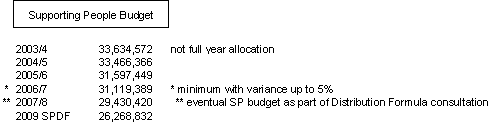
4 Hampshire's Response 4.1 A number of organisations and agencies in Hampshire may wish to respond to the papers. This includes District Councils, the Health Authorities, service providers, the Probation service and service user groups. It is proposed that the County Council provides a model response which others may wish to adopt. 4.2 In general the thrust of the paper is in line with changes already taking place in Hampshire Supporting people.
4.3 The SP team is currently in the first stage of strategically reviewing all services. This is being implemented in three clusters which are very similar to the clusters proposed by ODPM. There are some areas of overlap in the clusters, particularly long term services for people with mental health problems. 4.4 The SP team is also developing proposals to restructure. Currently Local Co-ordinators are based with district councils acting as a bridge between the County and other stakeholders The new structure will focus more clearly on joint commissioning with Social Care on disability services, housing on homelessness services, and both for services for older people.
4.5 The SP team is also working towards integration within the LAA, specifically though the strand dealing with older and vulnerable people. 4.6 ODPM emphasise the need for appropriate tendering and procurement practices. The Hampshire SP team has been working with the County Council Central Procurement team to ensure that the necessary skills are adapted to the Strategic Review process.
4.7 However it is proposed that the inter agency Commissioning Body should be retained until the governance arrangements for the LAA become clearer and it can be seen that they are appropriate for the diversity of the SP programme. Although funding arrangements for, for instance, disability services, should be primarily agreed with Adult Services, the Commissioning Body should retain responsibility for "signing off" the annual SP spending plan. 4.8 The retention of the Commissioning Body will aim to retain the programmes focus on preventative services. 4.9 Although the proposed distribution formula is not as detrimental to Hampshire as earlier proposals there is still a significant and damaging cut to funding.. Although £4m has already been saved from the budget this would require a further £5m with inevitable consequences for each of the cluster groups. 4.10 This is general to County Councils and the County Council Network (CCN) will be taking the issue up with ODPM on our behalf. It is proposed that Hampshire continue to work through the CCN To ensure a fair funding package. 5 Conclusions 5.1 In conclusion it is proposed to give a cautious welcome to many of the suggestions being put forward by ODPM given that they are broadly in line with developments already underway in Hampshire. 5.2 It remains necessary, however, to move carefully towards integration with the LAA and to retain the unity of the SP programme at a local level, while ensuring that the programme supports the agendas of the various SP stakeholder agencies. | 