Archived decisions
Hampshire County Council Item 3
30th January 2006
IMPLEMENTING THE DEMOCRATIC REVIEW
Report of the Chief Executive
Officer Contact: Share D'All, Chief Executive's Department.
e-mail: [email protected] Tel: 01962 846634
1. Introduction:
1.1. Following the recommendations agreed by Full Council in July 2005 asking for further work to be done on the implementation of the Democratic Review outcomes this report outlines the proposals for future ways of working with respect to improving the effectiveness, integration and efficiency of the three main elements of local government:
· Decision Making & the Executive Role
· Local Representation and Community Leadership Role of Members
· Providing Scrutiny & Challenge
1.2. The purpose of the Review was to maximise the efficiency of Hampshire County Councils local governance to focus time, energy and resources on the things that really matter and make a difference for the people of Hampshire.
1.3. The report seeks agreement to implement changes in all three elements above which will constitute a step change in the way the council and members work. It seeks to support the way forward for Hampshire to balance strategic and local government to reflect its own unique balance between the elements that make the County Council fit for purpose:
· Community Leadership
· Democratic Renewal
· High quality services and lower quartile council tax
2. Structure of this Report:
2.1. This report is structured to outline what the review is aiming to achieve, the areas which will not be impacted by this review and the three main recommended action areas with a summary of the overall issues and recommendations at the end. The report seeks to strike an effective balance between providing enough information for decision making (given that members have had the opportunity for an interactive briefing) without going into too much detail.
3. Overall Outcome targets:
3.1. Where we are now:
a) As a top performing council value for money in all the Council's affairs is always a top priority. This review reflects Hampshire County Council's recognition that how the Council provides local democracy and makes decisions is an area where there is always room for improvement.
b) After four years of operating the Leader and Cabinet model there is a body of experience locally and nationally which points the way towards change and refining how the internal processes of councils operate. The County Council continues to have many formal meetings, which are resource intensive both in terms of Member and Officer time.
c) Decision processes were not markedly streamlined with the move to a Cabinet structure. There has been limited success in engaging non-Executive Members in activities which provide effective challenge for improvement or in enabling them more effectively to represent their local communities, or have an impact on the quality of life for their local people.
3.2. The outcomes Hampshire are aiming for include:
a) Reducing the cost of bureaucracy
b) Focusing resources, including Councillor and Officer time, on things that matter and make a difference for the people of Hampshire.
c) Making clearer and more accessible routes for the public and non-Executive Members to know about and influence decisions that affect them and the people they represent.
d) Engaging more effectively with local people and partners to ensure Hampshire County Council is prioritising the things which will make a real difference to the quality of life of the diverse people and communities of Hampshire
e) Ensuring that the scrutiny function of non-Executive members focuses it time and resources on:
· challenge that has real impact on improvement
· issues which people care about
4. Areas that will not be impacted:
4.1. Due to their statutory or legal nature there are some elements of the democratic structure which will not be affected by this process and will remain broadly the same as they are now. The only difference may be that where structures are making decisions they may be published in a more accessible way in the future. The unaffected areas include:
a) Regulatory Committees
b) Standards Committees
c) Governance Committee
d) Pension Fund Panel
e) Employment in Hampshire County Council Committee
f) Statement of Accounts Panel
g) Standing Advisory Council for Religious Education
h) Strategic Planning Joint Advisory Panel
i) Health Overview & Scrutiny Committee
5. Decision Making & the Executive Role:
5.1. Issues:
a) The County Council's policy of openness in decision making results in early publication of decisions due to be made. This is more generous than the statutory minimum in relation to decisions of the Executive but it is considered that more can be done to inform and engage the community in this respect and to involve members more effectively in electoral division and countywide affairs.
b) Work has started on a new Internet portal for decision information which will provide:
· The public and non-Executive Members with early information about the existence of decisions that are in the pipeline
· One easy access point for all decision information with the capability to:
_ Search for decisions by subject or locality
_ Identify who to contact & how in order to input to decisions
_ Increased non-Executive member input to decisions at an early stage
c) The process leading to the making of decisions still reflects the processes in place for the previous Committee system with high resource focus on pre-meetings, process and paperwork and is resource intensive. Formal Executive decisions are made in public.
d) Non-Executive Member input before decisions either:
· Lacks easy visibility to the public (where undertaken by individual Councillors) or
· Happens through formal input late in the decision timetable.
5.2. Desired Outcomes:
a) Easier access to decisions with early & visible opportunities for input and influence
b) Flexible but robust and streamlined processes which enable quicker Executive decision making where necessary
c) Reduction in bureaucracy
5.3. Recommendations:
It is recommended to:
a) Reduce the resource burden associated with formal decision making by having different processes for different types of decision:
· Key decisions made collectively
· Key decisions made individually
· Non-key decisions
b) Remove all unnecessary briefing meetings
c) Improve visibility of local member input to decisions:
· by adding in Member statements as appendices to a report clearly identifying which members have commented and allowing them to do so in their own words
6. Supporting The Local Role of Members:
6.1. Current Context & Issues:
a) There is currently limited designated support provided by Hampshire County Council focused on enabling the local effectiveness of Members.
b) There are complex local partnerships including: Local Strategic Partnerships and Crime & Disorder Reduction Partnerships; two other tiers of local government in Districts and Borough Councils, Parish & Town Councils as well as numerous voluntary and community organisations; existing and developing partnership arrangements focused on cross-cutting and / or local targets or service areas such as LPSA, Children & Young People's partnership and not least the evolving Local Area Agreement. For many of these there is very limited opportunity for direct County Elected Member involvement.
c) In this context there is also growing recognition nationally that the gap or weak point in many partnership activities is proactive engagement with communities and the integration of locally elected representation into priority setting, problem solving and impact measurement locally.
d) There is evidence that there is a clear need for improvement in the public's perception of the success of Councillors in their local representation role. It was demonstrated in Hampshire's MORI Residents survey that:
· The two things the public most expect of their Councillors are:
_ to listen to their views
_ to support their local communities
· 75% of residents don't know who their County Councillor is
· 42% agree or strongly agree that the Council rarely takes residents views into account when making decisions that affect them (with a further 22% sitting on the fence)
· 51% think it is a priority for the Council (with its partners) to listen to its residents with 32% willing to say the County is fairly or very unsuccessful at doing it
· 46% think that Hampshire County Council is remote and impersonal with growing trends of people choosing to describe it as `bureaucratic', `faceless' and `unresponsive'
e) Communities are not only based on geography and, even when they are, they do not fit conveniently into established political boundaries. There are communities of different kinds and interests as well as within and across political boundaries that have different needs; effective local government needs to be able to respond effectively to this diversity.
f) National research and Hampshire's own experience with the Area Committee pilots showed that there is little public appetite for formal committee style meetings at local level and that Members need a lot more information and support to identify how they can best engage with their communities and really add value at a local level.
g) Taking action that is over and above that already resourced within services will often require at least an element of pump priming so it will be important that local County Councillors have access to some resources to enable responsive working. This should come from existing budgets used for local services already. The object will be to enable the community to influence more at a local level, through engagement with their local councillors.
h) Whereas there is wide agreement that there is scope for taking a more flexible and local approach to some resource distribution and decision making, there are often strategic and cross-county parameters which hinder real local flexibility. Consequently, at this stage, more work needs to be done to identify any additional areas where resource distribution or strategy could be realistically determined at a more local level.
6.2. Desired Outcomes:
a) Local County Councillors with access to the support they need in order to gain a comprehensive understanding of the issues that affect their communities and the views, perceptions and priorities of those communities
b) Councillor time spent engaging at a local level developing their role as community leaders
c) Activities by members at a local level which add value
d) Systems which make information about Hampshire's activities at a local level easily accessible to both the public and local Councillors
e) Ways of working which enable representation of, and actions to support, the diverse and changing nature of the communities the County Council represents.
f) Streamlined officer involvement in the complex partnership arrangements at local level so that duplication can be reduced and effective targeting of resources achieved.
6.3. Proposed model:
a) The formation of Hampshire Action Teams (HATs) which would focus Councillor time on actions and activities which achieve the above in a flexible and dynamic way.
b) The starting point would be locally based induction for Members immediately following their election to tie them in to information that is already collected across the County Council about the needs and issues in their communities as well as what is already known about the perceptions of their residents.
c) Officers would be put into place who would become well grounded in research about the needs of the communities that exist within Hampshire and the activities of local partnerships. They would provide a filter which enables Councillors to avoid duplicating work already taking place and so support them in making effective decisions about where there is scope for them to proactively support and add value to currently planned activity, engage with their communities about specific things and initiate actions where there are gaps.
d) The HATs may act on a geographical basis to undertake consultations with partners such as District Councils on issues best dealt with on that basis (e.g. prioritising options for projects); or in smaller groups involving more local stakeholders where issues arise at that level. They may also work across boundaries with other stakeholders. HATs would come together to take action rather than acting in a static and formal way.
e) The intention would be that, over time, where there are areas for local resource prioritisation or setting of strategy at a local level these should be devolved. An effective balance would need to be kept in terms of value for money.
6.4. Recommendations:
a) To create effectively supported and resourced, dynamic, flexible, Hampshire Action Teams:
· Rooted in evidence of what local needs and priorities are:
_ Using information, statistics & data available from across the organisation
_ Using perception evidence from existing and new consultation and community engagement exercises
· Focussed on action and impact - not talking shops
· Adding value in a complex partnership environment:
_ engaging with communities to support democratic renewal
_ Supporting effective local partnership actions
_ Problem solving to improve local services
_ Setting locally flexible Hampshire priorities and strategies
· Measured and published outcomes and impact
· Integrated into the overall Hampshire County Council democratic and planning processes.
b) To work over time to identify locally flexible:
· resources to be prioritised by local Members
· priorities / strategies to be set locally
· decisions to be devolved
c) To pilot this approach across the County for two years, from implementation, and then review its effectiveness before deciding upon a long term approach
7. Providing Scrutiny & Challenge:
7.1. Context and Issues:
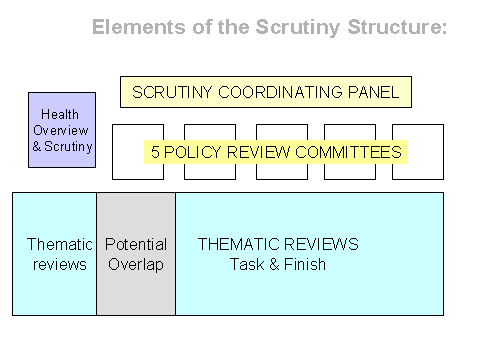
a) The current `Scrutiny function' consists of five Policy Review Committees (PRCs) which in some cases meet prior to decision days of the respective Executive Members. Their function has been largely to look at "key" and some "non key" Executive decisions just before they are made and make comment to the Executive member as well as spending a large amount of time on receiving reports for information and keeping up to date with what service departments are doing. PRCs are each currently scheduled to meet between 6 and 11 times per year.
b) The PRCs have powers of call-in which it is not recommended should be changed.
c) The scrutiny function has largely carried on with the same support and processes as the previous Committee system and has found itself closely bound in with the Executive members and dependent on departmental officers to provide reports for information and guide them as to what to look at.
d) A previous CPA identified the need for the scrutiny function to become more evidence based and provide a more effective challenge to policy setting and decision making.
e) Members involved in the scrutiny function are anxious to make their role more effective recognising that the current way of working does not make good use of their time or enable them to focus their attention on providing effective challenge for improvement. Scrutiny Members want to improve their ability to provide the appropriate `checks and balances' to the Executive function and to focus attention on issues that the public want them to look at and where they can have real hope of effecting improvement.
f) Whilst keeping informed about what is happening is a necessary process, this Council has the same problem as many others in that there is often little output from the provision of all this information. It is also widely recognised that the current method of informing members in formal meetings using lengthy reports may not always be the most effective or efficient method.
g) The scrutiny function in Hampshire was not set up with any designated support officers with any access to research capacity. A pilot using the Select Committee approach has shown that it is useful to use this technique for some intensive inquiries but it did highlight the need to have specialist and intensive support capacity to enable them to add value.
h) The largely outward looking statutory Health Overview & Scrutiny function is working well but, with an increasing amount of joint working with Health, particularly around the `well-being' agenda, there is recognition that there is likely to be an increasing overlap between this and the internal scrutiny function. They need to work together effectively.
7.2. Desired Outcomes
A scrutiny function which:
a) provides real, constructive challenge where it is most needed
b) provides the checks and balances to the Executive
c) voices and explores public concerns (internal and external to the organisation)
d) takes control of its own agenda
e) undertakes a wide range of scrutiny activities
f) works from an evidence base
g) covers all functions of the organisation
h) makes good use of valuable time and resources
7.3. Suggested model:
Appendix 2 shows the proposed structure in broad outline.
7.4. Recommendations:
It is proposed that the scrutiny function will:
a) Undertake a wide range of scrutiny functions including
· holding the Executive to account
· cross-cutting performance monitoring
· policy review
· external reviews
b) Proactively seek topics:
· Of concern and interest to the public
· Where there is real potential for impact & improvement
c) Retain the current Policy Review Committees with:
· formal meetings reduced to four per year for each Committee
· informal planning rather than Chairman's Briefings
· cross-cutting Terms of Reference ensuring coverage of all the work of the organisation and all Executive functions
· pre-scrutiny by choice
d) Have an overall work programme of task & finish thematic reviews:
· topics for which will be prioritised by the Scrutiny Coordination Panel on the basis of potential impact and timeliness
· receiving specialist scrutiny support from dedicated officers
e) The Scrutiny Co-ordination Panel will:
· Be politically proportionate based on including PRC and Health OSC Chairmen
· Prioritise suggested topics for the overall work programme and facilitate ratification of outcomes
· Be Chaired by a PRC Chairman.
8. Summary:
8.1. The challenges we face:
a) Local Government for many years has commonly been described as being steeped in bureaucracy, driven by process rather than outcomes and resistant to radical change. The recommendations in this report will require significant change and improve the County Council's democratic process whilst at the same time increasing efficiency. The changes will need to not only be in processes but also behaviours and culture of both Members and Officers and these do not change easily and quickly without strong drivers and investment in the future.
b) This investment also has to be balanced by removing some of the structures, processes and activities that have taken up valuable time and energy over the years. Some of these losses may feel painful but are as important to making the future work as is the investment.
8.2. Resource Implications:
It is proposed that resources are put into place to facilitate the success of above activities. There will be opportunities to divert existing resources but there will be a transitional period and the scrutiny and HATs activity will require a new and different type of resource. If the principles in the report are accepted, the resourcing issues will be dealt with in the main budget report in February.
8.3 These changes will require total commitment by members and officers. Without this the approach carries significant risks.
8.4 Recommendations for Increased Efficiency:
a) Making a significant reduction in the number of members meetings and pre-meetings and briefings.
b) Managing information items and occasional seminars via pre-programmed monthly briefings (10 a year) wherever possible incorporating information hitherto reported to the various advisory panels; these would be wound up given the alternative opportunity which would be available to all members to be briefed. This issue will require further in-depth consideration but preliminary views from members identify opportunities for efficiencies here.
c) The business of the County Council's transport advisory panels should be integrated into the HATs structure and other formal site advisory / management panels will be reviewed with a view to incorporating them into the local HATs arena.
d) Delivering long term efficiency savings through:
· Improving the provision of information in:
_ easily accessible and low resource methods for both officers, the public and Members
_ more effective and focused report writing
· Fewer formal meetings
· Streamlining Executive decision making processes
· Streamlining officer attendance at partnership / local arrangements
· Regular review of effective use of both staff and Member time as a resource with efficiency adjustments where possible
RECOMMENDATION:
That the recommendations set out in the Appendix to this report be approved and any detailed issues requiring Constitutional change be reported to the Annual Meeting of the Council in May 2006.
Section 100 D - Local Government Act 1972 - background papers
The following documents disclose facts or matters on which this report, or an important part of it, is based and has been relied upon to a material extent in the preparation of this report.
None
N.B. the list excludes:
1. Published works
2. Documents which disclose exempt or confidential information as defined in the Act.
Presentation to the Members' Seminars Chief Executives
Internal Communications
Appendix 1
Recommendations
1. To streamline the decision making function by:
a) Reducing the resource burden associated with formal decision making by having different processes for different types of decision:
· Key decisions made collectively
· Key decisions made individually
· Non-key decisions
b) Removing all unnecessary briefing meetings
c) Improving visibility of local member input to decisions by adding Member Statements
2. To create effectively supported and resourced, dynamic, flexible, Hampshire Action Teams (HATs):
a) Rooted in evidence of what local needs and priorities are:
· Using information, statistics & data available from across the organisation
· Using perception evidence from existing and new consultation and community engagement exercises
b) Focussed on action and impact - not talking shops
c) Adding value in a complex partnership environment:
· engaging with communities to support democratic renewal
· Supporting effective local partnership actions
· Problem solving to improve local services
· Setting locally flexible Hampshire priorities and strategies
d) Measured and published outcomes and impact
e) Integrated into the overall Hampshire County Council democratic and planning processes.
3. To identify real local flexibility which will enable HATs to undertake:
· Prioritisation of resources within budgets by local Members for their area
· Setting of priorities / strategies which are really locally flexible
· Decision making or recommendation at a local level
4. To pilot the Hampshire Action Team (HATs) approach across the County for two years from implementation, and then review its effectiveness before deciding upon a long term approach
5. To improve the Scrutiny Function by:
a) Ensuring it undertakes a wide range of scrutiny functions including:
· holding the Executive to account
· cross-cutting performance monitoring
· policy review
· external reviews
b) Putting systems in place to proactively seek topics:
· Of concern and interest to the public
· Where there is real potential for impact & improvement
c) Retaining the current Policy Review Committees with:
· formal meetings reduced to four per year for each Committee
· informal planning rather than Chairman's Briefings
· cross-cutting Terms of Reference ensuring coverage of all the work of the organisation and all Executive functions
· pre-scrutiny by choice
d) Having an overall work programme of task & finish thematic reviews:
· topics for which will be prioritised by the Scrutiny Coordination Panel on the basis of potential impact and timeliness
· receiving specialist scrutiny support from dedicated officers
e) Having a Scrutiny Co-ordination Panel which will:
· Be politically proportionate based on including Policy Review Committee (PRC) and Health Overview & Scrutiny Committee Chairmen
· Prioritise suggested topics for the overall work programme and facilitate ratification of outcomes
· Be Chaired by an appointed PRC Chairmen.
6. To achieve improved efficiency overall by:
a) Reduction in the number of members meeting, pre-meetings and briefings.
b) Managing information items and occasional seminars via pre-programmed monthly briefings (10 a year) wherever possible incorporating information hitherto reported to the various advisory panels; these would be wound up given the alternative opportunity which would be available to all members to be briefed. This issue will require further in-depth consideration but preliminary views from members identify opportunities for efficiencies here.
c) Integrating the business of the County Council's transport advisory panels into the HATs structure and reviewing other formal site advisory / management panels with a view to incorporating them into the local HATs arena.
d) Delivering long term efficiency savings through:
· Improving the provision of information in:
_ More cost effective and easily accessible ways for officers, the public and Members
_ more effective and focused report writing
· Fewer formal meetings
· Targeting specialist officer attendance at partnership / local arrangements where it can have the most value
· Regular review of effective use of both staff and Member time as a resource with efficiency adjustments where possible.
7. Appendix 2