
Archived decisions
Appendix 1
Local Government Finance Settlement 2006/07 and 2007/08
Headlines
The Government confirmed its local government finance settlement on 31 January 2006. There are no major policy changes to the provisional national totals published by the Government on 5 December 2005 for consultation.
Some indicator data used for individual local authorities in the formulae have been revised.
Hampshire County Council's final formula grant for 2006/07 has reduced by £52,000 (0.04%) compared with the provisional consultation figures issued in December 2005. The County Council's grant for 2006/07 remains at the floor damping level. The reduction arises because the Government has made a minor change to the adjusted base position for 2005/06 used to calculate the 2.0% increase for authorities at the floor.
The Government has also confirmed the grant figures issued in December 2005 for 2007/08, again with minor amendments. This is the first time that the Government has issued firm figures for two years, 2006/07 and 2007/08, as a stage in its move towards three-year settlements. The County Council's formula grant for 2007/08 is £577,000 (0.5%) lower than the provisional figure announced in December 2005.
The key points of the national settlement for 2006/07 are:
· 3.0% increase in formula grant nationally, after adjusting for function and funding changes, including the transfer of schools funding to the ring-fenced specific grant called the Dedicated Schools Grant (DSG)
· 6.0% increase in DSG for schools nationally compared with equivalent figures for 2005/06
· £328m additional formula grant in 2006/07 towards spending pressures
· up to £800m of new burdens recognised by Government, by means other than increased grant or to be discussed further with local government
· new `Four-Block Model' for grant distribution, with formula spending shares (FSS) renamed as relative needs formulae (RNF)
· grant distribution formulae revised, with Census 2001 data now included
· a `resource equalisation' uplift in the Government's control totals for personal social services, police and fire to move them closer to actual spending levels - with the effect of transferring grant away from `lower need / higher resources' areas such as the South East - similar to the uplift in 2003/04
· continued use of floors to limit general grant losses - and to dampen losses on children's and younger adults personal social services RNFs
· amendments to the formula grant allocations for 2004/05 and 2005/06 to correct errors mainly on population data
· continued threat of capping for "excessive" increases in council taxes, with an expectation that the average increase will be less than 5%
The provisional national settlement for 2007/08 includes:
· 3.7% increase in formula grant nationally
· 6.0% increase in DSG for schools nationally
· over £500m additional formula grant in 2007/08 towards spending pressures
· continued use of floors to limit grant losses
· Government expectation that council tax increases in 2007/08 will also average 5%
· no statutory requirement to set a council tax now for 2007/08.
Further details of the national and local grant settlements are attached.
Figures for 2005/06 throughout this Appendix have been adjusted for changes in function and transfers to or from specific grants, in order to make them comparable with the figures for 2006/07.
The contents of this Appendix listed on the following page.
Contents
page 4: The Four-Block Model
page 5: Formula Spending Shares and Relative Needs Formulae - a comparison
page 6: Relative Needs Formulae 2006/07 - England and Hampshire County Council
page 7/8: Floor Damping 2006/07
page 9: Analysis of Government Support 2006/07 - England
page 9: Business Rates 2006/07
page 10: Grant increases 2006/07 by Region and Class of Authority
page 11: Grant increases 2006/07 for County Councils
page 12: County Councils' Formula Grant 2006/07 per head after Floor Damping
page 13: Specific Grants 2006/07 - England total
page 14: Specific Grants 2006/07 for Education and Children's Services
page 15: Specific Grants 2006/07 for Adult Services
page 15: Specific Grants 2006/07 for Environmental, Protective and Cultural Services
page 16: Calculating Hampshire County Council's council tax for 2006/07
page 17: Relative Needs Formulae for 2007/08 - England and Hampshire County Council
page 18: Formula Grant 2007/08 - England and Hampshire County Council
page 19: Specific Grants 2007/08 - England total
page 20: Floor Damping 2007/08
page 21: Analysis of Government Support 2007/08 - England and Hampshire County Council
page 22: The Government's reserve capping powers
page 23: Glossary of Terms used in the Revenue Grant Distribution System
Annex 1: The County Council's letter of response to the Government's consultation on the provisional settlement, 9 January 2006
Annex 2: The Office of the Deputy Prime Minister's reply, 17 January 2006
Annex 3: The County Treasurer's reply, 23 January 2006
The Four-Block Model
The Government has introduced a new system for distributing formula grant between local authorities, using four blocks for:
· relative needs - intended to equalise local authorities' need to spend. Assessed through relative needs formula (RNF), similar to formula spending shares (FSS) but expressed for each local authority as tiny fractions of total assessed need in England, instead of as monetary values
· relative resources - intended to equalise local authorities' resources from the council tax. Assessed using the council tax base and expressed as a negative amount so that higher resource areas, such as Hampshire, receive less grant
· central allocation - the remainder of the available formula grant after needs and resources have been equalised, allocated on a per capita basis
· floor damping - to make sure that all authorities receive a minimum percentage increase in grant, financed by scaling back the grant of authorities that are above the floor.
The national totals are shown below, compared with County Council's formula grant for 2006/07.
England |
Hampshire County Council | |||
£m |
% |
£m |
% | |
Relative needs amount |
14,821 |
71.0 |
99.449 |
82.6 |
Relative resource amount |
-5,130 |
-24.6 |
-133.194 |
-110.7 |
Central allocation |
11,187 |
53.6 |
132.463 |
110.1 |
Floor damping |
0 |
0.0 |
21.625 |
18.0 |
---------- |
---------- |
----------- |
---------- | |
Total excluding police grant |
20,878 |
100.0 |
120.343 |
100.0 |
---------- |
----------- |
---------- | ||
Police grant |
3,936 |
|||
---------- |
||||
Total formula grant |
24,814 |
|||
---------- |
||||
Formula Spending Shares and Relative Needs Formulae - a comparison
The Relative Needs Formulae (RNF) for 2006/07 and the Formula Spending Shares (FSS) for 2005/06 for England and Hampshire County Council, below, illustrate how the system under the new Four-Block Model has become even less understandable.
England |
Hampshire | ||||
FSS |
RNF |
FSS |
RNF | ||
2005/06 |
2006/07 |
2005/06 |
2006/07 | ||
adjusted |
adjusted |
||||
£m |
£m |
||||
Adult Social Services |
|||||
Adult Social Care |
10,369 |
0.16749768 |
205.4 |
0.00305392 | |
Adult Social Care damping |
0 |
0.00000000 |
0.0 |
0.00026638 | |
--------- |
--------------- |
--------- |
--------------- | ||
Total Adult Services |
10,369 |
0.16749768 |
205.4 |
0.00332030 | |
Children's Services |
|||||
Youth and Community |
571 |
0.00949950 |
9.8 |
0.00016366 | |
LA Central Education Functions |
2,610 |
0.04155749 |
58.3 |
0.00090450 | |
Children's Social Care |
4,375 |
0.07284560 |
64.7 |
0.00109925 | |
Children's Social Care damping |
0 |
0.00000000 |
0.0 |
-0.00003291 | |
--------- |
--------------- |
--------- |
--------------- | ||
Total Children's Services |
7,556 |
0.12390259 |
132.8 |
0.00213450 | |
Highway Maintenance |
2,054 |
0.03199865 |
46.0 |
0.00071938 | |
Environmental, Protective and |
|||||
Cultural Services |
11,769 |
0.18720868 |
84.0 |
0.00134292 | |
Capital Financing |
3,638 |
0.06143061 |
62.1 |
0.00102733 | |
--------- |
--------------- |
--------- |
--------------- | ||
Total excluding Police and Fire |
35,386 |
0.57203821 |
530.3 |
0.00854443 | |
Police |
4,753 |
0.07728726 |
- |
- | |
Fire |
1,789 |
0.02878762 |
- |
||
--------- |
--------------- |
--------- |
--------------- | ||
Total |
41,928 |
0.67811309 |
530.3 |
0.00854443 | |
--------- |
--------------- |
--------- |
--------------- | ||
The FSSs for 2005/06 shown above have been adjusted for function and funding changes, including the introduction of the Dedicated Schools Grant, and for Resource Equalisation.
Each of the RNF factors is published by the Government to 15 decimal places. They are derived from setting the England total for FSSs for 2005/06 as 1.000000000000000 (ie, £64,180bn). Each 0.000015581090002 represents £1m.
Relative Needs Formulae 2006/07 - England and Hampshire County Council
The percentage increases in RNF show the Government's priority for Children's Services.
England |
Hampshire | ||
Increase |
Increase | ||
2006/07 |
2006/07 | ||
% |
% | ||
Adult Social Services |
+3.7 |
+3.7 | |
Children's Services |
|||
Youth and Community |
+6.8 |
+7.4 | |
LA Central Education Functions |
+2.2 |
-0.5 | |
Children's Social Care |
+6.9 |
+5.8 | |
Total Children's Services |
+5.2 |
+3.2 | |
Highway Maintenance |
0.0 |
+0.4 | |
Environmental, Protective and Cultural Services |
+2.1 |
+2.5 | |
Capital Financing |
+8.4 |
+6.2 | |
Total excluding Police and Fire |
+3.8 |
+3.4 | |
Police |
+4.4 |
||
Fire |
+3.3 |
||
Total all services |
+3.8 |
||
Floors for Formula Grant 2006/07
Floor |
Scaling of other LAs * | ||||||
% |
No of LAs affected |
% |
No of LAs affected | ||||
Education and social services authorities |
+2.0 |
71 |
-84.5 |
79 | |||
Police authorities |
+3.1 |
21 |
-97.2 |
17 | |||
Fire authorities |
+1.5 |
9 |
-87.2 |
22 | |||
District councils |
+3.0 |
84 |
-51.0 |
154 | |||
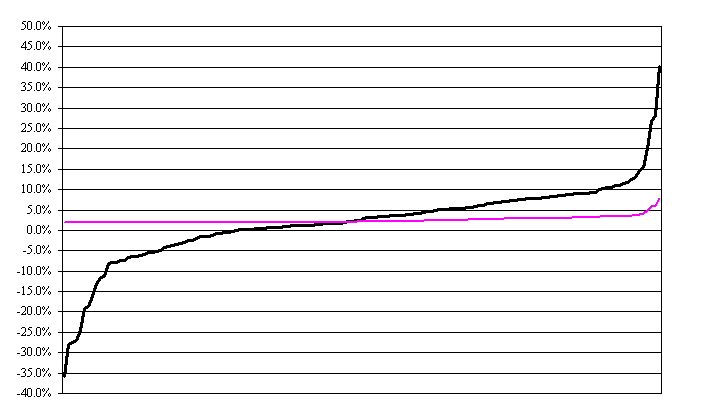
* the scheme is self-financing for each group of authorities. The cost of giving additional grant to authorities that are below the floor, such as Hampshire County Council, is financed by scaling back the above-floor increases in grant for all other authorities by the percentages shown. The scaling back required is severe. Education and social services authorities that are above the floor lose 84.5% of their grant above the floor. | |||||||
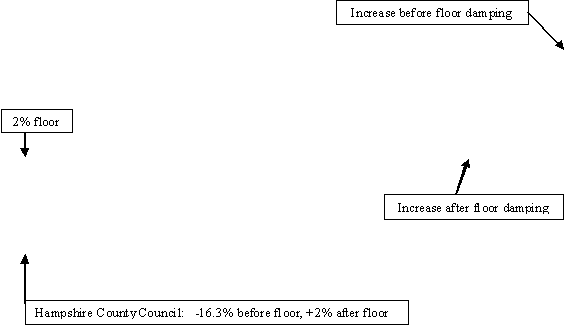
Education and Social Services Authorities' Formula Grant Increases 2006/07
Floors in the Relative Needs Formulae for Children and Younger Adults Personal Social Services 2006/07
|
||||
Floor |
Scaling of other LAs * | |||
% |
No of LAs affected |
% |
No of LAs affected | |
Children |
+2.7 |
49 |
-50.9 |
101 |
Younger Adults |
+2.7 |
72 |
-88.5 |
78 |
For Children's Services, Hampshire County Council is subject to scaling, losing grant of £2.1m in 2006/07. | ||||
For Younger Adults, the County Council is at the floor, receiving additional grant of £17.1m in 2006/07 to reach the floor level. | ||||
The net amount of grant at risk when the Personal Social Services floor scheme is unwound, based on the grant settlement for 2006/07, is £15m. | ||||
Analysis of Government Support 2006/07 - England
2005/06 adjusted |
2006/07 |
Change | |||
£m |
% |
£m |
% |
% | |
Dedicated schools grant |
25,072 |
42.2 |
26,576 |
42.8 |
+6.0 |
Police grant |
3,895 |
6.5 |
3,936 |
6.3 |
+1.1 |
Other specific grants |
10,237 |
17.2 |
10,672 |
17.2 |
+4.2 |
--------- |
-------- |
--------- |
-------- |
||
Total specific grants |
39,204 |
65.9 |
41,184 |
66.3 |
+5.1 |
Revenue support grant |
2,256 |
3.8 |
3,443 |
5.5 |
+52.6 |
--------- |
-------- |
--------- |
-------- |
||
Total Government grants |
41,460 |
69.7 |
44,627 |
71.8 |
+7.6 |
Business rates |
18,000 |
30.3 |
17,500 |
28.2 |
-2.8 |
--------- |
-------- |
--------- |
-------- |
||
Total Government support |
59,460 |
100.0 |
62,127 |
100.0 |
+4.5 |
--------- |
-------- |
--------- |
-------- |
||
Includes Formula grant: |
|||||
Revenue support grant |
2,256 |
3.8 |
3,443 |
5.5 |
+52.6 |
less for specified bodies |
-63 |
-0.1 |
-65 |
-0.1 |
+2.6 |
Business rates |
18,000 |
30.3 |
17,500 |
28.2 |
-2.8 |
Police grant |
3,895 |
6.5 |
3,936 |
6.3 |
+1.1 |
--------- |
-------- |
--------- |
-------- |
||
Total Formula grant |
24,088 |
40.5 |
24,814 |
39.9 |
+3.0 |
--------- |
-------- |
--------- |
-------- |
||
Business Rates 2006/07
The rate in the £ has been increased in line with the change in the Retail Price Index in September 2005 of 2.7%.
2005/06 |
2006/07 | |
p |
p | |
Rate in £ |
||
Standard |
42.2 |
43.3 |
Small businesses |
41.5 |
42.6 |
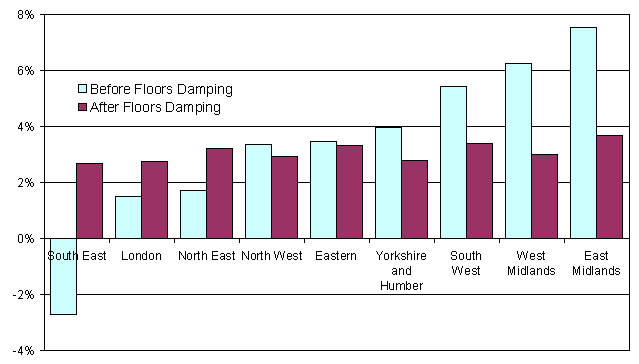 Grant increases 2006/07 by Region - England average +3.0%
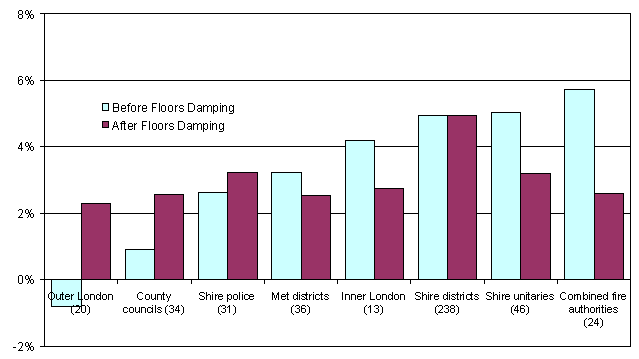 Grant increases 2006/07 by class of authority
The number of authorities in each class are shown at the foot of the graph
Grant increases 2006/07 for County Councils
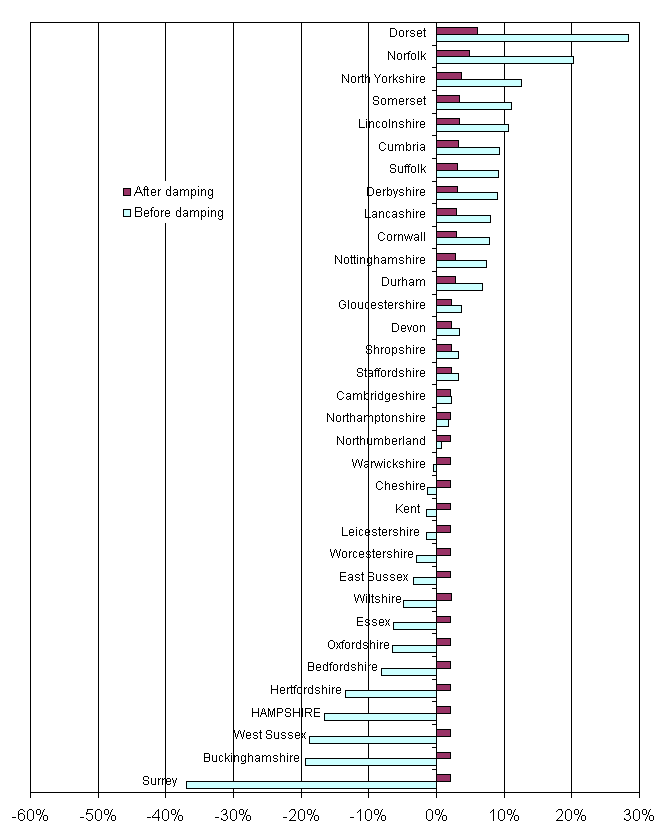
County councils' average: before floor damping +0.9%, after floor damping +2.6%
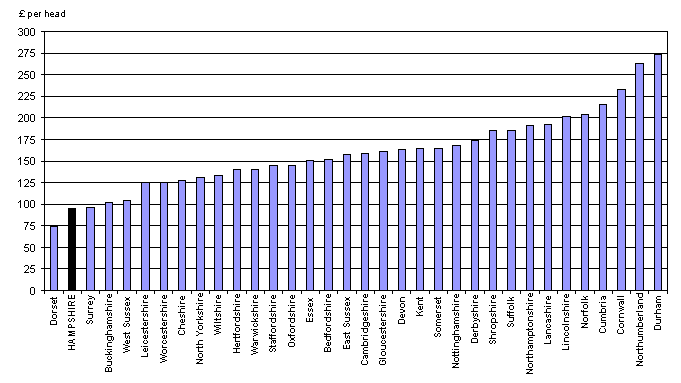
County Councils' Formula Grant 2006/07 per head - after floor damping
Specific Grants 2006/07 - England
A 5.1% increase in specific grants in total with above average increases for Education, and Children's Services.
2005/06 |
2006/07 |
Increase | |
adjusted |
|||
£m |
£m |
% | |
Education |
|||
Dedicated Schools Grant |
25,072 |
26,576 |
+6.0 |
Other Education Grants |
3,604 |
3,890 |
+7.9 |
Personal Social Services |
|||
Children |
1,150 |
1,320 |
+14.7 |
Adults |
1,655 |
1,582 |
-4.4 |
Police |
|||
Principal Grant |
3,895 |
3,936 |
+1.1 |
Other Police Grants |
559 |
588 |
+5.2 |
Fire |
1 |
1 |
0.0 |
Environmental, Protective and |
|||
Cultural Services |
389 |
392 |
+0.7 |
Capital Financing - PFI |
425 |
455 |
+7.1 |
Other |
|||
Neighbourhood Renewal |
525 |
525 |
0.0 |
Greater London Authority |
38 |
38 |
+1.0 |
Local PSA Reward Grant |
176 |
196 |
+11.4 |
Supporting People |
1,715 |
1,685 |
-1.7 |
----------- |
----------- |
||
Total Specific Grants |
39,204 |
41,184 |
+5.1 |
----------- |
----------- |
||
Specific Grants 2006/07 for Education
2005/06 |
2006/07 |
Increase | |
adjusted |
|||
£m |
£m |
% | |
Dedicated Schools Grant |
25,072 |
26,576 |
+6.0 |
School Development Grant |
1,962 |
2,042 |
+4.1 |
School Standards |
912 |
1,012 |
+11.0 |
Ethnic Minority Achievement |
168 |
181 |
+7.7 |
Targeted Primary Strategy |
125 |
168 |
+34.4 |
Targeted Secondary Strategy |
88 |
109 |
+23.9 |
Extended Schools |
77 |
80 |
+3.9 |
Music Services |
59 |
62 |
+5.1 |
Targeted School Meals Grant |
30 |
50 |
+66.7 |
School Meals |
30 |
30 |
0.0 |
Aimhigher |
34 |
34 |
0.0 |
Secondary: LA Co-ordination |
35 |
35 |
0.0 |
Primary Strategy: LA Co-ordination |
30 |
30 |
0.0 |
Secondary: Behaviour and Attendance |
14 |
14 |
0.0 |
Playing for Success |
9 |
12 |
+33.3 |
Education Health Partnerships |
9 |
9 |
0.0 |
Fresh Start and Partnership |
8 |
8 |
0.0 |
School Travel Advisers |
7 |
7 |
0.0 |
School Improvement Partners |
7 |
7 |
0.0 |
--------- |
--------- |
||
Education specific grants |
28,676 |
30,466 |
+6.2 |
--------- |
--------- |
||
Specific Grants 2006/07 for Children's Personal Social Services
2005/06 |
2006/07 |
Increase | |
adjusted |
|||
£m |
£m |
% | |
General Sure Start Grant |
862 |
1,111 |
+28.9 |
Children's Services |
130 |
152 |
+17.4 |
Teenage pregnancy support |
33 |
30 |
-10.3 |
Unaccompanied asylum seeking children |
11 |
12 |
+9.1 |
Youth Opportunity Grant |
10 |
11 |
+10.0 |
Safeguarding children |
90 |
0 |
-100.0 |
Other |
14 |
4 |
-72.8 |
------- |
------- |
||
Children's PSS specific grants |
1,150 |
1,320 |
+14.7 |
------- |
------- |
||
Specific Grants 2006/07 for Adult Personal Social Services
2005/06 |
2006/07 |
Increase | |
adjusted |
|||
£m |
£m |
% | |
Access and systems capacity |
642 |
546 |
-15.0 |
Preserved rights |
330 |
297 |
-9.9 |
Carers |
185 |
185 |
0.0 |
Mental health |
133 |
133 |
0.0 |
National training strategy |
108 |
108 |
0.0 |
Delayed discharge |
100 |
100 |
0.0 |
Child/adolescent mental health |
91 |
91 |
0.0 |
Human resources development strategy |
50 |
50 |
0.0 |
Preventative Technology |
0 |
30 |
- |
Partnerships for Older People Projects |
0 |
20 |
- |
Aids support |
16 |
16 |
0.0 |
Individual Budget Pilots |
0 |
6 |
- |
------- |
------- |
||
Adults PSS specific grants |
1,655 |
1,582 |
-4.4 |
------- |
------- |
||
Specific Grants 2006/07 for Environmental, Protective and Cultural Services
2005/06 |
2006/07 |
Increase | |
adjusted |
|||
£m |
£m |
-% | |
Waste performance and efficiency |
90 |
105 |
+16.7 |
Planning delivery |
130 |
104 |
-20.0 |
Homelessness strategies |
45 |
66 |
+45.3 |
Rural bus subsidy |
53 |
54 |
+2.5 |
Bus Challenge and Kickstart |
29 |
18 |
-37.9 |
De-trunking roads |
39 |
42 |
+7.7 |
Beacons |
3 |
3 |
0.0 |
------- |
------- |
||
EPCS specific grants |
389 |
392 |
+0.7 |
------- |
------- |
||
Calculating Hampshire County Council's council tax - based on the recommendations for 2006/07
£/Band D | |
Council tax implied by the Government's grant distribution system |
863.75 |
Effect of spending above the level implied in the Government's grant |
|
distribution system, by 3.6% |
+40.31 |
Less surplus on council tax collection funds from previous years |
-6.66 |
Add effect of district councils' assumptions about losses on council tax |
|
collection in 2006/07 |
+13.22 |
---------- | |
Council tax for 2006/07 |
910.62 |
---------- | |
Provisional Settlement for 2007/08
For the first time the Government has published two-year figures for 2006/07 and 2007/08 as part of a process that will eventually lead to three-year settlements.
The following tables summarise the provisional figures for 2007/08.
Relative Needs Formulae 2007/08 - England and Hampshire
England |
Hampshire | |||||||
RNF |
RNF |
RNF |
RNF |
|||||
Adjusted |
Adjusted |
|||||||
2006/07 |
2007/08 |
% |
2006/07 |
2007/08 |
% | |||
Adult Social Services |
||||||||
Adult Social Care |
0.16767239 |
0.17424267 |
+3.9 |
0.00305772 |
0.00319420 |
+4.5 | ||
Adult Social Care damping |
0.00000000 |
0.00000000 |
- |
0.00026638 |
0.00025964 |
-2.5 | ||
-------------- |
-------------- |
--------------- |
--------------- |
|||||
Total Adult Services |
0.16767239 |
0.17424267 |
+3.9 |
0.00332410 |
0.00345384 |
+3.9 | ||
Children's Services |
||||||||
Youth and Community |
0.00949950 |
0.01006945 |
+6.0 |
0.00016366 |
0.00017385 |
+6.2 | ||
LA Central Education Functions |
0.04155749 |
0.04286461 |
+3.1 |
0.00090450 |
0.00093308 |
+3.2 | ||
Children's Social Care |
0.07284560 |
0.07596182 |
+4.3 |
0.00109925 |
0.00114346 |
+4.0 | ||
Children's Social Care damping |
0.00000000 |
0.00000000 |
- |
-0.00003291 |
-0.00003385 |
+2.8 | ||
-------------- |
-------------- |
--------------- |
--------------- |
|||||
Total Children's Services |
0.12390259 |
0.12889588 |
+4.0 |
0.00213450 |
0.00221654 |
+3.8 | ||
Highway Maintenance |
0.03199865 |
0.03199865 |
0.0 |
0.00071938 |
0.00071938 |
0.0 | ||
Environmental, Protective and |
||||||||
Cultural Services |
0.18701752 |
0.19406184 |
+3.8 |
0.00133883 |
0.00138953 |
+3.8 | ||
Capital Financing |
0.05977512 |
0.06359430 |
+6.4 |
0.00101399 |
0.00108165 |
+6.7 | ||
-------------- |
-------------- |
--------------- |
--------------- |
|||||
Total excluding Police and Fire |
0.57036627 |
0.59279334 |
+3.9 |
0.00853080 |
0.00886094 |
+3.9 | ||
Police |
0.07728726 |
0.08081232 |
+4.6 |
- |
- |
- | ||
Fire |
0.02878762 |
0.02973807 |
+3.3 |
- | ||||
-------------- |
-------------- |
--------------- |
--------------- |
|||||
Total |
0.67644115 |
0.70334373 |
+4.0 |
0.00853080 |
0.00886094 |
+3.9 | ||
-------------- |
-------------- |
--------------- |
--------------- |
|||||
Formula Grant 2007/08 - England
2006/07 |
2007/08 |
Increase | |||
adjusted |
|||||
£m |
% |
£m |
% |
% | |
Relative needs amount |
14,821 |
71.4 |
15,337 |
71.0 |
+3.5 |
Relative resource amount |
-5,130 |
-24.7 |
-5,309 |
-24.6 |
+3.5 |
Central allocation |
11,186 |
53.8 |
11,576 |
53.6 |
+3.5 |
Floor damping |
0 |
0.0 |
0 |
0.0 |
0.0 |
Adjustments |
-106 |
-0.5 |
0 |
0.0 |
-100.0 |
---------- |
---------- |
---------- |
---------- |
||
Total excluding police grant |
20,771 |
100.0 |
21,604 |
100.0 |
+4.0 |
---------- |
---------- |
||||
Police grant |
3,936 |
4,029 |
+2.4 | ||
---------- |
---------- |
||||
Total formula grant |
24,707 |
25,633 |
+3.7 | ||
---------- |
---------- |
||||
Formula Grant 2007/08 - Hampshire County Council
2006/07 |
2007/08 |
Increase | |||
adjusted |
|||||
£m |
% |
£m |
% |
% | |
Relative needs amount |
99.449 |
83.2 |
103.535 |
84.4 |
+4.1 |
Relative resource amount |
-133.194 |
-111.5 |
-137.831 |
-112.3 |
+3.5 |
Central allocation |
132.463 |
110.9 |
133.695 |
108.9 |
+0.9 |
Floor damping |
21.626 |
18.1 |
23.293 |
19.0 |
+7.7 |
Adjustments |
-0.878 |
-0.7 |
0 |
0.0 |
-100.0 |
----------- |
---------- |
----------- |
---------- |
||
Total |
119.466 |
100.0 |
122.692 |
100.0 |
+2.7 |
----------- |
---------- |
----------- |
---------- |
||
Specific Grants 2007/08 - England
2006/07 |
2007/08 |
Increase | |
adjusted |
|||
£m |
£m |
% | |
Education |
|||
Dedicated Schools Grant |
26,576 |
28,171 |
+6.0 |
Other Education Grants |
3,890 |
4,118 |
+6.0 |
Personal Social Services |
|||
Children |
1,320 |
1,294 |
-1.9 |
Adults |
1,582 |
1,600 |
+1.1 |
Police |
|||
Principal Grant |
3,936 |
4,029 |
+2.3 |
Other Police Grants |
588 |
840 |
+42.9 |
Fire |
1 |
1 |
0.0 |
Environmental, Protective and |
|||
Cultural Services |
392 |
390 |
-0.4 |
Capital Financing - PFI |
455 |
535 |
+17.6 |
Other |
|||
Neighbourhood Renewal |
525 |
525 |
0.0 |
Greater London Authority |
38 |
38 |
+1.0 |
Local PSA Reward Grant |
196 |
196 |
0.0 |
Supporting People |
1,685 |
1,696 |
+0.7 |
----------- |
----------- |
||
Total Specific Grants |
41,184 |
43,433 |
+5.5 |
----------- |
----------- |
||
Floors for Formula Grant 2007/08
Floor |
Scaling of other LAs * | ||||||
% |
No of LAs affected |
% |
No of LAs affected | ||||
Education and social services authorities |
+2.7 |
60 |
-68.8 |
90 | |||
Police authorities |
+3.6 |
21 |
-97.9 |
17 | |||
Fire authorities |
+2.7 |
8 |
-91.1 |
23 | |||
District councils |
+2.7 |
64 |
-38.4 |
174 | |||
* the scheme is self-financing for each group of authorities. The cost of giving additional grant to authorities that are below the floor, such as Hampshire County Council, is financed by scaling back the above-floor increases in grant for all other authorities by the percentages shown. The scaling back required continues to be severe. Education and social services authorities that are above the floor lose 68.8% of their grant above the floor. For police authorities, it is 97.9% which restricts the range of grant increases for police authorities from 3.6% to 3.8%. | |||||||
Floors in the Relative Needs Formulae for Children and Younger Adults Personal Social Services 2007/08
|
||||
Floor |
Scaling of other LAs * | |||
% |
No of LAs affected |
% |
No of LAs affected | |
Children |
+2.7 |
46 |
-70.0 |
104 |
Younger Adults |
+2.7 |
70 |
-83.5 |
80 |
For Children's Services, Hampshire County Council is subject to scaling, losing grant in 2007/08 of £2m. | ||||
For Younger Adults, the County Council is at the floor, receiving additional grant in 2007/08 of £16m to reach the floor level. | ||||
The net amount of grant at risk when the Personal Social Services floor scheme, based on the provisional grant settlement for 2007/08, is unwound is £14m. | ||||
Analysis of Government Support 2007/08 - England
2006/07 |
2007/08 |
Change | |||
adjusted |
|||||
£m |
% |
£m |
% |
% | |
Dedicated schools grant |
26,576 |
42.9 |
28,171 |
43.3 |
+6.0 |
Police grant |
3,936 |
6.3 |
4,029 |
6.2 |
+2.3 |
Other specific grants |
10,672 |
17.2 |
11,233 |
17.2 |
+5.3 |
--------- |
-------- |
--------- |
-------- |
||
Total specific grants |
41,184 |
66.4 |
43,433 |
66.7 |
+5.5 |
Revenue support grant |
3,336 |
5.4 |
4,163 |
6.4 |
+24.8 |
--------- |
-------- |
--------- |
-------- |
||
Total Government grants |
44,520 |
71.8 |
47,596 |
73.1 |
+6.9 |
Business rates |
17,500 |
28.2 |
17,500 |
26.9 |
0.0 |
--------- |
-------- |
--------- |
-------- |
||
Total Government support |
62,020 |
100.0 |
65,096 |
100.0 |
+5.0 |
--------- |
-------- |
--------- |
-------- |
||
Includes Formula grant: |
|||||
Revenue support grant |
3,336 |
5.4 |
4,163 |
6.4 |
+24.8 |
less for specified bodies |
-65 |
-0.1 |
-58 |
-0.1 |
-10.8 |
Business rates |
17,500 |
28.2 |
17,500 |
26.9 |
0.0 |
Police grant |
3,936 |
6.3 |
4,029 |
6.2 |
+2.3 |
--------- |
-------- |
--------- |
-------- |
||
Total Formula grant |
24,707 |
39.8 |
25,634 |
39.4 |
+3.7 |
--------- |
-------- |
--------- |
-------- |
||
Analysis of Formula Grant 2007/08 - Hampshire County Council
2006/07 |
2007/08 |
Change | |||
adjusted |
|||||
£m |
% |
£m |
% |
% | |
Revenue support grant |
split not published by Government |
||||
Business rates |
|||||
------------- |
-------- |
------------- |
-------- |
||
Formula grant |
119.466 |
100.0 |
122.692 |
100.0 |
+2.7 |
------------- |
-------- |
------------- |
-------- |
||
The Government's reserve capping powers - procedure and timetable 2006/07
Late March or April 2006 |
The First Secretary of State (the Deputy Prime Minister) decides whether to invoke capping powers - after councils, including police and fire authorities, have set their budgets for 2006/07. He publishes the criteria to be used for the capping limits for different categories of local authorities. Criteria must include a comparison with budgets of a previous year and may include a comparison with a previous year's council tax. |
The First Secretary of State also publishes the proposed capping limit for the 2006/07 budget for any individual authorities that he intends to cap. May also set a further budget `target' for the authority to reach in a future year. | |
Local authorities have 21 days in which to challenge their capping limits. | |
July 2006 |
The First Secretary of State decides whether to proceed with imposing capping limits. If he does, he lays an Order before Parliament setting the maximum budgets for the local authorities that he intends to cap. |
If he decides not cap an authority in 2006/07 after all, he may accept its budget for 2006/07 and, instead, `nominate' it for possible capping in 2007/08. Alternatively, he may accept the budget for 2006/07 for the purposes of setting the council tax for 2006/07 but can then set a lower notional budget for 2006/07 that can be used to measure increases in future years for capping purposes. The First Secretary of State would inform the authorities of his decisions in such cases in writing. Both alternatives avoid the costly re-billing of council tax payers. | |
If the capping limits for 2006/07 are approved by Parliament, each capped authority must recalculate its budget. Major precepting authorities including the County Council and the Fire and Police Authorities must re-set their precepts. Billing authorities must reissue the council tax bills. | |
Late November / early December 2006 |
The First Secretary of State confirms the `nomination' and sets a capping limit for 2007/08 or a `target' for the authority's budget to reach by a specified future year. |
nb All dates are approximate and are based on the actual timetable for the Government's capping of budgets in 2005/06. | |
Glossary of Terms used in the Revenue Grant Distribution System
Aggregate External Finance (AEF)
The total level of support the Government provides to local authorities. This support is normally made up of Revenue Support Grant, police grant, specific formula and ring-fenced grants and the amount redistributed from business rates.
Amending Report
May be issued by the Government to correct errors subsequently discovered in the data used in the Local Government Finance settlement. Only one Amending Report may be issued for each settlement year.
Area Cost Adjustment (ACA)
The top-up factor applied to Formula Spending Shares (FSS) to reflect higher costs, mostly pay. Originally applied to authorities in London and the South East but, since 2003/04, extended to other areas of England with higher costs.
Assumed National Council Tax (ANCT)
This term is no longer used in the Four-Block Model which has been introduced from 2006/07 for distributing revenue support grant. Prior to 2006/07, ANCT was used as follows. The difference between Total Assumed Spending and Aggregate External Finance is approximately the amount that would be raised in Council Tax if local authorities as a whole spent at the level of their Formula Spending Shares. Dividing this total amount by the total Council Tax base produces an assumed national tax rate. This then gives the standard level of Council Tax for a band D property if all authorities spent at the level of their Formula Spending Share. It is used to work out how the Revenue Support Grant should be shared between authorities. Formerly known as the `Council Tax for Standard Spending'.
Billing authorities
These are the 353 authorities that collect Council Tax - district councils, London
boroughs, and unitary authorities.
Budget requirement
This is the amount each authority estimates as its planned spending, after deducting
any income it expects to raise from fees and charges for services and specific grants from the Government and any funding from reserves. The budget requirement is set before the beginning of the financial year and financed from general Government grant (Revenue Support Grant), business rates and the council tax.
Business rates
These rates, called the National Non-Domestic Rates (NNDR), are the means by which local businesses contribute to the cost of providing local authority services. All business rates are paid into a central pool. The pool is then divided between local authorities, along with the Revenue Support Grant, as part of the Formula Grant. Prior to 2006/07, NNDR was allocated per head of resident population in each authority's area.
Capping
This is the term used when the Government limits a local authority's budget requirement, and hence the council tax that the local authority sets.
Central Allocation
A component of the Four-Block Model introduced by the Government in 2006/07, allocated between local authorities on a per capita basis. It represents the balance of the national total for Formula Grant after Relative Needs and Relative Resources have been equalised.
Collection Fund Surplus or Deficit
Billing authorities such as the district councils maintain a collection fund into which they pay all the council taxes they collect in their area and from which they pay precepts to the precepting authorities such as the County Council, fire and police authorities. If they collect more or less than they expected at the start of the year, the surplus or deficit is shared with the precepting authorities in proportion to their council taxes. These surpluses or deficits have to be returned to the council taxpayer in the following year through lower or higher council taxes. They may not be used to finance additional spending.
Control Totals
Prior to 2006/07, the Government published the national totals for Formula Spending Shares for each major service area. Under the Four-Block Model introduced in 2006/07, these control totals are hidden in the system's methodology.
Council Tax
A local tax on domestic property set by local authorities in order to meet their budget
requirement.
Council Tax base
The Council Tax base of an area is the number of band D equivalent properties. The number of properties in each of the eight council tax bands A to H are counted. The totals are then converted to an equivalent number of band D properties. For example, one band H property is equivalent to two band D properties, because the taxpayer in a Band H property pays twice as much council tax. The ratios between the council tax bands are shown in the table below. The amount of revenue which could be raised by the council tax in an area is calculated allowing for discounts and exemptions but, for the purpose of the Formula Grant calculation, assuming that everyone pays.
Council Tax bands
There are eight Council Tax bands. How much Council Tax each household pays
depends on the value of their home. The bands are set out below.
Council Tax bands
Value of home estimated at April 1991 |
Proportion of the tax due for a band D property | |
Band A |
under £40,000 |
66.7 % (ie, 6/9ths) |
Band B |
£40,001 - £52,000 |
77.8 % (7/9ths) |
Band C |
£52,001 - £68,000 |
88.9 % (8/9ths) |
Band D |
£68,001 - £88,000 |
100.0 % (9/9ths) |
Band E |
£88,001 - £120,000 |
122.2 % (11/9ths) |
Band F |
£120,001 - £160,000 |
144.4 % (13/9ths) |
Band G |
£160,001 - £320,000 |
166.7 % (15/9ths) |
Band H |
over £320,001 |
200.0 % (18/9ths) |
Council Tax discounts and exemptions
Discounts are available to people who live alone (25%) and owners of dwellings that are not anyone's main home. Billing authorities have been able to reduce the discount for second homes from 50% to a minimum of 10% from 1 April 2004. Council Tax is not charged for certain classes of properties, such as those occupied only by students.
Damping
Damping is used by the Government to phase the impact of changes to the revenue grant distribution system, to give stability in funding for individual local authorities. It limits the effect these changes have on Council Tax levels and is intended by the Government to give authorities more time to adjust their spending following the changes. Damping of grant is achieved by setting a minimum floor level for the percentage increase in grant, with the cost of providing this additional level of grant met by scaling back the grant allocated to authorities whose percentage increase in grant is above the floor minimum. Prior to 2005/06, ceilings limited the maximum increase, but were removed to allow fast growing authorities to receive greater benefit from increases in grant. Damping has also been introduced in 2006/07 in the Relative Needs Formulae (RNF) for children's services and younger adults personal social services to limit losses as a result of introducing new RNF methodologies.
Distributable Amount
This is the estimated total amount in the business rate pool that is available to be
distributed to local authorities. The business rates are collected by local authorities
and paid into a national pool and then redistributed to all authorities.
Environmental, Protective and Cultural Services (EPCS)
The RNF block for all other services, ie, excluding adult services, children's services, police, fire, highway maintenance and capital financing costs.
Fixed Costs
There is a separate RNF allocation for each authority's fixed costs, which are defined by the Government as the element of an authority's costs which does not vary with the size of the authority. This mainly consists of the costs of the corporate and democratic core of an authority, sometimes described as "the costs of being in business, not the costs of doing business".
Floor Damping
Floors and Ceilings
See Damping.
Formula Grant
Comprises Revenue Support Grant, redistributed business rates and, for police authorities, the police principal grant.
Formula Spending Shares (FSS)
Between 2003/04 and 2005/06, FSSs were used by the Government to provide a basis for distributing its Formula Grant between local authorities. Formulae were used to calculate each authority's share of the national Control Totals for seven main service blocks: education, personal social services, police, fire, highway maintenance, capital financing and environmental, protective and cultural services. Typically, each formula includes a basic amount per client, topped up for deprivation and the Area Cost Adjustment. From 1990/01 to 2002/03, Standard Spending Assessments (SSA) were used instead of FSSs. With the introduction of the Four-Block Model in 2006/07, the Government replaced FSSs with Relative Needs Formulae (RNF).
Four-Block Model
New system for calculating Formula Grant introduced by the Government in 2006/07, consisting of four block for Relative Needs, Relative Resource, Central Allocation and Floor Damping.
Indicators
In this context, information used in the calculation of Relative Needs Formulae, such as population, number of school children, number of elderly people or lengths of road.
Local Government Finance Settlement
The Local Government Finance Settlement is the annual determination of Formula Grant distribution as made by the Government and approved by Parliament. It includes:
· the totals of Formula Grant;
· how that grant will be distributed between local authorities; and
· the support given to certain other local government bodies.
The provisional settlement is announced by the Government for consultation in late November or early December. The consultation period ends in early January and the final settlement figures are announced in late January.
Net Revenue Expenditure (NRE)
This represents an authority's budget requirement and use of reserves.
Non-Domestic Rates
See business rates.
Precept
This is the amount of Council Tax income that precepting authorities (see below) need to provide their services. These authorities request the billing authorities to raise these amounts from council tax payers by issuing a formal precept. The amounts for all local authorities providing services in an area appear on one Council Tax bill, which is issued by the billing authority (district councils, unitary authorities, London boroughs and metropolitan districts).
Precepting authority
This is an authority which sets a precept to be collected by billing authorities through
the Council Tax bill. County councils, police authorities, the Greater London Authority, combined fire authorities and parish councils are all precepting authorities.
Receiving authorities
These are the 432 authorities that are eligible to receive Revenue Support Grant.
Relative Needs Formulae (RNF)
One component of the Four-Block Model introduced by the Government in 2006/07, intended to equalise spending needs between local authorities. Formulae similar to those previously used in Formula Spending Shares (FSS) are used to assess the local authorities' relative need to spend. The results, however, are expressed as fractions of total spending in England, instead of as monetary values. The formulae are based on an amount per client with top-ups for deprivation and other additional costs including the Area Cost Adjustment.
Relative Resource Amount
A component of the Four-Block Model introduced by the Government in 2006/07, intended to equalise resources between local authorities. It reflects the different capacity of local authorities to raise income from the Council Tax. It is a negative amount in the calculation of the Four-Block Model, with those authorities with higher levels of Council Tax resources having a higher negative Relative Resource Amount.
Reserves
This is a council's accumulated surplus income (in excess of expenditure) which can be used to finance future spending.
Resource Equalisation
The way in which the formula grant distribution system takes account of councils'
relative ability to raise council tax. Councils with a higher taxbase, because properties in their area are more highly valued, are able to raise more income from each £1 of council tax. "Resource equalization" has also been used by the Government to describe its action in uplifting its service Control Totals for FSS (in 2003/04) and RNFs (in 2006/07) to the national levels of actual spending by local authorities. This has the effect of transferring Formula Grant from areas of `lower need and higher resources' such as the South East to areas of `higher need and lower resources' such as the North and Midlands.
Revenue Expenditure
Expenditure financed by Aggregate External Finance (AEF) grants, council tax and the use of reserves.
Revenue Support Grant (RSG)
A Government grant forming part of the Formula Grant alongside the redistributed business rates and the police principal grant.
Ring-fenced grant
A grant paid to local authorities which has conditions attached to it that restrict the
purposes for which it may be spent.
Second homes discount
Billing authorities have been able to reduce the council tax discount given to owners of second homes from 50% to a minimum of 10% from 1 April 2004. The additional council tax income raised is shared between local authorities in the area in proportion to their precepts.
Share of Assumed National Council Tax (SANCT)
Prior to 2006/07, this was the portion of the Assumed National Council Tax (ANCT) attributable to each class of authority. Following the introduction of the Four-Block Model by the Government in 2006/07, no equivalent to ANCT is published.
Specific and Special Grants
Specific formula grants, targeted or ring-fenced grants are sometimes referred to as
specific or special grants. A specific grant is paid under a specific legislative power
whereas a special grant uses a general power to pay grants to councils.
Specific Formula Grant
A grant which is distributed outside the formula grant distribution system but with no
conditions attached as to how it is spent.
Specified Body
This is the term used for bodies (such as the Improvement and Development Agency for Local Government and the Employers' Organisation for Local Government) that are directly funded from Revenue Support Grant and provide central services for local government as a whole.
Standard Spending Assessment (SSA)
Between 1990/01 to 2002/03, SSAs were used by the Government to divide its general revenue grants between local authorities. This is now done by Formula Spending Shares (FSSs).
Targeted grant
A type of ring-fenced grant which has conditions attached which specify a broad
outcome.
Total Assumed Spending (TAS)
Prior to the introduction of the Four-Block Model in 2006/07, this was the amount of spending by local government as a whole which the Government assumes in its spending plans. An equivalent figure is not published by the Government in the Four-Block Model.
Total Formula Spending (TFS)
Prior to the introduction of the Four-Block Model in 2006/07, this was the total of Formula Spending Shares.
i:\. . . .\ian\docs\rsg app 2006-07 10feb2006a.doc 03 February 2006