Archived decisions
Adult Services' demand pressures Appendix B
1. The budget background report presented to the Adult Social Care PRC and Executive Member on 20 January 2006 contained detailed information about pressures on the Adult Services' budget. They were summarised as:
_ Increasing numbers of vulnerable people;
_ Increases in the complexity of needs;
_ Changes in Health Service capacity, delivery methods and customer base;
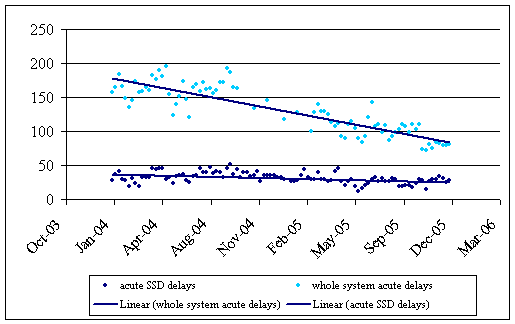
_ Funding difficulties for and performance pressures on the Health Service locally leading to disputes over continuing care and under-funding of s28a transfers;
_ Increasing service expectations;
_ Increasing performance requirements;
_ Changes to required models of care which are more expensive - particularly care at home in preference to residential care;
_ New requirement to develop well-being services and early intervention;
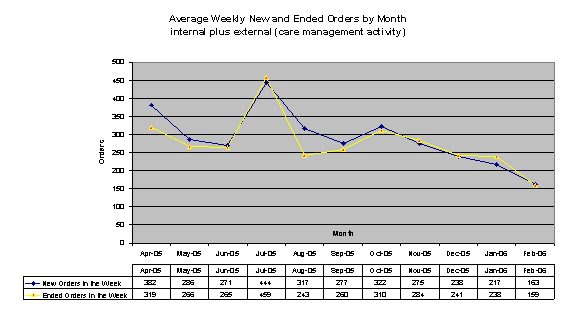
_ Funding decreasing relative to the population in need and cost pressures and absolutely in the medium term;
_ Requirements to find efficiency savings;
_ Increasing costs of purchasing care from the independent sector well above the prevailing rate of inflation.
2. In common with England as a whole, Hampshire's retirement age population - and particularly the very elderly - is growing faster than the population in general. There are roughly 1,000 more people aged 85+ to provide services for, potentially, each year for the next two decades. Thanks to advancements in medical technologies, more seriously disabled babies are surviving birth and childhood and needing services to sustain them as adults. Around 60 more young disabled people are expected to require such services each year. More are also surviving into the retirement age group when their parents and carers have died and the state is often expected to assume full-time care.
3. Health service changes are also impacting severely on adult services across the country. Geriatric, learning disability and psychiatric beds have been closed in large numbers and this process is continuing (21.5% of geriatric beds and 24.1% of learning disability beds in hospitals serving the Hampshire area closed between 2000/01 and 2004/05). Substantial numbers of community hospital beds in all parts of Hampshire have been closed. In addition, acute hospital throughput is increasing with in-patient stays shorter than ever before. Older people are commensurately less likely to recuperate and receive rehabilitation in hospital after, for example, hip replacement operations. The success of such trends depends on the availability of community health services. However, the number of district nurses employed by the NHS nationally and locally has been falling for some years (by 12% between 1997 and 2004) and the rate of contact with older people reducing as a result. These changes have had the effect of channelling more requests for help to adult services departments.
4. The number of people contacting the Department for help grew by 3% between 2000/01 and 2004/05. However, the significant change has been the increase in the number meeting the Council's eligibility criteria. The table below shows an increase of 9,600 (80%) in the number who met the criteria applied in the initial screening process and went on to receive a full assessment of their needs. Of this group, only 7.5% did not meet the eligibility criteria and therefore were not offered a service.
Total people who contacted the dept |
Total people diverted to other services |
Total receiving an assessment | |
2000/01 |
26,505 |
14,577 (55%) |
11,927 (45%) |
2004/05 |
27,287 |
5,730 (21%) |
21,556 (79%) |
5. A comparison with neighbouring authorities, and those further afield in the South-East, shows that the proportion of the population for whom an assessment is completed (`new clients') is somewhat below average for people of retirement age but very high amongst the relatively small number of people below retirement age.
Authority |
New clients - all ages - per 1000 adult popn |
Younger adult clients per 1000 working age popn |
Older clients per 1000 retirement age popn |
|
|
|
|
Portsmouth (2003/4 data) |
11.5 |
3.5 |
11.4 |
Oxfordshire |
7.9 |
1.9 |
12.7 |
Isle of Wight |
13.3 |
6.2 |
29.3 |
West Sussex |
12.8 |
2.6 |
38.4 |
Essex |
13.0 |
1.9 |
46.6 |
Buckinghamshire |
13.3 |
3.5 |
47.0 |
East Sussex |
19.7 |
6.2 |
48.6 |
Hampshire |
21.0 |
12.2 |
48.6 |
Surrey |
15.3 |
3.5 |
53.3 |
Reading |
19.7 |
12.6 |
53.4 |
Southampton |
17.8 |
8.5 |
56.2 |
Kent |
19.6 |
6.5 |
58.7 |
West Berkshire |
19.8 |
9.6 |
59.3 |
Bracknell Forest |
9.2 |
6.1 |
62.6 |
Dorset |
28.9 |
12.4 |
62.6 |
Poole |
23.0 |
6.8 |
63.1 |
Windsor & Maidenhead |
21.0 |
8.7 |
64.2 |
Slough |
18.9 |
9.0 |
66.5 |
Bournemouth |
25.0 |
7.7 |
71.9 |
Wiltshire |
23.6 |
7.2 |
74.4 |
Wokingham |
8.6 |
1.3 |
140.3 |
Average |
17.0 |
5.9 |
50.8 |
6. The increase in the number of requests emanating from the NHS has resulted, in part, from the measures taken to avoid delayed discharges from hospital and the consequent fines (`reimbursement') of £100 a day per patient. The number of people discharged from hospital is increasing. Weekly monitoring of new applications for care, introduced in November 2005, indicate that approximately one-third of all cases considered are patients discharged from hospital and that, of these, half (500) would have incurred a fine. Had these people remained in hospital for the 12 weeks of the monitoring period, this would have cost the County Council over £2m in fines (assuming the hospitals had capacity to keep these patients). In contrast, delays in people being discharged from hospital has reduced. The number of delays since January 2004 is shown in the chart below. This good progress has been made in the context of a net reduction of 1 delay being the product of expediting 15 hospital discharges.
7. The increase in the number of NHS requests has also resulted, in the current financial year, in an increase in the number of people receiving domiciliary services. While there had been a reduction in previous years in the number of people receiving these services, there has also been a continuing trend towards greater use of intensive services - a minimum of 10 hours and 6 visits a week - which are having to be provided to support very disabled people in their own homes. The table below shows that the number of people receiving intensive services increased by 10% between 2004 and 2005 while the number receiving less than five hours care a week reduced by 21%.
Clients in receipt of care to live at home - September Snapshot |
| |||||||
|
|
|
|
|
|
|
|
|
|
Total clients |
% |
Total Clients |
% |
Total Clients |
% |
Total Clients |
% |
|
2002 |
|
2003 |
|
2004 |
|
2005 |
|
Less than 5 hours care |
4268 |
56.5 |
4526 |
54.9 |
4081 |
49.8 |
3202 |
42.9 |
5 - 9 hours care |
2032 |
26.9 |
2134 |
25.9 |
2408 |
29.4 |
2388 |
32 |
10+ hours care/6 visits |
1248 |
16.5 |
1577 |
19.1 |
1713 |
20.9 |
1882 |
25.2 |
Total |
7548 |
100 |
8237 |
100 |
8202 |
100 |
7472 |
100 |
8. On average, these service users were receiving 10.29 hours of domiciliary care a week in September 2005 compared to an average of 8.42 hours a week in September 2004, reflecting a greater level of dependency.
9. The year-on-year increase in demographic demands described in paragraph 2 is likely to result in annually increasing financial pressures, at constant prices, of:
_ £3m for younger adults (60 people with a residential placement or care package costing around £50,000 a year)
_ £6m for older people (170 people supported in residential or nursing care at an average of £20,000 a year each and 330 people with an intensive domiciliary care package costing around £8,000 a year each), on the assumption that 50% of the increasing number of people aged 85+ will seek help and meet the Council's eligibility criteria.
10. Average costs of services for older people are likely to increase as the balance between residential and nursing provision shifts. This happens as demands rise and eligibility criteria are tightened in an attempt to contain spending within budget limits. Inevitably, some people who would have received a service some months or weeks previously are denied a service, only those people with the greatest needs satisfying the eligibility criteria for services. These people are likely to be dementia sufferers or judged to be in need of nursing care for other reasons.
11. Both features - of tightening eligibility criteria and shift towards nursing care - can be seen in the information presented in the budget background report comparing service delivery in April 2005 and December 2005. This showed that the number of people newly provided with a service in the month dropped from 1,626 to 916 (a reduction of 44%) and, of those provided with residential or nursing care, the proportion provided with nursing care rose from 25% to 32%. The chart below illustrates this reduction, plotting the number of care episodes starting and ending between April 2005 and February 2006.