
Archived decisions
d |
Hampshire County Council | ||
Adult Social Care Policy Review Committee |
Item 6 | ||
29 March 2006 |
|||
Budget Monitoring 2005/06 | |||
Report of the County Treasurer and Director of Adult Services | |||
Contact: Paul Carey-Kent, (01962) 847525; [email protected]
Rea Mattocks, (01962) 847200; [email protected]
1 Introduction and Summary
1.1 The January budget position statement, as reported to the Adult Services Policy and Review Committee was based on data for Period 7 (to the end of October) and showed a projected overspend of £5.5m. This projected overspend was due to increases in the amount of care provided to existing clients and increases in the number of people who met the eligibility criteria. The January report highlighted that demand pressures were increasing rather than reducing, despite management action, but it was expected that continued management action would slow down the rate of increase. This, combined with offsetting savings of £1m and the LPSA1 reward grant of £0.5m lead to a predicted projected overspend of £4m at period 7.
1.2 It is now apparent that the pressures reported were understated, and management action taken was not able to restrain the demand from existing and new clients sufficiently to bring the budget into balance.
1.3 In addition, the LPSA1 grant monies are in dispute and unlikely to be resolved in Hampshire's favour.
1.4 As a result of these changes and factors, a predicted overspend of £11.3m (4.6% of the total budget) is now forecast as shown in Appendix A.
1.5 This overspend position creates severe pressures for 2006/07. The budget was based on repaying an overspend of only £2m, and dealing with the client activity carried forward at that level, not with the level of activity that now exists. Clients of Adult Services usually remain with the service for their lifetime, and commitments entered into in one year are carried through into following years. Money is only released from the placements budget if people improve and need less or no services, or if attrition occurs. The Leader in his budget speech referred to changes to assimilate some of the predicted overspend and to provide some assistance in 2006/07. This is not part of this report, but will be returned to in the report on the provisional outturn for 2005/06 for the County Council which will be considered by Cabinet in April.
Table 1 : Summary of variances
Period 7 |
Period 10 | ||
£m |
£m | ||
Adult Services: |
|||
Adults |
+1.9 |
+3.4 | |
Older People |
+3.6 |
+10.5 | |
+5.5 |
+13.9 | ||
Management and Resources |
-1.0 |
-0.9 | |
Other measures |
0 |
-1.7 | |
TOTAL |
+4.5 |
+11.3 | |
LPSA Reward Grant - Older People |
-0.5 |
-0.0 | |
TOTAL |
+4.0 |
+11.3 |
The questions to be addressed are:
· What are the reasons for the increase in projected overspend between Period 7 and Period 10?
· What are the overall and longer-term reasons behind the projected overspend?
· What immediate actions are being taken to minimise the overspend in 2005/06 and reduce spend in 2006/07?
· What are the medium term actions to stabilise the position?
Each of these matters is considered in turn in this paper.
1 Reasons for the increase in projected overspend
1.1 The forecast overspend has risen sharply between that reported for Period 7 and that for Period 10 for two main reasons:
· It was expected to drive down spending through management action, but whilst the action did prevent further growth in spending, it did not reduce it, and the pressures of people presenting to Adult Services continued to grow throughout the year.
· The interface between SWIFT (the management information system) and SAP (the financial system) was bedding down and this made it difficult to establish a view of gross spending pressures. Judgements were made on previous years' patterns and activity and a view was taken as to the potential outturn, which proved to be overly optimistic.
1.2 For Older People there are 12,000+ client records and predicting outturn is always challenging when having to deal with this amount of information. The judgements about patterns of activity, taking into account information that was available at the time through the SWIFT information system and SAP financial system lead to a view that, after substantial error corrections were made, £5.3m of pressure was indicated, and this is what was reported to Members at period 7. This did not, at the time, feel inconsistent with previous years in which the adult services elements of Social Services had projected pressures, but had typically been able to bring spend in closer to budget at final outturn. However, it is clear now that the pressures being reported during 2005/06 were higher than previous years.
Since that report:
· The interface between SWIFT and SAP has improved.
· From period 7 onwards, rather than basing outturn on commitments, it has been possible to use the 7 months' worth of actual expenditure which has been projected forward and is, therefore, more reliable.
· Using this methodology, it is evident that there were some £11m of pressures on Older People at the end of October.
1.3 In Younger Adults, the predominant factor has been the increase in the projected overspend for Physical Disability. A pressure of £0.5m had been identified earlier in the year, and this had grown to £0.85m by Period 7, but with management confident that this position could be managed down in the remainder of the year, as has happened previously for this client group. However, management action has not compensated enough for the substantially increased pressure, and in addition, data updates reflecting improved system reliability showed additional commitments. Consequently, a £1.6m overspend is now projected.
1.4 The Learning Disability service has successfully restrained demand but been unable to reduce the projected overspending of £1.9m, and so the forecast outturn has remained. There is a small underspend (£50,000) projected for mental health.
1.5 Overall, the analysis of data as at the end of October made judgements which have proved overly optimistic and the management actions put in place have succeeded in restraining, but not reducing, the level of spend.
2 Overall and longer-term reasons behind the projected overspend
2.1 The level of overspend for the year as a whole is essentially explained by more care being provided (more clients and higher levels of dependency for existing and new clients) than was allowed for in the budget.
2.2 In social care, demand usually exceeds the budget available, and this was the case for 2005/06. It is normally expected for this to be managed throughout the year. Historically, the Social Services department has managed such pressures down to less than 1% of the budget at outturn, with underspends as frequent as overspends. This year an overspend of up to 5% is predicted.
2.3 The budget was set, then, on a basis which required successful management of demand within the legal need to provide services as assessed. For example, if the placements budget is over-committed at the start of the year, it is expected that management action should reduce the total number of clients within the year to meet the budget.
2.4 Three factors combined to make the management of demand much more difficult than in previous years:
· increases in underlying levels of demand, both in 2004/05 with a full year effect in 2005/06, and in 2005/06 itself. These are due to both demographic factors and issues linked to the state of the health economy.
· the budget required efficiency savings of £2m. It is expected that efficiencies will be achieved, but whereas in other years such measures would have been available to help with the cost of increased demand, they were already assumed in the 2005/06 budget.
· the transitional cost of the Enhance project: £3.8m was budgeted for this, leaving less budget available for other demand pressures. Actual transitional costs have been higher, due to slower implementation than planned.
Client activity is summarised in the following table:
1 |
2 |
3 |
4 |
5 |
6 | |
No. of clients allowed for by budget (full year equivalents) |
Average gross cost per client/ year assumed in budget |
Budgeted total spend |
Average number of clients being provided for (fye) |
Average actual expected gross cost per client per year |
Predicted total spend | |
£000 |
£m | |||||
Older People
|
11,988 |
10.8 |
130.5 |
12,192 +1.7% |
11.5 +6.4% |
139.6 +7.0% |
Learning Disability |
3,281 |
19.6 |
64.2 |
3,324 +1.3% |
20.2 +3.1% |
67.1 +4.5% |
Physical Disability |
1,477 |
11.1 |
16.3 |
1,623 +9.9% |
11.1 - |
18.1 +11% |
Note that these are best assessments which may be subject to refinement, as on-going work continues to refine the systems and improve staff's ability to input accurately into the systems, and findings from the review will be incorporated.
2.5 Overall, more care has been provided than is budgeted for, and there has been an increase in numbers of referrals to Adult Services in 2005/06 as well as an increase in dependency levels, and therefore a greater number of people needing services. There has also been a significant increase in the average unit cost for each client receiving care.
2.6 In the short term, it is difficult to make savings in placement budgets as money will only be released if there is attrition or people regain their independence and no longer need care. This has not happened at a fast enough rate to offset new demand.
2.7 The analysis at 3.4 shows that pressure (gross of income) arose from increased numbers and dependency levels of clients as follows: Older People £9.1m, Learning Disability £2.9m, Physical Disability £1.8m. Appendix B suggests that the positions lying behind these figures are somewhat different between client groups and care types, though some of the data does require further verification:
· In Older Persons' domiciliary care, numbers of packages purchased are 5% above the level assumed in constructing the budget. Cost per package has remained relatively stable for external packages. For in-house home care, numbers have fallen whilst cost per client has increased: that is consistent with offering more intensive care on a reablement basis.
· In Older Persons' residential care, numbers have increased but with a sharp (9.8%) increase in the cost per client. That suggests significant re-classification of clients as having higher needs. There have also been costs associated with in-house homes that were not fit for purpose and this has increased the unit costs, as occupancy levels were low.
· In Older Persons' nursing care client numbers are within expectations but transitional costs from Enhance have been £4.6m compared with the budgeted £3.8m, reflecting the increased costs of slower implementation.
· The timetable for new nursing homes coming on stream has meant that only 109 beds are expected to be used on average across the year compared with a budgeted 169. That translates into an extra 60 beds needing to be purchased from the independent sector at a net cost of £1.35m
· The dominant factors in Learning Disability are increases in both number (1.3%) and cost (3.1%) of residential care placements. This is likely to represent a combination of additional provision for clients with deteriorating conditions, and higher needs assessments for new clients than for those clients passing out of the system. The gross pressures shown in the analysis of client activity (not allowed for in the original budget) were significantly offset by new Section 28A income which reduces the overspend.
· Physical Disability shows significant increases in nursing care, domiciliary care and direct payments, although unit costs per client remained similar to last year due to the balance of numbers in overall residential and nursing care versus those receiving domiciliary care.
2.8 Why has 2005/06 seen demand at such levels? The background paper to the January meeting of the Executive member set out in detail many of the trends which appear to lie behind this problem. The case made was that the demographic factors already in place - notably, an ageing population and an increasing prevalence of disabilities - have been exacerbated by restrictions in local health capacity due to Health's own financial problems. Those problems have been especially acute since 2004/05, and the surge in demand in terms of numbers occurred largely in the second half of that year.
2.9 It is understood that many other authorities - especially in the South East - are likely to overspend on their Adult Services budget this year, confirming that these are widespread trends. Appendix B sets out these factors, and also shows newly-acquired comparative information on the rate at which new clients were taken on in 2004/05, which can now be seen as a critical period for increased demand: Hampshire's position was typical for Older People but showed a comparatively high increase for Younger Adults.
2.10 Other factors have undoubtedly contributed to the overspend:
· the need to minimise the impact of any savings action taken on the department's performance rating
· reductions in Supporting People funding with knock-on consequences for spending on learning disabilities
· the fining regime, which means that it costs rather than saves money to slow down or reduce provision of care packages for those in hospital.
2.11 However, three fundamental questions remain:
· has the increase in demand been minimised given the number of referrals by applying eligibility criteria consistently and with sufficient rigour so that only those who qualify receive care?
· once eligibility is agreed, is the right amount of care provided, consistent with minimum statutory requirements?
· Is the data now being used accurate; are the systems robust and are staff inputting correct information into the systems?
Those issues will be examined further as part of the investigation now under way.
3 Immediate actions to minimise overspend and reduce spend in 2006/07
3.1 The Leader's budget speech on 22 February suggested that there may be some help for Adult Services with the repayment of part of the 2005/06 overspend, but even were that to be met corporately, spending is currently running at a level which cannot be sustained by next year's budget and immediate action is being taken to reduce the overspend by £1.7m.
3.2 This action consists of maximising use of Supporting People grant (£1.2m), redefining revenue spend as capital (£0.2m), a recruitment freeze in the last two months of the year and cessation of all training not already committed in financial terms. Unfortunately, none of these measures helps with the 2006/07 position.
3.3 The key to controlling 2006/07 spending will be to manage down client numbers and the average cost of care packages being awarded.
3.4 It will also be crucial to take immediate steps to enact and monitor the outcomes from the savings plans already built into the 2006/07 budget. These are already at the limits of achievable change. The key here is to ensure that where services are re-provided in a different way, there is adequate evidence to show that future service costs will be reduced, not increased.
4 Medium term action to stabilise the position
4.1 As a complement to the immediate actions, an audit task group has been set up consisting of staff from the Chief Executive's department, Internal Audit and County Treasurer's Consultancy team. The project brief for this work is attached as Appendix C. The main strands are :
· Phase 1: to report to the Chief Executive as soon as possible in advance of 29 March Adult Social Care PRC. To establish the facts giving rise to the current budget projection and why it was not predicted with a reasonable degree of accuracy
· Phase 2: follows on from Phase 1, timelines to be agreed. To explore and report on detailed findings for specific service areas of concern within Older people and People with Learning Disabilities, and identify areas for potential improvement that will help to put Adult Services spending on a sounder financial footing in the short and medium term.
· Phase 3: to start in parallel with phase 2, timescales and resources to be agreed. Scope and plan the resources and activities required to carry out and monitor the improvement plan within Adult Services.
4.2 The figures in this report may change for two reasons:
· The findings of the Extraordinary Review might affect some of the initial views taken in this report.
· The figures in this report are based on period 10 projected to the year end and are, therefore, provisional. They may change when the final accounts analysis is completed, and all creditors and debtors have been finalised.
Recommendations
1. That the Adult Social Care Policy and Review Committee be invited to consider this report and make any observation on its content to the Executive Member.
Section 100 D - Local Government Act 1972 - background documents
The following documents discuss facts or matters on which this report, or an important part of it, is based and have been relied upon to a material extent in the preparation of this report.
NB the list excludes:
1. Published works.
2. Documents which disclose exempt or confidential information as defined in the Act.
Appendices:
A : Summary of variances
B : Demographic and Comparative Data
C: Extraordinary Review Brief
0 |
Other Measures |
30,567 |
0 |
|
(1,700) |
(1,700) |
|
||
262,951 |
Total |
234,887 |
258,791 |
229,114 |
270,141 |
11,350 |
4.4 |
||
|
|
|
|
|
|
|
|
||
0 |
Elements relating to C & F/Other |
|
(9,621) |
0 |
(9,621) |
0 |
0.0 |
||
262,951 |
Revised Budget Per Budget Book |
|
249,170 |
229,114 |
260,520 |
11,350 |
4.6 |
||
The figures above profile income due from health at 1/12 per month, assuming that all of this is collected. As at 31.10 there was |
|||||||||
in fact £8.2m collected from Health of the £19.6m due across the year (of which 10/12 is included in the 'actuals' columns above), | |||||||||
of which Health have indicated that £3.8m from this and earlier years may be disputed. Similarly, expected recharges |
|||||||||
of £7.5m from other departments have been included at 1/12 per month in order to provide a more realistic 'actuals' profile. |
|||||||||
1. The budget background report presented to the Adult Social Care PRC and Executive Member on 20 January 2006 contained detailed information about pressures on the Adult Services' budget. They were summarised as:
_ Increasing numbers of vulnerable people;
_ Increases in the complexity of needs;
_ Changes in Health Service capacity, delivery methods and customer base;
_ Funding difficulties for and performance pressures on the Health Service locally leading to disputes over continuing care and under-funding of s28a transfers;
_ Increasing service expectations;
_ Increasing performance requirements;
_ Changes to required models of care which are more expensive - particularly care at home in preference to residential care;
_ New requirement to develop well-being services and early intervention;
_ Funding decreasing relative to the population in need and cost pressures and absolutely in the medium term;
_ Requirements to find efficiency savings;
_ Increasing costs of purchasing care from the independent sector well above the prevailing rate of inflation.
2. In common with England as a whole, Hampshire's retirement age population - and particularly the very elderly - is growing faster than the population in general. There are roughly 1,000 more people aged 85+ to provide services for, potentially, each year for the next two decades. Thanks to advancements in medical technologies, more seriously disabled babies are surviving birth and childhood and needing services to sustain them as adults. Around 60 more young disabled people are expected to require such services each year. More are also surviving into the retirement age group when their parents and carers have died and the state is often expected to assume full-time care.
3. Health service changes are also impacting severely on adult services across the country. Geriatric, learning disability and psychiatric beds have been closed in large numbers and this process is continuing (21.5% of geriatric beds and 24.1% of learning disability beds in hospitals serving the Hampshire area closed between 2000/01 and 2004/05). Substantial numbers of community hospital beds in all parts of Hampshire have been closed. In addition, acute hospital throughput is increasing with in-patient stays shorter than ever before. Older people are commensurately less likely to recuperate and receive rehabilitation in hospital after, for example, hip replacement operations. The success of such trends depends on the availability of community health services. However, the number of district nurses employed by the NHS nationally and locally has been falling for some years (by 12% between 1997 and 2004) and the rate of contact with older people reducing as a result. These changes have had the effect of channelling more requests for help to adult services departments.
4. The number of people contacting the Department for help grew by 3% between 2000/01 and 2004/05. However, the significant change has been the increase in the number meeting the Council's eligibility criteria. The table below shows an increase of 9,600 (80%) in the number who met the criteria applied in the initial screening process and went on to receive a full assessment of their needs. Of this group, only 7.5% did not meet the eligibility criteria and therefore were not offered a service.
Total people who contacted the dept |
Total people diverted to other services |
Total receiving an assessment | |
2000/01 |
26,505 |
14,577 (55%) |
11,927 (45%) |
2004/05 |
27,287 |
5,730 (21%) |
21,556 (79%) |
5. A comparison with neighbouring authorities, and those further afield in the South-East, shows that the proportion of the population for whom an assessment is completed (`new clients') is somewhat below average for people of retirement age but very high amongst the relatively small number of people below retirement age.
Authority |
New clients - all ages - per 1000 adult popn |
Younger adult clients per 1000 working age popn |
Older clients per 1000 retirement age popn |
|
|
|
|
Portsmouth (2003/4 data) |
11.5 |
3.5 |
11.4 |
Oxfordshire |
7.9 |
1.9 |
12.7 |
Isle of Wight |
13.3 |
6.2 |
29.3 |
West Sussex |
12.8 |
2.6 |
38.4 |
Essex |
13.0 |
1.9 |
46.6 |
Buckinghamshire |
13.3 |
3.5 |
47.0 |
East Sussex |
19.7 |
6.2 |
48.6 |
Hampshire |
21.0 |
12.2 |
48.6 |
Surrey |
15.3 |
3.5 |
53.3 |
Reading |
19.7 |
12.6 |
53.4 |
Southampton |
17.8 |
8.5 |
56.2 |
Kent |
19.6 |
6.5 |
58.7 |
West Berkshire |
19.8 |
9.6 |
59.3 |
Bracknell Forest |
9.2 |
6.1 |
62.6 |
Dorset |
28.9 |
12.4 |
62.6 |
Poole |
23.0 |
6.8 |
63.1 |
Windsor & Maidenhead |
21.0 |
8.7 |
64.2 |
Slough |
18.9 |
9.0 |
66.5 |
Bournemouth |
25.0 |
7.7 |
71.9 |
Wiltshire |
23.6 |
7.2 |
74.4 |
Wokingham |
8.6 |
1.3 |
140.3 |
Average |
17.0 |
5.9 |
50.8 |
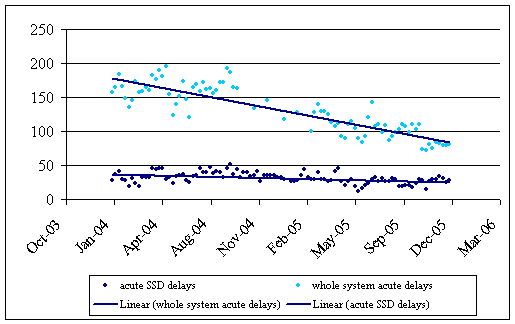
6. The increase in the number of requests emanating from the NHS has resulted, in part, from the measures taken to avoid delayed discharges from hospital and the consequent fines (`reimbursement') of £100 a day per patient. The number of people discharged from hospital is increasing. Weekly monitoring of new applications for care, introduced in November 2005, indicate that approximately one-third of all cases considered are patients discharged from hospital and that, of these, half (500) would have incurred a fine. Had these people remained in hospital for the 12 weeks of the monitoring period, this would have cost the County Council over £2m in fines (assuming the hospitals had capacity to keep these patients). In contrast, delays in people being discharged from hospital has reduced. The number of delays since January 2004 is shown in the chart below. This good progress has been made in the context of a net reduction of 1 delay being the product of expediting 15 hospital discharges.
7. The increase in the number of NHS requests has also resulted, in the current financial year, in an increase in the number of people receiving domiciliary services. While there had been a reduction in previous years in the number of people receiving these services, there has also been a continuing trend towards greater use of intensive services - a minimum of 10 hours and 6 visits a week - which are having to be provided to support very disabled people in their own homes. The table below shows that the number of people receiving intensive services increased by 10% between 2004 and 2005 while the number receiving less than five hours care a week reduced by 21%.
Clients in receipt of care to live at home - September Snapshot |
| |||||||
|
|
|
|
|
|
|
|
|
|
Total clients |
% |
Total Clients |
% |
Total Clients |
% |
Total Clients |
% |
|
2002 |
|
2003 |
|
2004 |
|
2005 |
|
Less than 5 hours care |
4268 |
56.5 |
4526 |
54.9 |
4081 |
49.8 |
3202 |
42.9 |
5 - 9 hours care |
2032 |
26.9 |
2134 |
25.9 |
2408 |
29.4 |
2388 |
32 |
10+ hours care/6 visits |
1248 |
16.5 |
1577 |
19.1 |
1713 |
20.9 |
1882 |
25.2 |
Total |
7548 |
100 |
8237 |
100 |
8202 |
100 |
7472 |
100 |
8. On average, these service users were receiving 10.29 hours of domiciliary care a week in September 2005 compared to an average of 8.42 hours a week in September 2004, reflecting a greater level of dependency.
9. The year-on-year increase in demographic demands described in paragraph 2 is likely to result in annually increasing financial pressures, at constant prices, of:
_ £3m for younger adults (60 people with a residential placement or care package costing around £50,000 a year)
_ £6m for older people (170 people supported in residential or nursing care at an average of £20,000 a year each and 330 people with an intensive domiciliary care package costing around £8,000 a year each), on the assumption that 50% of the increasing number of people aged 85+ will seek help and meet the Council's eligibility criteria.
10. Average costs of services for older people are likely to increase as the balance between residential and nursing provision shifts. This happens as demands rise and eligibility criteria are tightened in an attempt to contain spending within budget limits. Inevitably, some people who would have received a service some months or weeks previously are denied a service, only those people with the greatest needs satisfying the eligibility criteria for services. These people are likely to be dementia sufferers or judged to be in need of nursing care for other reasons.
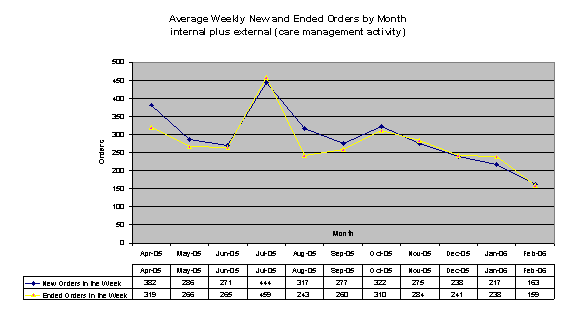
11. Both features - of tightening eligibility criteria and shift towards nursing care - can be seen in the information presented in the budget background report comparing service delivery in April 2005 and December 2005. This showed that the number of people newly provided with a service in the month dropped from 1,626 to 916 (a reduction of 44%) and, of those provided with residential or nursing care, the proportion provided with nursing care rose from 25% to 32%. The chart below illustrates this reduction, plotting the number of care episodes starting and ending between April 2005 and February 2006.
APPENDIX C |
Adult Services Budget: Extraordinary Review |
Peter Robertson, Chief Executive |
Project Initiation Document |
Version 3 |
Led by Chief Executive's Policy Unit: Chris Lawrence-Pietroni (wef 20 March 2006) and Jenny Heath |
Supported by: Gary Smith, Policy Unit, Lynn Mead, Treasurer's Consultancy and Sharon Harding, Internal Audit |
28 February 2006 |
Document location: F:\HantsnetDMS\2004120900019a.doc |

Table of Contents
10 Project organisation structure 88
12 Project resources and costs 99
1.1 At the Adult Social Care PRC 20 January 2006 Adult Services were projecting a forecast overspend of £4million after planned management saving actions based on data as at 31 October 2005. The budget monitoring and PRC reports identified Older Persons purchased domiciliary care, direct payments and nursing care as the core service areas responsible with a forecast gross overspend of £5.1m. The key reasons cited were:
· Continued growth in the number of nursing care placements, direct payment recipients and people in receipt of domiciliary care that were not allowed for in the budget
· Demographic changes with significant increases primarily in the over 65 year (and particularly the over 85 years) categories impacting on demand and need
1.2 Management actions were put in place to try to mitigate the impact, but the effect of this has not been significant enough to offset the overspend.
1.3 In early February 2006 when papers were sent out for 9 February Adult Services DMT the forecast, using data to 31 December 2005, had moved to indicate an overspend of £11m in the current financial year 2005/06. Subsequently the forward impact for 2006/07 was identified as being at least £20m, assuming repayment of the 2005/06 overspend.
1.4 Within Adult Services a team are working to formulate a recovery plan that will enable actions to be put in place as immediate measures to contain the position as much as possible.
1.5 A need was identified to set up a team independent of the Adult Services department to understand why the department finds itself in this position, verify any findings from the in-house teams, and to explore further measures to improve management information, systems and the ability to deliver on planned savings actions.
1.6 The independent team is also tasked with checking that eligibility criteria are being applied as rigorously as possible and to look at radical savings options.
1.7 Given the breadth of services delivered within the Adult Services department this project initiation document will identify how these actions will be planned to be met, and most importantly where work will be focussed to ensure management assurance can be given within set timelines. This is particularly important given the high profile of this work, the wide scope of the department as a whole and the finite resources available.
This work will be constructed in two distinct phases.
Phase 1: to report to the Chief Executive as soon as possible in advance of 29 March Adult Social Care PRC
To establish the facts giving rise to the current budget projection and why it was not predicted with a reasonable degree of accuracy.
Phase 2: Follows on from Phase 1, timelines to be agreed
Much detail here will be derived from phase 1, but in essence it will:
Explore and report on detailed findings for specific service areas of concern within Older People and People with Learning Disabilities, and identify areas for potential improvement that will help to put Adult Services spending on a sounder financial footing in the short and medium terms.
Phase 3: to start in parallel with phase 2, timescales and resources to be agreed - Chief Executive to indicate reporting routes
Scope and plan the resources and activities required to carry out and monitor the improvement plan within Adult Services.
Phase 1: To validate and challenge as appropriate:
1. where the budgetary pressures have arisen from
2. the sequence of events leading up to the February 2006 budget position (as at 31 December 2005)
3. management actions taken, by whom and when, regarding the financial position
4. follow on actions required
Phase 2: To:
1. validate and challenge as appropriate the findings of the Adult Services in-house team who are currently formulating the recovery plan
2. identify and verify specific projects that need to be investigated in detail, including:
· analysis of the single assessment process, information available and used in the decision making process and application of eligibility criteria for Older Persons to assess how they are applied within the statutory constraints in order to minimise spending (working with the Service Manager, Older People, Basingstoke identified to help support this review)
· analysis of unit/comparative costs of in-house and external services so that an overview can be taken of the options for changing the balance (data to be provided by the DFU)
· examine the budget monitoring and management reporting processes
· examine the system related issues between SWIFT and SAP, linking in with the planned Internal Audit in this area
3. develop an improvement plan including allocation of resources, bringing together actions from the project work, looking at both the short and medium term
Phase 3:
1. That resources and inter-dependencies are identified, and timescales agreed that will enable each project to be complete in line with the improvement plan timeline
10.3 Links to Corporate Objectives
· Achieving economic prosperity
· Improving services
· Developing councillors and staff
To make recommendations that recognise the balance that needs to be struck between providing an affordable service and one which operates within statutory guidelines and provides a level of service which meets users needs
Phase 1 will be limited to analysis giving rise to the current budget projection
Phase 2 will be targeted at specific areas of overspend within Adult Services, primarily within Older Persons but also physical and learning disabilities
Phase 3 will be limited to identifying resources, inter-dependencies and timescales to deliver and processes to monitor the projects identified within the improvement plan
Examining the whole of Adult Services in detail due to finite availability of resources and time
Phase 1
A report for the Chief Executive to review with the Executive Member prior to taking to the Adult Social Care PRC 29 March 2006, and subsequently for formal review with the Executive Member for 31 March 2006. The exact date this will be required for will need to be agreed
Phase 2
A report outlining findings and including the improvement plan. As projects are identified resources will be allocated to deliver those, along with agreed reporting timelines.
Phase 3
A high level communication scoping each project identified within the improvement plan. It will need to be agreed who will be taking each of the projects forward beyond the end of phase 2.
That Older Persons is the key area of focus as it is the largest contributor to the overspend, although People with Learning Disabilities will also be examined
Examination of the application of the eligibility criteria will provide opportunities to address the overspend
That data provided is correct
That information provided to the independent team during the process is reliable
A risk is a possible problem that might threaten project success and needs to be monitored.
Risk No |
Summary of Risk |
Probability |
Impact |
Importance (P x I) |
Containment |
1 |
Availability of sufficient time within the allocated team to deliver the required output to the required timeline |
M |
H |
H |
To have a clearly defined scope for the work and keep in close contact and evaluate work loads in a pragmatic way. Regular communications with the identified corporate contact, with exception reporting to the Chief Executive as necessary |
2 |
Availability and existence of information and data to the required standards of completeness and consistency required to substantiate the work |
M |
M |
M |
Evidenced based conclusions will be drawn where possible, but otherwise this will require clarity about assumptions and statements being made |
3 |
Availability of and co-operation by the staff within Adult Services to enable the team to come to evidenced statements |
M |
H |
H |
Secure senior management endorsement of the process and their communication with all staff involved within Adult Services and appropriate Treasurer's staff, including the Devolved Finance Unit The team will take a collaborative approach, have transparency of the brief and avoid a blame culture |
Due to the high sensitivity and political nature of this work the team must be aware of other interested parties, including County Council members and the media
The detailed approach will emerge as the process unfolds
The Chief Executive will approve key documents, provide direction and review and approve deliverables
The initial approach for phase 1 will be:
· Identifying the budget position and the detailed financial information and reporting
· Reviewing Internal audit previous recommendations that have arisen as part of the Governance Audit and planned 2006/07 internal audits
· Reviewing any relevant Treasurer's Consultancy projects
· Reviewing what has come out of the Annual Performance Assessment from CSCI
· Identifying the background and latest position on the health contribution, linking with Kevin Gardiner, Head of Legal Practice
· Reviewing and understanding the senior management perspective in both Adult Services and Treasurer's
· Mapping the sequence of events and management actions leading to the budget position in February 2006 (which is as at 31 December 2005)
· Identifying what management information was provided, the decision making process and impact on front line service delivery leading up to the budget position in February 2006
· Interviews with Rea Mattocks, Director Adult Services and Adrian Thorne, Head of Adult Services Devolved Finance Unit (with effect from 1 March 2006) as required
To produce the report for phase 1 the findings from the above analysis will be coupled with further interviews and desk top work.
The detailed approach following the above work will be mapped out in preparation for phase 2.
Executive - Peter Robertson, Chief Executive
Senior User - Rea Mattocks, Director Adult Services and John Clifton, Deputy Director Adult Services
Senior Supplier - Paul Carey-Kent, Deputy County Treasurer
Project Manager - Head of Policy Unit, Chief Executive's
Project team - Jenny Heath, Chief Executive's
Gary Smith, Chief Executive's
Sharon Harding, Internal Audit
Lynn Mead, Treasurer's Consultancy
Adult Services Advisor Rosemary Gould, Service Manager, Older Persons, Basingstoke
18.2 Other interfaces and resources:
Adult Services staff
Treasurer's staff
Reporting to the Chief Executive as soon as possible prior to 29 March in order that the information can be reviewed with the Executive Member prior to the Adult Social Care PRC on 29 March
Other reporting requirements will be on an exceptions basis, unless otherwise specified
Reporting to officers and members as determined by the Chief Executive
Briefing and communicating to staff within Adult Services regarding this process will be the responsibility of the Director of Adult Services or delegated responsible officer
Days will be made available across the project team as required to complete the work. This work is being treated as a priority.
I confirm that this project initiation document describes accurately the scope of the work proposed as at the current date and ask for the project to commence.
Any changes to the scope above will be subject to change control. This project initiation document is valid for one month after issue.
No work should proceed unless the project initiation document is approved.
1st Authorising signatory - Project Executive [Peter Robertson] |
|
Signature..................................... |
Date: ............... |
2nd Authorising signatory - Senior User [Rea Mattocks or John Clifton] |
|
Signature..................................... |
Date: ............... |
3rd Authorising signatory - Senior Supplier [Jon Pittam or Paul Carey-Kent] |
|
Signature..................................... |
Date: ............... |