
Archived decisions
Hampshire Fire and Rescue Authority Human Resources Committee Item 7 21 April 2006 Medium Term Plans - Training and Human Resources - Outcomes 2005/06 and new Plans for 2006/07 Report of the Chief Officer |
Contact : Dave Curry, Deputy Chief Officer Tel : 023 80 644 000
e-mail : [email protected]
1 |
Summary |
1.1 |
This report presents the draft Medium Term Plans for the following functions :- Appendix A - Training Appendix B - Human Resources |
1.2 |
These plans set out what each of the Functions are planning to achieve over the next three years. They detail the current progression of the functions, a clear statement of what is to be achieved and the method by which this progress is to be monitored. |
1.3 |
The Medium Term Plans will be available in hard copy at the Committee for members to take away. |
2 |
Recommendations |
2.1 |
The HR Committee note the content of the Medium Term Plans 2006/07 (Appendix A and B). |
2.2 |
The HR Committee note the progress made by each of the Functions during 2005/06. |
3 |
Introduction and Background |
3.1 |
The Medium Term Plans are developed by each Function as part of the Service business planning process. The plans have been developed in line with The Service's IRMP and Fire Service National Framework and legislative requirements. The Function Heads have prepared these plans taking into consideration the human, physical and financial resources available over the planning period. |
4 |
2005/2006 Review |
4.1 |
Training and Development |
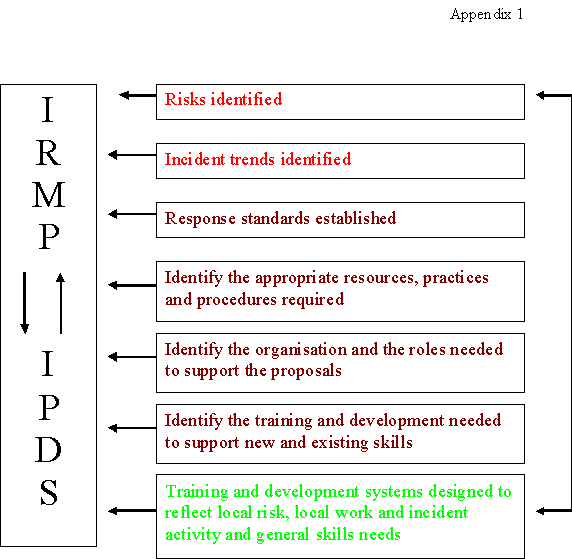
As in the previous two years, much of the project development work within the Function has focused on the introduction of the Integrated Personal Development System (IPDS). The coming year is the final year for the completion of this strategic project for the Service, with full implementation due to be completed by April 2007. This will continue to have significant benefits for all staff throughout the Service. | |
The need for IPDS to support the Services Integrated Risk Management Plan (IRMP) requires the Function to be much more flexible and responsive to providing the wide range of skills required by our staff. The last year has seen a continued demand for, and increase in, the provision of flexible high quality Training and Development across the Service. | |
In recognition of the progress made within the Service in the development of IPDS, Hampshire became one of the first Services in the Country to have its development systems externally validated by Edexcel. | |
Significant building project work is now underway on the SHQ site to provide improved Training facilities for our staff. This work will also ensure that Hampshire is well placed in the future to play a key role in regional collaboration for the provision of specialist Training activities. | |
4.2 |
Human Resources |
The Human Resources (HR) Department has had another busy year. In addition to normal business, which includes managing the payroll, recruitment, selection, termination, employee relations issues, a range of new service orders and implementation of new/impending legislation and sickness absence, the department has been leading or supporting a number of key initiatives as part of the Services IRMP, both internally facing and working with Regional partners and/or informing/setting direction within the Region. With a dedicated project team the Department has been at the forefront of the senior and middle management Grey Book post reviews, followed by Grey Book Job Evaluation, a fundamental requirement of the modernisation agenda and a cornerstone to support future work and issues regarding equal pay and value. Alongside the project was also the resolution of back pay for posts regraded, preparation and issue of new contracts of employment with role job descriptions, all providing the foundation for the culture change from rank to role on 1 April 2006. | |
In other areas, teams have successfully piloted the new fire-fighter selection tests both with new whole time recruits and with existing retained employees to inform the level of support needed to assist applicants to maintain the Service's recruitment needs and standards which the department took responsibility for from Group Managers during the year. The Equality and Diversity Outreach Teams were recruited and have quickly embedded themselves into the Service and Community alongside the range of strategies and procedures required by legislation and a good employer. The new retained pay system was implemented following the removal of Hampshire County Council's mainframe. In respect of training, managers at all levels have received training in managing sickness, disciplinary and grievance part of an ongoing programme to assist in enabling managers to manage these areas. The Occupational Health and Welfare teams have been integrated into the Department providing a more cohesive approach to issues as many aspects of the work were inter related. Workforce planning under the lead of the Deputy Chief Officer Dave Curry has been consolidated with the setting up of a range of working groups at which HR Team members are leading/represented. | |
5 |
Contribution to Corporate Aims, Objectives and Key Tasks |
5.1 |
The plans have been drafted in order to support the Corporate aims of the Service and the objectives of the Integrated Risk Management Plan. The key tasks highlighted in the plans will be delivered using an approach aligned to the draft corporate values and monitored through the timelines process. |
6 |
Risk Analysis |
6.1 |
The plans have been developed with due consideration of the corporate risks facing the organisation. Elements of the plans are detailed as control measures to manage the risks on the Corporate Risk Register. |
7 |
Resource Implications |
7.1 |
The development of the plans have taken into account the human, physical, information and communications technology resources and financial resources available within the Functions. If further resources are identified through implementation these requirements will be forwarded to the Human Resources Committee and supported by a business case which sets out the implications for the Service. |
8 |
Equality Impact Assessment |
8.1 |
Each Function is currently undertaking an Equality assessment of all activities. This process will include the items highlighted in the plans and it is anticipated this will assist the further development, and nature of implementation, of these proposals. |
9 |
Consultation |
9.1 |
Consultation has been undertaken in the development of the plans and will continue as part of the Service business planning process. |
10 |
Conclusion |
The Medium term plans of Training and Human Resources are presented to the Human Resource Committee for consideration and views as part of the Service business planning process. | |
11 |
European Convention on Human Rights and the Human Rights Act 1998 |
11.1 |
The proposals within this report are considered compatible with the provisions of the European Convention on Human Rights, the Human Rights Act 1998, and the Race Relations (Amendment) Act 2000. |
Section 100D - Local Government Act 1972 - Background Papers The following documents disclose the facts or matters on which this report, or an important part of it, is based and has been relied upon to a material extent in the preparation of the report. None Note: The list excludes: (1) Published works (2) Documents that disclose exempt or confidential information as defined in the Act | |
lajC/HFRA/Medium Term Plans
22 March 2006
Appendix A
Hampshire Fire & Rescue Service
Training and Development Function
Medium Term Plan 2006-2007

Bob Ratcliffe
SDO (Training and Development)
Appendix B
Human Resources
Medium Term Plan 2006/07
(Including Occupational Health and Welfare)
What are we trying to achieve?
The Human Resources (HR) Function has a key role in supporting the workforce management across the whole Service. As our organisation delivers the Government's modernisation agenda, effective workforce planning is crucial in determining our ability to deliver the corporate aims and objectives and ultimately, the Service's Integrated Risk Management Plan.
One of the key objectives for the HR Function is support the implementation of the Service's Workforce Planning Strategy. We want to provide professional direction and support to the variety of working groups established to deliver the right numbers of people, in the right place, with the right skills to deliver the objectives of the Service.
We realise the recent change in priorities for the organisation has put even greater challenges upon our managers. We will, therefore, seek to establish high quality HR policies and management support to assist our staff in meeting these new demands. Managers have highlighted Management Information as an area of concern and we are determined to work with other functions to make improvements in this area, by providing timely, accurate and relevant information to managers, to inform decision-making and people management.
We also seek to identify clear expectations from our internal customers by agreeing the scope of in-house specialist services available, including defined areas of responsibility for the HR Function and those we support. We want to establish effective forums to allow feedback on our performance to influence continuous improvement of our service's, aligned to the changing needs of the wider Service.
We will build upon the provision of support to our staff and the development of managers on all matters regarding employment law and legal compliance for the Service. At every opportunity we will look to promote and embed equality of opportunity within all Human Resource activities and will take all necessary action to address any inequality or adverse impact, in all aspects of service delivery.
Where are we now?
The Human Resources Function, along with the wider Service, is currently undergoing a period of major transition, resulting in numerous and often-conflicting priorities for teams within the Function. This has led to mixed expectations, both for staff within these teams and for our internal customers, of how an effective HR Function team should contribute towards service delivery. We are therefore highly committed to embedding and clarifying the revised role and structure of the HR Function, which includes the appointment of a new Head of HR, in order to underpin the current needs of the Service.
Lack on workforce planning information is negatively impacting upon the HR Function's ability to achieve its aims and support the work of our managers; improving upon these systems will therefore, be one of our main priorities for the forthcoming year.
Despite the challenges of the past 18 months, the function has continued to deliver established core business and has in addition been leading or supporting on a number of key initiatives as part of the Service's IRMP and working with others to set direction within the Region. The following indicates the scale of achievement, in terms of the new expectations for the function, that have been delivered on time:
· Senior and Middle Management Review
· Grey Book Job Evaluation
· Development of Grey Book Job Descriptions
· Development of new Contracts of Employment
· Pilot of new Fire-fighter Selection Tests
· Establishment of Equality and Diversity Outreach Teams
· Introduction of new RDS Pay System
What are we going to do?
We will become a high performing HR Function, ensuring that we are in the right position to meet the needs of the Service through modernisation and change. The HR Function will be aligned to meet the needs of a changing Service by maximising the efficiency of our resources. This will be achieved in a number of ways:
Review of the HR Function
To ensure that the HR Function is best placed to support service delivery and capable of meeting the corporate aims through the Service's Integrated Risk Management Plan, we will concentrate a review on the following areas:
· HR Focus
· Departmental Structure
· Workflow and Capacity
· Workforce Planning Information Systems
· Accommodation
Further integrating our approach with other functions and enhancing our customer focus
Our plan is to work with all other functions to ensure that expectations of both the HR Function and its internal customers are clear and, wherever possible, all needs are met. We will establish a series of formal agreements with other functions, clearly defining the expectations and responsibilities between service managers and the HR Function.
We will work hard to develop further HR policies to underpin the foundations for change to enable legal compliance and the adoption of best practice to support effective service delivery.
Developing a specification for a Workforce Planning Management Information System
In conjunction with the other users, we aim to identify the range of workforce planning information required to support the needs of managers throughout the Service. We will work on the introduction of a bespoke Management Information System, capable of integration with the existing systems, to provide accurate and relevant information for managers at their place of work. To facilitate this we will:
· Use the Prince II project management model
· Agree user requirements with all functions
· Establish management information requirements for all working groups associated with the Workforce Planning Steering Group
· Work with technical specialists to develop a user specification, with costings, prior to commencement of tender process
Supporting the Integrated Risk Management Plan (IRMP)
MR1 - Workforce Planning
The workforce plan sets out our improvement priorities, targets and performance indicators over the next three years to underpin the workforce development required to deliver our IRMP. The HR Function will have a lead role to play in :
· Recruiting and Retaining Employees
· Ensuring Legal Compliance
· Developing Employee Relations
· Establishing appropriate Pay and Rewards
· Establishment & Attendance Management
· Workforce Planning Management Information
MR2 - Changes to Working Patterns and Duty Systems
There are a number of changes planned for staff working patterns and duty systems to increase productivity across the Service. HR will support other functions to deliver these changes by working with the key groups and projects, as they occur.
MR3 - Reviewing the Retained Duty System (RDS)
This project is one of the largest to be undertaken by the Service in recent years and will place a great deal of demands on staff from various functions, including HR to make it's recommendations by June 2007. Under a Prince II Project Board, HR will play a pivotal role in co-ordinating and advising the work of various working groups, both existing and new, in there work towards the project objectives. The scope of this project includes:
· Establishing the role of the Retained Duty System for the future and what duties they will undertake
· Forecasting the scale and disposition of resources
This work will include working with other functions to establish the type of service offered by the RDS and the activities to be undertaken in Prevention, Protection and Response, establishing employment contract arrangements in line with the Working Time Directive, as well as assessing the requirements of the new Workforce Planning Management Information System associated with supporting the RDS. Closely linked with this project will be the work undertaken by the HR Function on recruitment campaigns and the appointment process, as well as the impact of Firefighter Selection tests.
MR4 - Cultural Change and Living Our Values
All of our activities will be underpinned by our commitment to fairness and equality, promoting greater diversity amongst our workforce, cultural change and championing our Core Values. Acknowledging the corporate responsibility to deliver on this objective, the HR Function currently takes the lead on these matters and will continue to do so until equality can be mainstreamed across the Service. We will ensure the Service achieves the Equality Standard for Local Government Level 2 by April 2007 and Level 3 by October 2007.
Occupational Health & Welfare
What we are trying to achieve?
The functional line management for Occupational Health and Welfare (OH&W) has recently been moved to HR Function, with the aim of providing clear direction and focus for the team and increased opportunities for joint working with other areas of HR, as well as other functions.
OH&W plays an essential role in ensuring that all current and potential staff within Hampshire Fire and Rescue Service are fit to carry out their role and achieve our aim of Making Hampshire Safer. We will therefore continue to focus on the need to drive down sickness absence and ill health retirements, in accordance with the Health and Safety Commission's report, `Securing Health Together' (2000) and are committed to achieving the following targets by the year 2010:
· A 20% reduction in the incidence of work related ill health
· A 30% reduction in the number of work days lost to ill health
In order to achieve these targets and our corporate aims, we seek to provide a high quality, efficient service which is focussed on proactive health promotion initiatives, in addition to providing day to day occupational health and welfare services.
Where are we now?
In September 2005, the Service Management Team agreed to a re-structuring of the Occupational Health Safety & Welfare Department (OHS&W) that proposed the management of Occupational Health and Welfare be moved away from Health and Safety. The rationale behind this proposal was the desire for closer working practices between HR and OH&W; the growing need for Welfare support within the Service and the identified risks associated with a lack of capacity within the Health and Safety team. However, it is important to note, that the provision of an integrated OHS&W unit for the Service, remains as a requirement of this proposal.
Within the new structure several key posts were created. Appointments to these positions have now been made and progress is underway to establish improved working practices, providing closer links between relevant departments within the Service.
Occupational health and fitness services are also undergoing a period of transition. Staff have now been appointed to these new positions and will play a crucial role in clarifying the occupational health and welfare needs of a modernised Fire and Rescue Service.
Throughout these recent changes, the OHS&W team have managed to provide highly effective support service for our staff. During 2005 the following contracts were reviewed and are now well-established and working extremely effectively for the benefit of all staff within the Service:
· Occupational Health Physician provision
· Fast-track physiotherapy service
· Employee Assistance services to support the role of the Service's Welfare Adviser
Risk profiling of HFRS activities has led to the enhancement of the Health and Safety team, establishing a more proactive approach to risk reduction across the Service. In addition, the department has raised its profile and has been very successful in marketing the benefits of Occupational Health, Safety & Welfare Services. During its health promotion week, many members of staff had the opportunity to experience alternative methods of health care and receive information on good practice to supporting health and well-being.
What are we going to do?
We will continue to develop and implement clear policies for monitoring the health and well-being of our staff and will promote proactive health initiatives throughout the Service. In achieving these objectives, we will provide an efficient and high quality support service, which helps ensure that staff are fit for their roles and thereby able to achieve our corporate aims. During 2006/2007 we will focus specifically on:
· Continuing to work closely with the Health and Safety team to ensure clear exchange of information and joint working to reduce risk across the Service
· In conjunction with the HR Function we will establish agreements with all functions so that expectations about the service we provide are clearly identified and achievable
· Establishing proactive Health and Welfare education initiatives with particular emphasis on weight management and noise monitoring
· Establishing a system for conducting Workplace Stress Risk Assessments, including education and training for managers and staff
· Continuing to monitor corporate compliance with emerging legislation
· Reviewing audit processes for the Occupational Health and Welfare service
· Engaging in the regional Occupational Health and Welfare agenda in order to facilitate sharing of best practice and information exchange
How will we monitor and learn?
Human Resources and Occupational Health & Welfare
Our corporate planning processes and performance management for Hampshire's Integrated Risk Management Plan is now well established. The Service has a clear set of objectives and a mission to Make Hampshire Safer.
The HR Function will play its part in delivering on all IRMP objectives and the HR specific objectives in this Medium Term Plan. This plan contains details of the HR project work and timelines, which are monitored and reviewed by the respective Principal Officer.
Progress associated with HR key tasks is reported to the Service Management Team, the HR Committee on a quarterly basis, and directly or indirectly to the Hampshire Fire and Rescue Authority, as appropriate.
The HR Function has 13 Best Value Performance Indicators and two Local Performance Indicators, reflecting national and local standards. These are reported on a regular basis to the Performance Review Committee and Service Management Team.
The HR Policy Group (HRPG), chaired by the Head of HR, has responsibility for the monitoring and evaluation for all areas related to functional performance within the scope of the Medium Term Plan, and coordinates any additional requirements, or amendments as they may occur. Specifically, this year, HRPG will review the effectiveness of recent changes to the function, in terms of Occupational Health and Welfare provision.
In line with the Corporate Improvement Planning Matrix, in particular, the key objective to engage staff, our objectives detail the methods by which we will evaluate feedback from internal customers and project boards working on joint initiatives. We will also be reacting to comments and feedback from various working groups and standing committees such as, Workforce Planning Steering Group, Local Diversity Group and Service Management Team
Vision for Human Resources and Occupational Health & Welfare
Through the provision of consistent and professional advice, we will support our employees and managers to deliver on all aspects of the Service's Integrated Risk Management Plan. We will promote employment best practice and legislative compliance to maximise corporate performance and actively seek to encourage all our employees to champion equality and diversity in every aspect of their work in accordance with the Service's core values.
We will provide positive support to the Service's workforce planning and people strategy and continue to work with our regional and national partners to develop unified HR polices and strategies that enable our managers to create a healthy and effective working environment with value for money efficiencies.
T/ACO Charlie House