
Archived decisions
Hampshire Children and Young People's Plan Item 3
April 2006 - March 2009
Contents
Highlight and insert table of contents here
Foreword
The guiding principle of this plan is that in Hampshire each and every child really does matter. It has been written by a multi-agency team led by Hampshire County Council not only in consultation with its statutory and voluntary sector partners, but, most importantly, with children and young people themselves. The significant role played by children and young people in drawing up the plan which I believe to be so important for their future makes a reality of its title "The Children's and Young People's Plan".
I believe that by drawing up this plan together and implementing it together we shall help children and young people stay safe, be healthy, enjoy and achieve, make a positive contribution and achieve economic well-being. But I also hope that by supporting parents and carers and encouraging family-led decision-making, their childhood will be as happy and carefree as possible while at the same time enabling them to acquire the life skills so that they reach their full potential as individuals and become active citizens of tomorrow's world.
I wish to express my gratitude to everyone who has contributed to this plan and I look forward to its successful implementation.
Section 1
Introduction, vision and how it will work
1.1 Introduction
Why a plan?
Welcome to Hampshire's first Children and Young People's Plan. This plan details how we (all organisations delivering services to children, young people and their parents and carers under the Hampshire children's trust approach) will support all children and young people aged 0-19 in Hampshire, (and a smaller group of young people with particular needs to age 25).
A key element of the new way of working is the expectation that all services work in partnership with children, young people and their parents and carers, and consult with them about the planning and delivery of services. This approach to working in partnership includes a strong commitment to identify a child's needs at the earliest possible stage, and work collaboratively with everyone involved to find effective solutions.
We are setting high standards for our work with all children and young people. We believe they should all grow up to achieve fully under the 5 main aims of Every Child Matters:
· be healthy
· stay safe
· enjoy life and achieve their full potential
· be interested and fully involved in the community they live in and
· achieve economic independence.
1.2 How the plan is structured
There are four sections:
1 Introduction, vision and background information
2 Outcomes for children and young people
3 Management of services
4 Action Plan
In addition there is an Executive Summary and a summary version for children and young people.
Children, young people and their parents and carers are at the centre of this work. We want them to:
· ask us about what support we can give them
·
· tell us what services they need
· tell us when we are doing something well or not so well
· get involved in designing local services.
Development of the Plan
The whole process of developing the plan has been an extremely valuable learning experience for all the agencies involved. It has been an important tool in the steady development of multi-agency co-operation and working over the past year. All the statutory agencies and the voluntary sector are committed to the delivery of the plan, and will be focussing resources on the outcome areas identified. So although there are a significant number of priorities, there is also strong multi-agency and voluntary sector agreement to deliver them.
Responsibility for developing the plan rested with a multi-agency steering group with representation from:
· Children and young people
· Community Action Hampshire
· District Councils
· Hampshire Constabulary
· Hampshire Council for Voluntary Youth Services
· Hampshire County Council, Children's Services
· The 7 National Health Service Primary Care Trusts in Hampshire
· The Hampshire and Isle of Wight Learning and Skills Council
· The Hampshire and Isle of Wight Strategic Health Authority
· South Central Connexions
· Wessex Youth Offending Team
To prepare the first draft, this steering group supported 12 full day workshops between July and September in the 11 district council areas in Hampshire. Over 1100 young people and adults from a wide range of organisations in Hampshire attended, including practitioners and managers from the health services, schools, colleges, the voluntary sector, Connexions, district councils and the County Council.
Young people were an essential part of workshops and were supported to attend by their schools, the local youth council and Connexions.
Everyone who attended the workshops contributed their thoughts on what outcomes should be included in the plan. There was broad agreement on what should be the priority outcomes for children and young people and main areas of focus in the management of services.
Consultation on the draft
The draft Plan was widely distributed and consultation events were held targeting specific groups (see list of organisations in Appendix 1). Examples of the consultation are:
· two conferences organised by and targeted at the voluntary sector
· work with children and young people in schools and those not in school
· work with vulnerable groups of children and young people
· discussion of the draft at senior level within organisations with responsibilities for services to children and young people including the health sector, schools, colleges, voluntary sector, Connexions and Hampshire Children's Services department
· widespread dissemination of the draft to all staff and organisations supporting the Plan and those who attended the consultation events
· discussions at all Local Strategic Partnerships and Primary Care Trust boards
· discussion with advisers at Department for Education and Skills (DfES), Government Office for South East (GOSE), Department for Health (DH), Office for Standards in Education (Ofsted) and the Commission for Social Care Inspection (CSCI).
Comments and contributions have been received and considered from a wide range of partners. We believe the Children and Young People's Plan will constantly develop and will help us improve services year on year. Therefore, we welcome comments in the future.
The final document and the priorities
This final document is a true partnership document. It has 20 priorities, but these can be broken into three groups:
1 we have prioritised the identification of the needs of specific vulnerable groups in Hampshire in outcome 2.1 The needs of these children will be considered throughout all the other outcomes in the plan, and will be the focus of equalities impact assessments. These are shown in section 2
2 A series of priorities based around outcomes for all Hampshire children and young people. These will be achieved through the resources of a wide range of services, including all the statutory agencies and the voluntary sector. These are shown in section 2
3 A series of priorities around major processes - shown in section 3.
1.3 Vision
Our vision is that every child and young person, including those who are vulnerable or disadvantaged, has the best possible start in life and develops to their full potential. They should expect to:-
· receive excellent health care
· be able to grow and develop in safety and free from prejudice and discrimination
· receive an excellent education in preparation for a fulfilled life
· have their achievements celebrated
· be listened to and have their views taken into account
· be treated with respect
· have easy access to the information and support they and their families need to help them to take responsibility for their own lives
· belong to and be valued in their community
· see their needs and interests at the heart of everything we all do
1.4 Rights, Respect and Responsibilities
Most children and young people spend a large proportion of their time in schools and colleges. Schools and colleges recognise the vital role they play in supporting them to achieve their full potential and many have introduced the Hampshire Rights, Respect and Responsibilities initiative. This initiative supports children and young people to be more aware of their rights under the UN Convention and their responsibility to respect the rights of others.
Our schools are encouraging and enabling children and young people to:
· be reflective
· know everyone is different
· develop courteous relationships
· talk and negotiate
· respect everyone
· be able to think and learn
· take increasing responsibility for their own decisions
· meet others to play and talk
· behave responsibly
and to expect:
· that adults are aware of and support the rights of the child;
· that adults act in a respectful way to children, young people and other adults;
· to be asked about things that affect their lives;
· to see how what they have said has been acted on.
This programme complements schools' personal development and learning curriculums which support the spiritual and emotional development of our children and young people.
1.5 The way we will work
This plan illustrates the importance we attach to working together to identify problems at the earliest possible stage, and promptly seek solutions.
All organisations in the Hampshire children's trust approach will therefore:
· develop cultures that promote and enable children, young people and their partners and carers to be equal partners in the development of services
· develop cultures that embed early intervention and prevention work
· support the Safeguarding Board to ensure the safety of all children and young people
· work to improve multi-agency service delivery based in the local community
· implement the Common Assessment Framework, to assess need and identify the most vulnerable
· develop and implement efficient systems for collecting and sharing information
· maximise use of financial and human resources
· restructure the management of the workforce and develop the workforce, including the lead professional role
· increase interagency training opportunities
Schools, colleges, health services, voluntary and community organisations and other service providers are at the heart of our communities and they all have an important role to play to ensure we achieve against the outcomes.
Staff in these organisations are often the first people children, young people and their parents and carers turn to for support or who first recognise there may be a need. Whatever their job, everything in this Plan, especially the vision, is relevant to everyone providing services and activities for children, young people and their parents and carers. It is important everyone knows what the 20 outcomes for children and young people are, (see Section 2) as well as how we intend to improve the management of services, (see Section 3).
Everyone working with children and young people should:
· think about how everything they do makes a difference to children, young people and their parents and carers' lives
· check everything they do supports the vision and the outcomes and processes in sections 2 and 3
· take action to bring about improvements (however small) to how services are delivered
· collaborate with colleagues from other organisations to create services that meet needs, regardless of who delivers them
· undertake continuous professional development to update their skills and knowledge base
· know the limitations of their own skills and knowledge and know how and where to obtain further support
Remember: "The best way for adults to find out what children and young people think is to be an asking and listening sort of adult". These were younger children's views on Every Child Matters, expressed at a national event in 2005.
1.6 Governance
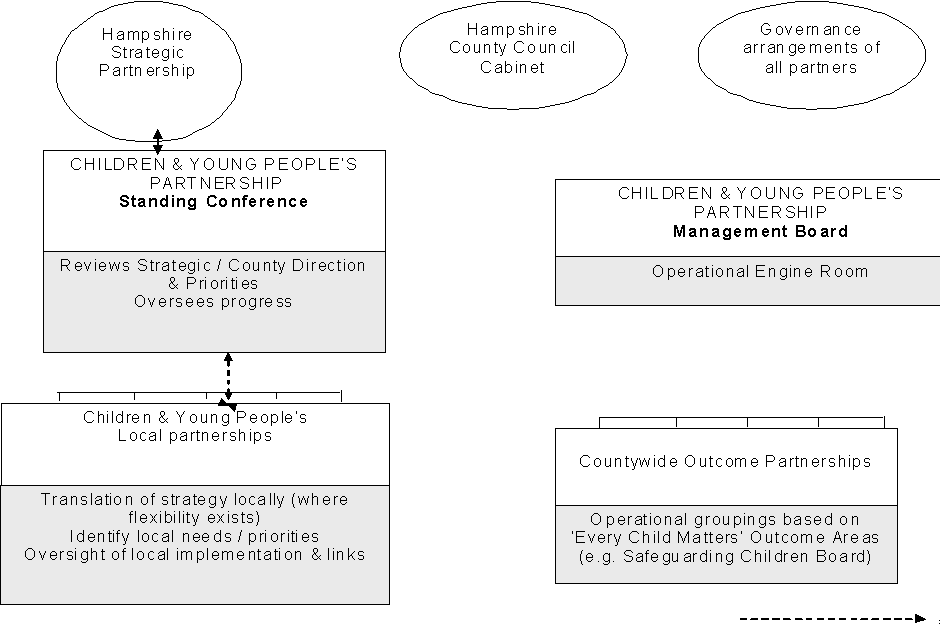
To ensure success in working together we have agreed that we will govern our work through the structure outlined below. Within this structure we will build in support to ensure that children, young people and their parents and carers, including those who are hard to reach, can express their views and be equal partners in the development of our services.
Children and Young People's Partnership - Standing Conference
This county-wide conference will be chaired by Hampshire County Council's Executive Member for Children's Services. All organisations within the children's trust approach will be involved. The conference will identify strategy and establish priorities through this Children and Young People's Plan, identify resources and oversee progress in improving outcomes.
Children and Young People's Partnership - Management Board
This will be chaired by Hampshire County Council's Director of Children's Services. Its purpose will be to manage the implementation of agreed strategy through this plan; recommend how resources should be allocated to priority areas; establish service delivery agreements and performance management arrangements.
Partnerships for particular outcomes
These will assist the Standing Conference and the Management Board in managing particular areas of joint work. There is still development work to do to establish exactly how these will operate and be governed. They will be focused on specific developments, e.g. Safeguarding Children or Youth Matters .
Local partnerships
These will assist the Standing Conference and the Management Board in ensuring a local perspective and will develop around district council areas. Following the issue of this Hampshire-wide plan, organisations in each district council area will work together to develop a local plan based upon this plan. Organisations that deliver services at a local and county level will prioritise their outcomes to meet the needs of their local communities. Data sets to help identify local needs more accurately are being developed. Local Partnerships will link to Local Strategic Partnerships and other existing partnership arrangements.
 Governance arrangements in Hampshire


1.7 Links to other plans
The Plan will be placed on HantsFish, Hampshire's internet based Children's Services Directory. The sections will be hyperlinked to each other and there will also be hyperlinks to the plans of other organisations.
1.8 The Local Area Agreement
The aim of the Local Area Agreement (LAA) is to bring together local partners in order to achieve better outcomes for communities which are agreed with the government. These outcomes relate to 4 blocks: children and young people; healthy communities and older people; safety and strong communities and economic development.
Hampshire's LAA is based on eight priority outcomes, which support the priorities in this CYPP. These LAA priority outcomes are listed below, together with a reference to the section of the CYPP that they support:
· improve the life chances for children and young people (see Sections 2 and 3). This specifically includes:
· a project based around 12 schools in areas of deprivation
· Child and Adolescent Mental Health Services (CAMHS)
· Parenting
· Teenage Pregnancy
· deliver first class support for business, promote skills and workforce development and address barriers to employment (see Section 2, 2.18)
· improve the co-ordination of transport and access to services across the County (see Section 2, 2.19)
· improve access to housing and accommodation (see Section 2, 2.20)
· tackle crime and anti-social behaviour recognising the harm of drug and alcohol misuse (see Section 2, 2.7 and 2.9)
· promote and improve the health and well being of people in Hampshire (see Section 2, 2.3 to 2.7)
· use material resources more efficiently (see Section 3, 2.7)
· empower local people to have a greater voice and influence over the decision making and the delivery of services (see Section 3, 2.1)
1.9 Resources
Everything in this plan must be achieved through existing resources. Everyone recognises that more could be done with more money. As we have no new money we will decide, where possible, together, how to deploy our current resources to best effect. We will do that based on the overall direction set out in this plan and ongoing assessment of local and individual needs. See section 3 of this plan for further information on current and future use of human, financial and information technology resources.
1.10 Needs Analysis
The process of bringing together this plan reflects the ongoing nature of needs analysis in services across Hampshire, which we see as a perpetual activity, not to be captured statically in a plan. In the last year multi-agency needs analysis has contributed to the selection of priorities for the Local Public Service Agreement 2, the Local Area Agreement and the Annual Performance Assessment.
Needs analysis has three parts:
· input from children, young people, their parents and carers
· the professional opinion of staff and
· data.
The three elements together give a balanced picture. Throughout this plan there is reference to the data that have contributed to the underlying needs analysis. The outcomes in the plan also reflect the judgements of priority of all the participants in the district workshops, including young people.
The data-driven needs analysis in Hampshire can be broadly broken into two types, set out below.
1 Information to inform the universal services
Extensive use is made of data to drive allocation of resource within the universal services. For example:
· schools are funded, through the direct schools grant, to reflect a range of variables including the relative deprivation levels of their pupils; above average movement of pupils (`turbulence' - a particular issue in military areas or where there are significant numbers of Traveller pupils); the needs of pupils with special educational needs.
· The allocation of the school inspection resource is through a sophisticated system of school classification which takes into account a large number of performance indicators
· The annual reports of the Primary Care Trusts show the basis of resource allocation centred upon analysis of the geography of health need.
· The annual pupil attitude survey covering pupils across Hampshire in years 2, 6, 7 and 9.
· The identification of the 12 schools for targeted work within the Local Area Agreement.
2 Information to inform specialist services
Here the varied geography of need in Hampshire really shows through. Each of the specialist services relies heavily on their needs analysis to allocate resource according to the considerable variation in need across the diverse county that is Hampshire. Some examples of services where sophisticated needs analysis is enabling resource to be targeted very effectively are:
· The Teenage Pregnancy Partnership
· The Child and Mental Health Services Children's Trust
· The Drug and Alcohol Advisory Service
· The Ethnic Minority Achievement Service
· The development of Children's Centres
· The education welfare service (school attendance)
· The education other than at school service (school exclusions)
Much of this needs analysis makes use of the indices of multiple deprivation, driving increased targeting of resource into the most deprived areas. We are, however, aware of the issues of rural areas, where isolated instances, or very small pockets, of multiple deprivation can go unnoticed within even the most detailed breakdown of data. In total, 40% of our deprived children and young people live outside the areas of greatest relative deprivation. That is when local knowledge, the voices of the individuals concerned and the work of staff across all services is of greater value than data alone.
Without doubt there is more that can be done. As part of the preparation of this plan, sixty indicators from the Joint Area Review dataset that are available at postcode, sub-district or district council level have been identified. They have been collated into a dataset for each district council area and for the first time an overall picture of need is available. Each dataset can be compared across districts and with the overall county averages, and will help to further highlight particular local needs and enable targeting of resources.
Some of the actions in part 4 indicate activity to collect further data to inform needs analysis e.g. the plans to set a baseline for the work to reduce obesity through collection of height, weight and body mass information for year R from September 2006.
1.11 Performance management
1 Performance Indicators
Performance indicators for each of the 20 outcomes are shown in section 4 (the action plan). They all have identified baselines and targets (with a few exceptions which are under development). These performance indicators incorporate the indicators used in the Local Area Agreement and the Local Public Service Agreement 2. They also incorporate the initial set of 12 indicators agreed by Hampshire Children's Services Board as a precursor to the development of this Children and Young People's Plan.
2 Monitoring and reporting
Each outcome will have a lead officer drawn from one of the partners on the CYPP steering group.
Hampshire County Council's Executive Member for Children's Services has the statutory responsibility for ensuring the delivery and evaluation of this plan. The governance arrangements through the Children and Young People's Partnership Standing Conference, supported by the Management Board will ensure that progress is being made in taking the plan forward. The CYPP steering group will co-ordinate activity on their behalf. There will be a half-yearly progress report on the action plan in October and a full evaluation and review of the plan in April each year.
Both these reports will use a `traffic light' system for showing progress against actions and against the targets set for each indicator.
The April review and evaluation will form a significant part of the evidence for the County Council's Children's Services Department's Annual Performance Assessment, and for the Joint Area Review (JAR) of all services to children in Hampshire (due 2007/08). The monitoring and evaluation of the Local Area Agreement and the Local Public Service Agreement 2 will also dovetail to the work on this plan.
3 Refresh and review process
This will work to the following outline timetable:
Month |
Annual process 2006/07 |
2007/08 |
April |
Publish action plan 2007/08 | |
May |
Publish CYPP |
APA (or Joint Area Review (JAR) based extensively on CYPP |
June |
County Council Annual Performance Assessment (APA) | |
July |
Revise action plan for 2007/08. All partners involved. First 6 -monthly monitoring report |
Then as for 2006/07 |
August | ||
Sept | ||
Oct | ||
Nov |
Annual budget setting process for all partners. Final feedback and judgement on County Council's APA. |
|
Dec |
||
Jan |
Finalise action plan for 2007/08 in light of all partner's budget decisions and APA |
|
Feb |
||
March |
Prepare first year's evaluation and review of CYPP |
1.12 Impact Assessment
Every organisation on the Partnership Board is committed to ensuring equality of opportunity for all.
The main groups of children and young people considered to be particularly vulnerable have been identified within this plan. They are:
· Children Looked After
· Black and ethnic minority and Traveller children and young people
· Children and young people in relative deprivation
· Children and young people with special educational needs and with disabilities
· Young Parents
· Young Carers
The particular needs of these groups have been considered in developing this plan.
However, we see this impact assessment as an ongoing process. We know that we do not have as much information as we could have on the needs of some of these groups. Part of our work during the duration of this plan will be to improve that. We will also ensure that the needs of these groups are considered against all the outcome indicators in this plan, and that will form part of the ongoing impact assessment of subsequent action plans.
Appendices
Appendix 1:
Organisations who have been part of the consultation process
Appendix 2:
JAR indicators for which data has been collated by district council area
Appendix 3:
Glossary/Organisations who have been part of the consultation
Many organisations and young people were involved in the development of the first draft of the plan. The following list shows the organisations who were invited to comment during the 1 January - 31 March 2006 consultation period. There is a list of the 80+ individuals and organisations who sent responses at www.hants.gov.uk/childrenact Hampshire Drugs and Alcohol Advisory Service (DAAT) |
Advice Zone at Alton CAB |
Andover & District Mencap |
Bushy Leaze Early Years Centre |
Carers Together |
Castle Club, Before & After School Club |
Child and Adolescent Mental Health Services (CAMHS) |
Chairs of Children's Fund Partnerships |
Children and Adolescent Mental Health Service |
Children Centre Managers |
Children's Fund |
Children's Service Department Staff |
Citizens Advice Bureau |
Colden Commen Youth Work Project |
Community Action Hampshire |
Community First New Forest |
Community Learning Partnerships |
Connexions |
Contact a Family |
Country Wide |
Department for Education and Skills |
Dioceses |
District Councils |
Drum Housing Association |
Early Years Centre Managers |
Fairbridge Solent |
Family Support Services |
Fareham Borough Council |
FASST - Family & School Support Team |
Fleet Infant School |
Foster Care NCH - Wessex Community Projects |
Further Education and 6th Form Colleges |
Government Office for the South East |
Hampshire Ambulance Service |
Hampshire Catering |
Hampshire Children & Families Forum |
Hampshire Children's Fund |
Hampshire County Scouts |
Hampshire County Voluntary Youth Services |
Hampshire Fire and Rescue |
Hampshire Inspection and Advisory Service (HIAS) |
Hampshire & Isle of Wight Association of Youth Clubs |
Hampshire Music Service |
Hampshire Police (Chief Constable + community safety team) |
Hampshire Police Authority |
Hampshire Probation Board |
Hampshire Scouts |
Hampshire Strategic Partnership |
Hampshire Voluntary Sector Infrastructure Development Group |
Headteachers & chair of Governors of all Hampshire schools |
Hart Voluntary Action |
Havant & Petersfield Special Needs Forum |
Headteachers of all Hampshire schools |
Healthy Schools |
Home Start |
Horndean Technology College |
Hythe Social Services |
Kids Church |
Kids South East |
Joy Wayland 12 Schools LAA project Better Schools: Better Lives |
Learning and Skills Council |
Local Strategic Partnerships |
Members of Parliament |
NCMA - National Childminding Association |
Network Fareham |
Outdoor Centres |
Parents Action Group for Special Play |
Porchester Community Association |
Portsmouth Diocesan Board of Education |
Primary Care Trusts |
Property, Business and Regulatory Service (HCC) |
School Library Service (all areas) |
Schools Sports Partnership |
Sport Hampshire & Isle of Wight |
Strategic Health Authority |
Strategic Health Manager |
Teachers Liaison Panel |
Voluntary Sector Leads |
We are the Voice |
Wessex Local Medical Committee |
Winchester CF Local Partnership Group |
Hampshire 60 JAR indicators for which data has been collated by district council area | ||||
Department |
Section code |
Detail Code |
Section |
Name |
Health |
1 |
1 |
SECTION 1 : BEING HEALTHY |
Proportion of expectant mothers smoking during pregnancy |
Health |
1 |
2 |
SECTION 1 : BEING HEALTHY |
Percentage of babies with low birth weight |
Health |
1 |
3 |
SECTION 1 : BEING HEALTHY |
Proportion of mothers initiating breast feeding [for 2 months] |
Health |
1 |
4 |
SECTION 1 : BEING HEALTHY |
Immunisation rates by 2nd birthday |
Health |
1 |
5 |
SECTION 1 : BEING HEALTHY |
Immunisation rates by 5th birthday |
Health |
1 |
8 |
SECTION 1 : BEING HEALTHY |
Admissions to hospital for under 18s with asthma |
Health |
1 |
9 |
SECTION 1 : BEING HEALTHY |
Diagnosis of Chlamydia amongst under 16 and 16-19 year olds |
Social Care |
1 |
10 |
SECTION 1 : BEING HEALTHY |
Teenage pregnancy, conceptions below age 16 and 18 |
Education |
1 |
14 |
SECTION 1 : BEING HEALTHY |
Percentage of schools participating in the National Healthy Schools Standard |
Health |
1 |
19 |
SECTION 1 : BEING HEALTHY |
Infant mortality rate (deaths per 1,000 live births - infant under 1 year] |
Health |
1 |
20 |
SECTION 1 : BEING HEALTHY |
Perinatal mortality (number of stillbirths and deaths of infants at ages under 7 days) |
Health |
1 |
21 |
SECTION 1 : BEING HEALTHY |
Deaths of children under age 15 per 10,000 under 15s by cause of death |
Health |
1 |
24 |
SECTION 1 : BEING HEALTHY |
Oral health in children : number of decayed/ missing/ filled teeth in children aged 5, 12 and 14 |
Health |
1 |
33 |
SECTION 1 : BEING HEALTHY |
Substance misuse related admissions to hospital, ages under 20 [or ages under 18 depending on how this is collected] |
Health |
1 |
34 |
SECTION 1 : BEING HEALTHY |
Percentage of Child and Adolescent Mental Health Service (CAMHS) new cases with length of wait under 4 weeks and under 26 weeks [proxy measure: number of children waiting for an initial appointment with specialist CAMHS] |
Social Care |
1 |
38 |
SECTION 1 : BEING HEALTHY |
PAF C19: The average of the percentages of children looked after who had been looked after continuously for at least 12 months, and who had their teeth checked by a dentist during the previous 12 months and had an annual health assessment during the prev |
Police |
2 |
1 |
SECTION 2 : STAYING SAFE |
The number of children aged 0-15 killed or seriously injured in road traffic accidents |
Health |
2 |
2 |
SECTION 2 : STAYING SAFE |
Admission to hospital due to injuries for ages under 18 (accidental and non-accidental) |
Police |
2 |
3 |
SECTION 2 : STAYING SAFE |
The incidence of identifiable crimes against children (abandoning a child under the age of 2, abuse of trust, child abduction, cruelty or neglect, gross indecency, unlawful sexual intercourse) |
Social Care |
2 |
12 |
SECTION 2 : STAYING SAFE |
CH141: number of referrals of children per 10,000 population |
Social Care |
2 |
14 |
SECTION 2 : STAYING SAFE |
CH143: percentage of referrals of children in need that led to initial assessments |
Social Care |
2 |
18 |
SECTION 2 : STAYING SAFE |
CH145: number of core assessments of children in need per 10,000 population aged under 18 |
Social Care |
2 |
20 |
SECTION 2 : STAYING SAFE |
CH01: children and young people on the Child Protection Register per 10,000 population aged under 18 |
Social Care |
2 |
36 |
SECTION 2 : STAYING SAFE |
The ratio of the proportion of children on the Child Protection Register that were from minority ethnic groups to the proportion of children in the local population that were from minority ethnic groups |
Social Care |
2 |
42 |
SECTION 2 : STAYING SAFE |
CH39 Children looked after per 10,000 population aged under 18 |
Education |
3 |
2 |
SECTION 3 : ENJOYING AND ACHIEVING |
Teacher assessment results on reading: achievement at KS1 and Average Point Scores Level 2+ (all pupils) |
Education |
3 |
3 |
SECTION 3 : ENJOYING AND ACHIEVING |
Teacher assessment results on writing: achievement at KS1, Level 2+ and Average Point Scores (all pupils) |
Education |
3 |
4 |
SECTION 3 : ENJOYING AND ACHIEVING |
Teacher assessment results on mathematics: achievement at KS1, Level 2+ and Average Point Scores (all pupils). |
Education |
3 |
5 |
SECTION 3 : ENJOYING AND ACHIEVING |
Tests results on English: achievement at KS 2, Level 4+ and Average Point Scores (all pupils) |
Education |
3 |
6 |
SECTION 3 : ENJOYING AND ACHIEVING |
Tests results on mathematics: achievement at KS 2 Level 4+ and Average Point Scores (all pupils) |
Education |
3 |
7 |
SECTION 3 : ENJOYING AND ACHIEVING |
Tests results on science: achievement at KS2, Level 4+ and Average Point Scores (all pupils) |
Education |
3 |
8 |
SECTION 3 : ENJOYING AND ACHIEVING |
Value added measures· KS1 to KS2. |
Education |
3 |
9 |
SECTION 3 : ENJOYING AND ACHIEVING |
Tests results on English: achievement at KS3, Level 5+ and Average Point Scores (all pupils) |
Education |
3 |
10 |
SECTION 3 : ENJOYING AND ACHIEVING |
Tests results on mathematics: achievement at KS3, Level 5+ and Average Point Scores (all pupils) |
Education |
3 |
11 |
SECTION 3 : ENJOYING AND ACHIEVING |
Tests results on science: achievement at KS3, Level 5+ and Average Point Scores (all pupils) |
Education |
3 |
12 |
SECTION 3 : ENJOYING AND ACHIEVING |
Value added measures KS2 to KS3. |
Education |
3 |
13 |
SECTION 3 : ENJOYING AND ACHIEVING |
Percentage achieving: 5+ A*:C (all pupils) |
Education |
3 |
14 |
SECTION 3 : ENJOYING AND ACHIEVING |
Percentage achieving:1+ A*:G (all pupils) |
Education |
3 |
17 |
SECTION 3: ENJOYING AND ACHIEVING |
Value added measures KS2 to GCSE/GNVQ |
Education |
3 |
18 |
SECTION 3 : ENJOYING AND ACHIEVING |
Value added measures KS3 to GCSE/GNVQ |
Education |
3 |
19 |
SECTION 3 : ENJOYING AND ACHIEVING |
Percentage of schools not attaining floor targets |
Education |
3 |
33 |
SECTION 3 : ENJOYING AND ACHIEVING |
Performance indicators (PI) 49a - % of schools in special measures, in serious weaknesses, and which are underachieving. |
Education |
3 |
34 |
SECTION 3 : ENJOYING AND ACHIEVING |
Authorised and unauthorised absences at primary schools |
Education |
3 |
35 |
SECTION 3 : ENJOYING AND ACHIEVING |
Authorised and unauthorised absences at secondary schools |
Education |
3 |
38 |
SECTION 3 : ENJOYING AND ACHIEVING |
Ofsted Form 4 PI 142 - percentage of permanent exclusions in relation to the number of pupils in primary phase |
Education |
3 |
39 |
SECTION 3 : ENJOYING AND ACHIEVING |
Ofsted Form 4 PI 143 - percentage of permanent exclusions in relation to the number of pupils in secondary phase |
Education |
3 |
40 |
SECTION 3 : ENJOYING AND ACHIEVING |
Ofsted Form 4 PI 146 : percentage of fixed term exclusions of more than five days in relation to the number of pupils in primary phase |
Education |
3 |
41 |
SECTION 3 : ENJOYING AND ACHIEVING |
Ofsted Form 4 PI 147: percentage of fixed term exclusions of more than five days in relation to the number of pupils in secondary phase. |
Education |
3 |
43 |
SECTION 3 : ENJOYING AND ACHIEVING |
BVPI 159a, 159b, 159c and 159d - percentage of pupils permanently excluded from school who receive full-time education provision |
Youth Service |
3 |
48 |
SECTION 3 : ENJOYING AND ACHIEVING |
Contact : percentage of young people aged 13:19 reached by publicly funded youth services |
Social Care |
3 |
53 |
SECTION 3 : ENJOYING AND ACHIEVING |
PAF CF/A2 The percentage of young people leaving care aged 16 or over with at least 1 GCSE grade A*:G |
Social Care |
3 |
56 |
SECTION 3 : ENJOYING AND ACHIEVING |
PAF CF/C24: percentage of children looked after continuously for at least 12 months, of compulsory school age, who missed at least 25 days schooling for any reason during the previous school year |
Education |
3 |
62 |
SECTION 3 : ENJOYING AND ACHIEVING |
Ofsted Form 4 : PI 66 : percentage of pupils with a statement of SEN |
Youth Offending |
4 |
3 |
SECTION 4: MAKING A POSITIVE CONTRIBUTION |
Recidivism - the rate of re-offending |
Youth Offending |
4 |
4 |
SECTION 4: MAKING A POSITIVE CONTRIBUTION |
The number of first timers in the Youth Justice System |
Connexions |
5 |
11 |
SECTION 5 : ACHIEVING ECONOMIC WELL:BEING |
Connexions Partnership data 3.10.1 : number and percentage of young people aged 16:19 who are NEET broken down by active in labour market and not active in labour market |
District Councils |
5 |
19 |
SECTION 5 : ACHIEVING ECONOMIC WELL:BEING |
BVPI 183a Length of stay in bed & breakfast (weeks) |
District Councils |
5 |
20 |
SECTION 5 : ACHIEVING ECONOMIC WELL:BEING |
BVPI 183b Length of stay in hostels (weeks) |
Sure Start |
5 |
21 |
SECTION 5 : ACHIEVING ECONOMIC WELL:BEING |
Sure Start data· the proportion of children, aged 0:4 and 5:14, living in households where no-one is working (DWP). |
Social Care |
5 |
25 |
SECTION 5 : ACHIEVING ECONOMIC WELL:BEING |
The number of disabled children supported in their families or living independently, receiving services in the census week, as percentage of the estimated total population of disabled children in the council area |
2.1 Introduction
This section outlines the current position on the 20 outcomes that all partners to this plan have agreed as the 20 main priority outcomes for children and young people in Hampshire. Through their inclusion in this Children and Young People's Plan all partners have agreed to work together to improve performance against these outcomes to ensure that all children and young people can achieve to their full potential. Where appropriate we will work in partnership with children, young people and their parents and carers to identify needs and difficulties early and agree solutions.
For each outcome we have described some examples of the work currently taking place and then take a brief look forward to what all the organisations would like to see achieved in the next three years.
All of the outcomes are inter-related so we have not repeated details in other sections. The outcomes relating to vulnerable groups and support to parents and carers must be considered across all outcomes.
For ease of reference, the 20 outcomes are presented under the five core outcomes as set out in the Children Act 2004:
· Be healthy
· Stay safe
· Enjoy and achieve
· Make a positive contribution
· Achieve economic well being
Section 4 of this Plan details the main indicators of progress, targets, lead partners and resource requirements for each of the 20 outcomes.
2.2 Increased availability of generic and specialist support for vulnerable children, young people and their parents and carers
All children and young people will need to access services and other opportunities at different times during their life. Through needs analysis we have identified seven groups of children, young people and their families who are more likely to have additional needs and are less likely to achieve their full potential. They are:
· Looked after children
· Black and minority ethnic and Traveller children and young people
· Children and young people in areas of relative deprivation (child poverty)
· Children and young people with special educational needs and with disabilities
· Young parents
· Young carers
· Young offenders
The statements made throughout the Plan refer to all children and young people and specifically the above groups.
2.2.1 Children looked after
Current position
There are currently 1050 Children Looked After (CLA) in Hampshire. These children and young people are in the care of the local authority, either because of court proceedings, or by voluntary arrangement with their parents. Hampshire County Council acts as their `corporate parents' and has a duty to work in partnership with the child and young person's parents and carers. This is achieved through an allocated social worker who is responsible for ensuring the child or young person's needs are identified and appropriate support is provided by a range of organisations.
The County Council continues to recruit more foster parents to ensure that most Children Looked After are cared for in families, ideally with the extended family, or fostering through family and friends care (Kinship Care). We have been working hard with our carers to ensure that permanent arrangements for a child's care are made wherever possible. There are some circumstances where children and young people need to live in residential care and for this group we provide a range of specialist children's homes.
Some children with disabilities are looked after in what is referred to as respite care, meaning they will have short, regular, planned sessions with another carer. This support helps their own parents to provide care the rest of the time.
We are committed to improving the life chances of all of our Children Looked After in Hampshire through a multi-disciplinary team for the education of children in care. The team promotes and supports the education of all Children Looked After, wherever they are being educated with a specific focus on narrowing the gap in academic achievement between these children and the overall average achievement of Hampshire pupils.
We have a Leaving Care team that works with young people leaving care throughout the year. The service seeks to ensure all young people leaving care have access to the wide range of support services, education, health and voluntary services they need to make a successful transition into adult life. The Leaving Care team works with some young people until they reach 24 years of age if they are attending higher education. We have 20 care leavers currently in higher education places and some who have now moved into Hampshire County Council apprenticeships.
We continue to provide support to children and young people looked after to meet as a group through the Care Action Team (CAT). This group meets to ensure that children and young people looked after have opportunities to be involved in developing, monitoring and evaluating the service as well as having good fun! CAT is run by children looked after and meets regularly throughout the year. During the last year it has:
· represented the views of Children Looked After to senior managers to influence policy and service provision including the development of this plan
· developed the CAT Mark - a quality mark designed by young people to assess how user friendly a service for Children Looked After actually is. They have assessed college, care home and other teams
County Council Members and staff recognise the needs of Children Looked After, taking their role as Corporate Parents very seriously. This involves not only doing things that we would do for our own children but more to ensure we challenge the prejudice and discrimination that exists and is faced by this group. We work hard to ensure the children and young people in our care can and do participate in general activities alongside their peers, so that they are given the same opportunities and chance to achieve their full potential.
Looking forward
We want to:
· increase the percentage of Children Looked After living in family based care and in or near their local communities
· improve multi-agency support to foster carers, especially beyond the standard working day. This will improve placement stability and reduce placement breakdown. It will also develop the pool of Hampshire foster carers who can provide intensive support
· increase the number of children and young people who achieve permanence outside the care system by way of kinship care, Residence Orders, Special Guardianship or Adoption
· Improve the educational achievements of Children Looked After , improve their attendance at school and reduce their levels of exclusions
· encourage and enable Children Looked After to use public libraries and discovery centres and have free access to country parks and other recreational facilities.
2.2.2 Black and minority ethnic and Traveller children and young people
Current position
Black and minority ethnic children and young people make up 4.7% of the school population. For 1.7% of the school population English is their second language. 84 different languages are spoken by children and young people across the county. 354 black and minority ethnic children and young people started school across the county in the same months in 2005. This is 27% more than in September and October 2004. Some of our children and young people from minority ethnic groups achieve more than the national average in tests and exams at the end of Year 2, 6, 9 and 11 and some groups achieve less at one or more of these points.
There are 25 identified asylum seekers/refugees including unaccompanied young people in Hampshire schools and colleges.
Hampshire County Councils Ethnic Minority Achievement Service offers support and help to minority ethnic pupils (including asylum seekers) particularly those newly arrived in the UK. All new arrivals receive early assessment of background, 10 hours bilingual assistance or specialist teaching and staff in their schools receive training on strategies for working with ethnic minority children including those with English as an additional language. They will also liaise with other agencies where necessary - eg on school admissions or mental health and offer specific provision for certain groups such as a Kosovan After School Club (KASC). Various services such as the schools library service make information and resources available in other languages.
The Commission for Racial Equality and Department for Education and Skills (DfES) recognise that Traveller children and young people are amongst the lowest achievers within the school population. The County Council's Traveller Service supports Traveller children and young people residing in Hampshire. The service supports pre-schools, schools and colleges to recognise cultural differences in the Traveller community, so that children, young people and their families have access to education and other services.
Hampshire County Council has long established guidance on racial harassment in schools, including on-line collation forms and regular reports to elected members.
Looking forward
We will continue to work to improve the educational achievement of targeted groups. We will review the racial harassment guidance for schools in the light of official guidance from government.
All organisations will ensure regular impact assessments of functions, policies and projects and that they have clear and consistent Equalities strategies.
2.2.3 Children and young people in relative deprivation (child poverty)
Current position
There are approximately 10,500 children and young people living in the most deprived areas of Hampshire. There are xxxx pupils in receipt of free school meals in Hampshire. There is a strong (but not absolute) correlation between relative deprivation, free school meals and low educational attainment. We recognise that there are some children and young people living in poverty in rural locations. This group can often become invisible as they are not present in sufficient numbers in any one locality to show up in datasets.
We are working to improve the outcomes of children and young people growing up in poverty, through:
· supporting schools to improve standards and increase overall achievement
· increasing the availability of health services
· improving the environment in which they live
· improving the provision of play, leisure and recreational opportunities
We have seen a significant increase in educational attainment in some of the areas of highest relative deprivation, but pupils in these areas are still more likely to underachieve against the Hampshire averages.
A variety of early intervention and prevention work is taking place that seeks to lift children and young people out of these circumstances. For example the work of the Children's Centres, under Sure Start, to engage families and work with them and their under 5's to identify and remove barriers.
The Children's Fund has proactively supported hundreds of voluntary and statutory organisations to provide formal and informal support to the 5 - 13 age group. 8,000 children and young people benefited in 2005 from more than 130 separate projects which target the most deprived areas and fill gaps in existing provision.
The work undertaken throughout the year by the statutory Youth Service seeks to support young people aged 13 plus living in deprivation to raise their self esteem and aspirations.
The work of the Children's Fund has been crucial in identifying and addressing the needs of children living in relative deprivation in rural areas.
Looking forward
We want to continue to provide additional support for children and young people in this situation. We want to reduce, and if possible, eliminate, the gap between the progress made against the 5 Every Child Matters outcomes by pupils eligible for free school meals and the rest of the pupil population.
2.2.4 Children and young people with special educational needs and with disabilities
Current position
There are approximately 4750 children and young people with special educational needs in Hampshire. There are xxx children and young people with disabilities.
The County Council works with statutory, community and voluntary partners to remove barriers to participation and achievement so that children and young people with special educational needs and disabilities have every opportunity to achieve and enjoy success, whilst living with their families in their community and attending local education provision. Their needs may relate to learning difficulties; behavioural, emotional and social difficulties; speech, language and communication needs including those with autism; physical disability; medical or health needs; hearing or visual impairment. About one in twenty children and young people may experience some learning difficulty and the vast majority of needs are met by providing support in a mainstream pre-school setting, school or college. More specialist support is needed for about 2% of children and young people for whom a statement of special educational needs is produced, and some of these attend special schools or resourced provision in mainstream schools. Some 0.4% of children and young people with the most severe disabilities and their families are further supported by social care services.
There are policies for Inclusion, Special Educational Needs and Behaviour Support focusing on broad whole system approaches to early identification, assessment, prevention, intervention and provision. It is recognised that the diversity of children and young people's needs should be met through a continuum of flexible, responsive and varied provision, enabling parents to work with us to find their own solutions. The multi-agency strategy for children with disabilities (Joint Exceptional Needs Initiative - JENI) focuses on specific action for children and young people with the most severe learning difficulties, physical disabilities and hearing or visual impairments. The District Councils provide support through grants for adaptations to help them live independently in their own homes.
Specialist County Council and Health Authority services provide targeted advice, support and intervention for children and young people with special educational needs and disabilities from birth to 16 and in some cases 19 or 25. This ranges from personalised support for some children and young people and their parents and carers through to advisory and consultancy services to pre-school settings, mainstream and special schools and colleges. Across Hampshire there are numerous multi-agency projects, initiatives and training programmes designed to build skills in services, promote partnership working and improve the outcomes for children and young people. Special schools and support services are at the centre of developing sustainable networks with mainstream providers, voluntary and community agencies to ensure that there are the necessary skills, capacity and confidence to match quality inclusive provision to identified needs.
Direct payments are made by the County Council to approximately 80 families of children and young people with disabilities, giving them greater flexibility to make their own arrangements to meet their needs as assessed and agreed within a care package. A support worker service is provided for these families, currently by Carers Together. Direct payments can now be made to the young people themselves when they reach 16 years of age, thus enabling them to manage their own transition to adulthood.
Multi-disciplinary assessment processes have been developed collaboratively. The early support programme Together from the Start 'will be piloted across the county, targeting children aged 0-5 years. The programme seeks to identify children with disabilities and special needs who require additional support and put together a package of services to ensure their needs are met. Early Years teams are providing Core Worker support to those needing additional support.
We aim to fully involve children, young people and their parents and carers whenever assessment, review and planning for them takes place. Work is ongoing to further develop this and will build upon existing processes including the successful Family Group Conference system.
Schools across the county ensure that every child and young person with a statement of special educational needs has an annual review and that in Year 9 (age 14) a transition review is completed. The child/young person and their parents are encouraged and supported to participate and a variety of other people are involved such as teaching and learning support staff, educational psychologists. specialist teacher advisers, therapists, social workers and, for those in Year 9 and above, Connexions personal advisers.
Hampshire is involved in a regional pilot project to develop person-centred planning and all schools are seeking to ensure that the transition review is based on the aspirations and informed choice of the young person. In the last year of compulsory schooling, all young people with statements who intend to continue in further education at another education provider have a detailed assessment completed by Connexions. They are also supported to access Learning and Skills Council funding for further education.
Looking forward
We will continue to support children and young people with special educational needs and disabilities by:
· actively involving them and their parents and carers in all decisions affecting them and in shaping local services
· planning and developing provision across agencies and partners recognising the full age range from 0 to 19 (and in some cases 25) and the full range of needs. This includes close working with the voluntary sector in an early intervention capacity to address needs that do not meet the criteria for provision through the statutory services, but nevertheless cause difficulties for children, young people, their parents and carers.
· working with special schools and mainstream schools with specialist provision to improve the range and quality of their provision and to build capacity of mainstream education settings to further reduce and remove barriers to participation and learning
· continuing to develop suitable provision and build capacity in Hampshire services, including improved access to respite provision, to reduce the need for out of area placements made by Children's Services both in independent special schools and residential care/independent foster care
· increasing the use of direct payments to offer more flexibility to families in the delivery of services.
2.2.5 Young Parents
See section 2.6, page xxx
2.2.6 Young Carers
Current position
A young carer is a young person under the age of 18 years, whose life is affected by looking after someone with a disability or long-term illness. The person cared for may be a parent, a sibling or another family member, and the care given may be practical, physical and/or emotional.
The 2001 census identified 175,000 young carers nationally, and 2,500 in Hampshire. This is equivalent to 1 in every 100 school pupils. Young Carers may be as young as five years old. Many young people in a caring role suffer from their own mental health problems, severe levels of anxiety or depression, self harm, have eating disorders or use alcohol or drugs.
There are currently eight projects across the county which provide support in a range of ways and settings specifically for young carers. Support and counselling is offered to young people in extremely challenging circumstances such as:
· impending bereavement of a parent or sibling
· parents misusing substances
· caring for someone with mental illness
· caring for someone with Alzheimer's or serious debilitating and degenerative physical illnesses
The projects work with schools to raise awareness with staff and other children and young people about the role young carers take through the Personal Development and Learning curriculum. They also offer support to families who are not receiving support from the statutory agencies, which reduces the number of families who need to be referred to Children or Adult Services and they undertake fund-raising activities to provide young carers with the opportunity to have a few hours respite from their caring role and meet their peers.
Throughout 2005, the statutory Youth Service and the Children's Society were funded via Carers Grant monies to employ Development Workers to:
· promote the provision of specific support to young carers
· work with existing services in the locality to raise awareness and enable them to meet the needs of young carers within a holistic family centred environment
· promote through networking and liaison good practice by all organisations so that young carers' needs are addressed wherever they may come into contact or seek help.
Looking forward
A Hampshire multi-agency Young Carers Strategy was produced during 2005. This sets out a shared vision and action plan for the next three years for all organisations in Hampshire involved with young carers and their families. It focuses on those children who provide a substantial amount of care to a member of their family or to a friend.
The aims of the strategy are:
· to raise awareness and highlight the needs of young carers
· to ensure all young carers have access to projects or services which can provide support for their emotional needs, personal, social and educational development
· to encourage agencies to work towards supporting families to reduce the amount of inappropriate care that a child or young person provides to any family member
We are participating in the Children's Society Young Carers Initiative three year pilot project Whole Family Practice for Young Carers to:
· reduce the number of young people providing a substantial caring role within the family
· recognise at all levels that a young person is in a caring role, what that might mean to them and their family, and the support they may require
· ensure that young people in a caring role have the same opportunities for education, recreation and leisure, and health provision as other young people
· ensure that young people in a caring role have choices about their life and feel confident that if they are not able or do not wish to provide the care, then the cared for person is not put at risk
· ensure that young people in a caring role are not reluctant to seek help for fear of the family being split up and themselves being subject to care proceedings
2.2 Improved support and advice to parents and carers
Current position
The quality of parenting can have a huge impact on the life of a child or young person, and for their children through role modelling. Supporting the parents, carers and wider family is often the very best way to ensure that a child or young person achieves their full potential. This is particularly important for vulnerable young people.
A range of organisations provide parenting advice, support, and development opportunities either on a one to one, or on a group basis. Examples include support and advice for parents expecting a baby; families experiencing relationship breakdown or parental illness; early education and childcare choices; support for parents to improve the management of children's behaviour difficulties at home. There is also a wide range of recreational activity and support such as early years music, play activities and library activities.
However, these parenting programmes are currently not co-ordinated or of consistent quality. There are many providers. Some parents may find much on offer, others may not receive any support at all, perhaps because of where they live, or because they don't know it is there. All agencies know this can be improved.
Looking forward
Development and implementation of a Hampshire strategy for supporting parents is a part of the Hampshire Local Area Agreement. We plan to ensure parenting programmes are better co-ordinated, of consistently high quality and more accessible across the county.
We aim to develop central commissioning of parenting support that is then delivered locally and flexibly through inter-agency partnerships. These partnerships will deliver well co-ordinated parent development and support services, so that all parents can access services in a way that benefits their children the most. Parent development and support services will be delivered in line with the National Occupation Standards for working with parents.
Be Healthy
2.3 Increased access to excellent general health care provision
Current position
Our health services continue to perform well in comparison to others across the South East region for:
· births and infant deaths
· low birth weight
· infant mortality rates
· immunisation levels
· long term illness rates
· hospital admission rates due to serious injury
However, the level of performance in each of the above areas varies across the 11 district council areas. The factors continuing to affect the health of our children and young people include fruit and vegetable consumption, physical activity levels, obesity, alcohol consumption and smoking, levels of poverty and quality of housing.
480 of our schools across the county continue to be engaged in the National Healthy Schools Standard. 200 of them are working to achieve the highest standard available. This standard supports schools in planning what they will deliver under the Personal Development and Learning Curriculum. It includes areas such as: sex, relationships, drugs awareness, emotional health and well being, healthy eating and physical activity. All these factors impact on the health of our children and young people.
Looking forward
The National Service Framework (NSF) for Children, Young People and Maternity Services, published in September 2004, is a ten year strategy to improve the lives and well-being of children and young people by establishing clear standards for promoting health and providing high quality services. The first five core standards are:
· Promoting health and well being, identifying needs and intervening early
· Supporting parents, particularly teenage parents
· Child, young person and family centred services
· Growing up into adulthood
· Safeguarding and promoting the welfare of children and young people
There are six other standards which apply to specific services or circumstances.
We want to achieve in all these areas.
Our Child Health Promotion Programme has a particular focus on reducing health inequalities and active intervention for children at risk (for either medical or social reasons) will ensure all children and young people are informed of and able to access appropriate health service provision.
2.4 Increased healthy eating and physical activity and reduced obesity
Current position
The numbers of overweight and obese children has been steadily increasing with growing concern for the long term impact on children's health. The projected rate of increase in childhood obesity in 10 year olds over the next 5 years is 5%. Currently 34% of 10 year olds are overweight and 17.9% are clinically obese.
The Health Survey for England 2003 highlighted the following obese and overweight figures for Hampshire:
Age 4-5 6-7 8-10
Obese 11.8% 14.4% 17.9%
Overweight 24.8% 28.7% 34.0%
A MORI survey conducted in August 2005 showed that only 25% of 16-24 year olds in Hampshire currently undertake the national health recommendation of 30 minutes of moderate intensity physical activity 5 times per week.
Increased childhood obesity may mean today's children have shorter life expectancy than their parents. Childhood obesity increases the risk of early onset of preventable disease in adulthood, including diabetes, stroke and cardiovascular disease and thereby increases demand on NHS services (Delivering Choosing Health 2004).
Looking forward
The government has set us all a national target to halt the year on year increased risk of obesity among children aged under 11 by 2010. The public health White Paper, Choosing Health also gives a commitment to action on obesity in children and adults through a range of measures.
The Local Public Sector Agreement 2 Strategy group is working with 25 target schools across the county to reduce obesity by 1% and the number deemed overweight by 1% by 2010. There is also a stretch target that 90% of schools will have achieved the Enhanced Healthy Schools status by 2010.
Currently 483 of our schools are aware of, and are addressing, the issues of healthy eating and the need to promote physical activity through their involvement in the Healthy Schools programme and work with the Food in Schools initiative. Schools provide opportunities for children and young people to have positive experiences of physical activities. The School Meals Strategy is designed to ensure all children and young people have access to a school meal and to introduce children and young people to healthy eating. Through engagement with the Sports Partnerships schools have been able to increase opportunities for physical activity within and outside the curriculum.
We are aiming for a reduction in the year -on- year increase in obesity in children and a reduction in ill health of children as they mature so that all children can lead an active healthy life and achieve their full potential.
2.5 Increased availability of mental health services
Current position
The County Council and the Primary Care Trusts have formed a children's trust to focus on Child and Adolescent Mental Health Services (CAMHS). This is one of 35 pathfinder Children's Trusts across the country and is unique in focussing upon CAMHs.
The CAMHS children's trust brings together Hampshire County Council's Children's Services Department, the Primary Care Trusts and other CAMHS providers under a formal partnership arrangement which means that we pool funding and staff in order to plan and deliver services together. The Trust exists to improve the emotional well-being and mental health of children and young people in Hampshire by finding ways in which agencies can work together to deliver better services.
CAMHS activities are part of the Hampshire Local Area Agreement
Looking forward
We want to achieve greater equity of provision of CAMHS across the county, addressing problems as soon as they are identified. We are working towards ensuring that the majority of CAMHS money pooled through the Trust is spent on services designed and implemented by teams drawn from across a range of providers. We want all CAMHS based on a shared understanding of what works, provided in a range of accessible and non-threatening environments without stigma, working in a culture where CAMHS are seen as everyone's responsibility.
Since the Trust was established it has worked and will continue to work to:
· promote positive emotional health and well-being
· ensure that children and young people are supported at as early a stage as possible by working with schools, GP practices and other professionals;
· improve access to CAMH services so that they are available across the county where and when children and families need them;
· increase the numbers of CAMHS professionals working with children and families and types of service to ensure greater choice;
· enhance services to children and young people with specific needs, in addition to mental health difficulties;
· make sure 16-17 year olds, who can fall between children and adult services , receive age-appropriate services
· develop new services to meet the needs of children through joint commissioning from a range of providers including the voluntary and community sectors.
· offer services based on a shared understanding of what works and gaps that exist;
· establish a culture where services promoting emotional well-being work together;
· provide useful information about services on offer by all agencies across Hampshire;
· develop the infrastructure to maintain and develop high quality and effective services;
2.6 Improved sexual health, reduced teenage pregnancies and support to young parents
Current position
The under 18 teenage pregnancy rate in Hampshire has been reduced by 15.8% between 1998-2004 and is lower than the national and south east regional averages. However, there are significant local differences between district council areas.
In 2004/5, there were 744 births to young mothers under 20 in Hampshire. Research indicates that teenage parenthood often results in social exclusion for both parent and child, though it is also frequently a trigger to stimulate enthusiasm to do the best possible for the child. The Hampshire Teenage Pregnancy Partnership aims to ensure that those who become teenage parents are actively supported to ensure that they and their children are able to reach their full potential. Young parents of school age and pupils continuing their pregnancy are now better supported to continue their education. There are three specialist Connexions personal advisers in the areas with the highest rates of teenage pregnancy who help teenage mothers go back into education, employment or training and give on-going support. The Education Welfare Service supports schools to develop Reintegration Plans for pregnant pupils and young parents.
The Teenage Pregnancy Partnership is active and successful. It has a partnership board supported by Local Implementation Teams (LITs) which ensure effective roll-out of programmes. Initiatives include a full range of sex and relationship education courses geared to people from any agency working with vulnerable young people. 350+ people have been trained so far. There are 8 Sex and Relationship Forums working across Hampshire to provide a network of support for schools and colleges.
Connexions and the Teenage Pregnancy Partnership have jointly produced local information cards for young people which include sexual health services and support groups for young people.
Access for young people to contraception and health services has been improved in most parts of the county.
Looking forward
The Hampshire Teenage Pregnancy Partnership aims to ensure that by 2010 all young people in Hampshire are well supported through education and high quality services so that they can make informed decisions about relationships, sex, parenthood and sexual health. Those who become teenage parents will be actively supported to ensure that they and their children are able to reach their potential.
We are working with Parentline Plus to publicise their Time to talk initiative, geared to helping parents to talk to their children about sex & relationships issues. All parenting course tutors are being offered training in strategies to help parents with these issues and a resource directory will be developed.
We are working with the National Healthy Schools initiative to help all schools to become Healthy Schools by 2009, through supporting the development of good sex & relationships education (SRE) and confidentiality policies, (a requirement for Enhanced Healthy Schools status). Local Primary sector SRE Forums will be established where needed and schools supported to develop their work on self-esteem, friendships and relationships in addition to puberty issues. Secondary sector SRE Forums will continue to focus on new resources, initiatives and local issues. SRE advice through colleges and training providers will be developed. The extensive multi-agency SRE training programme for all practitioners who work with young people, especially those who are not fully involved with their education and those 16-19, will continue to be developed and accreditation will be sought.
Up-to-date information on sexual health issues and local services will continue to be made available to all young people through a range of media, in consultation with their expressed needs.
Work will continue to improve access to contraception and sexual health services for young people through specialised services, or local GP practices as appropriate. The Get it on condom scheme, the pharmacy emergency contraception scheme and the Chlamydia Screening Programme will be fully county-wide by 2007.
Whilst recognising the need for improvements for all young people and parents, those groups of young people particularly at risk to unintended pregnancy and sexually transmitted infections will continue to be the focus for much of our work.
We are working to develop better support and information for young parents so that they are aware of opportunities, encouraged and enabled to participate. The barriers faced by many young parents include self-esteem issues, accommodation problems, uncertainities over benefit entitlements, childcare support, social isolation and prejudice. Young parent groups have been developed in most areas where there are significant numbers of young parents and their work will be integrated into the developing Children's Centres. More education and training opportunities are being developed with colleges and the Learning and Skills Council, together with access to appropriate childcare.
2.7 Reduced substance misuse
Current position
The Drug & Alcohol Action Team (DAAT) is a multi-agency partnership, including Hampshire Constabulary, responsible for the local implementation of the Government's ten year drug strategy Tackling Drugs. There are four themes:
· prevent young people from using drugs
· reduce the prevalence of drugs
· reduce drug related crime
· reduce the demand for drugs
The DAAT has developed an Alcohol Strategy which includes a focus on young people, aiming to help them resist alcohol misuse.
The DAAT Young Person's Substance Misuse Plan provides details of a comprehensive range of services for young people, their parents and carers, including substance misuse education and prevention, early intervention, treatment and aftercare.
A Young People's Joint Commissioning Group (YPJCG) has been established and commissions a range of services. This group aims to ensure substance misuse services are integrated within mainstream services. The group links with the Crime and Disorder Reduction Partnerships to ensure jointly agreed targets and priorities for young people with the DAAT.
Local Drug & Alcohol Reference Groups assess the nature and scale of local drug and alcohol misuse problems and advise the County DAAT and 11 Community Safety Partnerships.
In 2005 a new young people's drug treatment service was launched offering comprehensive assessment, individualised packages of care, intervention and treatment based on the needs of children and young people.
The workforce and the quantity of services has been developed by increasing the knowledge and skills levels amongst the young people's workforce.
Looking forward
Our DAAT has set itself a priority to meet the new Healthy Schools standards compulsory themes. They are also developing a county-wide network of early intervention services for vulnerable young people. This will build on existing DAAT provision including Youth Offending Team substance misuse specialist resources.
Stay Safe
2.8 Improved safety awareness and child protection
Current position
Several programmes have been developed and delivered in schools and the community across the county to improve awareness of road, fire and home safety issues and where children, young people and their families can go for support.
Our schools are committed to improving safety and are working with Hampshire Constabulary through their school liaison officer and safer school partnership officers.
Performance on child protection issues across the county is good compared to national averages and comparator groups. Hampshire had a well established child protection infrastructure based around Area Child Protection Committees. The Children Act 2004 required the County Council and partners, including Hampshire Constabulary and Hampshire Strategic Health Authority to work together to safeguard and promote the welfare of children. From March 2006 a multi-agency Local Safeguarding Children's Board (LSCB) replaced the Area Child Protection Committee. Hampshire's LSCB has agreed it should initially be chaired by the Director of Children's Services at least until the procedural and other changes are in place. The LSCB is responsible for coordinating and ensuring the effectiveness of the work of each partner in relation to safeguarding and promoting the welfare of children and young people.
Assessments of our children and young people are carried out swiftly and children and young people looked after by the local authority all have social workers. A number of schemes provide support to enable children and young people to live at home and remain safe. These include the Joint Exceptional Needs Initiative (JENI) for children and young people with very severe learning difficulties and challenging behaviours to support intensive interventions at home and at school.
Looking forward
The LSCB has responsibility for developing policies and procedures for safeguarding and promoting the welfare of children and young people.
The County Council training department, on behalf of the LSCB, will provide safety awareness training, guidelines, monitoring and a contract for a specialist service for vetting employer placements.
We are aware through the crime and disorder audits that children and young people are often victims of crime. The Community Safety Strategy contains a number of actions to try and prevent this and keep children and young people safe.
2.9 Increased prevention work to reduce youth crime, anti-social behaviour and exclusion
We recognise that young offenders are a vulnerable group and need additional support to access opportunities and services
The Wessex Youth Offending Team (YOT) is a multi agency partnership (Children's Services, Health Service, Connexions, Hampshire Constabulary and Probation) which supervises young people who have offended and are sentenced in the criminal courts. In doing this the YOT seeks to:
· address the underlying causes of the young person's offending
· ensure that young people make good the harm they have caused in some way
· work with the families of young offenders to help them improve their capacity to manage their children's behaviour and take appropriate responsibility
· help children and young people who offend to understand how their behaviour may put them and others at risk physically, sexually and emotionally. The team encourages healthy lifestyles and good physical and mental health
· ensure young people can get treatment for substance misuse problems.
The YOT also works with young people in custody to ensure that they can access appropriate education whilst serving their sentence. It works with the young people, their families and carers and others to ensure that adequate provision is in place for their release into the community.
The YOT prevention programmes, in defined areas, are designed to divert children and young people from anti-social and offending behaviour and increase the take-up of safe, supervised positive activities alongside early intervention support offered to families. This includes:
· Youth Inclusion and Support Projects (YISP) currently run by the Children's Fund and soon to be supplemented by additional funds provided by the Youth Justice Board
· Projects initiated by the 11 Crime and Disorder Reduction Partnerships in Hampshire under the Government's Prevent and Deter strategy.
· Joint working with district council on anti social behaviour
Looking forward
In the next 3 years we aim to reduce offending and re-offending by taking the following actions:
· planning, commissioning and introducing new prevention programmes aimed at reducing anti-social behaviour and crime in Hampshire, to complement and enhance existing Children's Fund provision.
· targeting YOT resources more effectively on high risk and prolifically offending young people using a new matrix of intervention based on assessed needs and risk.
· continuing to develop the YOT parenting work in partnership with other providers and building prevention programmes around this.
· developing new programmes to reduce re-offending amongst violent offenders.
· increasing the level of victim involvement in restorative justice processes, especially young victims.
· working closely with partners in Police, Crime and Disorder Reduction Partnerships, Probation and Her Majesty's Court Service to ensure that young people identified under the Prolific and Priority Offenders scheme are dealt with in the most effective manner through timely information sharing and effective case management.
2.10 Increased identification, protection and support for children and young people affected by domestic violence
Current position
We recognise that living, witnessing or experiencing domestic violence and abuse can have an impact on every aspect of a child's or young person's life. The exact impact varies greatly and will be dependent upon the total context of the child and their environment. From January 2005 the legal definition of harm to children was extended to include the impairment suffered from seeing or hearing the ill treatment of another - particularly in the home.
Within Hampshire there are 10 refuges providing 100 family rooms on a temporary, crisis basis to women and children when they are forced to flee their homes. Whilst some of the refuges offer comprehensive services including crisis support, advice, outreach and resettlement and children and young people's services, this is not consistent across the county. Our community based services for children are less developed. There is a small number of community based projects such as the DOVE project, the Strengthening Families project, and domestic violence services run by The Hampton Trust.
Looking forward
Over the next 2 to three years we will be developing better reporting systems for domestic violence and improving early intervention and victim support services. During 2006/07 we will be developing a County-wide system for identifying children affected by domestic violence or domestic abuse.
2.11 Reduced incidences of bullying
Current position
Bullying is defined as the persistent use of verbal or physical aggression with the intention of hurting another person, (in or out of school). To identify the extent of bullying, and the impact it is having on our children and young people, Hampshire County Council in its annual survey of pupil attitudes asked children about their experience of bullying. 36% of Year 2 pupils said they had been picked on in school at least once in the last year. One in four Year 7 pupils said they had been bullied, as did one in five Year 9 pupils. These figures are a real cause for concern. All bullying is unacceptable behaviour.
All schools across the county were issued with guidance about combating bullying in 1998 and the resource materials available from the DfES to support schools in their development of anti-bullying strategies are promoted throughout the county. Schools have developed and implemented policies and include dealing with bullying within PSHE programmes. The Primary and Secondary Behaviour and Attendance Strand materials have also proved to be useful.
Commission for Social Care Inspectorate inspections of children's homes has shown that they tackle bullying well and appropriate advice and support is provided to help staff deal with incidences quickly.
Looking forward
National and local voluntary organisations provide advice and support to victims, families and schools. We will continue to develop and disseminate good practice to reduce the incidence of bullying, to support victims and to develop resilience, for example, by developing positive relationships and support networks. We will encourage the problem of bullying, and the solutions, to be owned by children and young people themselves.
Enjoy and Achieve
2.12 Increased access to excellent general education
Current position
We believe children and young people who receive an excellent education grow up enjoying learning and are equipped with the values, knowledge, skills, and attitudes they need to achieve their full potential. Children and young people, from the age of 4 to 16, spend about a quarter of their waking hours in education. Therefore we require all our educational and childcare establishments to ensure that they are looking after the total needs of the children and young people in their care. All our children and young people in Hampshire must be able to access high quality education, including early years' education which is vitally important in preventing social exclusion.
During 2004-2006 over 55,000 three and four year old children received free, part-time nursery education. Well over 1000 settings were registered to provide nursery education, two-thirds of which are in the private, voluntary and independent sector who were paid nearly £40 million in nursery education grant. Take up of nursery education steadily increased to an average of 4.19 sessions per week for three year olds and 4.62 sessions per week for four year olds. The number of registered childcare places increased to 45,600 - the highest for any local authority in England. This represents 3.1% of all the childcare places in England - well above the 2.5% percentage of children nationally who are resident in Hampshire. The quality of early years education and childcare measured by Ofsted was found to be generally better than similar local authorities.
Around 250 families received support for their pre-school child with special needs through the Portage Service. The Area Special Educational Needs co-ordinator (SENCO) team for Early Education was completed - this ensured every setting had access to good quality advice and guidance in including children with disabilities and special needs, and the service introduced the Index for Inclusion.
We will continue to provide professional leadership and support to early years education and childcare in Hampshire by supporting high quality, affordable and sustainable provision where the needs and views of children and families are at its heart.
Our children and young people generally perform well in schools compared with national averages and our comparator groups. Our results for 2005 can be summarised as follows:
· Key stage 1 - maintained at the established high level of performance.
· Key stage 2- test results showed improvement from the previous year.
· KS3 results were good compared to the national picture.
· GCSE results showed a 2 percentage point increase.
Children and young people from the wards with highest deprivation made a significant increase in attainment; however, they are still more likely to underachieve.
We are actively seeking to support schools in maintaining high standards. During 2005 the county supported:
· governing bodies to appoint 55 head teachers
· schools subject to special measures or a notice to improve, to achieve improvement quickly
· schools to identify pupils whose progress is insufficient and develop support
Looking forward
For the 14-19 age group, schools, further education providers and employers will continue to develop effective links to offer access to work related and vocational courses. All young people must also have access to challenging opportunities and support services, such as Connexions for impartial careers and learning information, advice, guidance and support, youth services and voluntary organisations.
Education providers, whether they are early education centres, schools, colleges of further education, or other statutory, independent or voluntary providers, have a vital role to play within their local communities. They work in partnership with each other, and with other organisations, sharing facilities, good practice and expertise for the benefit of children and young people and the wider community, and ensuring smooth transitions between the various stages of education. See Section 3; 2.4.
We will continue to ensure a range of challenging and inspirational learning opportunities are available to meet individual needs. This includes appropriate provision for pupils whose needs must be met in special ways and provided in both informal and formal settings.
2.13 Increased numbers of children and young people in school and improved support for those not in school
Current position
We recognise that there are a variety of reasons why children and young people of statutory school age are not in school. These include those children who are:
· on permanent or fixed-term exclusions
· taking authorised or unauthorised absence
· emotionally vulnerable and/or medically unwell
· being educated at home
· providing a substantial amount of care within their home
· unable to secure appropriate school places.
· members of the Travelling community
There are certain groups of children and young people who are over represented in some of these groups, in particular Children Looked After, gypsies and Travellers.
The schools across the county achieved a 27% reduction in exclusions last academic year. This reduction means that we are below the national average and our comparator groups1. Within the same period, Primary and Special school permanent exclusions were at their lowest for more than 10 years.
Our schools have worked well to reduce absence (including both authorised and unauthorised absence). The Primary Schools rate of absence for the academic year 2004-05 was 5.0%. The national average is 5.4% and our comparator groups were 5.1%. Our Secondary Schools were also successful at working with young people and parents to achieve an absence level of 7.5%, which is below the national average of 7.8% but above our comparator groups, 7.3%.
We have continued to work throughout the year to reduce the number of children and young people who are `missing education', either because their whereabouts might be unknown or because they have not managed to be registered with another school.
Our Education Other Than At School (EOTAS) service works with other local authority services and agencies to offer support and guidance to about 450 children and young people who are being educated at home, and their families.
Looking forward
We are working towards, and expect to see, a continued reduction in the number of permanent exclusions, of authorised and unauthorised absences and of children and young people "missing from education". To achieve this we will be continuing to develop better multi-agency working to support schools, parents and carers and will work with the most vulnerable and disadvantaged children and young people including
· excluded pupils,
· those at risk of exclusion,
· school refusers,
· children without school places and other "Hard To Place Pupils" (HTPP)
to help them to access appropriate provision. There will be a particular focus on Children Looked After throughout this work.
2.14 Increased access to play, leisure and recreation
Current position
The benefits to children and young people of engaging in challenging and enriching cultural, play, leisure and recreation activities are immense - both in the present and in later life. They are worthwhile and fulfilling in themselves and bring about well documented positive impacts on health, well being, personal motivation and self esteem. These benefits should be available to all, including those children and young people who currently experience difficulties in accessing these services and those who need to be supported to take part in recreational and social activities.
All sectors are working to ensure that service availability increases, including Education providers, voluntary and community sector, District and Borough Councils, County's Recreation and Heritage Department and Town and Parish Councils. Through these agencies there is significant investment in the operation and development of indoor and outdoor facilities, as well as participatory programmes across the County. There is a lot of close cooperation taking place such as: the School Sports Partnership Network, Sport Hampshire and Isle of Wight, the Joint Investment Fund in the Arts and the Healthy Schools Partnership. Joint working will be further enhanced by the actions in this Plan and through the Local Area Agreement.
Looking forward
Despite the fact that there is this wide range of provision from many different agencies, the consultation phases of the planning process for this plan, particularly the feedback from young people, showed that there are barriers to continued participation, particularly concerning accessibility. This can especially be the case for those with additional needs and from vulnerable groups.
Access issues are often a matter of local provision and arrangements. We will continue to improve accessibility of play, leisure and recreational facilities through greater partnership work between local and county organisations and appropriate support for those with additional needs. Information, provision close to where people live, outreach delivery and affordability are all part of what needs to be addressed. In doing so, children and young people must be engaged in those actions.
Make a Positive Contribution
2.15 Increased accessibility and quality of information on services
During 2005 a multi-agency group worked to develop a Directory of Children's Services: Hantsfish (www.hantsfish.org.uk). Hantsfish is web- based and allows people to locate information for themselves or others. It was developed after extensive and is where:
· Children can find out about fun things to do locally, keeping safe, help with homework, being healthy and lots more.
· Young people can access advice on drugs, alcohol, relationships, having their say, leaving school, money management
· Parents and carers can find information and links on a variety of topics including pregnancy, birth, coping with teenagers, as well as general information about fostering and adoption
· Practitioners can access the latest research and news as well as details of other organisations which provide support to children and young people, their parents and carers.
Hantsfish also links to the Children's Information Service website which holds information on early year's education and childcare provision.
In all districts there are a number of centres where children, young people and parents can obtain information, including: information centres, libraries and discovery centres, Connexions Centres, youth centres, voluntary sector information centres. Many of the centres have internet access which is accessible to young people.
Most schools, colleges and training providers have some kind of Connexions information centre or a resource centre, resourced with internet based ICT that enables young people to access Hantsfish and other websites for information.
Looking forward
We will continue to review the quality, format and impartiality of the information available to children and young people, their parents and carers to ensure:
· it is age appropriate and can be understood by children and young people at all levels including those with additional needs
· it is easier to access through projects based locally and through greater use of information technology
· there is a comprehensive and up to date directory of services for children, young people and their parents and carers, which is easy to use and search by organisation name, type of service and location
· children and young people are aware of and understand the choices available to them
2.16 Increased access to volunteering opportunities
Current position
We know many children and young people are enthusiastic about volunteering and access opportunities through many routes such as: faith groups, youth clubs, schools, voluntary and community organisations, Millennium Volunteers, Duke of Edinburgh Awards and Princes Trust. Additionally structured opportunities aimed at and engaging young people not in education, employment or training (NEET) are provided by organisations funded from a variety of sources including: Big Lottery; New Deal and European Social Fund.
Currently no central data source exists to quantify the extent of young people's volunteering activities across the county. Only Millennium Volunteers and the Duke of Edinburgh Awards are able to provide information on their activity levels.
As at September 2005, 490 young people aged 16+ were involved in Millennium Volunteers, and between 1 April 2005 and 30 September 2005, 110 achieved their 100-hour award, and 90 achieved their 200-hour award. (Figures include Portsmouth and Southampton areas).
Approximately 2,500 young people are currently working towards their Duke of Edinburgh Award.
District Volunteer Centres act as a point of access for the public wishing to volunteer. They link young people with Millennium Volunteers, and other organisations directly but have no current strategy (outside of Millennium Volunteers) aimed at specifically engaging young people. Volunteer Centres will be central to delivering the Local Public Sector Agreement 2 target in Hampshire which is a part of the Local Area Agreement.
Looking forward
We will look to use the Russell Commission funding to increase the opportunities for all young people to have access to a diverse range of volunteering opportunities that they regard as attractive, add value to their lives and enrich their communities. We will continue to develop an infrastructure where voluntary and statutory organisations, including the Hampshire Youth Council, work together to engage young people in volunteering.
2.17 Increased numbers of positive local news stories about children and young people
Current position
National research carried out by MORI (2004) found a majority of new stories offered a negative perspective on young people and their activities. Three out of four articles concerning young people had a negative tone, while 14% were positive and 15% neutral. A third of articles discussed young people in the context of violent crime or antisocial behaviour. Comparing this with the reality, MORI research for the Youth Justice Board (2003) reveals that only 7% of young people in mainstream schools had been in trouble with the police in the past year, and of the offences carried out the vast majority are not violent crimes.
Further evidence of the mismatch in media and young peoples behaviour can be found in the British Crime Survey, which surveyed 40,000 people aged 16+ each year on their experience of crime over the past 12 months, boys (15% of 16-24 year olds) are twice as likely to be victims of violent crime than girls (7% of 16-24 year olds) which challenges their portrayal as perpetrators of violence in the media. Young people's views are also noticeable by their absence in stories about them, only 8% of articles included any direct comment or quotes from young people.
Looking forward
We recognise the lack of positive images and are working to increase the number of positive images promoted in the local media, over which we have a greater influence, with the view to drip feeding stories to the national media as well.
We will continue to use our own publications to raise awareness of the many positive initiatives and projects that children and young people are involved with across the county. An example of this is Hampshire County Council's Hampshire Now publication that is delivered to all households across the county. Most partner organisations have their own publication along these lines and we will work together to share articles and features.
· We will identify ways to encourage the media and local communities to look for positive angles when reporting stories about young people such as:
· motivating youth groups, including Hampshire Youth Council, and young people to be proactive in contacting the media and presenting themselves positively in their communities.
· supporting a press code that will help to give young people a voice on the issues that affect them.
· all organisations celebrating young people as part of their communities.
2.18 Increased practical and work related learning opportunities for 14 -19 age group
Current position
A range of broad vocational choices at Key Stage 4 continues to be available across the county at different levels. This includes some schools offering, among other qualifications, applied GCSE and BTEC options.
Young people in Year 10 and 11 have an opportunity to undertake work experience with an employer and are introduced to enterprise and personal development learning.
An increasing number of young people, aged 14-16, in most schools, are offered the option of a work-related programme. This programme targets those who will benefit from a practical approach and/or are at risk of dropping out of education. Vocational courses are most frequently run by a local college, are linked to a work experience placement, and offer the opportunity to obtain an NVQ or other vocationally related qualification.
More young people, aged 14 - 16, have been supported through Increased Flexibility funding, to attend college courses which lead to either an applied GCSE or an NVQ or BTEC qualification. This programme is limited because of the funding available and the capacity of the colleges to provide courses, but planned changes to funding arrangements will lead to an expansion in this area.
Young people receive information, advice, guidance and support services to identify and access the most appropriate options for their 14-19 education, employment and training from schools and Connexions. With the development of a 14-19 Area Prospectus, personalised progression pathways will be increasingly possible.
The Learning and Skills Council and relevant skills agencies work with employers and training providers. This is improving access to work related learning and apprenticeships, leading to progression in education and training or to employment with training. The needs of rural communities will continue to be a priority and will build upon the work of the 14-19 pathfinder project which focused on improving 14-19 education opportunities in rural areas..
Looking forward
The practical aspect of 14-19 education and training is an increasing priority, with the introduction nationally of the new general and specialised diplomas in schools and colleges from 2008. The Department for Education and Skills 14-19 Implementation Plan will require increased cross- phase partnership working in local consortia. The development of 14-19 area prospectuses will be a catalyst for targeted continuous professional development for staff across organisations, ensuring local capacity to deliver entitlement for all young people. The appointment in Jan 2006 of a 14-19 Partnership Adviser will help to progress this work.
2.19 Improved transport options and reduced costs
Current position
We are aware that there are currently large differences in the level of transport options available to residents across the county. Generally if you live in larger towns and urban areas many services are reasonably accessible although there may be issues in particular local areas. It is more difficult for those living in rural areas to access the same services. For those who do not have a car, or are not in a position to drive, especially young people, access to a wide range of services including education, employment, health, leisure and entertainment is restricted due to the cost and availability of suitable transport.
Looking forward
All organisations across the county have been working to improve the accessibility of their services. These services include hospitals, doctors' surgeries, schools, colleges, shops and entertainment facilities. These services have different opening and closing times which can make it difficult for non car drivers to co-ordinate access to the range of services offered.
We will continue to improve accessibility to a wide range of services taking into account travel and other accessibility needs. More services need to be provided in a way that removes or reduces the need to travel. Residents need to be well informed about their accessibility choices which should result in fewer missed appointments and easier and quicker access to services.
2.20 Improved housing arrangements for those in unsuitable accommodation
Current position
The most significant housing issue in Hampshire is the lack of affordable accommodation. There has been an increase in the number of young people and families with children registered on local authority waiting lists since 2001. However, there has been an increase in the delivery of new affordable housing, with 2004 - 5 showing the highest number of new affordable homes in the last decade.
Homelessness is a significant issue and in 2004 around 900 young people and families with children were accepted as homeless. Currently there are nearly 2,000 homeless households in temporary accommodation across the county. The number of those registering as homeless and those placed in bed and breakfast has significantly decreased over the last few years.
Our housing authorities are very active in seeking to prevent homelessness. Links between housing authorities and organisations working with children and young people have also improved significantly over recent years, with joint working on providing information on housing, the allocation of supported accommodation and housing related support in most districts.
Looking forward
There will be an increased focus on the housing needs of people with children (including those with special needs) so everyone has an opportunity to live in suitable accommodation. There will be closer working between all agencies involved with children and young people to ensure that homelessness is prevented and other housing problems are resolved.
We will continue to identify and support the development of affordable and suitable housing for young people and parents and carers with children including:
· activities to prevent children and young people becoming homeless
· access to suitable housing especially for estranged young people under 19 with no current family support
Section 3
Management of Services
3.1 Introduction
The efficient and effective management of services is crucial, not only in achieving the five outcomes for children, young people and their families but also as a major contributory factor in ensuring that every single penny of our budgets is spent appropriately.
This section sets out 7 major processes that are at the heart of the future development of services. Each begins by detailing some of the key activities currently taking place and then outlines the improvements that we would like to achieve.
All are inter-related and must be considered together, so we have not repeated details. Each supports the outcomes in section 2 to enable all children and young people to achieve their full potential.
3.1 Ensure the children's trust approach enables children, young people and their families to be equal partners in the development of services
Current position
Many groups and organisations are currently listening to and involving children, young people, parents and carers in decisions that directly affect their lives, enabling them to shape services to meet their individual needs, including the choice of people to work with them. All organisations are aware of the need to further improve and develop the ways we listen to and talk with children, young people, parents and carers, including those who may be harder to reach, or who may have additional communication needs. It is important to ensure their views and opinions help shape our services.
We have been working together to establish a common understanding and definition of the term `participation' and have developed guidelines that all organisations are now using. These cover participation at three different levels:
· Personal (children, young people and their parents and carers engage as individuals or in small groups eg. Family Group Conferences)
· Consumers (within local groups and communities children, young people and families take part as consumers and providers of services)
· Democratic (children, young people and families contribute, as representatives, to the development of the policy and planning around services, and to the democratic process as a whole).
Through adopting this approach to our work we believe that we are able to increase self-esteem and personal control in the lives of children, young people, parents and carers. Mutual respect and shared responsibility are also developed.
Looking forward
We will utilise existing expertise and good practice among a wide variety of organisations to further develop our work, especially with the more vulnerable groups such as people from ethnic minorities, those with disabilities or those who live in disadvantaged areas.
We will ensure that all organisations have identified ways of feeding back to children, young people and their parents and carers on the impact their views and opinions have had.
We will develop the Participation steering group role to advise on best practice, commission activities and monitor relevant sections of this plan.
3.2 Embed early intervention and prevention work across all organisations
Current Position
In all our work with children, young people, their parents and carers we want to be able to work with them to recognise need early, prevent things going wrong in the first place and encourage self help and responsibility. This supports family led decision making.
We all recognise that any child or young person may experience difficulties in their lives. These difficulties might reduce their chance of achieving their full potential. We all agree the best way to help children and young people is to work with them to tackle problems as soon as they arise. This helps to stop them becoming serious and long term.
The current provision of services shows a tendency towards a polorisation of provision at opposite ends of a continuum. So we see excellent `universal' provision in education and health, and highly rated `acute' social care and health services for when things have gone badly wrong. However, there is a scarcity of services and provision in the `middle ground', where difficulties for a child or young person may be just beginning. This is where we need to find ways to work together to provide the `early intervention' and `preventative' services that have the potential to nip problems in the bud. The diagram below shows the `windscreen of need' which illustrates provision across the continuum of need.
Insert windscreen of need here in final published document..
Some specific examples of our current joint early intervention and prevention work can be seen in the work of the Children's Fund and in the family mentoring scheme. The Children's Fund work is planned, overseen and co-ordinated by Local Partnership Groups. They fund over 130 voluntary and statutory organisations to deliver services to groups of vulnerable children and young people. They currently fund the work of the Youth Inclusion and Support Panels (YISPs). These multi-agency Panels work with those young people who are most at risk of exclusion and offending, or who may become involved in anti-social behaviour in their communities. They design specific programmes of support and commission services where they are not already available. We will expand the YISP work in the coming year.
Looking forward
Several of the major partners in the delivery of children's services are currently restructuring:
· Hampshire County Council's Children's Services Department
· The Strategic Health Authority
· The Primary Care Trusts
· Connexions
· The Learning and Skills Council
This provides a huge opportunity to consider changes to the alignment and delivery of services that might enable greater emphasis to be given to the early intervention and prevention elements of that windscreen of need. Discussions are underway
Whatever the final configuration in terms of integrated multi-agency services, the focus of all the reorganisation work will be on multi-disciplinary teams. They will have responsibility for all the children in a local area, and schools will be a major focal point for services.
Reorganisations aside, our work on agreeing information sharing protocols and the common assessment framework is designed to support improved early intervention work. Piloting will begin in the autumn. The concept of a lead professional who will have responsibility for co-ordinating services to meet the full range of needs of an individual child will be key to this approach.
3.3 Improve multi -agency service delivery, based in local communities
Current Position
Children, young people, their parents and carers predominantly want to access services locally. We have all been working to increase the number of services based in local communities. The government is supporting us in this work through providing financial support for Children's Centres and extended schools.
While there are currently some good examples of different services and agencies working together, e.g. the Drug Action Team, Community Safety Partnerships and the Child and Adolescent Mental Health Services (CAMHS) Children's Trust, all organisations acknowledge that there is potential for much more joint working and shared service delivery.
Looking Forward
Children's Centres
The Children's Centre initiative will enable us to establish 53 Children Centres across Hampshire in the next 2 years (six are already in place). These will operate as one-stop shops in disadvantaged areas for children and their parents and carers, providing combined preschool education, child care and health services. They will provide services to over 42,000 children (aged 0-5) and their parents and carers. They will also reach a much larger number of children and young people through provision of services beyond the age range they are legally obliged to serve.
Choice of location of the Children's Centres is based on deprivation measures. The exact nature of each Centre and the services it provides will be determined in consultation with the local community, who will also be well represented in the governance arrangements.
Extended Schools
By 2010 we want all our schools to be working with local organisations to provide the core range of extended services, where possible building on existing good provision. We will look at ways of linking with adult services and using other community facilities and approaches to encourage participation and use of services. This means that children and young people will be able to access a variety of services and activities, beyond the school day and throughout the year.
3.4 Implement the Common Assessment Framework
Current Position
The government has devised a Common Assessment Framework that any organisations working with children and young people will be expected to use. The framework is designed to reduce duplication of assessment of the needs of a child or young person, identify their needs early and provide a system for supporting them without further assessment, regardless of which services they need. The framework is based on the principle that each child or young person that is assessed will have a single identified worker known as the lead professional who will be their main point of contact. The lead professional will enable them to access the services of other organisations, including adult services.
Looking Forward
We have agreed that when an organisation has a concern about a child or young person an assessment should be carried out as soon as possible. We have worked to ensure that assessments take into account all the needs of a child/young person, and include contributions from the child or young person, their parents and carers and all organisations involved with them.
We will use the Common Assessment Framework as the basis for this work. We have a multi-agency group that is ensuring that all staff are trained in its use.
During the year we will establish pathfinder sites for the new system along with specific specialist training to support workers and family members acting as the lead person.
3.5 Develop and implement efficient systems for collecting and sharing information
Current Position
Information sharing relates to:
· the sharing of information across professional boundaries to support children and young people and
· the analysis of collated information to identify needs.
Information sharing among professionals working with children and young people, for example: teachers, health visitors, police, Youth Offending Team (YOT) workers, Connexions, youth workers, voluntary sector practitioners, is a priority across the county. It is being developed through an Information Sharing Protocol. This protocol has been agreed and signed by:
· Hampshire County Council's Children's Services department
· The Primary Care Trusts
· Connexions
· Children's Fund
· Hampshire Constabulary
· The 11 district councils
· The Youth Justice Board
· Hampshire Fire & Rescue
The information sharing protocol contains detailed guidance on when information on the children and young people we are working with should be shared. When working with children, young people and their parents and carers consent to share information must always be sought. The Information Sharing Protocol outlines the circumstances when information should be shared without consent. Through effective information sharing we can ensure that we collectively identify needs early and respond appropriately.
Looking Forward
The government's current initiative the Information Sharing Index (ISI) will support our approach to information sharing. This system will be implemented from mid-2007 to late 2008.
The system will enable basic details about children and young people, such as their school and doctor and where to contact other people working with them, to be held. The system will not hold any personal information, like exam results or health records.
3.6 Develop the Children's Workforce
Current Position
We will only achieve some of the ambitious targets and outcomes for children and young people outlined in part 2 of this plan through more integrated planning and working across organisations. It is only by doing this that we can give the human element of the resource equation greater impact and effectiveness.
There are already some excellent examples of multi-disciplinary and multi-agency team working across Hampshire. For instance teams providing services to children with disabilities; the Education for Children in Care team; the Child and Adolescent Mental Health (CAMHS) Trust; Teenage Pregnancy Partnership, Homestart and the Children's Fund and Youth Inclusion and Support Panels (YISPs).
People working with children and young people of all ages are employed by many different organisations. We have traditionally provided services within clearly defined organisational boundaries.
Many of these organisations are now reviewing and reorganising their staffing structures, cultures and ways of working in order to meet government demands to reform services. This includes HCC Children's Services; the Strategic Health Authority; the 7 Hampshire Primary Care Trusts; Connexions (and HCC Youth Services) and Hampshire Constabulary. The voluntary sector is also considering the way it represents the sector in its contribution to strategic decision making.
Looking Forward
We aim to continue this practice of multi-disciplinary teams and in the future increase numbers of practitioners who will work under joint management arrangements. We will engage in discussion with all partners of the children and young people's service management board to increase opportunities for the voluntary, independent and business sectors to work in an increasingly integrated way with the statutory sector. We are committed to developing the voluntary sector infrastructure and partnerships and to finding opportunities for joint skills development to enhance the overall children's workforce.
Our workforce needs to have the right skills and knowledge and be competent and confident with well developed listening skills, so that they can understand and respect the views of children, young people, parents and their carers.
All organisations will continue their work to align staff recruitment, induction, job profiling and training against the six areas defined by government as essential skills and knowledge for all practitioners working with children and young people. These are known as the Common Core:
· Effective communication and engagement with children, young people and families
· Children and young person development
· Safeguarding children and promoting the welfare of the child
· Supporting transitions
· Multi-agency working
· Sharing information
The six Common Core areas are underpinned with a core set of values:
· Promote equality
· Respect and diversity
· Challenging stereotypes
· Helping to improve the life chances of children and young people
· Effective and integrated services
These values support the vision of this Children and Young People's Plan.
The Common Core supports changes to the workforce structure such as the development of the Lead Professional role, implementation of the Common Assessment Framework and Information Sharing.
We will continue to use national developments to develop our workforce, including taking account of the proposals for a new common induction standard across the children's workforce and to a new integrated qualification framework. We will work with all organisations to produce a joint Children and Young People's Workforce Strategy.
We will continue to recruit and retain high calibre people to work with children and young people. We will support them through providing learning, development and career progression opportunities, consulting them on interagency and multi-disciplinary working and workforce remodelling and providing strong leadership, management and supervision.
3.7 Use of resources
Current position
This plan has been developed against a backdrop of change for a number of the statutory agencies involved, and reorganisations in the voluntary sector. While bringing challenges this also provides opportunities to do things differently. Some key features of the current resource position are:
· Reorganisation decisions for the County Council's Children's Services Department; the Primary Care Trusts, the Strategic Health Authority, the Ambulance Service and Hampshire Constabulary
· 2 Year budget stability for schools from April 2006
· A Compact with the Voluntary sector
· Significant budget pressures across all the statutory agencies
· Early pilots of jointly commissioning services through the Child and Adolescent Mental Health Children's Trust , The Teenage Pregnancy Partnership and the Drug and Alcohol Action Team.
· A Hampshire Local Area Agreement which opens opportunities for significant innovation in resource deployment.
Looking forward
Exploring the options for further development of joint commissioning of services is a priority, and work is underway on this.
As restructuring across the various organisations progresses, opportunities will be taken to increase joint working and the sharing of staff and premises. This will encourage multi-agency working and will be targeted at improving early intervention and preventative services while maintaining the high quality of existing services.
During 2006/07 there will be a gradual alignment of planning and resources across all agencies to reflect the priorities in this plan, and to develop multi-agency working and early intervention services. There will also be work with the voluntary sector to align their funding for service delivery with the Hampshire Compact.
Resources including Information Technology and the County Council will be leading the work to develop information systems to support the whole Change for Children programme, particularly the common assessment framework, information sharing, the integrated children system and the electronic social care record.
3.8 Increase interagency training opportunities
Current Position
We are all committed to providing continuous professional development for our workforces. Planning training that brings together practitioners, and managers from different organisations will help us to achieve the change in culture we are seeking. Joint training also helps everyone to understand each others' work and how we can best deliver services to children, young people and families.
Throughout 2005 we have developed working relationships to enable the growth in inter-agency training including, information sharing, drug awareness, child protection and sexual health. This training has been attended by Health, Hampshire County Council Children's Services, police, probation, Connexions and representatives from the voluntary sector. The voluntary sector and Connexions have formed a training group that spans their Partnership area (Hampshire, Isle of Wight, Portsmouth and Southampton) to identify training needs of their workforces and plan joint training.
Southampton, Portsmouth and Winchester Universities continue to deliver parts of the initial training for doctors, nurses, social workers, physiotherapists and teachers.
Looking Forward
We will continue to support the support the Southampton University CETL (Centre for Excellence on Teaching and Learning) continuous professional development opportunities for existing and new practitioners, specifically leadership in inter-professional teams. We will identify opportunities to allow our practitioners to use its inter-professional library facilities.
We will continue to explore ways of further developing joint training with all organisations, including the voluntary and community sector, for the wider workforce including administrators and transport staff.
We want our joint working training to expand so that courses and programmes offered to children, young people and their families are delivered in partnership, such as training for the CAT Mark assessment.