Archived decisions
Hampshire County Council Executive Member - Environment: South Hampshire and Resource Management 30 May 2006 Street Lighting - Extension of Contract Report of the Director of Environment |
Item 3 Amended Report |
Contact: Brian Millen, tel 01256 764444 email: [email protected]
1 Summary
1.1 The main issues relating to the proposal for awarding an additional one year extension to the Street Lighting Maintenance Contract are as follows:
(i) contract expectations;
(ii) contract compliance in achieving key performance indicators;
(iii) outstanding contractual issues;
(iv) preparation work required for a new contract;
(v) value for money compared to re-tendering;
(vi) changes to working practices; and
(vii) consequences of not awarding an extension.
1.2 This report discusses the implications relating to the above issues with regard to the award of a one year extension to the contract.
2. Contract Expectations
2.1 The Street Lighting Maintenance Contract was awarded to Southern Electric Contracting Limited (SEC) for the period 1 April 2002 to 31 March 2007 with three possible one year extensions. The extension periods are included under Clause 67.2 of the Conditions of Contract and are subject to agreement between the Employer and Contractor. Page 48 of the Contract documents states that performance of the Contractor determined by Key Performance Indicators (KPIs) will form the basis of any extended period, but the Conditions are not specific on this issue.
2.2 Although the extensions were not definite, both SEC and the County Council at the time of the tender expected the contract to be managed so as to promote the award of the extensions. The Joint Partnering Board, comprising of senior members of the Environment Department Network Management Board and SEC senior management, was established to manage the partnering activities of the contract. This in turn would lead to more efficient working practices and procedures to be identified and implemented. The Joint Partnering Board expected that a one year extension of the contract would be recommended to the Employer subject to SEC demonstrating compliance and improvements to the KPIs.
2.3 The investment needed on a contract of this size is significant. SEC currently employs 86 staff with all the associated plant and overheads. It is considered normal that a street lighting maintenance contract would run for a minimum of five years to make the degree of investment worthwhile. Contract durations of up to eight years are not unusual, including extensions.
3. Contract Compliance in Achieving Key Performance Indicators
3.1 There are five KPIs detailed in the specification:
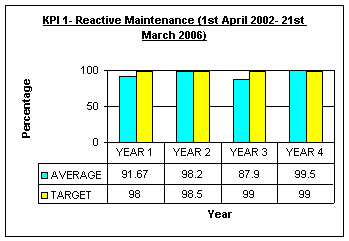
(i) KPI 1.....Reactive maintenance - Low cost repairs. SEC is required to attend any street light that is out within three working days of notification to effect repair. The KPI measures its success in achieving this.
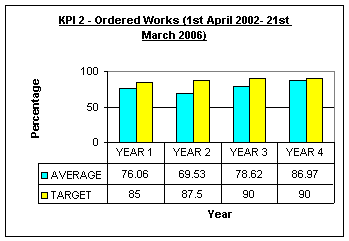
(ii) KPI 2.....Ordered works - High cost works ordered by the County Council. SEC is required to complete these works orders within eight working days for orders that do not require excavation and 20 working days for orders that do require excavation. The KPI measures its success in achieving this.
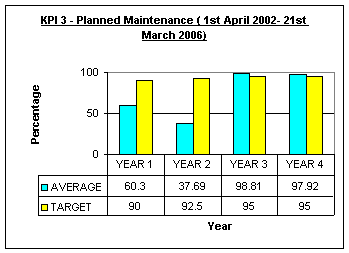
(iii) KPI 3.....Planned maintenance - Routine preventative maintenance includes lamp cleaning, inventory checking, lamp changing and electrical checking and is undertaken every two, four or six years. All lighting units are allocated a planned maintenance round, there are 134 rounds. All rounds have programmed completion dates. The KPI measures SEC's success in completing these rounds by the programmed date.
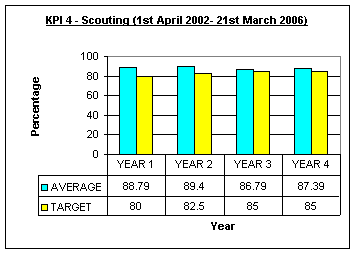
(iv) KPI 4.....Scouting efficiency - Checking contractors' night time scouts. Every lighting unit is checked at night 19 times each year by SEC scouts. County Council staff check 2% of these units on the same night to confirm the scouts accuracy. The KPI measures SEC's success in reporting lights that are out.
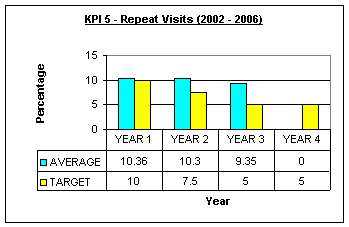
(v) KPI 5.....Repeat visits - Monitoring first time repairs. This KPI measures SEC's ability to repair a lighting unit and not return to it within 35 working days.
3.2 The following table details the performance of SEC over the first four years of the contract:
(i) The performance against KPI 1, with the exception of year three, has been very close to the performance target.
(ii) The performance against KPI 2 has been a problem throughout the first three years but has significantly improved in year four as a result of the new working arrangements.
(iii) The performance against KPI 3 was a problem for the first two years but once SEC had reorganised its working procedures the situation improved dramatically in years three and four with targets being met.
(iv) The performance against KPI 4 has exceeded the targets over the first four years.
(v) The performance against KPI 5 has improved over the three years but not achieved the targets. There are no figures for year four due to the performance report not yet being available in Deadsure. The repeat visits by the Contractor are not paid for; therefore not meeting the targets has involved the Contractor in additional expense not Hampshire County Council.
(vi) All figures in the performance table are in percentages.
|
2002 - 2003 |
Year 1 |
2003 - 2004 |
Year 2 |
2004 - 2005 |
Year 3 |
2005 - 2006 |
Year 4 |
|
TARGET |
ACTUAL |
TARGET |
ACTUAL |
TARGET |
ACTUAL |
TARGET |
ACTUAL |
KPI 1 |
98 |
91.67 |
98.5 |
98.2 |
99 |
87.9 |
99 |
99.50 |
KPI 2 |
85 |
76.06 |
87.5 |
69.53 |
90 |
78.62 |
90 |
86.97 |
KPI 3 |
90 |
60.3 |
92.5 |
37.69 |
95 |
98.81 |
95 |
97.92 |
KPI 4 |
80 |
88.79 |
82.5 |
89.4 |
85 |
86.79 |
85 |
87.39 |
KPI 5 |
<10 |
10.36 |
<7.5 |
10.3 |
<5 |
9.35 |
<5 |
Not available |
3.3 The performance for years one to three was satisfactory albeit that the KPIs 1-3 were generally not achieved. However the situation for year four, following the introduction of the new working arrangements has demonstrated a significant improvement, particularly in KPI 2. It is anticipated that a further improvement will be realised in year five once the software problems in Deadsure have been resolved and with the imminent introduction of on-site data recorders.
3.4 All though the number of "lights out" is not a specific KPI, for the period 1 April 2005 to 31 March 2006 there was an average of 99 lights out each night. For a lighting population of 147,000 this equates to 99.93% lights on at any particular night.
4. Outstanding Contractual Issues
4.1 Over the first three years of the contract there were a number of financial and contractual issues between SEC and the County Council. These have been resolved through agreement with the proper use of re-measurement and operation of the contractual clauses.
4.2 In year four of the contract there have been no further issues. SEC is, however, concerned over the price of materials, in particular steel, and labour which have increased significantly over the past three years. Discussions are currently ongoing as to the likely additional cost to the County Council of SEC undertaking the additional year.
5. Preparation Work Required for a New Contract
5.1 There are several alternative methods available for the letting of a new street lighting contract. At present a Departmental Working Team is looking at the various options should the Private Finance Initiative (PFI) expression of interest not be successful.
5.2 Under normal circumstances it would take approximately one year to prepare a contract document, this being presented to the select tender list companies by the August preceding the start date of the contract. Award of contract would then be made in December.
5.3 As there will need to be a period of debate and consultation regarding the format of any new contract, together with resources required for the investigation of a PFI bid, it is considered unlikely that the Environment Department would be in a position to recommend new contractual arrangements starting before April 2008. This implies a strategic need to extend the existing Contract for at least a further 52 weeks to cover the intervening periods between contracts. Consideration could be given to further extensions of contract when the results of the PFI bid and likely timescales are known.
6. Value for Money Compared to Re-Tendering
6.1 A significant decision to be made by the Employer when considering an extension to the Contract is whether lower prices can be achieved by allowing the contract to end at its natural life span and issuing new tenders. To assist with this decision, an examination of all comparable tender and costs indices can be undertaken together with a view on market conditions.
6.2 The Contract with SEC allows adjustment of rates and prices on an annual basis according to changes in the Retail Price Index (RPI -x). Prices for the first year of the Contract were fixed at tender levels with adjustment being applied thereafter. The attached appendix shows the indices used to calculate changes and the movement of rates and prices applied to date.
6.3 Unlike other elements of the building and construction industry, maintenance of electrical installations such as street lighting is a very specialist market with a limited number of contractors. Almost all street lighting maintenance contracts are bespoke in terms of contractual mechanisms and payment provisions and therefore benchmarked tender price indices do not exist. The only cost data available for comparison of prices is generic cost indices. The most respected and reliable source is Spon's Mechanical and Electrical Services Price Book edited by Davis Langdon Mott Green Wall Engineering Services. The appendix shows the comparative changes in cost indices used for approximate estimating of electrical services. The percentage increase during the currency of the street lighting contract is indicated.
6.4 Although Spon's is a generic index in the overall movement of costs, investigation of individual elements such as specialist electrical labour, plant and road vehicles and electrical materials support and exceed the single index. It is also known through reference against contracts the County Council has with other suppliers that the net price for increases in steel lighting columns has increased significantly due to global shortages.
6.5 The current Contractor (SEC) was selected on a combination of price and quality. The SEC tender was won on extremely competitive prices and the variation of price adjustment is significantly lower than generic cost index data. SEC has won a number of recently tendered street lighting maintenance contracts and it is unlikely that another contractor would be better placed or more competitive than the Contract prices being paid.
7. Changes to Working Practices
7.1 In March 2005 SEC and the County Council launched a new `Collaborative Working' initiative to optimise the performance between both organisations. This necessitated the co-location of County Council street lighting maintenance staff and SEC staff in the same office environment at SEC's main operating depot in Cosham. The advantages of this co-location have been significant with a much improved understanding and working relationship being cultivated between management and operational staff.
7.2 Another major change to the working practices has been the implementation of the Construction Lean Improvement Programme (CLIP) to the maintenance contract. Significant improvements have already been realised and performance is now at or exceeding the required levels as detailed in the specification and measured by the KPIs. It is expected that Continuous Improvement, as part of the CLIP programme, will further improve upon the efficiency with mutual benefits to both SEC and the County Council.
7.3 SEC also now employs its own staff to facilitate underground service connections, which was traditionally done by the Regional Electricity Company (REC) now known as the Distribution Network Operator (DNO). This has enabled SEC to establish Multi-Tasking Teams to change lighting columns in a `one visit' operation, such works now being normally completed in 10 days from the order date as opposed to 20-25 days as prior to the changes to working practices. The benefit to the public of Hampshire is that street lights are now being repaired more quickly and with minimum disruption to residents.
8. Opportunities Missed By Not Awarding An Extension
8.1 If a 52 week extension is not approved then a new contract will need to begin on 1 April 2007. To meet the programme for tendering and mobilisation a new contract document will need to be prepared by August 2006. The short timescale would allow little variance from the existing contractual structure. Although the existing contract is operating successfully the timescale does not allow innovation to be included into the tender documents due to the short drafting period.
8.2 A further year's extension would enable the new working arrangements to fully mature and the advantages and disadvantages could then be fully analysed for inclusion into the next contract, either PFI or conventionally structured.
8.3 The extension allows the County Council to divert resources into innovative procurement strategies and to meet the demands of the PFI process.
9. Impact Assessments
9.1 An impact assessment of the service will be undertaken as part of the PFI or when a new contract is re-let as a standard part of the equalities submission.
10. Conclusions
10.1 There is improved performance under the contract, with CLIP and the `collaborative working' initiative. The current contract prices give value for money compared to re-tendering.
10.2 With the uncertainty of a PFI award it would make sense to extend the contract during this interim period. If the contract was not extended and the PFI bid proved successful then there would be an anticipated two year gap between the expiry date of the current contract and the commencement of the PFI contract. The County Council would then need to tender for a short term contract to cover this period. It is unlikely that this would prove cost-effective due to the front end loading of such a contract to cover a short period. Premises and plant would need to be leased for two years, the normal lease period being five years. There is also the risk that only SEC would be interested in tendering, as it is already established in the county.
10.3 Should the PFI bid not prove successful then the extra year would enable the County Council to fully explore innovative practices for a replacement contract.
Recommendations
1. That a one year extension be granted in principle to the Street Lighting Maintenance Contract.
2. That the Director of Environment, in consultation with the Executive Member for Environment: South Hampshire and Resource Management, concludes negotiations with the contractor on the precise details of the contract terms and conditions for the additional year.
Section 100 D - Local Government Act 1972 - background papers | |
The following documents disclose facts or matters on which this report, or an important part of it, is based and has been relied upon to a material extent in the preparation of this report. | |
NB the list excludes: | |
1. |
Published works. |
2. |
Documents which disclose exempt or confidential information as defined in the Act. |
TITLE |
LOCATION |
None. |
924Rpt/BGM
APPENDIX
Price and Cost indices comparison
Base date |
Retail Price Index (RPI-x) |
Electrical Services Cost index |
December 2001 |
172.5 |
487 |
December 2002 |
177.2 |
513 |
December 2003 |
181.8 |
541 |
December 2004 |
186.4 |
589 |
December 2005 |
190.2 |
618 |
Percentage Increase |
10.3 |
26.9 |