
Archived decisions
Hampshire County Council
Policy and Resources Scrutiny and Select Committee
5 June 2006
Community Safety Service - Review of Service
Report of Director of Property, Business and Regulatory
Contact: Tony Langstone x 6619 [email protected]
1. Summary
1.1 At its meeting on 23 January 2006 members requested a report outlining the impact the Accredited Community Safety Service has had during its first year of operation and feedback on a range of operational matters. Following the meeting a number of specific questions were raised by Members and these are addressed in the report and appendices:
o Appendix 1 Summary of Incidents
o Appendix 2 Satisfaction survey results
o Appendix 3 Yellow Card Scheme
o Appendix 4 Frequently Asked Questions
1.2 Members will recall that the Community Safety Service was established in response to repeated feedback from MORI Residents Surveys and other surveys, that residents had a fear of crime and a desire for more visibility in dealing with anti-social behaviour.
1.3 This report concludes that the service has made a significant and visible contribution to community safety and has dealt with over 10,000 incidents during its first year. The development of the service was a direct response to the strategic objective of making Hampshire a safer place.
2. Background
2.1 The Service commenced during December 2005 with officers established in four teams, covering the following `pilot' areas:
· Basingstoke & Deane Borough Council - 7 officers
· Gosport Borough Council - 9 officers
· Havant Borough Council - 9 officers
· New Forest District Council - 11 officers (includes 2 officers funded by New Forest District Council (NFDC) + New Milton Town Council (NMTC)
All officers have been trained and police accredited.
2.2 The areas were chosen on the basis of information from the police and district councils, including crime audit reports, and the need to have a geographic spread across the county A study of crime and related activities in the latest `Profile of Hampshire' suggests that the four areas were well chosen.
2.3 The officers' workload has steadily increased and over 10,000 incidents, at an average of over 700 per month, have been dealt with. Gosport and Havant are the busiest areas, with a high incidence of nuisance behaviour and alcohol-related issues. Lower numbers of incidents in Basingstoke reflect the smaller team, while the New Forest team deal with a lot of youth nuisance and under-age drinking. Full details of the incidents in each area are contained in Appendix 1.
2.4 A breakdown of the cost of the service during 2005/06 is given in the table below:
Staffing and on costs £'000 |
Non Pay Costs £'000 |
Income * £'000 |
Total £'000 |
1,062 |
341 |
58 |
1,345 |
* includes £50,000 from NFDC | |||
This funding is provided by increased revenue due to reduction of second homes discount.
2.5 The original staff numbers were based on estimated costs and income and it was agreed that the savings in year 1 (due to introducing the service part way through the year) would be rolled over to cover expected higher costs in the subsequent two years. The anticipated income from fixed penalty notices did not materialise as officers have found that the threat of issuing a ticket is usually sufficient to remedy unacceptable behaviour. After testing four shift patterns the final cost of unsocial hours payments was also higher than originally estimated prior to the start of the service. There have also been higher costs due to the need to provide stab proof vests. All this resulted in carrying forward an over spend of £77,000 from 2005/06, which will be offset by an additional £100,000 approved by the Leader in February 2006. However, variations from original projections are inevitable when a new service is introduced.
2.6 The service is managed by the Director of Property, Business and Regulatory Services. The Executive Member for Policy and Resources is the portfolio holder. Team leaders, reporting to the Community Safety Manager, produce daily and monthly reports on the patrols and incidents in their areas. A steering group of stakeholders, including the police and district councils, provide feedback for improvement.
3 Role of the Community Safety Service
3.1 As noted earlier, the service was established to tackle community safety issues, such as anti-social behaviour and nuisance, to reduce the fear of crime, and to deter anti-social behaviour. In practice, the service, through the sharing of intelligence with other agencies, has played a wider community role in supporting partners on such matters as breaches of anti-social behaviour orders (ASBOs) and environmental issues such as noise, litter and highway obstructions. It is important to remember that previously the majority of the 10,000 recorded incidents would not have been dealt with by the Police or other agencies.
3.2 Through the introduction of a `yellow-card scheme', the service is working with young people and their parents to change behaviour and to identify, where necessary, the need for additional specialist support. This scheme is discussed in more detail below.
3.3 The officers are community driven and deal with everyday problems that affect residents' quality of life - matters that the police often regard as low priority such as youth nuisance, mini-motor bike nuisance and under-age drinking. Officers hold surgeries and often act as intermediaries between the public and other agencies. They report breaches of anti-social behaviour orders (ASBOs), or acceptable behaviour contracts (ABCs) and also provide evidence that can initiate such interventions. Intelligence sharing between the ACSOs, the police and other agencies is crucial to making a difference to communities. While the officers have the power to issue fixed penalty notices, generally the threat of such action has been sufficient.
4 Partnership Working
4.1 Indications from the four areas suggest that the ACSOs make a significant contribution in their communities and have integrated their work based on a multi-agency approach to deployment. It varies with each area but generally they work closely with community wardens, anti-social behaviour coordinators and district councils. They frequently operate in partnership with local police beat managers to target local issues and hotspots. All their work is monitored by the Community Safety manager who, in liaison with the ACSO team leader in each area, determines how they are deployed. In the New Forest the team leader chairs a multi-agency tasking group. In Havant the officers work mainly with the police. In Gosport tasking is split between the police and work with the Borough Council. Basingstoke work closely with the police, community wardens and Borough Council. Deployment factors are based on the police National Intelligence Model, which the Government is amending to reflect community issues.
4.2 The teams work closely with other County Council services, including Children's and Adult Service and the Youth Service. The Basingstoke team developed and now deliver a schools package to all the schools in the town, working closely with Head teachers. A good working relationship has been established with the Trading Standards teams, with regular reporting on the underage sales of alcohol and spray paint, and the sale of fireworks. The officers have been involved with the Protecting Older People (POP) team, advising the elderly and vulnerable about the dangers of bogus doorstep callers. They also work closely with Hampshire Fire & Rescue to discuss arson reduction using the Environmental Visual Audits (EVA) method. Officers also patrol to deal with issues of behaviour and security in and around Discovery Centres, schools and childrens' homes. They have also worked with Education Welfare officers regarding truancy and the Youth Offending Team (YOT) regarding problem youngsters. Havant officers are also trained to delivery cycling proficiency courses to enhance the safety of school children.
4.3 Police Community Support Officers (PCSOs)
4.3.1 Hampshire Constabulary have 62 PCSOs (36 were recently recruited as part of a Pathfinder project in Portsmouth).
4.3.2 Currently the Council's officers do not work directly with the Police Community Support Officers (PCSO) as they are deployed in different locations and have a distinctly different role. The ACSOs tend to work with local police officers (beat managers) and sergeants.
4.3.3 PCSOs have the power to detain people for up to 30 minutes, i.e. until a police officer arrives and can also direct traffic in certain situations. It is understood that PCSOs will be deployed after 11:00 pm to deal with anti-social behaviour and could be out on the streets up to 2.00am. PCSOs may be taken off community policing when an incident arises e.g. to secure an area, door to door enquiries and traffic problems etc.
4.3.4 The Home Office has allocated funding to Hampshire Constabulary for a further 513 PCSOs in order to implement the National Neighbourhood Policing Strategy, which requires every neighbourhood to have its own dedicated Neighbourhood team in place by 2008. Hampshire Police Authority has agreed to recruit the additional PCSOs by April 2008, in line with Home Office requirements. Government funding is for 100% in the year of recruitment with 75% continuation funding in subsequent years. Out of the total 539 PCSOs, 219 must be employed between April 2006 and March 2007 and 320 between April 2007 and March 2008. To achieve maximum impact it will be important that the work of the County Council's ACSO's is coordinated with the Police and others whilst recognising the different activities and outcomes that will be achieved.
4.3.5 Neighbourhood policing will be much more than high-visibility reassurance policing. It will also be using local knowledge and intelligence from local people to target crime hotspots and the disorder issues causing most concern to local communities. It will therefore mirror the aims of the County Council's service and the ACSOs will need to work closely with Neighbourhood teams and be seen as an integral part of the strategy in responding to community needs and reducing anti-social behaviour. The police plan to deploy PCSOs throughout the county and each Operational Command Unit will be allocated officers, although the precise model is still to be developed. Regulatory Services are working closely with the police to ensure that resources are deployed to the best effect and in a county the size of Hampshire there is little prospect of duplication of effort.
4.4 Community Wardens
4.4.1 The role of Community Wardens is to help regenerate areas and build links with the community in order to encourage local participation. They are provided by District Councils and the service is aimed at developing youth facilities and providing sports and holiday events, for example. They have no enforcement powers and generally do not work at weekends during the winter. Community warden schemes are mainly set up in deprived areas and assist with combating poor parenting. They also help to improve the local environment by arranging litter sweeps and arranging for overgrown hedges to be cut.
5 Measuring and evaluating the impact of ACSOs
5.1 A key measure of success is public perception of the difference made by the service. A survey of service users in the four areas shows high satisfaction levels together with very positive views on the impact the service has had in improving feelings of community safety. The key findings from the survey are shown below:
· 62% felt it was a lot better/safer place to live
· 23% a little better/safer
· 79% were fairly or very satisfied with the service
The full survey results are provided in appendix 2.
5.2 The high number of incidents dealt with is another key measure of the impact the service has had in dealing with the following issues:
· youth nuisance and related anti-social behaviour eg under-age drinking
· vandalism
· graffiti
· untaxed vehicles
· cycling on footpaths in Gosport and Havant
· fly-tipping
· abandoned cars
5.3 In many cases the service has helped to bring partner agencies together for the first time and the development of positive relationships with the Police, Fire and Rescue, District Councils and others is a significant measure of success. This is mirrored by the good relations built between officers and the local community. The officers' high visibility presence provides a positive representation of the County Council and emphasises the importance which the County attaches to community safety.
5.4 As the service has only been operating for a year there is insufficient data to demonstrate trends and since the service is either acting as a deterrent or dealing with previously unrecorded crimes, there is little base data. However, Lymington & Pennington Town Council reported `an appreciable fall in incidents of vandalism due in no small way to the regular calls made by the officers' and there is anecdotal evidence from all four areas that crime has reduced. The new Crime and Disorder Data Information Exchange (CADDIE) database, which is being hosted by Regulatory Services, will help to fill this gap in data once it is operational.
5.5 Summary of key outcomes
Generally, the increase in resources being directed at community safety from the different agencies and authorities must be seen as a positive move to meet community perceptions of poor behaviour and the need for improved safety. The real trick in the development and deployment of these resources will be to maximise their impact for the benefit of the community. The different focus which each service has also allows different sets of priorities to be tackled. The ACSO service is also able to be deployed as the County Council sees fit, both in terms of geography and incidents. Having democratic control of such a service provides significant flexibility that other agencies will not have towards County Council objectives.
The following are practical examples of the impact the service has had:
· The introduction of an innovative `Yellow Card' scheme mainly aimed at deterring anti-social behaviour by teenagers. Over 340 cards have now been issued, mainly to 14 to 16 year olds.
· Attended court as witnesses on numerous occasions to provide evidence of breaches of ASBOs.
· An Education Resource has been introduced for primary schools linked to Citizenship curriculum and respect for people and the environment. This is linked to an anti-litter award for young school children that teaches them to dispose of packaging considerately.
· Reporting over 1,800 untaxed vehicles to the DVLA, worth an estimated £250,000 in annual duty revenue.
· Intervention in over 700 incidents involving the under-age consumption of alcohol.
· Officers take time to engage youngsters to find out what they need to get them off the streets. They are working with the community and local businesses to provide a Drop-in centre for young people in Basingstoke and Waterlooville.
· Initiated arrest of drug dealer in New Milton.
· Identified the assailant of a local retailer leading to his arrest - and the release of another individual mistakenly arrested for the offence.
· Identified two suspects who had carried out a robbery on a male youth at an ID parade.
· Commendation from police for helping to trace an elderly man who went missing from an elderly persons home.
· Played a major part in eradicating almost nightly anti-social behaviour at Forest End, Havant.
· Issued 98 fixed penalty notices (fpns)
· Submitted juvenile nuisance reports on 135 individuals to Hampshire Constabulary for incidents ranging from anti-social behaviour to breaches of ASBOs or ABCs. CCTV on the vans has provided back-up evidence and greatly helps in deterring offending behaviour.
· Dealt with 268 community safety enquiries from the public and businesses at HQ.
· Monitored Purbrook, which has one of the largest dispersal areas in the country, to provide intelligence to the police.
· Taken part in all Crime Reduction and Environment Weeks (CREW) in their areas. This is a multi-agency initiative designed to focus on specific localities to reduce all levels of crime.
· Helped to run SAFE discos for young people, thus releasing police time for more serious matters.
5.6 Yellow Card Scheme
5.6.1 The Yellow Card scheme is designed to tackle low level crime and anti-social behaviour amongst primarily 14-18 year olds although a yellow card may be issued, as a warning, to over 18's. A yellow card is issued to an individual who, in the officer's opinion, is acting in an unacceptable manner and, in the case of under 18s, should be brought to the attention of the individual's parents or guardians.
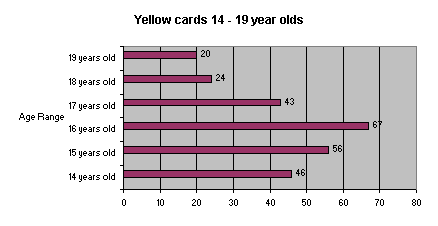
5.6.2 Figure 1 shows the number of yellow cards issued to 14 to 19 year olds. Out of 348, 256 yellow cards have been issued to this age group. Further information is contained in appendix 3.
6 Service Development
6.1 There is already considerable demand across the county and officers have worked in various hotspots outside the pilot areas on a short term basis. The new Single Non Emergency Number (SNEN) 101 is already resulting in a significant increase in enquiries, even before it is officially launched. It has always been the intention to eventually provide the service to all residents in Hampshire, and with the additional £300,000 approved by the County Council this is now a possibility It is therefore proposed to widen the geographical scope of the current four teams and introduce an additional (mobile) team to cover central parts of Hampshire.
6.2 A central mobile team of eight officers will be based in Winchester which will assist the other four areas when extra resources are needed. The deployment of the mobile team will be based on bids from the Community Safety Partnerships and District Councils, reacting to information from Members and the public, and in liaison with the police. From the MORI survey conducted in 2005 Eastleigh would appear to be a key area as it is the district where the fear of crime appears to be highest. A central team based in Winchester, would be in close proximity with good transport links to the south and central parts of the county.
6.3 The four pilot areas will be expanded into Tactical Areas Of Responsibility (TAOR) i.e. wider geographical areas. These will link with the new police Operational Command Units. The established bases with IT links, car parking arrangements etc would remain and act as a tactical headquarters for the TAOR. Therefore, there will be five TAOR's across Hampshire:
o TAOR 1 will incorporate Basingstoke & Deane, Hart, Rushmoor, Andover, and surrounding area.
o TAOR 2 will incorporate Gosport, Fareham, Portchester, parts of south Eastleigh Borough and Winchester City Council i.e Whiteley area.
o TAOR 3 will incorporate Havant, East Hampshire, including Petersfield, and surrounding areas.
o TAOR 4 will incorporate the New Forest and parts of southern Test Valley including Romsey.
o TAOR 5 will incorporate the main towns of Winchester, Alton, Alresford, and Eastleigh.
6.4 Recruitment of 8 new officers will begin in June with advertising, and assessment centres held in late July followed by shortlisting and interviews. Allowing for CRB checks the new officers should be in post by late September. Officers will be appointed as Probationers to allow for training and accreditation to fully competent officers within 6 months. Consideration is also being given to the concept of "Apprentice Officers" from 16 to 19 year olds.
6.5 As stated above, additional powers are available under the Police Reform Act 2002, to issue Penalty Notices for Disorder (PNDs) for behaviour likely to cause harassment, alarm or distress. Permission to speak to the Chief Constable was agreed by Cabinet in July 2005 and while agreement was reached on extending the powers to cover throwing of fireworks in the street progress on the above has been slow. PNDs for drinking in a designated public place may be another issue to consider in the future.
7 Further Service Development - Ambulance Service
7.1 Hampshire Ambulance Service (HAS) is keen for the ACSOs to be equipped with automatic defibrillators (AEDs), which normally cost £1,600 each but HAS will supply free of charge. The aim is for the ACSOs to respond to anyone with a cardiac arrest if they can get there sooner than the ambulance service. Time is crucial after a cardiac arrest and each minute the AED shock is delayed reduces the survival chance by 10%. Managers have been discussing this with the Ambulance Service for sometime but the cost of equipping vans with tracking devices has been too expensive. It was also felt that this new role could distract ACSOs from their core work. However, the HAS now believe that the tracking device may not be necessary.
7.2 Further clarification is being sought from HAS on the level of incidents and the potential impact on the ACSO workload. Discussions are currently ongoing between the County Council's Legal Service and the HAS on a range of issues associated with liabilities etc. It will be important to address any concerns and protect the County Council's position and individual ACSO's position before any agreement to introduce these services is agreed.
8 Conclusions
8.1 This review, by its nature, will only give interim results given the short time the service has had to develop. In drawing conclusions and scrutinising the ACSOs a number of significant points can be made so far:
(a) The service has already had an extensive and beneficial impact on various communities and behaviour in Hampshire.
(b) The service has provided the County Council with a direct means of influencing the community's perception of making Hampshire a safer place to live and work.
(c) The service has worked well with other agencies involved in crime and community safety.
(d) The service is in demand from Members, community groups and others and has demonstrated that it is responsive to local circumstances arising across the County Council.
8.2 The issues for the service in the future will be to:
(a) Ensure it develops in an effective manner, integrates with other agencies whilst remaining focused on County Council priorities, objectives and policies.
(b) Deploy incrementally beyond the pilot areas as further recruitment takes place.
(c)Develop a performance framework that allows an evidence based appraisal of its impact to be made over time.
8.3 A report on the operational deployment of the ACSOs and the proposal for the development of the team is planned for the Executive Member for Policy and Resources meeting in July.
Recommendations
1. That Committee note the progress made by the service and the partnership and support of other agencies in the field.
Section 100D - Local Government Act 1972 - Background Papers:
The following documents disclose facts or matters on which this report, or an important part of it, is based and has been relied upon to a material extent in the preparation of this report.
NB the list excludes:
1. Published works.
2. Documents which disclose exempt or confidential information as defined in the Act.
File Location
None.
P&RSSC0406A
Appendix 3
Yellow Card Scheme
The Yellow Card Policy is in line with the enforcement policy for the Community Safety Service. It is designed to tackle low level crime and anti-social behaviour for the age range 14 -18, although a yellow card can be issued as warning to 18 and above.
A yellow card is issued to an individual who, in the officer's opinion, is acting in an unacceptable manner and, in the case of under 18s, should be brought to the attention of the individual's parents or guardians. The main types of anti-social behaviour appropriate for a yellow card are :
· Using obscene or foul language in the street
· Alcohol, tobacco, drug, or solvent misuse
· Throwing litter
· Riding a bicycle on a footway
· Using threatening, abusive, insulting words or behaviour
· Engaging in threatening or intimidating behaviour in large groups
When officers issue a yellow card they must clearly tell the individual the reason and write this on the warning section of the card. The card is given to the individual at the time and a copy is sent the Winchester HQ where the details are entered onto a database. In the case of under 18s a letter is sent to the person's parents informing them what has happened and acting as a first warning.
Individuals remain on the database for six months and are then removed if there are no further yellow cards issued. Anyone receiving a second yellow card within six months will receive a further letter, which explains that other agencies will be contacted to offer support and mentoring. For example a young person who is constantly underage drinking may be referred to the Drugs, Alcohol Action Team. All second letters are copied to the Youth Offending Team and the local police station. This letter also highlights to parents that any further unacceptable behaviour is likely to lead to an FPN being issued.
If a third Yellow card is issued, this will be followed by an FPN being sent to the parents of the young person. The issue of the FPN will be recorded on the Enforcer database, which is the management system for all FPN's issued. The FPN is required to be paid within 28 days and failure to do so may result in a prosecution.
Appendix 4
Frequently Asked Questions
Q What terms and conditions are the ACSOs employed on?
A The officers are employed on Employment in Hampshire County Council (EHCC) terms and conditions and work 37 hours a week on average. The jobs were role profiled and evaluated using the County Council's job evaluation scheme which gave rise to the following grades:
ACSO Scale 6 Total upto £24,200
Consideration is also being to Apprentice, Probationary, and Trainee ACSOs which would be recruited at lower rates.
Q What is the current shift pattern and how is the unsocial hours allowance calculated?
A The current shift pattern is shown below and payment for unsocial hours is in accordance with EHCC ie time and a third for hours after 10pm during the week and time and a half for work on Saturdays and Sundays.
Monday |
Tuesday |
Wednesday |
Thursday |
Friday |
Saturday |
Sunday |
Rest Day (RD) |
RD |
0830-2000 |
0830-2000 |
1130-2300 |
RD |
RD |
1130-2300 |
1130-2300 |
RD |
RD |
RD |
1100-2300 |
1130-2300 |
This shift pattern was adopted following guidance from the police and partners, and after trialling four different shift patterns. However, it has been reviewed and a revised six week shift pattern is being introduced to increase Friday and Saturday coverage during the summer and to make it less predictable. The new shift pattern will be introduced at the beginning of July 2006.
Given New Forest District Council's recent agreement to fund a further two officers it is anticipated that there will be sufficient staff numbers in the New Forest by the autumn to introduce a split shift system, which will provide 7 day a week coverage. The long term aim is to have this shift pattern across the whole service once the teams are large enough to split into two.
Q Where are the officers currently based?
A. The officers are based at the following locations, which are within the areas of duty to minimise travel time. Accommodation is provided free of charge at Basingstoke and Gosport (the latter by the Borough Council) and a nominal rent is paid for The Grove in Hythe and to Staunton Park school. The Fire and Rescue Service also provide accommodation at no cost in New Milton.
Basingstoke John Hunt of Everest Community School
Popley Way
Basingstoke
Gosport The Depot
Wilmot Lane
Gosport
Havant Staunton Park Community School
Wakefords Way
Havant
New Forest Hythe & Dibden Parish Council
The Grove
25 St John's Street
Hythe
Fire Station
New Milton
Q What powers do the ACSOs have?
A Powers granted to Accredited Community Safety Officers are:
· Power to issue a fixed penalty notice (FPN) for the following offences:
· Power to stop cycling on footpaths and issue of FPN.
· Power to request name and address for FPN offences and offences that cause injury, alarm and distress to another person or damage or loss of another's property
Note: discussions are underway with the police for ACSOs to issue FPNs for causing injury, alarm and distress under the Public Order Act.
· Power to request the name and address of a person acting in an anti-social manner
· Power to confiscate alcohol from young people or being consumed in a certain public place
· Power to confiscate cigarettes and tobacco from young people
· Power to require the removal of abandoned vehicles
· Power to issue FPN in respect of failure to secure regular attendance at school of a registered pupil*
* Officers to be authorised but no action taken except in liaison with County Council Education Welfare Officers
Q How many fixed penalty notices have been issued
A 98.
Q What factors are used in determining where ACSOs are deployed.
A The Team Leader liaises with local partner agencies e.g the police; District Council officers; Anti-social Behaviour Officers; Environmental Health Officers; and Community Warden Managers and will also respond to complaints direct from Members, community groups and the public. After consulting the Community Safety Manager the team leader will allocate the resources and the time period that the team will operate in that area. The team is deployed as a complete team or an agreed number depending on the task.
Q Where do the Police Community Support Officers operate?
A The police have 62 Police Community Support Officers (PCSOs).
They are operating in Hampshire as follows:
· Portsmouth 42 (36 as part of Pathfinder Project)
· Southampton 6
· Havant 4 - Leigh Park
· Winchester 4 - 1 Fourmarks
1 Kingsworthy & Colden Common
1 Liss
1 Liphook
· Rushmoor 4 - 1 Aldershot
1 Farnborough
1 Fleet Services
1 Yateley
· Basingstoke 2 - Town Centre
Q How many PCSOs are Hampshire Constabulary recruiting?
A The Police Authority have approved plans to recruit a total of 539 PCSOs by April 2008.
Q What are the pay scales of PCSOs and Community Wardens
A New PCSOs are paid upto £21,000. It should be noted that they are on employed on different terms and conditions to ACSOs, with different pension and retirement rights. Their job is distinct from those of ACSOs. Comparison on pay between the different agencies is difficult given the different shift , allowances, tasks, career paths, pension rights and conditions of service
Community Wardens in Basingstoke are paid upto £24,708, and Senior Wardens upto £28,221.
ACSOs are unique as they provide a dual role, combining the key community aspects of the Community Warden together with many of the enforcement powers of a PCSO.
The table below outlines the roles of each type of officer and demonstrates how the ACSO work merges across the boundaries. In the case of PCSOs it should be noted that their role involves a strong element of support for front-line police work, taking them away from general community work and patrols.
What sort of thing do Community Wardens do? |
What sort of things do ACSOs do? |
What sort of things do PCSOs do? |
· community well being, safety and regeneration mainly working on estates · engage with the community on environmental issues and cleaner neighbourhoods · provide information to anti-social co-ordinators and the police · engage with young people and provide holiday play schemes; non-alcoholic snack bar · promote local community events e.g. carnivals · organise community litter sweeps · report fly-tipping etc |
· go on highly visible, uniformed foot patrols · provide low-level crime prevention · take enforcement action in appropriate circumstances for low level environmental crime · seize alcohol and cigarettes · provide information on under-age sales to Trading Standards · work with Children and Adult Services and the Youth Service from under-age young people · engage with the community, youth and local schools · work with the community and local business to provide alternative diversions for young people · liaise and work with Community Beat Officers and Community Action · provide intelligence to local anti-social behaviour co-ordinators · act as a professional witness in court · recommend ASBOs or ABCs against repeat offenders · collect CCTV evidence · support the police in missing person enquiries Teams in local problem-solving initiatives; · offer public reassurance following minor crimes or anti-social behaviour; · engage with key stakeholders in the community, such as community, religious and business leaders; · liaise with local Community Safety groups e.g. Horse Watch, Neighbourhood Watch · take part in Crime Reduction & Environment Weeks (CREW) · raise the profile of the County Council by taking part in local Community Events. · prevent fire setting via Environmental Visual Audits |
· go on highly visible, uniformed foot patrols; · support Community Beat Officers and Community Action Teams in local problem-solving initiatives; · make house visits to gather intelligence and offer public reassurance following minor crimes or anti-social behaviour; · engage with key stakeholders in the community, such as community, religious and business leaders; · liaise with Community Watch schemes e.g. Business Watch, Horse Watch, Neighbourhood · preserve crime scenes; · collect CCTV evidence; · provide low-level crime prevention and personal safety advice; · undertake low-level missing person enquiries in line with their role of increasing visible policing; · act as professional witnesses, attending court when needed; · undertake environmental audits to support crime prevention; · engage with youths; · interact with schools; · support the Mobile Police Station; · support Crime and Disorder Reduction Partnerships.
|
Q What does Neighbourhood Policing actually mean?
A The following is an extract from the draft ACPO `Practical Advice on
Professionalising the Business of Neighbourhood Policing 2005'.
Neighbourhood policing has been described as delivering control in response to public priorities.
This requires an organised approach to tackling public concerns within the mainstream of police activity, while maintaining the consistent standards of responsiveness and quality of service. This means that a commitment to neighbourhood policing requires consideration of structures and evidenced based deployment of resources and tactics.
Neighbourhood policing is, in particular, concerned with maximising the opportunities for police support staff, collaborative partnerships and public support in order to increase the collective influence for resolving public concerns.
Neighbourhood policing aims to achieve:
The Right People, at the Right Places, in the Right Numbers, in order to
create neighbourhoods that are safe and feel safe.
For successful implementation and sustainable operations there are three guiding themes:
1) Dedicated and accountable resources with geographic ownership;
2) Intelligence led targeting of the issues that matter most to the public;
3) Joint action by the police, partner agencies and the public.
Q What are the Performance Indicators for PCSOs?
A From the Home Office Study the following factors were considered.
o Percentage of total time spent on attending incidents and on patrol
o and community engagement by CSOs
o The number of incidents attended
o Salaries of CSOs and police constables
o Ethnicity and gender of CSOs and police officers
o The percentage of CSOs using the certain powers
o at least once a week
o Comparison of the number of recorded crimes of criminal damage
o for an experimental and control area in Merseyside
o Comparison of the number of reported incidents relating to misuse
o of public space for an experimental and control area
o in Northumbria