
Archived decisions
Annexe 1
Individual Representations
Policy CC1: Sustainable Development
Support or Object. |
Object |
Policy Number; |
CC1 |
Paragraph Number; |
|
Chapter Number. |
D1 |
Policy CC1: Sustainable Development
The principal objective of the Plan shall be to achieve and to maintain sustainable development in the region. The strategy and policies of the Plan promote measures that contribute to:
i Achieving a sustainable economy
ii Promoting good governance
iii Using sound science responsibly
iv Living within environmental limits
v Ensuring a strong, healthy and just society.
All public authorities shall ensure that their actions contribute to meeting the objectives set out in the Integrated Regional Framework (IRF).
Representation
Hampshire County Council believes that the overall level of housebuilding proposed in the SE Plan is at the maximum that could be accepted by the public in terms of the impact on quality of life. This is in large part due to concerns over the likelihood of adequate and timely provision of infrastructure and services to support the new development. A primary research exercise carried out in February 2005 by ICM Research on behalf of the South East Counties showed that there were widespread concerns about the amount of housing proposed and the infrastructure required to support it.
Half of Hampshire residents sampled believed that recent developments had a negative effect on the local community, and a significant number felt there should be a lower rate of new housing provision than in the last 5 years. More residents are likely to support increases in the rate of housebuilding if infrastructure provision is guaranteed but there are still a third who would prefer a lower rate even with this guarantee.
The County Council therefore considers that the first, and subsequent reviews of the RSS should explicitly commit to reviewing the level of housing proposed, based on an assessment of the delivery of infrastructure and establishment of services, against the implementation plan requirements, and in accordance with Policy CC5 in the preceding period.
Change to Policy
Add to end of Policy CC1:
"In reviewing the Regional Spatial Strategy, the Regional Planning Body will satisfy itself as to whether the level of development proposed meets these objectives".
Policy CC5: Infrastructure And Implementation
Support or Object. |
Object |
Policy Number; |
CC5 |
Paragraph Number; |
|
Chapter Number. |
D1 |
Policy CC5: Infrastructure And Implementation
The scale and pace of development will be dependent on there being sufficient capacity in existing infrastructure to meet the area's current needs and the provision of new infrastructure to meet the needs of new development. The funding for this infrastructure will require substantial contributions from central Government. In addition, partnerships between central Government, local government and the private sector have the capacity to lever in additional funding. To help achieve this:
i The Assembly expects all the relevant infrastructure agencies and providers to align their investment programmes to help deliver the proposals in the Plan
ii Local Development Documents should identify the necessary additional
infrastructure and services required to serve the area and the development
they propose together with the means, broad cast and timing of their provision related to the timing of development
iii Development shall not proceed until the relevant planning authorities are
satisfied that the necessary infrastructure required to serve the development is available or will be provided in time
iv Contributions from development will also be required to help deliver the
necessary infrastructure. To provide clarity for landowners and prospective
developers, local authorities should include policies and prepare clear
guidance in their Local Development Documents, in conjunction with other
key agencies, on the role of development contributions towards infrastructure.
The Assembly therefore proposes to Government the need for a package of initiatives designed to improve infrastructure delivery and create greater confidence and assurance. This package is underpinned by a proposed Concordat between Government and the Assembly.
In order to further secure effective delivery of the Plan, and particularly the timely delivery of the necessary supporting infrastructure, an Implementation Plan will be prepared, monitored and reviewed, which will set out the requirements and obligations for public and private sector bodies at the
national, regional and local levels. The Implementation Plan will include a regional and sub-regional investment framework identifying the strategic infrastructure schemes needed to deliver the Plan.
Representation
Hampshire County Council supports the thrust of Policy CC5 and in particular the proposal that the scale and pace of development must be conditional on infrastructure guarantees.
Research carried out for the South East Counties in February 2005 showed that more than half of Hampshire residents were not confident that infrastructure improvement will occur.
Where infrastructure provision keeps pace with development, public attitudes to increases in housebuilding become more positive.
Residents are fearful that their quality of life in respect of access to services and facilities will diminish unless infrastructure is provided in step with development.
Changes to Policy
Replace the words "broad cast" with "broad cost" in paragraph three of the policy
Replace paragraph six of the policy with the following text:-
"The Assembly therefore proposes to Government the need for a package of initiatives designed to improve infrastructure delivery and create greater confidence and assurance. This package should be underpinned by a contract between Government and the Assembly".
Representation
Hampshire County Council urges the Panel to recognise that for new development to take place in a sustainable way a full range of facilities will be required. Where the term `infrastructure' is used it should be taken to mean the whole range of provision including green space of all kinds (playing fields, landscaping, amenity open space, nature reserves and so on), community facilities, health care and waste management. The Panel is requested to acknowledge that all infrastructure is critical, not simply `hard' infrastructure such as transport schemes and utilities.
Change to Policy
The scale and pace of development will be dependent on there being sufficient capacity in existing infrastructure to meet the area's current needs and the provision of new infrastructure to meet the needs of new development In this context infrastructure means the whole range of facilities required for sustainable development including: green space of all kinds; community facilities; health care; waste management facilities, schools, health and social care facilities, as well as roads, transport and waste water treatment facilities.
Representation
Hampshire County Council supports the ongoing development of the Implementation Plan. The County Council is continuing to work with infrastructure providers to refine information on future needs and funding requirements and requests that the Implementation Plan be updated when this information becomes available.
Change to Policy
Insert additional paragraph at end of Policy CC5:
The Regional Planning Body will produce an annual `position statement' setting out progress on the requirements and obligations which will be used by Local Planning Authorities to determine whether development should proceed. "In reviewing the Regional Spatial Strategy, the Regional Planning Body will satisfy itself as to whether the level of development proposed meets the objectives of this policy".
Representation
Hampshire County Council wishes to see Infrastructure Funds set up and managed by existing arrangements. Management by local authorities at below Regional level has the advantage of the ability to react with greater sensitivity to adjustments needed to funding and to make the processes more accountable.
Change to Policy
Add the following text to the policy:-
"Infrastructure Funds to be set up below Regional level are a critical element of the package and are specifically designed to address the issue of timing of infrastructure delivery. They are not an additional source of funding but the practical application of the `ringmaster' approach."
The Funds would provide substantial upfront capital investment for necessary development-related infrastructure. The cost of the investment would then be recovered through contributions collected through the planning system.
Policy CC12: Character of the Environment and Quality of Life
Support or Object. |
Object |
Policy Number; |
CC12 |
Paragraph Number; |
|
Chapter Number. |
D1 |
Policy CC12: Character of the Environment and Quality of Life
Actions and decisions associated with development and the use of land should actively encourage the conservation, and where appropriate the enhancement of the character, distinctiveness, and sense of place of settlements and landscapes throughout the region. Opportunities for creating a high quality environment should be sought, based on a shared vision that places emphasis on good design, innovation, sustainability and achieving a high quality of life.
Representation
Hampshire County Council welcomes the inclusion of Policy CC12: Character of the Environment and Quality of Life, but considers that it could be strengthened with the suggested amendment. This will ensure implementation of the policy, whilst requiring all local authorities to review their assessments to reflect current guidelines and best practice working, and ensuring that a consistent approach is taken across the region.
Change to Policy
Add an additional section (shown underlined below) to Policy CC12 of the draft South East Plan:
"Actions and decisions associated with development and the use of land should actively encourage the conservation, and where appropriate the enhancement of the character, distinctiveness, and sense of place of settlements and landscapes throughout the region. Opportunities for creating a high quality environment should be sought, based on a shared vision that places emphasis on good design, innovation, sustainability and achieving a high quality of life. Local Authorities shall ensure that landscape and townscape character assessments are undertaken and reviewed in accordance with best practice, in order to underpin decisions on land use planning."
Policy H4: Affordable Housing
Support or Object. |
Object |
Policy Number; |
H4 |
Paragraph Number; |
|
Chapter Number. |
D3 |
Policy H4: Affordable Housing
Local Development Documents will contain policies to deliver a substantial increase in the amount of affordable housing in the region, reflecting both this Plan and the Regional Housing Strategy. Local Development Documents will set targets for the provision of affordable housing, taking account of the results of housing need and market assessments and having regard to the overall regional target that 25% of all new housing should be social rented accommodation and 10% other forms of affordable housing. Where justified by housing need assessments, Local Development Documents should specify the tenure of housing being sought. There will be a presumption in favour of on-site affordable housing provision.
To help ensure the delivery of affordable housing, Local Development Documents will provide comprehensive policy and guidance on financial viability and the role of public subsidy in the light of guidance from the Regional Assembly and the Regional Housing Board.
In rural areas, Local Development Documents will promote small scale affordable housing sites within or well-related to settlements, possibly including land which would not otherwise be released for development.
Representation
Hampshire County Council believes the plan must recognise that the provision of affordable housing is no simple matter. The recent DCLG report "valuing planning obligations" has revealed that two-thirds of all homes are built without any affordable housing contribution at all, and that obligations vary considerably, even between similar sites and similar authorities. Achieving the target of 35% of all new housing being affordable will therefore require two things: a different combination of affordable housing targets and thresholds in each authority; and a more rigorous approach in general, to reflect how the system works in practice.
The only way to successfully implement the policy will be to set out sound advice for local authorities in a rigorous guidance document that carefully considers the barriers that prevent the planning system from delivering as much affordable housing as it ought to. The document must provide rigorous evidence on targets, thresholds, and threshold-mechanisms such as sliding scales or site-capacity systems.
Change to Policy
Amend Policy H4 (shown underlined below) of the draft South East Plan:
"Local Development Documents will contain policies to deliver a substantial increase in the amount of affordable housing in the region, reflecting both this Plan and the Regional Housing Strategy. Local Development Documents will set targets for the provision of affordable housing, taking account of the results of housing need and market assessments and having regard to the overall regional target that 25% of all new housing should be social rented accommodation and 10% other forms of affordable housing. The policies necessary in Local Development Documents to achieve this will be set out in a subsequent guidance document."
Policy H5: Housing Density and Design
Support or Object. |
Object |
Policy Numbers; |
H5 |
Paragraph Number; |
|
Chapter Number. |
Section D3 |
Policy H5: Housing Density and Design
In conjunction with the delivery of high quality design and in order to make good use of available land and encourage more sustainable patterns of development and services, higher housing densities will be encouraged, with an overall regional target of 40 dwellings per hectare over the Plan period. Local authorities will reflect this target with appropriate local variations in their Local Development Documents. Positive measures to raise the quality of new housing, reduce its environmental impact and facilitate future adaptation to meet changes in accommodation needs will also be encouraged. Local authorities will prepare guidelines for the design of new housing in their areas that encourage the use of sustainable construction methods and address the implications of changing lifestyles for new housing design.
Representation
Housing Density and Design sets the basis for development densities in line with Government Guidance, and also provides the basis for increased densities where appropriate at local levels to make the most efficient use of land. Hampshire County Council supports and promotes the benefits of good quality design. As such the County Council supports Policy H5: Housing Density and Design, which aims to raise the quality of new housing across the region, but believes that the Policy should be amended to make it clear that higher densities will not always be appropriate. Local planning authorities are best placed to determine particular local circumstances, which should be identified and tested through their Local Development Documents.
Change to Policy
In conjunction with the delivery of high quality design and in order to make good use of available land and encourage more sustainable patterns of development and services, higher housing densities will only be encouraged in appropriate locations. Local authorities will reflect this with appropriate local variations in their Local Development Documents. Positive measures to raise the quality of new housing, reduce its environmental impact and facilitate future adaptation to meet changes in accommodation needs will also be encouraged. Local authorities will prepare guidelines for the design of new housing in their areas that encourage the use of sustainable construction methods and address the implications of changing lifestyles for new housing design.
Policy NRM1: Sustainable Water Resources, Groundwater And River Water Quality Management and Policy EN1: Development Design For Energy Efficiency And Renewable Energy
Support or Object. |
Object |
Policy Number; |
NRM1, EN1, |
Paragraph Number; |
|
Chapter Number. |
D5 |
Policy NRM1: Sustainable Water Resources, Groundwater And River Water Quality Management
Water supply, ground water and river water quality will be maintained and enhanced through avoiding adverse effects of development on the water environment. A twin-track approach of demand management and water resource development will be pursued, together with development of sewerage and waste water treatment infrastructure.
In preparing Local Development Documents, and determining planning applications, local authorities should:
i Ensure compatibility with River Basin Management Plans and take account of other plans and strategies including water and sewerage company asset management plans, the Environment Agency's Regional Water Resources Strategy, Catchment Abstraction Management Strategies, groundwater vulnerability maps and groundwater source protection zone maps
ii Ensure that the rate and location of development does not lead to unacceptable deterioration of water quality and is in step with current and planned provision of adequate water supply, sewerage and waste water treatment infrastructure capacity
iii Require development that would use significant quantities of water to incorporate measures to achieve high levels of water efficiency, and reflect current best practice including BREEAM2 "very good" and increasingly "excellent" standards and, where appropriate, sustainable drainage solutions where these are consistent with protection of groundwater quality
iv Work with water and sewerage companies and the Environment Agency to identify infrastructure needs, allocate areas and safeguard these for infrastructure development
v Encourage winter water storage reservoirs and other sustainable farming practices which reduce summer abstraction, diffuse pollution and runoff, increase flood storage capacity and benefit wildlife and recreation
vi Not permit development that presents a risk of pollution or where satisfactory pollution prevention measures are not provided in areas of high groundwater vulnerability (in consultation with the Environment Agency)
Policy NRM3: Sustainable Flood Risk Management
Support or Object. |
Object |
Policy Number; |
NRM3 |
Paragraph Number; |
|
Chapter Number. |
D5 |
Policy NRM3: Sustainable Flood Risk Management
The sequential approach to development in flood risk areas set out in PPG25 (to be superseded by PPS25) will be followed. Inappropriate development should not be allocated or permitted in zones 2 and 3 of the floodplain or areas with a history of groundwater flooding, or where it would increase flood risk elsewhere, unless there is over-riding need and absence of suitable alternatives.
Representation
Whilst Hampshire County Council accepts that there may, in exceptional circumstances, be justification to allow development in areas at risk from flooding (conditional on meeting the criteria set in the Exception Test of PPS25), the Council does not feel that it is appropriate to make `allowing exceptions' part of a policy in the Plan particularly, bearing in mind the significance of areas prone to groundwater flooding in Hampshire. The question of exceptions should arise when a particular application is being considered and treated as a departure from the plan if necessary.
Change to Policy
Delete the last sentence from the policy:
Policy NRM3: Sustainable Flood Risk Management
The sequential approach to development in flood risk areas set out in PPG25 (to be superseded by PPS25) will be followed. Inappropriate development should not be allocated or permitted in zones 2 and 3 of the floodplain or areas with a history of groundwater flooding, or where it would increase flood risk elsewhere. unless there is over riding need and absence of suitable alternatives.
Policy EN1: Development Design For Energy Efficiency And Renewable Energy
Local Development Documents should encourage the incorporation of high standards of energy efficiency in all development, subject to economic viability considerations. This will be achieved through design, layout and orientation. Local authorities should use design briefs and/or Supplementary Planning Documents to promote development design for energy efficiency and renewable energy.
Local authorities should also encourage the use of energy efficient materials and technologies, by using all the tools at their disposal.
A proactive approach towards the implementation of this policy may involve:
i Encouraging developers to submit an assessment of a development's energy demand and provide at least 10% of the development's energy demand from renewable sources for housing schemes of over 10 dwellings and commercial schemes of over 1,000m2.
ii Attainment of high energy efficiency ratings in all new development, where appropriate, through the use of best practice guidance such as the Building Research Establishment Environmental Assessment Method (BREEAM) and the National Home Energy Rating (NHER).
iii Incorporation of renewable energy sources including, in particular, passive solar design, solar water heating, photovoltaics, ground source heat pumps and in larger scale development, wind and biomass generated energy.
iv Active promotion of energy efficiency and use of renewable energy sources where opportunities arise by virtue of the scale of new development, including the regional Growth Areas.
Local authorities and other public bodies, as property owners and managers, should seek to achieve high levels of energy efficiency when refurbishing their existing stock.
Policy W3: Regional Self-Sufficiency
Support or Object. |
Object |
Policy Number; |
W3 and W4 |
Paragraph Number; |
|
Chapter Number. |
D6 |
Policy W3: Regional Self-Sufficiency
Waste authorities and waste management companies should provide management capacity equivalent to the amount of waste arising and requiring management within the region's boundaries, plus a declining amount of waste from London. Provision of capacity for rapidly increasing recycling, composting and recovery should be made reflecting the targets and requirements set out in this chapter.
Provision for London's exports1 will usually be limited to landfill in line with the Landfill Directive targets and, by 2016, new permissions will only provide for residues of waste that have been subject to recycling or other recovery process. Waste Planning Authorities should provide landfill capacity for the following apportionment of London's exported waste:
Recommended 2006-2015 2016-2025 Total
Apportionment %2 million tonnes million tonnes million tonnes
Berkshire unitaries 8.5 1.4 0.9 2.2
Buckinghamshire 16.8 2.7 1.7 4.4
East Sussex 8.4 1.4 0.8 2.2
Hampshire 8.4 1.4 0.8 2.2
Kent and Medway 12.2 2.0 1.2 3.2
Milton Keynes 10.1 1.6 1.0 2.7
Oxfordshire 17.0 2.7 1.7 4.4
Surrey 8.4 1.4 0.8 2.2
West Sussex 10.1 1.6 1.0 2.6
SE Total 100.0 16.2 10.0 26.2
1 Estimated imports of MSW and C&I in 2005 is 1.76 million tonnes, as set out in RPG9 as amended.
2 From ' Towards a Methodology for Apportionment of London's Exported Waste', Jacob, Babtie report, July 2005. p.20.
Provision for recovery and processing capacity for London's waste should only be made where there is a proven need, with demonstrable benefits to the region, including improving the viability of recovery and reprocessing activity within the region, and where this is consistent with the proximity principle. A net balance in movements of materials for recovery and reprocessing between the region and London should be in place by 2016.
The Regional Assembly should continue to work closely with all neighbouring regions to monitor and review waste movements and management requirements.
Representation
Hampshire County Council has led nationally on the adoption of a materials and resources approach to waste and minerals, and has been successful in reducing the use of landfill for waste management within Hampshire. The proposal that provision should be made to landfill a proportion of London's waste throughout the South East is contrary to the Government policy and to the proper planning of waste management within London and the South East. The proposed apportionment is also directly contrary to Hampshire's proposals in its `core' Minerals and Waste LDD Strategy for the pre-treatment of wastes prior to landfill. Hampshire has a distinct lack of suitably located sites, either in North East Hampshire and/or that are readily accessible to sustainable transport modes.
The County Council requests that Policy W3 should be amended as set out below, and that the reference to "waste from London" in Policy W4 should be deleted.
Change to Policy W3
Delete references to `planning for London's waste' insofar as this relates to landfilling of London's waste - principally the second paragraph and table in policy W3 - on regional Self-sufficiency of Section D6 of the draft South East Plan:
Policy W3: Regional Self-Sufficiency
Waste authorities and waste management companies should provide management capacity equivalent to the amount of waste arising and requiring management within the region's boundaries. Provision of capacity for rapidly increasing recycling, composting and recovery should be made reflecting the targets and requirements set out in this chapter.
Provision for recovery and processing capacity for London's waste should only be made where there is a proven need, with demonstrable benefits to the region, including improving the viability of recovery and reprocessing activity within the region, and where this is consistent with the proximity principle. A net balance in movements of materials for recovery and reprocessing between the region and London should be in place by 2016.
The Regional Assembly should continue to work closely with all neighbouring regions to monitor and review waste movements and management requirements.
Change to Policy W4
That Reference to "waste from London" in the first bullet point should be deleted.
Policy C2: Areas of Outstanding Natural Beauty
Support or Object. |
Object |
Policy Number; |
C2 |
Paragraph Number; |
|
Chapter Number. |
D7 |
Policy C2: Areas of Outstanding Natural Beauty
Priority should be given to conservation and enhancement of natural beauty in the region's Areas of Outstanding Natural Beauty (AONBs) and planning decisions should have regard to their setting. Proposals for development should be considered in that context. Positive land management policies should be developed to sustain the Areas' landscape quality. In drafting Local Development Documents Local Planning Authorities should have regard to statutory AONB Management Plans.
In considering proposals for development, the emphasis should be on small-scale proposals that are sustainably located and designed. Proposals which support the economies and social well being of the Areas and their communities, including affordable housing schemes, will be encouraged provided that they do not conflict with the aim of conserving and enhancing natural beauty.
Representation
Hampshire County Council considers that the existing Policy C2: Areas of Outstanding Natural Beauty, makes an erroneous distinction between national parks and AONBs. In doing so, the draft Plan degrades the value of AONBs, contradictory to Government Planning Guidance as set out in Paragraph 21 of PPS 7.
Change to Policy
Amend Policy C2 (shown underlined below) of the draft South East Plan:
"Policy C2: Areas of Outstanding Natural Beauty
The conservation and enhancement of the natural beauty of the region's AONBs should be given the highest priority. Proposals for development must meet this primary purpose of designation. Positive land management policies should be developed to sustain the Area's landscape quality which may include sensitive treatment of land outside an AONB in order to support AONB purposes. In drafting Local Development Documents, Local Planning Authorities should have regard to statutory AONB management plans.
In considering proposals for development, the emphasis should be on small scale proposals that are sustainably located and well designed. Proposals which support the economies and social well-being of the Areas and their communities, including affordable housing schemes, will be encouraged provided that they do not conflict with the aim of conserving and enhancing natural beauty, which includes biodiversity, landscape quality and cultural heritage."
Policy SH3: Sub-Regional Gaps
Support or Object. |
Object |
Policy Number; |
SH3 |
Paragraph Number; |
|
Chapter Number. |
E1 |
Policy SH3: Sub-Regional Gaps
To prevent coalescence and protect the separate identity of settlements, local authorities should designate strategic gaps between:
i Emsworth and Havant
ii Fareham/Stubbington and Fareham Western Wards/Whiteley (the Meon Gap)
iii Southampton and Eastleigh
iv Southampton and Totton
v Southampton - Hedge End/Bursledon/Netley
vi Stubbington/Lee on the Solent and Fareham/Gosport
vii Waterlooville and Havant.
The precise boundaries of these gaps will be defined in Local Development Documents to include land which has a predominantly open and/or rural appearance.
Representation
Hampshire County Council supports Policy CC10b which covers the principle of strategic gaps being defined through local development documents. There is however a danger that Policy SH3 may be regarded as superseding policy CC10B in South Hampshire, and therefore the County Council requests that Policy SH3 be amended to cross refer to CC10b and that the list of gaps identified in the policy be clarified as indicative only, and extended to include reference to the strategic gap between Romsey and Southampton.
Change to Policy
To prevent coalescence and protect the separate identity of settlements, local authorities should designate strategic gaps between settlements, such as between :
i Emsworth and Havant
ii Fareham/Stubbington and Fareham Western Wards/Whiteley (the Meon Gap)
iii Southampton and Eastleigh
iv Southampton and Totton
v Southampton - Hedge End/Bursledon/Netley
vi Southampton - Romsey
vii Stubbington/Lee on the Solent and Fareham/Gosport
viii Waterlooville and Havant.
The precise boundaries of these gaps will be defined in Local Development Documents to include land which has a predominantly open and/or rural appearance.
Policy SH11: Transport Management and Integration
Support or Object. |
Object |
Policy Number; |
SH11 |
Paragraph Number; |
|
Chapter Number. |
Section E1 |
Policy SH11: Transport Management and Integration
A delivery agency, based upon Solent Transport, will be developed for South
Hampshire with the responsibility and necessary powers to manage and integrate public and private transport.
Representation
Hampshire County Council supports the proposal for a transport delivery agency for Hampshire, including Solent Transport. The County Council urges the Panel to recommend that this be empowered to manage and integrate public and private transport in Hampshire.
Change to Policy
A delivery agency, based upon the Solent Transport model will be developed for Hampshire with the responsibility and necessary powers to manage and integrate public and private transport.
Policy SH12: Scale and Location of Housing Development
Support or Object. |
Object |
Policy Number; |
SH12 |
Paragraph Number; |
2.31 |
Chapter Number. |
E1 |
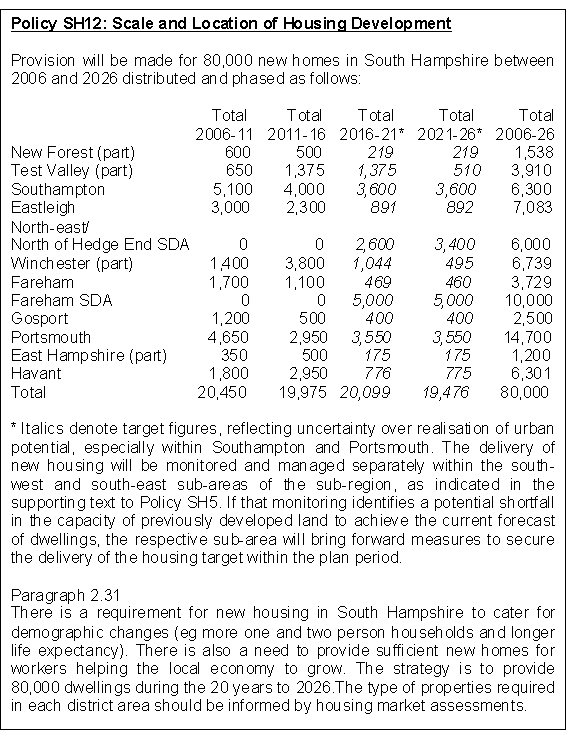
Representation
Hampshire County Council is concerned that the growth target for South Hampshire is too ambitious and may not be achieved. If the proposed level of housing is not adjusted to reflect this there will be a mis-match between the number of prospective workers living in the sub-region and the number of locally available jobs. This in turn will either result in higher levels of unemployment or longer commuting journeys as people travel further afield to find work.
A more sustainable approach is required using Plan, Monitor and Manage. The County Council proposes that the baseline number of dwellings for South Hampshire be set at 73,000, with the remaining 7,000 dwellings held as a reserve for release after 2016. The baseline figure equates to a growth of around 3.25% GVA which the County Council believes is a more realistic projection. In the event that this figure is exceeded the Regional Assembly would release some or all of the housing reserve.
The mechanism to release the reserve would be through a review of the South East Plan
Change to Policy
Add to end of 2.31:
"7,000 dwellings will be held as a reserve - to be released when the rate of economic growth in South Hampshire increases to the level at which the new homes will be required. Reviews of the Plan will determine if the reserve dwellings should be released".
Policy WCBV3: Scale And Distribution Of Housing Development
Support or Object. |
Object |
Policy Number; |
WCBV3 Table WCBV1 |
Paragraph Number; |
|
Chapter Number. |
E6 |
Policy WCBV3: Scale And Distribution Of Housing Development
Within those parts of their areas that lie within the Western Corridor and Blackwater Valley sub-region, the local authorities will make provision for the annual average levels of new housing set out in table WCBV1.
In allocating land for new housing, Local Development Frameworks will reflect the principles established by the general housing policies in regional policy and Policy WCBV2.
Consideration may be given to the preparation of joint Local DevelopmentDocuments by adjoining authorities in circumstances where urban expansion would need to cross existing administrative boundaries.
In the event that the uncertainties in relation to the Thames Basin Heaths Special Protection Area cannot be resolved during work currently underway by the Assembly, the affected authorities and English Nature, both the scale of the housing allocation for this sub-region and its distribution between the area's local authorities will be fundamentally reviewed from first principles.
TABLE WCBV1
New Housing: Annual average rates of provision 2006-2026 (net additional dwellings)
District Annual Average Total
2006-2026 2006-2026
Slough 235 4,700
Windsor 281 5,620
Bracknell Forest 539 10,780
Wokingham 523 10,460
Reading 521 10,420
West Berkshire (part) 475 9,500
South Bucks 90 1,800
Wycombe (part) 300 6,000
Basingstoke (part) 795 15,900
Hart (part) 195 3,900
Rushmoor 310 6,200
Surrey Heath 187 3,740
Guildford (part) 25 500
Sub-region Total 4,476 89,520
NOTES
1. Wokingham wish to record that their allocation is conditional upon the release of Arborfield Garrison and assumes that this site will contribute to their housing numbers from 2011. Without it, their submission is that their housing allocation should be limited to 320 per annum. This was noted at the meeting of the Western Corridor and Blackwater Valley steering group on 30 November 2005.
2. These are average levels of development for the 20-year life of the Plan. Phasing of this development may be introduced in the light of local circumstances, through individual Local Development Frameworks.
3. Surrey's allocation for the sub-region is slightly below that recommended by the Assembly, but has been correspondingly increased in the rest of county area.
4. Hampshire County Council does not endorse the figure of 795 per annum for Basingstoke and Deane Borough because of the uncertainty about future foul water disposal at Basingstoke. The County Council accepts the advice of
the Borough Council that the figure should be 710 per annum, and proposes that the balance should be a strategic reserve of dwellings at Basingstoke to be released after 2016 in the event that there is clear evidence that the foul drainage constraint can be satisfactorily overcome.
Representation
Basingstoke housing/waste water
The Environment Agency (EA) has expressed concern for more than a decade that the sewage treatment works which serves Basingstoke town may have an upper capacity limit. The recent review of the Borough Local Plan prompted the EA to warn that it could not guarantee that the works could accommodate any further connections after 2016. The works outfall is into the River Loddon, a watercourse characterised by low flows and high ecological quality.
The local authorities and the EA have commissioned a catchment strategy study to examine the long term problems and opportunities and to advise on a way forward. Until the outcome of this study is known the housing allocation for Basingstoke and Deane should remain provisional.
Hampshire County Council proposes that the housing allocation for Basingstoke and Deane should be 710 per annum unless and until the capacity of the sewage treatment works can be shown to be sufficient to accept a higher figure.
Change to Policy
In Table WCBV1 accompanying Policy WCBV3, replace Basingstoke figure with 710
Delete Footnote 4 and insert new Footnote:
The housing allocation for Basingstoke and Deane shall be 795 per annum until 2016 and 370 thereafter until it can be demonstrated that waste water disposal beyond this figure can be provided to the satisfaction of the Environment Agency. This figure will be re-examined at the first review of this Plan.
Policy CC3: Resource Use
Support or Object. |
Support |
Policy Numbers; |
CC3, CC4, H1 and NRM4 |
Paragraph Number; |
|
Chapter Number. |
Sections D1, D1, D3 and D5 |
Policy CC3: Resource Use
In order to reflect the Plan's emphasis on more sustainable resource use the Regional Assembly will promote measures that seek to stabilise the South East's ecological footprint by 2016, and to reduce the ecological footprint during the second half of the Plan period. Implementation will require a sustained new programme of action incorporating:
i Increased efficiency of resource use in new development
ii Adaptation of existing development to reduce its use of energy, water and other resources
iii Complementary legislation and fiscal measures by Government
iv Changes in behaviour by organisations and by individuals.
Representation
Hampshire County Council plays an important leadership role in the community through the Hampshire Natural Resources Initiative. The initiative is action orientated natural resources strategy and land use plan that aims to minimise the use of resources and creation of waste, promote sustainable use of water, energy, soil and air, and raise awareness of the impact of resource use upon climate change. The Council supports Policy CC3: Resource Use, as it contains the same targets that Hampshire County Council is working towards and sets the framework for a consistent approach to be implemented across the whole region.
Change to Policy
None.
Policy CC4: Sustainable Construction
The construction of all new buildings, and the redevelopment and refurbishment of existing building stock, will be expected to adopt and incorporate sustainable construction standards and techniques. This will include:
i High standards of energy and water efficiency that exceed current standards required by the Building Regulations and reflect best practice
ii Designing to increase the use of natural lighting, heat and ventilation, and the provision of a proportion of energy demand from renewable sources
iii Reduction and increased recycling of construction and demolition waste and procurement of low-impact materials
iv Designing for flexible use and adaptation to reflect changing lifestyles and needs and the principle of `whole life costing'.
Representation
Sustainable Construction, aims to embed the principles of sustainable design into all new, refurbished and renewal building across the region. Hampshire County Council supports Policy CC4 as it provides the basis for the region to deliver consistent results in line with current best practice including Building Regulations, EcoHomes and the forthcoming Code for Sustainable Homes.
Change to Policy
None.
Policy H1: Housing Provision
In the South East provision will be made for an annual average of 28,900 net additional dwellings between 2006 and 2026.
Local authorities should make the following provision in their Local Development Documents:
[The Plan contains a table of district housing allocating at this point]
Local authorities should adopt a Plan, Monitor, Manage approach to housing provision, with appropriate phasing policies in Local Development Documents and taking account of any phasing and provisos set out in the sub-regional strategies/policies.
The total level of housing provision to be planned for includes an allowance to address the backlog of unmet housing need that existed in the South East in 2001. Local authorities should demonstrate in their Local Development Documents how they have addressed any backlog of unmet housing need in their areas.
Representation
Hampshire County Council supports the principle of Plan, Monitor, Manage, as set out in Policy H1
Change to Policy
None
Policy NRM4: Conservation and Improvement of Biodiversity
In the development and implementation of plans and strategies, local authorities and other bodies shall avoid a net loss of biodiversity, and actively pursue opportunities to achieve a net gain across the region by:
i Providing the highest level of protection for nationally and internationally designated sites (map NRM3).
ii Ensuring damage to county wildlife sites and locally important wildlife and geological sites is avoided wherever possible.
iii Ensuring that unavoidable damage to wildlife interest is minimised through mitigation, that any damage is compensated for, and that such measures are monitored.
iv Ensuring appropriate access to areas of wildlife importance, identifying areas of opportunity for biodiversity improvement and setting targets reflecting those in figure NRM2. Opportunities for biodiversity improvement, including large-scale habitat restoration, enhancement and re-creation in the areas of strategic opportunity for biodiversity improvement (Map NRM4) should be pursued.
v Influencing and applying agrienvironment schemes, forestry, flood defence, restoration of mineral extraction sites and other land management practices to deliver biodiversity targets.
vi Maintaining and establishing accessible green networks and open green space in urban areas.
Representation
Biodiversity is a key measure of sustainable development, and as such the state of the region's biodiversity is a good measure of how it is achieving its sustainable development aims. Hampshire County Council, which has an enviable reputation in conserving and promoting biodiversity, considers biodiversity to be key to quality of life and therefore supports Policy NRM4: Conservation and Improvement of Biodiversity, which actively pursues achieving a net gain in biodiversity.
Change to Policy
None.
Annexe 2
The South East Plan Examination-in-Public
Public consultation on the draft South East Plan closed on 23 June 2006. Issues arising from the representations made will be discussed at a type of public enquiry called an Examination-in-Public (EiP) during winter 2006/7. This appendix explains the nature of the EiP and the process leading up to it.
The format of an Examination-in-Public
An Examination-in-Public (EiP) comprises a series of round-table discussions of selected issues conducted by an independent panel of Planning Inspectors appointed by the Secretary of State. The format is intended to test the soundness of the draft Plan, and not to hear objections/representations. Only invited participants can take part; they are selected by the Panel to ensure that a range of opinions are aired. No individual or organisation has a right to appear at the EiP, even if they made objections/representations on the draft Plan. The format enables an informal round table discussion between the Panel and participants, with seating to enable the public and press to observe. Legal advocacy and cross examination are regarded as inappropriate to an EiP. Thus it is totally different to the public inquiries into District Local Plans which have taken place in recent years.
A three person Panel will conduct the EiP of the draft South East Plan: Corinne Swain, Martin Shaw and Mary Travers. Corinne Swain and Martin Shaw conducted the EiP into the regional waste and minerals strategy in 2004 while Mary Travers conducted the Eastleigh Local Plan Inquiry. They are supported by a Panel Secretary Susan Morgan and are based in an office at Guildford.
Selecting the EiP issues and participants
After the close of public consultation, the Panel will analyse all the representations and identify the issues they feel merit discussion at the EiP and the participants who will take part. The Panel will publish the draft list of EiP issues and participants on 31 August 2006, for comments by 28 September 2006.
The Panel will publish the final list on 12 October 2006. Participants will be able to submit a statement on the issue to be debated, but these must be sent to the Panel by 9 December 2006, so that they can be circulated to other participants in advance of the discussion.
The South East Plan EiP programme
The EiP of the draft South East Plan is currently planned to occupy 11 weeks during 27 November 2006 to 30 March 2007. The first three weeks at Woking will deal with region-wide matters, before the EiP moves around three other locations at which sub-regional issues will be discussed:-
Dates |
Location |
Issues for debate |
28 November - 15 December 2006 |
Woking |
Region-wide issues |
16 - 26 January 2007 |
Chichester |
South Hampshire, Sussex Coast, Isle of Wight |
6 - 15 February 2007 |
Maidstone |
East Kent and Ashford, Thames Gateway |
27 February - 9 March and 20 March - 30 March 2007 |
Reading |
London Fringe, Gatwick area, Western Corridor and Blackwater Valley, Oxford, Milton Keynes |
The participants will vary according to the issue under discussion. The number of seats will be limited and it is unlikely that every Council will be invited to take part. Hampshire County Council is likely be invited to participate in some of the debates relevant to Hampshire but this is not certain. There is more likelihood that a representative of groups of authorities rather than individual District Councils will be invited.
After the EiP
After the EiP, the Panel will present their report to the Secretary of State, including their recommendations on how the draft Plan should be amended. The Secretary of State will consider the Panel's report and then publish the modifications he/she proposes to make to the draft Plan. There will be a period of public consultation on the draft modifications, after which the Secretary of State will finalise the Plan.