
Archived decisions
Hampshire County Council Buildings, Land and Procurement Panel Item 11 11 July 2006 Procurement Initiatives, Performance Assessment, Building Cost Trends and additions to the Capital Repairs Programme Report by the Director of Property, Business and Regulatory Services |
Contact: David Corcoran Ext: 7930 email: [email protected]
1.0 |
Summary |
1.1 |
The Executive Member for Policy and Resources approved at his meeting of 6 April 2006 the annual review of procurement initiatives for 2005/6 and a series of new initiatives to be implemented over the current financial year and beyond. |
1.2 |
This report recommends approval by the Executive Member for Policy and Resources to a number of negotiated schemes including schemes to be procured under the second framework pilot arrangements. The report also provides members with a summary of the performance analysis carried out for projects completed during 2005/6, examples of efficiencies achieved through the collaborative procurement arrangements, examples of the construction costs for a range of projects and programmes of work and explains the work being done in respect of BREEAM Assessments and Whole Life Costs. |
1.3 |
The report also recommends approval by the Executive Member for Policy and Resources to a number of additions to the capital repairs programme. |
2.0 |
Project Proposals |
2.1 |
Appendix 1 details a number of projects it is proposed to negotiate with preferred contractors, including an update on projects to be procured through the second framework pilot arrangements reported to the Panel in April 2006. The proposals are as follows: _ Second Tier Framework - update and additional schemes _ External repair and redecoration - additional packages of work _ Priestlands School - reception extension and alterations through the framework for Major Schemes with Mansell _ Extension of the Second Tier framework Pilot with Nolan Davis and RV Dart _ Whiteley School to be undertaken through the framework for Major Schemes with Brazier _ Staunton Park Community School to be undertaken through the framework for Major Schemes with Balfour Beatty. |
2.2 |
Early feedback from the Second Tier (SME) framework pilot has been very positive, and the involvement of the contractors in the design and development period has reduced the uncertainty of the tender process. The initial Key Performance Indicators (KPIs) for the first three projects completed have shown results above the average for tendered projects. During the period of the pilot, further projects have been identified at sites where projects have been allocated to R V Dart, and Nolan Davis. This has resulted in a predicted total workload in excess of the approved £1m. Current anticipated totals are £1.14m for RV Dart, and £1.22m for Nolan Davis. Approval is sought to extend the arrangements to allow the work to be allocated as planned, and to provide continuity across a small programme of works at the sites concerned. The early contractor involvement will provide an opportunity to further develop standardised solutions and test efficiencies gained. |
3.0 |
South East Centre Of Excellence (SECE) Framework for Major Schemes |
3.1 |
Following receipt of the tenders for the SECE Framework for Major Schemes in May, detailed analysis has been undertaken to identify those contractors to be appointed to the framework under the `fast track' arrangements set out as part of the procurement process. The following five contractors are now recommended for appointment: _ HBG _ Kier _ Mace Plus _ Mansell/Balfour Beatty _ Warings The tender evaluation will now be completed for the remaining contractors and further tenderers identified for interview and possible selection to the framework. |
4.0 |
Performance Assessment | |||
Major Capital Projects | ||||
4.1 |
During the last three years contractor performance on a sample of major projects procured through traditional competitive tendering and best value arrangements, including the framework for major schemes, has been assessed against eight headline key performance indicators: · On Time · On Budget · Contractor performance · Supply chain management · Health & safety · Quality achieved · Collaborative approach · Customer satisfaction Consideration of the KPI scores for these projects allows a comparison of the performance achieved through different procurement routes and the performance trends over time. | |||
4.2 |
For projects procured through best value routes, which include negotiated, partnered and framework projects, the results indicate an improving performance trend over time: Project Completion Average KPI Score Pre-2004/5 (17 projects) 78% 2004/5 (17 projects) 79% 2005/6 (13 projects) 85% |
|||
4.3 |
The performance of projects procured through competitive tendering has been more variable: Project Completion Average KPI Score Pre-2004/5 (16 projects) 57% 2004/5 (24 projects) 72% 2005/6 (20 projects) 69% 2004/5 saw a significant improvement in the performance of competitively tendered projects as the Framework for Major Schemes was introduced for the higher value, higher risk projects. However performance has fallen slightly during the last financial year mainly due to poor contractor performance on a small number of projects. This highlights the unpredictability of traditional competitive tendering and supports the introduction of collaborative working with small to medium sized firms which is being piloted through the second framework reported to members in April 2006. The challenge in both cases is to maintain strong competitive tension in future arrangements. | |||
4.4 |
The radar chart provided at Appendix 2 highlights the significant improvements that the introduction of new forms of procurement has delivered. The chart shows the average performance of a sample of high-value projects procured through traditional competitive tendering prior to 2004/5 compared with average results for a sample of similar projects procured through a partnering approach or the Framework from Major Schemes. | |||
Framework for Major Schemes | ||||
4.5 |
The performance of projects procured through the Framework for Major Schemes has been consistently good with an average score of 81% for all projects completed to date. These projects have shown a generally improving trend as the partnerships between the framework contractors and design teams develop. This is particularly noticeable for the Enhance programme of work where lessons learned on the early schemes have been applied to deliver excellent performance on the later projects. | |||
Other Programmes of Work | |
4.6 |
A sample of projects procured by best value procurement routes through specialist framework arrangements and programmes of work have also been assessed. These include projects procured through: · Ramps and hard landscaping framework · Flat roofing framework · Negotiated arrangements for external decorations · NDS Modernisation and SCOLA recladding programmes of work · Temporary buildings framework |
4.7 |
Generally all projects procured through these arrangements scored well with average scores for the various programmes of work ranging from 80% to 95%. These scores are consistent with previous years' results for these initiatives and programmes of work and demonstrate the consistency that is being achieved through the relationships developed with the preferred contractors under these procurement arrangements. |
Development of Performance Management Arrangements | |
4.8 |
From 1 April 2006 a new set of KPIs has been introduced. In addition to measuring contractor performance a number of KPIs have been developed to allow measurement of the department's performance in the delivery of construction projects. The new KPIs will also allow performance to be benchmarked against industry standards by comparison with the Construction Industry KPIs published by Constructing Excellence. |
5.0 |
Efficiencies |
5.1 |
The National Procurement Strategy and the "Gershon" Efficiency Review of public services have focused attention on how improved efficiency can be achieved across a range of services including construction procurement. |
5.2 |
Property Services has identified new procurement strategies as the way forward. These include the development of the strategic partnerships such as the Framework for Major Schemes, with the clear objective to remove waste and streamline processes through the whole life of projects, to identify and manage risk more effectively, and to provide more predictable outcomes. |
5.3 |
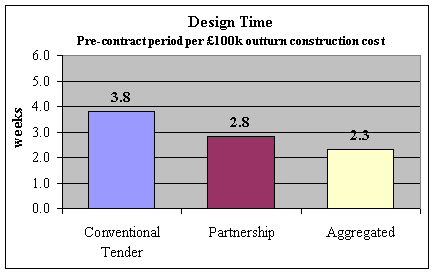
The key elements to new procurement strategies are: · Collaborative working arrangements with contractors which facilitate earlier identification of all project risks, enabling more effective management and predictable outcomes. Partnership working also removes the adversarial approach by giving the team common objectives. This in turn reduces or eliminates claims and disputes. · Greater involvement of the supply chain in the design process to allow identification of best value solutions and longer term relationships with supply chains allowing them to deliver more predictable products with associated quality and value gains. This also preserves learning and provides opportunity to seek out further opportunities. · Combining individual projects into programmes of work reduces the number of bespoke components, reducing design times and providing opportunities to leverage volume discount from the supply chain. |
5.4 |
To demonstrate that efficiencies are being achieved, a sample of major projects procured through traditional competitive tendering, collaborative partnering arrangements including the Framework for Major Schemes, and projects which had been aggregated into programmes of work - the NOF Sports Halls and the Enhance schemes - were analysed against a number of performance measures. |
5.5 |
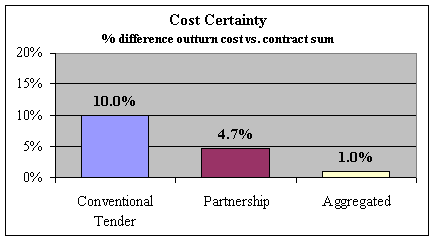
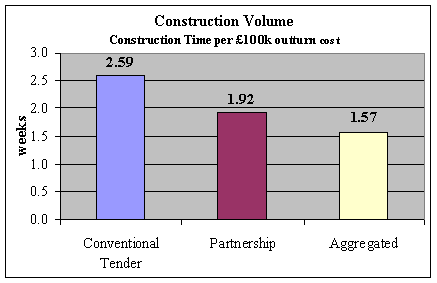
The outcome of this analysis is presented in Appendix 3 and demonstrates that a range of savings and efficiencies are being achieved through the use of collaborative partnering arrangements when compared against schemes procured through competitive tendering. The greatest benefits have been gained where the collaborative working principles have been implemented on a number of similar schemes aggregated to form a programme of work. |
5.6 |
The efficiencies gained include: · Reduction in the pre-contract design period and associated fees · Increased time and cost certainty · Improvements in health and safety · Increase in construction volume · Savings on construction cost |
6.0 |
Building Cost Trends |
6.1 |
A study of the general trend of costs for the County Council's building projects over the last five years has been undertaken. The results of this study have been compared with construction inflation as identified by both the DTI and the Royal Institution of Chartered Surveyors Building Cost Information Service (BCIS). The study of County Council projects was based on analysis of actual costs per square metre of floor area. The analysis has shown that over the period costs for the County Council's schemes have remained in line with reported inflation. The trend graph covering the study period is shown in appendix 4. |
6.2 |
Schools Building Programme |
6.2.1 |
The Procurement Initiatives report presented to this panel in July 2004 identified the relationship between the cost benchmarks for school buildings identified by the DfES (their publication entitled `Education Building Projects: Information on Costs and Performance Data' of April 2003) and County Council school building projects. It showed that County Council schemes are on average 4% above the guideline cost. The benchmark figures from the DfES have not been revised since publication in 2003. |
6.2.2 |
Using the same methodology based on the latest analysis, the following comparison can be made:
- DfES guideline net cost (updated to 4Q05 base) £1,442/m2 - HCC equivalent schemes (average of 13 schemes carried out in 2005, at a 4Q05 base) £1,462/m2 - HCC schemes now show a reduced variation of 1% above the DfES guideline | |
6.2.3 |
It should be noted that the DfES Benchmark draws on real data from recent and past completed Schools. There is usually a `time lag' before the index catches up with the latest legislative requirements for school building design. In addition Hampshire's core brief for schools exceeds the minimum requirement of the DfES benchmark, therefore additional specialist facilities such as IT Suites and Music Drama spaces are included as standard. Both of these factors would go some way to explaining the marginal premium that the County Council experience over the DfES benchmark . | |
6.3 |
Property Management Projects | |
6.3.1 |
Cost benchmarking is also undertaken for smaller repetitive works particularly in relation to major maintenance programmes. The following examples highlight some of the trends that are being seen with repeat packaged works. | |
6.3.2 |
External redecoration work is undertaken strategically through a number of pre-selected contractors using a common paint system which has been chosen in consultation with specialist suppliers. An element of this work is always subjected to tendering to serve as a benchmark for comparison purpose and for succession planning. Successful negotiation with decorating contractors has enabled the County Council to maintain a stable and consistent level of pricing. Over the period 2001 to 2006 overall inflation on the County Councils decorating work has been calculated to be 16%, compared to BCIS trade indices for Painting and Decorating showing an increase of 23% for the same period. | |
6.3.3 |
A consistent price level for the recladding of school buildings, in line with normal inflation has also been achieved by Property Management in the period 2001 to 2005. | |
6.4 |
Future Cost Trends | |
6.4.1 |
Looking forward BCIS and DTI predict annual Tender Price Inflation of between 5% and 6% for the period 2006 to 2010. On top of this, recent additions to the building regulations are expected to add between 2-5% to building costs from April 2006 (DCLG suggest 1.9% on public buildings, whilst studies conducted by both Gleeds and Davis Langdon indicate up to 5%). The additional load on the construction industry in preparation for the Olympic games in 2012 is also expected to increase construction costs by 1-2% over and above normal inflation, in this region. | |
7.0 |
BREEAM Assessment and Whole Life Cost Models | |
7.1 |
The Procurement Initiatives report to the Panel in April 2005 noted the use of whole life cost models for capital projects as an important component in demonstrating value for money. The report also highlighted the proposal to include a value for money statement in the project appraisal process. | |
7.2 |
Whole life cost is also a consideration in the BREEAM Schools environmental assessment method launched in October 2004 by the DfES. BREEAM Schools assesses the performance of buildings in the following areas: management, energy use, health and wellbeing, pollution, transport, land use, ecology, materials and water. The outcome of the assessment is an overall score categorised as pass, good, very good or excellent. There is evidence that future funding for school projects could be linked to a `very good' BREEAM rating. | |
7.3 |
BREEAM assessments are currently being undertaken on the Pinewood Infant School and Kings Copse Primary School projects, together with a review of whole life costs. An early assessment of both projects indicates that a `very good' rating will be achieved for Kings Copse and an `excellent' rating could be achieved for Pinewood. It is proposed to include the outcome of these assessments, together with an assessment of other relevant factors in a value for money statement in the project appraisals when these are presented to the Panel in the next few months. | |
8.0 |
Additions to the Capital Repairs Programme | |
8.1 |
It is intended to include the following projects into the capital repairs programme. Many of the schemes relate to addressing issues associated with the Corporate Risk Assessment for the Built Estate. Up to £100,000 Thurlston House - fire alarm and emergency lighting Testwood School - roofing repairs Noadswood School - repair flat roof Swanmore School - repairs to Technology Block Harrison Primary School - external redecorations Bedenham Primary School - external redecorations Fryern Junior School - roofing repairs Bidbury Junior School - roofing repairs South Farnborough Infant School - roofing repairs Portchester School - replace windows Lee-on-Solent Library - repairs and refurbishment Hampshire Scientific Services Laboratory, Southsea - internal refurbishment Merrydale Children's Respite Unit - boiler replacement Crofton Secondary School - wall tie replacement £100,000-£250,000 Mill Chase School - roof and water tank repairs and upgrade of electrical supply (NDS funding) Testwood School - window replacement | |
Recommendation(s) | ||||
That the Buildings, Land and Procurement Panel advises the Executive Member for Policy and Resources that: 1 Approval be given to the procurement proposals set out in Appendix 1 relating to: _ Second Tier Framework - update and additional schemes _ External Repair and Redecoration - additional packages of work _ Priestlands School - reception extension and alteration through the framework for Major Schemes with Mansell _ Extension of the Second Tier framework Pilot with Nolan Davis and RV Dart _ Whiteley School to be undertaken through the framework for Major Schemes with Brazier _ Staunton Park Community School to be undertaken through the framework for Major Schemes with Balfour Beatty. 2 Approval be given to the recommendations for the appointment of contractors identified in item 3.1 to the SECE Framework for Major Schemes. 3 That the information on performance, efficiencies, cost trends and whole life costing is approved. 4 That the schemes identified in paragraph 8.1 be included in the Capital Repairs Programme. Section 100 D - Local Government Act 1972 - background papers The following documents disclose facts or matters on which this report, or an important part of it, is based and has been relied upon to a material extent in the preparation of this report. NB the list excludes: 1. Published works 2. Documents which disclose exempt or confidential information defined in the Act. ............................... ...............................
BLPP0706D |
||||
Procurement Initiatives 2006 Appendix 1
Additional Proposals
Second Tier Framework Pilots
Arrangements for the second tier framework pilots were reported to the Panel in April 2006, together with a list of schemes to be procured through the pilot arrangements. The following additional schemes have now been identified for procurement through the second framework pilot arrangements during 2006/7:
Contractor |
Project |
Estimated Value |
RV Dart |
_ Oak Meadow EYC |
£250,000 |
Nolan Davis Contracting Ltd |
_ Yateley School |
£100,000 |
Gregory Havant |
_ Alderman Quilley School |
£100,000 |
Nolan Davis Contracting Ltd |
_ Connaught School |
£100,000 |
Nolan Davis Contracting Ltd |
_ Crestwood School |
£120,000 |
Gregory Havant |
_ Brookfield School |
£75,000 |
Nolan Davis Contracting Ltd |
_ Yateley School |
£120,000 |
External Repair and Redecoration
A programme of negotiated packages of repair and redecoration work valued at £1.54 million, funded mainly by NDS, was reported to the Panel in April 2006. The report also identified an additional £2 million of external redecoration and repairs work identified in the Capital Repairs report to the Panel, of which it is proposed to negotiate approximately £1.5 million with preferred contractors as follows:
Contractor |
Properties |
Estimated Package Value |
Atkins (package 1-06) |
_ Foxhills Junior School |
|
_ Hazel Wood Infant School |
||
_ Manor Farm Country Park |
£142,000 | |
Ferris (package 2-06) |
_ Copythorne Infant School |
|
_ New Milton Infant School, New Milton |
||
_ Tiptoe Primary School |
||
_ Fawley Infant School |
£95,000 | |
Contractor |
Properties |
Estimated Package Value |
Haylock&Pitman (package 3-06) |
_ Selborne CE (A) Primary School |
|
_ Buriton Primary School |
||
_ Sheet Primary School |
||
_ Talavera Infant School |
||
_ Weyford Infant School |
£115,000 | |
Mitie (package 4-06) |
_ Haselworth Primary School |
|
_ Baycroft School |
||
_ Lord Wilson Special School |
||
_ Swanmore School |
£315,000 | |
Richardsons (package 5-06) |
_ Mill Rythe (F) Infant School |
|
_ Riders Junior School |
||
_ Warren Park Primary School |
||
_ Denmead Junior School |
||
_ Hart Plain Infant School |
||
_ Horndean Infant School |
||
_ Blackfield Infant School |
£ 253,000 | |
Pools (package 6-06) |
_ Richard Aldworth School |
£ 281,000 |
Purkiss (package 7-06) |
_ Haven Early Years Centre |
|
_ Bedenham Primary School |
£ 92,000 | |
Tews (package 8-06) |
_ Micheldever CE (C) Primary School |
|
_ Shakespeare Infant School |
||
_ Preston Candover Primary School |
||
_ Bishops Waltham Infant School |
£92,000 | |
Warwick (package 9-06) |
_ Holbrook Primary School |
|
_ Harrison Primary School |
£119,000 | |
Total |
£ 1,504,000 |
Priestlands School - reception extension and alterations
Priestlands School has identified £190k funding, including fees, to carry out a package of refurbishment and remodelling to the existing school buildings. The works will be undertaken by Mansell Construction as an addendum to the existing contract for the Centre for Performing Arts at the school which was procured through the Framework fro major Schemes. Mansell has developed an excellent relationship with the school who have requested that they undertake this further phase of work. To minimise disruption to the school and allow the contractor full access to the buildings, the works will be undertaken during the summer holidays with completion by the end of August.
Staunton Park Community School
Project being developed to provide repairs and refurbishment to changing rooms and sports hall with an estimated value of £600k. The work will be joint funded with equal contributions from the Landlord, Children's Services and the School. The work will provide necessary modernisation to support the school's specialist college status. It is proposed to negotiate with Balfour Beatty through the Major Project Framework in conjunction with Woodlands Education Centre and Sundridge BESD School, the two other major Education projects in close proximity, currently in design. Combining the schemes into a single package of work offers the opportunity for efficiency savings in terms of shared management arrangements and key supply chains.
Whiteley School - new primary school
Major project to provide a new Voluntary Aided Primary School incorporating a church facility. The estimate for the construction work is £4,327,000 excluding any land acquisition and highways costs. The project is being promoted by the Diocese of Portsmouth, The Methodist Church and The United Reformed Church and is funded jointly by the various stakeholders, including significant grant from the DfES and a contribution from the Children's Services Capital Programme, which is currently a provision of £1.240m. The work is to be negotiated with Brazier Construction through the Major Projects Framework, with the County Council named as employer on the building contract, subject to agreement with other stakeholder groups.
Procurement Initiatives 2006 Appendix 2
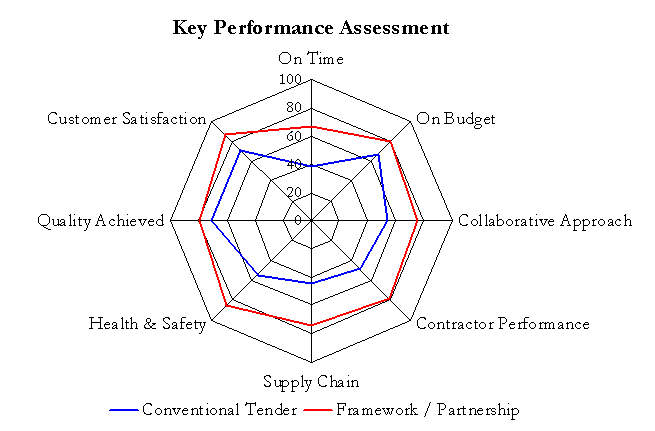
Comparison of major projects procured through conventional tender prior to 2004/5 and projects procured through best value partnership and framework arrangements.
Procurement Initiatives 2006 Appendix 3
Efficiencies
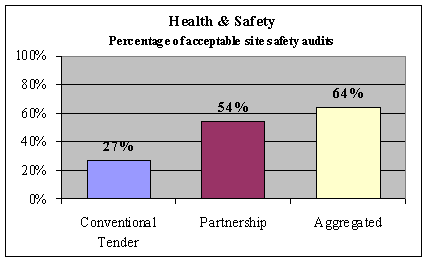 IMPROVED HEALTH AND SAFETY
 Hampshire's experience is that aggregated procurement can lead to significant efficiency savings: