1 |
Summary |
|
|
1.1 |
The purpose of this report is to review the Draft Scheme produced by the Charity Commission to replace the original Trust Deed for the Sir Harold Hillier Gardens (SHHG) produced at the formation of the Charity in 1977. The review is at the request of the Charity Commission and sets out the political and management arrangements for the arboretum in relation to the County Council's role as the Sole Trustee. The review of the Trust Deed is part of a wider corporate review of County Council trusts. It is also an opportunity to modernise and consider the scope and role of a model to increase the influence and contribution of the Management Committee and its members to the horticultural development of the SHHG. This report also highlights a number of proposals associated with the Management Committee including its title, composition and terms of reference. |
1.2 |
The County Council is the sole Trustee of the SHHG and on the advice of the Charity Commission, following its review in 2005, has agreed to review and in practice replace the original Trust Deed. The Charity Commission has suggested a model template which, with some minor amendment is enclosed as Appendix 1. The County Council has also been advised by a specialist firm of solicitors, Lawgram, who have been assisting the County Council to modernise a number of its Trusts and Charitable arrangements. |
1.3 |
The proposals in this report are consistent with the County Council's constitution, the advice of the Charity Commission and Lawgram. Where possible (and in particular in relation to horticultural matters) it has been recommended that the governance arrangements should not be concluded without first seeking the views of the existing Chairman and members of the Management Committee. |
2 |
The Charity Commission for England and Wales |
2.1 |
The Charity Commission has, following its visit in 2005, pointed out that the object of the charity is to provide for the public benefit an arboretum and to promote its conservation and protection alongside its educational benefits. |
2.2 |
The Charity Commissioners under `Powers of the Trustee' make the point that the trustee, inter alia, has the power to: |
|
· make rules and regulations consistent with the scheme for the management of the charity; · set up advisory committees; · appoint staff (who must not be trustees); and · from time to time, to amend the trust if it is expedient in the interests of the Charity to do so.
|
2.3 |
Recognising that Hampshire County Council is the trustee of the charity, the Council proposes to undertake this role through the (new) Arboretum Trust Board. |
3 |
Governance and operational issues raised by Lawgram |
3.1 |
Understanding the Roles of Hampshire County Council |
3.1.1 3.1.2 |
Of particular importance to creating good governance structures is understanding the legal relationships which exist and properly delineating between them. The most complex of these is Hampshire County Council's role in relation to the Trust, which takes many forms as follows: · As Trustee
· As a corporate body, being:
o primary funder o user of the Trust's facilities (ie by hiring rooms) o service provider (eg IT support services etc)
Understanding the difference between HCC's role as trustee and corporate body is critical to effective governance.
|
3.2 |
Lawgram suggested two options for future governance:
|
3.2.1 |
· retain the Trust Structure and improve the governance framework · Incorporate the Management Committee as a charitable company limited by Guarantee and appoint the County Council as Custodian Trustee.
The County Council's preference is for Option 1. Lawgram has suggested in this case that "much clearer mechanisms are put in place on how the relationships between the various groups will work". They have further suggested that the Council (as Trustee) needs to formalise its role, recognising that the Trust is a charitable entity and independent of the County Council. Lawgram suggested a committee of three people - hence the proposal for an Executive Board (or Arboretum Trust Board) with specific terms of reference and that specific policies be developed for financial matters, risk management and a conflict of interest policy. |
3.3 |
Governance Risks |
3.3.1 |
Lawgram have pointed out that there are risks associated with local authorities acting as trustees and, in the case of the Trust, these are risks where mechanisms could be introduced to better mitigate those risks. A summary of the risks is set out below: |
|
· There is a blurring of the two roles performed by the Council in relation to the Trust, which has a number of risks attached:
o The Council (as Trustee) may inadvertently deal with property of the Trust in the same way as it deals with corporate property of the Council and this may be inconsistent with the Trust's charitable trusts.
o By having clear procedures in place for decision-making on behalf of the Trust and separate meetings for Trust business, the distinctions between the two roles become clearer.
o There can be an assumption that any trading risk will be assumed by the Council, ie the Council will "bail out" the Trust if it encounters difficulties or unforeseen expenditure.
o Arrangements between the Council in the two roles can lack formality.
o The Trust may be operated within the statutory and regulatory rules governing local authorities, rather than under the regime governing charities (including the Charities Act 1992 and 1993 and the Trustee Act 2000) and having regard to Charity Commission best practice.
|
| |
o There is the potential for potential conflicts of interest between the Council as Trustee and the Council (as user of the facilities at the Gardens).
o Changes in personnel at the Council and any local government re-organisations can mean that the independent identity of the Trust might become lost and it is important that the Trust is clearly identified as an independent body and not treated, in effect, as another local authority department. The creation of a clear committee structure to fulfil the duties of the Council (as Trustee) would help to establish the independence of the Trust.
|
| |
o There are potential conflicts of interest where local authorities act as trustees. Individuals acting on behalf of the Trust must always act in the Trust's best interests and those of its beneficiaries (not those of the local authority). To manage this risk, there should be a Conflicts of Interest policy in place for the Trust.
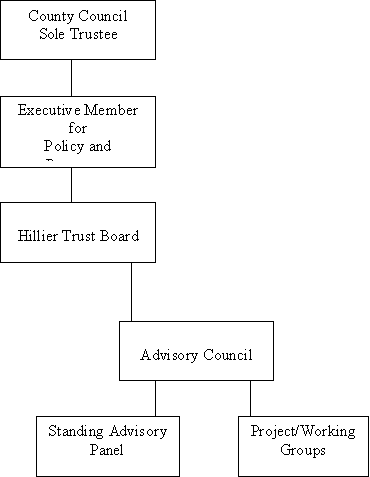
With these issues in mind a formal definition of the management arrangements is suggested below and shown in Appendix 2. |
4 |
The Financial and Political Context |
4.1 |
The Local Government Act 2000 was the most significant change to the constitution of the Council in over 100 years. In practice the government legislated to replace the committee system with a Cabinet, Leader and Executive Member arrangement. By law the County Council can have a maximum of 10 Cabinet Members (out of 78 County Councillors) who can have Executive and Policy making powers. |
4.2 |
The Executive Member for Policy and Resources, also the Leader of the Council, is responsible for all land and property matters on behalf of the County Council. The County Council as trustee of the SHHG is included in the portfolio of the Leader. The constitution of the County Council sets out the decision making policies of the Leader consistent with the Local Government Act 2000. In practice the key and major policy decisions of the Council must be made by the Leader. The introduction of these new arrangements (probably) should have prompted a review of the County Council's role in relation to the original trust deed. |
4.3 |
The constitution also sets out the operational responsibility of the Council's Chief Officers. The Director of PB&R is the senior officer of the Council responsible for land and property functions, which includes the operation of the SHHG, its budget, staffing and management and operations of the directly employed staff. In reviewing the Trust Deed it will be necessary to ensure that any new arrangement is consistent with the constitution of the County Council, and the management arrangements established by the Council for the SHHG whilst recognising the Council's role as a Sole Trustee. The objective of this review is to: |
| |
· ensure the effective operation of the Gardens consistent with the Council constitution and its role as a Sole Trustee · recognise the Executive management arrangements that currently exist · modernise, review and strengthen how the Members and Chairman of the Management Committee can contribute to the Gardens and advise the Sole Trustee on its future development and strategy.
|
4.4 |
The existing executive management and financial control rests with the County Council. This position does not change under these proposals. |
5 |
Executive Board |
5.1 |
The first proposal is to establish an Executive Board (or Arboretum Trust Board). This will need to recognise the County Council's political, executive and trustee functions, and proposes for the first time to allow the Chairman of the Management Committee to sit on that Board. |
5.2 |
While constitutionally the executive, political and trustee responsibilities cannot be shared with a non elected and non paid members, a new Board could be established comprising: 1. Leader of the Council 2. Director of Property, Business and Regulatory Services 3. Chairman of the Management Committee* In practice, the Leader of the Council and Director of PBR already meet informally to make decisions. This formalises the process and introduces the Chairman to the decisions. The Director of PBR could in practice nominate other officers to represent him and take part. As the Leader of the Council cannot share his political or decision making responsibilities, it is not anticipated that there would be voting rights established for the Board. |
5.3 |
This creates a new role for the Chairman of the Management Committee and provides a governance arrangement consistent with the constitution of the Council. The Executive Board would be responsible for: |
|
1 endorsing major policy and strategic issues relating to the development of the SHHG; 2 ensuring that the development of the SHHG is consistent with the (new) Trust Deed and meet the requirements of the Charity Commission; 3 ensuring that the operations of the SHHG are compliant with the best and long-term interest of the SHHG;
4 approving the annual report and accounts prior to submission to the Charity Commission. |
|
Political leadership will remain with the Leader of the County Council consistent with the Council's constitution. |
5.4 |
The Executive Board (or Arboretum Trust Board) model allows the Chairman of the Management Committee first hand access to influence the political and executive management arrangements. Key to this role is then to determine what should replace the Management Committee, its terms of reference, selection and term of office of its Members, and how to best work with the Chairman to ensure that highest level of horticultural advice, leadership and experience is offered to the County Council. |
6 |
The Management Committee |
6.1 |
Arguably, you could retain the status quo. For reasons suggested above by the Charity Commissioners and Lawgram that would appear to be a lost opportunity to modernise and review the operations. |
6.2 |
The original Trust Deed requires there to be a Management Committee established for the `general management' of the Gardens (although this is without prejudice to the Trustee's (Hampshire County Council's) overall responsibility for the control and administration of the Trust). Key features of the Management Committee are: · It comprises 15 individuals including nominees from the County Council (2 no) and of various eminent bodies in the field of horticulture (see Appendix 3). The Chairman is nominated by the Council, which is reviewed at the start of each new administration. (Note the Chairman cannot be a member of the County Council) · It meets 4 times per year (note it is a requirement of the Trust Deed that it meets at least twice a year) · Its remit is not formalised through terms of reference, although in practice it considers issues affecting the trust and its operation. · It makes recommendations to the Trustee but has no decision-making powers · It receives advice and recommendations from the Standing Advisory Panel (a sub-panel set up many years ago to consider horticultural and landscaping issues, in particular the long-term Master Plan for the SHHG) · In recent years it has assisted in fund raising activities for specific projects at the Gardens. |
6.3 |
Title |
6.3.1 |
The Management Committee members have no financial or legal liability for SHHG which falls to the County Council. |
6.3.2 |
The Management Committee has supported the County Council in the development of the SHHG providing advice on a range of issues particularly horticultural, future development and fund raising. The County Council is keen to build on the positive contribution made by the Committee and the personal commitment of its members, but it is probably timely to review its title. It is therefore proposed to formally recognise this role and recommend a change to its title to that of `Advisory Council'. It is also proposed to seek the views of the Advisory Council members as to how this role can be strengthened (see below). |
|
|
6.4 |
Composition of Management Committee |
|
|
6.4.1 |
As indicated in Appendix 3 the Management Committee comprises nominations from the following: · Hampshire County Council (2 no) · Royal Horticultural Society · Hillier Nurseries Ltd · Royal Botanic Gardens, Kew · Forestry Commission
In addition up to 8 co-opted members may be appointed to the Management Committee. This together with the Chairman (appointed by the County Council) comprises a membership of 15. |
|
|
6.4.2 |
The advice from Lawgram is that a smaller committee would be appropriate, possibly with a membership of up to 10. Many of the co-opted members have been on the Committee for many years, some since its inception 29 years ago. This review provides an opportunity to review both the membership and the term of office for members. Whilst the existing Trust Deed does make reference to a term of office for co-opted members of 3 years, in practice this has never been enforced. |
|
|
6.4.3 |
It is suggested that the Management Committee be asked to consider its composition possibly by retaining nominations from the bodies highlighted in 6.4.1, but reduce the number of co-opted members to, say, 5. This in effect would provide a membership of 10 plus the Chairman. |
|
|
6.4.4 |
It is also suggested that the term of office for all members (excluding the Chairman) be three years, with individuals and representatives from the nominated bodies serving a maximum of two terms. A member could then be subject to a quarantine period of 1 year before being eligible to sit on the Committee again. This would encourage a healthy turnover of Members and bring new ideas to the Trust. This would be in line with most other forms of Trust and is generally regarded as good practice in terms of governance. |
|
|
6.4.5 |
It would be necessary to introduce this process in an incremental way. If the committee was to reduce in size it would be necessary in the first instance to agree which members would not be replaced. The Management Committee should be asked for their views on how best to effect this change, and to do so within a 12 month period. |
|
|
6.5 |
Terms of Reference |
|
|
6.5.1 |
The Management Committee has provided significant support to the County Council in the development of the SHHG during the last 29 years. The Council is keen to continue and develop this relationship and build on the skills, expertise and enthusiasm of individuals while recognising the contribution the Committee can make, particularly in areas associated with: · the horticultural development of the gardens · conservation/biodiversity issues · medium and long term planning for the development of the Gardens · fund raising activities · the development of education and learning through SHHG
|
|
|
6.5.2 |
No formal terms of reference have previously been produced for the Management Committee and this review provides an opportunity to formalise this. Suggested terms of reference are detailed below: · To provide advice to the Executive (or Arboretum Trust) Board on matters associated with: _ the horticultural development of the SHHG _ enhancing the conservational role of the SHHG _ improving the educational opportunities at the SHHG _ the landscape master plan _ fundraising activities for key projects identified by the Executive Board (or Arboretum Trust Board)
· to report to the Executive Board (or Arboretum Trust Board) (through the Chairman of the Committee) on the outcome of its meetings (minutes to be included on Executive Board agenda) · to meet three times per year · to appoint working groups/panels to consider specific issues and agree their terms of reference. In this respect it is suggested that the Standing Advisory Panel be reconstituted in a manner consistent with the proposals above. The County Council would also like to strengthen the role of the Standing Advisory Panel and individual members by developing arrangements which are more project focused where members of the Committee and/or Panel could act as project sponsors. This could include individual landscape/ horticultural projects or fundraising activities. This would allow members to contribute in areas where they have relevant experience. A `task and finish model' could be adopted for these working groups.
|
7. |
Next Steps |
|
|
7.1 |
Following approval of this report by the Executive Member for Policy and Resources it is intended to consult with the Management Committee in September on the proposals contained in this report, including the Draft Scheme at Appendix 1. |
7.2 |
The Draft Scheme, with any amendments, will then be agreed with the Charity Commission. Once approved the Scheme has to be displayed publicly for 21 days (or advertised in the press). The Charity Commission will also post the Scheme on their website and respond to any objections. The Scheme is then sealed and becomes a legal document. |
7.3 |
Whilst this process is proceeding it is intended to formalise the Terms of Reference for the Arboretum Trust Board and the new Advisory Council, and produce Reserves, Risk Management and Conflict of Interest policies to support the executive and management process. |
7.4 |
It is anticipated that this will be in place by 1 September 2007 (or earlier if the necessary approvals and consultation allow). As an interim measure it is intended to establish a `shadow' Arboretum Trust Board as identified in Section 5 with immediate effect. |
The following documents disclose facts or matters on which this report, or an important part of it, is based and has been relied upon to a material extent in the preparation of this report.
2 Documents which disclose exempt or confidential information as defined in the Act
........................
........................
Christopher D Brickell, Esq. CBE VMH