
Archived decisions
Hampshire County Council Environment Policy Review Committee 20 July 2006 Term Maintenance Contract (Raynesway) Highway Performance - Annual Report Report of the Director of Environment |
Item 8 |
Contact: Alan Giles, ext 7712 email: [email protected]
1. Summary
1.1 The Highways Term Maintenance Contract (TMC) was awarded to Raynesway Construction Southern (RCS) in May 2002. The contract was for an initial five year period with options for up to three, One Year extensions. The annual value of the works carried out under the contract is currently running at £34 million (2005/06).
1.2 This report updates Members on the progress of the TMC over the past year. It summarises the performance of the contractor Raynesway Construction Southern, the results of public surveys relating to the service, partnering initiatives and the future of the contract.
1.3 The contractor has maintained an improvement in the standards of service delivery during 2005/06 (Year 4 of the contract) and public survey responses also indicate a good level of service. Partnership working to identify and implement efficiency savings continue to be developed. In particular the setting up of working groups under the Government sponsored Construction Lean Improvement Programme (CLIP) has already identified a number of saving through improved working methods. A One Year Extension to the TMC has been agreed with RCS, which takes the contract up to April 2008.
2. Corporate Strategy
2.1 This report supports the following Aims of the Corporate Strategy:
(i) Aim 5 (Improving Services) by presenting the performance results for scrutiny; and
(ii) Aim 6 (Developing Councillors and Staff) by keeping Members up to date with progress on the Highways TMC.
3. Introduction
3.1 This report summarises the performance of the Highways TMC over the past financial year. It also explains the various initiatives that Hampshire County Council highways staff and contractor's staff are jointly working on to find improved ways of delivering the service.
3.2 The delivery of highway maintenance services in Hampshire requires a close degree of working between the Highways Network Management client staff of Hampshire County Council and RCS, the contractor. Client staff manage the regular inspections of the highway network in order to assess its condition. Maintenance programmes are then prepared based upon maintenance need and available budgets. Highway inspection and budget coordination as well as general contractual management is carried out by Headquarters based staff. Day to day operational management of works orders and scheme supervision is carried out by the local Highway Teams. These are grouped under the four main Highway Units - North, East, South and West, with sub-units based in each district, often in district council offices.
3.3 It should be noted that the Highways Network Management staff are also involved in a wide range of other highway activities, eg dealing with Utility works, regulation activities (skips, scaffolding, obstructions), road closures, highway search information, which are not directly associated with the management of the TMC.
4. Methods of Ordering Work
4.1 The contract allows for two main types of works. Firstly, conventional schedule of rates items. The client staff will design a scheme or identify maintenance works required and then produce a works order, the contractor already having priced the works at tender stage. The scheme is remeasured after completion to allow for any slight differences between the ordered and final quantities.
4.2 The contract also includes a second type of arrangement called Performance Works. These relate to a number of highway items that the contractor is required to maintain at a satisfactory standard for the duration of the contract. For example this includes dealing with potholes, sign cleaning, road markings, etc on the `A' Road network. This method of working requires the contractor to inspect and assess the maintenance need and carry out all necessary works for a fixed annual payment each year, regardless of the actual quantity of work. The idea being that this method avoids the duplication of inspection and supervision work by client staff and should therefore generate efficiency savings. This method of work is relatively new in highway maintenance contracts and Treasurer's Consultancy has recently been commissioned to work with Highways Management staff to carry out an analysis of the value for money of this approach in order to help with the preparation for the next generation TMC.
5. Contractor's Performance
5.1 In Year One (2002/03) of the contract a joint working group of County Council and RCS staff identified and agreed a set of Key Performance Indicators (KPIs) that would be used to measure performance in Year 2 (2003/04). Data obtained in Year 1 enabled suitable base levels for those indicators to be established and for improvement targets for Year 2 to be set.
5.2 In the light of further experience in Year 2 of the contract, the Performance Indicators were slightly modified for Year 3 and the method of calculating improvements was altered to provide a better method of assessment. This allowed for less dependence upon performance in individual months and more on the achievement of steadily improving performance averaged over a complete year of the contract. The revised calculation method was therefore slightly more complicated but it was felt that the results provided a better indication of overall performance.
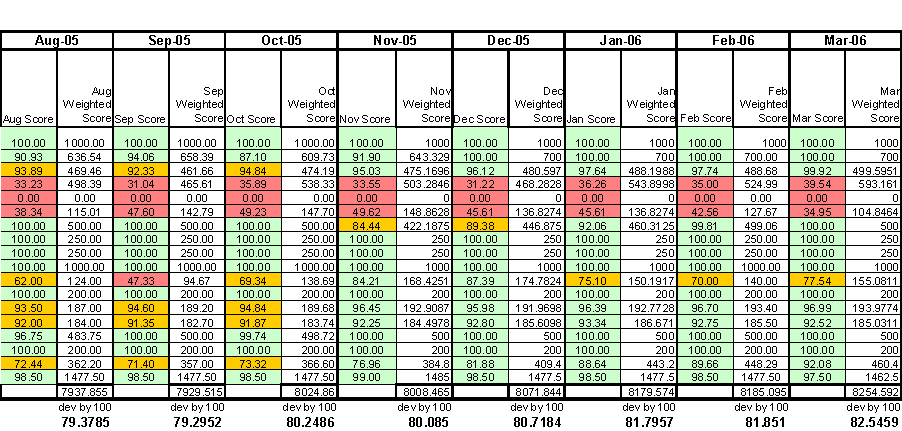
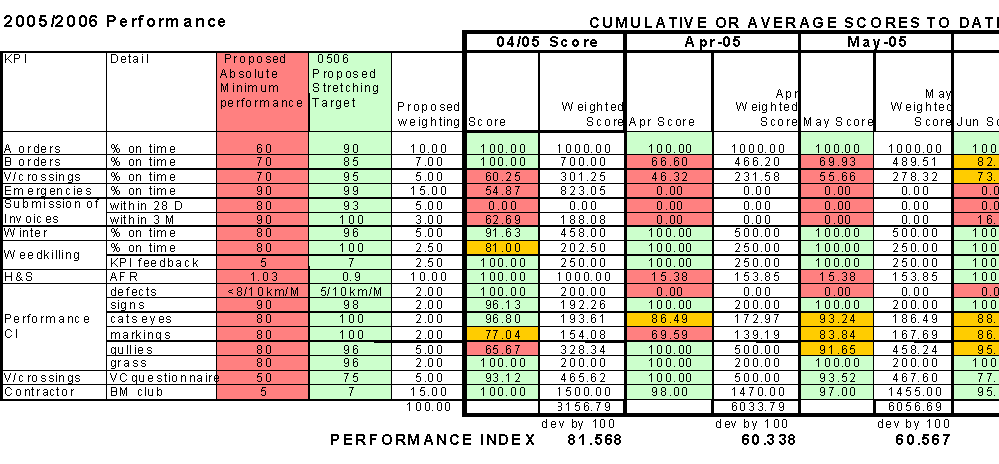
5.3 Details of the KPIs, the target levels and the actual performance improvements achieved in the most recent year of the contract (Year 4, 2005/06) are given in Appendices 1 and 2. The assessment method showed that a small overall improvement in performance in accordance with the agreed targets had been met. Performance in Year 4 is assessed at 82.5% compared with 81.9% in Year 3. The rate of improvement in performance has reduced in the fourth year of monitoring, ie although there is still improvement, it is growing at a smaller rate than in the earlier years of the contract. This levelling off is not unexpected as the scope for further improvements becomes less and less.
5.4 The improvements to performance have been achieved by client and contractor's staff working together to analyse the performance results and identify problem areas. This may be anything from poor performance by a particular contractor's gang (thus needing additional contractor staff training), poor programming (needing more time being spent on priorities and advance planning), poor supply of information by the client staff to the contractor (needing additional client staff training) or delays to invoicing (needing changes to paperwork and IT systems), etc.
5.5 There are regular meetings between client and contractor's staff (weekly for local highway staff looking at specific scheme issues, monthly between Assistant Chief Engineers looking at larger schemes and local programmes of work, and quarterly between Chief Engineers and senior management from RCS looking at county-wide issues). This enables issues at every level to be investigated jointly by the most appropriate staff from both organisations and for the best solutions to be identified and implemented as quickly as possible.
6. Public Survey Information
6.1 As well as collecting technical data about the operational performance of the contractor, public survey information is also collected. This is done in two main ways, through questionnaires issued by Hampshire County Council and RCS to local residents during works and also by analysing telephone calls and correspondence received by the County Council.
6.2 Public Opinion Survey data regarding the general condition of the highway network is not included in this report. This is because it generally relates to factors beyond the scope of the contactor's responsibilities (eg the level of highway maintenance budgets, traffic management policies) and not necessarily to contractor's performance.
6.3 Correspondence and telephone calls relating to contractor's performance received by Hampshire County Council:
Year Complaints Compliments
2003/04 68 4
2004/05 66 16
2005/06 47 14
Over 2005/06 there were 16,280 individual works orders raised. The ratio of complaints to compliments is decreasing. Also, given that people are more likely to complain than send a compliment, the above results are considered good.
6.4 Hampshire County Council questionnaire results from vehicle crossing works:
Year Questionnaires Average Score
Returned
2004/05 364 73%
2005/06 299 73%
Scores are based on a scale of `poor' = 0% and `excellent' = 100%.
Vehicle crossing questionnaires were only introduced in 2004/05 and there is no comparative data for previous years.
6.5 During 2005/06 the RCS questionnaire sheet was subject to modifications as a result of changes to the Works Order procedures arising from the CLIP investigations (see Section 9). There were insufficient forms returned to give a reasonable assessment of performance and hence the results were not considered reliable enough to be included.
7. Members' Concerns
7.1 Both County Council client staff and RCS are keen to ensure that any concerns expressed by Members about performance issues are properly addressed as quickly as possible. Where such issues relate to specific schemes then this is generally best dealt with directly by the local highways staff concerned. Where the issues relate to county-wide or contractual issues, then staff at Headquarters can help.
7.2 Although there have been occasional instances of problems raised by Members about specific schemes, these are relatively few compared to the total number of orders. Below is a table based on data taken from the Department's Public Enquiry Manager system regarding compliments and complaints from Members about RCS performance. More informal day to day contacts from Members are not routinely logged as complaints on the system and therefore will not be included.
Year Complaints Compliments
2003/04 1 0
2004/05 1 1
2005/06 0 2
8. Partnership Initiatives
8.1 As part of the continuing partnership ethos of the TMC, Hampshire County Council and RCS have produced a Joint Business Plan which details the various aspects of the TMC work where there are opportunities for joint efficiency savings and to promote the sustainability and recycling policies of the County Council - see Appendix 3.
8.2 The Joint Business Plan is intended to identify those aspects of the contract where both County Council and contractor's staff are equally involved in the activity concerned and can work together to identify efficiency savings, avoidance of duplication and other service improvements. The items cover a wide range of activities from operational delivery of services, to joint staff training and the production of joint newsletters.
8.3 The partnership between Hampshire County Council and RCS extends to more than just improving highway maintenance works. For example RCS, in conjunction with Adult Services, has recently taken seven teenagers leaving care homes and foster homes, for a three day taster course to experience highway construction works. Since the training, a number of the teenagers have applied for apprenticeships with RCS.
8.4 There have also been continued improvements to the County Council's Depots paid for out of rents received from RCS and in some cases by means of jointly funded improvements by the Council and RCS. By working in partnership it has been possible to provide asset improvements for the better performance of existing and future contracts.
9. Construction Lean Improvement Programme (CLIP)
9.1 This is a national programme supported by Government to encourage more efficient working practices in the construction industry. It follows earlier initiatives by national groups such as Movement for Innovation and Sustaining Construction.
9.2 The CLIP analysis techniques are particularly suited to many of the highway maintenance operations, which involve a mixture of input from both client and contractor's staff, with opportunities to identify and eliminate duplication and put in place more efficient ways of working. The methods require a detailed analysis to be undertaken of the various tasks carried out to deliver a particular service (eg Emergency Response), to look at the times taken for each of the individual tasks and then to think about better ways of achieving the desired end results. A summary of the results from the five CLIP working groups is included below.
9.3 Five CLIP Working Groups were originally set up to look at various issues. The groups have all identified better ways of working, which will result in efficiency savings and improved quality of service.
CLIP Group
· Emergency Response
· Surface Dressing Programming/Pre-Patching
· `A' Road Inspections
· Works Orders
· Winter Maintenance
9.4 The CLIP results are considered to be a major success in identifying efficiency improvements. Savings of approximately £500,000 up to the end of Year 6 of the contract have been identified. These savings will be shared equally between Hampshire County Council and the contractor.
9.5 A sixth CLIP Group (looking at Gully Emptying) has now been established and it is expected that this will also be able to identify further efficiency savings.
10. Contract Costs
10.1 The value of works ordered through the TMC has gradually increased over the life of the contract.
Table showing Value of Works Ordered
Financial Year |
Annual works ordered |
2002/03 |
£26 million |
2003/04 |
£30 million |
2004/05 |
£36 million |
2005/06 |
£34 million |
11. One Year Extension to the Term Maintenance Contract
11.1 The Highways Maintenance TMC was awarded to RCS in May 2002, initially for a five year period. The contract included the option to award up to three, one-year extensions, subject to agreement between the client and contractor, and to the contractor demonstrating continuous improvement and the achievement of agreed performance targets.
11.2 An assessment of the agreed performance indicators for Contract Year 2 (2003/04) and Contract Year 3 (2004/05) shows that the contractor has met the required targets and a one year extension has been offered to, and accepted by, the contractor. The situation with regard to further one year extensions is presently being considered based on the further improvements in 2005/06 and the long term procurement strategy of Hampshire County Council.
12. Impact Assessments
12.1 Assessment of the Race Relations (Amendment) Act has been considered in this report but no adverse impact has been identified.
13. Conclusions
13.1 The Highways TMC is continuing to provide a good service to the highway users in Hampshire. There is a small but steady improvement in the quality of the service and a similar improvement in the public opinion of the contractor.
13.2 The contract provides value for money through the application of the limitations on inflation increases and the refunds from the higher turnover. The CLIP savings are shared between the contractor and Hampshire County Council and demonstrate the benefits of partnership working. The changes to working practices resulting from the CLIP efficiency initiatives will be fed back into the new TMC, which is currently being prepared for, in order that the next contract starts from day one, using the most efficient working methods.
Recommendation
That the Committee notes the performance of the Term Maintenance Contractor.
Section 100 D - Local Government Act 1972 - background papers | |
The following documents disclose facts or matters on which this report, or an important part of it, is based and has been relied upon to a material extent in the preparation of this report. | |
NB the list excludes: | |
1. |
Published works. |
2. |
Documents which disclose exempt or confidential information as defined in the Act. |
TITLE |
LOCATION |
Term Maintenance Contract Documents |
Environment Department Room 409 |
969/AG
APPENDIX 1
Term Maintenance Contract Key Performance Indicators for 2005/06
APPENDIX 2
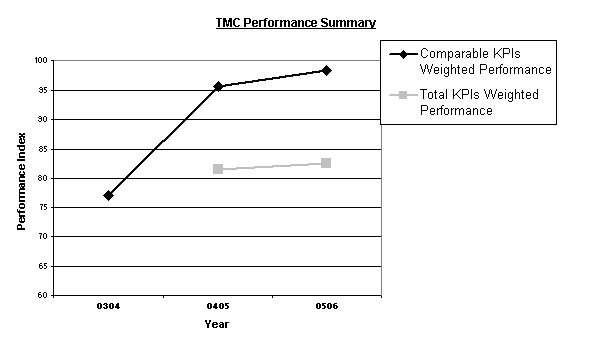
· The `Comparable KPIs' Weighted Performance (darker line) relates to those items originally chosen for assessment and shows the increase in the overall level of performance for years 2003/04, 2004/05 and 2005/06.
· In 2004/05 a number of new items were included for assessment and given much stricter target performance levels to be achieved. The `Total KPIs' Weighted Performance (lighter coloured line) includes the new items.
APPENDIX 3
JOINT BUSINESS PLAN ITEMS AND PROGRESS
Aim 1 - To deliver high quality service to our customers
Monitor feedback and improvement |
Progress so far | |
1. |
KPI level for 04/05 was 81.75%. The target for 05/06 is to exceed the 04/05 figure. |
Target achieved. KPI level of 82.55% met for 2005/06. |
2. |
Monitoring and review results and feedback |
Actioned. |
3. |
Set up regular customer surveys and react to feedback. |
Actioned for Special Maintenance schemes. |
4. |
Set up regular staff surveys and react to feedback. |
In progress. |
5. |
Review Independent Public Survey information and react to feedback. `Speed of repair' Interim action, RCS to consider ways of speeding up work. |
Initial trial carried out. Further sites to be trialled. Trials using larger RCS gangs taking place. |
6. |
Review Hampshire performance against other Authorities and arrange visit to top performer to compare systems. |
Investigations underway. |
7. |
Review incentives for routine maintenance gangs to raise productivity |
RCS investigating. |
Improve communications and information to customers |
Progress so far | |
8. |
Set up roadworks database for access by staff and customers. |
Complete. Roadworks information now available on the internet for all customers. |
9. |
Joint Communication Plan. |
In place. |
10. |
Joint Communications Plan to be widened to include Area 3 Motorways and Trunk Roads. |
Discussions with Area 3 Commission started. |
11. |
Newsletter. |
RCS regularly contributes to County Council newsletters. |
Public safety |
Progress so far | |
12. |
Investigate options to allow RCS to rectify safety related defects when spotted (potholes, etc). |
System in place. |
Aim 2 - To Respect the Environment
Provide an environmentally sustainable maintenance regime |
Progress so far | |
1. |
Programme works to maximise opportunities for recycling |
Methods using recycled materials are now automatically considered as the first option in any maintenance works. |
2. |
Set up and monitor use of `sustainable' contract items |
In place. |
3. |
Promote the use of recycling |
Regular road-shows, workshops and presentations to staff, developers and utility companies are undertaken. |
4. |
Investigate requirements for infrastructure of waste transfer stations |
Business case produced for development of a new site at one of the existing depots. Scheme progressing. |
5. |
Investigate requirements to recycle all black waste generated from patching |
Some work complete. |
6. |
PSA1 target - to achieve a target 40,000T diverted from landfill |
Achieved. |
7. |
Prepare report on the green waste recycling |
Some composting in place. |
8. |
Infra red patching |
Successful take-up of this kind of work. New equipment now on order. |
9. |
PSA2 target - to achieve a target 40,000T diverted from landfill |
Ongoing. |
Aim 3 - To Implement Best Practice and Innovation
Aim 4 - To be a Good Employer
Develop Staff |
Progress so far | |
8. |
Share training opportunities. |
In hand with branch training group. |
9. |
Regular good news etc e-mails. Produce template. |
To progress. |
Aim 5 - To be an Efficient Team