
Archived decisions
Hampshire County Council | |||
Cabinet |
Item 10 | ||
24 July 2006 |
|||
Capital programme review | |||
Report of the County Treasurer and Director of Property, Business and Regulatory Services | |||
Contact: Jon Pittam (01962) 847400 [email protected], and
Andrew Smith (01962) 847826 [email protected]
1 Background
1.1 In approving the capital programme for 2006/07 to 2009/10 in February 2006, Cabinet agreed that:
1 That the County Council continues to lobby the Government to provide full revenue grant funding for Government supported borrowing allocations or provide its support as capital grants
2 That, if the Government does not change the basis for its capital support as outlined above, the County Council limits the use of Government supported borrowing allocations from 2007/08 onwards to the amount that will replace debt falling out as a result of normal debt repayment, so that the total level of annual loan charges rises by no more than the overall increase in the revenue budget
3 That the Director of Property, Business and Regulatory Services review and update the projections of capital receipts and report to Cabinet during summer 2006
4 That the County Treasurer and Director of Property, Business and Regulatory Services review the basis for estimating the cost of fees and report to Cabinet during summer 2006 on proposals for bringing future years' capital expenditure flows into line with available resources
5 That the Executive Member for Adult Social Care be asked to report to an early meeting of Cabinet on the outstanding financing of the following schemes, as originally requested by Cabinet in February 2005, and that the approval of the Adult Services' capital programme be deferred until solutions for the financing shortfall on these schemes has been agreed by Cabinet:
· £1.32m for Social Services' contribution towards the cost of the improvements already made to residential homes for older people
· £0.375m for the replacement day centre for older people in the Hythe and Dibden area
· £1.7m for the shortfall on the SWIFT social care IT system.
1.2 This report deals with each of these issues, starting with the review of the cost of fees.
2 Capital fees for professional resources
2.1 The Director of Property, Business and Regulatory Services comments that for over 20 years the provision made in the capital programme for construction fees in relation to most building projects has been at 16% of the cost of construction work. Fee provision relating to the New Deal for Schools programme, some major projects and capital repairs are set below this at between 6% to 15%. In addition, £680,000 is included in the Policy and Resources capital programme to support feasibility studies and other advance work.
2.2 More efficient working practices and smarter contracting has enabled some of the cost pressures to be absorbed in recent years. For example, planning supervision added 1.5% to the cost of professional fees when the requirement to appoint the role was introduced through legislation several years ago. Similarly, the Property, Business and Regulatory Department has absorbed the cost of establishing a specialist procurement team of five people, while the new procurement arrangements have demonstrably improved the performance of contractors and reduced the need for professional support by virtually eliminating claims. Performance indicators relating to procurement are regularly reviewed by the Buildings, Land and Procurement Panel and are summarised in Appendix 1. However, two factors have put increasing pressure on the 16% fee level: feasibility work and the management of consultants.
Feasibility work
2.3 The most significant pressure facing the Property, Business and Regulatory Department is the preparatory work needed to support new policy developments, such as key-worker housing, major reorganisations such as the Ashburton Court refurbishment and general feasibility studies. During 2005/06, over £1m was needed to support this area of work against a provision in the Policy and Resources capital programme of only £680,000. Since this provision was first established in 2001/02, the funding as a proportion of the overall capital programme has reduced from 1.21% to 0.73% although the need for this type of support is not necessarily in direct proportion to the value of the capital programme.
2.4 It is worth noting that virtually all the time put into preparatory work results in the development of a tangible project. This work is critical to the future successful delivery of projects and in the development of Council priorities. This year feasibility costs in excess of the capital provision of £680,000 are estimated to be between £350,000 and £500,000.
Management of consultants
2.5 During 2005/06 around 33% of work was undertaken by consultants. The reasons for using consultants vary but would principally include:
· the unavailability of in-house resource to meet project timescales
· the need for specialist support, eg acoustic engineering, traffic surveys
· the desire to maintain a `mixed economy' of provision in order to benchmark in-house quality and cost of provision, and to respond to changing work-loads
· lack of sufficient in-house resource, particularly quantity surveying and engineering, increasingly due to an inability to recruit these disciplines.
2.6 It is likely, even if the capital programme reduces or projects are deferred, that consultants will continue to be required particularly to support the hard-to-recruit areas of engineering and quantity surveying and to meet the demand for specialist expertise associated with the Ashburton Court redevelopment, for example. While essential to support the capital programme, employing consultants does nevertheless come at a premium and increases the cost of a project by up to 0.5%.
2.7 A recent review of business processes has reduced the time spent on administering consultant appointments considerably and allowed 0.5fte to be re-deployed into the procurement team, but pressure on in-house staff to manage consultants' performance, as part of a project team, remains considerable. The cost of this management time is estimated to be between £200,000 and £400,000. In the next two years, costs are likely to be at the upper end of this range given the use of consultants in connection with the Ashburton Court redevelopment (£40m) and getting the capital receipts from Merton Rise development in Basingstoke (£60m). This has a disproportionate impact on the Department's most senior managers.
Resource planning and control
2.8 The Department uses a series of fee models in order to estimate the resource and range of professional disciplines needed to deliver individual projects. The fee models are based on commercial fee scales and have recently been assessed to reflect current practice. The accountable manager is responsible for monitoring actual performance against the model and for identifying any interventions.
2.9 The individual resource plans are collated together with the resources used in other areas of work such as feasibility, management of consultants and specialist disciplines thus enabling the total capital fee entitlement to be projected. Taken together the estimated capital fee in the current year will be between £550,000 and £900,000 greater than the 16% provision made in the capital programme representing around 0.5% to 1.0% of the 2006/07 capital programme. As discussed above, this is principally a result of the shortfall of resources associated with feasibility studies (£350,000 to £500,000) and the management of consultants (£200,000 to £400,000).
2.10 It is proposed that the existing provision of £680,000 per annum for feasibility studies and other advance work should be increased to reflect current spending levels when the Policy and Resources capital programme is next reviewed. The increased provision will be met from within the existing guideline for the Policy and Resources capital programme unless additional capital receipts can be achieved to allow the guideline to be increased.
2.11 It is also proposed that the additional cost of managing consultants should be recovered by increasing the provision made by services for fees on standard building schemes from 16% of construction costs to 16.5%, with effect from 2007/08. The lower percentages used for the New Deal for Schools programme, some major projects and capital repairs should also be similarly increased. This will make sure that these costs are recovered across the whole of the building-related capital programme, rather than being an overhead having to be funded from limited local resources.
3 Strategic Property Review, forecasts of capital receipts and meeting the projected shortfall of resources for the capital programme
3.1 The capital programme for 2006/07 to 2009/10 approved by Council in February 2006 was projected to result in a shortfall of capital resources, compared with capital expenditure flows, of £9.3m in 2005/06, £4.0m in 2007/08 and £8.1m in 2008/09. A surplus of resources of £15.9m was estimated in 2006/07. These shortfalls and surpluses are, in part, a result of differences in the cashflow profiles for payments and resources. Overall, the capital programme is projected to be back in balance by 2012/013 with all the shortfalls, provided the estimates of resources prove to be correct particularly for capital receipts. However, it is still necessary to make plans for funding the shortfalls in 2007/08 and 2008/09.
3.2 The actual shortfall in 2005/06, following the closure of the accounts, of £1.9m was less than estimated in February 2006. This was largely because a capital receipt expected in 2006/07 was received a few months earlier. It is likely that there will still be a surplus of capital resources in 2006/07, even after adjusting for the earlier capital receipt. The estimates in February 2006 assumed that this surplus will be added to the Capital Reserve and be used to fund expenditure in 2007/08. Even after using that surplus from 2006/07, there will continue to be a shortfall in 2007/08 of around £4.0m.
3.3 The latest review of the estimates of future capital receipts has not identified any significant increases in 2006/07 and 2007/08. No decision is required now on how to finance the shortfall of £4.0m in 2007/08. It can be taken into account in setting guidelines for the 2007/08 revenue budget and capital programme later in the year.
3.4 In the meantime, efforts will be increased to generate higher levels of capital receipts. Additional receipts, and larger amounts, could be achieved if the County Council undertook additional work to unblock planning delays for sites to be marketed, including preparing transportation and environmental assessment and other advanced feasibility work. It would be necessary to appoint two or three additional development surveyors within the Property, Business and Regulatory Services Department. The cost of these additional employees or equivalent consultancy resources would need to be recovered through much higher, and earlier, capital receipts.
3.5 Provision of £190,000 has already been made on an invest-to-save basis to fund staff to generate capital receipts. Subject to confirmation that achieving higher capital receipts than planned in 2006/07 and 2007/08 is feasible, it is proposed that this provision of £190,000 should be increased to £500,000 for 2006/07 and 2007/08 to help generate additional capital receipts. This £500,000 would include the funding of £150,000 per annum for the Strategic Property Review agreed by Cabinet on 27 February 2006. Future provision will be reviewed at the end of the two-year period in the light of the success in generating additional capital receipts.
4 Use of Government supported borrowing allocations
4.1 Changes by the Government in the way that it calculates revenue support grant for local authorities' capital schemes from 2006/07 were reported to Cabinet in February 2006. Briefly, the Government provides the `support' for its supported borrowing allocations in the form of revenue grant towards the cost of principal repayments and interest charges incurred by local authorities in servicing the loans. The revenue grant formula includes a component that delivers revenue grant to meet 100% of the loan charges, in broad terms.
4.2 If a local authority's grant allocation is so low, however, that it is subject to the floor damping mechanism that guarantees a minimum percentage increase in grant (2.0% in 2006/07 for education authorities), there is no immediate benefit from additional Government supported borrowing allocations in terms of revenue grant to meet the additional loan charges. This is because the increase in the grant entitlement merely takes the authority closer to the minimum floor for grant increases. It does not actually increase the revenue grant at the margin. For authorities such as the County Council that are below the floor by a considerable margin, there is no prospect in the foreseeable future of any benefit from increased revenue grant as a result of taking up additional Government supported borrowing allocations. The cost falls entirely on the council taxpayer.
4.3 Local authorities whose grant increases are above the floor level are also affected because their above-floor grant increases are severely scaled back (by a factor of 84.5% in 2006/07 in the case of education authorities) to pay for the cost of the floor. So they too receive little benefit in terms of revenue grant for taking up Government borrowing allocations from 2006/07 onwards.
4.4 In previous years, this issue was acknowledged by the Government and the floor damping mechanism prior to 2006/07 included a `capital adjustment' intended to give authorities some revenue grant benefit from additional borrowing allocations. However, the Government has decided to remove the capital adjustment from 2006/07, possibly because the cost for floor authorities would have increased the scaling factor for authorities that are above the floor to more than 100%, rendering the floors mechanism unworkable.
4.5 The Government could resolve the problem, if it wished, by reinstating an effective capital adjustment or providing all its capital support as capital grants. Representations were made to the Government in the County Council's response to the revenue support grant consultation for 2006/07 and by other bodies such as the County Councils Network and the Local Government Association but to no avail. Ministers argue that the floor mechanism provides all authorities with an adequate increase in grant each year to cover the marginal revenue consequences of utilising supported borrowing allocations. They have not accepted local authorities' perception that grant entitlements at the floor would be the same whether or not any supported borrowing allocations had been awarded and so, at the margin, there is no benefit from using the borrowing allocations.
4.6 There seems little likelihood that the Government will change its position in 2007/08, as it is already committed to a two-year revenue grant settlement extending to 2007/08. There is likely to be more scope for persuading the Government to change the basis of its support from borrowing to capital grant as part of the Comprehensive Spending Review in 2007 (CSR2007) or to restore the recognition of increased capital financing costs in calculating the revenue grant floor. But changes in CSR2007 would not take effect until 2008/09.
4.7 In the meantime, taking into account other pressures on the budget, it is proposed that Cabinet should revise for 2007/08 the current policy of setting capital programme guidelines on the basis that borrowing allocations are taken up in full. This change of policy was foreshadowed in the report to Cabinet in February 2006. Otherwise, the full cost of using Government borrowing allocations in 2007/08 will fall on the council tax. It is suggested that the increase in loan charges is limited to no more than the non-pay inflation assumption in the revenue budget, currently 2.5%. Debt is repaid each year at the rate of the statutory minimum revenue provision of 4%. This will allow some new loans to be raised, equivalent to these repayments, with a neutral impact on the level of loan charges to be financed from the council tax. Adding a further 2.5% of debt outstanding will allow loan charges to increase in line with inflation.
4.8 Applying this limit would restrict the take-up of Government borrowing allocations in 2007/08 to £32m (broadly £20m to replace debt to be repaid in 2007/08 and £12m for the 2.5% increase in estimated debt outstanding at 31 March 2007 of just under £500m excluding unsupported borrowing). This £32m compares with the Government supported borrowing allocations for 2007/08 announced to date of £44.5m, requiring a reduction of £12.5m in the take-up of. borrowing. The following table shows the borrowing allocations.
Table 1 - Government supported borrowing allocations | ||
2007/08 |
||
£000 |
||
Adult Services |
||
Mental health |
336 |
|
Children's Services |
||
New pupil places |
4,445 |
|
New Deal for Schools - modernisation |
7,623 |
|
Schools Access Initiative |
2,143 |
|
Environment |
||
Integrated transport and structural maintenance |
19,952 |
|
Policy and Resources |
||
New Deal for Schools - capital repairs |
8,949 |
|
Single capital pot allocations used to support the locally resourced capital programme |
||
Adult Services |
757 |
|
Children's Services |
253 |
|
---------- |
||
Total |
44,458 |
|
---------- |
||
4.9 The revenue grant lost by the County Council on the borrowing allocations listed in Table 1 because of the Government's changes to the revenue grant system will be £1.3m in 2007/08, rising to £4.4m in 2008/09.
4.10 To enable Executive Members to plan now for reductions in their currently approved capital programmes for 2007/08 and future years, it will be necessary to apportion the £12.5m reduction between services. The basis of apportionment suggested is pro rata to the allocations in Table 1, with the reduction in respect of the single capital pot allocations for Adult Services and Children's Services allocated pro rata to the cash limit guidelines for the locally resourced capital programme as those single capital pot allocations are used to fund the local programme. The reductions are shown in the table below.
Table 2 - Reductions in capital programme guidelines for 2007/08 | ||
£000 |
||
Adult Services |
102 |
|
Children's Services |
3,997 |
|
Environment |
5,733 |
|
Policy and Resources |
2,661 |
|
Recreation and Heritage |
7 |
|
---------- |
||
Total reduction |
12,500 |
|
---------- |
||
4.11 The annual reductions represent about 30% of each service's borrowing allocations, so about 70% of the programmes supported by these allocations will still be able to proceed and be funded by loans. It is proposed that Recreation and Heritage should be required to make a small proportionate contribution to the reductions even though the service does not receive any borrowing allocations directly from the Government. Recreation and Heritage's locally resourced capital programme, along with those of the other services, is partly funded by a share of the single capital pot allocations shown in Table 1.
4.12 As indicated in paragraph 4.6 above, the Government may change the arrangements for supporting local authority capital investment for 2008/09 onwards, following the Comprehensive Spending Review in 2007. If no change was to occur, the rationale for the revised policy on supported borrowing in 2007/08 would apply equally in future years. The delay in conducting the Spending Review from 2006 to 2007 has already had an impact on the planning of Government supported programmes beyond 2007/08 and uncertainty about the future mechanisms for giving effect to Government support adds to the difficulties of planning for the medium term.
4.13 If any further borrowing allocations are announced by the Government for 2007/08, Cabinet will need to decide the level of take-up to be permitted before the schemes are added to the capital programme. If the additional allocation is relatively small, it should be possible to allow Executive Members to use 70% of the allocation.
4.14 Executive Members will be able to transfer funding from other parts of their services' capital programmes to replace the borrowing, subject to Cabinet approval. They could also supplement the reduced level of borrowing by financing the resultant loan charges from elsewhere within their revenue budgets, including any reductions in running costs achieved by capital investment, again subject to Cabinet approval. Funding from capital grants and other sources could also be used to offset the implications of the proposed reductions. For Environment, for example, changes to the funding arrangements for safety cameras may provide some additional resources for financing transport projects.
4.15 The new four-year capital programme for 2007/08 to 2010/11 will be reviewed during the winter for approval in February 2007. However, as it is now clear that no change to the Government's arrangements for support for borrowing allocations is likely in 2007/08, the impact of these reductions needs to be considered as soon as possible, particular with regard to any advance work on preparing schemes for inclusion in the 2007/08 programme.
5 Adult Services' capital programme
5.1 It was acknowledged in the report to the Executive Member for Adult Social Care on the service's final accounts for 2005/06 that the capital programme had not yet been reconciled with the resources available and that a further report would be brought to this meeting of the Cabinet proposing how to achieve that. Accordingly, this part of the report sets out what are judged to be the inescapable capital commitments for Adult Services (including the schemes carried forward from previous years) against the resources available, and demonstrates that there is the potential for future capital receipts to balance the programme. The recommendations are those which would enable that to be achieved.
Adult Services programme to be funded
5.2 The main elements in arriving at the final programme to be funded are:
· Those elements of the former Social Services capital programme which previous budget strategies have acknowledged will be funded through future capital receipt streams. This includes some £0.9m worth of IT spending on the Children's Services related elements of the SWIFT social care IT system. This could be financed from capital receipts estimated at £0.9m expected from the sale of two adjacent Social Services properties known as Woodend and Copsehill in Andover in which services for children were run. The disposal of these properties was agreed by the Executive Member for Policy and Resources in February 2005 but a decision on whether Social Services should retain 100% of the net sale proceeds was deferred until Cabinet had agreed proposals for meeting the shortfall of resources for the Social Services capital programme. It is proposed that the liability for this expenditure on SWIFT and the resources from these capital receipts should be retained by Adult Services.
· Completion of spending on projects already committed, among which SWIFT and e-government IT projects and the furniture and equipment for nursing homes and associated refurbishments of residential homes are notable.
· A minimum future programme to cover statutory requirements, foremost among which are fire and general health and safety work on Adult Services' buildings and Government-driven requirements for IT systems such as the electronic social care record and multi-agency information sharing infrastructure.
· Comparatively small amounts of spending to deal with inescapable demand factors (eg community equipment stock), maintenance of the extra care housing programme which is financially advantageous in the long run, and the Adult Services contribution towards the corporate priority of the new day centre for older people in Challenger Way, Hythe and Dibden.
· No invest-to-save schemes are included at this stage: there is potential for such schemes, for example in home care management systems, enhancements to Occupational Therapy (OT) direct, and development of mobile working, but none of these will be advanced unless there is a business case, approved by Cabinet, that is sufficiently robust to enable them to be funded through additional borrowing under the prudential guidelines. Consequently, there is no impact on the resource requirements.
5.3 The proposed capital programme for 2006/07 to 2009/10 is summarised in Appendix 2. Whilst funding is identified in the following paragraphs to meet this proposed programme, including the shortfall brought forward from previous years, this represents a significant increase in the level of capital expenditure on Adult Services.
Funding available for Adult Services programme
5.4 Adult Services' existing capital guideline for the locally resourced capital programme of £656,000 per annum is supplemented by Government allocations in the form of capital grants for information management and borrowing allocations for mental health services. In addition and not part of the costs shown in Appendix 2, funding for capital repairs and fire precaution works in Adult Services' buildings is provided by the Executive Member for Policy and Resources in the role of landlord. The main mechanism for meeting the shortfall of resources is the use of capital receipts from the disposal of Adult Services properties. The proposed balancing of the programme is based around two key assumptions, as follows.
5.5 First, that the £1.320m contribution to the improvements to homes for older people between 2000/01 and 2002/03, carried out under the Strategy for the Built Estate, can be met from Adult Services' 25% share of the net sale proceeds for Winton House in Winchester. A decision on the use of Winton House capital receipt was deferred in July 2005 when the property was declared surplus, pending this report on the capital funding shortfall. It was acknowledged, however, in the report to Buildings, Land and Procurement Panel that 25% of the proceeds from Winton House should be made available to the then Social Services, after a £1m contribution to the Sir Harold Hillier Gardens Visitor Centre and meeting the cost of relocating a secure tenant from the Winton House site. The exact proceeds from the Winton House site, and the timing of its receipt, are not certain but 25% should be sufficient to cover the £1.320m required for the improvements to homes for older people. In order to provide a more certain basis for Adult Services to move forward, it is recommended that the £1.320m contribution be waived in return for Adult Services' 25% share of the Winton House receipt being retained centrally.
5.6 Secondly, in January 2006 the Executive Member for Policy and Resources considered the use of capital receipts from Adult Service residential properties at Pier House in Lee-on-Solent, Chrismas Lodge in Aldershot and Courtbourn in Farnborough following the re-provision of services. It was agreed that 100% of the capital receipts resulting from those disposals should be retained by Adult Services to fund the fire safety and other requirements of the core stock residential homes. This use of 100% of capital receipts for recycling into the Adult Services capital programme recognises the exceptional issues faced by Adult Services and is the most important single factor in achieving the balanced programme attached as Appendix 2. It assumes that capital receipts of £5.93m will be achieved by re-provisioning the services provided by homes for older people, at Chrismas Lodge, Pier House and Courtbourn, and that these receipts will be applied in support of the property-related element of the Adult Services capital programme. Such action both reduces liabilities (by eliminating the need to carry out work on the buildings) and helps towards funding other work. If any further spend is identified as necessary, then this would have to be funded from further capital receipts generated by additional re-provisioning.
5.7 The recommendations arising from this part of the report are included in the decision sheet as recommendations 6 to 9.
5.8 No adjustment has been made at this stage for the reduction of £102,000 in the guideline for Adult Services' capital programme for 2007/08 which is suggested in section 4 of this report as part of the response to the Government's decision not restore full revenue funding for loan charges arising from its borrowing allocations.
6 Equalities impact
6.1 An impact assessment has been made on the proposals in this paper and shown that they are not discriminatory.
7 Recommendations
a. That the provision of £680,000 per annum in the Policy and Resources capital programme for fees on feasibility studies and other advance work on building-related schemes be increased from 2007/08, when the capital programme is next reviewed
b. That the standard percentage for fees on building-related schemes be increased from 16% of construction costs to 16.5% from 2007/08
c. That, subject to the feasibility of achieving higher than planned capital receipts in 2006/07 and 2007/08, the provision for additional staff or consultancy resources to generate additional capital receipts, funded on an invest-to-save basis, be increased from £190,000 to £500,000 per annum in 2006/07 and 2007/08
d. That the shortfall of capital financing resources in 2007/08 and 2008/09 be taken into account when the capital programme is next reviewed
e. That the failure of the Government to respond positively to representations to provide revenue grant support for loan charges arising from its `supported' borrowing allocations be noted and, as a result,
£000 | |
Adult Services |
102 |
Children's Services |
3,997 |
Environment |
5,733 |
Policy and Resources |
2,661 |
Recreation and Heritage |
7 |
--------- | |
12,500 | |
--------- | |
f. That the requirement for Adult Services to pay its contribution of £1.320m towards the programme of improvements to homes for older people between 2000/01 and 2002/03 be waived by retaining centrally its share of the capital receipt from the disposal of Winton House, Winchester
g. That the plans to fund the required programme of capital investment in Adult Services, incorporating the use of 100% of capital receipts from the re-provisioning of Adult Services residential care homes for recycling into property-related spending on Adult Services be agreed
h. That 100% of the proceeds from the sale of two former Children's Services properties, Woodend and Copsehill, in Shepherds Row, Andover, be retained by Adult Services to cover unfunded Social Services capital expenditure relating to Children's Services
i. That the revised capital programme for Adult Services for 2006/07 to 2009/10, as set out in Appendix 2 of the main report, be approved.
Section 100 D - Local Government Act 1972 - background papers
The following documents disclose facts or matters on which this report, or an important part of it, is based and has been relied upon to a material extent in the preparation of this report.
NB the list excludes:
1. Published works.
2. Documents which disclose exempt or confidential information as defined in the Act.
TITLE FILE
None
Appendix 1
Procurement Initiatives 2006
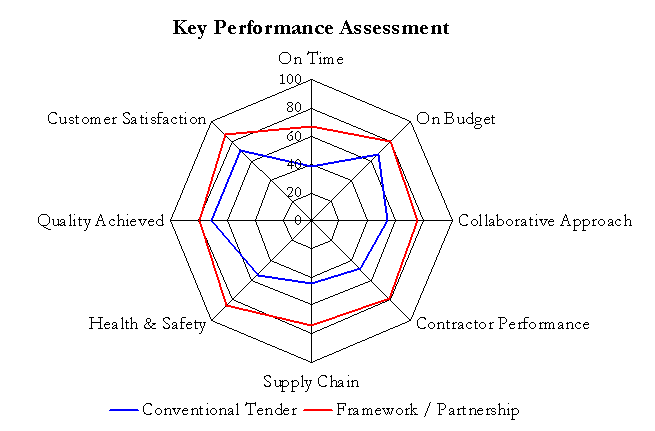
Comparison of major projects procured through conventional tender prior to 2004/5 and projects procured through best value partnership and framework arrangements.
Appendix 2 | ||||||
Adult Services Capital Programme | ||||||
The costs for 2006/07 to 2009/10 include expenditure relating to Children's Services as summarised in the | ||||||
right hand column | ||||||
|
2006/07 |
2007/08 |
2008/09 |
2009/10 |
Children's | |
Services | ||||||
£000 |
£000 |
£000 |
£000 |
£000 | ||
Property schemes |
||||||
Carried forward from 2005/06 |
309 |
164 | ||||
Minor works schemes |
500 |
246 |
246 |
246 |
32 | |
Normal furniture & equipment replacement |
164 |
164 |
164 |
164 |
- | |
Offices |
115 |
92 |
92 |
92 |
- | |
Day centre for older people, Challenger Way, |
||||||
Hythe & Dibden |
750 |
- | ||||
IT Training base |
228 |
- | ||||
Enhance furniture & equipment |
650 |
- | ||||
Contribution to improvements to homes for |
||||||
older people |
1,320 |
- | ||||
Fire precautions etc |
0 |
900 |
900 |
246 |
- | |
--------- |
--------- |
--------- |
--------- |
--------- | ||
Sub-total |
4,036 |
1,402 |
1,402 |
748 |
196 | |
Information systems |
||||||
Swift (2004/05 carry forward) |
1,049 |
367 | ||||
Swift (2005/06 carry forward) |
321 |
112 | ||||
Children's Services DISCS Projects (2005/06 |
||||||
carry forward) |
111 |
111 | ||||
Information Management (SWIFT) |
145 |
126 |
52 | |||
SAP Time Recording System |
0 |
58 |
- | |||
IT equipment |
72 |
72 |
72 |
72 |
- | |
e-Government (2004/05 carry forward) |
204 |
71 | ||||
e-Government (2005/06 carry forward) |
70 |
25 | ||||
Mental Health Infrastructure and Systems |
376 |
198 |
- | |||
Performance Management Information |
0 |
100 |
- | |||
Multi-Agency Information Sharing Infrastructure |
66 |
100 |
100 |
27 | ||
Electronic Social Care Record |
150 |
367 |
500 |
180 | ||
Lone Working System |
50 |
18 | ||||
Web-based Care Choice Older People and |
||||||
Physically Disabled Self Assessment |
10 |
100 |
- | |||
Older People Single Assessment |
5 |
150 |
- | |||
--------- |
--------- |
--------- |
--------- |
--------- | ||
Sub-total |
2,629 |
1,271 |
672 |
72 |
963 | |
Other |
||||||
Extra-care / supported housing |
82 |
82 |
82 |
82 |
- | |
Community equipment stock |
100 |
100 |
100 |
100 |
- | |
--------- |
--------- |
--------- |
--------- |
--------- | ||
Sub-total |
182 |
182 |
182 |
182 |
- | |
--------- |
--------- |
--------- |
--------- |
--------- | ||
Total Programme |
6,847 |
2,855 |
2,256 |
1,002 |
1,159 | |
--------- |
--------- |
--------- |
--------- |
--------- | ||
2006/07 |
2007/08 |
2008/09 |
2009/10 |
Children's | ||
Services | ||||||
£000 |
£000 |
£000 |
£000 |
£000 | ||
Resources |
||||||
Locally resourced capital programme guideline |
656 |
656 |
656 |
656 |
- | |
Carried forward from 2005/06 |
861 |
- | ||||
Information Management - capital grant |
376 |
367 |
259 | |||
Mental Health - Government borrowing allocation |
346 |
336 |
- | |||
Capital receipts - Adult Services properties |
3,580 |
2,620 |
1,050 |
- | ||
Capital receipts - Children's Services properties |
900 |
900 | ||||
--------- |
--------- |
--------- |
--------- |
--------- | ||
Total Resources |
6,719 |
3,979 |
1,706 |
656 |
1,159 | |
--------- |
--------- |
--------- |
--------- |
--------- | ||
Shortfall (+) / Surplus (-) of Resources |
128 |
-1,124 |
550 |
346 |
- | |
Total surplus over the four years |
-100 |
|||||