Archived decisions
Hampshire County Council Health Overview and Scrutiny Committee Item 6 25 July 2006 Proposals to Develop or Vary NHS Services Report of the Chief Executive |
Contact: Denise Holden ex 7338
e-mail: [email protected]
1. Summary and Purpose
1.1. The purpose of this report is to alert Members to proposals from the NHS to vary or develop health services provided to people living in the area of the Committee.
1.2. Proposals that are considered to be substantial in nature will be subject to formal public consultation. The nature and scope of this consultation should be discussed with the Committee at the earliest opportunity.
1.3. The response of the Committee will take account of the Framework for Assessing Substantial Change and Variation in Health Services agreed by the Hampshire, Isle of Wight, Portsmouth and Southampton Joint Committee in March 2005. This places particular emphasis on the duties imposed on the NHS by Section 11 of the Health and Social Care Act 2001.
1.4. This Report is presented to the Committee in 2 parts:
_ Items for information: these alert the Committee to forthcoming proposals from the NHS to vary or change services. This provides the Committee with an opportunity to determine if the proposal would be considered substantial and assess the need to establish formal joint arrangements
_ Items for action: these set out the actions required by the Committee to respond to proposals from the NHS to substantially change or vary NHS services.
1.5. This report and recommendations provide members with an opportunity to influence and improve the delivery of health services in Hampshire and therefore support the delivery of Aim 5 (Improving Services) of the Corporate Strategy.
Items for Information
2. Hampshire PCTs: Hampshire Child Health & Maternity Services: A discussion Paper
2.1. The lead PCT has responded to the Committee confirming the following feedback received to the discussion paper
_ Strong support for joint working and the overall direction of travel, including joint commissioning
_ Acknowledgement of the need for further work with regard to interface issues, specialist commissioning and commissioning care pathways
_ The expert advice and support already available via existing networks
_ A mixed response to the suggestion of a single directorate
_ The importance of health needs assessment and equity audits to inform commissioning
_ Acknowledgement of the challenges that need to be managed
2.2. These points will inform the work supporting the transition arrangements for the new PCT and the development of an implementation plan for taking this work forward.
2.3. Three workshops will be held across Hampshire over the summer to involve and inform all staff who work in child health & maternity services
Recommendation
2.4. That Members are updated on progress with this work at their November meeting.
3. South West PCT Alliance/SUHT: Closure of Maternity Beds and Review of Maternity Services in South West Hampshire
3.1. No further information on this has been provided by SUHT
3.2. The letter to the SHA is attached at Appendix One. No response has yet been received
Recommendations
3.3. Members continue to follow progress with this work.
4. South East PCT Cluster: Maternity Services in South East Hampshire
4.1. Cllrs Wright and Edgar attended the `Grange' open day on 6 June on behalf of the Committee. This provided helpful information about the way in which other birth centres had increased the number of births in these settings.
4.2. PHT has indicated that they may be in a position to reopen the Grange in October or November however figures on current vacancies produced at the Grange open day raised concerns about the feasibility of this intention as the figures relating to long term sickness seemed to show an upward trend.
4.3. The proposal not to invest further funding in the Blackbrook Birth Centre put forward by the PCT has been supported by the MSLC, Blackbrook support group and the Fareham & Gosport P&PIF.
4.4. The Chairman has written to the PCT setting out his concerns about this closure in the context of the delays to the community hospital and asking that the alternative arrangements for maternity services in the area are agreed by the stakeholders, prior to any further action being taken.
Recommendations
4.5. Members are kept up-dated on the progress of the Joint Committee
5. The future of Services in Fareham & Gosport/ South East Hampshire Capacity Plan
5.1. Comments from members in the capacity plan agreed at the last meeting were sent to the SHA.
5.2. No response has yet been received.
5.3. No issues have been raised by Adult Services.
Recommendation
5.4. Members are apprised of the response from the SHA at their next meeting.
6. East Hampshire PCT: Transfer of Older Persons Medicine Services
6.1. The PCT has now produced a paper outlining how it wishes to proceed with this issue (this is attached at Appendix Two). This seeks to address concerns raised by the Committee with regard to the following:
_ There is no clarity about the service specifications or the service model
_ There is no clinical consensus on the transfer
_ The proposal is not in line with the policy direction set out in `Commissioning a Patient Led NHS'.
_ It is not clear what section 11 engagement has taken place
6.2. Portsmouth City HOSC shares these concerns and a joint Committee will consider this issue on 19 July.
6.3. Adult Services has not indicated any concerns about the proposal
Recommendations
6.4. That the Committee confirms the appointment of the Chairman and Vice Chairman and Cllrs Mrs Dickens and Wright to the Joint Committee to consider the transfer of Older Peoples Services.
6.5. The Committee is advised of the outcome of the meeting on 19 July and any further action required.
Items Requiring Action
7. Department of Health: Commissioning a Patient Led NHS
7.1. Lord Warner has now responded to the Committee declining the request for the configuration of Ambulance Services to be referred to the Independent Reconfiguration Panel. This is attached here.
7.2. Warwickshire County Council has concluded that it is not possible to proceed with a judicial review of this decision
Recommendation
7.3. The concerns raised by Members with regard to the Ambulance Service are raised with the new management team for a detailed response.
8. South West Alliance PCTs: Neurology Rehabilitation Services
8.1. This issue, formerly raised as an inquiry with the Committee is now subject to formal consultation that commenced on the 11 July. This is attached for consideration by members at Appendix Three.
8.2. The Chairman has requested, on behalf of the Committee, that a report is received at the September meeting outlining the outcome of the Consultation process and resulting changes to the proposal
Recommendation
8.3. Members advise the Health Review Manager of any issues to be flagged to the PCTs in response to the consultation by 15 August
8.4. A presentation on the outcome of the consultation is made to the Committee at its September meeting.
9. Department of Health: A Stronger Local Voice: A Framework for Creating a stronger local voice in the development of health and social care services.
9.1. This suite of documents was published on 13 July and circulated electronically to members. It outlines changes to the way P&PI in health will be supported in the future as well as the integration of this requirement with social care commissioning and provision.
9.2. Comments on the proposals are invited by the 7 September.
9.3. For ease of reference a short briefing paper will be circulated to provide members with the key points covered by the documents.
Recommendations
9.4. Any views are shared with the Chairman or Health Scrutiny Manager by 29 August for inclusion in the response of the Committee.
Section 100 D - Local Government Act 1972 - background papers
The following documents disclose facts or matters on which this report, or an important part of it, is based and has been relied upon to a material extent in the preparation of this report.
NB the list excludes:
1. Published works
2. Documents that disclose exempt or confidential information as defined in the Act.
File Location
RE/ |
|
7 June 2006 |
|
A. Health Overview and Scrutiny Committee | |
Elizabeth 11 Court, The Castle | |
Eileen Spiller Acting Chief Executive Hampshire & Isle of Wight SHA Oakley Road Southampton SO16 4GX |
Winchester, SO23 8UJ |
Telephone 01962 847338 | |
Fax 01962 867273 | |
E-mail [email protected] | |
www.hants.gov.uk | |
Dear Eileen
Changes to Maternity Services in Hampshire
I am writing by way of follow-up to my comments on the discussion paper outlining a strategy for a Hampshire wide approach to maternity and child services. This was a very helpful document and one that our members strongly supported. My purpose in writing to you at this juncture is to ask that the Health Authority defers current proposals from south east and south west Hampshire about possible changes to the pattern of maternity provision until there is clarity about the direction of travel across Hampshire as a whole. The paper prepared by South West Alliance PCTs, if carried forward, would enable this to happen. My reasons for requesting this deferral are as follows:
· The poor information about the health needs and demand for maternity and child health provision across Hampshire, including identification of vulnerable groups.
· Variations in the provision of, and access to, services across the county. Agreed care pathways need to be defined and the views of locality commissioners secured. We were concerned to hear recently that some screening, including that for Downs's syndrome, was not available in some areas. We need to be clear what is available and where.
· Conflicting professional advice about the models of care that can be provided safely in different care settings.
· The need for options to be fully informed by evidence, including changes to the deployment and organisation of staff that can impact on choices made by women and their families.
South east Hampshire has already indicated its intention to postpone further work on the options appraisal until the autumn. We believe that the proposals currently being prepared for south west Hampshire should do likewise, clearing the way for the development of a coherent and consistent approach to the provision of maternity services across the Hampshire, with full engagement of local people.
I hope you will feel able to give this request your full consideration and look forward to hearing from you.
Cllr Dr Raymond J Ellis C.Chem FRSC
Chairman, Health Overview and Scrutiny Committee
cc |
Health Overview and Scrutiny Committee Cllr David Stephen Butler Cllr Peter Marsh Jenks John Richards Ann Kelly John Wilderspin Ursula Ward Mark Hackett |
Appendix Two
DEPARTMENT OF MEDICINE FOR OLDER PEOPLE -
TRANSFER OF MANAGEMENT RESPONSIBILITIES
1 1.1 |
INTRODUCTION This document outlines proposals for the transfer of management responsibilities for services provided by the Department of Medicine for Older People. It has been produced to inform stakeholder involvement and engagement in the process, with a view to endorsing the proposals set out in Section 5, which have been produced with the involvement and agreement of the following organisations: · East Hampshire/Fareham and Gosport PCT Cluster · Portsmouth City Teaching PCT · Portsmouth Hospitals NHS Trust | ||||||
1.2 |
Discussions have taken place over a number of months between key clinical, managerial and staff representatives from each of the organisations involved so that appropriate new arrangements could be put in place for the future management and ongoing development of the service. | ||||||
1.3 |
These proposals are not related to the way services themselves are provided directly to patients. The discussions and subsequent proposals have been about how services could be managed most effectively into the future. | ||||||
2 2.1 |
I. BACKGROUND The management responsibility for the Portsmouth and South East Hampshire Medicine for Older People secondary care services transferred to East Hampshire Primary Care Trust in April 2002 on the dissolution of Portsmouth Health Care Trust, the former host organisation. East Hampshire PCT provides this service to the population of East Hampshire, Portsmouth City and Fareham and Gosport. This was part of a wider set of hosting arrangements agreed through a stakeholder consultation process and which resulted in each of the three South East Hampshire Primary Care Trusts hosting a major care group/service. It was felt at the time that a Primary Care Trust was the most appropriate host organisation as it could facilitate a closer integration between acute and community care services and ensure a priority focus was maintained on a key care group. As this was at the time (and still is) an arrangement not widely replicated across the rest of the country, it was proposed that the hosting arrangements would be reviewed after 18 months to confirm whether the arrangement should continue. In the event wider organisational changes meant that this review was not carried out at that time. | ||||||
2.2 |
However, during 2005-06 East Hampshire PCT (by now working formally as a `cluster' with Fareham and Gosport PCT) undertook a review of its major hosted clinical services, with a view to finding the most appropriate hosting arrangements for them to develop in the future. Alongside this, in July 2005 the Department of Health published "Commissioning a Patient-Led NHS', a document that emphasised that Primary Care Trusts should focus on commissioning services and increasingly withdraw from service provision. This paper also indicated a review of the configuration of Primary Care Trusts, Strategic Health Authorities and Ambulance Service Trusts. Proposals in Hampshire and the Isle of Wight have been for the creation of a single Primary Care Trust coterminous with the County of Hampshire. This has recently been agreed by the Secretary of State and will result in the dissolution of East Hampshire Primary Care Trust on 30th September 2006. | ||||||
2.3 |
This outcome had been anticipated from earlier consultation and led East Hampshire PCT to expedite thinking around the most appropriate future hosting arrangements for the Medicine for Older People service, particularly in view of the organisational change. The change will enable the new PCT to focus on its core function of commissioning appropriate pathways for patients, including older people, rather than providing large secondary care elements of those services. | ||||||
2.4 |
Since the decision was made to review the current provider/management arrangements for these services there have been many meetings and discussions between clinicians and managers across the health economy. During this time, a number of different models for managing the service emerged, each of which had varying degrees of support. The model agreed upon and presented in this paper, represents the most appropriate and workable solution at the present time. | ||||||
2.5 |
The proposed model for the transfer of management responsibilities: · Maintains clear clinical responsibilities across a number of different providers. · Enables the future shape and modelling of older people's services to take place within a strong commissioning framework. · Maintains a `steady state' provision for clients and their families which will be important during this time of wider organisational change. Continuity of a safe service, with as little disruption as practically possible to the care pathway for this vulnerable patient group, is paramount. | ||||||
2.6 |
It is recognised that all the PCTs' commissioning intentions for this service are at different stages of development (including Practice Based Commissioning) and there may be proposals for change to the current model and service provision in the future as these new arrangements evolve. The changes will be subject to consultation with the relevant parties at the appropriate time. | ||||||
2.7 |
It is clearly imperative that the expectations outlined in Commissioning a Patient Led NHS and the more recent White Paper `Our Health, Our Care, Our Say' can be met, and the management arrangements being proposed will need to continue to ensure the effective delivery of these policy documents and more generally:
· Requirements of the National Service Frameworks for older people · Development of Practice Based Commissioning · Patient choice · Management of long term conditions · Need to improve the health care environment · Greater emphasis on wellbeing and the prevention agenda · Efficiency, affordability and Payment by Results · Patient safety and quality standards | ||||||
2.8 |
The other models discussed were: · Transfer the management of all the beds and day hospital on Queen Alexandra and St Mary's site to Portsmouth Hospitals Trust, with the remaining services managed by the PCTs. · Transfer the management of all the beds on the Queen Alexandra site and some on the St Mary's site with the remainder of these beds managed by the PCTs. · Various permutations were discussed and discounted because at the current time this would introduce too high a clinical risk and destabilise the patient pathway. | ||||||
2.9 |
All parties in these discussions sign up to the value that in any service change, whether clinical, or, as in this case where management arrangements are concerned, the needs of the patient must be the prime focus. The proposed transfer of the hosting arrangements for the service will also offer the potential to improve the patient journey through all health care services - primary, community and secondary care and find the most appropriate provider of service for each aspect of this journey. | ||||||
3 3.1 |
CURRENT SERVICE PROVISION The majority of services for older people are delivered by primary and community care, in conjunction with other secondary care specialties and Social Services. The Department of Medicine for Older People provides a full range of specialist services for frail, vulnerable elderly people who have multiple pathologies. This includes acute inpatient care, rehabilitation, palliative care, continuing care, day hospitals, outpatient clinics, domiciliary visits and community geriatrics. | ||||||
3.2 |
Within this, a wide range of sub-specialties are encompassed, such as stroke, falls, orthogeriatrics, bone health, Parkinson's disease and syncope. | ||||||
3.3 |
These services are provided for the whole district in a variety of settings, including acute and community hospitals and the patient's own home. The medical team and some specialist nurses, whilst based in the acute hospital setting, work across the district in acute and community settings. | ||||||
3.4 |
Where appropriate the specialist service offers support and advice to primary, community and other providers of service to enable them to meet the needs of the older person - this team includes doctors, nurses, physiotherapists, occupational therapists, speech and language therapists and administration and management staff. | ||||||
3.5 |
Current service provision is as follows: A. HOSPITALB. WARDSPECIALTY 1. BEDS/PLACESQueen Alexandra Philip Acute Acute Stroke 13 6 Mary Acute Stroke 19 Ann Acute 18 Charles Acute 15 St Mary's Exton 7 Acute 26 Blendworth 1 Acute 22 Ashdown 1 Palliative Care 8+6 Guernsey Stroke Rehabilitation 20 Exton 5/6 General Rehabilitation 27 Amulree Day Hospital 15 Trevor Howell Day Hospital 15 Outpatient Clinics Jubilee House, Cosham NHS Continuing Care 25 Community Community Stroke Rehabilitation Team Stroke Rehab for City and SE Hants) 18 Virtual Petersfield Community Hospital Cedar Rehab General and Stroke continuing care assessment 25 Laurel Day Hospital 10 Outpatient Clinics Wenham Holt, Liss NHS Continuing Care 16 (block purchased) Gosport War Memorial Hospital Dryad Stroke Rehabilitation 20 Daedalus General Rehabilitation 24 Dolphin Day Hospital 15 Outpatient Clinics |
||||||
4 4.1 |
PROPOSAL FOR FUTURE MANAGEMENT ARRANGEMENTS The proposal for future management arrangements for the service has been agreed by East Hampshire/Fareham and Gosport PCTs, Portsmouth City Teaching PCT and Portsmouth Hospitals NHS Trust and the Department of Medicine for Older People. It now needs to be formally shared with key stakeholders and other interested parties for discussion and final agreement. |
||||||
4.2 |
There is broad agreement that any solution should ease and improve the patient journey through different aspects of the service - primary, secondary and community care. It should also ensure that links into social care are facilitated and enhanced and that key national drivers for change, such as increased choice, care in a variety of settings closer to home and cost effective and efficient services are embraced. |
||||||
4.3 |
The PCTs recognise that there is a requirement for a `medicine for older people' specialism and that to ensure a steady state transfer, this should be transferred to the acute sector, the main focus being the care of frail, vulnerable elderly people, particularly during an acute episode. There is also a requirement for specialist input into a wide range of community based services including consultant led outpatient clinics, domiciliary visits, links to intermediate care, support and advice to primary care. Furthermore, there is a need for consultant influence in service provision along the whole pathway through the support, training and development of other health care professionals. |
||||||
4.4 |
Importantly, the PCTs also believe that the appropriate place for the provision and management of pre and post acute services should continue to be within primary care, alongside other intermediate care, community and Social Services. This will ensure congruency with commissioning intentions and patient choice where there is a range of acute providers. |
||||||
4.5 |
Under the proposal, hosting arrangements would be simplified with Portsmouth Hospitals Trust taking responsibility for all the acute care aspects of the service, day hospitals (with the exception initially of the Laurel Day Unit in Petersfield, from which services will be delivered as a pilot working closely with the Department of Medicine for Older People) community stroke services and certain wards at Gosport War Memorial Hospital and Petersfield Hospital. Host Organisation Responsible for Portsmouth Hospitals NHS Trust · All wards at Queen Alexandra Hospital · All wards at St Mary's Hospital + Trevor Howell and Amulree Day Hospitals · Outpatients · Community Stroke (SE Hants, PCPCT) · Cedar Ward, Petersfield Hospital · Dryad/Daedalus Wards, Gosport War Memorial Hospital · Dolphin Day Hospital, Gosport War Memorial Hospital Portsmouth City PCT · Jubilee House East Hampshire PCT · Laurel Day (as a pilot - see Appx 1) · Wenham Holt In addition the following principles would apply: - The current SLAs and service provision relating to therapy services may need to be reviewed by all three organisations but on the agreed date of transfer would remain unchanged. - The ownership of premises would remain unchanged. - GP beds currently at Havant War Memorial Hospital, Rowan Ward (Petersfield Hospital) and Sultan Ward Gosport War Memorial Hospital, would remain unaffected by this proposal. - The current service specifications will transfer with the service. |
||||||
|
Transfer of this specialist service into the acute provider offers a number of benefits, ie: · Centralisation and clarification of the acute core business functions · Simplified operational management of acute and specialist community wards · Further improvement of acute patient pathway - contributing to 4 hour A&E trolley wait target · Opportunity to develop services that span the acute and community interface · Integration and closer working between this specialist service and other secondary care services · Safer governance arrangements across acute and community wards · Economies of scale; support functions, staff education, risk management etc · Access (for the specialist service) to the enhanced support service infrastructure of the acute trust · Simplification of acute sector commissioning discussions and SLAs |
||||||
4.7 |
It must be acknowledged that there are also a number of risks associated with this proposal, ie · Medicine for Older People service may be encouraged to focus on acute care, to the detriment of community services and the acute/community interface · Insufficient priority focus on the Medicine for Older People service, once placed alongside other secondary care specialisms · Potential limitation of PCT bed based intermediate care services. These risks would be mitigated by the development of a District-wide Strategic Board, with a clear focus on the development of integrated services for older people across all organisations. In addition, named senior managers and clinicians from the Medicine for Older People service would act as identified links with the Practice Based Commissioning clusters and local primary and community services and the service will be monitored via the SLA and service specification. Acute and community services share a common goal in seeking to avoid acute hospital admissions, unless essential, and in facilitating timely discharge. This joint goal would be the driving focus to ensure that an effective balance is achieved between care provided inside and away from hospitals and that the interface between services is enhanced - not just between primary, acute and community services, but between hospital services generally. |
||||||
4.8 |
The proposal would also enable the Primary Care Trusts to shift their focus towards commissioning services, in line with the Commissioning a Patient Led NHS guidance. As a consequence, it is recognised that commissioning intentions within different PCTs may evolve in different ways, perhaps with differing priorities. This proposal acknowledges the possibility that there may be further developments in the future recognising the developments taking place at Queen Alexandra Hospital, Community Hospital and the outcome of the capacity map discussions. |
||||||
4.9 |
In summary, both the direction of travel captured in `Commissioning a Patient Led NHS' and associated anticipated organisational changes, together with experience of hosting secondary care services, strongly support a move towards focusing the new PCTs on their main tasks - commissioning, and the provision of primary and community services, rather than the continued provision of secondary (and, in particular specialist) care services. The proposed transfer of the specialist Medicine for Older People service has the potential to improve the patient experience whilst in the acute hospital and commissioning arrangements will need to ensure that mechanisms are in place to provide a seamless transition between acute and community care, and that systems are in place to monitor conformance to any service level agreements in place and the revised patient pathway. There is no financial implications of this transfer as money associated with the management of this service would transfer to the relevant organisation. |
||||||
4.10 |
Once final agreement on the proposal is reached, arrangements would be in place for the transfer of all management responsibilities, before the dissolution of East Hants PCT, on 1st October 2006. |
||||||
5 5.1 |
STAKEHOLDER ENGAGEMENT In order for this proposal to be thoroughly tested, it is the intention of the PCTs and Portsmouth Hospitals NHS Trust to engage key stakeholders and interested parties in the decision making process, but emphasising that the proposals set out here concern the management of services and not the way in which they are provided to patients. |
||||||
5.2 |
Stakeholders to be included in this process are: Clinicians and staff within the service (including community) PCT boards, staff and managers Portsmouth Hospitals staff and managers GPs and Primary Care Services Social Services - Portsmouth and Hampshire District and Borough Councils Overview and Scrutiny Committees Patient and Public Involvement Forums Voluntary Organisations - Age Concern (Havant and Portsmouth), Help the Aged, Pompey Pensioners, Alzheimers' Society Salvation Army Councils of Community Service Leagues of Friends Service User groups MPs SHA Patient Experience Council - Portsmouth Hospitals Trust Patient Experience Group - East Hampshire PCT Carers Together - Hampshire |
||||||
5.3 |
Staff Consultation and Communication The arrangements for staff to transfer within a service to a different organisation are detailed within the Transfer of Undertakings (Protection of Employment) Regulations 1981, commonly known as the TUPE regulations. The regulations require the employing organisation to identify the staff attached to a specific service and to ensure those staff are transferred to the new employer with protection of employment terms and conditions. The general rule is that no staff should receive less favourable treatment because of the transfer of the service to a different employer. There is a requirement to consult with the appropriate Trade Unions and Professional bodies and in past examples of TUPE transfers locally, three months' written notice of the transfer has been given in this respect. There are no set rules regarding written notice to staff affected by the transfer, but the NHS has a strong culture of informing and involving staff to ensure they have adequate opportunity to be prepared for the transfer. Key staff, such as operational leads and HR staff, will be working with the receiving organisation to ensure a smooth integration of working arrangements, such as HR policies and procedures take place. The more difficult issue is the fragmentation of support services, such as finance and risk management support, where a staff member will work across many different areas. Attention needs to be paid to staff working within support services are offered opportunities within the new providers of service to ensure true compliance with TUPE regulations and minimise redundancy compensation payments. Proposals for ensuring staff are aware of the transfer include: regular communication bulletins, team meetings, HQ roundups. There will be an HR and Communications group established to oversee the effective transfer of staff within the Medicine for Older People Services. |
||||||
5.4 |
Other Stakeholders In addition to sharing this document, stakeholders will be invited to attend a series of Workshop/Discussion events - one at least to be held in each locality. These will include presentations on the proposal and an opportunity to discuss the implications and give feedback. There will be a meeting with the joint OSCs in July, when the outcome of stakeholder engagement will be discussed. |
||||||
5.5 |
It is proposed that a month is allowed for this work to be carried out so that a final proposal can be presented to PCT/Portsmouth Hospitals boards in June/July. |
||||||
Appendix Three

Public Consultation Document
Modernising Rehabilitation Services
11 July - 26 September 2006
Contents
1. Summary 4
· Relocation of neurological rehabilitation services based at Snowdon House 4
· Have your say 4
2. Background 5
· Links with NHS strategic plans 5
3. Introduction to Snowdon House 6
· Current usage of beds 6
· Links with the local health economy 6
4. The proposals 7
· Clinical advantages 7
· Jobs 8
· Site use 9
· Links with Victoria House at Southampton General Hospital 9
5. Options 10
A. The Western Community Hospital Site 10
· Younger patients 10
· Respite care 11
· Jobs 11
· Transport 11
· Improved access to services 11
B. Royal South Hants Hospital 12
· Respite care 12
· Transport 12
· Improved access to services 12
C. Snowdon House 12
6. The Issues 13
· Option A 13
· Option B 13
· Option C 13
7. What decisions have already been taken? 13
8. Your views count 13
· Listening and engaging with stakeholders 14
· What will the changes mean for people using the services 14
9. Contact us 15
10. Timescales 15
11. Feedback 15
12. Glossary of terms 15
13. Appendix 1 17
Modernising Rehabilitation Services
Public Consultation Document
1. Summary
1.1 The latest government white paper `Our Health, our care, our say: a new` direction for community services' published in January 2006, highlights the move of care from hospital beds to more care in the community. The white paper also sets out how services will focus on maximising people's independence so they can remain in their own home and minimise the amount of time people need to stay in hospital.
To enable us to meet these objectives we are proposing changes to our hospital services so patients receive the best possible care in the best place for them. This consultation is on one of the proposed changes, the relocation of the neurological rehabilitation service from Snowdon House.
1.2 Relocation of the neurological rehabilitation services based at Snowdon House
We propose to achieve this by considering some changes as follows:
· Relocating the neurological rehabilitation service and beds run by Southampton City Primary Care Trust (PCT) from Snowdon House at Ashurst Hospital to the Western Community Hospital, in Millbrook. The relocation of these patients to the Western Community Hospital site gives us an opportunity to develop closer links with the Wessex Neurological Centre and the work of the rehabilitation unit at Victoria House both based at Southampton General Hospital (see page nine for more information). This is not a redesign of the service, but a relocation to a more central and suitable site.
· Bringing together general rehabilitation beds at the Royal South Hants Hospital in the recently established community wards.
1.3 Have your say
We would like to know what you think of our plans and help us develop these proposals. To enable us to do this we are undertaking a formal public consultation for 11 weeks between 11 July 2006 - 26 September 2006.
This document is available from the Southampton City PCT website, www.southamptonhealth.nhs.uk or by contacting the PCT using the contact details at the end of this document.
We are advertising the document and consultation period to the residents of Southampton and the New Forest, Eastleigh and Test Valley. We are also working closely with our staff, patients and user and carer groups and other stakeholders to ensure they are fully informed, engaged in the process and have the opportunity to help us develop our proposals.
The information will be circulated widely to:
· staff
· doctors surgeries and health centres
· out of hours primary care centres
· walk-in centres
· pharmacists
· accident & emergency departments in Southampton
· primary care trusts in Eastleigh and Test Valley South, New Forest and Mid Hampshire
· local councils
· Southampton and Hampshire social services
· MPs
· Southampton and Hampshire Overview and Scrutiny Committee
· patient forums/user groups
· libraries
· local media.
2 Background
There has been an increasing awareness over the last few years that the Hampshire and Isle of Wight health service has to radically change hospital and community services in order to modernise and redesign services. The focus of care is increasingly moving towards keeping people in their own home wherever possible, avoiding admission to hospital, where treatment can be given in a different way. If hospital care is necessary the best thing for patients is to be able to return home as soon as possible. This is through a combination of rehabilitation work while in hospital and the right care available at home. It is planned that our proposal to relocate the neurological rehabilitation service from Snowdon House, will not only improve accessibility and quality of care for patients, but will also increase efficient use of NHS resources.
Links to NHS strategic plans
In March 2006, the Mid and South West Hampshire local health community undertook a review of health services. As a result of this review the paper `A health plan for greater Southampton' was written. The paper outlines some of the main aims for the health community in the areas of Southampton City, New Forest, Eastleigh and Test Valley. These include:
· to provide modern, safe and sustainable services for patients
· improving access to health services for local people
· creating more choices for patients
· shifting work from hospitals to the communities where people live.
For a copy of the full Health Plan for Greater Southampton, please contact the Patient and Public Involvement office on 023 8029 6932.
3 Introduction to Snowdon House
Snowdon House is based on the Ashurst hospital site and provides a neurological rehabilitation service for adults from 16 to 65 years of age. The purpose of the service is to provide assessment, treatment and review a range of care rehabilitation and support interventions to meet the individuals' needs.
Service delivery is directed towards encouraging people to maximise their independence and take responsibility for their healthcare wherever possible, and where restoration of health is not possible, supporting people and their carers/family with their progressive illness.
Snowdon House cares for patients with conditions such as Multiple Sclerosis (MS), Motor Neurone Disease, Congenital Neurological Deficit, Huntingdon's Disease, Parkinson's Disease, and younger stroke patients.
The beds at Snowdon House are used by patients from Southampton City, New Forest, Eastleigh and Test Valley South and Mid Hampshire.
Current usage of beds
The table below shows how many patients from the different areas used the service during the period April 2005 to March 2006. .
Area |
Number of patients |
Percentage |
Southampton City |
48 |
51% |
New Forest |
30 |
32% |
Eastleigh and Test Valley South |
13 |
14% |
Mid Hampshire |
3 |
3% |
Total |
94 |
100% |
Links with the local health economy
Until December 2005 New Forest and Eastleigh and Test Valley PCTs commissioned nine neurological rehabilitation beds from Southampton City PCT, which were among the 15 beds located at Snowdon House. In 2004 the PCTs invested £98,000 in community neurological rehabilitation services across the two areas with the aim of providing more neurological rehabilitation services outside of a hospital-based setting. Since January 2004 there has been a reduction in usage of these beds by patients from both Eastleigh and Test Valley South and New Forest
The table below shows the reduction in use of beds for New Forest and Eastleigh and Test Valley South.
Primary Care Trust |
Year |
Number of days that beds were used |
New Forest |
04/05 |
1918 |
05/06 |
923 | |
Eastleigh and Test Valley South |
04/05 |
833 |
05/06 |
666 |
In January 2006 the two PCTS reviewed the demand for the service following the closure of a further five beds at the unit due to staffing difficulties. As use of the service had reduced over the previous two years to an average of four beds from July - Dec 2005, the PCTs decided to commission four beds from Southampton City PCT at Snowdon House from January 2006. As part of these plans the PCTs have identified funding which can be used to purchase care in the private sector to meet the needs of individual patients should this be required.
4 The proposals
Southampton City PCT proposes to relocate neurological rehabilitation beds from Snowdon House at Ashurst Hospital to the most appropriate location. This will:
· provide opportunities to make better use of our hospital buildings
· provide better nursing and medical cover
· provide improved therapy facilities
· bring together neurological rehabilitation services on one site - combining the Western Community Hospital stroke unit and the neurological rehabilitation service from Snowdon House
· resolve the isolated position of Snowdon House both physically and from the service delivery aspect
· make staffing easier to manage as there would be the potential to work flexibly to cover sickness, annual leave and training leave
· improve security for staff with only one site to cover.
· allow staff expertise and cover to be improved by the opportunities of closer working with other staff in a shared location.
We have developed this proposal and the options in discussion with stakeholders, users, carers and staff.
Vicky Butt, Parkinson' s Nurse said "Some patients with Parkinson's disease have a number of different conditions. If all the specialist nurses were based on the same site it would make professional working much easier."
Clinical advantages
There are many clinical advantages for patients by relocating the service to a more central location. The service is currently very isolated and clinical support which can be given to staff is limited at the moment because of the position. By moving the service we would be able to provide better nursing and medical cover along with improved therapy facilities at the Western Community Hospital.
If the unit is moved to Western Community Hospital we would be able to bring together all neurological rehabilitation services onto one site. This would enable staff with similar specialist skills to share knowledge and provide expert medical and nursing care. This would resolve the staffing problems currently being experienced at Snowdon House.
Recommendation from the National Institute for Clinical Excellence (NICE), clinical guidelines for Multiple Sclerosis (MS) state:
"Specialist neurological and neurological rehabilitation services should be available to every person with MS, when they need them. This is usually when they develop any new symptom, sign, limitation on activities, or other problem, or when their circumstances change."
Dr David Paynton, Professional Executive Committee Chair for Southampton City PCT said: "We must ensure we deliver services which meet NICE guidelines as detailed above and our patients receive the highest level of care."
All consultants involved in the care of neurological rehabilitation patients have been consulted and support the relocation of the service to a more central location.
Dr Hutchings, Consultant in Rehabilitation Medicine said "I would like to see Snowdon House located on a site where others are engaged in similar rehabilitation. I would like to be in a less clinically isolated unit, where there is better medical and nursing cover. This will enable us to take people earlier in their rehabilitation phase, ensure better staff support, and easier recruitment of staff."
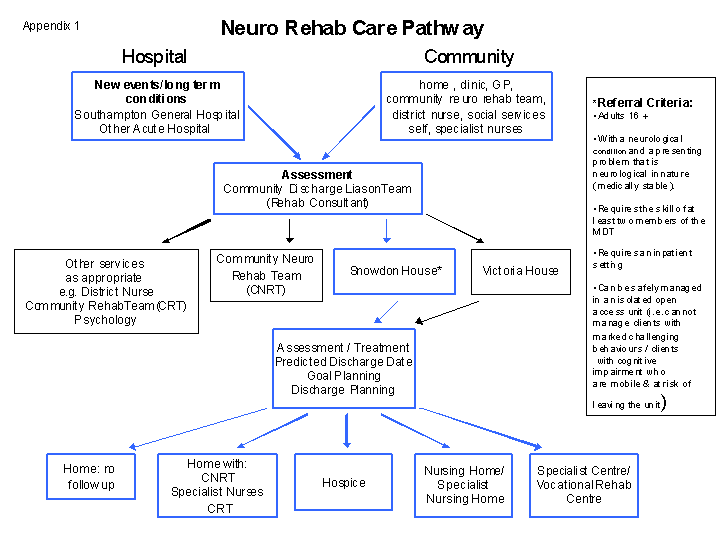
The doctors, nurses and therapists who provide neurological rehabilitation services are working together to re-develop the patient care pathways. This will ensure wherever patients with neurological rehabilitation needs enter the health service, in the acute hospital, community hospital or in the community their needs will be identified and managed in the best way for them and their families.
Appendix 1 shows the existing patient care pathway.
Jobs
The number of care staff currently in post at Snowdon House is 19.82 full time equivalent staff. In negotiation with staff, the plan is for all of these staff to transfer with their patients to Western Community Hospital.
Existing Riverside ward care staff numbers are 24.34 full time equivalent staff. All of these staff will either transfer with the patients to the Royal South Hants hospital or some may remain at the Western Community hospital. These options will be discussed individually with staff and their preferred option agreed wherever possible as service needs allow.
Site use
This move would also enable South West Hampshire PCTs and Southampton University Hospitals Trust to develop services for people in the New Forest, southern Test Valley and Eastleigh.
Links with Victoria House at Southampton General Hospital
Southampton General Hospital provides neurological rehabilitation services at Victoria House - a single storey building on the hospital site but not within the main building. Its location can sometimes create difficulty in managing any acute episodes of patient care. Also accommodated in the building, but separate from the clinical environment, are Bereavement Services.
Victoria House is a secure 14 bedded unit providing specialist assessment and treatment of patients requiring rehabilitation. A waiting list is held for all appropriate patients with referrals coming, in the main, from Medicine and Neurosciences directorates. Ten beds are currently open with eight occupied (as at 26/5/06).
Southampton University Hospitals NHS Trust (SUHT) is currently reviewing the existing service configuration at Victoria House with key drivers including:
· A wider Neurosciences Service Development Plan
· SUHT strategic direction: aim of moving services that are not appropriate to be on an acute site to more appropriate healthcare settings
· Southampton Community Hospitals review
We will be working with users, carers and local Primary Care Trusts on the reconfiguration proposals.
If you would like more information about the review for Victoria House, please contact Mrs June Farrar, Clinical Service Manager or Mrs Pam Sorensen, Head of Patient and Public Involvement, Southampton General Hospital, Tremona Road, Southampton SO16 6YD. Telephone 023 8079 6779 or 023 8079 6301 respectively.
SUHT, SCPCT and SWHPCT are proposing to develop better and improved models of care similar to those used with stroke patients. The vision is to see acute neurological care taking place at Southampton General Hospital with longer term rehabilitation needs being met either in a community hospital setting or supported by community rehabilitation specialists as part of the redesigned patient care pathway.
If we were able to move Snowdon House to the Western Community Hospital site we would explore long term plans with Southampton University Hospitals NHS Trust to transfer neurological rehabilitation patients currently using facilities at Southampton General Hospital to the service created by these proposals.
5 Options
We are considering three different options for the relocation of the neurological rehabilitation service from Snowdon House.
Option A: To move the service to Riverside ward at the Western Community Hospital.
Option B: To move the service to the Royal South Hants Hospital
Option C: For the service to remain at Snowdon House
A Western Community Hospital site
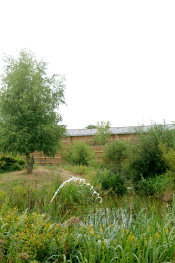
The beds from Snowdon House would move to Riverside Ward at the Western Community Hospital which has a safe and pleasant environment to aid rehabilitation The space in the ward, which currently has 25 beds, will enable specific therapies to take place. There would be no reduction in the current level of beds for stroke rehabilitation and neurological rehabilitation.
The Western Community Hospital is a modern purpose built low rise building with improved accessibility. It has beautiful gardens with a lovely duck pond which creates a relaxed atmosphere to help aid recovery for patients and support rehabilitation.
This move would bring together neurological rehabilitation services on one site by combining the Western Hospital stroke unit and the neurological rehabilitation service from Snowdon House.
The general rehabilitation beds displaced from the Western Community Hospital will be combined with those in the community wards at the Royal South Hants hospital. This move would bring together the PCT's general rehabilitation and managed care services on one site.
A new therapy and rehabilitation area would be set up to improve recovery time for patients so they can return home sooner. Patients will be in single rooms and services such as the Fatigue Management course will continue.
Younger patients
We are conscious of the younger client group based at Snowdon House and believe the proposed move to the Western Community Hospital would offer a whole range of new opportunities for the patients. Some of the activities that would be accessible are:
o Active Options, a joint venture between SCPCT and Southampton City Council, which is a supported exercise scheme at the Quays in Southampton.
o Swimming at the Quays swimming complex in Southampton. The Quays is fully equipped for people with disabilities. This includes disabled toilets, ramps, lifts and a specialist lift system for access to the pool.
o Superbowl centre (half a mile away) also has facilities for people with disabilities including ramps and specialist toilet facilities.
o Tesco superstore (adjacent to the hospital grounds) is a low rise building with disabled toilets.
There is also a thriving voluntary sector which could support and organise activities for patients and proactive steps would be taken to encourage this.
Respite care
Respite care will continue. Patients will undergo a continuing care assessment to establish the level of care needed. If any health needs are identified which require an in-patient stay this will be provided as before within the neurological rehabilitation unit.
Jobs
It is anticipated that all current nursing and care staff jobs could be accommodated within our community hospital wards. i.e. there would be no job losses.
Transport
The Western Community Hospital is on the outskirts of Southampton City Centre, approximately five miles from Snowdon House in Ashurst. It has very good public transport and motorway links.
The Hospital is on direct bus routes from across the city centre and is close to the train station in Southampton City and Millbrook. There are also regular bus services from the New Forest area provided by Wilts and Dorset (56, 56A, X34 and X35).
The Hospital has ample free parking for visitors and staff with enough room to accommodate the minibus currently used by patients at Snowdon House. Any existing NHS transport will continue.
We acknowledge this is a slightly longer journey for some patients but for many others it will be a shorter distance to travel.
Improved access to services
The Western Community Hospital site is the proposed site for a LIFT project, a major private finance/NHS partnership, to build a Primary Care Centre with diagnostics and other services on the site. This will give all patients on site much improved access to care such as x-ray and other diagnostic facilities, outpatients and follow-up appointments without needing to attend another hospital.
B The Royal South Hants Hospital
We would transfer all patients from Snowdon House to the Royal South Hants Hospital in the City centre, causing minimal disruption to existing services.
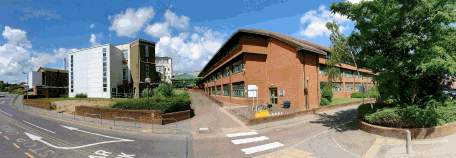
The Royal South Hants Hospital (RSH) site is due to be taken over by Southampton City PCT in 2006 and will be the base for a new primary care treatment centre. The centre will contain a GP surgery and dental services. We are also looking at plans to strengthen rehabilitation facilities for elderly care both from an inpatient and outpatient perspective.
Respite care
Respite care will continue. Patients will undergo a continuing care assessment to establish the level of care needed. If any health needs are identified which require an in-patient stay this will be provided as before within the neurological rehabilitation unit.
Transport
The RSH site in the centre of Southampton city and is approximately seven miles from Snowdon House in Ashurst. It is very close to all the public transport links across the city and is serviced by bus routes from the New Forest area by Wilts and Dorset.
Any existing NHS Transport services will continue.
We acknowledge this is a longer journey for some patients but for many others it will be a shorter distance to travel.
Improved access to services
Patients will be close to diagnostic services based at Southampton General Hospital such as x-rays and outpatients facilities.
C Snowdon House, Ashurst
If relocating the neurological rehabilitation services from Snowdon House would adversely affect patient clinical outcomes we would keep the service as it is operating at present.
6 The Issues
Option A
1. Neurological rehabilitation beds will no longer be provided at Snowdon House, Ashurst. This service will be located alongside stroke services at the Western Community Hospital
2. All general rehabilitation beds will be sited at the Royal South Hants Hospital (RSH)
3. There may be an overall reduction in number of general rehabilitation beds (approximately ten beds).
4. We are aware of the different accommodation needs for Snowdon House patients and this may need some internal alteration work at Western Community Hospital. The cost and time of this work will be taken into account when planning the project.
Option B
1. Rehabilitation beds will be based at the RSH
2. There is no gym and limited specialist neurological rehabilitation facilities on
the RSH site.
3. Younger neurological patients could be disadvantaged as space is limited and all facilities on RSH will need upgrading or replacing to accommodate these patients
4. There may be an overall bed reduction. (Approximately 35 beds)
Option C
1. Staffing levels at Snowdon would be hard to maintain. Staff sickness and training and annual leave would be hard to cover whilst maintain a high quality service, due to the isolation of the unit.
2. We would not be able to develop the service and improve on service patients currently receive.
3. Remaining at the unit would comprise any alternative uses for the site by PCTs in the area.
4. We could be asked to leave the site as it is not in Southampton City PCTs area and belongs to neighbouring PCTs.
7 What decisions have already been taken?
There will be a small reduction in bed numbers as detailed above. This will be compensated for by an increase in therapy which could reduce the length of time people need to be in hospital.
8 Your views count
8.1 The PCT has engaged with patients and the public on a number of projects which reflect the longer term vision for future delivery of healthcare e.g. the Primary Care Strategy, the Clinical Blue Print, Modernisation of Community Services etc. Our patients and public support the move to more community based care.
We would like to hear your views and receive your comments to help us shape the proposals we are developing. It is important to us to make sure our services meet your needs. Wherever possible we will incorporate your ideas. We are particularly interested in finding out which option you would favour.
8.2 Listening and engaging with stakeholders: Pre Consultation
The options were developed following discussions and meetings with external stakeholders, including users and carer groups, staff and Primary Care Trusts.
The PCT is grateful for the many supportive and constructive comments received, many of which have been incorporated into the proposals now put forward in this consultation document. For example carers wanted details about the future of the fatigue management course and if patients would still be in single bedded rooms. These have been incorporated into this document.
We have been also been meeting regularly with our patient and carer groups along with staff and a number of issues have been raised. To answer these queries directly we have included the following section into the document. In addition a detailed Questions and Answer sheet is also available from our website or our Public Involvement Office on 023 8029 6933.
What will the changes mean for people using the services?
· The plans for any alteration work will include bedrooms large enough for equipment and access, space for both occupational therapy and physiotherapy activity, computer room, quiet room and dining room. Staff from Snowdon House will be fully involved in the design. The cost and time of this work will be taken into account when planning the project.
· A wheelchair assessment has taken place on the ward. Planners have identified storage areas for wheelchairs and other equipment. There are currently 25 beds on Riverside ward at the Western Community Hospital, this number will reduce allowing more room for storage and other requirements for the unit.
· Staff, patients, Friends of Snowdon etc, would be able to continue with social activities taking advantage of the facilities at the Western Community Hospital, the conservatory, dining room and day rooms. Existing staff are keen to support and assist with any future events.
· The Western Community Hospital has its own hairdressing salon on site. There are also designated rooms for podiatry and dentistry.
· The hospital is situated close to the local shops on Shirley High Street, Megabowl and a variety of pubs.
9 Contact us
For general information about the proposals, please see our website www.southamptonhealth.nhs.uk where you can also complete our online comment form. Alternatively you can send your comments and questions to:
Heather Snook
Southampton City Primary Care Trust
Trust Headquarters, Western Community Hospital
William Macleod Way, Southampton, SO16 4XE
Email: [email protected]
Telephone: 023 8029 6951
10 Timescale
The consultation will run from 11 July 2006 to 26 September 2006 inclusive.
11 Feedback
We will be grateful for all responses received and will produce the results of the consultation on our website within eight weeks of the deadline for responses. If you would like us to send you a copy of the findings directly please indicate this and provide your postal or email address when you respond.
12 Glossary of terms
Terms |
II. Definition |
Acute services |
Medical and surgical interventions, both emergency and non-emergency, undertaken in hospitals rather then in a community setting. Acute means short term, as opposed to chronic which means long term |
Health economy |
All organisations with an interest in health in one area including Patient and Public Involvement Forums and voluntary and statutory organisations |
Primary care services |
Those health services provided by general practitioners, general practice nurses, dentists, pharmacists, opticians and other community-based professionals, to which patients may normally refer themselves for treatment or advice |
Primary Care Trust (PCT) |
A statutory, locally managed, free-standing NHS organisation, responsible for improving health, commissioning and delivering health care for local residents |
Rehabilitation |
The treatment of residual illness or disability which includes a whole range of exercise and therapies with the aim of increasing a patients' independence |
Neurological rehabilitation |
Rehabilitation for people who have difficulties as a result of an incident or accident that has affected their nervous system. For example: multiple sclerosis ,motor neurone disease ;stroke. |
Stroke |
An event which affects the brain which may affect the body physically or emotionally. |
Secondary health services |
Those health services, normally provided by NHS Trusts in hospital premises, to which patients are referred by a primary or community care professional for more specialist treatment or advice, or for emergency care |
Strategic Health Authority |
A statutory organisation in the NHS, proposed to be the bridge between the Department of Health and local NHS services, to manage the performance of NHS Trusts and Primary Care Trusts, and to provide strategic leadership to ensure the delivery of improvements in health, well being and health services locally |