
Archived decisions
12th April 2006
A Discussion Paper
Introduction
This high level paper has been drafted to stimulate discussion and seek agreement to a strategy and a proposal to bring together planning and delivery arrangements for child health services in Hampshire. It is the intention that this proposal will improve the contribution that health makes to partnership working and implementation of `Every Child Matters' (2004) and the `National Service Framework for Children and Young People and Maternity Services' (2004), underpinned by policy guidance in `Choosing Health' (2005) and `Our health, our care, our say: A new direction for community services.' (2006).
Implementing `Commissioning a Patient Led NHS,' delivering financial balance, and the top national and Strategic Health Authority (SHA) priorities will be the main focus for the PCT/PCT's during 2006/7. None of which will directly contribute to achieving the 5 key outcomes for children. However, it is imperative that the PCT's as they are now, and in the future configuration, are able to support the implementation of the `Change for Children Programme' and deliver the health contribution unimpeded by organisational change in health. This proposal would facilitate and enable this work to progress.
The proposal is part of a stepped approach, the first being the development of a county wide model of child health services which is described in this paper. This would position health services for future work with Hampshire County Council's (HCC) Children's Services to implement a children's trust approach. It also acts as a springboard for testing the `market' and the potential establishment of independent provision. This preparatory work is critical due to the disparate nature and lack of information on cost and quality of current health service provision.
The proposal would offer the following benefits:
i) Strong leadership for children's health and maternity services with direct accountability to PCT Board/ Boards to work alongside the senior management team in HCC's Children's Service.
ii) Bring commissioning (needs assessment, strategic planning, local planning and contracting) together across the HCC area
iii) Development of pathways to deliver consistent models of quality assured health services for maternity, children and young people across Hampshire
iv) Development of common systems and processes for evaluation of services and measurement of health outcomes for children
v) Position health services to work as integrated partners with the Local Authority in implementing the Change for Children Programme led by the Director of Children's Services HCC
vi) Prepare for contestability
The Strategy
A single approach to commissioning of children's health services across Hampshire County Council area which contributes to the delivery of the 5 key outcomes for children through consistent service delivery
Rationale for Change
There are numerous national and local drivers for change to note (Appendix 1) but specifically `Commissioning a Patient led NHS' (2005). Implementation of this key policy will strengthen the commissioning function of PCT's, primary care practitioners and promises to engage patients and the public in both the development and monitoring of services. It requires a separation of the commissioning and providing functions, and in due course, the introduction of contestability into NHS health care. In addition `Our health,our care,our say: A new direction for community services' (2006) provides the framework to facilitate integration of services across health and social care, shifting the balance of care from acute to community and primary care and giving greater control of services provided to young people and their families.
The emerging vision underpinning Hampshire Children & Young Peoples Plan (CYPP) is for an integrated children's service with the local authority and all it's partners. This integration can be achieved through a strong commissioning strategy at a HCC level providing the framework for devolved commissioning to meet local need. In order to achieve integrated delivery, various devices can be employed, these range from: virtual teams ie staff from various organisations working together to agreed priorities; co-location of staff employed by different agencies; to joint management/employment arrangements.
The current position
The various organisational arrangements for needs assessment, strategic planning, service development, contracting and provision of child health services across Hampshire has created a significant challenge for partners and child health leads within the PCT's. Four PCT's have nominated leads for children's services at the executive level and arrangements have been put in place to represent colleagues in the absence of an executive lead. Without dedicated time, children's service planning at an executive level has been limited and fragmented. The child health leads with responsibility for commissioning in each PCT cluster have made considerable progress over the last year. They are beginning to co-ordinate planning activity in order to avoid duplication of effort and provide some coherence and consistency to the planning processes with the Local Authority in particular and other partners.
The PCT's directly provide some child health services and commission from a range of organisations from both within and outside the county. (Appendix 2) Few delivery systems align with Local Authority areas. Recent audits123 have identified inequitable staffing levels, different models of service and access criteria across the county. The investment in children's services is not known, as most service level agreements are part of ill defined block contracts in which activity and cost for services for children are not specified. Inconsistency and paucity of data collection makes it difficult to assess the impact of this fragmented provision on outcomes. The national child health mapping exercise, will provide some comparative data about investment and activity levels for the first time in June 2006. However, experience of the CAMHS mapping would suggest caution in use of the first year of data, due to problems with process, definitions and accuracy.
A number of PCT's are reconfiguring child health services in order to achieve congruence with organisational boundaries and partners, however, this change is placing services at risk. For example: the Surrey PCT's are withdrawing from services provided by Blackwater Valley and Hart PCT, the remaining service will not have the critical mass to be viable without merging with other services in Hampshire. Similarly in SW Hants PCTs an exercise to reconfigure some of the children's services provided by Southampton City PCT was undertaken which illustrated similar difficulties regarding the critical mass and thus the viability of specialist services.
A SWOT analysis of the current position can be found in Appendix 3
The Proposal
A single service model for commissioning and delivery of child health and maternity services
1) To separate the resources, commissioning budgets and staff providing services, for children from those for adults and older people.
2) Establish a single directorate for children's health services, with distinct commissioning and provider functions, serving the population in HCC area. Depending on the outcome of consultation on PCT configuration this will be in a single PCT or hosted by one PCT on behalf of the others. The accountability arrangements within health and with HCC Children's Service will need to be determined. Evidence from early pathfinder trusts would suggest joint accountability to PCT and Directors of Children's Services. This arrangement should be considered between the PCT/PCTs and HCC.
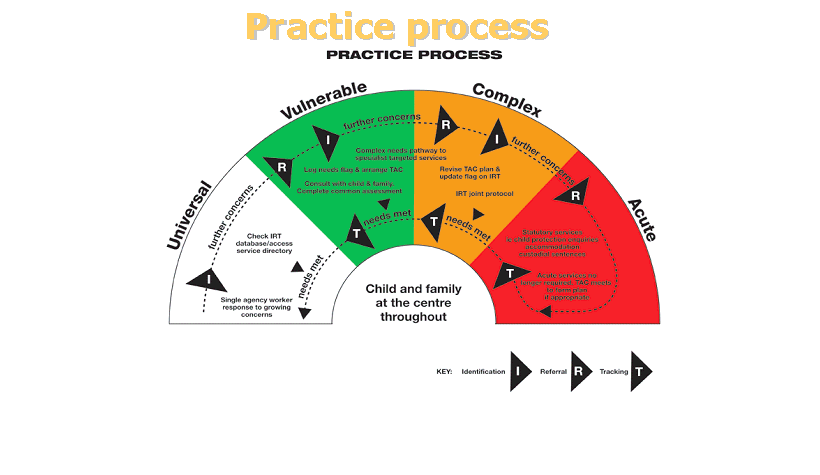
3) To develop a county wide model of provision working to agreed pathways, delivered through multi disciplinary teams serving communities aligning to the emerging school clusters, children centre developments and, if possible, practice based commissioning localities. This may be through directly provided services or through services commissioned to a common specification. The synergy that this will generate with partners including primary care will facilitate more integrated service provision for children and young people, mirroring the care pathways illustrated by the `Windscreen of Needs' developed by HCC Children's Service Appendix 4. The implementation of the model at a local level to meet local needs will necessitate the development of strong professional networks and agreed clinical governance arrangements to monitor and address problems across organisational boundaries. (A description of the proposed service components can be found in Appendix 5)
4) To mandate the PCT Child Health leads to develop a commissioning plan and options for organisational arrangements which will support implementation of the strategy within the new PCT/PCTs arrangements. (A SWOT analysis of the proposed model is at Appendix 6).
Questions for consideration
1. Do you support the strategy for a single approach to commissioning of children's health services across the Hampshire County Council area?
2. Do you support the proposal to separate resources for children from those for adults and older people to mirror the emerging arrangements in Hampshire County Council?
3. What structure and reporting arrangements would best support commissioning and delivery of health services for children in the new PCT arrangements?
4. Do you support the proposed model of provision with service components aligning to emerging structures for delivery in Hampshire County Council?
5. Are there additional strengths/ weaknesses/ opportunities or threats that have not been identified?
6. It is proposed that commissioning and provision are led from a single Directorate, although the two functions will need to be separately structured and resourced. Would this structure be supported in light of the national directive to separate commissioning and providing functions within `Commissioning a Patient Led NHS'?
Appendix 1
Drivers for change
Children Act (2004) - Places a legal `duty' for health services to co-operate with Local Authority Children's Services and strategically facilitates an integrated model of working together with all partner agencies, statutory and voluntary Choosing Health (2004) - Encourages front-line practitioners to focus on prevention and early intervention and addresses health inequality
Youth Matters (2005) - Provides direction for `health' particularly school nurses in terms of enabling young people to make healthy choices and avoid risk taking behaviours
Children & Young People and Maternity Services NSF (2004) - Provides quality standards from universal prevention and early intervention to specialist services for ill children, children with learning disabilities, mental health, maternity and medicines management
Commissioning a Patient Led NHS (2005) - drives a fundamental change in focus through strengthening commissioning and promoting choice, diversity and contestability in service provision and places the patient at the centre
Practice Based Commissioning (2005)- furthers the opportunities for service development in primary and community care developing appropriate alternatives to secondary care providing quality care closer to local communities. Draft Strategic Framework for the Development and Implementation of Practice Based Commissioning in H & IoW SHA suggests in point 7.45 that Children and Maternity Services will not normally be considered within the local scope of PBC during 2005/6 & 2006/7
Our health,our care,our say: A new direction for community services (2006) provides the framework to facilitate integration of services across health and social care, shifting the balance of care from acute to community and primary care and giving greater control to young people and their families.
Hampshire Children and Young Peoples' Plan ((2006) - the opportunity to make a real difference by working differently maximizing efficiency and effectiveness across agencies to agreed priorities
Local Area Agreement (2006) will mirror plans within the CYPP
Overview & Scrutiny Committee Review of Therapy Services (2004) - identified inequitable provision and inconsistent service models across the county
Office of Public Management Acute Paediatric Review (2005) - highlighted variation in models of service delivery, difference in reference costs and vertical integration of acute and community services
Appendix 2
Current commissioning and provision arrangements
The PCT's are responsible for commissioning services from Health providers through Service Level Agreements (SLA's).
Acute Services
Commissioners | ||||||
East Hants PCT |
Fareham & Gosport PCT |
North Hants PCT |
Blackwater Valley and Hart PCT |
Mid Hants PCT |
Eastleigh and Test Valley South PCT |
New Forest PCT |
Providers* | ||||||
PHT |
PHT |
NHHT |
NHHT |
WEHT |
SUHT |
SUHT |
SUHT |
SUHT |
WEHT |
FPH |
SUHT |
WEHT |
SHCT |
St RH |
CHIC |
RBT |
RSCH |
SHCT |
SHCT |
WEHT |
RSCH |
RSCH |
NHHT |
PHT |
RBCH | ||
WEHT |
WEHT |
PGH | ||||
Services provided within the SLA for acute services include
· General Paediatrics
· In patient, Outpatient
· Maternity
· NICU
· Specialist services such as Ophthalmology, ENT
Community Services
Commissioners | ||||||
East Hants PCT |
Fareham & Gosport PCT |
North Hants PCT |
Blackwater Valley and Hart PCT |
Mid Hants PCT |
Eastleigh and Test Valley South PCT |
New Forest PCT |
Providers* | ||||||
EHants PCT |
F&G PCT |
NHants PCT |
BVH PCT |
MHants PCT |
ETVS PCT |
NFPCT |
PCPCT |
PCPCT |
BVH PCT |
NHHT** |
WEHT** |
WEHT** |
SCPCT |
EHants PCT |
NHHT** |
SCPCT |
SHCT | |||
Services provided within the SLA for community services include
· Health Visiting
· School Nursing
· Child Protection
· Children Looked After
· Community Paediatrics
· Learning Disability
· Physiotherapy
· Occupational Therapy
· Speech and Language Therapy
· Children Community Nursing
· Child and Adolescent Mental Health Services
Tertiary / Specialist Services are commissioned by a Specialist team which commissions on behalf of all PCTs in HIOW and along the central south coast
Tertiary Providers
Hampshire Partnership Trust |
Southampton University Hospital |
Great Ormond Street |
St Georges |
Guys and St Thomas |
Royal Brompton |
Harefield |
Royal Marsden |
Specialist services provided within the SLAs include
· Tier 4 CAMHS
· Burns
· Cleft Palate
· Genetic screening
Complexities of commissioning
· PCTs commission services from a number of different providers following historic patterns of referral. Services have evolved differently in each area resulting in a variation of models of service, capacity, access criteria, quality and measurement of input or outcomes. This variation occurs not only between PCT's but also within the PCT's presenting a challenge to commissioning and the redesign of provision.
· A number of the SLAs are with providers from outside the Local Authority boundary.
· Some areas have community and acute services provided by the same organisation, whilst others have different providers for community and acute services covering the same geographical area - both create different challenges.
· There are a number of intra provider SLAs between some PCT and acute providers for support services which add to the complexity of the SLAs and which impact on the services children receive.
* Key to provider codes
FPH Frimley Park Hospital NHS Trust
NHHT North Hampshire Hospital Trust, Basingstoke
PHT Portsmouth Hospital Trust
RSCH Royal Surrey County Hospital, Guildford
SUHT Southampton University Hospital Trust
WEHT Winchester and Eastleigh Healthcare Trust
SHCT Salisbury Health Care Trust
RBT Royal Berkshire NHS Trust , Reading
RBCH Royal Bournemouth and Christchurch NHS Trust
PGH Poole General Hospital NHS Trust
St RH St Richards NHS Trust, Chichester
PCPCT Portsmouth City PCT
SCPCT Southampton City PCT
** Acute Hospitals providing some community services
Appendix 3
A SWOT analysis of current arrangements for commissioning and service delivery
Strengths |
Weaknesses |
Development and experience gained through CAMHS Pathfinder Trust Areas of good practice eg: · Integrated child & family health teams (SE) · CAMHS workers in YOT teams Committed workforce Knowledge and experience both front line practitioners and managers Good communication with Primary Care Child Health & Maternity Network Information from National Child Health Mapping (June 06) 3 years data and analysis from National CAMHS Mapping Understanding of issues for acute services (Acute Paediatric Review) Child Health Leads appointed and representing all PCT Clusters Examples of effective alignment of budgets and teams ie,. Sure Start Leigh Park Shared understanding and direction of travel between community stakeholders through development of the CYPP |
Lack of strategic coherence/direction of travel across health organisations including workforce planning and redesign Lack of knowledge of resources available to spend on children's services Workforce issues · Ageing workforce · Specialist skills deficit Health organisations focus on adult and older peoples services (top 9 performance targets) Lack of critical mass in each organisation for efficient and effective working, recruitment & retention of specialist staff eg: community paediatricians, Child psychiatrists, community children's nurses Inevitable duplication of work across large numbers of providers and commissioners Different models of provision locked into particular organisations Difficulty for business partners to engage `health' as a whole for both strategic and operational planning and service delivery Low staff morale due to uncertainty and perceived lack of commitment from health to children's services Ability to deliver identified health outcomes for children Connection between children's service planning and Drug and alcohol service development |
Opportunities |
Threats |
To use organisational change to trigger different models of service delivery within health, HCC & partners To strengthen commissioning through Commissioning and Patient Led NHS to secure 5 key outcomes for children Extended Schools and Children Centre development Use Section 31 & Local Area Agreement flexibilities more extensively Financial Recovery Plan for health organisations drives change for greater efficiency and effectiveness To implement Children and Young People Plan Extend alignment of budget and teams to other areas |
Impact of workforce reductions and financial recovery plans leading to disinvestment from children's services to meet deficit and fund top SHA 9 priorities Instability through organisational change and potential loss of organisational memory Knowledge management through loss of experienced staff Practice Based Commissioning with further threat of fragmentation The outcome of PCT and SHA consultation and ensuing change `takes eye off the ball' Power bases individual/ professional/organisational resistingchange |
Appendix 4
Windscreen of Needs
Appendix 5
Service Components from universal to specialist and acute provision to meet `Windscreen of Needs'
Services contribute at different stages of the pathway building services around the needs of the child and family
Primary Care
· General medical services
· General dental services
· Opticians
· Pharmacies
Prevention and Early Intervention services aligned to communities served by the developing Children's Centres and Extended schools clusters, composing of.
· Health Visiting
· School Nursing
· Primary Mental Health Workers
· SALT
· Midwifery
· Public Health/ Dental Health Promotion
Specialist Multi disciplinary services for children with developmental problems and supporting prevention and early Intervention services comprising of:
· Community paediatrics
· Occupational Therapy
· Physiotherapy
· SALT
· Special Needs Co-ordination
Specialist Learning Disability services for children with severe learning disabilities and supporting prevention and early Intervention services comprising of:
· LD Nursing
· Psychology
· Psychiatry
Specialist CAMHS services for children with complex mental health problems and supporting Prevention and Early Intervention Teams comprising of:
· Psychiatry
· Psychology
· Nursing
· Social Workers
· Therapists
Community and Specialist Nursing supporting care of the child at home and in school
Acute Ambulatory care, Inpatient and highly specialist tertiary services
Special needs dentistry
Screening and diagnostic services eg. Audiology, Orthoptics
Appendix 6
SWOT
Proposal for a single service model for commissioning and delivery of child health and maternity services
Strengths |
Weaknesses |
Clear strategic direction Supports interface with business partners (PCT commissioners, LA and others) Facilitates modernisation across `health' & LA & others through section 31 flexibilities & other available devices Framework for consistent implementation of NSF standards Achieves FRP with less risk to front-line service provision Creates critical mass to support cohesive workforce planning and development: · recruitment and retention · clinical excellence · skill mix · training experience Enables strong leadership and management for children's health services to support cultural change across the county Commissioning of appropriate children and family focussed learning and education for all staff groups/disciplines Supports the recruitment and retention of staff through the process of change and strengthens professional identities Creates structure to support implementation of : o Hants CYPP - NSF, CAF, Preventative Strategy, Parenting Strategy, Children's Centres & Extended Schools Strategy o SHA acute paediatric review o OSC Therapy review Child Health & Maternity Network to support clinical development and quality standards Information from National Child Health and CAMHS Mapping to inform planning and decision making |
Under developed ICT systems to support service development, delivery, evaluation, performance, contracting and commissioning arrangements etc. Workforce, lack of skills and capacity to implement change Recruitment to disciplines with national deficits |
Opportunities |
Threats |
To achieve cultural changes within Health and LA putting children, young people and families at the centre of planning and service provision Raise profile of health To strengthen commissioning to secure 5 key outcomes for children To extend use of Section 31 & other flexibilities To achieve national agenda `Change for Children' To achieve effective use of resources across organisations to contribute to the FRP To act as catalyst for change for greater efficiency and effectiveness To develop multi-agency leadership and management To deliver Hants CYPP To improve morale for staff Repatriation of services Build workforce and develop skills to meet skills deficits |
Demonstrating contestability, diversity and value for money Lack of sign up to model in any part of the health system Resistance to change Fear of loss of autonomy for health, being subsumed by the education and social care priorites Potential to destabilise providers Impact on providers working to different models in PCT's in Unitaries Failure to delivery on strategy and meet the health outcomes for children
|