
Archived decisions
· 9 |
|||
Contact: Jos Creese ([email protected]), ext 7436
Index:
Page | ||
1. |
Management Summary |
2-3 |
2. |
Corporate Context |
4 |
3. |
Performance and Benchmarks: |
4-10 |
3.1 Financial performance |
4-6 | |
3.2 External benchmarking |
6-7 | |
3.3 Project performance |
7-8 | |
3.4 Operational performance |
8-9 | |
3.5 Customer satisfaction |
9-10 | |
4. |
Unlocking the Value of IT: |
10-13 |
4.5 Partnership with the business |
10-11 | |
4.6 Resisting Complexity |
11-12 | |
4.7 IT Training and Awareness |
12-13 | |
5. |
Strategic Direction: |
13-17 |
5.1 Post e-Government |
13 | |
5.2 `Transforming through Technology' Strategy |
13-15 | |
5.3 Technology directions and priorities |
15-17 | |
6. |
IT Roles and Structures |
17-18 |
7. |
Legal Implications |
18 |
8. |
Financial Implications |
18 |
9. |
Personnel Implications |
18 |
10. |
Impact Assessment |
18 |
7. |
Conclusions and Recommendations |
18 |
Appendix A - IT Project Achievements 2005/06 |
19-22 | |
Appendix B - IT Services Structures |
23-24 | |
Appendix C - Activity Performance Graphs |
25-26 | |
Appendix D - Pre-project Checklist |
27 | |
Appendix E - Summary of Conclusions and Recommendations |
28-29 | |
Glossary of Terms |
30 |
Summary
IT is increasingly an integral part of the development of the County Council's strategies and services. This report sets out achievements made over the past year and the main priorities currently identified for development.
1. Management Summary
1.1 The Annual IT Performance Report examines the performance and contribution of IT (and of IT Services in particular) across the County Council. It also looks ahead at IT plans and priorities for the coming year. A glossary of terms is appended.
1.2 A wide range of electronic services (e-services) for the public are now in place on Hantsweb following the successful conclusion of the Implementing e-Government Programme (IEG). It is now a priority to ensure that these new services are sustainable, supported, well publicised and actually used by the public. This must be integral to wider service planning.
1.3 IT Services delivered over 250 projects in 2005/06, and at any one time is managing over 150 separate projects in addition to the `bread and butter' of delivering high quality operational IT services. Further IT projects are run independently in departments. In addition to the e-Government programme, the following are noteworthy:
· The County Council's website, `Hantsweb' has been re-designed with a new `clean' image. Further improvements are planned for 2006/07;
· The Contact Centre strategy and business plan has gained Cabinet support and the programme for implementation is now under way;
· A range of tools has been introduced to support mobile and flexible working;
· Progress has been made in improving the usability of SAP;
· The core network infrastructure within the County Council's main computing centre has been replaced with minimal disruption to services, improving service performance.
1.4 A longer list of IT projects by department during 2005/06 is attached at Appendix A, and this report details the operational IT service improvements achieved during 2005/06.
1.5 The requests for SAP support to the Help Desk have reduced significantly and whilst there is still some dissatisfaction with SAP, customer satisfaction with IT genuinely remains good. This year IT Services will be repeating the independent external review of IT customer satisfaction across the County Council, including a survey of schools' satisfaction with IT (see section 3.5).
1.6 Detailed independent benchmarking with the private sector has shown continuing high IT efficiency in the County Council. The report describes over £900,000 new efficiency savings generated by IT Services which have been mostly passed to departments in price reductions, and in 2005/06, the County Council won a national award for IT efficiency.
1.7 Some service managers still do not see IT as a `key differentiator of excellent services' but rather as a `costly fact of doing business'. It is important that `How can I maximise the value from IT investments?' should be as prevalent as `Why does IT cost so much?'. Therefore, whilst last year's performance report concentrated on costs (benchmarking, transparency, explaining how IT costs are made up), this year the report concentrates more on securing greater value from IT investment.
1.8 Three areas are singled out as priorities in securing greater value from IT spend.
1.9 Firstly, is the importance of a strong partnership between IT professionals and service managers. This helps with choosing the right technology and making sure IT projects deliver. In some cases IT investments are still not planned well enough - financial planning, information use and integration, change management, and benefits tracking. Closer working helps departments manage the essential change to working practices to achieve the value from IT investments, after adopting standard business processes. Equally IT professionals need to demonstrate that they have the skills and competencies necessary to do this. There is evidence that this is improving, but CMT may wish to consider a more coordinated corporate approach to co-ordination of business transformation programmes (see section 4.5).
1.10 Secondly, is the importance of resisting unnecessary IT complexity, especially the temptation to optimise departmental solutions. This can increase ongoing costs and reduce value corporately, especially where reuse of standard business processes becomes more limited. Analysis shows that the source of the County Council's IT efficiency lies significantly in the adoption of standard technology architecture of Hantsnet - Microsoft tools, `thin client', SAP, HPSN. Stronger governance of corporate tools and their integration is a priority.
1.11 Thirdly, the need to increase IT skill levels of staff and managers and to review the provision of IT training across the County Council.
1.12 To help improve IT performance, IT Services has re-organised during 2005/06. Details of IT Services' new structures and roles are summarised in Appendix B.
1.13 IT priorities for 2006/07 will be dominated by the Corporate ``Transforming through Technology'' Strategy, with central themes supporting the other corporate strategies of the County Council. These themes include: customer focus and the Contact Centre, flexible and new ways of working, information management, partnerships, and the improvement of IT skills. Increasing productivity and efficiency is part of each of these. Work is already well under way and the strategy will be ready for Cabinet by September 2006.
1.14 Technology priorities include: IT business continuity improvement, wireless communications, security, integration `middleware' tools and enhanced Hantsnet tools.
1.15 As underlying technology to support the business becomes more complex, so the County Council requires software integration tools to simplify information management to drive performance of the organisation. Such `middleware' technology will be essential to support systems and information exchange for the Contact Centre programme and Integrated Children's Services in particular.
1.16 Another key priority will be improving IT resilience as the County Council's reliance on technology increases. Few services can operate for long without IT. Many public services are extending opening hours and staff are working flexible hours. IT must be available accordingly. Many services are now directly available through Hantsweb, and the County Council is hosting services for other public service organisations. Work is under way to establish a second computer suite and to move the current computer suite to a more suitable location as part of the refurbishment work on Ashburton Court.
1.17 In terms of IT structures, the priority will be to deliver and demonstrate the benefits targeted from the IT Services reorganisation. There also remains a need, (in my view), to review the devolved IT arrangements given the range of organisational changes across the County Council and the need for efficiency through and in IT. This needs CMT support.
2. Corporate Context
2.1 IT is central to delivering many if not all of the County Council's services. Unless IT is working well, services will quickly suffer. The majority, if not all, of the corporate aims of the County Council depend heavily on IT for their deliverability - productivity, and service improvements often cannot be achieved without changes enabled by technology.
2.2 Typically, IT contributes in three ways:
· The development and support of high value and effective IT services and solutions, supporting front line services and corporate goals - this is the traditional IT role, and remains essential. It includes running SAP, Hantsweb, email, Hantsnet and the many County Council applications (over 150 are recorded);
· Contribution to wider service planning, policy and strategy, including the Corporate Strategy and many corporate initiatives. Service and policy managers need help to appreciate and to harness the potential of technology to maximise performance. This will be essential for future CPA rating;
· Leadership and support for transformation and change programmes enabled by technology. Examples include `Gershon' efficiency savings, integrated Children's Services, the SAP programme, the Contact Centre programme, flexible working and e-Service developments. Such changes must be properly planned and effectively executed, often on a corporate basis with significant changes to how people work (see section 4.5).
2.3 For these reasons this annual performance report being brought to CMT.
3. Performance and Benchmarks
3.1 Financial performance
3.1.1 IT Services operates as a business unit, which creates a strong focus on financial management and customer service and encourages decisions about resources to be taken in the appropriate context. Concerns over costs of internal trading are typically addressed by the efficient way in which the business operates and it is notable that this model is now becoming more prevalent in the private sector. Nonetheless, it is important for IT Services to be seen a responsive department supporting corporate needs, not simply chasing income to cover costs at a departmental level.
3.1.2 For 2005/06, IT Services' financial plans were prepared whilst there was some considerable uncertainty given the introduction of SAP charges and the termination of the mainframe environment. In practice, the financial models put in place have broadly followed expectations and IT Services' outturn has been close to its financial targets.
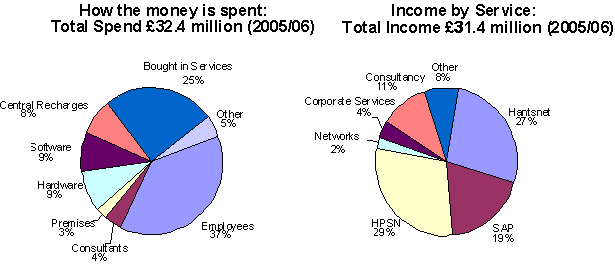
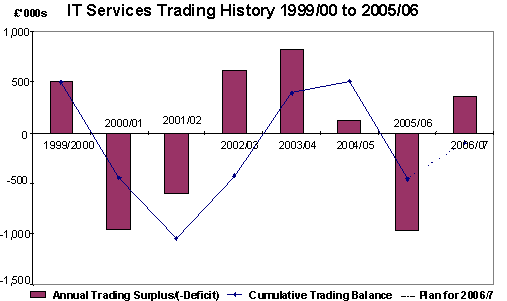
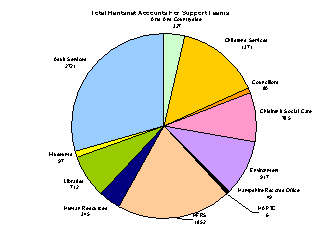
3.1.3 Over time IT Services expects to break even, taking the risks on major investments and ensuring the return on investment to finance these. A business plan is agreed each year with the County Treasurer and IT Services has been successful in hitting financial targets. The following diagrams summarise IT Services' trading history over the last 4 years.
How the money is spent and income by service:
3.1.4 There were a number of new efficiency improvements in 2005/06:
· Cost reductions in computer screens have been passed on to departments £130,000p.a;
· Working with County Supplies, the cost of mobile phones and BT call charges have been reduced, saving about £450,000 which has been passed on to departments in full;
· Hardware maintenance contracts were re-negotiated saving £57,000 passed on to departments;
· Data storage technology was replaced and consolidated, producing annual savings of £266,000, the majority of which has been passed back to departments through a 67% reduction in charges and a 100% increase in data storage allowances;
· Network management tools have been introduced which have made it possible for a greater proportion of problems to be solved without the need for staff to make a visit, saving a further £22,000p.a.
3.1.5 These efficiencies and savings have also enabled continued investment in the SAP Usability Improvement Programme and support for other corporate initiatives such as mobile and flexible working.
3.1.6 In 2005/06 the County Council won a national public sector e-Government award for IT efficiency, sponsored by the Cabinet Office, ODPM, SOLACE and SOCITM.
3.1.7 2006/07 will be financially challenging. At a time when funding is very tight there is a significant IT investment programme, which includes:
· A second computer site, essential to reducing the current risk to business continuity of the County Council and barriers to extending services;
· Replacing the very old central telephone equipment which cannot support modern communications (e.g. for a mobile workforce);
· Technology consolidation to reduce IT costs in the future (e.g. there are nearly 800 network and application computers supporting the County Council);
· IT Support for major corporate initiatives such as the Contact Centre programme and the Ashburton Court refurbishment project;
· Investment in tools to improve the management and sharing of information;
· Replacement of a large number of obsolete PC's and screens;
· Further SAP and SWIFT ease of use improvement, especially for Integrated Children's' Services and Adult Services, and improved management information.
3.2 External benchmarking
3.2.1 During 2005/06 an in-depth independent benchmarking of IT costs compared with the private sector was undertaken using the `The Corporate IT eForum' (Tif)1. This analysed and compared costs and performance across several service blocks including help desk, desktops, network, technical infrastructure and business application development.
3.2.2 Hampshire County Council proved to be very similar in profile to the majority of Tif subscribers in terms of average numbers of desktops and IT staff, although our IT costs are much lower at about 65% of those of other subscribers.
3.2.3 The extent to which organisations outsource their IT varies, and in absolute terms, the County Council out-sources a higher proportion (30%) than is typical (14%), mainly because of HPSN volumes.
3.2.4 The County Council spends proportionately more on voice and data services because of the large number of sites, many of which are remote, and to some extent because of the `thin client' architecture which can put cost on the network rather than the desktop.
3.2.5 Summary of the analysis is as follows:
· Desktop costs per user for the County Council are nearly 75% lower than the private sector average, due to the benefits of `thin client' and the ability to support equipment for nearly twice as long as average, (although we support a higher ratio of printers than most).
· Help Desk costs at the County Council average £5 per call, comparing well with the industry average of £9 per contact. The volume of calls received by the IT Services Help Desk was similar (but does not include the calls being handled by the EdICT Help Desk). The IT Services Help Desk is also resolving calls faster than average.
· Infrastructure investment per annum at the County Council is relatively low by comparison at nearly half the average spend (£7.07m compared with £13.78m). This is largely because we support only one data centre and do not have as much disaster recovery protection. This is a high priority for investment for the County Council and is covered elsewhere in this report.
· Business application costs at the County Council are also much lower than average - about £8.6m p.a. compared with an industry average of £28.6m p.a., although the number of projects run and the size of teams are comparable. There are several likely reasons for this:
_ The County Council has a smaller applications portfolio and therefore lower costs and risk (see the section in this report on `complexity');
_ We have retained a strong in house development capability; salaries are on average about 50% of external contractor costs;
_ IT Services operates as a business unit which forces departments to fund and justify IT expenditure. Industry comparisons show that central IT budgets are typically less well spent, (except for main corporate applications);
_ Where departments run their own IT projects locally without central reporting of costs, these figures are excluded (the County Council has a more devolved IT approach than many organisations).
3.2.6 The following graph highlights key cost differences:
£k
per
user
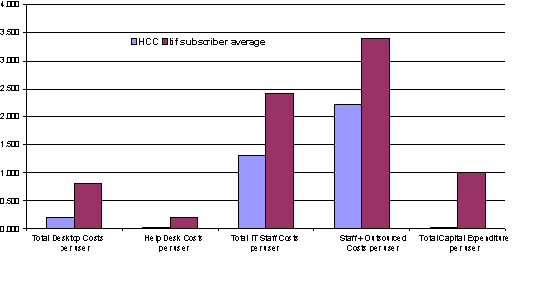
3.2.7 Overall, these results are very pleasing, but in some areas our lower numbers indicate under investment that leaves us vulnerable, especially around business continuity and infrastructure support. Departments that remain concerned about the costs of IT projects should take note of the comparisons and the costs of alternatives.
3.3 Project performance
3.3.1 IT Services managed and delivered over 250 projects in 2005/06, and at any one time is running over 150 projects. All IT Services' projects now conform to Prince II project management standards and project performance is routinely reviewed by the IT Management Team (ITMT). The new SAP Time Recording System is enabling tighter control of project costs, and the IT Services reorganisation has concentrated all project activity in one group - the Projects and Consultancy section which includes SAP services (see Appendix B).
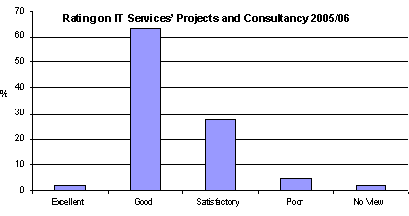
3.3.2 Whilst over 65% of IT Services' projects are rated as `good' or `excellent' on sign-off, compared with an IT industry average below 50% (see below), there is room for improvement. Also, whilst project sponsors are encouraged to sign off on all projects this does not always happen. In the coming year this will be more strongly encouraged, with added information being requested from customers about perceived and measurable value - not just the standard delivery to `time, budget and quality' criteria.
3.3.3 Although the County Council has a good track record of success with IT projects, there are exceptions. The Document Management System has not proved to be suitable as a corporate application, and alternatives are now being sought. Also a new recruitment system ran into difficulties at the start of last year, although this was successfully resolved by bringing work back in-house and the final project was successful. Being open about problems and successes is an important way of learning from mistakes and reducing the likelihood of costly problems being late in a project life cycle.
3.3.4 IT projects across the County Council should be run on the same basis, not just those in IT Services. Adopting the same standards and methods across all devolved IT units would yield benefits corporately and allow a wider assessment of IT performance. This may require more central governance of IT, which may be unpopular (see also Section 6), and also a review of the effectiveness of IT Services methods before these are generalised.
3.4 Operational Performance
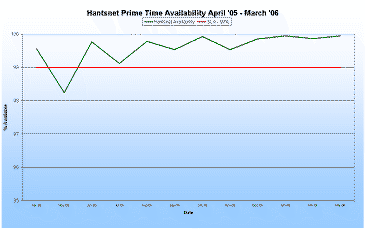
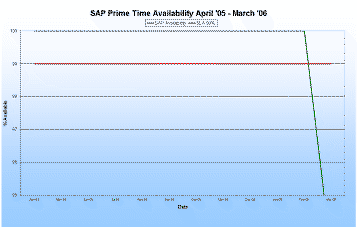
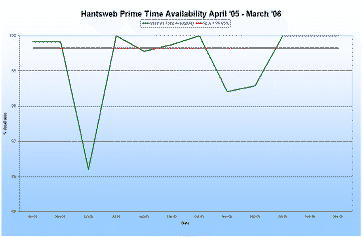
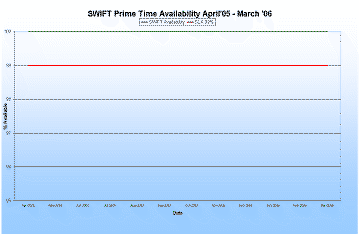
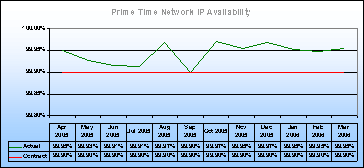
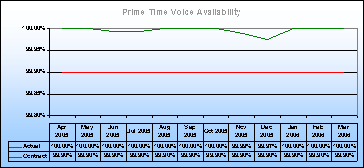
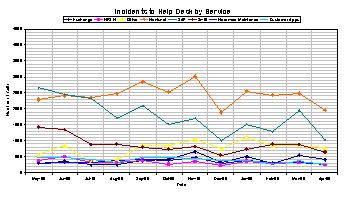
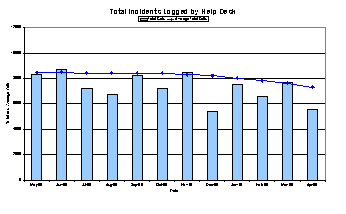
3.4.1 Operational IT systems which are highly available and responsive are essential to the County Council. Performance measures are reviewed monthly by ITMT (see Appendix C) using information from the Help Desk, account teams and monthly surveys of IT users, covering:
· Availability (uptime) of key Hantsnet services and systems;
· Help Desk performance and taken time to fix problems;
· Network/HPSN service levels;
· Service satisfaction.
3.4.2 Last year saw improvements in nearly all areas of operational IT performance. Major systems and network services had a stable year with the majority having met or exceeded their prime time availability targets (the exception being SAP which was unavailable for a day after a major infrastructure upgrade in April). The Help Desk received fewer calls due the stability of the services and SAP incidents in particular reduced by nearly 50% to just over 1,000 a month. Further analysis shows that many of these calls could be eliminated by further training and communication.
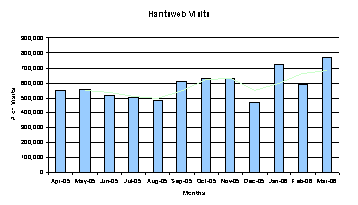
3.4.3 Hantsweb popularity continues to grow, with an average of 13,000 unique visitors each day, and 70 million Hantsweb pages viewed each year. This is an estimated increase of approximately 30% during the last 12 months.
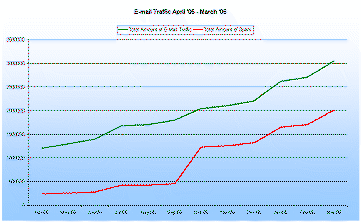
3.4.4 E-mail traffic also continues to rise with over 21 million messages processed by the County Council over the last year. 66% of external messages are stopped as part of the `spam' filtering system, and approximately 1% are trapped (210,000) as virus attacks.
3.4.5 Service improvements planned for the next twelve months include:
· We will increase the depth and range of out of hours support to help mobile and flexible working and improve support for members;
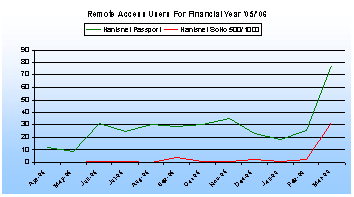
· We will report more fully on the availability of the smaller systems e.g. Hantsnet Passport and the web publishing system (WPS);
· Industry standard `IT Infrastructure Library' processes (ITIL) are being adopted for improved management control and reporting;
· Downtime will be reduced through a range of changes in the computer suite and through improved recording of calls into the Help Desk;
· Self service and supported self service will increase, either through the Help Desk or directly e.g. resetting your own password;
· A new corporate Service Level Agreement (SLA) will be put in place.
3.5 Customer Satisfaction:
3.5.1 IT Services continues to undertake a monthly electronic customer satisfaction survey of 500 randomly selected users. Typically around 30-35% reply( which is fairly standard for questionnaires of this type). The questionnaire assesses the gap between perceived performance and importance of services. The largest gap remains SAP, although there has been a steady improvement over the last 12 months.
3.5.2 Typically around a third of respondents submit comments and ideas, providing a useful insight into the real issues for IT users. Comments and scores indicate that the main strengths are:
· The Help Desk, which is seen as efficient and user-friendly;
· The professional performance of IT staff called to solve local problems;
· The value of newer services, such as Hantsnet Passport.
3.5.3 Negative comments and lower scores which are the priorities for improvement, include mainly:
· System response times (this is being monitored and investigated);
· SAP usability (an improvement plan is already under way);
· System outages (availability has improved during the year and all SLA targets have been exceeded).
3.5.4 IT Services also commissions SOCITM to undertake an independent survey of IT users every two years, and this gives valuable benchmarking information on a range of factors is much more detail. This provides a comparison across nearly all local authorities, and will be re-run in 2006, including a specific survey of schools.
4. Unlocking the Value of IT
4.1 At its heart, it is the role of IT to deliver IT solutions and services which are benchmarked as `low cost' and which meet needs, but IT also has to be able to show it is delivering quantifiable value. Maximising return on IT investments is much more than just meeting Service Level Agreements (SLAs) and controlling IT spend.
4.2 One key to this lies in the contribution IT can make to business process change. This requires innovative use of IT going beyond automating the current ways of doing things. This can only be achieved if service managers have strong IT awareness and understanding, and IT professionals are more skilled in understanding service objectives and problems.
4.3 All IT projects must show a good business payback before investments are made. Such benefits tend to come from better use of resources (e.g. property or staff time), an ability to reduce customer demand (e.g. through self service) or increased productivity and efficiency and lower overheads. IT investments are still not planned well enough: this includes financial planning, risks, change management and rigorously tracking through and demonstrating the business value of IT investments. A pre-project checklist has been produced to help with this process (see Appendix D), although this alone will not ensure success.
4.4 Three areas in particular are a priority in unlocking greater value from IT and are covered below:
· The partnership of IT professionals and service and policy managers;
· Resisting over-complicated IT solutions;
· Increasing the awareness and understanding of IT.
4.5 Partnership with the business
4.5.1 IT professionals need to work as closely as possible with front line services in planning and delivery - and not just of the IT components of service improvement. Ideally this should include joint accountability for results and hitting performance targets, with service managers ensuring that this results in:
· IT and business change projects are properly planned, costed, managed and driven through with a high likelihood of success;
· The total cost of ownership of different technology solutions is understood in the planning stage rather than simply making comparisons of `price tag' options;
· Business processes change to exploit the potential of new technologies and service planning and policy development link to IT opportunities;
· There is rigour in defining and delivering benefits realisation programmes from IT investments, not merely ensuring that projects are delivered to time, quality and budget.
4.5.2 In some parts of the organisation this works well and there is a good understanding of IT and its potential, including how costs are made up and how benefits from IT investments can be realised. IT professionals bring experience of business analysis, change and project management. In this respect the label `IT' can be an obstacle, and some service managers still see the role being little more than `technology' advice and management. It is tempting to change the title of the IT Services department! It is also important that IT professionals acquire and demonstrate a depth of skills and experience, especially in change management.
4.5.3 Change leadership skills are in high demand in all organisations. Typical required competencies include experience of managing complex programmes and projects often with an IT element, but genuinely embracing strategy, organisational design, process and engineering, communication and other change management disciplines. The County Council has an increasing number of change programmes planned or underway which are designed to standardise and improve business processes enabled by new technologies; e.g. the Contact Centre programme, mobile and flexible working changes, alignment of SAP business processes, `self service' for staff and the public etc.
4.5.4 CMT may wish to consider how major corporate business transformational activity could be corporately co-ordinated and monitored. Currently major corporate changes programmes are set up on an individual basis (eg. the Contact Centre programme) and having a repeatable corporate approach could help to ensure pooling of scarce change management skills, sharing of best practice, adoption of standard approaches to change as well as standardising business processes across departments. Not all programmes would lend themselves to this approach, and departmental leadership will remain essential.
4.6 Resisting Complexity
4.6.1 Technology architectures are everywhere more sophisticated and complex than was the case ten years ago. The internet, the Web, diverse access devices such as PDAs and laptops, wireless services, a wider range of applications and new office tools have all created support, security and integration challenges.
4.6.2 Yet at the same time unnecessarily complicated technology significantly undermines the realisation of corporate value from IT investments. It adds risk, reduces the agility of IT services to respond to changing needs and limits the potential for adopting standard business processes and business process innovation. It also increases costs of support, training, change management and integration.
4.6.3 Examples of avoidable complexity would be where an unnecessary range of applications, technologies and methods is permitted in response to diverse departmental needs, and where solutions are over complicated by `nice to have' functions.
4.6.4 Whilst corporate projects must demonstrate adequate control and the delivery of the business benefits promised, departments must avoid acting unilaterally to optimise `point' solutions. This includes maximising the value from a set of corporate portfolio tools such as Microsoft, SAP and HPSN and resisting the temptation to extend the application portfolio for specific services solutions, even when these appear to have the lowest price tag and most immediate benefits.
4.6.5 A critical aspect of the increasing complexity of underlying technology in large organisations such as the County Council is the ability to develop and successfully manage integration `middleware' tools that help unlock the value of information and hide unnecessary technology complexity from IT users. IT Services is exploring the need to invest in middleware integration tools (eg. Service Oriented Architecture - SOA) as a priority.
4.6.6 Such tools will be essential for support information and systems integration needed for the Contact Centre programme, Integrated Children's Services, improving management information for all departments, (including document and record management) and secure identity management.
4.6.7 It will not be possible to manage this additional complexity without a change in our approach. This will include increasing corporate control over standards (eg. software tools, core data sets, interface standards and standards for information sharing, etc), as well as moving to a greater separation between the complex underlying technologies and simpler and easier tools which are used to exploit it. This in turn will require staff and managers to be encouraged to develop a fuller understanding of what can be achieved through the application of IT without having to develop a corresponding in-depth knowledge of the technology itself.
4.7 IT Skills and Awareness
4.7.1 IT is still not universally seen across the County Council as a core job competency, akin to basic numeracy and literacy. Increasing the IT skills of all of the County Council's staff is an essential part of increasing the value from IT investments. Moreover, this will increase job satisfaction and satisfaction with IT generally.
4.7.2 For example, the contribution of technology to individual performance and productivity has never been greater. Service Managers need to make sure that their teams are competent in the use of IT tools. As an example, email continues to be a significant drain on time, despite its undoubted value. During 2005/06 nearly 300 people attended the IT Services `Effective Use of Email' course, and reported an average saving of at least 5 minutes per person per day as a result of the tips and techniques learnt. Across the whole organisation this would be the equivalent to employing nearly 140 staff. Whilst such claims are both difficult to substantiate and the actual savings difficult to realise, it is likely this is an under-estimate of the productivity improvements that can be made by more efficient and effective use of email.
4.7.3 In practice this is more than just providing more IT training:
· Systems must be designed and implemented in ways which are intuitive and easy to understand for users of those systems, reducing need for training;
· Recruitment and staff development must consider IT competency - it is no longer acceptable for anyone to admit they are `IT illiterate'. Managers need to review the IT core competency of their teams and HR should review policy and guidance for recruitment and IPP in this respect;
· Managers need to be knowledgeable about the potential of IT to bring about fundamental change in the way their services operate, and the total cost of ownership models for IT investments;
· The potential value of a single IT training service across the County Council is being considered, drawing together those IT trainers in IT Services and Departments, linked to the corporate HR training client, operating on a business basis (maybe with a 3rd party partner).
5. Strategic Direction
5.1 Post e-Government
5.1.1 The e-Government era is over; the Implementing e-Government targets (IEG and BVPI157) have been met, and a report was made to CMT on this in January 2006.
5.1.2 A new national strategy is emerging, and `e-Government' is being replaced with `transformational government' or `t-government' - likely to be equally misunderstood and overworked as a term! The national priorities post e-Government are broadly:
· Customer focus and services designed for the citizen and business, including take-up of services and digital inclusion;
· Shared Services for increased efficiency;
· IT Professionalism dealing with the perceived failings of public sector IT projects.
5.1.3 Although informed by national strategy and policy, for the County Council the priorities will be led by the corporate strategy `Transforming through Technology'.
5.2 Corporate `Transforming through Technology' Strategy
5.2.1 In 2003/4 the County Council abandoned the use of an `IT Strategy' which tended to focus on technology with only a passing connection to business and service outcomes. The `Transforming through Technology' strategy 2004-2006 was instead based on how technology would support new ways of working and corporate service improvement priorities.
5.2.2 This has proved a successful approach, due in large part to the considerable involvement and support of service managers and chief officers across the County Council in its development. The strategy is now being updated and workshops are being run across the County Council. A number of themes are already emerging which are likely to be priorities for the next two years:
· Customer focus - the contact centre strategy, digital inclusion, increasing the take up of e-services and self-service;
· Mobile and flexible working - changing working practices;
· Increased efficiency and productivity including adopting new ways of working enabled by technology;
· Information management and better use of information;
· Partnerships and shared services - creating genuine collaboration to improve services across organisational boundaries;
· IT skills and awareness - for everyone (see section 4.7).
5.2.3 Customer Focus - The phrase `citizen centric' is almost as widespread and misused as `transformational' - but the principle of getting back to doing what the public want rather than simply putting electronic services on web sites has to be right. For the County Council, the Contact Centre strategy lies at the heart of this, and will inform development of Hantsweb and systems integration to enable both mediated and self-service access to information and applications, along with public consultation and communications. This programme represents one of the biggest challenges the County Council faces. It is an essential part of service improvement planning and strategically important for the Council's future position as a public service provider in Hampshire.
In the enthusiasm surrounding new technologies, disadvantaged groups can become unintentionally excluded. Hampshire County Council provides support for digital inclusion through the Peoples' Network in libraries, Silver Surfers week, design of Hantsweb and Hantsweb Awards. We need to ensure that the implications of technology trends in society are reflected in the Community Strategy, and in Adult and Children Services planning in particular.
Significant investment has been made across the country putting services `on-line'. Yet actual use by the public of these services nationally is low compared with many other countries. The Council needs to ensure that Hampshire residents are aware of and encouraged to use these new services where appropriate and service managers need to be prepared to adapt e-services to meet the needs of the public better, as part of service development.
Self-service access to electronic information and systems is necessary both internally and externally, without mediated help. This will help scarce and expensive personal support to be focused where it is most needed and where electronic methods are genuinely inappropriate. This requires systems to be easy to use, with a greater emphasis on `personalised' services. Examples include the way in which Hantsweb will develop as well as increasing the value and reducing the support costs of internal systems through Hantsnet.
5.2.4 Mobile and Flexible Working has great potential for the County Council and has been covered in the last two annual IT reports. IT Services has put in place common services including video conferencing, secure broadband access from home, wireless and synchronised PDA, laptop and tablet access. These, in combination with the existing Hantsnet infrastructure which allows access to common desktops from any location, provide a foundation for flexible and mobile working. Several challenges remain:
· Helping managers to acquire the skills and have access to the support they need to successfully lead a mobile workforce, abandoning management practices of the past based around staff being located in offices and having regular meetings to control work;
· Changing business processes to suit mobile or flexible working, rather than simply importing new technologies into the existing ways of working. This includes reassessing the use of property, travel, team management practices and staff contracts.
· Exploiting existing technology where possible rather than acquiring new tools as they appear on the marketplace.
· Extending corporate function existing IT where necessary of (e.g. instant messaging).
5.2.5 Increased efficiency and productivity - Innovative and effective use of technology is often the key to increased efficiency and productivity. IT can deliver significant corporate, team and individual productivity, but poorly executed IT solutions can also create new costs or business rigidity. Typically, change is needed in order to maximise the return on technology investments (e.g. mobile and flexible working tools) and to meet the needs of the public (e.g. in delivering the most responsive services in the most cost efficient way). Increasing service and policy management awareness and understanding of how to unlock the potential of technology for business change, will assist this.
5.2.6 Information Management - Technology on its own delivers limited value. The value comes in being able to do things better and more cheaply, typically requiring access to the right information and information management tools. During 2006/7, a new corporate Information Management Strategy will be put in place which will identify the actions needed to deliver improved support for electronic document and records management, corporate search and information reporting tools.
5.2.7 Partnerships and Shared Services - Public services cannot operate independently. Integrated children's services, local strategic partnerships, a new community focus, public protection and search for greater efficiencies all demand the join up of activities at the point of delivery and in the `back office'. The Hampshire and Isle of Wight e-Government partnership has made good progress in this area, for example with the Hampshire Public Services Network, but true integration across organisational boundaries remains elusive. A recent paper on shared IT services has met with strong support from partners in Hampshire and IT services is putting in place the necessary governance and infrastructure to support wider shared IT services in the region. Service managers are asked to work with IT Services to jointly develop new shared services.
5.3 Technology directions
5.3.1 Corporate technology direction is led by service needs, cascaded down from the Corporate Strategy through the corporate `Transforming through Technology' strategy. It is contained in a `Blueprint' of technology architecture and plans (a bit like a traditional `IT Strategy').
5.3.2 A number of technology priorities are clear, and in common with other organisations:
· Increasing IT business continuity and systems resilience;
· Meeting growing demands for wireless and communications technologies;
· Security and authentication;
· System integration and process re-use;
· Enhanced desktop and collaboration tools.
5.3.3 Business Continuity and Systems Resilience - One effect of e-Government has been to increase the reliance on technology and systems by the Public, partner organisations, staff and Members. Measurable costs to the County Council of total Hantsnet systems downtime are estimated to be over £10 million per week, and this does not include the costs of the potential loss of reputation, impact on other organisations, or the risks of consequential damages. During the Member Scrutiny of IT last year, this was identified as an area of weakness to be addressed.
The demands for higher availability of computer systems include:
· Extended service opening hours - for example, the Contact Centre will require systems available out of normal hours, libraries are planning to increase opening hours along with other services and Hantsweb has to be available 24 hours a day;
· Managed Services - the County Council already provides managed IT services to a wide range of public service partners and this is likely to increase. A high level of auditable resilience will be required if we are going to continue to be able to provide managed services, including to schools as a Local Education Partner (LEP);
· Changing working practices - as the County Council moves away from a traditional `9 to 5' working day, so this also requires systems to be available outside office hours;
· Self Service access by the public and intermediaries - as `self service' becomes commonplace, public reliance on e-services available directly on the web or through intermediaries leads to an expectation that they will be available at any time.
These changes put pressure to reduce both planned and unplanned systems downtime, constraining the time available for essential IT maintenance. The combined effect of these is that the County Council will require a second computer site in addition to the computer centre in Winchester. The possible use of Babbage House is being considered but outsourced options are also feasible. A number of external organisations have offered to collaborate on this project, and this will potentially draw in new funding and reduce costs for the County Council. In addition, the computer centre in the Castle basement at Winchester will move as part of the Ashburton Court refurbishment project to a new location, with increased levels of environmental controls and resilience.
But business continuity is not just an IT issue and service managers will need to take a broader look at business continuity planning. This includes ensuring that when extending service support that the increased levels of IT backup and service availability required are appropriate and affordable.
5.3.4 Wireless and communication technologies - Wireless technology enables easier networking within and between buildings, avoiding complex and costly cabling, and it is becoming an essential ingredient for mobile and flexible working. IT Services is tendering for a corporate wireless infrastructure with a flexibility to grow and develop as the needs of the County Council change. At the same time, the County Council will need to work collaboratively with HPSN partners to develop the range of services and value of HPSN.
5.3.5 Security and Authentication - In order to support the wide range flexible and open access to Hantsnet required as simply and straightforwardly as possible, so the need for security becomes more complex and important. Single sign-on access across systems, locations and devices where possible is important, and the management of a single staff identity helps to reduce costs and increase security.
Unfortunately there are still no national public sector standards in this area, something which is probably the single most important failing of the national e-Government agenda to date. However, the County Council is involved as a pilot site in the national `Government Connect' programme which aims to help to address this.
5.3.6 System Integration - Although many technologies are becoming commodity items, integrating them so they work together in a corporate environment can be complex. Developing a single Enterprise Architecture view for the County Council, with middleware integration technology, will bring a lower cost of ownership and better value from information resources in particular. IT Services is developing an approach to this, building on the investments already made in IT components such as SAP and Microsoft Enterprise tools, and reusing service processes (called a `Service Orientated Architecture' - SOA).
5.3.7 Desktop and Collaboration tools - The County Council has been very successful in controlling overall costs through the `thin client' Hantsnet technology, although multimedia function has been limited. It is now a priority to enhance the multimedia tools where required (eg. voice, video and other collaborative working tools), but without compromising the basic design that has brought so much value. This could increase the proportion of `thin client' rather than PC's in the Council from 70% to 80%, saving an estimated £240k p.a.
Document and information management technologies are now of critical corporate importance, and as teams become more mobile, improved information management tools, enhanced email and instant messaging will become more important alongside conventional office systems.
6. IT Roles and Structures
6.1 Defining an `IT professional' is notoriously difficult. IT Services and many of the IT teams within departments comprise a mixture of business professionals who have knowledge of IT, working alongside `traditional' IT professionals. In the plans for a national IT profession within the public sector, the emerging definition is `those who work within an IT department for a CIO/Head of IT'. Under this broad definition, there are probably 450 IT staff across the County Council, of which just over 300 are within IT Services and roughly 200 are `technologists'.
6.2 During 2005/06 IT Services reorganised - perhaps the most significant restructure since CCT in the late 1980s. Ideas for change were discussed with customers across the County Council and were implemented on a project basis against a business proposal for change. Success criteria were set around improving the efficiency and effectiveness of the department - being easier to do business with, ensuring greater transparency, faster delivery of services and better integration across services. The new structure for IT Services is described at Appendix B. It should be noted that there has been significant change in the IT Services' Management Team, with virtually all team members having joined within the last four years. A period of stability is necessary to help drive through the programmes of change being led by ITMT.
6.3 As one of the outcomes from the Member Scrutiny of IT carried out in 2005/06, Members have asked for a review of the devolved arrangements for IT in departments. Questions that have arisen (through this and other areas) have been in the following areas:
· Demonstrating value for money, especially in terms of overall head count and efficient links with central IT;
· Ensuring the right structures are in place to meet the needs of the new Adult and Children's Services departments;
· Ensuring consistency in processes and standards across different IT teams;
· Improving career opportunities and IT professional development to maximise the value of scarce IT skills.
6.4 A devolved arrangement for IT is advantageous in ensuring that IT really is working with the services it supports. However the current arrangements are sometimes too fragmented and autonomous, and it is clear that overall costs can be understated, and management practices can be inconsistent. As with all other services, IT must respond to changing needs and the tightening financial environment, without creating undue risk to existing services and support. Local delivery with stronger central management is the preferred model.
6.5 Ideally the IT lead in departments should be at departmental management team level covering strategy, policy, business change enabled by IT, and `client' responsibility for IT performance and value. A clear performance link to the Head of IT is essential, but often lacking.
6.6 In addition to looking at internal structures, IT Services is also exploring ways of making use of the pool of IT expertise across the local authorities in Hampshire and the Isle of Wight, and it is arguable that this could extend to IT support in schools.
As this report is for information only and no decision is sought, it has no financial and legal implications or an impact on race equality or crime prevention.
7. Financial Implications - None.
8. Personnel Implications - None.
9. Impact Assessment - Race and equality impact assessment has been considered in the development of this report and no adverse impact has been identified.
10. Crime Prevention Issues - None
11. Recommendations
It is recommended that:
i. The Annual IT Performance Report of the Head of IT Services for 2005/06 is endorsed and the performance achieved (see section 3) is noted.
Appendix A
IT Project Activity 2005/06
(details submitted by departments)
1. Corporate
a. Hantsnet Services
· Delivery of numerous SAP improvements e.g. reducing payroll closure time, single sign-on for all key SAP functions, staff absences in Employee Self Service, automatic loading of absence quotas and SAP system design for Pay & Benefits completed.
· SAP user administration now undertaken by the Hantsnet security team to standardise process and lead to more efficient working.
· Help Desk self service `unique simple Hantsnet form, including a facility for resetting Hantsnet passwords is available to approximately 300 pilot users from mid-May, which will be of particular benefit to those who work out of normal office hours, including members.
· A problem management tool is in pilot to achieve greater rigour in tracking down underlying causes leading to a reduction in incidents, greater efficiency and less disruption for customers.
· New standardised monthly performance reporting has been delivered, and work is underway to increase the range of Help Desk calls that can be resolved at the first point of contact.
· A trial of home working under way, (Matisse - funded by SEEDA), involving staff from HCC and local SMEs, measuring the benefits to staff & employers.
· Corporate Voice Strategy developed to improve telephony services
b. Training
· New LearnIT web pages launched to assist with corporate staff induction process.
· Project Management training and change programme completed for IT Services as part of the `PlanIT' programme.
· 95% of training courses delivered by IT Services' Training Services achieved rating of good or excellent and the `Effective use of e-mail' course minimum time savings of 5 minutes per person per day being reported, (equivalent to 140 fte pa).
c. Technology Infrastructure
· New UPS and electrical substation implemented to increase service resilience.
· Data storage technology refresh resulting in better performance, improved services and information on resource usage, and reduced costs to the customer. All backups now completed overnight. Winchester City Council data back up media now supported by the County Council.
· Equipment maintenance cohort re-tendered which has improved contract SLA's and reduction of costs to departments.
· Project completed to reduce single points of failure in the IT infrastructure including UPS and electrical substitution upgrades, particularly those affecting the critical applications, resulting in higher application availability.
· Improvements to the IT systems change management process to reduce risk of IT changes.
· Over 150 new servers successfully installed during the year.
· New Hantsnet mobile PDA Service launched, enabling users to read and reply to e-mails, book meetings and connect to the Internet from virtually anywhere. The new PDAs have a built-in connection to the County's mobile telephony network.
· POP3/Webmail upgrade involving the migration of nearly 600 domains, and over 30,000 users in total.
· Ironmail spam system installed, dealing with over 750,000 unwanted emails each year.
· New Enterprise Licence Agreement secured with Microsoft resulting in savings and improved flexibility, especially in working other organisations.
· Hantsnet was a winner in the `efficiency' category of e-Government National Awards, sponsored by the Cabinet Office e-Government.
2. Environment Department
· The Land Availability Monitoring System implemented for the Land Development Progress Team. Also used by Portsmouth and Southampton.
· Time Recording/Project Systems go-live for several hundred staff, underpinned by the complete restructuring of financial and project management coding structures required.
· Implementation of e-consultation for all Environment public consultations, now being considered for extension for Corporate implementation.
· Planning system and website received the maximum rating in the Pendleton Survey. This will mean that Hampshire will receive 100% of the available grant from the ODPM. In addition software developed has been made available to other authorities.
· Hampshire's CANGO service (demand responsive bus service) is now the largest implementation of Mobisoft software in the country.
· Street works are now displayed on maps on Hantsweb, enabling the public to plan their journeys avoiding road works.
· Highways Inspectors are now collecting their data on mobile devices. This removes the need to record manually and then re-key and should also increase accuracy.
· The public can now report street light problems and monitor progress on line by identifying the lamp affected on a map. This Hantsweb facility is integrated with operational systems.
· The public can now access to the Archaeological and Historic Buildings record on Hantsweb.
· Romanse on line traffic and travel information has been extended and improved, providing a wide range of frequently updated map-based traffic information from major towns and major routes across the county.
· Skip and scaffolding companies may now apply for licences on line. This system is popular with contractors, reduces our need to input data and also protects the public by checking that skip and scaffolding companies insurance is valid.
· Minerals and Waste Planning now accept planning applications and objections on Hantsweb.
· Farmers and contractors can now to find out all about snow plough contracts and they can apply on Hantsweb.
3. Chief Executives
· Successful rollout, of SAP HR functions to approximately 250 devolved schools.
· On-line Job Application system developed, linked to the SAP recruitment module. It allows internal and external applicants to search and apply vacancies, or submit a speculative application against a particular work area (e.g. IT, administration, social care etc.).
· New County Election System has been implemented and election results will be dynamically published to the Hantsweb election pages as they arrive on election day.
· Implementation of NLIS level 2 (common land search requests) processed electronically.
· Launch of the eVolve. An online directory of voluntary and community clubs, societies and organisations within Hampshire and the Isle of Wight.
· Education Appeals system - purchase and implementation of an Access database that helps to manage the increasing number of Appeals processed by Democratic Services.
· Grants Website - information about grants for voluntary and community organisations - advice and how to apply. There is also a database used by Departments to manage, track and monitor grant applications.
· Development and use of e-Learning to cascade information e.g. IPP, Equality and Diversity.
4. County Treasurer's
· e-payments facility developed for use with any County application that needs to take a payment over the internet.
· e-invoice payment developed to enable any HCC invoice to be paid using the e-payments facility.
5. Recreation & Heritage
· Completed the rollout of the Peoples Network Expansion by adding 205 extra terminals in libraries.
· Gosport Discovery Centre opened March 2005 with significant focus on public IT.
· Satellite connections for mobile libraries to link to internet and library management system.
· A simple shopping cart facility implemented to enable purchasing of goods.
· Implementation of Rights of Way information in GIS on Hantsweb.
6. Children's Services
· Continued successful rollout of the Synetrix (HPSN) network to schools.
· New School Websites Hosting service has now been launched and is available at no additional charge to schools that use Hampshire County Council's HPSN service. It will help schools without their own website to create an easily maintained site.
· Upgrading of schools e-mail system to double the capacity and increase functionality at no extra cost
· Cleansing of data warehouse data-sets prior to critical upgrade of our core information systems
· Developing a new high quality videoconferencing solution for Hampshire schools
7. Adult Services
· OT Direct has won several awards this year, delivering real benefits to the public.
· Two new nursing homes are now operational and procurement of essential systems to build the platforms for delivering the management IT system via a wireless network for tablet devices in the homes, and provision of an advanced (telecare) resident monitoring system to safeguard the health and wellbeing of residents.
· A mobile and flexible working pilot has been undertaken to identify the potential for developing a wider business case.
8. PB&R
· Registration Service has developed a system to allow the public to book appointments over the Internet to register births and deaths, reducing administration and allowing staff to help the public more with other areas of the service.
· Development is underway of a GIS SAP Property and Land System that will provide information corporately on the County's assets and link seamlessly to financial systems. This will support a future Strategic Property Review
· County Supplies are developing a corporate e-tendering solution that is being piloted by several departments, which has been proven to save administrative time and cost. Also, it assists with increasing competition and encourages suppliers to trade electronically.
· Hampshire Printing have developed a high speed, high function printing service to all parts of the Council. This service will help to rationalise local printing equipment and possibly the amount of printed material generated by the County.
· Regulatory Services in conjunction with the Districts, Police and Fire are delivering the Crime And Disorder Data Information Exchange system. (CADDIE). This is key to the County's responsibility in working with other agencies and organisations to develop and implement strategies to tackle crime and disorder and misuse of drugs in their area.
· HC3S and County Supplies have implemented a pilot of the Government Procurement Card for the purchase of catering supplies. This is expected to reduce the need for processing 20,000+ paper invoices each year.
9. Other
· Project management of partnership working aspects of the `101 single non-emergency' number project, in partnership with Hampshire Police and the Hants and Isle of Wight local authorities. The service went live in May 2006.
· Silver Surfer Week 23-27 May 2005 -to encourage older people to gain experience in the use of the internet.
· Implementation of a package for HFRS for management and monitoring Fire Safety.
· Test Valley Borough Council public planning portal went live in April 2005 hosted through the County Council.
· A replacement Joint Child Protection Register implemented to allow multi-agency co-operation for Social Services, NHS and New Forest District Council.
· The Hantsweb Awards event celebrated the best in web sites and web services throughout Hampshire and the Isle of Wight.
· Rt Hon Jim Fitzpatrick, Minister for Local e-government visited the Hampshire Fire and Rescue Service (HFRS), and reviewed `Kidzone', a website aimed at young people.
· Hart District Council Web site is now hosted by the County Council.
Appendix B
Extract from IT Services' Reorganisation - Business Proposal, February 2006
1. New Structure of IT Services:
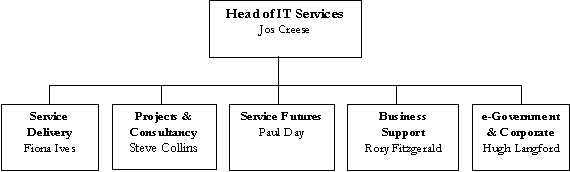
The proposed new structure in line with industry best practice (the Corporate IT Forum and ITIL), separating out the key roles and functions for clarity of responsibility and control of costs.
2. Group Descriptions:
2.1 Service Delivery Group
This group manages all operational IT infrastructure, including Hantsnet, Hantsweb and the computer centre. It also identifies opportunities for technical and service improvement, and undertakes technology development activities as part of projects led by Service Futures.
The main benefits of the change are:
· Service development projects will be drawn together transparently as part of an overall Roadmap managed by the Service Futures Group working more closely with customers.
· All contracted applications support will be drawn together with support teams and other SLA driven services.
· All Network Services and Desktop Services will be drawn together in one single streamlined group.
2.2 Projects & Consultancy Group
This Group provides business-focused systems solutions and consultancy and the technical expertise as required to deliver the required outcomes against commissioned work. It undertakes business analysis, application development, testing, programme and project management.
The main benefits of the change are:
· All corporate and departmental consultancy and business development projects, including SAP, are drawn together in one section underpinned by standard methods.
· Improved capability to employ business professionals to lead change management projects.
· A strengthening of quality control and test environments for new applications and developments.
2.3 Service Futures Group
This Group is the part of the IT supplier activity which draws together service improvement plans and secures new external business. It also includes those aspects of the supplier business not already covered by the other sections that are typically `cross-cutting' - e.g. account management, communications and marketing, technology `blueprint' and customer satisfaction plans.
The main benefits of the change are:
· A concentration and clearer focus for service direction and account management.
· Drawing together of all service development projects and programmes as part of a customer-agreed Road Map.
· Strengthening the external focus of IT Services, through co-ordinated communications, focussed marketing and coherent technology planning.
2.4 Business Support Group
This Group ensures the smooth running of the IT business, including adherence to corporate standards for financial control, centralised overheads, corporate governance, business planning and independent external benchmarking. Work includes financial planning and management, reporting, ordering and invoicing and support services such as training.
The main benefits of the change are:
· Introducing an independent performance and benchmarking function to demonstrate best value and identify opportunities for service and efficiency improvements.
· Strengthening and developing the ordering service, providing a single point of contact for customer queries around products and services.
· Strengthening the corporate lead on financial, legal, procurement and HR management, including efficient links to other IT groups outside IT Services.
2.5 e-Government & Corporate Client
Corporate ownership of technology standards, policies, strategy and overall direction including approving corporate IT development priorities. As the `non-supplier' part of IT Services, the Group has a key role to play in business transformation initiatives that have a strong corporate dimension.
The main benefits of the change are:
· Leadership role on the Contact Centre programme.
· Reducing the scale of activity following the successful completion of the `Implement Electronic Government' targets, and delivering benefits from this.
· Strengthening the basis of Corporate IT policies, standards and strategies.
Appendix C
Activity Performance Graphs
|
|
|
|
|
|
Appendix C
continued
|
|
|
|
|
|
Appendix D
PROPOSALS CHECKLIST FOR IT PROGRAMMES AND PROJECTS
(extract from report to the e-Government and ICT Steering Group)
Note: This checklist is intended as an aid, not a formula for producing proposals. The way it is applied should therefore vary according to whether the proposal is a programme or a project, and whether it is `big' or `small'.
Appendix E
Summary of Conclusions and Recommendations
This appendix summarises the conclusions and recommendations within the report identifying the sections referred to.
Service and Policy Managers:
· Service managers should ensure e-services are sustainable, supportable and well publicised and well used, as part of broader service planning (1.2), (5.2.3).
· Service managers should adopt the agreed pre-project checklist for all IT project proposals and be vigorous in defining and delivering measurable benefits from those. IT projects should be run on a consistent basis (3.3.3), (4.3), (4.5.1).
· In extending the availability of services to the public, planning must include the costs and support implications of IT systems and business continuity (5.3.3).
· Service managers need to involve IT professionals early in service planning, strategy and policy development, not just in technology service delivery. Where possible joint IPP targets for IT and managers should be set (4.5).
· Re-use of standard corporate technology, processes and systems is a priority wherever possible resisting the temptation to optimise `point solutions' in departments. This includes maximising the potential of tools such as Microsoft and SAP and "thin client" (4.6), (5.2.4), (5.3.7).
· Service managers need to ensure they are competent IT users, and understand the potential of IT to transform services, leading changes to working practices accordingly (4.7.3), (5.2.4),(5.2.5).
· Service managers need to ensure their staff are competent in the use of IT tools (4.7.2).
· Service managers are asked to work with IT Services to develop new shared services across public service boundaries (5.2.7).
HR Matters:
· IT needs to be seen as a core competency for all staff reflected in IPP planning, policy and guidance, as well as in recruitment and career progression. This includes managers understanding the total costs of ownership of IT and how technology can transform services and increase value. HR may wish to review policies and guidance accordingly (4.2),(4.5),(4.7.1),(4.7.3).
· Managers need support and training in leading a mobile and flexible, based workforce (5.2.4).
· A review of IT training provision (delivery and corporate leadership arrangements) should be undertaken working with the corporate IT Group, bringing together all IT training delivery in one group (4.7.3).
IT Services' Matters:
· IT professionals need to acquire a depth of skills and experience especially in change management and demonstrate a real understanding of the working practices and the business needs of departments to help them achieve the value from IT investment (1.9), (4.5.2).
· Corporate IT projects must be signed off by customers with a rating for satisfaction and values and consideration given to adopting standard project controls across all departments through a single Project Office (3.3.2).
· IT Services needs to ensure a document management system is delivered as part of the Information Management Strategy (3.3.3).
· A review of devolved IT arrangements should be undertaken by the Head of IT reporting to CMT including reporting, project control and other output (3.3.4).
· Independent review of IT customer satisfaction to be undertaken, including a specific survey of schools (3.5.4).
· IT Services need to develop a business case for integration middleware tools which supports the `Transforming Through Technology' strategy (4.6.6).
· Systems must be designed and implemented in ways which are intuitive for users, reducing need for training (4.7.3).
· IT Services must put in place the information management tools to support the developing Information Management Strategy (5.2.6).
· Business plans must be developed for a second computer site (5.3.3).
Other:
· The corporate strategy `Transforming Through Technology' be brought to Cabinet in September following CMT endorsement (5.2).
· Digital Inclusion should be considered in the Community Strategy and in Adult and Children's services planning (5.2.3).
· The SAP Usability Improvement Programme remains a high priority (3.5.3).
Glossary of Terms | |
Best Value Performance Indicator (all of services to be delivered electronically by 2005) | |
Chief Information Officer (equivalent to `Head of IT') | |
Contact Centre |
Group of Staff trained and equipped to field telephone calls. |
Corporate Management Team | |
Comprehensive Performance Assessment | |
Compulsory Competitive Tendering. | |
Electronic government | |
Enterprise Resource Planning - an approach to integrated corporate systems (SAP). | |
Employee Self Service (SAP) | |
Enterprise Buyer Procurement (SAP) | |
A framework to align business process, IT, projects and people with an organisation's strategy. | |
This is a leading provider of highways software for the Environment Department (ex Oracle). | |
Electronically delivered services, typically on the World Wide Web | |
Gershon Review of Public Sector Efficiency | |
Geographic Information Systems | |
A joint Central/Local Government programme to deliver online authentication. | |
The County Council's Intranet includes electronic information and systems | |
A secure link from a broadband connection to Hantsnet (eg. from home) | |
The County Council's web site, providing a range of community services | |
Hampshire and Isle of Wight e-Government Partnership | |
Hampshire Public Services Network - Broadband for public services. | |
Implementing e-Government - an ODPM annual return | |
Immediate and direct communication between two people on a network. | |
Individual Performance Plan for staff. | |
IT Infrastructure Library - a universal standard of IT processes. | |
IT Services Management Team | |
Local Education Partner (for schools) | |
Managers' Desk Top (SAP) | |
Software which supports application integration. | |
Office of the Deputy Prime Minister (now DCLG) | |
Personal Digital Assistant - small hand held electronic device. | |
Industry standard project management methodology. | |
The IT Services' plan for service development and improvement | |
SAP Enterprise Resource Planning - integrated system for finance, procurement and HR etc. | |
South East England Development Agency | |
Generic term for older people using the world wide web | |
Service Oriented Architecture (see Enterprise Architecture) | |
Service Level Agreement | |
Small and medium enterprises | |
Society of IT Management | |
Society of Local Authority Chief Executives | |
Unwanted email - from Monty Python "spam with everything" | |
Social Care Information System provided by Anite (supplier) | |
A notebook computer that accepts screen input via a stylus | |
The County Council's Technology statement and plans. | |
Technology design for networks with minimal local processing | |
Corporate IT. Forum - a benchmarking subscription club for larger corporate IT users. | |
Uninterruptible power supply | |
World Wide Web - services on the internet. | |