
Archived decisions
Hampshire County Council | |||
Pension Fund Panel |
Item 8 | ||
15 September 2006 |
|||
Economic and financial background | |||
Report of the Independent Adviser | |||
Contact: Harvey Cole, (01962) 865930
1 Introduction
1.1 This report provides the independent adviser's comments on the current economic outlook, and the prospects for markets over the rest of 2006 - as seen on 31 August 2006.
1 The broad picture
1.1 The most significant feature of the last three months has been the emergence of clear indications of an imminent slowdown in the US economy. This outweighs growing political concerns over the explosive situation in the Middle East and anxieties about airport security.
1.2 The motive power in America has been the willingness of consumers to spend even in the absence of the conventional source of energy - rising real incomes. Virtually stagnant personal earnings for most of the population have been affected by the ability to finance expenditure by tapping into the rising value of homes. This has been occurring at an even greater pace than in Britain. But the housing market - although patchy in regional terms - is now clearly on the turn, and the proverbial punchbowl is about to be removed at the height of the party.
1.3 Ironically, this is happening just at the moment when pay rises have started to show signs of acceleration. But this is so far only barely matching the continuing rise in retail prices although it also means that the rapid growth of the share of profits in national income over the past few years will also come under pressure. Profits have held up well in face of cost pressures from rising energy and commodity prices. But they are, by definition, a lagging indicator. If there is now also to be a squeeze from higher pay, then the prospect must be for lower profits or increased prices, or, of course, a combination of the two.
1.4 The problem is that if the American engine runs out of steam, there is no alternative locomotive available to perform the task of pulling the world economy at its recent pace. While Europe has been growing at a better rate, it is highly dependent on exports (Britain rather less so) and any slowdown in the US sales is bound to affect those from overseas. Japan is beginning to emerge from a long period of stagnation, but does not have the weight to take up much of the strain. China has been expanding almost out of control, and the growing need to damp down its financial expansion will set limits to the welcome increase in its own imports that could play a helpful role. India's day is still years ahead.
1.5 The conundrum for the next year or so is whether an American slowdown can be managed so as to avoid a damaging lurch into recession. A common, but irritating image is one of the economy making either a hard or a soft landing. This is not very helpful, as having achieved the presumably preferable soft return to earth, that is not the end of the journey, and the problem of taking off again remains.
1.6 In practice, achieving a gradual slowdown, without it becoming a sharp decline, is difficult. Even in these days of `just in time' policies in commerce and industry, reducing the amount of stock in the pipeline, lower sales still bring echoes of the old inventory problem. A small reduction in sales brings a larger (even if temporary) drop in orders as existing stock is sold at a slower rate, and this can escalate back along the production chain.
1.7 There is therefore a degree of risk that both the US economy and the world's economy in general will suffer more than a slight pause over the coming months, although nothing on the scale of a full-blooded recession seems to be on the cards. The relatively restrained reactions of markets to political upheaval on the international scene suggests that they are not, at least for the moment, in a mood to be easily panicked.
1.8 Two other interesting straws in the wind: ever since 1998 the 100 largest companies across the world have continuously built up their cash reserves: they have risen from a combined $1000 billion to over £1100 billion in the last year alone.
1.9 At the same time as this has occurred dividend increases and share buybacks have also increased so that, despite some recent signs of stirring, investment in new ventures has dropped as a proportion of income. This may help to explain why 75 per cent of American CEOs think that their own companies will show a further rise in profits in 2007 while only 25 per cent of them foresee an improvement next year in the economy as a whole.
2 Inflation
2.1 Discussions about the market and the trend of inflation tend to deepen confusion rather than dissipate it.
2.2 This seems to be due mainly to the simplistic identification of inflation with rising prices. In fact, taken on its own, an increase in prices is actually deflationary as it reduces the amounts that people can buy within their existing incomes.
2.3 An inkling of this seems to dawn on some commentators when they point out that the effect of higher oil prices is to act as a kind of tax - with the oil producers receiving the benefits. As is correctly pointed out, if you have to spend more on petrol you have to buy less of something else. But of course, exactly the same effect is also caused by a rise in the price of anything besides oil. It is only when pressure develops for higher incomes to match higher prices that the notorious spiral of inflation can get to work.
2.4 The most striking feature of the last five or six years has been the failure of wage pressure to emerge in the wake of higher basic prices (or, to use the jargon, to trigger secondary effects).
2.5 This has been due to much of the higher cost of basic materials being offset by a growing tide of highly competitive manufactured goods, not just from China but from a whole range of newly developing economies in Europe as well as Asia. In British shops the whole range of goods, other than food, now costs around 5 per cent less than in 1997.
2.6 We are now at the point where the prices of imported goods - while remaining highly competitive - are themselves rising in response to higher costs. And the point at which wage and salary earners start pushing for larger incomes to compensate must be getting closer.
2.7 In this context, raising interest rates seems to have something of a perverse impact: one of its immediate results is to push up the cost of mortgages and then further stimulate demand for higher pay.
2.8 The intended result is to try and head this off by making it difficult for employers to meet these demands by reducing activities in the economy, and thus profits. This is again a process that can become unintentionally self-reinforcing with perverse consequences.
2.9 It is difficult to resist the impression that some aspects of trying to control the economy still smack of the witch doctor or the medicine man, by placing great reliance on the magic of interest rates to fine tune events. There is an element of schizophrenia over how precisely the drug is supposed to work. On the one hand we are told that changes in interest rates take some time to work their way through. (This is reflected in the Bank of England's objective of targeting inflation two years ahead). On the other hand, news of an unexpected upturn in one month's figure for the retail price index tends to lead to calls for an immediate rise in interest rates.
2.10 Perhaps even more puzzling is the attempt to match interest rate policy to what is called the amount of `spare capacity' in the economy. While it is clearly sensible to try and avoid situations where either demand is excessive in relation to ability to meet it or where large amounts of capacity lie idle, the problem is measuring the so-called `output gap'. Indeed, it seems a perfect practical example of Heisenberg's uncertainty principle.
2.11 We are told that the spare margin of capacity in the British economy is, typically, between about 0.7 and 2.5 per cent. In itself, this is highly implausible. Even allowing for plant that is unlikely ever to come back into use, it cannot be the case that output cannot rise by more than 2 or 3 per cent without adding new capacity. The measuring problem is highlighted by the fact that output estimates are continually revised for several years after the original dates when they are made. Recently it was decided that output had been 0.7 per cent higher over a preceding period of five years - making hay and havoc of any policy decisions that might have been made on the basis of spare capacity over that time.
2.12 In contrast, the US regards utilisation of over 85 per cent of capacity as indicative of possible pressure on resources. One thing is certain: if you don't know where you are - and still worse, if you're not sure where you have been - your chances of reaching a defined destination must be impaired.
2.13 It is notable that the main oil exporters in the Middle East have actually been spending a smaller proportion of their surging incomes on importing goods from other countries than they did in the previous boom of the `70s then as much as 75 per cent of the inflow was spent on imports - but this still had a dragging `tax' effect on the rest of the world. But this time round, only $120 billion of the estimated $400 billion increase in export revenues has found its way back into the world trading system. The rest has piled up in foreign currency reserves (the six Gulf States have been adding reserves at the same pace as China). The reserves are now being invested in foreign bonds and equities, and the general rise in interest rates is likely to accelerate this movement. But this will put upward pressure on asset prices while still leaving large amounts of money effectively sterilised in terms of supporting world trade.
2.14 Much is often made of the fall in what is called `energy intensity' in the industrialised countries since the first oil crisis of 1973. By that is meant a drop in the amount of oil required for each unit of national output. This obviously helps to reduce demand. But the developed economies have grown so much in the past 30 years that they still absorb a great deal more oil in total - and that is becoming an ever-larger influence in the emerging countries from China and India to Brazil and South Africa.
2.15 With oil at $13 it accounted for 0.7 per cent of GDP in America in 1998, whereas today, with an increased national income $70 oil absorbs almost 4 per cent.
Oil: Current Background
2.16 Instead of the usual stock market chart, I thought that some background material on oil might be of topical interest.
Oil and Gas Reserves of State-controlled Companies (billion barrels)
1. |
Saudi Arabco |
295 |
8. |
ADNOC |
70 |
2. |
National Iranian Oil Company |
290 |
9. |
Nigerian National Petroleum Corporation |
45 |
3. |
Gazprom |
240 |
10. |
Sonatrach |
40 |
4. |
INOG |
135 |
11. |
Libya National Oil Corporation |
35 |
5. |
Qatar Petroleum |
120 |
12. |
Rosneft |
35 |
6. |
PDVSA |
105 |
13. |
Petronas |
25 |
7. |
Kuwait Petroleum Corporation |
95 |
|||
Source: The Economist |
2.17 The so-called four giants of the industry, the non state-controlled Exxon-Mobil; Lukoil; BP and Shell (in that order) fill the next four places, with combined reserves of some 65 billion barrels.
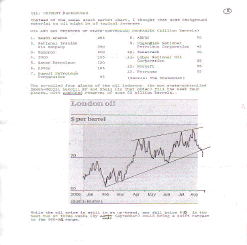
2.18 While the oil price is still in an up-trend, any fall below $70 in the next two or three weeks (by mid-September) could bring a swift retreat to the $60-64 range.
3 The Market Scene
3.1 In May I described markets as being in a state of `apprehensive ebullience' and fearful of something unexpected happening. What seems to have followed is that many people, in a variety of markets, decided at about the same time, to sell before anything unexpected actually occurred. And that was it.
3.2 This underlines not so much the irrationality or even the unpredictability of markets, but the way in which different perceptions of the same facts can produce different results over time - the old question of the half-full or half-empty glass.
3.3 One general lesson seems to be that trying to move in and out of markets to catch up trends and declines loses more in dealing costs than it is likely to capture in improved returns. It is always easier to persuade people to sell when prices are low rather than high - and to buy when they have already gone up a lot. An interesting example of the way this has worked in practice was recently provided by Legg Mason. Between 1983 and 2003, the annual return on a fund tracking the S&P Index was 12.8 per cent. The average US equity notional fund produced 10 per cent after charges. But typical investors in such a fund, because of poor timing of exits and entrances, got a return of 6.3 per cent. They would have been a whole percentage point better off just sticking to US Treasury Bonds over the whole of the 20 years.
3.4 The obvious moral is either to make sure you can call the tunes correctly, or pick the right holdings and stick with them. Of course, neither is easy in practice, so there is still no automatic recipe for successful investing.
3.5 The general impression of investment performance - in spite of setbacks since May - is probably that there has been good, solid if unspectacular progress. Indeed, CAPS indicate average gains on pension funds balanced portfolios of 15% a year in the three years to the second quarter of 2006.
3.6 But this hides some surprising ingredients, and background. The same CAPS report showed the first negative autumn for pooled funds for any quarter since the first three months of 2003. Even more striking, over 5 year and 10 years the return on UK equities was worse than on conventional bonds, index-linked gilts and property. Only overseas equities fared worse.
3.7 Insult is perhaps added to injury as funds have been switching their equity emphasis precisely from UK to overseas companies. Since the beginning of 2004, they have been net sellers of £50bn of UK shares. That they have been selling into (for most of that time) rising markets is some compensation.
3.8 The loss of confidence in equities has helped to fuel the search for alternative assets. Intriguingly, there are increasing signs that one effect of this attempt at diversification is to help make the new favourites, from hedge funds to commodities and from private equity to derivatives and foreign currency, behave more similarly, and to respond in the same way. This erodes the very characteristics of hedging risks in equities that it was hoped to capture.
3.9 Equity markets duly fell by almost precisely 10 per cent in May - because opinion expected (a) a drop of 5 per cent and (b) optimism on the part of most individual traders that they would beat the competition to the exit.
3.10 Since then, prices have fluctuated, seeming to have found a fairly firm floor, but finding it difficult to break back to above 95 per cent of the May high.
3.11 Volatility is also markedly higher and London seems to have decoupled itself to some extent from movements in New York. Daily changes in the FTSE and S&P indicate that they now move much more frequently in opposite directions, and the scale of movement is also more differentiated than pre-May.
3.12 Other signs of confusion and uncertainty can be seen in the erratic price movements of commodities. Virtually all industrial and agricultural materials came sharply off their peaks, and have not regained them in spite of political uncertainties. Oil is the one exception, but the surprising performance has been that of gold - now some 12 per cent below its peak. That seems to be symptomatic of a general feeling of uncertainty: if gold is no longer an automatic haven in times like these, there seems to be no consensus.
3.13 The outlook has changed in one important fact. While uncertainty persists - and will probably intensify - it has now unexpected good news that would have the main effect on markets. And there seems less reason to expect unexpected good news - economically and politically - on the world scene in the coming months than there was to fear the opposite in May.
3.14 However, there may be some comfort from Warren Belasco's comment:
"We need to be more savvy about the rhetorical conventions, false dichotomies, inappropriate analogies, questionable assumptions and dubious calculations that keep cropping up whenever the future is discussed".
Recommendation
1 That the adviser's comments be used as background to the discussions and process of selecting the new multi-asset managers.
Section 100 D - Local Government Act 1972 - background documents
The following documents discuss facts or matters on which this report, or an important part of it, is based and have been relied upon to a material extent in the preparation of this report.
NB the list excludes:
1. Published works.
2. Documents which disclose exempt or confidential information as defined in the Act.