
Archived decisions
Hampshire County Council | |||
Pension Fund Panel |
Item 7 | ||
15 September 2006 |
|||
Local Government Pension Scheme (LGPS): new look LGPS | |||
Report of the County Treasurer | |||
Contact: Nick Weaver (01962) 84 7568; [email protected]
1 Summary
1.1 The Government has issued a consultation on options for a new look Local Government Pension Scheme (LGPS) from April 2008. It is the latest in the lengthy "stocktaking" review as the Panel will be aware.
1.2 The draft response for the Hampshire Pension Fund (Appendix A) supports the continuation of a final salary scheme, similar to the current scheme.
1.3 The consultation also covers variations to the flexible retirement changes introduced in April 2006, which will be reviewed by the Employment in Hampshire County Council Committee (EHCC).
1.4 It is recommended that the employee contribution rate increases by 1% to 7%, and that the employer contribution rate is maintained at the agreed 2007 level of 17.7%, to enable the recovery of the existing deficit.
1 Reasons for changing the current LGPS
1.1 The development of a new look LGPS is taking place alongside reforms to other public service pension schemes and to the state pension system.
1.2 The Government's policy for the LGPS is that it must be:
· affordable and viable
· fair to taxpayers, who ultimately guarantee its pension promise
· attractive to existing and future scheme members, and to employers
· regarded and valued as an integral part of the overall remuneration package for employees in an increasingly diverse workforce
· able to deliver an appropriate defined benefit, index linked income in retirement for it members.
1.3 The membership of the LGPS has changed significantly since the current scheme was introduced in the early 1970s. Membership of the scheme is now more diverse and therefore the scheme needs to suit a wider range of needs.
1.4 The Government is keen that the new look scheme recognises that:
· a greater proportion of members are part-time and are building up retirement benefits on the basis of a part time salary. 72% of members are female, of which over half work part time.
· the average length of service for members has fallen since the early 1990s.
· salary distribution is skewed with large numbers of women being paid less than the average.
· the average period that a pension is expected to be in payment has risen by 31% for men and 18% for women.
2 Timetable
2.1 The Government is consulting all LGPS stakeholders on the options for a 2008 scheme. This consultation period ends on 29 September. Consultees have the opportunity to respond using a core response template. Hampshire County Council's draft response is attached in Appendix 1.
2.2 Although the new look scheme will come into effect on 1 April 2008, the regulations will come into force from 1 April 2007.
3 Proposed options
3.1 The consultation for a new look LGPS is based around four options, all of which meet the needs identified above and fall within a target benchmark cost established by the Government.
3.2 The Government Actuary's Department (GAD) costed the options on the assumption that 50% of the savings from the current scheme (from the removal of the 85 year rule and the introduction of increased commutation) are re-invested in the new scheme.
3.3 Each of the options offer improved benefits - an increase in the death in service lump sum, the introduction of partners' pensions for cohabitees and targeted two-tier ill health retirement provisions. (Current ill-health pension arrangements award, in most cases, enhanced benefits for life regardless of future health and employment prospects. A new two-tier scheme would distinguish between those who are permanently unfit and unable to work again and those who leave work on grounds of incapacity but who are judged to be capable of undertaking other regular employment).
3.4 The table below provides a summary of the options. Two of these options retain the final salary nature of the current scheme, the others incorporate a career average structure.
Option A |
Option B |
Option C1 |
Option C2 | |
Benefit Type |
Final Salary |
Final Salary |
Career Average |
Career Average |
Accrual rate |
1/80th |
1/60th |
1.85% (=1/54th) |
1.65% (=1/60th) |
Lump Sum |
3/80th plus commutation for extra lump sum up to HMRC limits |
On commutation of pension |
On commutation of pension |
On commutation of pension |
Revaluation |
Accrued pension based on final salary, RPI whilst deferred or in payment |
Accrued pension based on final salary, RPI whilst deferred or in payment |
RPI whilst active, deferred and in payment |
RPI plus 1.5% whilst active, RPI whilst deferred and in payment |
Notes: Her Majesty's Revenue and Customs (HMRC)/Retail price index (RPI)
4 Option A: an updated current scheme
4.1 Option A maintains the current 1/80th final salary scheme, with a 3/80th lump sum. This is the lowest cost option of the four in the consultation.
4.2 By keeping a scheme similar to that already in place, the impact on existing members is minimised.
4.3 The final salary scheme is a valuable recruitment and retention tool and is similar to other public sector schemes.
5 Option B: new final salary scheme with improved accrual rate
5.1 Option B retains a final salary structure but moves from a 1/80th scheme to a 1/60th accrual rate, but provides no lump sum. However people can choose to commute pension for a tax free lump sum.
5.2 This option is more attractive to employees as it has a faster accrual rate and also has the final salary advantages of option A.
5.3 However, this option will require the greatest rise in employee contributions and any shortfall in the assumed commutation rate (people electing to convert pension to a one off lump sum payment) will result in greater cost to the Fund.
6 Option C: a new, career average scheme
6.1 Option C consists of two career average schemes (C1 and C2) where benefits are calculated by reference to the average earnings over the member's whole service rather than by final salary. As with option B, there is no lump sum but pension can be commuted.
6.2 In the case of C1, the accrual rate is 1/54th and a revaluation on the basis of the Retail Price Index (RPI). Option C2 has a lower accrual rate of 1/60th and revaluation on the basis of RPI plus 1.5%.
6.3 Career average schemes tend to redistribute benefits towards shorter serving and or part time employees in comparison to final salary schemes.
6.4 In order to ensure the scheme's affordability to employers, it would be likely that an increase in employee contribution rate would be necessary. This increase would be more than in option A but less than that required for option B.
6.5 The change in structure and in the cost to employees may lead to demands for related compensatory changes to pay.
6.6 A change to a career average scheme may have a negative impact on recruitment and retention, particularly as this would be a different basis to that of other public sector pension schemes.
7 Option D: a new hybrid scheme
7.1 The fourth option is a hybrid scheme, retaining the features of option C but with a one off choice for scheme members to pay additional contributions to obtain final salary linked benefits.
7.2 This option will allow those who might benefit from a final salary scheme to do so whilst retaining a career average scheme for the majority of members.
7.3 The major disadvantages of this option are: that some individuals may make the wrong choice, leading to increases in appeals; and the costs of allowing multiple opportunities to switch between final salary and career average schemes are prohibitive.
7.4 In addition, there may be a perception that if final salary scheme requires additional contributions, it must be more valuable than the career average. This may mean it is difficult to `sell' the career average scheme to new members.
8 Comparative costs
8.1 The Government Actuary's Department has costed the four options using a common set of assumptions, most of which have been tested with local government actuaries.
8.2 One of these assumptions is a level of investment return which has around a 60% chance of being achieved in practice. Absolute costs of the chosen option therefore could differ from these comparative costs.
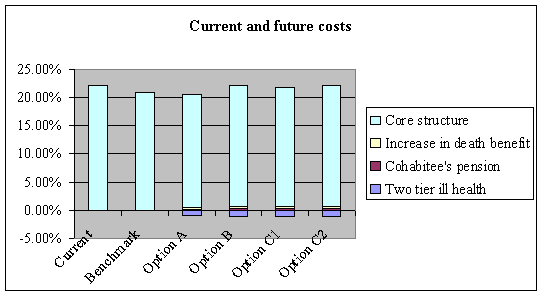
8.3 The table shows that Option A has the lowest comparative cost. The reduction in costs generated by the move to a two tier ill health pension provision actually means it costs less than the current scheme at 1 October 2006.
8.4 Hewitts has provided detailed costings for the Hampshire Fund which are not easily comparable with the GAD figures, but which are not used to here to provide a consistent response to the national assumptions. However these costs will be supplied separately to the Government to take into account before making a decision as required in the consultation.
9 Supported option
9.1 The draft response to the consultation supports Option A as:
· it provides the lowest cost option
· it maintains a final salary scheme which is a valuable recruitment and retention tool
· it will minimise the effect of the change on existing scheme members
· it keeps the LGPS in line with most other public sector schemes.
9.2 Option B would also achieve most of the above and provides a more attractive scheme for members. However, it is significantly more expensive and this cost could increase if there is a shortfall in the assumed commutation rate.
10 Flexible and early retirement
10.1 The EHCC Committee on 20 September 2006 will determine the policy decisions that need to be made regarding the April 2006 flexible retirement options.
10.2 The consultation for the new look scheme includes five variations to the current scheme for flexible and early retirement. These suggestions are to:
· allow members to make extra contributions to offset any reduction in their pension should they wish to retire early
· extend flexible retirement from age 60 to the scheme's minimum retirement age (currently 50 but will increase to 55 by 2010)
· remove the requirement for employees to obtain employer consent for flexible retirement
· remove the requirement for employees to take a reduction in hours or grade in order to take flexible retirement
· increase benefits accrued after age 65 by cost neutral uplift factors when a member elects to take payment of them after age 65.
10.3 Provided each of these options is cost neutral and individual decisions meet business requirements, there appears to be no reason why these variations should not be included in the new look scheme. These proposals need to be fully costed however to ensure cost neutrality. Consequently the EHCC retirement policies need to take into account that any of the above variations may be part of the 2008 LGPS scheme.
11 Employee and employer costs
11.1 The consultation also considers contribution rates, looking at:
· the average employee contribution rate
· an affordable employer contribution ratio
· whether there should be tiered employee contribution rates
11.2 The average employee contribution rate varies by the type of scheme and the balance between new and existing employees. For Option A, the total cost for existing members is estimated at 19.4% and for new members at 17.3%. If the employers' contribution rate (i.e. not recovering existing deficits) was reduced to 13%, then the employees average contribution rate would need to be 6.4%. (This is a small increase over the existing rate of 6% but could be justified by proposed improvements in death benefits and cohabitees' pensions).
11.3 The current ratio of employee to employer contribution will be 1:2.95 from April 2007. The general consensus is that a 1:2 ratio is more sustainable.
11.4 If the average employee's contribution rate increases to 6.4%, and the on-going cost of option A is 17.3%, then a ratio of 1:2 should be achievable, subject to investment performance and membership demographics.
11.5 However, recognising that there is a pension fund deficit, it would be prudent to maintain the agreed 2007 employer rate of 17.7% and increase the employee rate to 7% (as previously supported by the Panel).
11.6 Once the deficit is eliminated, it will be possible to reduce the employer rate to 14%, which both covers the cost of option A and achieves the 1:2 ratio.
11.7 The rationale for introducing a tiered employee contribution rate is to encourage low paid people to join the scheme. Under a two tier structure, employees would pay the reduced rate of contributions on pensionable pay below the cut-off point and then an increased rate on pensionable pay above that cut-off point. The table below illustrates a number of possible combinations.
Cut -off £7,185 (start of 22% |
Cut -off £12,000 (illustrative | |||
Weighted average contribution rate |
Lower band |
Upper band |
Lower band |
Upper band |
6.0% |
3.5% |
7.5% |
5.0% |
7.5% |
6.5% |
4.0% |
8.0% |
5.5% |
8.0% |
6.9% |
6.0% |
7.5% |
6.5% |
7.5% |
8.1% |
6.5% |
9.0% |
7.5% |
9.0% |
11.8 Although the aim of the two tiered contribution rate is to encourage low paid employees into the pension scheme, a Local Government Pension's Committee (LGPC) survey supported the findings from the Institute of Fiscal Studies which was that the bulk of the `unpensioned' are not paying into a pension scheme because of other urgent calls on their money (not because of the contribution rate) and for some such people, reliance on government-provided retirement income may be a rational decision. The Panel previously rejected the concept of tiered contributions, noting that it was not a requirement of other pension schemes, and that it would be more appropriate for the tax regime to deal consistently with the problem of low-paid, mainly part-time staff.
12 Future cost sharing mechanism
12.1 The consultation considers the introduction of a future cost sharing mechanism, where the employee shares the risk with the employer of future increases in liabilities and fund performance. The proposed mechanism would maintain a fixed employee/employer contribution ratio by changing the employee rate in response to substantial demographic shifts.
12.2 The cost sharing mechanism would have to be conducted at a national level. However the 89 separate funds are administered locally with differing employer rates, due to different approaches to valuation and funding, and varying local membership. This would mean that any national adjustment to employee contribution rate would have a different impact on each fund and their respective employers, because of the need to maintain the ratio.
12.3 The consultation document recognises that there are many issues which need to be resolved before any decision could be taken. However in principle a cost sharing mechanism seems fundamentally flawed as local accountability is lost.
13 Other public sector pension schemes
13.1 The Government has provided a framework of principle for the civil service, teachers and NHS pension schemes, but excluded LGPS, on the grounds that it is different for the following reasons:
· other schemes have a normal retirement age of 60 and can stay in work beyond 60
· the LGPS already had a normal retirement age of 65 (since the 1920's) with a facility to retire early
· this facility (the 85 year rule which allows retirement at 60 with unreduced benefits - i.e. the same as other schemes) is age discriminatory
· the other public sector schemes do not have this
· the LGPS is a funded pension scheme with real funds and different rate financing arrangements
· the other public sector schemes are unfunded, pay-as-you-go schemes which can manage short, medium and long-term costs in a different way from the LGPS, where costs are annually managed and reflected in local authority budgets
13.2 So despite having a later normal retirement age and being a funded scheme, the LGPS appears to be treated less sympathetically by Government in its approval and in the introduction of a tiered contribution rate (although it now appears that this is also being suggested for the NHS pension scheme as well)
Recommendations
1 Option A is supported as the Hamsphire Pension Fund's response to the government consultation.
2 Flexible retirement variations are accepted, as long as they are cost neutral.
3 The employee contribution rate increases to 7% for all contributors. The employer rate is maintained at the agreed 2007 figure of 17.7% until such time as the past service deficit is eliminated. It could then be reduced to 14%, achieving a 1:2 employee/employer contribution ratio which more than covers the cost of option A.
4 A future cost sharing mechanism is not supported.
Section 100 D - Local Government Act 1972 - background documents
The following documents discuss facts or matters on which this report, or an important part of it, is based and have been relied upon to a material extent in the preparation of this report.
NB the list excludes:
1. Published works.
2. Documents which disclose exempt or confidential information as defined in the Act.
Title File
None
Appendix 1
Hampshire Pension Fund core response to:
`Where next? - Options for a new-look Local Government Pension Scheme in England and Wales'
C1 - Which of the four options, or variations on them, would you support and which would you oppose? Why?
Option A is supported as it has the lowest cost and minimises the impact of a new scheme for existing members whilst continuing to offer the benefits of a final salary pension scheme.
The primary reason not to support the other options is that they are more expensive.
C2 - Bearing in mind the criteria for evaluation, and Chapters 1-4, which Option would you recommend to be taken forward for the new look scheme?
The Hampshire Pension Fund Panel recommend that Option A is taken forward for the new look scheme.
C3 - Which of the five possible extensions, to the current flexible retirement provisions, or varations on them, would you support and which would you oppose? Why?
All five possible extensions to the current flexible retirement provisions are supported, provided that they are cost neutral and meet business requirements as they give more flexibility to our workforce.
C4 - What should the average employee contribution rate be in the new look scheme?
Based on option A costing 19.4% for existing members and the employee/employer ratio being 1:2, the average rate should be 6.4%.
However, to eliminate the Fund's past service deficit we would support an employee contribution rate of 7%.
C5 - Should the employee contribution rate be tiered so that a lower contribution rate would be payable on pensionable pay below a certain cut off point? Would this depend on which Option was implemented and if so, how and why?
No, it is perceived that this would not attract low paid people into the scheme.
C6 - What would an affordable employer contribution rate be in the new look scheme, in relation to the employer rates being paid by scheme employers for future service costs under the current scheme?
It is recommended that the employee/employer ratio reduces from 1:2.75 (1:2.95 from 2007) to 1:2 in the new scheme, recognising that this is not practical until the existing deficit is recovered.