
Archived decisions
Hampshire County Council Audit 2005/06 |
External audit is an essential element in the process of accountability for public money and makes an important contribution to the stewardship of public resources and the corporate governance of public services.
Audit in the public sector is underpinned by three fundamental principles:
· auditors are appointed independently from the bodies being audited;
· the scope of auditors' work is extended to cover not only the audit of financial statements but also value for money and the conduct of public business; and
· auditors may report aspects of their work widely to the public and other key stakeholders.
The duties and powers of auditors appointed by the Audit Commission are set out in the Audit Commission Act 1998 and the Local Government Act 1999 and the Commission's statutory Code of Audit Practice. Under the Code of Audit Practice, appointed auditors are also required to comply with the current professional standards issued by the independent Auditing Practices Board.
Appointed auditors act quite separately from the Commission and in meeting their statutory responsibilities are required to exercise their professional judgement independently of both the Commission and the audited body.
Status of our reports to the Council
The Statement of Responsibilities of Auditors and Audited Bodies issued by the Audit Commission explains the respective responsibilities of auditors and of the audited body. Reports prepared by appointed auditors are addressed to members or officers. They are prepared for the sole use of the audited body. Auditors accept no responsibility to:
· any member or officer in their individual capacity; or
· any third party.
Copies of this report
If you require further copies of this report, or a copy in large print, in Braille,
on tape, or in a language other than English, please call 0845 056 0566.
Purpose of this report 5
Scope of the report 5
Key messages 7
Financial statements 7
Use of resources 7
Financial statements 8
Status of the audit 8
Matters to be reported to the Governance Committee 8
Next steps 11
Use of resources 12
Value for money conclusion 12
Use of auditors' statutory powers 15
Closing remarks 16
Appendix 1 - Audit responsibilities and approach 17
Audit objectives 17
Approach to the audit of the financial statements 18
Approach to audit of arrangements to secure value for money 18
Appendix 2 - Audit reports issued 20
Appendix 3 - Fee information 21
Appendix 4 - The Audit Commission's requirements in respect of independence and objectivity 22
Appendix 5 - Independent auditor's report to Hampshire County Council 23
Opinion on the financial statements 23
Opinion 24
Conclusion on arrangements for securing economy, efficiency and effectiveness in the use of resources 26
Best Value Performance Plan 27
Certificate 27
Appendix 6 - Letter of representation 28
Hampshire County Council - Audit for the year ended 31 March 2006 28
Specific representations 28
Appendix 7 - Action Plan 31
Purpose of this report
1 We are required by the Audit Commission's statutory Code of Audit Practice for Local Government bodies (the Code) to issue a report to those charged with governance summarising the conclusions from our audit work. For the purposes of this report, the Council's Governance Committee is considered to fulfil the role of those charged with governance and references to the Governance Committee should be read as such.
2 We are also required by professional auditing standards to report to the Governance Committee certain matters before we give our opinion on the financial statements. The section of this report covering the financial statements fulfils this requirement.
3 This is our annual governance report covering the audit of the Council for the year ended 31 March 2006 and is presented by the District Auditor.
4 The principle purposes of the report are:
· to reach a mutual understanding of the scope of the audit and the respective responsibilities of the auditor and the Governance Committee;
· to share information to assist both the auditor and those charged with governance to fulfil their respective responsibilities; and
· to provide the Governance Committee with recommendations for improvement arising from the audit process.
5 The Audit Commission has circulated to all audited bodies a Statement of Responsibilities of Auditors and Audited Bodies that summarises the key responsibilities of auditors. Our audit has been conducted in accordance with the principles set out in that statement.
6 In undertaking our audit, we comply with the statutory requirements of the Audit Commission Act 1998 and the Code. Auditors' responsibilities are to review and report on, to the extent required by the relevant legislation and the requirements of the Code:
· the Council's financial statements; and
· whether the Council has made proper arrangements for securing economy, efficiency and effectiveness in its use of resources.
7 Our risk assessment and planned response to the key audit risks was summarised in our audit and inspection plan in March 2005. A summary of our responsibilities and audit approach is included in Appendix 1. The annual governance report summarises the significant findings, conclusions and recommendations arising from our audit work. The results of our inspection work, and our separate grant claims certification programme, will be reported in the Relationship Manager Letter in early 2007.
8 We have issued separate reports during the year having completed specific aspects of our programme, and these are listed in Appendix 2. Appendix 3 provides information about the fee charged for our audit and Appendix 4 sets out the requirements in respect of independence and objectivity.
Key messages
9 Our work on the financial statements is still in progress, with one main outstanding issue to be resolved. Should any further matters arise in concluding the outstanding work that require reporting, we will raise them with the Chair of this committee.
10 Subject to the satisfactory conclusion of the work outstanding, we expect to issue an unqualified opinion by 29 September 2006. A draft auditor's report is attached at Appendix 5.
11 Our work on the Council's arrangements to secure economy, efficiency and effectiveness in its use of resources is now complete. We expect to issue an unqualified conclusion on the use of resources by 29 September 2006. A draft auditor's report is attached at Appendix 5.
Financial statements
12 We are required to give an opinion on whether the Council's financial statements present fairly:
· the financial position of the Council as at 31 March 2006 and its income and expenditure for the year then ended; and
· the financial transactions of its Pension Fund during the year ended 31 March 2006 and the amount and disposition of the Fund's assets and liabilities, other than liabilities to pay pensions and benefits after the end of the scheme year.
13 Our work on the financial statements is still in progress, with one main outstanding issue to be resolved. This involves work to gain assurance on the correct treatment of uncleared items in the GR/IR clearing account. Should any further matters arise in concluding the outstanding work that require reporting, we will raise them with the Chair of this committee.
14 Subject to the satisfactory conclusion of the work outstanding, we expect to issue an unqualified opinion by 29 September 2006. A draft auditor's report is attached at Appendix 5.
Matters to be reported to the Governance Committee
15 We have the following matters to draw to the Governance Committee's attention.
Expected modifications to the auditor's report
16 On the basis of our audit work, subject to the satisfactory conclusion of the work outstanding reported above, we currently expect to issue an unqualified audit report. A draft audit report is attached at Appendix 5.
Uncorrected misstatements
17 We have not identified any non-trivial (as defined in professional auditing standards) misstatements in the financial statements that management did not adjust or disclose. However, our work to confirm that the GR/IR clearing account is correctly stated, outlined in paragraph 22 below, has not yet been completed.
Adjusted misstatements
18 To assist you in fulfilling your governance responsibilities, we are required to consider reporting adjusted misstatements to you where these are material. A complete list of all adjustments will be provided to officers, but we have not identified any material adjustments that need to be reported to members.
Qualitative aspects of accounting practices and financial reporting
19 Our audit includes consideration of the qualitative aspects of the financial reporting process, including matters that have a significant impact on the relevance, reliability, comparability, understandability and materiality of the information provided by the financial statements. We wish to report the following matter to you.
20 The actuaries for the Pension Fund have not followed the June 2006 CIPFA advice in accounting for changes to the local government pension scheme that permit scheme members to take a larger proportion of their pension as a lump sum. However, as this does not affect either the overall value of pension liabilities at 31 March 2006 or the bottom line of the Consolidated Revenue Account for 2005/06, we have not sought an adjustment.
Material internal control weaknesses identified during the audit
21 Our audit identified the following weakness in systems of accounting and financial control which we should report to you.
22 The GR/IR clearing account contains the values of goods ordered and received, which are then cancelled when a matching invoice is received. Where invoice values are different from the 'goods received note' values, they have to be matched through manual intervention and any differences written-out. Any unmatched items at the year end are then included in the Council's balance sheet creditors. At the end of 2005/06 the balance on this account included substantial numbers of unmatched items more than 3 months old, the most significant of which related to capital property schemes. We are working with officers to satisfy ourselves that the inclusion of these sums in balance sheet creditors and corresponding capital assets is appropriate. There remains uncertainty about the proper operation of this account in 2006/07 and officers need to take action to ensure that it is being used correctly and is regularly cleared.
Recommendations |
R1 Ensure that a satisfactory process is in place for 2006/07 and future years to review the value of outstanding PREMIS (property management system) orders in the GR/IR account. |
R2 Introduce a corporate monitoring process to provide assurance that the GR/IR account is being operated properly. |
23 We have not provided a comprehensive statement of all weaknesses that may exist in internal control, or of all improvements that could may be made, but have addressed only those matters which have come to our attention as a result of the audit procedures we have performed.
Matters specifically required by other auditing standards
24 Other auditing standards require us to communicate with you in other specific circumstances including:
· where we suspect or detect fraud;
· where there is an inconsistency between the financial statements and other information in documents containing the financial statements; and
· non-compliance with legislative or regulatory requirements and related authorities.
We have no issues that we wish to report to you in these areas.
Any other matters of governance interest
25 Finally, we are required to report any other matters that we believe to be of governance interest. We report these matters in Table 1 below.
Table 1 Other matters of governance interest
There are two other matters we would like to bring to the attention of those charged with governance
Area |
Auditor responsibility |
Impact |
Statement on internal control (SIC) |
The auditor reviews the SIC for compliance with the requirements of proper practice as specified by CIPFA and consistency with other information from the audit of the financial statements. |
We have carried out our review and concluded that the SIC does not: · explain the annual review process required to demonstrate the effectiveness of controls · make clear whether the items reported as 'areas for improvement' are regarded as the most significant control issues for the Council to address · indicate clearly for each area identified both what the control issue is and what action is being taken to address it. |
Whole of Government Accounts' consolidation pack |
The auditor is responsible for issuing a report on the consistency of the Council's consolidation pack with the statutory financial statements. |
Our work is in progress and will be completed by the end of September 2006. |
Recommendation |
R3 Enhance the Statement on Internal Control for future years by explaining the process for reviewing effectiveness controls and giving more detail of the significant control issues and the action being taken to address them. |
Letter of representation
26 We obtain written representations from management as an acknowledgement of its responsibility for the fair presentation of the financial statements and as audit evidence on matters material to the financial statements. The text of the required letter of representation is included at Appendix 6.
27 We are drawing these matters to the Governance Committee's attention so that:
· you can consider them before the financial statements are approved and certified;
· the representation letter can be signed on behalf of the Council and those charged with governance before we issue our opinion on the financial statements;
· Members' have the opportunity to amend the financial statements if appropriate when audit work on the outstanding issue identified above has been completed.
Use of resources
28 The Code requires us to issue reach a conclusion on whether we are satisfied that the Council has proper arrangements in place for securing economy, efficiency and effectiveness in its use of your resources (the value for money conclusion). In meeting this responsibility, we review evidence that is relevant to the Council's corporate performance management and financial management arrangements. Our work in reaching the value for money conclusion is integrated with our work on the CPA use of resources assessment.
Summary
29 We have completed our work in relation to the Council's use of resources in 2005/06 and we propose to issue a report including an unqualified value for money conclusion.
30 We have reached this conclusion by assessing the Council's arrangements against twelve criteria, eight of which are linked directly to related judgements in our 2005 CPA Use of Resources assessment. We have updated these as part of the audit and can confirm our view that arrangements are adequate in the following areas:
· Internal control,
· Risk management,
· Improving value for money,
· Financial strategy,
· Financial standing,
· Budget setting and monitoring,
· Asset management, and
· Probity.
31 The key findings against the other four criteria are summarised below.
Strategic objectives
32 The Council has in place robust arrangements for setting, reviewing and implementing its strategic and operational objectives. The Council's decision making processes are effective, as are its arrangements for setting and establishing its priorities, objectives and policies.
33 The Council's corporate strategy and service business plans are effective and used successfully to set and drive its policy framework. The Council makes effective use of improvement and action plans to secure improvement, and progress in these is monitored and reported. The development of a revised Corporate Strategy with new agreed priorities, high level targets and a supporting corporate business plan for the period to May 2009, is progressing well.
Consultation
34 In accordance with our agreed Audit Plan, we have carried out a more detailed review of the Council's consultation arrangements and will be issuing a separate report on our detailed conclusions shortly. The main points are summarised below.
35 The Council's arrangements for communication and consultation with service users, partners and other stakeholders are effective. The Council undertakes a wide range of consultations with service users and these embrace equality and diversity. Its 2004/05 MORI survey included harder-to-reach groups, and a survey of BME residents on their `Quality of Life in Hampshire' resulted in service improvements.
36 The Council's management arrangements and systems and processes for consultation are clear within individual departments. A best value review of community engagement has been completed and resulted in an improvement action plan which has resulted in some improvement and greater focus, although it is still work in progress. There is scope to promote greater consistency of consultation policies and procedures and to develop the sharing of consultation messages across services in order to influence outcomes more effectively.
Performance management
37 The Council's arrangements for the monitoring and scrutiny of performance are effective. The Council takes appropriate action to identify and report variance against its objectives, and councillors are engaged in performance management. However, its current processes for managing performance data could be more efficient in some aspects. In order to decrease data quality risk the Council needs to reduce instances of multiple data-entry and the time it spends in manipulating data. Progress is being made towards acquiring a management information system to help with this and to meet the Council's performance management aspirations for making even better use of data.
38 Processes for monitoring costs and service performance are in place, but performance and cost information, and the monitoring and management of service performance and cost, is not yet fully integrated or consistent across services. The Council is researching service costs benchmarking and improving the links between financial and performance information. In addition, value for money outcome performance measures and targets are now being developed for each service area.
Data quality
39 The Council has effective arrangements for ensuring data quality. As we have not reviewed these arrangements previously, we will be issuing a separate report setting out our detailed conclusions shortly.
Use of auditors' statutory powers
40 Auditors are required to consider the exercise of certain statutory powers during the course of the audit, as summarised in Table 2 below.
Table 2 Use of statutory powers
Insert text
Issue |
Auditor responsibility |
Impact |
Section 8 reports |
Section 8 of the Act requires that auditors should consider whether, in the public interest, they should report on any matter that comes to their attention in the course of the audit so that it may be considered by the body concerned or brought to the attention of the public. |
There have been no section 8 reports in respect of the financial year 2005/2006. |
Section 11 recommendations |
To consider whether a written recommendation should be made to the audited body requiring it to be considered and responded to publicly. |
There have been no s11 recommendations. |
Best value |
To consider whether to recommend that the Audit Commission should carry out a best value inspection of the Council under section 10 of the Local Government Act 1999 and/or that the Secretary of State should give a direction under section 15 of that Act. |
Our work in respect of the Council's Best Value Performance Plan (BVPP) 2005 was explained in our November 2005 report. No recommendations were made to the Audit Commission or the Secretary of State. |
Closing remarks
41 This report was discussed with the Chief Executive and County Treasurer on 19 September 2006. It will be presented to the Governance Committee on 27 September 2006.
42 The report makes a number of recommendations. An action plan is included at Appendix 7, which includes responses from management and indicative target dates for the implementation of the recommendations.
43 The Council has taken a positive and constructive approach to our audit and I would like to take this opportunity to express my appreciation for the Council's assistance and co-operation.
Stephen Taylor
District Auditor
September 2006
Appendix 1 - Audit responsibilities and approach
1 Our objective as your appointed auditor is to plan and carry out an audit that meets the requirements of the Code of Audit Practice. We adopt a risk-based approach to planning our audit, and our audit work has focused on the significant risks that are relevant to our audit responsibilities.
Figure 1 Code of Audit Practice
Code of practice responsibilities
|
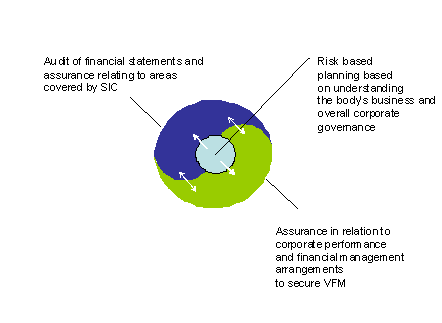
Approach to the audit of the financial statements
2 In our approach to auditing the financial statements, we adopt a concept of materiality. Material errors are those which might be misleading to a reader of the financial statements. We seek, in planning and conducting our audit of the accounts, to provide reasonable assurance that your financial statements are free of material misstatement. In planning our work we considered the arrangements of the Council which had most impact on our opinion. These included:
· the standard of the overall control environment and internal controls;
· reliance on internal audit;
· the likelihood of material misstatement occurring from of material information systems; or a material error failing to be detected by internal controls;
· any changes in financial reporting requirements; and
· the effectiveness of procedures for producing the financial statements and supporting material.
3 The results of the above feed into our risk assessment which determines the level and type of testing undertaken on each element of the financial statements. The key risks that we identified include:
· Asset valuation and maintenance of a comprehensive and up to date asset register
· Maintenance and reconciliation of control accounts
· Social Services financial systems and budgetary control.
Approach to audit of arrangements to secure value for money
4 The scope of these arrangements is defined in paragraph 20 of the Code as comprising:
· corporate performance management; and
· financial management arrangements.
5 Our conclusion is informed and limited by reference to relevant criteria covering specific aspects of audited bodies' arrangements, specified by the Code.
6 In planning audit work in relation to the arrangements for securing economy, efficiency and effectiveness in the use of resources, we considered and assessed relevant significant business risk. Significance is defined by the Code as 'a matter of professional judgment and includes both quantitative and qualitative aspects of the risk'.
7 The potential sources of assurance when reaching the value for money conclusion include:
· the Council's whole system of internal control as reported in its statement on internal control;
· results from statutory inspections or the work of other regulators, for example, corporate assessments, service assessments (whether by the Commission or other regulators), etc.;
· work specified by the Audit Commission, for example, the use of resources assessments, and data quality work;
· links to the financial statements' audit, including review of internal audit, the SIC and budgetary control arrangements; and
· other work necessary to discharge our responsibilities.
Appendix 2 - Audit reports issued
Table 3
Planned output |
Planned date of issue |
Actual date of issue |
Addressee |
Audit and inspection plan |
17 March 2005 |
Insert |
Governance Committee |
Interim audit memorandum |
Not specified |
Not required |
- |
Annual governance report |
Sept 2006 |
Sept 2006 |
Governance Committee |
Opinion on financial statements |
30 Sept 2006 |
Not yet issued |
The Council |
Value for money conclusion |
30 Sept 2006 |
Not yet issued |
The Council |
Final accounts memorandum |
October 2006 |
Not yet issued |
Management |
Use of resources assessments |
Not specified |
7 November 2005 |
Management |
BVPP report |
Not specified |
December 2005 |
The Council |
Governance report - ethical governance |
Not specified |
3 March 2006 |
Management |
Fee estimate |
Plan 2005/06 |
Actual 2005/06 |
Accounts |
£176,595 |
£176,595 |
Use of resources |
£ 71,432 |
£ 71,432 |
Total audit fees |
£248,027 |
£248,027 |
Voluntary improvement work |
None |
£ 17,060 |
[The audit is not yet completed, so 'Actual' figures are the expected values]
The outturn on inspection and grant certification fees will be reported in the Relationship Manager Letter
Appendix 4 - The Audit Commission's requirements in respect of independence and objectivity
1 We are required by the standard to communicate following matters to the Audit Committee:
· the principal threats, if any to objectivity and independence identified by the auditor, including consideration of all relationships between the Council, directors and the auditor;
· any safeguards adopted and the reasons why they are considered to be effective;
· any independent partner review;
· the overall assessment of threats and safeguards; and
· information about the general policies and processes for maintaining objectivity and independence.
2 We are not aware of any relationships that may affect the independence and objectivity of the team, and which are required to be disclosed under auditing and ethical standards.
Appendix 5 - Independent auditor's report to Hampshire County Council
Opinion on the financial statements
We have audited the financial statements and pension fund accounts of Hampshire County Council for the year ended 31 March 2006 under the Audit Commission Act 1998. The financial statements comprise the Consolidated Revenue Account, the Consolidated Balance Sheet, the Statement of Total Movements in Reserves, the Cash Flow Statement, and the related notes. The pension fund accounts comprise the Fund Account, the Net Assets Statement, and the related notes. The financial statements and pension fund accounts have been prepared under the accounting policies set out within them.
This report is made solely to Hampshire County Council in accordance with Part II of the Audit Commission Act 1998 and for no other purpose, as set out in paragraph 36 of the Statement of Responsibilities of Auditors and of Audited Bodies prepared by the Audit Commission.
Respective responsibilities of the Chief Finance Officer and auditors
The Chief Finance Officer's responsibilities for preparing the financial statements, including the pension fund accounts, in accordance with applicable laws and regulations and the Statement of Recommended Practice on Local Authority Accounting in the United Kingdom 2005 are set out in the Statement of Responsibilities.
Our responsibility is to audit the financial statements in accordance with relevant legal and regulatory requirements and International Standards on Auditing (UK and Ireland).
We report to you our opinion as to whether the financial statements and the pension fund accounts present fairly, in accordance with applicable laws and regulations and the Statement of Recommended Practice on Local Authority Accounting in the United Kingdom 2005:
· the financial position of the Authority and its income and expenditure for the year; and
· the financial transactions of its pension fund during the year and the amount and disposition of the fund's assets and liabilities, other than liabilities to pay pensions and other benefits after the end of the scheme year.
We review whether the statement on internal control reflects compliance with CIPFA's guidance (The Statement on Internal Control in Local Government, 2004). We report if it does not comply with proper practices specified by CIPFA or if the statement is misleading or inconsistent with other information we are aware of from our audit of the financial statements. We are not required to consider, nor have we considered, whether the statement on internal control covers all risks and controls. We are also not required to form an opinion on the effectiveness of the Authority's corporate governance procedures or its risk and control procedures
We read other information published with the financial statements, and consider whether it is consistent with the audited financial statements. This other information comprises only the Explanatory Foreword. We consider the implications for our report if we become aware of any apparent misstatements or material inconsistencies with the financial statements. Our responsibilities do not extend to any other information.
Basis of audit opinion
We conducted our audit in accordance with the Audit Commission Act 1998, the Code of Audit Practice issued by the Audit Commission and International Standards on Auditing (UK and Ireland) issued by the Auditing Practices Board. An audit includes examination, on a test basis, of evidence relevant to the amounts and disclosures in the financial statements. It also includes an assessment of the significant estimates and judgments made by the Authority in the preparation of the financial statements, and of whether the accounting policies are appropriate to the Authority's circumstances, consistently applied and adequately disclosed.
We planned and performed our audit so as to obtain all the information and explanations which we considered necessary in order to provide us with sufficient evidence to give reasonable assurance that the financial statements are free from material misstatement, whether caused by fraud or other irregularity or error. In forming our opinion we also evaluated the overall adequacy of the presentation of information in the financial statements.
In my opinion:
The financial statements present fairly, in accordance with applicable laws and regulations and the Statement of Recommended Practice on Local Authority Accounting in the United Kingdom 2005 the financial position of the Authority as at 31 March 2006 and its income and expenditure for the year then ended; and
The pension fund accounts present fairly, in accordance with the Statement of Recommended Practice on Local Authority Accounting in the United Kingdom 2005, the financial transactions of the Pension Fund during the year ended 31 March 2006, and the amount and disposition of the fund's assets and liabilities as at 31 March 2006, other than liabilities to pay pensions and other benefits after the end of the scheme year.
Stephen Taylor, District Auditor
Audit Commission, North Wing, Southern House, Sparrowgrove, Otterbourne, Winchester, SO21 2RU
Date
Conclusion on arrangements for securing economy, efficiency and effectiveness in the use of resources
Authority's Responsibilities
The authority is responsible for putting in place proper arrangements to secure economy, efficiency and effectiveness in its use of resources, to ensure proper stewardship and governance, and to regularly review the adequacy and effectiveness of these arrangements.
Under the Local Government Act 1999, the authority is required to prepare and publish a best value performance plan summarising the authority's assessment of its performance and position in relation to its statutory duty to make arrangements to ensure continuous improvement in the way in which its functions are exercised, having regard to a combination of economy, efficiency and effectiveness.
Auditor's Responsibilities
We are required by the Audit Commission Act 1998 to be satisfied that proper arrangements have been made by the authority for securing economy, efficiency and effectiveness in its use of resources. The Code of Audit Practice issued by the Audit Commission requires us to report to you our conclusion in relation to proper arrangements, having regard to relevant criteria specified by the Audit Commission for principal local authorities. We report if significant matters have come to our attention which prevent us from concluding that the authority has made such proper arrangements. We are not required to consider, nor have we considered, whether all aspects of the authority's arrangements for securing economy, efficiency and effectiveness in its use of resources are operating effectively.
We are required by section 7 of the Local Government Act 1999 to carry out an audit of the authority's best value performance plan and issue a report:
· certifying that we have done so;
· stating whether we believe that the plan has been prepared and published in accordance with statutory requirements set out in section 6 of the Local Government Act 1999 and statutory guidance; and
· where relevant, making any recommendations under section 7 of the Local Government Act 1999.
Conclusion
I have undertaken my audit in accordance with the Code of Audit Practice and I am satisfied that, having regard to the criteria for principal local authorities specified by the Audit Commission and published in July 2005, in all significant respects, Hampshire County Council made proper arrangements to secure economy, efficiency and effectiveness in its use of resources for the year ending 31 March 2006.
I issued my statutory report on the audit of the authority's best value performance plan for the financial year 2005 on 25 November 2005. I did not identify any matters to be reported to the authority and did not make any recommendations on procedures in relation to the plan.
I certify that I have completed the audit of the accounts in accordance with the requirements of the Audit Commission Act 1998 and the Code of Audit Practice issued by the Audit Commission.
Stephen Taylor, District Auditor
Audit Commission, North Wing, Southern House, Sparrowgrove, Otterbourne, Winchester, SO21 2RU
Date
Appendix 6 - Letter of representation
District Auditor
Audit Commission
North Wing
Southern House
Sparrowgrove
Otterbourne
Winchester
Hampshire
SO21 2RU
Hampshire County Council - Audit for the year ended 31 March 2006
We confirm to the best of our knowledge and belief, having made appropriate enquiries of Chief Officers and other officers of Hampshire County Council, the following representations given to you in connection with your audit of the Council's and the Pension Fund's financial statements for the year ended 31 March 2006.
We acknowledge the County Council's statutory responsibility to prepare and approve the financial statements in accordance with the proper practices as defined in relevant legislation or guidance.
These representations rely also on the Statement on Internal Control, the system of internal financial control and the County Treasurer's responsibilities fro the Statement of Accounts. The representations also place great reliance upon the work of internal audit.
Sufficient controls have been established, and have operated, to identify, classify and record correctly transactions processed via the Council's bank account.
There are no other material amounts relating to unfunded liabilities, curtailments or settlements of past service costs relating to pension provision other than those which have been properly recorded and disclosed in the financial statements.
The Council has reviewed the membership profile of the Hampshire local government pension scheme and has concluded that the data used by the actuary to calculate FRS17 disclosure information on a roll-forward basis continues to be appropriate and representative of the membership profile for the Council as at 31 March 2006.
The Council has no plans or intentions that may materially alter the carrying value or classification of assets and liabilities reflected in the financial statements.
Supporting records
All the accounting records have been made available to you for the purpose of your audit and all the transactions undertaken by the Council have been properly reflected and recorded in the accounting records. All other records and related information, including minutes of all members' meetings, have been made available to you.
Related party transactions
Based on the disclosure made by members and chief officers we confirm the completeness of the information provided regarding the identification of related parties.
The identity of, and balances and transactions with, related parties have been properly recorded and where appropriate, adequately disclosed in the financial statements
Contingent liabilities
There are no other contingent liabilities, other than those that have been properly recorded and disclosed in the financial statements. In particular:
· there is no significant pending or threatened litigation, other than those already disclosed in the financial statements; and,
· there are no material commitments or contractual issues, other than those already disclosed in the financial statements;
· no financial guarantees have been given to third parties.
Law, regulations and codes of practice
The Chief Executive and the Monitoring Officer have not declared any instances of non-compliance with laws, regulations and codes of practice, likely to have a significant effect on the finances or operations of the Council.
We acknowledge our responsibility for the design and implementation of internal control systems to prevent and detect error.
There have been no:
· irregularities involving management or employees who have significant roles in the system of internal accounting control;
· irregularities involving other employees that could have a material effect on the financial statements;
· communications from regulatory agencies concerning non-compliance with or deficiencies on, financial reporting practices which could have a material effect on the financial statements.
Post balance sheet events
Since the date of approval of the financial statements by the Governance Committee, no additional significant post balance sheet events have occurred which would require additional adjustment or disclosure in the financial statements.
Signed on behalf of Hampshire County Council
Signed Signed
Name: J Pittam Name: Councillor K Thornber
Position: County Treasurer Position: Governance Committee Chair
3
Recommendation |
Priority |
Responsibility |
Agreed |
Comments |
Date | |
GR/IR Clearing Account | ||||||
9 |
R1 Ensure that a satisfactory process is in place for 2006/07 and future years to review the value of outstanding PREMIS (property management system) orders in the GR/IR account. |
3 |
PB&R Finance Unit |
Yes |
December 2006 | |
9 |
R2 Introduce a corporate monitoring process to provide assurance that the GR/IR account is being operated properly. |
3 |
Corporate Finance |
Yes |
December 2006 | |
Statement on Internal Control |
||||||
11 |
R3 Enhance the Statement on Internal Control for future years by explaining the process for reviewing effectiveness controls and giving more detail of the significant control issues and the action being taken to address them. |
2 |
J Pattison (Head of Legal and Corporate Services) and E Knudsen (Assistant County Treasurer) |
Yes |
The next SIC preparation will provide evidence of the selection process for Areas of Improvement for the consideration of the Governance Committee |
June 2007 |