
Archived decisions
Annual Governance Report Hampshire Fire and Rescue Authority Audit 2005/06 |
External audit is an essential element in the process of accountability for public money and makes an important contribution to the stewardship of public resources and the corporate governance of public services.
Audit in the public sector is underpinned by three fundamental principles:
· auditors are appointed independently from the bodies being audited;
· the scope of auditors' work is extended to cover not only the audit of financial statements but also value for money and the conduct of public business; and
· auditors may report aspects of their work widely to the public and other key stakeholders.
The duties and powers of auditors appointed by the Audit Commission are set out in the Audit Commission Act 1998 and the Commission's statutory Code of Audit Practice. Under the Code of Audit Practice, appointed auditors are also required to comply with the current professional standards issued by the independent Auditing Practices Board.
Appointed auditors act quite separately from the Commission and in meeting their statutory responsibilities are required to exercise their professional judgement independently of both the Commission and the audited body.
Status of our reports to the Authority
The Statement of Responsibilities of Auditors and Audited Bodies issued by the Audit Commission explains the respective responsibilities of auditors and of the audited body. Reports prepared by appointed auditors are addressed to
members or officers. They are prepared for the sole use of the audited body. Auditors accept no responsibility to:· any member or officer in their individual capacity; or
· any third party.
Copies of this report
If you require further copies of this report, or a copy in large print, in Braille,
on tape, or in a language other than English, please call 0845 056 0566.
Purpose of this report 4
Scope of the report 4
Key messages 5
Financial statements 5
Value for money conclusion 5
Financial statements 6
Matters to be reported to the Authority 6
Next steps 9
Use of resources 10
Value for money conclusion 10
Use of auditor's statutory powers 12
Closing remarks 13
Appendix 1 - Audit responsibilities and approach 14
Audit responsibilities 14
Auditing the financial statements 15
Auditors' responsibilities in relation to the use of resources 15
Appendix 2 - Audit reports issued 16
Appendix 3 - Fee information 17
Appendix 4 - Integrity, objectivity and independence 18
Appendix 5 - Auditor's report to Hampshire Fire and Rescue Authority 19
Opinion on the financial statements 19
Conclusion on arrangements for securing economy, efficiency and effectiveness in the use of resources 21
Best Value Performance Plan 22
Certificate 22
Appendix 6 - Draft management representation letter (ISA+580) 23
Purpose of this report
1 We are required by the Audit Commission's statutory Code of Audit Practice
(the Code) to issue a report to those charged with governance summarising the conclusions from our audit work.
2 We are also required by professional auditing standards to report certain matters before we give our opinion on the financial statements. The section of this report covering the financial statements fulfils this requirement.
3 This is our annual governance report covering the audit of the Authority for the year ended 31 March 2006 and is presented by the District Auditor.
4 The principle purposes of the report are:
· to reach a mutual understanding of the scope of the audit and the respective responsibilities of the auditor and the Authority;
· to share information to assist both the auditor and the Authority to fulfil their respective responsibilities; and
· to provide the Authority with recommendations for improvement arising from the audit process.
5 The Audit Commission has circulated to all audited bodies a Statement of Responsibilities of Auditors and Audited Bodies that summarises the key responsibilities of auditors. Our audit has been conducted in accordance with the principles set out in that statement.
6 In undertaking our audit, we comply with the statutory requirements of the Audit Commission Act 1998 and the Code. Auditors' responsibilities are to review and report on, to the extent required by the relevant legislation and the requirements of the Code:
· the Authority's financial statements; and
· whether the Authority has made proper arrangements for securing economy, efficiency and effectiveness in its use of resources.
7 Our risk assessment and planned response to the key audit risks was summarised in our audit plan. A summary of our responsibilities and audit approach is included in Appendix 1. This annual governance report summarises the significant findings, conclusions and recommendations arising from our audit work.
8 We have issued separate reports during the year following completion of specific aspects of our programme, which are listed in Appendix 2. Appendix 3 provides information about the fee charged for our audit and in Appendix 4 we confirm that we have met professional requirements in respect of integrity, objectivity and independence.
Key messages
9 Our work on the Authority's financial statements is substantially complete and we intend to issue an unqualified opinion. A draft audit report is attached at
Appendix 5. Should any further matters arise in concluding the outstanding work that need to be reported, we will at raise them when presenting this report.
10 Our work on the Authority's arrangements to secure economy, efficiency and effectiveness in its use of resources is also largely complete and our conclusion on value for money has been finalised. This states that we are satisfied that the Authority made proper arrangements to secure economy, efficiency and effectiveness in its use of resources. A draft report is attached at Appendix 5.
Financial statements
11 We are required to give an opinion on whether the Authority's financial statements present fairly the financial position as at 31 March 2006 and its income and expenditure for the year then ended.
12 Our work is substantially complete and we intend to issue an unqualified opinion. A draft audit report is attached at Appendix 5. Should any further matters arise in concluding the outstanding work that need to be reported, we will at raise them when presenting this report.
Matters to be reported to the Authority
13 We are required to bring to your attention any significant issues concerning the following.
Expected modifications to the auditor's report
14 There are no proposed modifications to the auditor's report.
Uncorrected misstatements
15 We are not aware of any material uncorrected misstatements which remain in the post audit revised statements.
Adjusted misstatements
16 To assist you in fulfilling your governance responsibilities, we draw your attention to the following changes made to adjust for misstatements within the draft accounts provided to you at the end of June. The adjustments made were of a presentational nature and the revised statements have been adjusted without affecting the overall position of the authority
Table 1 Adjusted misstatements in the financial statements
Details of significant adjustments made to the financial statements
Issue |
Value of misstatement £000s |
Impact on surplus/(deficit) £000s |
Amendments made to Summary Revenue Account after approval to correct typing errors (but prior to audit) · Contribution to/from other reserves · Surplus understated due to omission of negative sign for AMRA entry |
|
|
Qualitative aspects of accounting practices and financial reporting
17 There are no significant matters to report.
Material weaknesses in internal control identified during the audit
18 Our audit identified the following weaknesses in systems of accounting and financial control which we consider we should report to you.
Table 2 Weaknesses in internal control identified during the audit
Matching grants received to expenditure Revenue Grants received in the 2005/06 year were carried forward to future years despite expenditure having been incurred. The values involved were not material so no amendment was required. |
Payroll clearing account errors We reported last year that payroll clearing accounts were not being reconciled properly. Our follow up work in 2005/06 found that satisfactory reconciliations are now being performed and significant progress has been made in clearing errors from previous years. However, errors have resulted from misposting between the HCC and HFRA ledgers. The net result of corrections in 2005/06 was that the HFRA cash balance was understated by £0.280 million from 31 March 2002 until the correction was made in November 2005. The sums involved are not material but HFRA suffered a loss of interest income for this period as a result. |
Estate Valuers Certificate The Estate Practice Valuers Certificate is a key document which verifies the value of land and buildings at balance sheet date. No certificate was provided until we requested this during the audit. |
Goods Received Clearing Account As part of our testing of creditors, we reviewed the entries in the Goods Received Clearing Account. We found that 485 out of 1,185 items were matched and should have been cleared from the account (this would not have changed the accounts). Of the remaining items, many were dated before 1 January 2006 and should almost certainly have been cleared. Regular clearing of balances in this account should be undertaken. |
19 We have not provided a comprehensive statement of all weaknesses which may exist in internal control or of all improvements which may be made, but have only highlighted matters which have come to our attention as a result of the audit procedures we have performed.
Other matters specifically required by other auditing standards
20 The actuaries for the Hampshire Pension Fund have not followed CIPFA advice in accounting for changes to the local government pension scheme that permits members to take a larger proportion of their pension as a lump sum. However, as this does not affect either the overall value of pension liabilities at 31 March 2006 or the bottom line of the Revenue Account for 2005/06, we have not sought an adjustment
Letter of representation
21 We obtain written representations from management as an acknowledgement of its responsibility for the fair presentation of the financial statements and as audit evidence on matters material to the financial statements. The text of the proposed letter of representation is included at Appendix 6.
22 We are drawing these matters to the Authority's attention so that:
· you can consider them before the financial statements are approved and certified; and
· the representation letter can be signed on behalf of the Authority before we issue our opinion on the financial statements.
Use of resources
23 The Code requires us to reach a conclusion on whether we are satisfied that the Authority has proper arrangements in place for securing economy, efficiency and effectiveness in its use of resources (the value for money conclusion). In meeting this responsibility, we review evidence that is relevant to the Authority's corporate performance management and financial management arrangements. Our work in reaching the value for money conclusion is integrated with our other audit work and is based on arrangements put in place by the authority for:
· setting, reviewing and implementing its strategic and operational objectives;
· channels of communication with service users and other stakeholders including partners, and monitoring arrangements to ensure that key messages about services are taken into account;
· monitoring and scrutiny of performance, to identify potential variances against strategic objectives, standards and targets, for taking action where necessary, and reporting to members;
· monitoring the quality of published performance information, and to report the results to members;
· maintaining a sound system of internal control;
· managing significant business risks;
· managing and improving value for money;
· putting in place a medium-term financial strategy, budgets and a capital programme that are soundly based and designed to deliver its strategic priorities;
· ensuring that spending matches its available resources;
· managing performance against budgets;
· management of the asset base; and
· promoting and ensuring probity and propriety in the conduct of its business.
24 On the basis of our work including a review of the Authority's good progress in improvement planning post CPA, we are satisfied that the Authority has made proper arrangements in respect of all the above criteria. We therefore propose to issue a report providing an unqualified value for money conclusion and there are no issues to raise with Members.
25 The criteria for the VFM conclusion and the CPA Use of Resources (UoR) judgement are closely linked. The latter is due to be reported later this year for the first time under the Fire Performance Framework, This will require a more in depth assessment than for the VFM conclusion and outcomes will be reported in our annual audit letter in March 2007.
Use of auditor's statutory powers
26 No issues have arisen during the audit requiring the exercise of the auditor's statutory powers.
Table 3 Use of statutory powers
There are no issues that have warranted the use of the auditor's statutory powers
Issue |
Auditor responsibility |
Impact |
Section 8 reports |
Section 8 of the Act requires that auditors should consider whether, in the public interest, they should report on any matter that comes to their attention in the course of the audit so that it may be considered by the body concerned or brought to the attention of the public. |
There have been no section 8 reports in respect of the financial year 2005/06. |
Section 11 recommendations |
To consider whether a written recommendation should be made to the audited body requiring it to be considered and responded to publicly. |
There have been no s11 recommendations. |
Best value |
To consider whether to recommend that the Audit Commission should carry out a best value inspection of the Authority under section 10 of the Local Government Act 1999 and/or that the Secretary of State should give a direction under section 15 of that Act. |
No recommendations were made to the Audit Commission or the Secretary of State. |
Closing remarks
27 The Authority has taken a positive and constructive approach to our audit and I would like to take this opportunity to express my appreciation for the assistance and co-operation provided both by HFRA and HCC based officers.
Stephen Taylor
District Auditor
September 2006
Appendix 1 - Audit responsibilities and approach
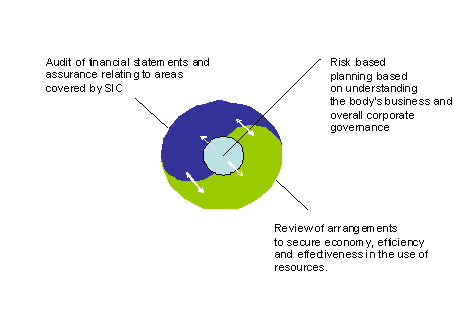
1 Our responsibility as your appointed auditor is to plan and carry out an audit that meets the requirements of the Audit Commission's Code of Audit Practice. We adopt a risk-based approach to planning our audit, and our audit work has focused on the significant risks that are relevant to our audit responsibilities.
Figure 1 Code of Audit Practice
Code of practice responsibilities
|
Auditing the financial statements
2 In our approach to auditing the financial statements, we adopt a concept of materiality. Material errors are those which might be misleading to a reader of the financial statements. We therefore seek, in planning and conducting our audit of the accounts, to provide reasonable assurance that your financial statements are free of material misstatement. In planning our work we considered the arrangements of the Authority which had most impact on our opinion. These included:
· the standard of the overall control environment and internal controls;
· the extent to which we could rely on the work of internal audit;
· the likelihood of material misstatement occurring from material information systems; or a material error failing to be detected by internal controls;
· any changes in financial reporting requirements; and
· the effectiveness of procedures for producing the financial statements and supporting material.
3 The results of the above feed into our risk assessment which determines the level and type of testing undertaken on each element of the financial statements. The keys risks that we identified have been identified in the audit plan.
Auditors' responsibilities in relation to the use of resources
4 Auditors have a responsibility to satisfy themselves that the audited body has put in place proper arrangements to secure economy, efficiency and effectiveness in its use of resources. The scope of these arrangements is defined in the Code as comprising corporate performance management and financial management arrangements.
5 The auditor is required to give a conclusion (the value for money conclusion) having regard to criteria specified by the Commission covering specific aspects of audited bodies' arrangements as defined in the Code. These criteria have been published on the Commission's website.
6 In planning audit work in relation to the use of resources, we considered and assessed relevant significant business risk. Significance is defined by the Code as 'a matter of professional judgment and includes both quantitative and qualitative aspects of the risk'.
.
Appendix 2 - Audit reports issued
Table 4
Planned output |
Planned date of issue |
Actual date of issue |
Addressee |
Audit Plan |
March 2005 |
March 2005 |
Authority |
Accounts Memorandum |
September 2006 |
September 2006 |
Treasurer |
Report to Those Charged with Governance (ISA 260) |
September 2006 |
September 2006 |
Authority |
Annual Audit and Inspection Letter |
December 2006 |
March 2007 |
Authority |
Fee estimate |
Plan 2005/06 |
Actual 2005/06 |
Accounts |
37,220 |
37,220 |
Use of resources |
14,957 |
14,957 |
Total audit fee |
52,177 |
52,177 |
The audit is not yet complete and so the actual values are the expected values
Appendix 4 - Integrity, objectivity and independence
1 We are required by ISA (UK and Ireland) 260 and the Auditing Practices Board Ethical Standard 1 to communicate following matters to the Authority:
· the principal threats, if any to objectivity and independence identified by the auditor, including consideration of all relationships between the Authority, directors and the auditor;
· any safeguards adopted and the reasons why they are considered to be effective;
· any independent appointed auditor review;
· the overall assessment of threats and safeguards; and
· information about the general policies and processes for maintaining objectivity and independence.
2 We are not aware of any relationships that may affect the independence and objectivity of the team, and which are required to be disclosed under auditing and ethical standards.
Appendix 5 - Auditor's report to Hampshire Fire and Rescue Authority
Opinion on the financial statements
1 I have audited the financial statements of Hampshire Fire and Rescue Authority for the year ended 31 March 2006 under the Audit Commission Act 1998. These comprise the Consolidated Revenue Account, the Consolidated Balance Sheet, the Statement of Total Movements in Reserves, the Cash Flow Statement and the related notes. These financial statements have been prepared under the accounting policies set out within them.
2 This report is made solely to Hampshire Fire and Rescue Authority in accordance with Part II of the Audit Commission Act 1998 and for no other purpose, as set out in paragraph 36 of the Statement of Responsibilities of Auditors and of Audited Bodies prepared by the Audit Commission.
Respective responsibilities of the Chief Finance Officer and auditors
3 The Chief Finance Officer's responsibilities for preparing the financial statements in accordance with applicable laws and regulations and the Statement of Recommended Practice on Local Authority Accounting in the United Kingdom 2005 are set out in the Statement of Responsibilities.
4 My responsibility is to audit the financial statements in accordance with relevant legal and regulatory requirements and International Standards on Auditing (UK and Ireland).
5 I report to you my opinion as to whether the financial statements present fairly the financial position of the Authority in accordance with applicable laws and regulations and the Statement of Recommended Practice on Local Authority Accounting in the United Kingdom 2005.
6 I review whether the Statement on Internal Control reflects compliance with CIPFA's guidance, `The Statement on Internal Control in Local Government: Meeting the Requirements of the Accounts and Audit Regulations 2003' published on 2 April 2004. I report if it does not comply with proper practices specified by CIPFA or if the statement is misleading or inconsistent with other information I am aware of from my audit of the financial statements. I am not required to consider, nor have I considered, whether the Statement on Internal Control covers all risks and controls. I am also not required to form an opinion on the effectiveness of the Authority's corporate governance procedures or its risk and control procedures.
7 I read other information published with the financial statements, and consider whether it is consistent with the audited financial statements. This other information comprises only the Explanatory Foreword. I consider the implications for my report if I become aware of any apparent misstatements or material inconsistencies with the financial statements. My responsibilities do not extend to any other information.
Basis of audit opinion
8 I conducted my audit in accordance with the Audit Commission Act 1998, the Code of Audit Practice issued by the Audit Commission and International Standards on Auditing (UK and Ireland) issued by the Auditing Practices Board. An audit includes examination, on a test basis, of evidence relevant to the amounts and disclosures in the financial statements. It also includes an assessment of the significant estimates and judgments made by the Authority in the preparation of the financial statements, and of whether the accounting policies are appropriate to the Authority's circumstances, consistently applied and adequately disclosed.
9 I planned and performed my audit so as to obtain all the information and explanations which I considered necessary in order to provide me with sufficient evidence to give reasonable assurance that the financial statements are free from material misstatement, whether caused by fraud or other irregularity or error. In forming my opinion I also evaluated the overall adequacy of the presentation of information in the financial statements.
Opinion
10 In my opinion the financial statements present fairly, in accordance with applicable laws and regulations and the Statement of Recommended Practice on Local Authority Accounting in the United Kingdom 2005, the financial position of the Authority as at 31 March 2006 and its income and expenditure for the year then ended.
Stephen Taylor
District Auditor
Audit Commission
Conclusion on arrangements for securing economy, efficiency and effectiveness in the use of resources
Authority's responsibilities
11 The Authority is responsible for putting in place proper arrangements to secure economy, efficiency and effectiveness in its use of resources, to ensure proper stewardship and governance, and to regularly review the adequacy and effectiveness of these arrangements.
12 Under the Local Government Act 1999, the Authority is required to prepare and publish a best value performance plan summarising the Authority's assessment of its performance and position in relation to its statutory duty to make arrangements to ensure continuous improvement in the way in which its functions are exercised, having regard to a combination of economy, efficiency and effectiveness.
Auditor's responsibilities
13 I am required by the Audit Commission Act 1998 to be satisfied that proper arrangements have been made by the Authority for securing economy, efficiency and effectiveness in its use of resources. The Code of Audit Practice issued by the Audit Commission requires me to report to you my conclusion in relation to proper arrangements, having regard to relevant criteria specified by the Audit Commission for other local government bodies. I report if significant matters have come to my attention which prevent me from concluding that the Authority has made such proper arrangements. I am not required to consider, nor have I considered, whether all aspects of the Authority's arrangements for securing economy, efficiency and effectiveness in its use of resources are operating effectively.
14 I am required by section 7 of the Local Government Act 1999 to carry out an audit of the authority's best value performance plan and issue a report certifying that I have done so;
· stating whether I believe that the plan has been prepared and published in accordance with statutory requirements set out in section 6 of the Local Government Act 1999 and statutory guidance; and
· where relevant, making any recommendations under section 7 of the Local Government Act 1999.
Conclusion
15 I have undertaken my audit in accordance with the Code of Audit Practice and I am satisfied that, having regard to the criteria for local government bodies specified by the Audit Commission and published in July 2005, in all significant respects, Hampshire Fire and Rescue Authority made proper arrangements to secure economy, efficiency and effectiveness in its use of resources for the year ending 31 March 2006
16 I issued my statutory report on the audit of the Authority's best value performance planning for the financial year 2005/06 in September 2005. I did not identify any matters to be reported to the Authority and did not make any recommendations on procedures in relation to the plans.
17 I certify that I have completed the audit of the accounts in accordance with the requirements of the Audit Commission Act 1998 and the Code of Audit Practice issued by the Audit Commission.
Stephen Taylor
District Auditor
Audit Commission
Appendix 6 - Draft management representation letter (ISA+580)
To: Mr Stephen Taylor
District Auditor
Audit Commission
North Wing
Southern House
Sparrowgrove
Otterbourne
Winchester
Hampshire
SO21 2RU
Dear Stephen,
Hampshire Fire - Audit for the year ended 31 March 2006
We confirm to the best of our knowledge and belief, having made appropriate enquiries of other officers of Hampshire Fire and Rescue Service, the following representations given to you in connection with your audit of the Authority's financial statements for the year ended 31 March 2006.
We acknowledge the Authority's statutory responsibilities to prepare and approve the financial statements in accordance with proper practices as identified in relevant legislation or guidance.
These representations rely also on the Statement of Internal Control, the system of internal financial control, and the Treasurer's responsibilities for the Statement of accounts. The representations also place great reliance on the work of both internal and external audit.
Specific representations
Sufficient controls have been established, and have operated, to identify, classify and record correctly transactions processed via the Authority's bank account.
There are no other material amounts relating to unfunded liabilities, curtailments or settlements of past service costs relating to pension provision other than those which have been properly recorded and disclosed in the financial statements.
The steps taken by the Authority to confirm that the data used by the actuary to calculate FRS 17 disclosure information continues to be appropriate and representative of the membership profile as at 31 March 2006.
The Authority has no plans or intentions that may materially alter the carrying value or classification of assets or liabilities reflected in the financial statements.
Supporting records
All the accounting records have been made available to you for the purpose of your audit and all the transactions undertaken by the Authority have been properly reflected and recorded in the accounting records. All other records and related information, including minutes of all members meetings, have been made available to you.
Related party transactions
Based on the disclosure made by members and officers we confirm the completeness of the information provided regarding the identification of related parties.
The identity of, and balances and transactions with, related parties have been properly recorded and where appropriate, adequately disclosed in the financial statements
Contingent liabilities
There are no other contingent liabilities, other than those that have been properly recorded and disclosed in the financial statements. In particular:
· there is no significant pending or threatened litigation, other than those already disclosed in the financial statements;
· there are no material commitments or contractual issues, other than those already disclosed in the financial statements; and
· no financial guarantees have been given to third parties.
Law, regulations and codes of practice
The Clerk has not declared any instances of non-compliance with laws, regulations and codes of practice, likely to have a significant effect on the finances or operations of the Authority.
We acknowledge our responsibility for the design and implementation of internal control systems to prevent and detect error.
There have been no:
· irregularities involving management or employees who have significant roles in the system of internal accounting control;
· irregularities involving other employees that could have a material effect on the financial statements; and
· communications from regulatory agencies concerning non-compliance with or deficiencies on, financial reporting practices which could have a material effect on the financial statements.
Post balance sheet events
Since the date of approval of the financial statements by the Finance and General Purposes committee, no additional significant post balance sheet events that have occurred which would require additional adjustment or disclosure in the financial statements.
Signed on behalf of Hampshire Fire and Rescue Authority
Signed
Name: J Pittam
Position: Treasurer
Date
Signed
Name: Councillor PRC Hutcheson
Position: Chairman of the Governance Committee
Date