Archived decisions

Hampshire County Council

Buildings Land and Procurement Panel Item *

3 October 2006

Strategy for the Built Estate

Report by the Director of Property, Business and Regulatory Services

Contact: Andrew Smith Ext: 7826 email: [email protected]

Karen Murray Ext: 7876 email: [email protected]

1

Summary

1.1

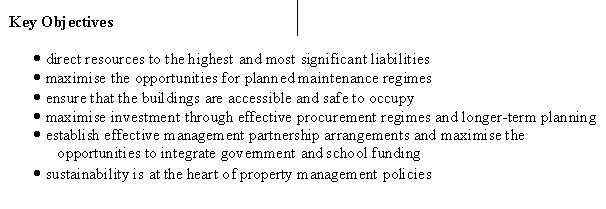
The strategy and key objectives for the current year relating to the built estate were confirmed by the Panel at its meeting in April and approved by the Executive Member for Policy and Resources on 6 April 2006. The purpose of this report is to review progress against the strategy and provide an overview of the issues that are emerging and discussed in more detail in the reports that follow. The objectives of the strategy, identified in Appendix 1, provide the framework against which the revenue, capital and NDS funds are determined. Significant progress continues to be made against all the objectives in the strategy.

1.2

The review and updating of the Strategy for the Built Estate ensures that resources are targeted at key areas and enhances the quality and safety of the Council's built estate.

2

Strategy and planning

2.1

Over the course of the remainder of the financial year regular reports will be prepared around landlord's key activities and programmes of work and the newer themes of procurement and property reviews, which taken together over many years, will ensure that the key objectives relating to the built estate are achieved. The challenge of balancing the distribution of resources across an increasing number of workstreams remains, including:

· health and safety priorities identified through the corporate risk assessment

· contributions to major capital programmes and projects

· the development of work for the South East Centre of Excellence (SECE)

· meeting sustainability objectives, particularly those relating to reducing energy consumption

· the outcomes of the Strategic Property Review

· the need to address outstanding maintenance liabilities in both the education and non-education estate at a time of declining budgets

· development of services to schools to maintain the current 100% buy back

2.2

The approach to maximising progress in each of the above areas is summarised below and considered in more detail in the reports later on the agenda.

3

Programme Management

3.1

The detailed budget distribution for 2006/07 was approved by the Executive Member on 4 April 2006. The report later on the agenda dealing with budget issues identifies the financial pressures on the budgets and the continuation of pressures in the non-schools estate. This year's allocation, together with indicative allocations to 2008/09, are given in the table below:

        2006/07 2007/08 2008/09

Capital Repairs 15,552 18,491 16,573

(including DSG)

Revenue Maintenance 14,130 14,130 14,130

NDS Condition 12,601 *10,247 -

Devolved Capital 20,800 20,688 21,824

(Schools )

        63,083 63,556 52,527

* This is 80% of the allocation (see 3.4 below)

Revenue

3.2

The bulk of the budget, over 60%, is committed to planned engineering servicing and maintenance and forms the most significant part of the Service Level Agreement with schools. The contracts, through which these services are delivered, have been re-tendered in order to ensure continuity of service at the commencement of the new SLA in April 2007. Less than 30% is spent on reactive maintenance such as roof leaks and vandalism. The continuation of major capital programmes such as the SCOLA re-cladding is having the impact of reducing maintenance liabilities, specifically external redecoration and repairs, where it is estimated that annual redecoration and repair costs have reduced by around £1m. This area of work also generates the highest satisfaction ratings from schools.

3.3

The implementation of NDS Condition Work (some £77 million so far) is aimed exclusively at permanent school buildings with the largest liabilities. The investment in major repairs and replacements has had a positive impact on recurring maintenance costs and the appearance of school buildings. Inspite of the recent unprecedented levels of funding however, maintenance liabilities continue to rise due to the increasing cost of work and the continuing deterioration of buildings, particularly those of SCOLA construction. Beyond 2007/2008 there is no certainty that NDS funding will continue, and the position will not be confirmed until after the Government's Comprehensive Spending Review.

3.4

Members will be aware that the Government has changed the way in which it provides support for the NDS programme from 100% capital grant until 2005/06 to a combination of capital grant and supported borrowing from 2006/07. For 2006/07 this support has been provided as 60% supported borrowing and 40% capital grant - in 2007/08 this will move to 70% supported borrowing and 30% capital Grant. Supported borrowing normally means that the Government provides additional revenue grant to meet in full the local charges incurred in servicing the borrowing. However, the County Council's low grant settlement means it is significantly below the minimum floor level for grant increases and any supported borrowing allocation would only have the effect of moving the County Council closer to the floor level at which grant increases can be received. For 2006/07 the County Council decided to continue its policy of taking up in full all supported borrowing approvals but this will no longer be affordable in 2007/08 and it is expected that only 80% of the total allocation will be available. The revised 2007/08 position assuming a 80% take-up is shown in the table above.

3.5

NDS funding has been allocated towards the following types of work:

* NDS Investment

Priority Area £'000

SCOLA recladding 16,600

Flat roofing/window replacement 13,500

Boilers mechanical system replacements 20,400

Fire precautions/electrical safety

External works and drainage 1,500

External redecoration 9,100

General building, engineering and structural repairs 11,805

Other work including temporary classroom

replacement and contingencies 4,400

          77,300

* excludes fee provision

3.6

As demonstrated in the above table, the impact of NDS funding is significant by dealing directly with many of the most significant liabilities along with wide coverage across school sites. However, as already noted, with resources for schools forecast to reduce, it will remain important to plan programmes over longer timescales and continue to work with schools through the SLA on the integration of their priorities and devolved funding.

3.7

While there has been significant additional funding for schools over recent years, investment in the rest of the estate, some 300 establishments covering 250,000 m² of floor space, has remained static. At the same time the creation of Discovery Centres and Nursing Care units for example has increased the floor area. While these facilities will not require major planned investment in the immediate future, routine maintenance, regular servicing of plant (sprinkler systems, for example) and the usual inspections relating to safe occupation are bringing about pressures against the revenue budget as reported at earlier meetings of the Panel.

4

Sustainability Initiatives

4.1

The following key themes form the basis for a sustainability strategy for the built estate in 2006/07 and progress reports on each of these will be brought to a future meeting of the Panel.

    · schools with low environmental credentials;

    · water management;

    · Landlord's capital repairs programmes;

    · new project design and BREEAM

4.2

Flagship/Demonstration Projects

A way of promoting the Council and publicising its work as a European Leader in sustainability would be through a small number of high profile flagship or demonstration projects.

The following demonstration initiatives are currently being examined:

    · wood fired boiler installation at Queen Elizabeth Country Park;

    · viability study with Hampshire Farmers for the production of bio fuels for use in the Council's heating systems;

    · pilot study looking at the feasibility for using Combined Heat and Power (CHP) systems at Council sites.

4.3

Other Sustainable Initiatives relating to the Existing Built Estate

4.3.1

One of the most cost effective ways for the Panel to have an impact on the national climate change agenda is through local measures delivered as part of the normal major capital repairs programmes. Examples of where the Panel have already achieved this include improving the efficiency of boilers and their controls and the thermal performance of windows, cladding and flat roof structures when undertaking major capital repairs. Consideration will now be given to creating a balance sheet to illustrate the carbon and energy savings generated by the Panel's programmes. First estimates suggest that the SCOLA recladding programme so far is generating opportunity for around 460 tonnes of CO2 savings per year and 5 million kWh of energy savings. It is now proposed to explore the possibility of these carbon energy savings being used as credits to offset against the requirement of the new Building Regulations and a further report will be prepared for a future meeting of the Panel.

4.4

New Building Regulations

4.4.1

Over the coming months, Members will start to see changes in the way capital projects are developed as a result of recent changes in the Building Regulations. The changes relate to the conservation of fuel and power, the key aim of which is to drive down carbon dioxide (CO2) emissions from buildings. The new regulations will have a significant technical and financial impact on the development of new buildings, extensions and major refurbishment projects, the outputs of which will feed directly into the Government's national sustainability agenda to reduce `green house' gas emissions from the UK. The main impact includes:

    · building design will become technically more complex in terms of achieving higher levels of thermal insulation, air tightness, efficient heating and ventilation controls and the use of alternative forms of energy with low or zero carbon outputs;

    · greater levels of training for building users will be needed to enable them to manage and control new and more sophisticated technologies used in the design of buildings;

    · upgrading the thermal performance of existing buildings will for the first time have to be taken into account when designing building extensions and undertaking major refurbishment schemes;

    · an increase in project costs.

5

Services to Schools

5.1

The provision of property services to schools has for many years been a key objective for the Council and features strongly in the Panel's Strategy for the built estate. The framework for delivering property services to schools is established through the Service Level Agreement (SLA) to which all Community schools subscribe. Around 30% of Foundation schools also subscribe to the Council's Property Services and it is hoped that this percentage will increase with the new SLA. All Aided schools buy back either the full service or engineering only service. A new 5 year (April 2007 to March 2012) SLA has been sent to schools and is due for return in January 2007.

5.2

The new SLA will ensure that:

    · liabilities are managed for every school irrespective of condition;

    · economies of scale and purchasing powers are maintained;

    · opportunities to integrate work programmes and maximise sources of funding;

    · access to specialist services;

    · continuity of existing programmes;

    · single points of contact;

    · assistance for schools with local health and safety and accessibility issues

5.3

The Panel will recall that independent market research was carried out in 2004 in order to gauge how schools feel about the existing service provision and any changes in the services they wished to receive. Schools consistently feedback high levels of support for the service and have asked that new services are developed. As a result the SLA will provide a range of new services to schools:

    · enhanced health and safety review programme;

    · interactive fire management guidance;

    · Disability Discrimination Act (DDA) advice to support school self assessment;

    · extended warranty arrangements for school funded devolved capital projects;

    · record drawings covering all buildings and site boundaries;

    · term contract arrangements for revenue building repairs/maintenance;

    · framework contracts for small and medium sized building projects;

    · induction presentation for new Headteachers, Governors and other school staff on premises matters.

5.4

Underpinning the SLA with schools are regular management partnership meetings between headteachers and Property Service staff. The meetings are one of the main conduits through which planning and consultation with schools takes place.

6

Fire Precautions

6.1

Fire and Arson remains the highest risk identified in the corporate risk assessment and Elderly Persons' Homes (EPHs) are the highest risk category of building. Detailed surveys have been completed on all EPHs and significant progress made in addressing the improvements identified. Proposals relating to the next phase of the fire precaution improvements is set out in the budget report and includes alarm and emergency lighting upgrades in seven EPHs.

7

Procurement Initiatives

7.1

As noted above, the engineering term contracts are an integral part of the service offered to schools through the SLA. Tenders for the renewal of the term contracts have now been received and analysed and the proposal to enter into new five-year contracts, to coincide with the SLA renewal, are contained in the report on procurement.

7.2

The work for SECE continues to develop and expand with the potential for initial project workloads of over £200m through the major framework. There is also significant interest in the development of second and third tier frameworks and from local authorities and other public bodies such as Fire and Police authorities. Detailed reports on the work for SECE and a general update on procurement initiatives appear later on the agenda.

8

Programme Management - Capital Repairs

8.1

As reported previously the other key objective which is monitored on a regular basis is the funding available for the spending on non-schools buildings. There is no supplementary funding available to County Council buildings in the shape of NDS which is available for schools. It remains a serious concern that liabilities in this sector of the Estate continue to grow at a rate significantly faster than effective repair strategies can be funded. This remains the major budget issue for the year ahead.

9

Policy Management Improvement

9.1

Strategic Property Review

9.1.1

The Council, in agreeing its budget for 2006/7, agreed to provide additional resources of some £300,000 for staff to undertake the Strategic Property Review. Recruitment is being undertaken and this review, together with the review of our 64 office accommodation sites, remains a major opportunity in terms of future efficiency, receipts and the ability to reduce our costs.

9.2

Key Projects

9.2.1

Members will be aware that the nursing care programme called ENHANCE involved the construction of ten new facilities and the refurbishment of seven existing homes. This work is nearing completion and will soon bring to an end one of the most significant building programmes that the Council has undertaken.

9.2.2

As one major programme finishes another in the shape of Ashburton Court is proceeding. The Panel has been given detailed reports on key elements for the project over the last 12 months. A review of the project is elsewhere on the agenda.

Recommendation

That the Buildings, Land and Procurement Panel advises the Executive Member for Policy and Resources that approval be given to the progress made against the Strategy for the Built Estate.

LINK(S) TO CORPORATE STRATEGY

Yes

No

Hampshire safer and more secure for all

_

Maximising well-being

_

Enhancing our quality of place

_

Section 100 D - Local Government Act 1972 - background papers

The following documents disclose facts or matters on which this report, or an important part of it, is based and has been relied upon to a material extent in the preparation of this report.

NB the list excludes:

1 Published works

2 Documents which disclose exempt or confidential information as defined in the Act

........................

........................  BLPP 1006E

                      Appendix 1

STRATEGY FOR THE BUILT ESTATE (REVIEW)
Support to Discovery Centres