
Archived decisions
Hampshire County Council Executive Member - Environment 10 October 2006 Household Waste Recycling Centres Business Case - Contract Retender Report of the Director of Environment |
Item 3 |
Contact: Paul Archer, ext 7022 email: [email protected]
1. Summary
1.1 The household waste recycling centre (HWRC) network is a key frontline service provided by Hampshire County Council, accounting for over 40% of Project Integra recycling performance. It is also crucial to achieving the Local Public Services II diversion from landfill target.
1.2 The current HWRC network is predominantly an infrastructure developed in the 1980s. However the public is demanding improved HWRCs, more of them and better service from them. To add further pressure, recent legislative changes require additional waste streams to be separated at source, ie at the HWRCs.
1.3 The HWRCs are provided for householders to deposit materials not collected by the refuse collection service. However, their effective operation is being compromised by the illegal deposit of trade waste (ie waste from commercial and industrial sources). Also, the lack of a clear and comprehensive waste acceptance policy lends to confusion on-site between the public and the site operators, which acts as a disincentive to recycling. It also causes operating difficulties between the site operators and the County Council. Thus there is a real need to create a formal Waste Acceptance Policy for managing waste deliveries into HWRCs.
1.4 Deposit of trade waste at HWRCs is not permitted by their Environment Agency site licences or by law. It is estimated that by 2008 such activity will cost the County Council over £1,000,000 per year in disposal costs and landfill tax. Hampshire is surrounded by authorities who have taken proactive measures to reduce trade waste levels and it is now recommended that the County Council does likewise.
1.5 The proposed trade waste controls aim to exclude trade waste by restricting and monitoring vehicles through:
(i) a Household Recycling Permit Scheme, ensuring that householders with high vehicles using sites legitimately are not excluded;
(ii) Automatic Number Plate Recognition (to allow frequency of site use to be monitored);
(iii) provision of height barriers as an interim measure (to exclude vans and other high vehicles) and;
(iv) a detailed Waste Acceptance Policy setting out what is and is not accepted as household waste will be developed.
1.6 It is proposed that the County Council takes a proactive approach to facilitating the provision of alternative facilities for small traders (some of whom currently use the HWRCs on an unauthorised basis). A wide-ranging, thorough and informed communications campaign, implemented well in advance of, and also during, the proposed changes will assist the site operatives and obtain support from all key audiences prior to the introduction of a new management contract from the beginning of 2008.
1.7 Approval to the changes is required now given that the existing HWRC management contracts expire at the end of 2007 and a retendering process, reflecting new policies, is necessary. Key dates in the process are as follows:
(i) December 2005 approval given to retender HWRC management contracts;
(ii) 10 October 2006 Executive Member for Environment considers case for a trade waste controls and a better defined waste acceptance policy and approves appropriate control measures and arrangements for phased implementation subject to Cabinet decision below;
(iii) 30 October 2006 Cabinet approves the principle of adopting a trade waste control policy;
(iv) 1 April 2007 phased introduction of trade waste controls commence; and
(v) 1 January 2008 new HWRC management contracts commence.
1.8 The linkage between trade waste controls and the new HWRC contracts are important as the latter are a vehicle to professionalise the HWRC operation and to improve customer service to the public. The aim is to achieve the optimum balance between service to the public (including site opening hours), achieving the best possible recycling levels and cost. Additional work, with particular reference to the cost of providing a higher quality service, is being carried out.
2. Background
2.1 The HWRCs are managed under contract by two contractors - Veolia Environmental Services plc and Hopkins Limited. In December 2005, at the end of the initial three year contract period, they were extended for two years to December 2007. At the same time, approval was granted for the contracts to be retendered in order to give continuous service provision from 1 January 2008.
2.2 The retendering of the contracts provides the opportunity to improve the operation of the facilities, particularly with regard to cost efficiency and customer service levels. A review has identified trade waste acceptance and waste acceptance policies generally as key issues. A range of investigations have been carried out including:
(i) identifying current waste acceptance policies and best practice in other authorities. These include West Sussex, East Sussex, Dorset, Wiltshire, Shropshire, Cheshire, Norfolk and North Yorkshire County Councils, and Blackburn with Darwen Borough Council and Bristol City Council;
(ii) obtaining further information from alternative HWRC site operators Weymouth and Sherborne Recycling and ECT Recycling;
(iii) consulting with current Hampshire County Council HWRC contractors;
(iv) investigating costs that can be avoided by robustly tackling trade waste abuse;
(v) investigating the provision and cost of trade control systems; and
(vi) implementing an independent survey of HWRC trade waste volumes in Hampshire, including production of a trade waste controls recommendations report.
3. Introduction to the HWRC Network and its Strategic Importance
3.1 HWRCs are a key direct public service provided by the County Council. Additionally, in waste management terms, it is the only time that the authority has direct face-to-face interaction with its customers. It is crucial therefore that service provision is continually improved in order to increase customer satisfaction, influence behaviour and consequently raise recycling rates across the county.
3.2 The County Council is responsible for 24 of the network of 26 HWRCs located in Hampshire, the two unitary authorities of Southampton City Council and Portsmouth City Council being responsible for one HWRC each. In 2005/06 the network:
(i) received over four-and-a-half million customer visits;
(ii) handled 243,000 tonnes of waste and discarded materials;
(iii) achieved a recycling/reuse rate of 60% (see Appendix 1); and
(iv) accounted for over 40% of the Project Integra partnership recycling performance.
3.3 The existing management contracts, which include incentive mechanisms, are valued at circa £1,100,000 million per annum. The incentive payments are funded from part of the financial benefits (lower disposal costs) associated with higher recycling performance. The contractors have increased HWRC recycling levels during each of the first three full years of the present contracts, from 54% in 2003/04, to 57% in 2004/05, then 60% in 2005/06.
4. Current Issues
4.1 The current HWRC network is predominantly an infrastructure developed in the 1980s. Since 2000/01 HWRC waste volumes have increased by almost 20%, or in excess of 40,000 tonnes which is the equivalent of twice the busiest site. Many of the sites are either too small, or of an outdated design to deal with the volumes of waste delivered, the high levels of customer use and the ever increasing need for segregation of waste types and recycling.
4.2 Recent and forthcoming legislative changes concerning a wide variety of hazardous wastes have put the network under increased pressure. The Waste Electrical and Electronic Equipment Directive and The Restriction on Hazardous Substances Directive will require additional waste streams to be separated at source, ie at the HWRCs.
4.3 The public is demanding better HWRCs, better customer service and more sites. Complaints related to inadequate size, queueing times, highways congestion (for users and non-users) and inequities in the service, ie location gaps and customer service are regularly being raised.
4.4 The programme of continuing improvements and investment in the HWRC infrastructure is ongoing. The next new HWRCs are likely to be for Romsey and Andover and should be operational by early 2008. Redevelopment schemes are also planned for the Havant, Marchwood, Fair Oak, Aldershot and Hartley Wintney HWRCs. This programme will be taken into account in the new contracts which will be flexible enough to cope with proposed or future changes.
4.5 There is a need to improve average recycling/reuse performance across the network towards, and over, 65%, comparable with the better performing HWRCs in Hampshire. The HWRC network is crucial to achieving the authority's Local Public Services Agreement II diversion from landfill target, with gains in performance at the HWRCs being necessary if the stretching target is to be met.
5. Trade Waste at HWRCs
5.1 Both anecdotal, plus survey evidence, suggests the County Council's HWRCs are currently accepting large quantities of trade waste and the current Disclaimer Form method of control, under which customers are asked to certify that they are delivering household wastes, is ineffective. Taking average trade waste volumes to be 17.5% (from recent independent surveys) suggests that to dispose of illegally deposited trade waste in 2008, when the new contracts commence, will cost the Council in excess of £1,000,000 per year in disposal costs and landfill tax. With waste growth, plus the landfill tax escalator, this will rise substantially over the years.
5.2 Deposit of trade waste is not permitted at HWRCs by their Environment Agency site licences or by law. Trade abuse also impacts negatively on the general running of the HWRCs as extra tonnages are being managed and staff are put under increased pressure by trade users. This results in a reduced service to householders and the general atmosphere on site is less likely to encourage segregation and recycling activity (see Appendix 2 for the background to trade waste at HWRCs).
5.3 Hampshire is surrounded by authorities which, either historically or as the result of recent changes, actively work to reduce trade waste levels. These actions include one measure or, more usually, a combination. Hampshire is increasingly standing out as an authority which does not enforce effective trade waste controls (see Appendix 2 for further details).
5.4 Introducing effective trade waste controls will not only reduce cost exposure across the network, it will also reduce demand and in turn greatly assist with improving customer service provision. Effective trade waste control can only be delivered with appropriate and effective methods. A review of other authority practices has narrowed down the methods recommended for Hampshire to the following:
(i) Household Recycling Permit Scheme - involves banning commercial vehicles as these are the type of vehicles mainly used by traders, and offers exemption permits for Hampshire householders who only have a commercial vehicle;
(ii) Automatic Number Plate Recognition - identifies frequent site users and provides irrefutable evidence and traceability of their use in a way that no other system can;
(iii) Follow-up process and eventual prosecution of offenders;
(iv) CCTV - as a back-up to investment in Automatic Number Plate Recognition and to improve site security and monitoring.
(v) Height Barriers - an immediate restrictive measure which will be phased in from April 2007.
See Appendix 2 for further details on these systems.
5.5 If trade activity reduces at a site, it is predicted that recycling rates would marginally increase. This is borne out by evidence from authorities who have recently introduced trade waste controls. For example, Dorset County Council introduced controls in 2003 and found that there was no negative impact on performance, and possibly a small recycling increase. Cheshire County Council introduced controls in July 2006 and is anticipating a slight performance improvement (see Appendix 2 for further details).
5.6 It is perceived that fly-tipping can significantly increase as a result of introducing effective trade waste controls at HWRCs. However, the evidence from other authorities suggests that although a small increase in fly-tipping levels may be witnessed after trade controls are introduced, the levels are minor and need to be set against a general increase in fly-tipping anyway. In addition, adequate provision and communication of viable alternatives for traders will be a major factor in minimising fly-tipping activity (see Appendix 2 for further details).
5.7 Early consultation with current contractors suggests that they fully endorse the trade control measures being proposed. They believe the measures will assist them in operating the sites more efficiently, as well as benefiting both the public and the County Council.
5.8 The start-up costs of implementing the proposed package of trade waste controls are estimated to be just under £1,000,000. The annual running costs are estimated at around £140,000. Taking trade waste volumes to be 17.5%, and on the prudent assumption that trade controls will only be able to remove 75% of trade waste volumes, the year on year cost avoidance is just over £840,000. This represents an investment payback period of less than two years.
5.9 In recent years a variety of operating efficiencies and savings have been gained at the HWRCs. Despite that, through the existing management contracts, the focus on improved customer service is likely to increase the management fee costs when the service is retendered next year. However with the year on year cost avoidance described in paragraph 5.8, increased management fees ought to be able to be absorbed. For further costs and cost avoidance detail see Appendix 3.
6. Waste Acceptance Policy
6.1 The problem of trade waste is exacerbated by the lack of a comprehensive and detailed waste acceptance policy for the HWRCs. This issue also leads to confusion and tension between site staff and the public, causing increased customer complaints, reducing the public's desire to segregate and recycle, diverting site staff away from recycling activities and increasing congestion as the public stay longer on site.
6.2 An overarching and watertight Waste Acceptance Policy would assist in managing waste deliveries into HWRCs. It should be based on industry best practice and clearly define what will and will not be accepted, particularly in the case of construction and demolition waste. It shall also contain clear statements and working guidance on how policies should be implemented (see Appendix 2 for further background to Waste Acceptance at HWRCs, including the acceptance of Charity Waste).
6.3 The Waste Acceptance Policy will be used by both the County Council and its contractors, both on- and off-site. It will be subject to change and update as required by internal policy, legislative and industry requirements and will be used as the basis for all HWRC public communications. The Waste Acceptance Policy is currently under development (see Appendix 2 for current Waste Acceptance Proposals).
7. Facilitating Trade Waste Alternatives
7.1 Facilitating the appropriate provision of trade waste disposal alternatives will be at the heart of the new contracts. Traders do not use HWRCs solely because of the financial gain involved - there are other practical factors which may be as or even more important. The most significant factor can be a lack of available alternative facilities which accept waste from small traders. Secondly, small traders are often unaware of the facilities which do exist and how to find out about them.
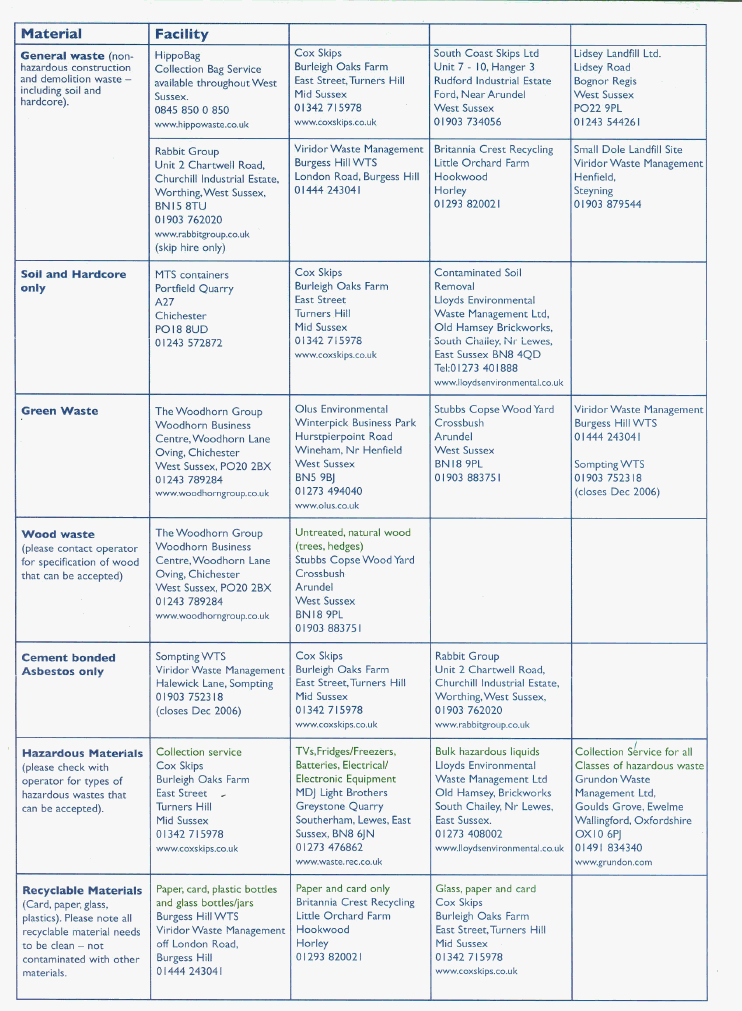
7.2 Close working with the Environment Agency will allow a definitive list of licensed trade waste facilities to be produced and communicated. Discussions are already underway with licensed operators to facilitate their use by small traders. Leaflets will be provided, also available online and via other media, giving clear and detailed guidance to traders on the operating procedures, rates charged and contact details, etc of:
(i) the many local facilities where they can legally dispose of and recycle their waste;
(ii) a wide variety of local waste collection companies;
(iii) local skip hire companies;
(iv) Hippo bags, a cost-effective and increasingly popular way of disposing of small amounts of waste; and
(v) the services offered by the Environment Agency, including how to quickly obtain a Waste Carriers Licence (required for traders to legally carry waste).
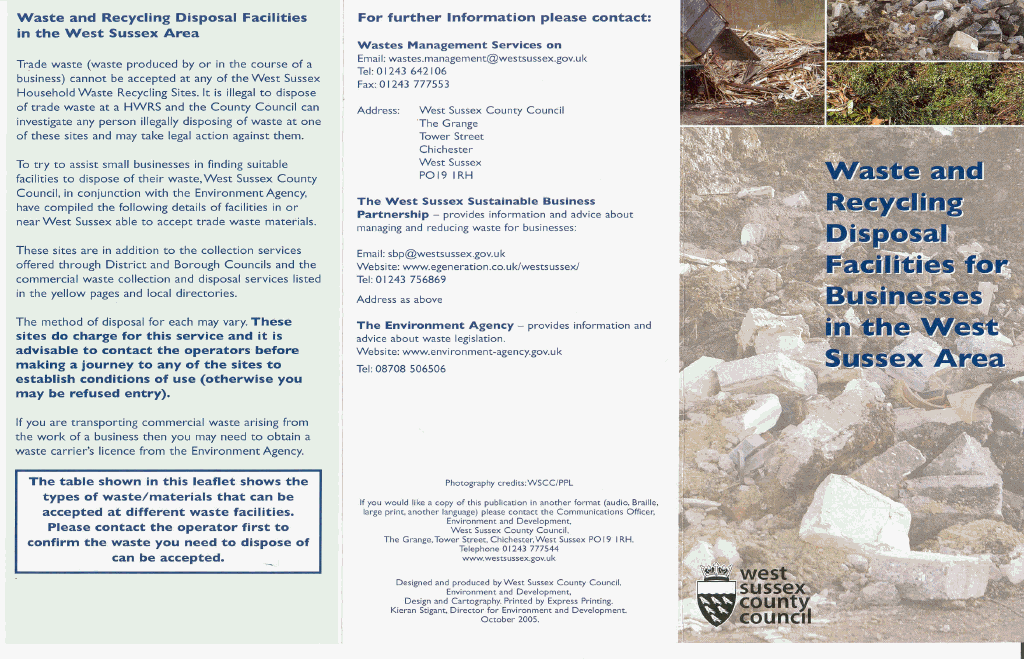
7.3 The leaflets will clearly explain why trade waste cannot be accepted at HWRCs and what can happen if traders do attempt to make deposits. Site staff will receive guidance and training on using the leaflets and getting the right message across to traders. Leaflets will be produced and issued many months in advance of the new Waste Acceptance Policy and trade waste controls. This will allow traders plenty of time to get used to the alternatives and cease their illegal use of the HWRCs (see Appendix 4 for an example of a leaflet produced by West Sussex County Council).
7.4 From previous research it has been identified that collection services are the preferred method of waste disposal for small businesses; pilot waste collection services are being undertaken. The HWRC retender work on trade controls and the facilitation of legal trade waste alternatives will complement this work. In addition the County Council will continue to work in partnership with the private sector, in order to facilitate the construction of new sites capable of handling trade waste. The Minerals and Waste Development Framework will assist the private sector to bring forward appropriate development projects.
8. Links with Enhanced Customer Service
8.1 Previous HWRC research has identified key customer concerns such as traffic congestion and queueing, both on- and off-site, a lack of parking and poor access to sites and to bins. The proposed trade waste controls and Waste Acceptance Policy aim to decongest the sites by removing the majority of trade waste volumes.
8.2 Other concerns identified include variable customer service, with regular issues relating to unhelpful staff and inadequate signage on-site. Additional HWRC research, in form of Focus Groups, has been commissioned to explore public opinion on the service that is currently provided and on any future changes that may occur. The findings of these groups will help to shape policy and service changes in relation to the new HWRC contract (see Appendix 5 for a draft Focus Group discussion guide).
8.3 The advantages and disadvantages of on-site bric-a-brac sales areas for reusable waste, as compared to off-site sales areas, are being investigated. All sites in the Hampshire HWRC network currently have on-site sales areas. However there are relatively few companies in the waste management industry and of these, some would only tender for the service if on-site sales were excluded. In order not to restrict the list of interested parties in the tender, it is planned that bids will be accepted from companies offering either on- or off-site sales.
8.4 It is important that the new contracts are seen as a vehicle to professionalise the HWRC operation and to improve customer service to the public. It is intended that additional work, with particular reference to cost, will be carried out in this area through the development of the contract specification. However currently proposed minimum acceptable levels of customer service include:
(i) staff training - must invest in site staff and equip them with the knowledge and front line customer service skills they need in order to improve segregation of waste and recycling levels;
(ii) staff must have uniforms and name badges, site supervisors to be clearly identifiable;
(iii) meeters and greeters, at least during busy times;
(iv) minimum staffing levels per site;
(v) consistent site signage, leaflets and branding;
(vi) sites to be clean and tidy at all times; and
(vii) site name - remove reference to waste and just have Household Recycling Centre (HRC).
8.5 The contract retender exercise will aim to achieve the optimum balance between service to the public, achieving the best possible recycling levels, and cost. It will determine what this means in terms of the following contract specification areas:
(i) customer service;
(ii) on-site sales areas;
(iii) impact of the Waste Electrical and Electronic Equipment Directive on metal revenues;
(iv) contract packages;
(v) key performance indicators;
(vi) contract length;
(vii) incorporating the three sites embedded in the main disposal contract;
(viii) site opening hours; and
(ix) mechanical compaction.
9. Communications
9.1 It is proposed that a wide-ranging, thorough and informed communications campaign is implemented well in advance of, and also during, the proposed changes. The aims of this campaign are to:
(i) assist the retendering process with clear communications to ensure a smooth project;
(ii) communicate fully with all audiences;
(iii) obtain support from all key audiences;
(iv) eliminate confusion over waste acceptance, and specifically communicate with traders to provide them with details of alternative disposal routes; and
(v) plan for contingencies.
9.2 Getting all key audiences on board with this Retender Project, particularly the Waste Acceptance element, will significantly help the smooth implementation of the revised arrangements. The communications programme must be innovative and well researched to ensure that everyone receives a consistent message.
10. Impact Assessments
10.1 Assessment of the Race Relations (Amendment) Act has been considered in this review but no adverse impact has been identified.
11. Conclusions
11.1 There is a real need to create effective trade waste controls and a detailed Waste Acceptance Policy for managing waste deliveries into HWRCs. Trade waste controls will be supported by a detailed waste acceptance policy based on industry best practice and clearly define what will and will not be accepted, particularly in the case of construction and demolition waste. In view of the impact of these proposals, the policy change is being referred to the Cabinet for decision.
11.2 Introducing effective trade waste controls will not only reduce cost exposure across the network, it will also reduce demand and in turn greatly assist with improving customer service provision. Effective trade waste control can only be delivered with appropriate and effective methods. The methods proposed for Hampshire are:
(i) a general vehicle ban linked to a Household Recycling Permit Scheme;
(ii) Automatic Number Plate Recognition;
(iii) effective follow-up procedures;
(iv) CCTV; and
(v) height barriers.
11.3 It is proposed to implement these measure in a phased way, commencing in April 2007. The costs of implementing this package of trade waste controls will be recouped in less than two years from avoided disposal and landfill tax costs.
11.4 The introduction of trade controls is expected to have a minimal but positive effect on recycling levels. Some minor increase in fly-tipping may been seen, however this can be minimised and better controlled through communication and adequate provision of trade waste alternatives.
11.5 The proposals set out in this report complement the contract retender exercise which will aim to achieve the optimum balance between service to the public, achieving the best possible recycling levels, and cost. The new controls will commence on 1 January 2008.
Recommendations
1. That the Executive Member for Environment:
(i) recommends to Cabinet the principle of introducing trade waste controls on all Household Waste Recycling Centres from 1 April 2007;
(ii) approves the elements of the new trade waste controls, including a Household Recycling Permit Scheme, Automatic Number Plate Recognition, closed-circuit television and height barriers, at the 24 household waste recycling centres in Hampshire, together with support for improving and enhancing trade waste alternatives; and
(iii) approves the proposed enhancement to service quality in the specification for the new household waste recycling centre contracts to operate from 2008.
2. That the Director of Environment, in consultation with the Executive Member for Environment, be authorised to conclude all other elements of the contract specification.
This proposal does not link to the Corporate Strategy but, nevertheless, requires a decision because it will improve service levels to households, reduce waste inputs and costs, and will have a positive impact on Best Value Performance Indicators, eg increased customer satisfaction, reduced unit costs and higher recycling levels. |
Section 100 D - Local Government Act 1972 - background papers | |
The following documents disclose facts or matters on which this report, or an important part of it, is based and has been relied upon to a material extent in the preparation of this report. | |
NB the list excludes: | |
1. |
Published works. |
2. |
Documents which disclose exempt or confidential information as defined in the Act. |
TITLE |
LOCATION |
Working File |
Environment Department Room 216 |
1026Rpt/PA
HWRC Performance - (inc all recycled and reused) April - March 2005/06 | |||||||||
|
Total Delivered (t) |
Total Green Recycled (t) |
Total Other Recycled (t) |
Total Recycled (t) |
Soil/Rubble & Bric-a-Brac (t) |
Wood (t) |
Total Residual (t) |
% Recycled |
Position |
RC1 |
| ||||||||
| |||||||||
Aldershot |
6,800.89 |
1,496.10 |
1,068.47 |
2,564.57 |
865.55 |
289.40 |
3,081.37 |
54.7% |
21 |
Andover |
8,257.89 |
2,193.92 |
1,518.59 |
3,712.51 |
1,339.61 |
357.26 |
2,848.51 |
65.5% |
7 |
Basingstoke |
12,847.62 |
3,232.29 |
2,026.58 |
5,258.86 |
1,929.46 |
506.65 |
5,152.65 |
59.9% |
16 |
Hartley Wintney |
7,247.72 |
2,130.85 |
976.73 |
3,107.58 |
891.93 |
198.64 |
3,049.57 |
57.9% |
18 |
Sub Total |
35,154.13 |
9,053.15 |
5,590.37 |
14,643.52 |
5,026.55 |
1,351.95 |
14,132.10 |
59.8% |
4 |
RC2 |
| ||||||||
| |||||||||
Efford |
11,273.32 |
4,769.41 |
1,362.02 |
6,131.43 |
813.86 |
269.54 |
4,058.49 |
64.0% |
9 |
Marchwood |
14,026.25 |
3,599.18 |
2,245.48 |
5,844.66 |
1,945.67 |
666.16 |
5,569.76 |
60.3% |
15 |
Netley |
10,749.34 |
1,990.39 |
1,396.06 |
3,386.45 |
1,140.42 |
487.04 |
5,735.44 |
46.6% |
26 |
Somerley |
9,151.12 |
3,719.71 |
1,224.43 |
4,944.14 |
1,126.10 |
333.40 |
2,747.48 |
70.0% |
1 |
Sub Total |
45,200.03 |
14,078.69 |
6,227.99 |
20,306.68 |
5,026.05 |
1,756.14 |
18,111.16 |
59.9% |
3 |
RC3 |
| ||||||||
| |||||||||
Alresford |
1,907.34 |
601.63 |
420.21 |
1,021.84 |
57.00 |
0.00 |
828.49 |
56.6% |
20 |
Alton |
6,816.76 |
1,718.70 |
1,268.61 |
2,987.31 |
1,162.19 |
217.37 |
2,449.59 |
64.1% |
8 |
Bordon |
7,942.06 |
2,043.52 |
1,440.02 |
3,483.53 |
1,048.94 |
352.66 |
3,056.93 |
61.5% |
12 |
Casbrook |
4,995.13 |
1,364.15 |
946.59 |
2,310.74 |
848.14 |
202.72 |
1,633.53 |
67.3% |
4 |
Petersfield |
5,969.38 |
1,787.80 |
1,149.67 |
2,937.46 |
805.00 |
201.00 |
2,025.87 |
66.1% |
6 |
Winchester |
7,356.30 |
1,912.26 |
1,485.96 |
3,398.22 |
1,051.70 |
253.30 |
2,653.08 |
63.9% |
10 |
Sub Total |
34,986.97 |
9,428.05 |
6,711.05 |
16,139.11 |
4,972.97 |
1,227.05 |
12,647.50 |
63.8% |
1 |
RC4 |
| ||||||||
| |||||||||
Bishops Waltham |
3,271.88 |
882.93 |
792.95 |
1,675.88 |
424.16 |
73.28 |
1,098.56 |
66.4% |
5 |
Eastleigh |
7,819.81 |
1,741.76 |
1,339.84 |
3,081.60 |
1,386.58 |
274.72 |
3,076.91 |
60.7% |
14 |
Fair Oak |
4,860.07 |
1,349.16 |
894.63 |
2,243.79 |
629.78 |
200.59 |
1,785.94 |
63.3% |
11 |
Hedge End |
7,298.94 |
2,040.40 |
1,195.72 |
3,236.12 |
1,418.43 |
331.62 |
2,294.77 |
68.3% |
2 |
Segensworth |
15,425.86 |
4,045.99 |
2,207.45 |
6,253.44 |
2,337.34 |
626.84 |
6,208.24 |
59.8% |
17 |
Sub Total |
38,676.56 |
10,060.24 |
6,430.58 |
16,490.83 |
6,196.29 |
1,507.05 |
14,464.43 |
62.6% |
2 |
RC5 |
| ||||||||
| |||||||||
Gosport |
16,291.96 |
3,258.72 |
2,102.59 |
5,361.31 |
3,299.58 |
634.08 |
6,996.99 |
57.1% |
19 |
Havant |
19,768.57 |
3,801.55 |
2,488.30 |
6,289.85 |
3,422.43 |
620.74 |
9,435.55 |
52.3% |
23 |
Hayling Island |
3,795.28 |
1,588.26 |
481.69 |
2,069.94 |
486.10 |
35.64 |
1,203.51 |
68.3% |
3 |
Waterlooville |
11,327.69 |
2,618.04 |
1,476.51 |
4,094.55 |
2,412.89 |
370.20 |
4,450.05 |
60.7% |
13 |
Sub Total |
51,183.50 |
11,266.57 |
6,549.09 |
17,815.66 |
9,621.00 |
1,660.66 |
22,086.09 |
56.8% |
5 |
RC6 |
| ||||||||
| |||||||||
Chapel |
11,873.02 |
1,363.97 |
1,476.55 |
2,840.52 |
2,502.16 |
479.28 |
6,051.06 |
49.0% |
25 |
Farnborough |
13,630.78 |
3,700.68 |
1,724.33 |
5,425.01 |
1,422.63 |
501.63 |
6,281.51 |
53.9% |
22 |
Paulsgrove |
12,403.23 |
1,715.61 |
1,520.36 |
3,235.97 |
2,363.34 |
506.46 |
6,297.47 |
49.2% |
24 |
Sub Total |
37,907.03 |
6,780.26 |
4,721.24 |
11,501.50 |
6,288.13 |
1,487.37 |
18,630.03 |
50.9% |
6 |
|
| ||||||||
Total |
243,108.2 |
60,667.0 |
36,230.3 |
96,897.3 |
37,131.0 |
8,990.2 |
100,071.3 |
58.8% |
|
HCC Total |
205,816.8 |
54,702.1 |
31,438.2 |
86,140.3 |
30,535.5 |
7,495.4 |
81,629.4 |
60.3% |
|
Please note this figures are unaudited and are therefore subject to change
Waste Acceptance and Trade Waste at Household Waste Recycling Centres
Background to Waste Acceptance at HWRCs
HWRCs are provided by Authorities under the Environmental Protection Act 1990 as "...places to be provided at which persons resident in its area may deposit their household waste...". The Council does not have to provide a facility for non Hampshire residents, or for the deposit of trade waste. Household waste is defined according to its source rather than its content. This makes it difficult for local authorities to control trade waste input, as it is close to impossible to know the source of a waste once removed from that source, i.e. when it arrives at an HWRC.
Construction and demolition waste has been defined as industrial waste, regardless of source. However Defra guidance is that some small amounts of DIY construction and demolition waste should be accepted at HWRCs, but with no definition of "small amounts". Nor does it assist with which of the myriad of other waste types should be accepted as household waste.
Charity waste is accepted free of charge at HWRCs. Waste from small-scale community activities is likely to be largely of `household' type waste, and is also accepted at HWRCs free of charge. This is subject to prior written notification and a number of validation checks. Pre-segregation of waste types is required in order to aid recycling.
The new waste acceptance policy will ensure that, once requests for charity or community-based waste disposal have been granted, procedures are in place to ensure their service requirements are met on an ongoing basis. Their continued eligibility and charity status will also be monitored.
At both the national and local level the increasing importance of the Voluntary and Community Waste Sector in delivering public services is recognised. Within waste management there already exist several successful examples of Voluntary and Community Waste Sector organisations operating local authority collection contracts, with a few managing HWRC sites.
The HWRC Retender Project will look into more formal methods of working with the Voluntary and Community Waste Sector in Hampshire and making the most of the `added value' it offers.
Waste Acceptance Proposals
(i) A clear definition of trade waste - it is recommended that this is "Trade waste includes waste from any business and waste from domestic premises carried for profit. This means that anyone who has received any payment for carrying waste, or produces waste from their work cannot take the waste to an HWRC."
(ii) Construction and demolition waste - current policy allows the equivalent of a medium-sized car boot full. However this places no restrictions on the number of times this amount can be deposited and is heavily abused. By stating that this quantity can only be brought in a maximum number of times this loophole can be closed.
(iii) There are a variety of other more minor areas which can also cause confusion on site. In particular there is a need to be clear about car parts, tyres, gas bottles and watersports waste.
Trade Waste at HWRCs
Background
In a national HWRC trade waste study in 2002, traders and householders were found to bring in very similar types of waste, although traders bring in around three times more waste. The only marked difference was that traders bring in higher proportions of construction and demolition waste and wood. Traders who use HWRCs for waste disposal are generally "manual" traders - builders, gardeners, house clearance, plumbers, electricians etc. These types of businesses tend to produce high amounts of waste, at ad hoc times, and from varying locations. Shops and offices, being based at permanent premises, rarely use HWRCs for waste disposal and generally prefer waste collections. It is thought that most traders using HWRCs are from small sized businesses. It is also suspected that a proportion of traders using HWRCs are likely to be "unofficial" traders.
After the introduction of landfill tax in 1996, HWRC tonnage took a dramatic upward turn. This increase was partly a result of ongoing increases in the population and numbers of households, and an underlying growth in the amounts of waste produced by households. However it is also generally considered to be partly attributable to an increase in waste brought by traders in order to avoid paying landfill tax.
If trader numbers reduce at a site, the prediction is that recycling rates would go slightly upwards. This is borne out by recent evidence from Authorities who have introduced Trade Waste Controls. Shropshire County Council introduced controls in 2002 and by 2003 had increased their recycling rates by over 40% on previous levels (other improvements we also made at this time so this increase is probably not all attributable to the trade controls). Dorset County Council introduced controls in 2003 and found that there was practically no impact, and possibly a small increase. Cheshire County Council introduced controls in July 2006 and are anticipating a slight improvement.
It is sometimes perceived that fly tipping, and other illegal waste disposal practices can significantly increase as a result of introducing effective trade waste controls at HWRCs. However the evidence from other Authorities who have introduced controls suggests that in fact this does not constitute a significant problem. Although there is some evidence to suggest a small increase in fly tipping levels will be witnessed, the levels are minor.
It is usually the case that fly tipping was increasing prior to the introduction of controls, as traders attempt to avoid paying disposal costs and landfill tax. However adequate provision and communication of viable alternatives for traders, as outlined in sections 8.1 to 8.4 of this report, will be a major factor in preventing an increase in fly tipping.
Complete and accurate data on fly tipping is difficult to obtain, although a number of case studies are cited in a national HWRC trade waste study in 2002. Devon, Kent and North Lincolnshire County Councils were all seeing a general increase in fly tipping even before any new trade waste controls were put in place, which can be partly attributed to the introduction of landfill tax in 1996.
Recent information from Portsmouth City Council shows that there has been no recorded increase in fly tipping incidents since height barriers were introduced three years ago. Although they did have a small amount of anecdotal evidence showing a minor increase. In the London Borough of Bexley and Dudley Borough Council anecdotal evidence suggests an increase in fly tipping around HWRCs following trade waste control implementation. Although this is considered partly to be of domestic origin due to congestion around sites.
Trade Waste Controls used by Neighbouring Authorities
Automatic Number Plate Recognition
By Appointment Only Booking
CCTV Security Monitoring
Declared Business Exclusions
Exemption Permits
Proof of Address/Residency
Site Operating Conditions Acceptance Note
Site Operator Alternative Facility Advice
Site Operator Challenge & Enforcement
Vehicle Gross Weight Restrictions
Vehicle Height Restrictions
Vehicle Towing Trailer Dimension Restrictions (trailers, large trailers)
Vehicle Type Restrictions (commercial vehicles, vans)
Waste Disclaimer Forms
Waste Type Restrictions (hazardous, special)
Waste Vouchers (per load)
Waste Weight and/or Volume Limits
Weighbridges
Controls by Authority (principal measures)
West Sussex
Automatic Number Plate Recognition (Automatic Number Plate Recognition)
CCTV Surveillance
Construction & Demolition Waste - Weight Limit
Disclaimer Forms
Security Staff Checks at site entrance
Site Operator Challenge and Vehicle Refusal (re Source of Waste)
Site Operator Non HWRS Disposal Site advice
Vehicle Restrictions - Height, Weight and Trailer Dimensions
West Berkshire
Controlled Waste Transfer Notes
Declared Business Exclusion
Local Guidance Note (site operating conditions agreement)
Suitable Trade Waste Vouchers (per load)
Vehicle Weight Restriction (over 4 tonnes gross vehicle weight)
Dorset
Commercial Van and Large Trailer Ban
Exemption Permits for genuine householders vans (not trailers).
List of Alternative Disposal Sites
Restriction of Construction Waste (by volume)
Site Staff turn away Commercial Vans
Wiltshire
By Appointment Only Booking
Disclaimer Forms
Hazardous Waste Volume Limit
Proof of Residency
Site Operator Challenge and Enforcement
Isle of Wight
Registered Charity Waste Disposal Permits
Vans or Vehicles with Trailers Restrictions
Waste Type Restrictions
Bracknell Forest
Honesty Form
Local Trade Waste Acceptance (Chargeable)
Site Operator Challenge
Height Barriers
Waste Type Restrictions
Weighbridge Opening Hours Restrictions (Over Height Household Vehicles)
Portsmouth
CCTV Surveillance
Extra Enforcement Officers (Over height household vehicles)
Height Barriers (barrier opening times)
Southampton
Council Officer monitoring (Over height household vehicles)
Height Barriers (barrier opening times)
Hampshire
Disclaimer Forms
NB This wide variety of trade waste controls is replicated by Authorities across the rest of the country.
Proposed Trade Waste Control Methods in Hampshire
Household Recycling Permit Scheme
Nationally this is fast becoming the most popular and effective method of HWRC trade waste control. It involves banning commercial vehicles as these are the type of vehicles mainly used by traders, and offers exemption permits for Hampshire householders who only have a commercial vehicle.
(i) Areas under consideration include how many permits to issue to ensure that opportunities for trade abuse are minimised. Best practice suggests that permits should be allocated for a period of time and are limited to a predetermined number of visits - often 12 permits valid for 12 months. However there are authorities which take a much tougher stance. Additional permits are only issued in exceptional circumstances.
(ii) Trailers are often used by traders to transport large quantities of waste. Trailers also cause congestion and health and safety issues on site. The permit system can be extended to trailers. This could involve issuing permits for trailers above a certain size, and/or possibly not allowing larger trailers on-site.
(iii) Usual practice with regards to residents from neighbouring authorities, in line with Environmental Protection Act (1990) requirements, is that permits are not issued. However Dorset County Council does not have this restriction and many Dorset residents use Hampshire sites. Discussions are planned with Dorset to resolve this issue.
Automatic Number Plate Recognition
This system is becoming increasingly popular at HWRCs as an effective back up to a permit scheme.
(i) It identifies frequent site users and provides irrefutable evidence and traceability of their use in a way that no other system can.
(ii) It helps in identifying traders who may be evading a permit scheme, for example by using a car, or by visiting multiple sites in an attempt to disguise the amount of waste they are depositing.
(iii) Various options are available - site staff can be alerted to the presence of certain vehicles, or the most persistent site users.
(iv) It can also help ensure that vehicles using the sites are safe and roadworthy.
(v) The data collected has wider use for accurate traffic counting analysis - used in the design and build of new sites, and service and staff vehicle movement analysis, all of which are gathered separately at present at a cost of up to £15,000 per annum.
CCTV
The Council has a duty of care to keep sites and site users secure and safe. However, a number of sites suffer from break-ins and vandalism most weeks and there are regular incidents where site staff are threatened by users, in particular by suspected traders. Of increasing concern is the impact this has on site operations and staff and customer safety, as well as site-staff morale. The cost of break-ins and vandalism ranges from £5,000 to replace a destroyed waste bin, to staff time lost through having to clear up and re-secure the sites, through to sites being closed to the public during clear up. There are a host of benefits to be gained from CCTV:
(i) a back-up and safeguard to the investment made in Automatic Number Plate Recognition;
(ii) greatly improved site security. It should be centrally monitored by an individual who can talk to intruders via a loudspeaker system on-site. Alarm calls would then be considered by the police as verified - to which they would allocate a priority response. In addition, and as part of the Local Area Agreement, we plan to work closely with the police and obtain more support from them;
(iii) support of Country Council staff by allowing them to monitor and view real-time site and contractor activity;
(iv) a deterrent effect preventing many potentially aggressive on-site confrontations from escalating; and
(v) very useful management information in case of disputes or incidents on-site.
Height Barriers
These are simple to install and send a strong message to traders that they are not permitted to use the site. They also aid site staff in turning away traders in high-sided commercial vehicles. They can be opened for set periods (as currently used by Portsmouth and Southampton City Councils) and thereby minimise inconvenience for householders with high-sided vehicles. As an interim measure it is planned to phase-in the use of height barriers from April 2007 through to the commencement of the new controls in January 2008. This will be funded from the annual HWRC Maintenance Budget. Height barriers, while not fully effective in controlling trade waste, will form a valuable support to a Permit Scheme and Automatic Number Plate Recognition.
Suspected Trader Follow Up Process and Eventual Prosecution
Once a Permit Scheme and Automatic Number Plate Recognition are introduced numbers of traders using the HWRCs are forecast to greatly reduce. However, individuals still using the network and identified as suspected traders must be rigorously followed up by the County Council.
We recommend the following system:
· Suspected trader is informed of the new restrictions by site staff but allowed to deposit waste on the first few visits to a site
· Thereafter a disclaimer form should be completed on each visit with evidence that the user is a trader
· Once 2 to 3 disclaimer forms have been completed by a particular site user, or once Automatic Number Plate Recognition has highlighted the user to be a very frequent visitor:
o A tailored letter is sent out listing the evidence which suggests they are bringing in trade waste. This is likely to include the recent number of visits made, type of waste disposed, type of vehicle, any physical/verbal abuse given to site staff. Ideally this letter should be endorsed by the Environment Agency and should list the reasons for potential prosecution.
o A home visit is made giving out the information as described above and to clarify whether the waste is from a household source.
· Eventual prosecution should be pursued in cases of persistent offenders - there are some local authorities who have successfully secured prosecutions.
· We intend to open discussion with the Waste Collection Authorities in Hampshire in order to enlist their help in applying their fixed penalty powers to abuse of HWRC sites, recently acquired from the Clean Neighbourhoods and Environment Act (2005).
· Our site operators are the people we have contracted to run and operate our HWRCs, they are the people on the ground who face the trade waste abuse, and resulting on site conflicts, on a daily basis. They know best who the traders are. We will ensure that that they receive the back up from Hampshire County Council that they require to do their job, and that we feed back to them on the follow up action we have taken.
Analysis of HWRC Cost Avoidance for Removal of Trade Waste |
|
|
|
| ||||
|
| |||||||
|
HWRC Costs |
Landfill Tax 1. |
Total |
HCC |
PCC |
SCC | ||
|
Savings |
84.42% |
6.85% |
8.73% | ||||
Base Costs 2. |
£4,657,077 |
£5,640,971 |
| |||||
|
| |||||||
11.25% Reduction 3. |
4,133,155 |
5,310,017 |
| |||||
Cost Avoidance |
-£523,921 |
-£330,954 |
-£854,875 |
-£721,686 |
-£58,559 |
-£74,631 | ||
|
| |||||||
13.13% Reduction 3. |
4,045,835 |
5,254,858 |
| |||||
Cost Avoidance |
-£611,241 |
-£386,113 |
-£997,354 |
-£841,967 |
-£68,319 |
-£87,069 | ||
|
| |||||||
15.00% Reduction 3. |
3,958,515 |
5,199,699 |
| |||||
Cost Avoidance |
-£698,561 |
-£441,272 |
|
-£1,139,834 |
|
-£962,248 |
-£78,079 |
-£99,507 |
Analysis of HWRC Costs for Removal of Trade Waste |
|
|
|
|
| |||
| ||||||||
|
Total |
HCC |
PCC |
SCC | ||||
|
Costs |
84.42% |
6.85% |
8.73% | ||||
|
| |||||||
Van Ban & Permit System |
Start Up Costs |
£8,100 |
£6,838 |
£555 |
£707 | |||
|
Annual Costs |
£85,250 |
£71,968 |
£5,840 |
£7,442 | |||
|
| |||||||
Automatic Number Plate Recognition |
Start Up Costs |
£388,980 |
£328,377 |
£26,645 |
£33,958 | |||
(ANPR) |
Annual Costs |
£3,205 |
£2,706 |
£220 |
£280 | |||
|
| |||||||
CCTV |
Start Up Costs |
£484,450 |
£408,973 |
£33,185 |
£42,292 | |||
|
Annual Costs |
£74,620 |
£62,994 |
£5,111 |
£6,514 | |||
|
| |||||||
Contract Development Costs |
Start Up Costs |
£126,096 |
£106,450 |
£8,638 |
£11,008 | |||
|
Annual Costs |
£0 |
£0 |
£0 |
£0 | |||
|
| |||||||
Communications 4. |
Start Up Costs |
£133,889 |
£133,889 |
£0 |
£0 | |||
|
Annual Costs |
£0 |
£0 |
£0 |
£0 | |||
|
| |||||||
TOTAL |
Start Up Costs |
£1,141,515 |
£984,527 |
£69,022 |
£87,966 | |||
TOTAL |
Annual Costs |
£163,075 |
£137,668 |
£11,171 |
£14,236 | |||
|
|
|
|
|
|
|
|
|
Payback Period |
|
|
|
|
|
|
|
|
| ||||||||
11.25% Reduction in Trade Waste |
1.60 |
Years |
| |||||
13.13% Reduction in Trade Waste |
1.34 |
Years |
| |||||
15.00% Reduction in Trade Waste |
1.16 |
Years |
| |||||
|
|
|
|
|
|
|
|
|
Notes |
||||||||
Savings | ||||||||
From survey carried out in 2006 |
||||||||
Costs | ||||||||
1. Landfill tax includes ALL waste tax costs including kerbside waste but the saving only relates to HWRC waste. | ||||||||
2. Based on 2006/07 volumes |
||||||||
3. Reductions equate to a 75% reduction in trade waste on three estimated current trade waste volume scenarios of - 15%, 17.5% and 20% of total HWRC throughput. | ||||||||
4. Includes both essential and desirable elements of communications |
||||||||
HWRC Research 2006
Introduction
The reason why we are doing this research is to shape policies that are being developed as part of the Household Waste Recycling Centre (HWRC's) re-tendering process. Contracts for 24 (possibly all 26) HWRC's will be awarded in Autumn 2007 so that new contracts can commence on 1 January 2008.
Policies that are being reviewed include the Waste Acceptance Policy (Waste Acceptance Policy), trade waste control measures, the use of sales areas as well as the customer interface (in the way that the service is provided and how we communicate with our customers).
Qualitative Focus Groups
It is proposed to commission four focus groups with the aim to explore in depth with customers issues.
Customer issue |
Aim |
Why they choose to use HWRC's (do they know of alternatives, why not use them) |
Warm up question |
Customer service and satisfaction with site e.g. how easy to use, opening times, signage and information at site |
Allow us to judge satisfaction with current service and what we could do to improve it |
Helpfulness of site-staff, are they visible/available/ approachable, would they like a `meeter and greeter' |
Will inform decisions on investment into HWRC staff - uniform, staff training etc Will clarify the need for `meeters and greeters, at site |
Communications e.g. how know about site (have they seen the HWRC leaflet), who operates it, what does it do, wastes that are accepted/not accepted, how would they give feedback e.g. complaint |
How can/do we communicate most effectively with the public on issues such as, location of sites, waste acceptance policies, complaints/feedback from complaints procedures |
Preferred method of being informed about sites e.g. leaflet at normal outlets (information points) or via websites |
Can help us identify if alternative methods of communication could be used more successfully than those currently used |
DIY waste - what DIY and home improvements do they do/how frequent, what home improvements would normally be contracted out to builders etc. How much waste and what methods to get rid of |
Will highlight the difference between what types/amounts of waste are usually produced by a householder and then by a contractor during DIY. Are the public aware of the different disposal methods available to them - are we doing enough to advertise these? |
Soil and rubble - do they bring in this waste, are they aware of alternatives (skips, hippo bags) and if so why do they not use them e.g. cost. |
Allow us to predict public reaction to new waste acceptance policy - possible further restrictions soil and rubble disposal |
Trade waste and abuse - are they aware that HWRC's should not be used to dispose of trade waste (trade waste is illegal and costs Hampshire residents money as well as adding to congestion), noticed any commercial vehicles/customers, would they support initiatives to reduce it (can give examples e.g. Automatic Number Plate Recognition, commercial vehicle ban and permit system) |
Are the public aware of trade waste abuse at sites? Allow us to judge if the public once aware of the trade waste abuse would support the use of an Automatic Number Plate Recognition system and commercial vehicle ban with permit system |
Sales area - are they aware of sales area and how it operates, do they use it, if done differently e.g. centrally what are their views |
Will allow us to judge public reaction to alternative sales options - keep existing system, existing system with reduced opening hours, central sites (away from HWRC's), not for profit organisations operating sites |
HWRC leaflet communications - the focus groups will be shown HWRC leaflets from other councils and asked which style they prefer and why |
Will allow us to gauge reaction on possible ways that we could develop the HWRC printed materials |
Improvements to facilities and the service provided |
Round down question |