
Archived decisions
Hampshire County Council
Hampshire Children's Services Department
Guidance and procedures for Hampshire schools on the use of
PARENTING CONTRACTS & PARENTING ORDERS
IN CASES OF EXCLUSION FROM SCHOOL
Effective from January 2007
Further information on parenting contracts and orders is available from the DfES website:
www.dfes.gov.uk/behaviourandattendance
CONTENTS
1. CONTEXT/INTRODUCTION PAGE 1- 2
2. PARENTING CONTRACTS PAGE 3 - 5
3. PARENTING CONTRACT FLOWCHART PAGE 6
4. PARENTING ORDERS PAGE 7 - 9
5. PARENTING ORDER FLOWCHART PAGE 10
6. APPENDIX A PAGE 11- 14
Parental Need Questionnaire
7. APPENDIX B PAGE 15
Suggested targets in a parenting contract
8. APPENDIX C PAGE 16 - 18
Example of a parenting contract (pro-forma)
9. APPENDIX D PAGE 19 - 20
Example of a parenting contract (pro-forma)
10. APPENDIX E PAGE 21
Request for a parenting order
11. PARENTING CONTRACTS - A Guide for Parents PAGE 22 - 24
12. APPENDIX F
Parenting Order Regulations PAGE 25 - 26
13. APPENDIX G PAGE 27 - 28
Specimen Application Form for a Parenting Order
CONTEXT
Under Section 19 of the Anti-Social Behaviour Act (ASBA) 2003 schools and Local Authorities can make formal agreements (parenting contracts) with parents/carers following a young person's exclusion from school. Under Section 20 of the ASBA Local Authorities can apply to the Court for a parenting order following a young person's exclusion from school.
Section 576 of the Education Act 1996 defines "parent" to include:
· all natural parents, whether they are married or not; and
· any person who, although not a natural parent, has parental responsibility for a child or young person; and
· any person who, although not a natural parent, has care of a child or young person.
Foster parents also fall within the definition.
References to `parent' mean each and every parent coming within the definition (whether acting jointly or separately) and should not be taken to mean that provisions only apply to `parent' in the singular.
INTRODUCTION
Hampshire schools already implement a range of good interventions and outcomes as demonstrated through OFSTED inspection reports and low exclusion rates. Parenting contracts and parenting orders are intended to add to the existing range of interventions already in use in Hampshire. For example, a parenting contract can be used in conjunction with an Individual Education Plan or a Pastoral Support Programme.
In considering whether or not to pursue a parenting contract or order a number of issues/factors must first be taken into account:
· The young person should be involved in the preparation of a parenting contract subject to the age, maturity and understanding of that young person.
· The current relationship between the school and the family should be considered and may be instrumental in determining who might be best placed to work positively with the parents.
· Special Educational Needs. Before making a Parenting Contract schools should consider whether the behaviour problem might be related to a pupil's special educational needs.
· Human Rights Act 1988. Schools must apply their powers fairly and consistently.
· Disability. Schools must be mindful of their duties under the amended Disability Discrimination Act 1995.
· Race Equality Issues. The Race relations Amendment Act 2000 places a general duty on schools to have due regard to eliminate unlawful racial discrimination and to promote equality of opportunity and good relations between people of different racial groups.
A key factor to the guidance is the need for schools and the Local Authority (LA) to work in partnership when considering either a parenting contract or order.
In order to ensure that behaviour contracts or orders are used to the best effect within our range of interventions the following guidance has been produced for use in Hampshire schools.
Parenting Contract
a) What is a Parenting Contract?
· A parenting contract is a two-way, formal written agreement between a parent/carer and the governing body of a school (usually delegated to the headteacher) or the LA.
· The contract is a VOLUNTARY agreement. A parent/carer cannot be compelled to enter into a parenting contract. Equally, there is no obligation on the governing body of a school or LA to offer a parenting contract.
· A parenting contract is intended to provide parents/carers with the support they need and to encourage a positive joint working relationship between school and the parents/carers to address the poor behaviour in school that has led to exclusion.
· Under the Contract:
o The parent/carer agrees to comply with specific requirements
o The Governing Body/LA agrees to provide specific support (tailored to the parents/carers needs) to enable the parent to comply
· A parenting contract should contain:
o A statement by the parent/carer that they agree to comply for a specified period with whatever requirements have been agreed
o A statement by the school agreeing to provide support to the parent/carer to enable them to comply with the contract
o A statement about what will happen if either the parent or the school are unable to meet the terms agreed under the contract.
b) When might a parenting contract be appropriate?
· A parenting contract can be offered to a parent/carer when a child/young person is excluded from school (whether for a fixed period or permanently).
· The purpose of a parenting contract is to improve the child's/young person's behaviour at school and to address any underlying causes. It is not to be seen or used as a punitive measure against the parent. Nor will it be appropriate in all cases.
· A parenting contract will be an appropriate course of action when the parent/carer wishes to address the child's/young person's poor behaviour in school but needs support to do so effectively.
c) Procedure for using a parenting contract by Hampshire Schools
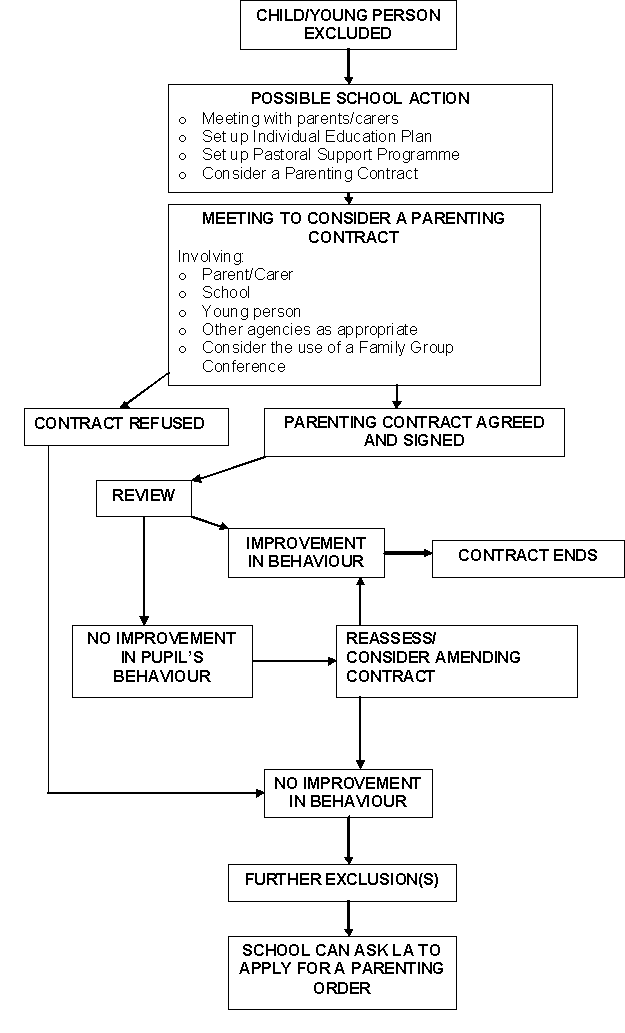
1) If a child/young person is excluded from school for a fixed period the governing body can consider offering a parenting contract to the parent/carer. In deciding whether a parenting contract may be appropriate the governing body should consider whether the child or young person's behaviour might be improved through working with the parent/carer. The parenting contract should be arranged as soon as possible after the exclusion and completion of any exclusions review and appeal process.
2) If the school are considering a parent contract checks should first be made to see whether any other professionals and agencies are working with the child/young person or parents/carers to establish how a parenting contract would fit in with any existing interventions and whether other agencies should be involved in the work on the contract. If the YOT is already involved in working with the child/young person it may be more appropriate that they take the lead with a parenting contract. If the child's home address is in another LA, these checks should also be made with that LA.
3) Where it is felt that a parenting contract would be appropriate the governing body should write to the parent/carer outlining what a parenting contract is and inviting them to a meeting at the school. The letter should make clear that it is not a punitive or compulsory measure, but rather is intended to support the parent/carer and improve the child's/young person's behaviour in school. A copy of the DfES's `Parenting Contract Guide for Parents' could be included with the letter and this is attached at the end of this guidance.
4) It is important to make clear to parents/carers from the outset that failure to comply with a contract, coupled with their child's continuing poor behaviour, could result in the LA applying for a parenting order. In such circumstances evidence that the parents/carers failed to comply with the contract could be presented to the court.
5) In order to identify all the issues that might be impacting on the child's/young person's behaviour the school should carry out an assessment with the parents/carers and, where appropriate, the child/young person. A suggested parental assessment form is attached (Appendix A). Once the issues have been identified an informed decision can then be made on whether to offer a parenting contract and, if so, the actions that need to be taken by all parties. A contract can then be drawn up and signed by all parties. Examples of what to include in a parenting contract and the form it should take are attached as Appendices B, C & D. A copy of the signed contract should then be given to all parties and an additional one sent to the Responsible Officer at the LA for monitoring and statistical purposes.
6) If English is not the parent's/carer's first language the school should arrange for the contract, and any associated paperwork, to be translated. (Hampshire Ethnic Minority Achievement Service 01256 330195).
7) A member of staff, either the Headteacher or designated senior teacher, should monitor and oversee the parenting contract (this may need to be in consultation with the person agreed as having the most positive relationship with the parent).
8) A requirement of a contract may be that the parent/carer attends a parenting support or parenting education programme. In Hampshire, details about the availability of these can be obtained through the County Parent Development Team 01962 876290. The party entering into the contract with the parent/carer (i.e. the governing body of the school) is responsible for bearing the cost of any support under the contract, should there be one. The governing body of the school may delegate responsibility for parenting contracts to the headteacher and the headteacher may commit funds on behalf of the governing body where the governing body has chosen to delegate this power. However the overall policy decision of whether parenting contracts should form part of the school's behaviour policy remains with the governing body (para 151 Government Guidance).
9) During the drawing up of a contract, it may be worth considering the suitability of a Family Group Conference.
d) Duration of Contracts
There is no specified time limit for a contract so duration is a question of what is reasonable and effective. As a guiding principle it is suggested that a contract runs for a minimum period of 3 months to allow impact to be measured and a maximum of 12 months as longer than this could be counter productive. A review date should be agreed as part of the contract.
e) Dealing with Breaches
A school should be working with the parents/carers to gain their cooperation and compliance with the contract but will have to judge whether any breaches are reasonable and whether the contract remains useful and should continue.
Although the contract is a voluntary agreement it is important to make clear to parents/carers from the outset that failure to comply with the contract, coupled with the child's/young person's continuing poor behaviour, may lead to the school asking the LA to seek a parenting order through the courts.
Any failures to comply must therefore be recorded and acted upon. The Responsible Officer should contact the parents to seek an explanation. If it is reasonable and overall the contract is still proving useful then the non-compliance and reasons should all be recorded and the contract should continue as normal. If the explanation shows that the contract is proving difficult to comply with through no fault of the parents/carers, the Responsible Officer should meet with the parents/carers to review the contract.
If the contract is breached and the explanation is not satisfactory then the parents/carers should be served with a formal warning letter.
If there is a further breach then the school should call a multi-agency meeting (to include a LA representative) at which consideration can be given to whether a parenting order is the appropriate next step. If it is agreed that this is appropriate the school will apply to the LA using Appendix E.
f) Parents who refuse to enter into a parenting contract
If a parent/carer refuses to enter into a contract then the Responsible Officer should seek constructively to meet all legitimate concerns and ensure that a written record is kept of all efforts to negotiate a contract. This would include whether the parent/carer was at least willing to meet to discuss the possibility and, if so, what was said.
If a parent/carer refuses to enter into a contract or fails to agree to an appropriate contract, and their child's/young person's poor behaviour results in further exclusions, the school can ask the LA to apply for a Parenting Order.
Parenting Orders
a. What is a parenting order?
· A court order that compels a parent/carer to fulfil the requirements as determined necessary (such as parenting classes) for improving their child's/young person's behaviour.
· The application is a freestanding civil application. It does not involve a criminal conviction. Prosecution and conviction for failing to comply with a requirement of a parenting order will lead to a criminal conviction.
· Only the LA can make an application for a Parenting Order but are under no obligation to do so.
· The purpose of an Order is to enable the school/LA to address behaviour issues with parents/carers where they are otherwise unwilling to engage.
b. When can it be used?
· An application for a parenting order can be made where a child/young person is permanently excluded or has received more than one fixed period exclusion for serious misbehaviour within 12 months.
· Where parenting is considered a factor in the child's/young person's behaviour (leading to exclusion) and parents/carers are unwilling to engage with the school or LA.
· Applications are time limited. Applications on the grounds of exclusion may only be made once the appeal process is complete:
_ Within 40 school days of completion of the appeal process, or
_ Within 6 months of signing a parenting contract if applicable
c. Procedure to be followed by Hampshire schools where a parenting order is being considered
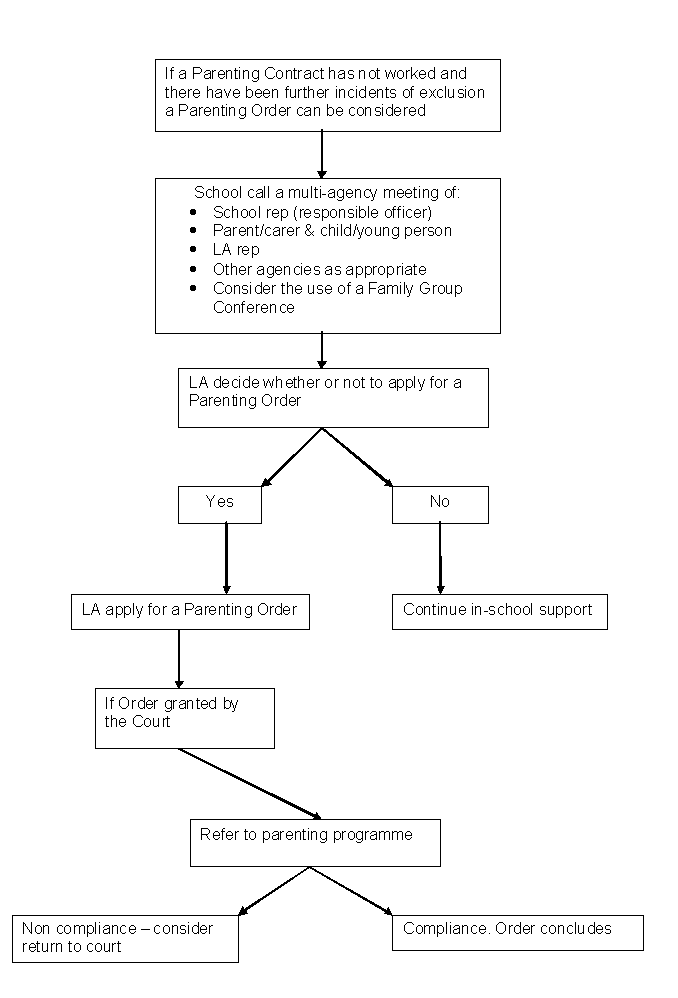
1. A parenting order can be considered where a child/young person has been permanently excluded from school or has received more than one fixed term exclusion within twelve months. Serious misbehaviour could include:
· Continual disruptive behaviour
· Threatening behaviour
· Verbal abuse
· Assault
· Damage to school property
· Theft
· Supplying an illegal drug
· Carrying an offensive weapon
· Bullying
2. A school should only consider such action where the head teacher considers this would have a positive impact on the child's/young person's behaviour, preventing further fixed period exclusions or permanent exclusion.
3. The school should then convene a multi-agency meeting to include a LA rep and any other agencies that are involved with the family. The remit of the meeting will be to consider:
· whether parenting is a significant factor in the child's/young person's misbehaviour
· whether a parenting programme could remedy this
· what other requirements (in a Parenting order) might be useful to address the child's/young person's behaviour
4. If the meeting agrees that a PO should be pursued, the school will need to submit the following paperwork with a request for a parenting order (see Appendix E):
· Parental assessment form
· Copy of the parenting contract
· Notes of meetings held with the parent(s)/carer(s)
· Evidence that the child/young person has been excluded - copy of exclusion letters plus notes from any meeting of the Discipline Committee
NB The Court will require evidence that making an order would be desirable in the interests of preventing any further poor behaviour in school, which may lead to exclusion.
5. If it is felt appropriate, the LA will then make an application to the Magistrates Court for a parenting order. The core requirement of a parenting order is that parents/carers attend a parenting programme.
6. If granted, the responsible officer will supervise the parenting order. The responsible officer will arrange for the provision of the parenting programme, and supervise any other requirements included in the order.
7. It is vital to ensure that the requirements are specific, measurable, and clear enough for a parent to know when they are breaching them and for the responsible officer to be able to monitor the parent's compliance.
d) Dealing with breaches
The parenting order is primarily designed to help parents/carers to address their child's behaviour. The responsible officer should aim to secure and maintain the parent's/carer's co-operation and compliance with the requirements of the order to ensure that it is successfully completed, and will need to make a judgement about what is reasonable in all the circumstances of the case.
If a parent/carer fails to comply with a requirement of the order, the responsible officer should contact the parent/carer within one working day by visit, telephone or letter. If there is no acceptable reason for the failure, the responsible officer should give the parent/carer a written warning and if possible a warning in person.
If the parent/carer has good reason for the failure to comply with the requirements of the parenting order, it may be appropriate for the responsible officer to consider whether to apply to the court for the terms of the order to be varied.
In the event of more than one unacceptable failure to comply within a period of three months, the responsible officer should meet the parent/carer to review the order and how it can be made to work. In light of this discussion the responsible officer should consider whether failure to comply should form the basis of a prosecution.
If a prosecution is brought, there will be a hearing to determine whether the parent/carer is guilty of failure, without reasonable excuse, to comply with a requirement of a parenting order.
If the parent/carer is convicted, they will be liable to a fine not exceeding £1000. The court will also have available to it an absolute or conditional discharge, probation order or curfew order.
APPENDIX A
Parental Need Questionnaire in preparation for a Parenting Contract
· This assessment will help the parent(s)/carer(s) identify particular areas of need which they and the family may have
· It is hoped that appropriate support in these areas may have a positive impact on their child's behaviour
· This assessment will form the basis for the Parenting Contract
· The parent(s)/carer(s) will be given a copy of this assessment when it is completed
Name of Parent(s)/Carer(s) involved
1._______________________ Relationship to child/young person_____________
2._______________________ Relationship to child/young person_____________
Name of School Representative______________________________
Position_______________________
Areas to be explored with the parent(s)/carer(s)
· Their child's behaviour
· Rewards and sanctions used
· Monitoring and supervision
· Family relationships/Managing conflict in the family
1. What is the parent's/carer's understanding of what is happening in school, in particular the view of the latest incident? Does this behaviour happen at home? How would this behaviour be managed at home? |
2. What areas of difficulties (behaviour and/or learning) has the parent/carer identified? Is there any other services currently involved e.g. educational psychology, clinical psychology? What support has been offered? What difference has this made? |
3. What rules are there within the family (e.g. boundaries/control)? |
4. What sanctions are imposed if rules are broken? Do both parents/carers consistently apply these? |
5. Is good behaviour acknowledged? Are rewards given and, if so, for what? |
6. What monitoring and supervision is in place? What does he/she do in the evening? What time does he/she come home? |
7. What sort of person is he/she? What are the young person's strengths/interests? |
8. How does everyone get on within the family? Are there extended family members who could offer support? |
9. How are arguments handled and resolved within the family? |
10. Are you or the family receiving any support at the moment? If so, who from, and what do you find most helpful? |
11. Are there particular family circumstances which may be contributing to the behaviours? |
12. What help do you feel the school could offer? |
APPENDIX B
Some suggestions for targets in a Parenting Contract
School may agree to do some of the following:
· Meet with the parents/carers on a regular basis
· Telephone contact with the parents/carers on a regular basis
· Daily written contact between home and school via planner or reports
· Provide a learning mentor
· Implement a reward system
Parents/Carers may agree to some of the following:
· Apply a curfew so that the child/young person is in at a reasonable time each night
· Keep in contact with the school as agreed
· Provide a reward system to respond to success
· Put sanctions in place when required
· Attend a parenting group to gain support and acquire new parenting skills
The child/young person may agree to do some of the following:
· Not distract others by talking during the lesson
· Sitting where the teacher asks
· Daily report to the Head of Year
· Accepting additional support which the school will provide
Meeting with form tutor at the end of each week to discuss progress/any difficulties
APPENDIX C
PARENTING CONTRACT
This Parenting Contract is a voluntary agreement between the Governing Body of.................................School and the parent(s)/carer(s) and child/young person named below. All parties agree to work together to ensure that the aims of this contract are fulfilled and the outcomes for (child's/young person's name) are successful.
It should be noted that although this is a voluntary agreement any departure from it, coupled with (child's/young person's name) continuing poor behaviour, could result in the Local Authority seeking a Parenting Order through the courts.
Name of Child/Young Person: Date of Birth:
Home Address:
Name of Parent/Carer: Relationship to Child/Young Person
1.
2.
Name of School:
Headteacher:
Chair of Governing Body (Name)
Reason for considering a Parenting Contract (Areas of concern)
The following will be undertaken in an effort to achieve the desired changes in
______(name of child/young person)______ behaviour:
School Agreement
____________School agrees to support the parents/carers by being committed to the following agreed action:
1.
2.
3.
Parental Agreement
_(Name of parents/carers)___agree to fulfil the following actions
1.
2.
3.
Pupil Agreement *
___(Name of child/young person)____ agrees to:
1.
2.
with the support of the school and his/her parents/carers.
* the child's/young person's involvement is subject to age, maturity and understanding
Important Dates
When are we next going to meet?________________________________
Are there any other important dates?____________________________________
Date of review:__________________________________
End of contract:__________________________________
Agreement/Parental Consent to Information Sharing
We will do what we have agreed in this parenting contract and will work together to help (child's/young person's name) behave in school.
By signing this agreement I/we the parent(s)/carer(s) understand that the information contained on this form may be shared with other relevant agencies to ensure that the appropriate services are provided. We understand that this information will be stored either electronically or in the manual records by the school/LA for case management purposes.
Headteacher: _______________________________ Date: ___________________
Parent/Carer: _______________________________ Date: ___________________
Parent/Carer: _______________________________ Date: ___________________
Child/Young person: __________________________ Date: ____________________
Cc: Parent/Carer
School File
Local Authority
Appendix D
Copy for Parent/Carer, school & the LA
PARENTING CONTRACT
Name of child/young person________________________ Date of Birth________________
School________________________________
Main objective
We are going to support you to try and encourage your child to improve their behaviour in school, by working on:

Main targets for the next three months
What are our targets? |
How is this going to be done? |
Who is going to do it? | |
1. |
|||
2. |
|||
3. |
To achieve these targets
The parent(s)/carer(s) agree to: (please detail)

The School agree to: (please detail)

Consent - Parent/Carer
By signing this agreement I/we the parent(s)/carer(s) understand that the information contained on this form may be shared with other relevant agencies to ensure that the appropriate services are provided. We understand that this information will be stored either electronically or in the manual records by the school/LA for case management purposes.
Important dates
When are we next going to meet? _________________________
Review date ________________________________
End of contract ___________________________________
Contact details
Responsible Officer's name: _______________________________________
Contact (school) telephone number: _________________________________
Agreeing the contract
I/we have agreed the parenting contract and will work with the school in an effort to address our child's poor behaviour in school. We also agree to information sharing under the Data Protection Act.
Signed:
Parent(s)/Carer(s) _______________________________ Date:_________________
_______________________________ Date:__________________
The School will provide the support detailed overleaf.
Headteacher ____________________________ Date: __________________
School Request for a Parenting Order
Child/Young Person Details
Name Date of Birth Home Address |
Parent/Carer Details
Mother/Carer Address Parental Responsibility Telephone number |
YES NO Home......................................... Mobile........................................ Work.......................................... |
Parent/Carer Details
Father/Carer Address Parental Responsibility Telephone number |
YES NO Home........................................ Mobile....................................... Work......................................... |
Please attach copies of the following:
Parenting Contract |
|
Minutes of meetings held |
|

Signed................................................(Head teacher) Date...........................
Parenting
Contracts
A Guide for Parents
What is a parenting contract?
A parenting contract is an agreement between a parent or carer and
either the LA or the governing body of a school.
Your child's school or LA may offer a parenting contract if your
child has been excluded from school.
Parenting contracts are NOT a punishment. They are a way for you
and the school or LA to work together to help improve your child's
behaviour or attendance and for you to get practical support from
the school or LA. This may be provided directly by someone from
the school or LA or by another organisation such as the voluntary
sector.
Who can be offered a parenting contract?
Parenting contracts can be offered to any mother, father, step-parent,
foster parent or other carer, whether they live with the child or not.
The school or LA will usually try to contact all of the child's parents
or carers to discuss what each of them can do to help improve their
child's attendance or behaviour and the types of support they might
need. Depending on the circumstances, the parents/carers may
then enter into a joint parenting contract or separate parenting
contracts.
What does it involve?
Parenting contracts are intended to give you support - to help you
help your child get the most out of school. They are also intended
to encourage a positive working relationship between the school,
LA and you so that you can all work together to tackle truancy and
poor behaviour and try to resolve problems.
Under the contract, you agree to do certain things e.g. ensuring that
your child arrives at school punctually every day for a fortnight by
accompanying them to school/making arrangements for them to be
accompanied or signing a weekly behaviour report and discussing
any problems raised with your child.
Do I have to enter into a parenting contract if my child's
school or LA offers it to me?
No - parenting contracts are a voluntary arrangement between the
school or LA and the parent. You cannot be forced to enter into the
contract.
However, they do provide you with a chance to get support and to
help your child get the most out of their education.
If you decide not to enter into a contract, you will need to try to find
other ways of improving your child's behaviour or attendance and it
may be worth discussing with the school or LA how you intend to
do this. If there is no improvement, the LA will have to consider
what further action should be taken. This could include applying for
a court order to make you attend parenting classes to deal with your
child's behaviour.
My child has been excluded and the school/LA
has offered a parenting contract - what happens now?
The school or LA should invite you to a meeting to discuss the
parenting contract. Your child may also be invited to attend
depending on their age and understanding.
DO NOT WORRY. Parenting contracts are not a punishment and
being offered a contract is not a bad reflection on you in any way.
The meeting is for you and the school/LA to discuss your child's
attendance or behaviour, the reasons behind it and ways in which it
might be improved. You can also use it to discuss more generally
any difficulties which you/your family are having and types of
support that may be helpful to you.
The offer of a parenting contract is an opportunity for you and the
school or LA to work together to tackle any difficulties which your
child is having. Tackling these issues now can make a real difference
to your child's life chances. Repeated exclusions are very disruptive
to a child's education and those who are excluded or who truant are
far less likely than their peers to get five or more good GCSEs and
more likely to become involved in crime.
A parenting contract is also an opportunity for you to get the help
that you might need both in relation to parenting and more
generally.
Before you attend the meeting, it is important to have a think about
what you would like to get out of it. In particular:
What do you think about your child's truancy/behaviour and are
there are any reasons behind it which it would be helpful to
discuss at the meeting?
Are there any things which would help you to improve your
child's attendance or behaviour e.g. help with transport to school,
regular meetings with your child's form teacher, etc?
Are you experiencing particular difficulties at the moment and, if
so, might the school or LA be able to help or let you know where
you can get help - e.g. benefits advice, parent groups, counselling,
etc?
What might you realistically be able to do to improve your child's
behaviour and attendance e.g. accompany them to the school
gate every day, sign a daily behaviour report, attend regular
parenting classes, etc?
It may also be helpful to write down any questions you have for the
school or LA.
If you are anxious about the meeting, ask the school or LA if you
can bring a friend or family member along for moral support.
Parenting
Contracts
Further information
National contacts: www.parentcentre.gov.uk
www.dfes.gov.uk/behaviourandattendance
For further help and support, contact the Parentline Plus helpline
on 0808 800 222 or visit their website
www.parentlineplus.org.uk
For advice relating to exclusions, contact the Advisory Centre for
Education on 020 7704 9822 or at www.ace-ed.org.uk
APPENDIX F
Parenting Order Regulations
STATUTORY INSTRUMENTS
2004 No. 182
EDUCATION, ENGLAND
The Education (Parenting Orders) (England) Regulations 2004
Made - - - - - - - - 29th January 2004
Laid before Parliament 4th February 2004
Coming into force - - 27th February 2004
The Secretary of State, in exercise of the powers conferred upon him by sections 20(1), 21(4) and 94 of the Anti-social Behaviour Act 2003 hereby makes the following Regulations:
Citation, commencement and application
1 (1) These Regulations may be cited as the Education (Parenting Orders) Regulations 2004 and shall come into force on 27th February 2004.
(2)These Regulations apply only in relation to pupils excluded from schools in England.
Interpretation
2 In these Regulations-
"the Act" means the Anti-social Behaviour Act 2003;
"the 2002 Act" means the Education Act 2002;
"school day" has the same meaning as in the Education Act 1996.
Prescribed conditions
3 (1) The following conditions are prescribed for the purposes of section 20(1)(b) of the Act.
(2) In the case of a pupil excluded for a fixed period the exclusion must be the second or subsequent exclusion of the pupil
from any school within twelve months from the day on which the previous exclusion began.
(3) The application must be made within the relevant period.
4 (1) In the case of a pupil excluded for a fixed period, the "relevant period" is whichever of the following is applicable, and if both are applicable whichever expires the later-
(a) the period of 40 school days beginning with the next school day after the day on which the exclusion was considered by the governing body (or in the case of an exclusion from a pupil referral unit, the local education authority) or, if it
was not so considered, the day on which it began;
(b) the period of six months beginning with the day on which a parent of the pupil entered into a parenting contract.
(2) In the case of a pupil excluded permanently, the "relevant period" is whichever of the following is applicable, and if both are applicable whichever expires the later-
(a) The period of 40 school days beginning with the next school day after-
(i) the day on which an appeal panel constituted under regulations made under section 52 of the 2002 Act decided to uphold the exclusion, or
(ii) if there was no appeal, the last day on which an appeal could have been made; or
(b) the period of six months beginning with the day on which a parent of the pupil entered into a parenting contract.
Costs of parenting order
5. The costs associated with the requirements of parenting orders, including the costs of providing counselling or guidance programmes, shall be borne by the local education authority.
Ivan Lewis
Parliamentary Under Secretary of State
29th January 2004 Department for Education and Skills
EXPLANATORY NOTE
(This note is not part of the Regulations)
These Regulations prescribe conditions one of which must be fulfilled before an application can be made for a parenting order under section 20 of the Anti-Social Behaviour Act 2003.
The conditions are set out in regulation 3. Where the pupil has been excluded permanently, the only condition is that the application must be made within the relevant period. Where the pupil has been excluded for a fixed term, there must have been at least two such exclusions in the last twelve months and the application must be made within the relevant period.
Regulation 4 defines the relevant period, including cases where a parenting contract has been entered into.
Regulation 5 prescribes for the purpose of section 21(4) of the Act that local education authorities are to fund the costs of parenting orders.
A full regulatory impact assessment has not been produced for this instrument as it has no impact on the costs of business.
APPENDIX G
Specimen Application Form for a Parenting Order
Application for Parenting Order
(Anti-social Behaviour Act 2003, section 20)
...........................Magistrates' Court
(Code)
Date: .........................................................................................................................
Child or young person: ...................................................................................................
Child or young person's address: .......................................................................................
Child or young person's age: .............................................................................................
Parent: .......................................................................................................................
Parent's address: ...........................................................................................................
Which is in the area of [ ] Local Authority
Parent : ......................................................................................................................
Parent's address: ...........................................................................................................
Which is in the area of [ ] Local Authority
Applicant Local Authority: ...................................................................................
It is alleged that:
(a) the child or young person has been excluded from school on disciplinary grounds; and
(b) the prescribed conditions are satisfied in that [insert details].
[The parent(s) entered into a parenting contract on [date].] [It is alleged that the parent(s) have failed to comply with the parenting contract, a copy of which is attached to this application form.
Short description of alleged failure to comply with parenting contract:
Evidence of this alleged failure to comply is attached.]
[It is alleged that the parent(s) have refused to enter into a parenting contract.]
[The child or young person is under 16. Information as to the family circumstances of the child or young person is attached.]
[It is alleged that:
(a) the attendance of the parent at a residential course is likely to be more effective than their attendance at a non-residential course in improving the child's or young person's behaviour; and
(b) any interference with family life which is likely to result from the attendance of the parent at a residential course is proportionate in all the circumstances.
The court is requested to order that the counselling or guidance programme may include a residential element.]
Short description of the counselling / guidance programme to be attended by the parent(s):
Further requirements to be included in the order: