
Archived decisions
2 |
Hampshire County Council | ||
Executive Member for Children's Services |
Item 1 | ||
12 October 2006 |
|||
Budget Monitoring 2006/07 - Children's Services Department | |||
Report of the County Treasurer and the Director of Children's Services | |||
Contact: Sheila Little, (01962) 847545; [email protected]
1 Summary
1.1 This report is the regular budget monitoring report for the financial year 2006/07, covering period 5 (end of August). The report also considers the progress made on co-ordinating activity data trend information.
1.2 The overall period 5 projected overspend is £3.385m, comprising:
· period 5 monitoring information indicates a projected overspend for 2006/7 of £2.925m, an increase of £1.439m over the period 2 projection, the last period reported to the Executive Member. The increase is mainly due to Children's Social Care services (£1.042m) and Home To School Transport increases (£159,000). The movements from period 2 are summarised in the table at section 3 below.
· planned savings of £340,000 from the Stonham contract reflected in the base budget for 2006/07 are not now considered to be achievable (more details in section 4).
· the accelerated Pay and Benefits realisation plan means the department has a target saving of £120,000 in 2006/07 (increasing to £480,000 from 2007/08).
1.3 The report then considers the recovery plan (section 8) being developed within the department aimed at recovering the projected overspend.
1 Up-date on Activity Data
1.1 The service is working to deliver regular activity data reporting as part of the budget monitoring report. This is to give a fuller picture on budget variations. Appendix 1 contains the latest activity data to the end of August 2006. By the nature of the service, some of this activity data will only be available on a termly basis. Work is on-going to obtain, where possible, historical data to ensure meaningful comparisons of the current data and to start to identify trends in activity. Some trend data is already available and is referred to later in this report.
1.2 For Children's Social Care, four of the key data comparisons currently available are:
· the numbers of independent foster agency (IFA) placements
· the numbers of referrals
· the number of Children Looked After
· the number of children on the Child Protection Register.
1.3 In respect of Children's Social Care, the last few months have seen a significant increase in activity in relation to numbers of referrals (37% increase since April 2006, although the year on year trend is less clear), but also in numbers of children on the Child Protection Register (9%) and becoming looked after (2.2%). Service managers believe this increase has an impact on workload, affects capacity and may limit the time available for supportive and preventative work with families.
1.4 Although numbers of non county placements (NCPs) are available over time, this has illustrated that the number is not a direct link to budget pressures as the numbers have remained static, but spend on NCPs has increased over time. A more appropriate budget driver indicator is being explored.
1.5 The fostering service runs a county wide approach to placement finding to ensure effective and maximum usage of available placements, but it regularly runs at capacity. The unexpected increase in Children Looked After numbers at this time of year has stretched the in-house carers beyond capacity, hence the increase in IFA placements (26%).
2 Revenue Budget Monitoring 2006/07 as at 31 August 2006 (Period 5)
2.1 Based on forecast outturn projections received from service managers and budget holders across all Children's Services at the end of period 5 (August), there is a forecast projected year end overspend of £2.925m (£535,000 relating to Schools Budgets, £385,000 LEA Budget and £2,005,000 Children's Social Care Budget). This compares to a projected overspend of £2.764m in period 4, £1.739m in period 3 and £1.5m in period 2.
2.2 The total department position is illustrated in Appendix 2 but the main areas with variations are summarised in the table below:
Original |
May 2006 |
August 2006 |
Movement | |
Budget |
Variation |
Variation |
||
Cash limited expenditure |
2006/07 |
|||
£'000 |
£'000 |
£'000 |
£'000 | |
Schools Budget |
||||
Out-County |
7,357 |
+270 |
+480 |
+210 |
School Catering |
124 |
-8 |
-6 |
+2 |
LMS contingency |
225 |
+20 |
+61 |
+41 |
Total Schools Budget |
+282 |
+535 |
+253 | |
LEA Budget |
||||
Home to School / College Transport |
21,439 |
+380 |
+539 |
+159 |
SEN Audit moderation |
54 |
-24 |
-24 |
0 |
Interest on school balances |
-853 |
-66 |
-104 |
-38 |
Recharges to support services |
26,603 |
+133 |
+165 |
+32 |
Unallocated budget adjustment |
-174 |
-174 |
-174 |
0 |
Other continuing education Premature Retirement |
487 |
-8 |
-8 |
0 |
Training and Curriculum Development (LEA Budget) |
6,017 |
0 |
-9 |
-9 |
Total LEA Budget |
+241 |
+385 |
+144 | |
Children's Social Care Budget |
||||
Commissioning and social work |
18,403 |
+6 |
+156 |
+150 |
Children looked after |
31,481 |
+1,112 |
+1,971 |
+859 |
Family support services |
6,554 |
+198 |
+502 |
+304 |
Youth justice |
2,335 |
-111 |
-44 |
+67 |
Other children and families services |
5,929 |
-478 |
-593 |
-115 |
Management and support |
-37 |
+236 |
+13 |
-223 |
Children's fund |
2,011 |
0 |
0 |
0 |
Total Children's Social Care |
+963 |
+2,005 |
+1,042 | |
Total Children's' Services |
+1,486 |
+2,925 |
+1,439 |
Schools Budget
Out County Special Schools +£480,000
2.3 This has increased by £210,000 over the projection for the previous period and reflects in the main the outcome of a tribunal awarded (in July) of a placement with a full year cost of £180,000.
2.4 Overall the main factor underlying this pressure is fee increases in 2006/07 which have ranged from 5% to 17%. Placements and expenditure are closely scrutinised by the County Placement Group and a clearer position would be expected early in the Autumn term.
Other SEN +£0
No change from period 2
2.5 Accurate prediction before early in the Autumn Term is difficult for the low incidence budgets so until more meaningful information becomes available, a balanced outturn is being reported.
2.6 No variation is being reported on the recoupment budgets. A number of 2005/06 claims by Hampshire against other LEAs are being challenged on a number of grounds including the pupils concerned not being their financial responsibility and incorrect dates being used. These challenges are being investigated, but if successful, would mean a budget pressure in excess of £100,000.
EOTAS +£0
2.7 No budget variation is reported for this budget, but it is worth noting that historic trend data is available looking at the numbers of excluded pupils and will be available to refer to if spend pressure emerge in future.
2.8 Further work continues to gather useful data to relate to the preventative aspects of the service.
Catering -£6,000
2.9 This is a minor change to the June reported figure and reflects an adjustment to the expected saving is the result of an anticipated increase in income from milk sales.
LMS Contingency +£61,000
2.10 An overspend of £20,000 had previously been reported in respect of the need to make adjustments for temporary classroom rentals relating to 2005/06. A further £41,000 overspend is now forecast in respect of extra 2006/07 costs associated with the decisions to allow extra pupils to be admitted to Elvetham Heath primary School.
LEA Budget
Home to School/College Transport +£539,000
2.11 The forecast overspend has increased by £159,000 over period 2. This results from a combination of factors including: an increase in contract prices between May and July and an increase in the rate of contract prices being re-priced (£15,000), an amendment to costings within a previous forecast (£100,000), and a number of additional invoices from other authorities relating to previous years (£45,000). The changes causing this variation are not activity based.
The period 2 variation is explained by:
· Increased Contracted Hours for Escorts +£104,000. Net effect of changes to routes, and an increase in the number of escorts for set routes, e.g. need for solo transport for pupils with behavioural difficulties
· Increased Contract costs +£792,000. This is a combination of inflation, catchment schools being full, net effect of pupil movements, and complex needs, offset by spend to save savings, although the information is not available at this stage to give the breakdown.
2.12 This variation is net of applying the HTST contingency of £517,000. It is important to note that a more certain outturn forecast will be available from October, when travel needs are known for the new academic year.
SEN Audit Moderation -£24,000
No change from period 2
2.13 The SEN Audit for which this budget is intended has stopped, hence this estimated saving. There is a continued need to allocate SEN funding to schools, a complex process, and the remainder of this budget will be used for this purpose. This is potentially a cashable efficiency for the service.
Interest on School Balances -£104,000
2.14 An increase in schools' balances (of £3.378m) caused £66,000 of the increased income, as previously reported. The increase in interest rates, announced in early August means that more interest will now be earned on the higher balances.
Recharges to Support Services +£165,000
2.15 This is mainly due to a combination of Change for Children project costs, the move of Eastleigh Families Centre to Wessex Way following a need to vacate the Eastleigh Borough Council office, and other minor variations.
Unallocated Budget Adjustment -£174,000
No change since period 2.
2.16 This small contingency will be used to offset overspends elsewhere within the Children's Services Department
Other Continuing Education -£8,000
No change from period 2
2.17 This saving is in respect of costs related to enhanced pensions for Further Education and Higher Education staff for early retirements when they were part of the County Council (prior to the changes in 1989 and 1993).
Training and Curriculum Development (Standards Fund) -£9,000
2.18 This saving reflects a small number of roundings and other adjustments made to the base budget over the last few years, money which is not needed for the Standards Fund programme.
Children's Social Care Budgets
2.19 The following paragraphs give explanations for the increased variations from cash limit in May (period 2) to August (period 5) for Children's Social Care of £963,000 to £2,005,000.
Commissioning Social Care +£156,000
2.20 The projected over spend of £156,000 is on a cash limit of £18,403,000 (variance 0.8%) and represents an increase of +£150,000 from the period 2 forecast. This overspend represents the net effect of pressures from staff above midpoint on the pay scales, recruitment and retention payments as well as market supplements particularly in the north of the county. Additional pressure as a result of a technical adjustment to teacher forecasts, to reflect the full year commitment is partly off-set by vacancy management.
Children Looked After +£1,971,000
2.21 This overspend is made up of the following:
Service |
August 2006 Variation |
£'000 | |
NCPs |
+803 |
IFAs |
+654 |
Residential children's homes |
+288 |
Fostering |
+306 |
Other |
-80 |
Total |
+1,971 |
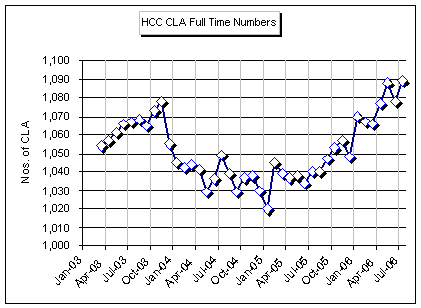
2.22 There has been an increase in the number of Children Looked After so far this year of 18, to a total of 1086. The graph below shows how the number of Children Looked After has changed in the last three years.
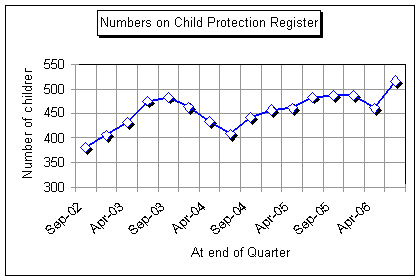
2.23 The numbers of children on the Child Protection Register has risen steeply in the first quarter of the financial year by 43 to a total of 501. The graph below shows this increase as part of the changes in numbers on the register since September 2002. The graph also shows that the current number of children registered is the highest level in the last three years.
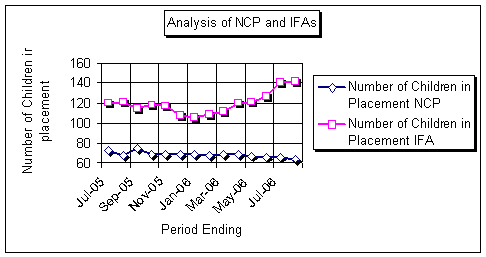
2.24 These increases in activity are reflected in the increased expenditure forecast in this financial year. The graph below shows the trend over the last 12 months of numbers of children in NCP and IFA placements:
· A sharp increase in IFAs purchased since the start of the financial year.
· The absolute numbers of children in an NCP placement is relatively stable. However there is turnover, and further work is needed to identify the activity indicator that does relate to the actual expenditure. Inflationary increases have been managed and are not believed, therefore, to have significantly impacted expenditure on these placements. An initial analysis of NCP placement turnover in the South-West of the County does indicate that a number of the new placements made during the financial years 2004-2006 have had particularly complex needs and therefore high cost, where as placements which have either ended or transferred to Adult Services have been less expensive. This has resulted in an increasing cost on NCP placements overall. Further work continues and will be reported in a future monitoring report.
NCPs +£803,000
2.25 NCPs are currently projecting an overspend of +£803,000 on a cash limit of £8,784,000 (9.14% variance). This is a increase in forecast expenditure from period 2 of £60,000. Further work is being undertaken to compare current placement costs to those in previous years.
2.26 Further work is also needed to identify appropriate activity data that can be directly linked to the budget pressures. Caution should be taken in linking directly the absolute activity data numbers to expenditure. This is because placement costs can fluctuate and can cause projected expenditure to vary without corresponding activity changes.
IFAs +£654,000
2.27 IFAs are currently projecting an over spend of +£654,000 on a cash limit of £5,533,000 (11.8% variance). This is an increase of £505,000 over the period 2 projection. There have been increases and decreases between these periods, reflecting the fluctuation in the number of placements at any one time. The number of IFAs has increased by 30 since the start of the financial year, including a substantial increase of 13 during July 2006. Of this increase of 13, 12 of these placements were in the north of the county, where there is an extreme shortage of in house foster care. The number of general in-house foster carers within the County has reduced by one since last month, from 304 to 303. Of these 303 general foster carers, 44 are in the north of the county. This is summarised in the following table.
North |
South-West |
South-East |
Total |
44 |
136 |
123 |
303 |
2.28 This has meant many children have been placed in IFAs who would be suitable for in-house care if it was available.
2.29 The increase in demand has been coupled with carers requiring respite, which has resulted in alternative provision being found. In addition some children have, during this year, had to be moved to a more expensive provision for safeguarding reasons.
Provision |
Client numbers at March 2006 |
Client numbers at August 2006 |
Non-County Placements (NCP) |
||
· Non-disability |
19 |
19 |
· Children With Disabilities (CWD) |
50 |
45 |
Total NCP |
69 |
64 |
Independent Fostering Agency (IFA) |
||
· Non-disability |
100 |
130 |
· Children With Disabilities (CWD) |
11 |
11 |
Total IFA |
111 |
141 |
Residential Children's Homes +£288,000
2.30 In-house residential homes currently show a pressure of £288,000 against a cash limit of £7,951,000 (variance 3.6%). There is an increase on expenditure from period 2 of £176,000. An analysis of where costs have increased suggest that a significant amount to be due to reduced occupancy levels during 2005/06, as a result of some homes operating with a reduced number of beds, partly due to staff vacancies and sickness during the year. An increase in pay costs has occurred as a result of many staff vacancies now being recruited to, with homes now operating to their full bed capacity. In addition a new partnership arrangement with Health operating a joint programmed care unit, providing CWD respite and day care provision, has resulted in an increase in forecasted expenditure for 2006/07.
Fostering Service +£306,000
2.31 The in-house Fostering service currently shows a pressure of +£306,000 an increase of £198,000 over the period 2 projection. This is broken down between a significant pressure on staffing +£320,000 and a pressure on allowances paid +£100,000. The authority's desire to increase in-house foster care capacity leads to pressure in the family placement teams to try to recruit to all vacancies in order to maximise support and capacity to the in-house carers and therefore reduce dependency on external providers. However, this is not being managed within existing budgets.
2.32 Payments of fostering allowances have increased by £100,000 from last year reflecting the increased placements of 13 in the first quarter of the year at an average costs per placement of £8,400 per year. (Refer to Appendix 1 on activity data)/
In 2005/06 the cost of the Fostering Pilot Scheme initiatives were met against the £166,000 funding made available for this purpose. This included the part year cost of nine Skill Fees Level 5 placements, an additional 3 social workers within the central foster recruitment team, and a number of foster care support workers. For 2006/07 the full year cost of these schemes will be incurred, at £116k, £108k and £34k respectively. It had been envisaged that the Skill Level 5 placements would be able to be rolled out at a cost neutral basis through savings achieved against the IFA budget. As such, the balance of the £166k could then be used to offset the cost of the other initiatives. However, it is currently unclear what financial savings will be achieved against these placements during 2006/07, particularly in light of the rise in IFA placements which has occurred this year.
Other Residential -£80,000
2.33 No change from period 2.
3.34 The cost of accommodation for Looked After Children within the care leavers team is included within this heading. The forecasted under spend is offset against the pressure of £13,000 which exists within the heading of "Other Children's Services" which includes the costs of the accommodation for former Looked After Children.
Family Support Services (Direct Payments, Day Care, Under 8s, Home Care, equipment and adaptations) +£502,000
3.35 The pressure of +£502,000 is on a cash limit of £6,554,000 (variation of 7.6%) This is an increase of £304,000 over the period 2 projection. Most of these budgets are used to support children with disabilities. The main variations relate to an increase in projected expenditure through Direct Payments (£196,000), home care services (£328,000), and other preventative family support services (£136,000) offset by various smaller decreases, as summarised below:
Service |
August 2006 Variation |
£'000 | |
Direct Payments |
+196 |
Day Care |
-72 |
Under 8s |
-14 |
Home Care |
+328 |
Equipment and adaptations |
-71 |
Other Family Support |
+136 |
Total |
502 |
3.36 This budget variation is explained through a combination of factors:
· There are over 800 children with disabilities who receive support from the disability teams with profound or severe disabilities and the costs of packages that they receive can be very high. Services are designed to enable them to be managed at home, without recourse to more expensive residential services, and the number of NCPs for this group has remained stable. However such support packages can be a high cost. All packages are to be reviewed and other arrangements put in place for acquiring new packages.
· One of the biggest pressure is in `other family support', which includes Kinship Care. The Kinship care policy has been very successful and the numbers of children cared for in this way have increased steadily over three years (50 % increase on last year to 62 children). Costs have therefore doubled on last year with an additional £200,000 forecast to be paid in allowances this year. This is considered to be good value to the authority (and better outcomes for children) because the alternatives are more expensive
· It has been recognised by CWD team managers that an increase in Direct Payments has occurred through an increase in the number of families making use of this facility to purchase their children's care needs. Also, a national promotion of the availability of this service has been undertaken which is anticipated would increase the use of the direct payments facility.
Youth Justice -£44,000
3.37 The under spend of -£44,000 is on a cash limit of £2,335,000 (variation of -1.8%), and is made up of the following:
Swanwick Lodge (Unit Expenditure) - £65,000
Swanwick Lodge (Income) +£23,000
Other Youth Justice expenditure including Wessex YOT - £ 2,000
Swanwick Lodge is anticipating a reduction of its expenditure on agency staff compared to last year. However, the under spend has been reduced from £85,000 in the last period to £65,000 this period to reflect the appointment of an admin officer. The overall under spend reflects the use of more casual staff and the reduction in long term sickness.
Other Children's Services -£593,000
3.38 The under spend of -£593,000 is on a cash limit of £5,772,000 (variation of -9%). This compares to a period 2 projected under spend of -£478,000. The table below shows the elements comprising this projected under spend:
Service |
August 2006 Variation |
£'000 | |
Care leavers |
13 |
Youth Justice |
-207 |
Quality Protects |
-200 |
Asylum seekers |
-163 |
Adoption service |
-26 |
Other |
-52 |
Total |
-593 |
3.39 Youth Justice under spend of -£207,000 was created by increasing the income budget at Swanwick Lodge to more accurately reflect the last two years income levels.
3.40 Currently there is a £200,000 Quality Protects budget which is not allocated.
3.41 The asylum seekers under spend of -£163,000 is due to be re-allocated.
Management and support +£13,000
3.42 The projected over spend of £13,000 is against a current cash limit of £7.651m, a reduction of £223,000 on the period 2 projection. An element of the fluctuation reflects the dis-aggregation of the Children's Services budgets from the Adults Services budgets.
3.43 Management and Support also includes the budget for legal services of £766,000, against which £912,000 is currently forecasted to be spent (an overspend of £146,000).
3 Business Unit Balances
3.1 There is a corporate requirement to make a one-off contribution to corporate reserves of £359,000 from Children's Services Business Unit balances in 2006/07. Appendix 3 sets out the proposal for how balances within Children's Services are adjusted. This reduces Children's Services balances to £1.422m as at 1 April 2006. A projection of end of year balances based on first quarter monitoring reports indicated a likely end of year balance of at least £1.376m. However, a projection of end of year balances based on updates for August monitoring, indicates a likely end of year of total balance of £1.624m, an increase in forecast of £248,000.
4 Progress against agreed savings targets
4.1 During the budget preparation for 2006/07 a number of savings targets were agreed of £1,071,000. There are two areas where these may not be achieved:
· Stonham contract savings - £440,000 in 2006/07 rising to £590,000 from 2007/08 onwards. It was expected that this contract would be used to bring back NCP and IFA placements. Savings originally profiled to have been made by the end of August were £108,000. Actual savings to the end of August were £18,000, a shortfall of £90,000. There were no placements to this contract during August. To date there have been no moves from NCP placements. If three NCP placements were made from 1 October for the remaining financial year and one additional IFA placement then there could be savings of £250,000. However, more recent estimates suggest that only around £100,000 of the savings target will be realised in this financial year.
· Wessex Way - £85,000 in 2006/07 - Eastleigh Family Centre have re-located to the premises (wef end of June) and therefore the Youth Service is unable to pursue selling the lease. Although there is some funding available to potentially off-set these foregone lease costs from the existing premises charges for the Family Centre (£38,000 in 2006/07), these are likely to be used to purchase office equipment in 2006/07, leaving the full £85,000 saving still to be achieved. However, the Youth Service have indicated that they will balance to their cash limit (which includes making this saving).
The Children's Services Management Team will need to ensure that these savings are achieved in full within the year, or identify alternative savings, and is required to report back to Cabinet in October 2006. The shortfall on the Stonham savings of £340,000 is therefore added to the recovery plan target in section 6 below.
5 Pay and Benefits Savings 2006/07
5.1 In July 2006 Cabinet agreed to accelerate the benefit realisation plans in 2007/08 and 2008/09 and to achieve (corporately) £500,000 in 2006/07 means £120,000 for Children's Services. CSDMT are required to submit their plans to deliver this in 2006/07 to Cabinet in December 2006. Use of other savings to substitute for workforce savings will not be acceptable
5.2 The best estimate of the savings that the department will have to find to fund the 25% of the Pay and Benefits on-going costs (75% being corporately funded), is £480,000 in 2007/08 onwards.
5.3 The department is considering what actions must be taken to achieve these savings (refer to section 8 below).
6 Children's Centre Funding
6.1 Hampshire has seven Children's Centres as at March 2006 and a target to deliver fifty two new centres in the period 2006-08. The Early Education and Childcare Unit has received capital and revenue funding for the development of Children's Centres through the General Sure Start Grant (GSSG) 2006-08.
6.2 Capital funding of £20.383m has been made available, as detailed below:
£m | |
Sure Start Capital grants |
15.699 |
Sure Start Grant Extended schools (70% of total)* |
2.433 |
Local resources* |
2.251 |
20.383 |
* Note that this includes additional capital from outside the Children's Centres programme.
6.3 At the start of the financial year the total capital costs were calculated based on the four models for delivery and are shown below both with inflation and without:
· Model 1 - large full core offer centre (requiring childcare on site)
· Model 2 - small full core offer centre (requiring childcare on site)
· Model 3 - rural based graduated offer centre
· Model 4 - graduated offer centre
Model |
Per model |
Total |
Plus inflation | |
£ |
£m |
£m | ||
Model 1 |
1,105,808 |
10 |
11.058 |
12.385 |
Model 2 |
645,055 |
10 |
6.451 |
7.225 |
Model 3 |
184,301 |
7 |
1.290 |
1.445 |
Model 4 |
184,301 |
22 |
4.055 |
4.541 |
Total |
49 |
22.854 |
25.596 |
6.4 As such, Hampshire has a shortfall of £5.2m with inflation (£25.6m - £20.4m). Work is underway to look at how to reduce the costs further for example by further re-profiling the delivery models with less full core offer centres and more graduated.
6.5 Revenue funding of the Centres has been confirmed now for 2006/07 and for 2007/08. Beyond 2008 forward funding for Children's Centres nationally has to be determined through the Spending Review 2007.
6.6 The models that have been used for revenue funding for Children's Centres highlighted that the authority could deliver the target number of centres within the overall GSSG funding for the two years by phasing delivery to happen for most centres later in 2007/08. Recent guidance from DfES has confirmed our GSSG funding for each of 2006/07 and 2007/08 profiling around £2.5m more into 2006/07 rather than 2007/08 and stating firmly that there is no prospect of carry forward.
6.7 Given the combination of the significant capital shortfall and the cash flow issues of the revenue profiling it seems there are now two routes to pursue:
· To continue to strive to deliver as close to DfES targets as possible. The implications of this are that the authority needs to lobby DfES for funding flexibility for GSSG and look for opportunities to re-profile other expenditure to allow an effective internal carry forward of the revenue funding to 2007/08
· To review the programme and agree new centre targets that fit within the current funding both in quantum and profile. The implications of this are failing to meet DfES targets for numbers of centres. The reach targets could still be achieved from a lower number of centres. There would also be the additional GSSG grant in this year which would then be available to meet other local pressures and priorities in delivering services to children.
6.8 At this stage the intention is to highlight the issues and to pursue both routes. Clearly the critical decisions over the approach to delivering DfES targets will need to be made shortly. A full report on the plans and progress for delivering Children's Centres in Hampshire will come to the Executive Member in December 2006.
7 Recovery Plan 2006/07
7.1 To summarise the total projected overspend is £3.385m and comprises:
· period 5 projected overspend (section 3) £2,925,000
· unachievable 2006/07 savings (section 5) £340,000
· Pay and Benefits business benefit contribution (section 6) £120,000
7.2 Intensive activity is underway within the Children's Services Department to address this overspend and ensure the budget balances by the end of the financial year. There are significant challenges to achieve this while at the same time sustaining the high performance of the services. Where additional controls will need to be applied to contain areas of service, such as in some elements of services to Children Looked After, there will be an emphasis on ensuring that risks to performance and service are minimised.
7.3 The actions being considered include:
· Children and Families Services have already identified savings to the value of £491,000 which includes for example: increased return of care leavers, the holding of some vacant posts; the reduction of support to low level family support initiatives
· £136,000 of Standards Fund grant aimed at workforce remodeling is available to be re-directed to address other priorities
· Vulnerable children's Standard Fund grant under spend identified - £102,000
· Up to £300,000 may be available through reviewing the core contribution to the Business Unit for one year. This will have the effect of reducing year end balances. (see section 5 above)
· Reducing the department's training budget would identify at least £80,000 saving, potentially more
· Reflecting that much of the budget pressure is activity related, several pieces of County Treasurers' consultancy work are underway to look at the provision of NCPs and IFAs.
· The department is also looking at the extension of the Level 5 Skills Foster Care options to achieve cost avoidance as well as carrying out a full case review to ensure that appropriate value for money placements for children are made wherever possible
· All aspects of the pay budget are being reviewed given the impacts of the Pay and Benefits initiative
· With Pay and Benefits implementation, other potential areas of pay growth and the future potential needs for historic pay and special allowances are being reviewed
· There will be one-off turnover savings arising from the departmental re-structure (through the natural delay in filling vacancies via external advertisement)
· Developing a protocol for arranging continuing care costs jointly with the newly formed PCT.
In summary a recovery plan of up to £1.109m in 2006/07 has been identified and work continues to develop further proposals.
8 Impact assessment
8.1 The proposals contained in this report are not considered to be discriminatory although work will be developed to ensure that the implementation of the recovery plan does not have an adverse impact.
Recommendations
The Executive Member is recommended to:
1 Note the projected outturn position for 2006/07 for the department
2 Endorse the proposed recovery plan and a further report on the recovery plan be brought to a future meeting
Note the funding issues for Children's Centres and that further discussion with the DfES to try and address these concerns is undertaken.
LINK(S) TO CORPORATE STRATEGY | ||
Yes |
No | |
Hampshire safer and more secure for all |
_ |
|
Maximising well-being |
_ |
|
Enhancing our quality of place |
_ | |
This proposal does not link to the Corporate Strategy but, nevertheless, requires a decision because: |
Section 100 D - Local Government Act 1972 - background documents
The following documents discuss facts or matters on which this report, or an important part of it, is based and have been relied upon to a material extent in the preparation of this report.
NB the list excludes:
1. Published works.
2. Documents which disclose exempt or confidential information as defined in the Act. - none
TITLE