
Archived decisions
Hampshire County Council
Cabinet Item 11
30 October 2006
London 2012 Olympic And Paralympic Games
Report of the Director of Recreation & Heritage
Contact: Julie Amies Ext. 6029 [email protected]
1. Summary
1.1 This report explains the national and regional structure that has been set up to deliver the 2012 Olympics in London and explores a number of ways that Hampshire County Council can provide support to and maximise well being and benefits from the Games for the people of Hampshire.
2. Introduction
2.1 The purpose of this paper is to begin to identify the role that Hampshire County Council can play in the short, medium and long term in the successful delivery of the Olympic and Paralympic Games in London in 2012.
3. Legal Implications
3.1 The County Council has the power under the Local Government Act 2000 to do anything that is likely to achieve the promotion or improvement of the economic, social or environmental well-being of an area. In particular Section 2 of the Act enables the County Council to incur expenditure and/or provide financial assistance for the promotion or improvement of the economic, social or environmental well-being of Hampshire for the benefit of the whole or any part of Hampshire or all or any persons resident or present in Hampshire.
4. Olympic Facts and Figures
4.1 2012 Olympics Paralympics
200+ Nations 150+ Nations
17,800 competitors and officials 4,000 competitors and officials
3 weeks in summer 2012 12 days in summer 2012
70,000 volunteers needed
· Based on Sydney's experience, 2012 could bring in well over £2 billion (direct) to the UK's visitor economy.
· Global exposure of the games - Athens was seen by 3.9 billion people on 300 channels in 220 countries, 35,000 hours coverage.
· 25-30,000 media visitors.
5. National Organisational Structure for 2012
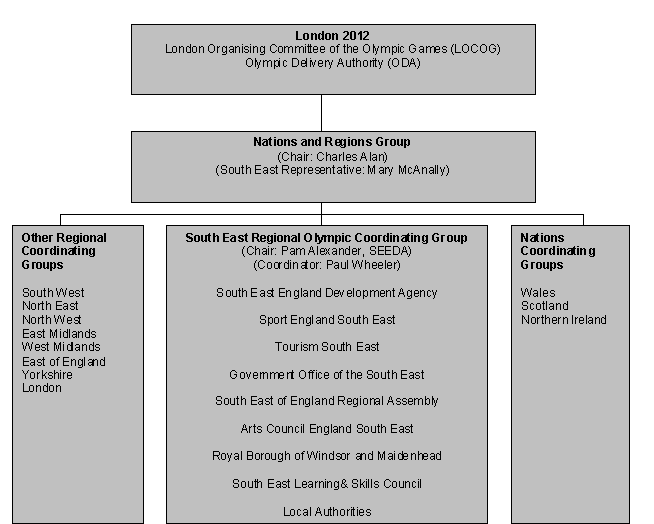
5.1 A table showing the London 2012 Structure for engaging UK Nations and Regions including South East Sub Groups for managing impacts can be found at Appendix 1. The structure involves the following:
5.2 The London Organising Committee for the Olympic Games (LOCOG) will be responsible for the delivery of the games and liaising with the International Olympic Committee and the Olympic Board. LOCOG will be responsible for:
· Volunteer recruitment |
· Infrastructure development |
· Procurement for games contracts |
· Tourism links |
· Preparation and holding camps |
· Commercial operations |
5.3 There will also be the Olympic Development Authority (ODA) who will be responsible for the building of permanent venues and infrastructure.
5.4 In addition to these groups, a Nations and Regions Group (NRG) has been set up to work with LOCOG to maximise the benefits to the regions and it is being led by the Regional Development Agencies and Regional Sports Boards in England. The NRG meets quarterly and is the principal route of two-way communication between LOCOG and the regions. Mary McAnally, Chair of the South East (SE) Regional Sports Board, SEEDA Board member and a Hampshire resident is the SE's representative on the NRG.
6. Regional Organisational Structure
6.1 A South East Group for the 2012 Games has been set up by SEEDA and Sport England SE to co-ordinate activities and actions within the region. Chaired by Pam Alexander, Chief Executive of SEEDA, the group met for the first time at the end of November 2005. It consists of the lead executive officers from Sport England SE, Tourism SE, SEEDA, GOSE, SEERA, Arts Council England SE, the Learning and Skills Council along with a representative from Kent County Council, Southampton City Council and Windsor and Maidenhead unitary authority.
6.2 The terms of reference for the South East Group for the 2012 Games are to:-
· Maximise the benefits of the Games to the region, ensuring a legacy for the SE.
· Involve and inform the Region.
· Undertake a two-way information channel to and from LOCOG.
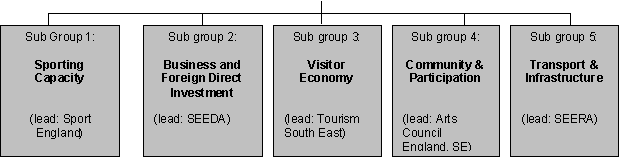
6.3 The first meeting of the group set up five sub groups to address key themes:
· Sporting Capacity (facilities and building), led by Sport England, SE (Sean Holt).
· Visitor Economy (Tourism and Culture), led by Tourism SE (Bob Collier).
· Business Investment, led by SEEDA (Greg Ward).
· Community and Participation (benefits to residents, inclusion and skills) led by Arts Council England, South East (Felicity Harvest).
· Transport and Infrastructure (Transport and Regeneration), led by the SE England Regional Assembly (Paul Bevan).
6.4 Each sub group have 10 key priorities for their respective themes and one major iconic project that will provide a legacy from the 2012 Games.
6.5 In addition to the organisational structure for 2012 described above, SEEDA and Sport England SE are planning to recruit a Regional Co-ordinator for the 2012 Games later this year.
6.6 The County Council is well placed to benefit from the opportunities arising from the first three regional sub-groups. It will be represented through the Senior Sports Officer on the Sport Group and needs to ensure it also stays close to the other groups too.
Action:- Sporting Capacity - Sports Development, Business Investment - Economic Development Office, Visitor Economy - Tourism Section, Community and Participation - Arts Service.
7. Olympic Venues Outside London
7.1 Several of the Olympic sports are being held at locations outside the Olympic Park in London. Whilst none are in Hampshire, the county is particularly well placed to maximise the opportunities from:
· Rowing and flat water canoeing at Dorney Lake, near Eton
· Sailing and water sports at Weymouth
· Tennis at Wimbledon
8. What is Happening Now?
8.1 Planning work is taking place nationally and work has already started on the preparation of the Olympic Park site in East London.
8.2 Sport England, the British Olympic Association and LOCOG have prepared a Technical Specification for hosting potential Pre-Games training camps. Sports facilities will need to be supported by appropriate accommodation, sports science services and transport. A document will then be published at the Beijing Games and will be the recommended route for International Olympic and Paralympic Federations to book Pre-Games training camps. The decision made by international teams to base themselves in Hampshire could well be influenced by other factors such as existing cultural links and the quality of the tourism products and experience in Hampshire. Further, other counties, for example, Kent, Buckinghamshire and West Sussex are working together to maximise county opportunities including the hosting of Pre-Games training camps.
8.3 There is an opportunity for Hampshire to host some of the Pre-Games training camps around appropriate facilities.
· What do we need to do to maximise this opportunity for Hampshire? Do we need a corporate approach i.e. Recreation and Heritage and Children's Services?
· Should Hampshire join with other counties to work on opportunities to host Pre-Games training camps and how do we resource this?
· What facilities could be freed up, e.g. outdoor and leisure centres/school facilities?
· Should HCC co-ordinate an approach across the administrative county of Hampshire, working perhaps through CLOA (Chief Leisure Officers Association)? As well as sports facilities the offer needs to include other information on accommodation (tourism) etc.
9. Youth, Arts and Culture
9.1 The 2012 Olympics are not just about sport. One of the reasons for London's successful bid was the emphasis placed on the legacy for the whole country, involving sport, culture and education, and the need to enthuse the youth of the world to enjoy the Olympics. This will be at the core of all Olympic related activity over the next 6 years.
9.2 One of the 17 themes for London 2012 is culture and education. This is all about this island nation expressing its desire to make new connections, to reach out to the world, to reveal the contemporary diversity of the UK and to embrace other cultures. Key aspects of the proposal are:-
· The Olympic Friendship - a full size ocean-going clipper crewed by young people, which will travel the world after the Beijing Games in 2008.
· A world Cultural Festival covering arts, film, food, languages and customs with events held in cities across the UK. It will include an International Shakespeare Festival.
· An Athlete Ambassador Programme for schools.
· Olympic educational materials to support the National Curriculum.
· 2012 UK-wide Torch Relay which will visit every major town and city.
9.3 Whilst it is too early to say how these aspects will be delivered, there is obviously scope for Hampshire to play its part in their delivery. Arts Council England are playing a key role nationally in developing these concepts and the County Council needs to ensure it stays close to this process.
10. Co-ordination in Hampshire
10.1 A recent discussion took place amongst Chief Leisure Officers in Hampshire about London 2012 and it was agreed that local authorities would look at areas in which they might collaborate. A working group from the Chief Leisure Officers Association will take this forward.
10.2 Given the uniqueness of the opportunities presented by London 2012 to the cultural sector as a whole, it is recommended that this report be referred to the Hampshire and Isle of Wight Local Government Association for discussion across the whole of local Government on if and how the area might best collaborate.
10.3 Hampshire Co-ordinator - Given the potential volume of work and to take best advantage of the opportunities afforded by London 2012, would the County Council, perhaps in partnership with local authorities and/or business, want to appoint a Co-ordinator, who would perform a similar role to those appointed in the London Boroughs, Kent and Hertfordshire? This needs to be considered by the proposed County Council 2012 Working Group and if appropriate, by all local authorities.
11. Hampshire County Council's Seven Themes for 2012
11.1 Over and above the areas already covered relating to the County Council's involvement in London 2012, the County Council could seize other opportunities offered by 2012 by developing seven themes:
i) Excellence - promoting excellence in sport and for potential Hampshire Olympians by developing a programme to support them. This could include a package of support around direct grant aid, transport costs, medical support, free access to training facilities, specialist coaching, encouraging leisure centres to let swimmers use the pool at reasonable times of the day, asking school governors to lower the charges for use of their sports facilities, reviewing the availability and pricing structure at Calshot Activities Centre etc. There is the opportunity for Hampshire residents to support and get behind Hampshire athletes in order to generate significant pride and sense of place benefits for Hampshire.
Target via the Sports Bursary Schemes, support potential Hampshire Olympic medal winners identified via their National Governing Body.
ii) Inspiration - involving more young people in sport via their schools and local clubs and ensuring that Hampshire meets its target for young people to spend at least 2 hours a week on high quality PE and school sport, within and beyond the curriculum. This means increasing the quantity and quality of coaches and training staff and volunteers within the sector. In addition, for Hampshire young people to be trained and developed to access the new opportunity provided by the introduction of the UK School Games.
Target - By 2008 85% of 5 - 16 year olds in school sports partnerships engaged in two hours a week minimum on high quality PE and school sport within and beyond the curriculum.
iii) Inclusion - ensuring that disadvantaged groups in Hampshire have an opportunity to become involved with the 2012 Olympics. This needs to be considered in more detail by the County Council and the district councils.
Target - TBD
iv) Fitness and Health - one of the key drivers of 2012 is to generate increased participation in sport at all levels. This has important social benefits and important knock-on effects to health and wellbeing.
Target -To increase adult participation (16+) in sport and physical activity to 5 times 30mins of moderate physical activity a week to 23.5% by 2009..
v) Economic impact - the major economic impact for Hampshire from 2012 will come from tourism which has emerged as one of the key economic legacies for countries that have hosted the Olympics. It is estimated that the event itself will attract 500,000 more visitors to the UK and Hampshire is well placed to benefit from some of the visitors wanting to stay in accommodation outside London, yet within easy reach of the Olympics. As well as attracting additional leisure visitors, Hampshire should also benefit from increased interest from the business/conference market too, which is very high spending. It is important to ensure that the full Hampshire offer is co-ordinated and made widely available by the web and so on.
However, a note of caution needs to be sounded here. Recent studies are suggesting that some `usual' visitors will stay away from the UK during an Olympic year, whilst domestic visitors will tend to go abroad rather than holiday in their own country. This is what happened in Greece in 2004. The likely scenario for Hampshire is that tourism numbers will increase in the lead up to 2012 and after 2012 too, but may decrease during the Olympic year itself. But overall, across several years, there should be a significant increase in visitors to Hampshire due to the Olympics.
Target - 2% increase in overnight stays between 2010 and 2015 in Hampshire, attributable to 2012 Olympics.
Other areas of economic impact will come from employment opportunities before, during and after 2012 and an increase in skills levels in construction, hospitality and so on. The Learning and Skills Council plans to focus on 14 - 19 age bracket and adults, utilising the hook of the Olympics to draw people into training and skills development programmes. The County Council's Economic Development Office has also an important role here in helping and advising Hampshire based companies to secure contracts, for example in food, uniforms, merchandising etc relating to 2012.
Target - x Hampshire companies successfully helped by the Economic Development Office to secure a contract relating to 2012.
vi) Volunteering - the close proximity of Hampshire to London presents an opportunity for Hampshire to supply a significant proportion of the London 2012 workforce (estimated at requiring 70,000 volunteers). We could set a target for the number of volunteers from Hampshire or look to give HCC staff three weeks paid leave to be volunteers etc. In addition, the organisers recruit multi disciplinary teams from businesses to work on the Games. The County Council might want to offer a team as part of its training and development programme.
Target - x HCC staff acting as volunteers during 2012.
vii) Legacy - increased participation levels in sport, skills development, volunteer experience, the `feel-good' factor from having Hampshire Olympians and the enhanced cultural offer for the Olympics will all continue after 2012 and be part of the legacy from the Olympics in providing an enhanced quality of life. The long-term tourism legacy for the SE will bring increases in the business/conference market as well as increasing the number of leisure visitors too for years to come. Hampshire is obviously well placed to benefit from the tourism legacy.
11.2 Work on some of the themes needs to be started upon now, others will start nearer 2012.
12. Financial Implications
10.1 An Hampshire Olympic Fund of £10,000 a year, every year until 2012 to be established and used to raise the profile of arts and culture in 2012. The sum to be funded from the Policy and Resources grants fund.
13. Impact Assessment
11.1 Race and equality impact assessment has been considered in the assessment of these applications. No adverse impact has been identified.
Recommendations
1. That Hampshire County Council, via Sport and Tourism, contribute to the comprehensive audit of sporting and supporting facilities in Hampshire.
2. That Hampshire County Council set up a cross-departmental 2012 Working Group consisting of representatives from Recreation & Heritage (Sport, Arts, Tourism), Economic Development, Children's Services and Environment, led by the Director for Recreation and Heritage.
3. That the Executive member for Recreation & Heritage take the lead role on London 2012 for the Cabinet.
4. That the Executive Member for Recreation & Heritage invite Mary McAnally (the SE representative on the National and Regions Group and a Hampshire resident) to meet the HCC 2012 Working Group.
5. That an Hampshire Olympic Fund of £10,000 a year, every year until 2012 be established and used to raise the profile of arts and culture in 2012. The sum to be funded from the Policy and Resources grants fund.
6. That the HCC 2012 working group determine the County Council's role in relation to the other local authorities in Hampshire, some of whom are well underway with their internal planning groups.
7. That Recreation & Heritage and Children's Services examine ways to resource, including financial, travel, equipment, training and medical support, Hampshire's potential Olympians via the sports bursary schemes.
8. That this report be referred to the Hampshire and Isle of Wight Local Government Association.
LINKS TO THE CORPORATE STRATEGY
Yes No
Hampshire safer and more secure for all _
Maximising well-being _
Enhancing our quality of place _ ?
Section 100 D - Local Government Act 1972 - background papers
The following documents disclose facts or matters on which this report, or an important part of it, is based and has been relied upon to a material extent in the preparation of this report.
N.B. the list excludes:
1. Published works.
2. Documents that disclose exempt or confidential information as defined in the Act.
TITLE LOCATION
None
Appendix 1
London 2012 Structure for engaging UK Nations and Regions including South East Sub Groups for managing impacts

South East Regional Stakeholders
Businesses Economic Partnerships Residents Local Authorities HE/FE
Voluntary Sector Accommodation Providers Attractions Transport Companies