Archived decisions
Hampshire County Council Health Overview and Scrutiny Committee Item 4 28 November 2006 Proposals to Develop or Vary NHS Services Report of the Chief Executive |
Contact: Denise Holden ex 7338
e-mail: [email protected]
1. Summary and Purpose
1.1. The purpose of this report is to alert Members to proposals from the NHS to vary or develop health services provided to people living in the area of the Committee.
1.2. Proposals that are considered to be substantial in nature will be subject to formal public consultation. The nature and scope of this consultation should be discussed with the Committee at the earliest opportunity.
1.3. The response of the Committee will take account of the Framework for Assessing Substantial Change and Variation in Health Services agreed by the Hampshire, Isle of Wight, Portsmouth and Southampton Joint Committee in March 2005. This places particular emphasis on the duties imposed on the NHS by Section 11 of the Health and Social Care Act 2001.
1.4. This Report is presented to the Committee in 2 parts:
_ Items for information: these alert the Committee to forthcoming proposals from the NHS to vary or change services. This provides the Committee with an opportunity to determine if the proposal would be considered substantial and assess the need to establish formal joint arrangements
_ Items for action: these set out the actions required by the Committee to respond to proposals from the NHS to substantially change or vary NHS services.
1.5. This report and recommendations provide members with an opportunity to influence and improve the delivery of health services in Hampshire and therefore
1.6. support the delivery of the Corporate Strategy aim of maximising well being.
Items for Information
2. Hampshire PCTs: Hampshire Child Health & Maternity Services: A discussion Paper
2.1. The SHA has confirmed that work is in hand to develop a strategic framework to guide the development of these services. The PCT has yet to confirm how it is going to take this work forward.
Recommendation
2.2. That Members are updated on progress with this initiative at their January meeting.
3. South East PCT Cluster: Maternity Services in South East Hampshire
3.1. The Grange opened with a limited service on the 30 October.
Recommendations
3.2. Members are kept up-dated on the progress of the Joint Committee, taking account of the SHA review
4. The future of Services in Fareham & Gosport/ South East Hampshire Capacity Plan
4.1. Feedback from the PCT to the Emsworth Residents Association has confirmed the following:
_ that account has yet to be taken of new housing as proposed in the South East Plan. When this is confirmed the NHS will remodel the capacity map to take the changes into account
_ the impact of any changes to NHS configuration in West Sussex. Has not been taken into account . If the shape of service provision changes in a way that is likely to affect local services this will be factored into the capacity plan and demand forecast
_ the services currently at Emsworth will move to Oak Park when this is built, circa 2010
Recommendation
4.2. Members continue to monitoring the development of plans for community services in south east Hampshire.
5. East Hampshire PCT: Transfer of Older Persons Medicine Services
5.1. Portsmouth Hospitals NHS Trust has confirmed progress with the transfer of these services and that the only changes will be to the documentation used by staff.
Recommendation
5.2. That the Committee is advised of any further issues through the joint committee.
6. North Hampshire PCT: Modernising Alton Hospital
6.1. Additional information on the changes to services and how these have been developed have been requested.
Recommendation
6.2. Members are apprised of the response of the PCT at their next meeting.
7. The Rainbow Centre Service Change: Feedback from the Patient and Public involvement Forum
7.1. The report on the impact of changes to these services by the Forum is not available due to changes the configuration of the Forums. The original plans for reviewing the impact of the changes on services provided by the Rainbow Centre have now been incorporated into the local Patient and Public Involvement Network plan.
Recommendation
7.2. Members are provided with a copy of this report when it is complete
8. South East England SHA: acute service reconfiguration
8.1. The SHA covering Surrey and Sussex has written to the HOSC to alert members to plans to reconfigure services that border Hampshire. This is attached at Annexe One. It is not yet known what form these changes will take or the likely timeframes.
8.2. As the changes will have a consequential impact on Hampshire residents the HOSC will have an interest in contributing to any joint Committee set up to consider the proposals from the NHS
Recommendation
8.3. Members agree a working group to consider any proposals to vary services that will have an impact on Hampshire residents.
9. Department of Health: Development of LINks
9.1. Health Minister Rosie Winterton MP has written to all Local Authority Chief Executives with Social Service responsibilities to confirm
_ Local Authorities with social services responsibilities will have a statutory duty for setting up the LINks
_ The LINks will bring local people together to engage with health and social care organisations to shape priorities and services
_ Funding will be provided by central government to host and support the LINks
9.2. More information is available here and is attached at Annexe Two
9.3. It is expected that the Health Select Committee will announce that it will be conducting a review of patient and public involvement in the NHS.
Recommendations
9.4. That the Committee works with lead officers and members within the County Council to inform the establishment of the LINks for Hampshire County Council
9.5. That the Committee provides evidence as appropriate to the Health Select Committee
10. Department of Health White Paper: Strong and Prosperous Communities
10.1. The Department of Health has published the White Paper on future policy . This can be accessed here. Part of the changes includes steps to significantly strengthen overview and scrutiny. A summary of the key points that will have an impact on the Committee is attached at Annexe Three.
Items Requiring Action
11. South West PCT Alliance/SUHT: Closure of Maternity Beds and Review of Maternity Services in South West Hampshire
11.1. The response of the Trust to the issues raised by members is attached at Annexe Four
11.2. Additional information has been requested with regard to access and transport and the availability of antenatal services
11.3. No issues relating to the adequacy of section 11 engagement, or the interests of the population served were flagged to the Chairman prior to the closure of the consultation process.
11.4. Representatives of the Trust will be attending the meeting to provide an outline of the outcome of the consultation and the recommendations to the Trust Board.
Recommendations
11.5. Members determine if they consider that the consultation process, and the response of the Trust to feedback from local people is adequate and if the proposed way forward is in the interest of the population affected.
11.6. SUHT provides the Committee with an update on the outcome of the consultation process and the next steps at the meeting.
12. South West Alliance PCTs: Neurology Rehabilitation Services
12.1. The PCT has confirmed its intention to relocate these services to the Western Hospital. This means that Snowden House, based at Ashurst Hospital will move to Riverside ward at the Western.
12.2. The Trust has given a commitment to ensuring that the issues raised by the public through the consultation period are taken into account in the arrangements for moving these services.
12.3. No further action was identified with regard to the consultation process or the interests of the population affected by the proposals after the last meeting.
Recommendation
12.4. Members note the outcome of the consultation
13. Hampshire County Council Social Services: Consultation on the eligibility criteria for accessing community services
13.1. The Executive member for Adult Services has withdrawn the consultation on changes to the eligibility criteria.
13.2. The response of the Director of Adult Services to the questions raised by the Committee is attached at Annexe 5.
Recommendations
13.3. Members note the response from the Director of Adult Services
14. Department of Health: Consultation on Non Emergency Patient Transport
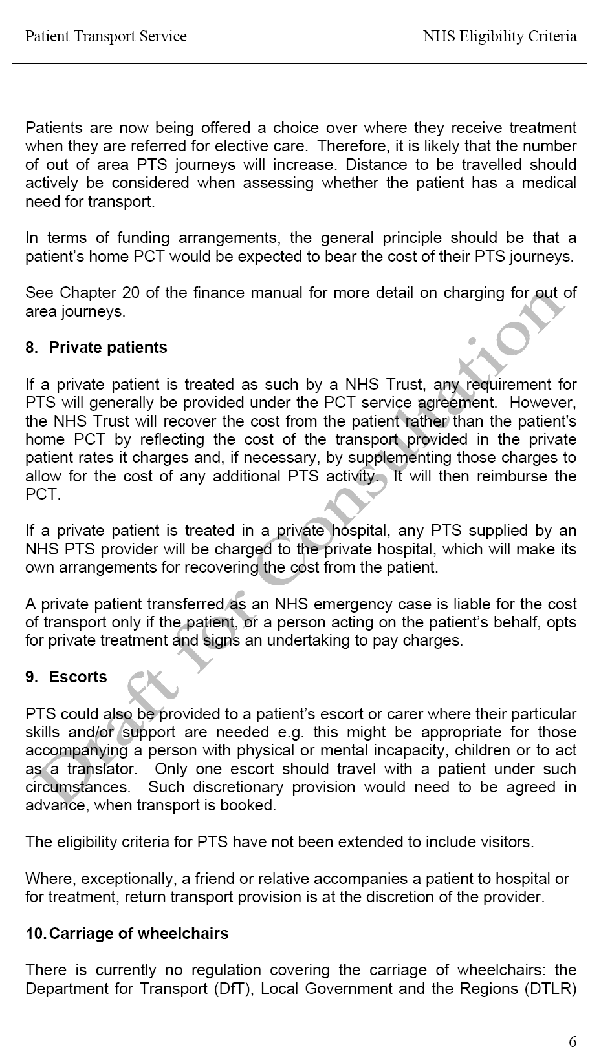
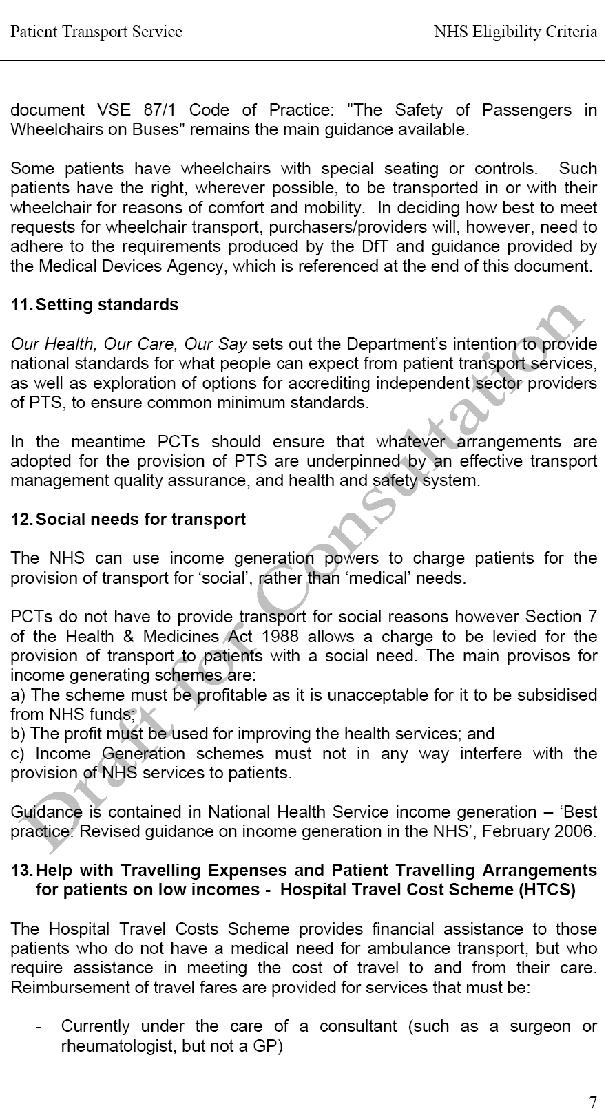
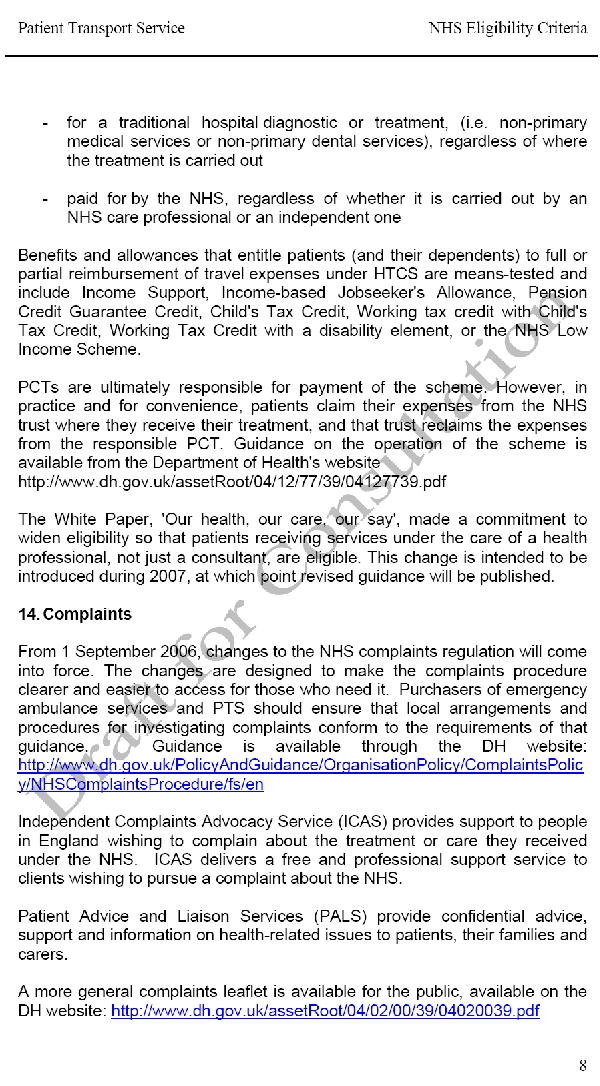
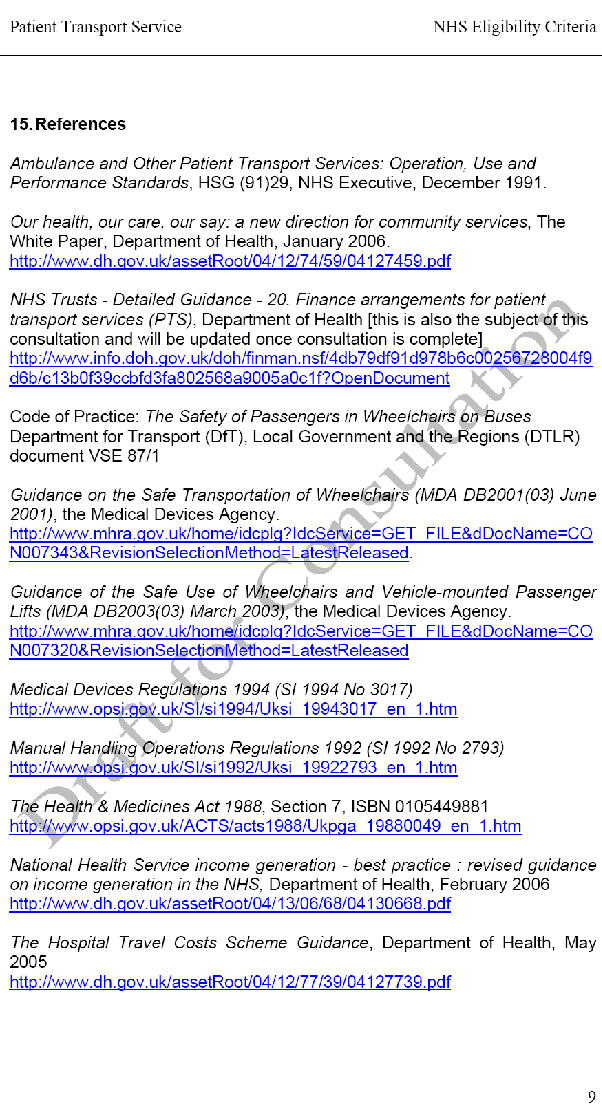
14.1. The Department of Health has launched a consultation on the eligibility criteria for non-emergency patient transport (PTS). This will run from 17 November to 16 February. The consultation paper can be accessed here and at Annexe Six.
Recommendations
14.2. The Chairman receives any feedback from members on these proposals by 19 January.
14.3. A draft response is available at the January meeting.
Section 100 D - Local Government Act 1972 - background papers
The following documents disclose facts or matters on which this report, or an important part of it, is based and has been relied upon to a material extent in the preparation of this report.
NB the list excludes:
1. Published works
2. Documents that disclose exempt or confidential information as defined in the Act.
File Location
None

STRATEGIC HEALTH AUTHORITY
18-20 Massetts Road
Horley
Surrey
RH6 7DE
Direct Tel: 01293 778808
Direct Fax: 01293 778888
1st November 2006
Our Ref: CM/JAF/CM560
Chair Health & Overview Scrutiny Committee
Dear Colleague,
Re: Creating an NHS Fit for the Future
As you may be aware, PCTs in Surrey and Sussex have been undertaking a review of services over recent months under the title `Creating an NHS Fit for the Future'. The `Fit for the Future' programme is enabling PCTs to fundamentally review how healthcare has historically been provided and, where the pattern of services is no longer suited to current needs, to design new, safe and affordable ways of providing services.
PCTs have been working over several months in partnership with local clinicians and stakeholders to develop proposals for change. These proposals have been developed according to principles of clinical sustainability, affordability and service improvement - ensuring patients are treated in the right setting, at the right time by the most appropriate health professional for their need. The options for the future are now being finalised in readiness for public consultation. We expect PCTs to be ready to proceed to consultation very shortly.
HOSCs in Surrey and Sussex have already been involved in local discussions during this process, both locally with PCTs and at a strategic level with the SHA through the HOSC reference panel which has been meeting regularly since late last year. The reference panel has been a helpful forum for discussion about the strategic direction of travel and the progress of the local engagement work, including scrutiny arrangements.
As PCTs move towards consultation, they will be formally approaching all HOSCs which may consider residents within the local authority area to be affected by the proposals in order to establish whether the proposals constitute a `substantial variation' to services within their area. The scope of the emergent proposals suggests that HOSCs neighbouring Surrey and Sussex will need to consider whether or not the proposals constitute `substantial variation'.
Clearly, the PCTs will then fulfil their duty under Section 7 of the Health and Social Care Act 2001 to formally consult those HOSCs which consider the proposals to be `substantial variation' to services. Where this is more than one HOSC, there will be a need to establish a joint HOSC in line with the Secretary of State's Directions (17 July 2003
The PCTs in Surrey and Sussex are currently considering whether or not there are significant interdependencies between their individual options. If the interdependencies prove to be significant, the PCTs may decide to jointly consult on Surrey and Sussex wide options and will approach HOSCs across South East Coast and neighbouring local authority areas on this basis.
I will be seeking support from our local South East Coast HOSCs, and, where appropriate, our neighbouring HOSCs in working with PCTs to expedite the establishment of any required joint HOSC arrangements to avoid prolonging any period of uncertainty. This will enable a robust consultation process to progress promptly, giving clarity to local people and the NHS as soon as possible. I will be seeking advice from Tim Gilling of the Centre for Public Scrutiny as to how best this process can be supported and facilitated.
I would welcome the opportunity to discuss the Fit for the Future agenda and the proposals being developed by PCTs in more detail with you and will telephone/arrange to meet with you shortly. I also look forward to hearing your thoughts on the consultation process and how PCTs can work effectively with you to ensure appropriate consultation arrangements under Section 7 of the Health and Social Care Act.
Yours sincerely,
Candy Morris
Chief Executive
South East Coast Strategic Health Authority
Funding for LINks will be provided from central government to all relevant authorities, which will, perhaps jointly where that seems appropriate, contract with local organisations such as voluntary and community groups or social enterprises to identify the most appropriate arrangements for hosting and providing support to the LINks. Given the skill requirements of support organisations, it is likely that they will chiefly be drawn from local non-profit organisations with skills in community development and networking.
The proposed legislation to create this duty will be introduced as soon as Parliamentary time allows.
The consultation on our plans following the publication of A stronger local voice has now come to an end, and we are currently considering the responses we have received and plan to publish a Government response document shortly. This will also include further details on how a LINk could work.
We are working with the Commission for Patient and Public Involvement in Health (CPPIH), which supports the current system of PPI forums, to establish seven `early adopter' sites around the country. These sites are located in County Durham, Doncaster, Manchester, Hertfordshire, Kensington & Chelsea, Medway and Dorset.
I am keen that you are kept up to date with our plans for LINks and able to learn from the experience of the early adopter sites. We would therefore like you to nominate a named person from within your organisation to lead on the procurement of LINks. This person should not be drawn from the team that commissions social care services but should be drawn from the separate procurement team within the authority so as not to create a potential conflict of interest. We will then communicate directly with this nominated person to disseminate information such as the tender specification we are currently developing, share best practice and learning from the early adopters sites, as well as inviting them to events and meetings where appropriate. There will also be other opportunities for local authorities to get involved and we will be communicating with you about these in due course.
I would be grateful if you could forward the details of the named contact within your authority for the attention of Florella Baker in the Department of Health, 692D Skipton House, 80 London Road, London, SE1 6LH.
Lessons from `early adopters' and plans to develop the LINk in your area will, I am sure, be of great interest to your health overview and scrutiny committee. OSCs and LINks will need to work closely together and I hope you will involve the lead officer for overview and scrutiny in discussions about how your local LINk will be developed. We have asked the Centre for Public Scrutiny, through its Health Scrutiny Support Programme, to ensure that health OSCs are updated about the development of LINks.
I will write again in due course, with how much you shall each receive once allocations have been confirmed.
Strong and Prosperous Communities: Issues for Scrutiny
Strengthening Overview and Scrutiny
· OSCs are an essential part of the democratic process for holding decision makers to account
· Role in reconciling community opinion/stimulating debate as well as reviewing services and engaging with service stakeholders
· Need to engage Cllrs as representatives in their areas to champion the interests of local people
· Constructive challenge based on improvements for people & communities
· Powers extended to look at actions of public service providers and public bodies and require information within 20 working days and respond to recommendations
· Council's response to OSC recommendations to be provided in two months
· Emphasis placed on OSCs within communities/neighbourhoods ( we need to link with HATs and districts here)
· At the level of full council the OSCs will be more strategic, informing policy development and allowing local councillors to influence decisions
· We will need to take account of what the districts are doing
· There will be specific responsibilities with regard to community cohesion- this will be developed in the consultation on the guidance for OSCs. There is some reference to a single OSC for LAs- it is not clear if this means HOSC or if the functions are to merge
· There is a possibility that OSCs will be able to recommend an independent inspection
· Consultations need to be co-ordinated
· The reformed best value duty on LAs to secure the participation of citizens will complement existing plans to strengthen section 11 of the Health and Social Care Act by requiring health bodies to respond to patients and the public
· OSCs will be required to respond to/investigate Community Calls for Action
Generic/ Cross Cutting Themes
· Linking LAA & performance framework (including publication of results)
· Citizen satisfaction and perception
· Communications and information
· Asset sharing/joint working/ pooled systems
· Changing role of local government
· Commissioning/provision issues?
· Partnerships
· Universal services vs. local services?
· Hard to reach groups and equalities
· Choice supported by devolved budgets and flexible procurement
· Community engagement and involvement- duty to inform, consult, involve and devolve
· Needs assessment/ priority setting will be part of the planning process
· Petitions & Community Calls for Action will need a framework for managing the referral to the OSCs and avoiding vexatious actions
Health
· Enhance local leadership on health & well being
· Local Involvement Networks are route for communities to engage with health and social care
· LA lead member for adult services should be able to influence commissioning decisions and drive action to reduce health inequalities
· Services should be seamless with joined up reporting /performance management arrangements for public health and social care
· LAs will be under a statutory duty to set up LINks - which can refer issues to OSCs
· There will be a new statutory partnership for health and well being under the LSP- relevant elected members should have a key role
· Guidance on commissioning health and well being will be published this winter to complement encouragement to LAs to move towards a commissioning role
Dear Ray,
re: Maternity Services Consultation
Thank you for your letter of the 27th September regarding the Maternity Services Consultation document that has been considered by your members.
Hampshire PCT has reaffirmed its support for the work undertaken in relation to the SW Hampshire Maternity Consultation and recognises the need to work towards a coherent strategy for the delivery of maternity care throughout Hampshire. Gareth Cruddace, Chief Executive Hampshire PCT, has confirmed this in writing to me.
I have addressed the points in relation to the consultation document that you have highlighted.
· The location of the under 4 year olds can be used to predict where the greatest number of pregnant women are likely to reside. Therefore, in planning future Maternity Services, the areas indicated show where the greatest demand for maternity services will come from. The locations of the three stand-alone birth centres may not be optimal in terms of the location of the greatest number of pregnant women. We are beginning to develop partnership working with other agencies in the South West Hampshire PCTs area in order to progress through the Children's Centre agenda. Included in this is a more standardised form of data collection for Maternity Services to identify areas of need using key indicators such as:
o normalising birth
o intervention rates
o breast feeding
o smoking cessation.
· I would like to confirm that of the 3,000 births that took place in 2005 in the South West Hampshire PCT's area 11% took place in the Stand Alone Units and that the rising birth rate is bringing more women to the Princess Anne Hospital not increasing the use of the Stand Alone Birth centres.
· Any cost savings made will be reinvested into future provision of maternity services
There is a clear commitment and timeframe for taking the Maternity and Child health Services agenda forward using the key driver of `Every Child Matters' to progress partnership working in South West Hampshire by 2008. The Joint South West Hampshire Maternity Services Liaison Committee is a key driver to progress the agenda forward.
· Women will continue to have current levels of access to antenatal, homebirth and postnatal care in their localities.
· Feedback from the consultation suggests that women have expressed some concerns about transport, however the main theme has been around distance to travel. It has been acknowledged by New Forest District Council that public transport is an issue for all those who are resident in this area.
Points to consider:
· It is planned that antenatal, home birth and postnatal services will remain local
· In 2005, 89% of the population in South West Hampshire PCTs area travelled to give birth in a Consultant Led Unit
· Hampshire Ambulance support option 3 as the Stand Alone Birth Centre due to its good access and transfer time to the Princess Anne Hospital
· There has been some feedback from GP's during the consultation
Romsey GPs appear to be in favour of the closure of Romsey Birth Centre as they consider it an uneconomical model.
Hythe GPs appear to support Hythe Birth centre to improve access to services for their most hard to reach groups.
We have had minimal feedback from Lymington GPs.
· !n the new national tariffs for health services, our birth centres are not economical due to poor utilisation and we would advise against additional funding.
· Women have always been able to access midwives in the early stage of pregnancy. Evidence suggests that in the majority of cases the midwife is the key influencer amongst health professionals, in the woman's decision about place of birth.
· The key element that the changes will deliver is partnership working across services by matching maternity services with a children and family centre. As an organisation we have made significant progress in addressing the NSF and are committed to continue to offer women the choice of having their baby in a midwifery led unit.
· Women in south west/western areas have always been able to access the birth centre at Romsey, however the numbers are small.
Thank you for inviting me to your meeting on the 28th November, but unfortunately I am unable to attend. The SUHT Trust Board will be meeting on that date to make a decision on the outcome of the consultation. I will be able to feed that back to you by telephone. More formal feedback will need to be presented at your next meeting.
Dear Councillor Ellis
Changes to eligibility criteria for community care
Thank you for your letter of 27 September regarding the consultation on changes to eligibility criteria for community care. At the time of writing we are still consulting, however Councillor Banks has been asked by the Leader to consider stopping the consultation at her decision day on October 27th. This is in response to the volume of responses we have received, and also the positive suggestions about how we might develop services in future.
The questions in your letter touch on other aspects of the comprehensive financial recovery and modernisation plan, which is in place for Adult services. Whilst the responses to your specific questions are set out below, other reports may be helpful to you should you wish to have a more in depth insight into the context that this consultation started and the action being taken in the department.
In order to ensure we have covered all the issues you raise in your letter, I have repeated the question and the answer is set out below each point. I have also enclosed a copy of the consultation leaflet as this provides some information which I will refer to in my response.
1. What is the current and projected level of need for those services broken down by "substantial" and "critical"
At any one time there are about 15,000 service users in receipt of a care managed service. Of these about one third will be critical and two thirds substantial. However the current Adult services care management guidance categorises many service users as substantial, who using the FAC's guidance would be critical if a change were made. This is because the legal definition (page 4 of the booklet) includes the "or will" qualifier. In the current guidance used by care managers people who meet the "or will " qualifying sentence are categorised as substantial. In any year about 25,000 people will receive a care managed service.
2. What level of savings will be generated by the change to only providing services for people whose needs are judges to be critical (between Jan 07 and March 07 as well as April 07 and March 08)
Detailed modelling work has been undertaken which shows the costs of care packages for each care group in critical and substantial. This has shown that if there was a 10% reduction in the numbers of people receiving a care package, the department would make savings of about ^5.2m.per annum. However, there is no certainty that this level of savings could be achieved because of the need to reassess every service user, including undertaking a risk assessment
3. What assessment process will be applied and how has this been agreed with partner organisations.
Every established service user has their care package reassessed at least once a year. In addition, new service users have their care package assessed on a regular basis until it is established. At a minimum this is after three months. However for many service users it is earlier than this because they are improving. For example, the pilot work undertaken to modernise home care has shown that after three months intervention, 32% of people receiving home care for the first time, either need no home care, or a reduced package.
If the eligibility criteria were changed and a after re-assessment (and risk assessment) a service user was likely to have services stopped because they did not meet the eligibility criteria there would need to be a plan for alternative universal services to minimise the impact to the individual and their family.
4. Application of the criteria implies the exercise of judgement- what mechanisms will be in place to ensure that the policy is applied fairly and consistently across Hampshire?
Whatever the outcome of the consultation we have recognised the need to review the guidance for staff and service users on the application of the eligibility criteria, to make it much clearer and easier to follow. We have recruited a lead officer to manage this work who will be supported by a team of expert colleagues. Our aim is to have new guidance in place by January 2007. We are planning an implementation programme for all care managers and a new induction programme for all staff in conjunction with the Training and Development team from Human Resources.
The improved information available to us through SWIFT is also providing excellent information which enables the department to clarify the levels of service users in each area and to monitor care management activity. Our new structure for Wellbeing and Community services will have senior officers in each of the three areas responsible for reviewing care management activity and expenditure to ensure consistency.
5. What will the impact of these changes be on other service providers, including the NHS, voluntary sector and informal carers?
As can be seen, because of the high number of existing service users who would be re categorised as critical, we estimate that there will be relatively small changes to existing service users and carers from the change to eligibility criteria. There has been some concern from NHS colleagues that if a change were made only serious abuse would be investigated. Our guidance to staff would be that all abuse would be treated as serious.
6. What will the impact of these changes be on services that are dependent on multi disciplinary team working such as continuing care, admission avoidance, palliative/respite services, chronic care management
Our care management staff already work in a multi disciplinary way as members of multi agency teams, both real and virtual. Whatever eligibility criteria are adopted the department has a duty to assess anyone who might be eligible for a social care service. The change (if the criteria changed) would be to the services that the department would provide on the basis of that assessment. As already stated in paragraph 2 the "or will" qualifier covers the concerns about health needs, including future needs which will occur if a service is not provided. The needs of informal carers are largely covered in the sentence in critical " vital family and other social roles and responsibilities cannot, or will not be, undertaken."
7. What progress has been made with agreeing continuing care criteria with the NHS
All discussions are in the context of the national consultation on the Continuing Care Framework. There is an acknowledged "gap" between the legislative powers of Adult Services Department (ASD) and the NHS to fund care which is being addressed nationally. In the meantime we are working closely with local NHS colleagues to resolve issues in a timely and respectful way for customers. The ASD contribution to this process is the appointment of a Team Manager to support our front line staff to make the right decisions with customers and give clear, consistent messages to NHS colleagues. This will set the right expectations for the public.
At a strategic level we have a new service manager who will lead our negotiations over disputes and interim funding solutions. We also have dedicated legal support for particularly contentious cases.
We are in the process of developing our relationships across the health and social economy in order to achieve the right outcomes for all those entitled to NHS funded care.
8. What impact will these changes have on people's ability to remain in their own homes?
As part of our financial recovery programme, staff have already been given guidance on the level and cost of support which can be given to enable an individual to remain at home. If this is likely to be needed in the long term, care managers are required to recommend a residential package as a more cost effective solution or to require the service user to fund the additional costs themselves.
9. What appeal process is in place and how is this shared with clients and their families/carers?
There is no specific appeals process for challenging decisions made regarding eligibility. The client and families/carers are fully involved in the assessment process and in the majority of cases the decision regarding eligibility is an outcome agreed by all parties. If the client or family/carer disagrees with the decision, and this cannot be resolved by further discussion with the care manager, a meeting with the team manager would be arranged, and the matter would be discussed by team and service manager in consultation with other colleagues as appropriate, to confirm or review the decision. The outcome would be confirmed in writing.
If the client or family/carer is still not satisfied with the decision, they would be able to use the Adult Services Complaints Procedure, and the Guidance for application of the Eligibility Criteria would be considered in the resolution of the complaint.
Information about Adult Services Complaints Procedure is a standard component of the information pack provided to clients and their families/carers at the beginning of the Assessment process.
10. What arrangements are in place to resolve differing professional views of a clients needs
All staff have supervision on a regular basis. This is to ensure staff follow department policy and to give support and guidance in managing complex cases. Clearly it is important to differentiate between identified needs and equally valid service users wants and aspirations. However, staff are very clear about the need
to manage within the financial limits agreed by the county council. In addition staff are encouraged to support each other within teams. In addition the department has four performance management workshops a year where current issues are debated. At the most recent event (October 12 2006) feedback was given on the recent investigation into supervision which reported a high level of confidence in this process by staff.
11. Will these changes mean that Adult services will not become involved until a crisis point is reached? Does this transfer unacceptable pressures to families and carers.
This is an understandable concern which has been raised by many people as a result of this consultation. As can be seen from the examples on page 6 of the consultation leaflet, the availability of a carer is the main differentiating factor between critical and substantial. However, we have been advised by the County Council legal practise that the human rights law, particularly the right to family life would have an impact here.
12. To what extent will carers assessments continue to inform these decisions.
No change to carers assessments is planned as a result of the eligibility criteria consultation
13. Has there been any assessment of the scope for the County to secure greater cost effectiveness in service provision by purchasing these services from the voluntary/private sector.
We currently purchase significant services from the independent sector and that uses over 50% of the Department's gross budget. Our contractors employ some 15,000 people in Hampshire. The department has itself already undertaken a procurement review pf all domiciliary care providers. The initiative referred to in paragraph 4 is an example of this. Once home care packages have been "right-sized", packages are be handed on to the independent sector for longer term provision.
The County Council is undertaking a procurement review which has already reported to Buildings Land and Property Panel. This is highlighted the complex nature of Adult services procurement because of the service users care provider relationships. The review has shown that Hampshire already procures services in a very cost effective and efficient way.
The department has asked Property Business and Regulatory services who lead the work on procurement to focus on high cost low volume areas such as Learning disability as a priority.
14. Has there been an assessment for securing greater cost effectiveness in providing these services through pooled budgets, joint appointments and integration with other service providers.
The department is currently working closely with the new PCT to agree a new Memorandum of Understanding which will support a Memorandum of Agreement. The plan is for this to be signed by the Chief Executives of Hampshire County Council and the Hampshire PCT at the end of October. This sets out ways of working in the future. Particularly with regard to the Section 28A agreements for people with a learning disability.
The department has already worked with the Hampshire PCT to agree a three area structure which will be coterminous for Children, Adults and the NHS. A joint appointment for Director of Public Health has been agreed who will work closely with this department in developing the Wellbeing agenda for which the Director of Adult Services has a lead role. This could be the first of a number of such posts which will be considered in future.
The new PCT structure and our own are developing at a similar pace and opportunities for joint appointments are being considered. In addition we are developing a new structure at a District council level to ensure continued engagement with the NHS in developing local services through practise based commissioning. Adult services representation has been secured on the interim PEC and at each of the NHS Area Commissioning Boards.
I hope that I have responded to all your concerns, please come back to me should you require further information.
Annexe Six