
Archived decisions
Hampshire Fire and Rescue Authority Human Resources Committee Item 5 1 December 2006
Service Management Team Pay, Rewards and Capacity Review Report by the Chairman of Hampshire Fire and Rescue Authority |
Contact: Councillor Michael Cartwright |
1 |
Summary |
1.1 |
This report sets out the conclusions of the working group which was set up by the Human Resources Committee on 8 September 2006 to examine the pay, rewards and capacity of the Service Management Team (SMT) |
2 |
Recommendations |
2.1 2.2 |
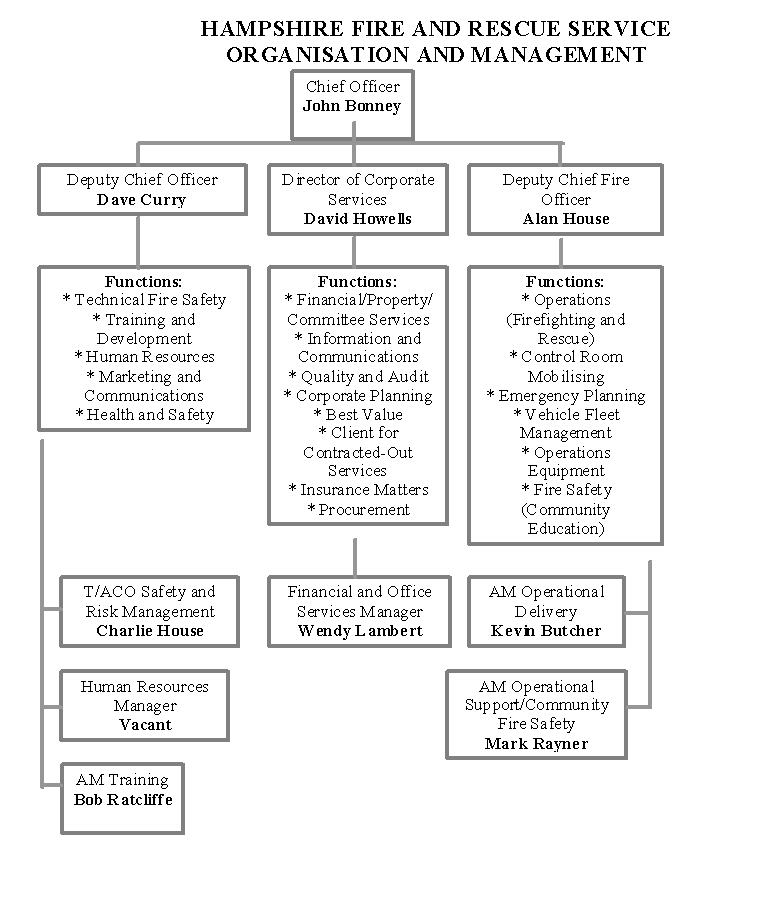
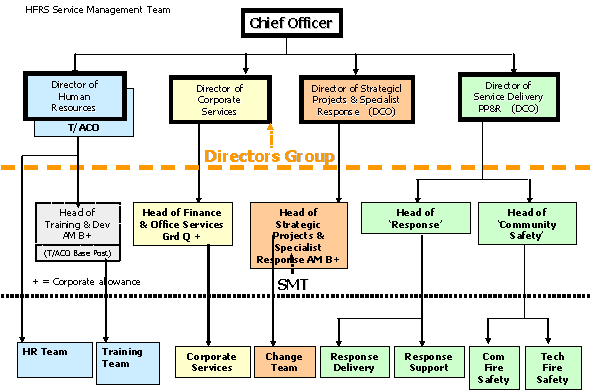
It is recommended that the conclusions of the working group, as detailed in this report and appendices are approved, specifically in relation to: SMT capacity and structure review · Re-organise the responsibilities of the two existing Deputy posts creating Deputy Chief Fire Officer, Director of Service Delivery and Deputy Chief Fire Officer, Director of Strategic Projects and Specialist Response. · Replace the post of Head of HR with a post of Director of HR. · Delete the posts of Head of Operations Delivery, Head of Operation Support and Community Safety, Head of SRM. (Area Manager B+ but covering Head of HR as Temporary Assistant Chief Officer) · Create the posts of Head of Strategic Projects and Specialist Response (Area Manager B+), Head of Response (Assistant Chief Officer), Head of Community Safety (Assistant Chief Fire Officer). · Other posts within the SMT remain broadly unchanged. There is no change to the total number of posts within SMT. A current structure chart and a revised structure chart are at Appendix 1. The Chief Fire Officer would be tasked with the implementation of these changes. Principal Pay Officer Pay Review Methodology a. The proposed methodology at Appendix 2 is accepted. b. Put mechanisms into place to enable the pay methodology to be implemented with recommendations in place for February 2007 HR Committee. |
3 |
Introduction and Background |
3.1 |
This review of the pay, rewards and capacity of the SMT was conducted by Members of the Fire Authority; Cllr Michael Cartwright (Chair of Working Group), Cllr Keith Chapman and Cllr Mark Cooper. Dave Curry attended as APFO representative and SMT adviser, external HR support was provided by Claire Williams and Helen Andrews provided support from the HFRS HR Department. |
3.2 |
The full working group met on three occasions and a sub group met to consider job evaluation and equal pay on one occasion. |
3.3 |
The terms of reference of the working group were to: |
a. Consider the current and anticipated activities and responsibilities of the SMT in terms of skills, reporting lines and capacity. | |
b. Develop a proposed structure that will support improved performance of the service, whilst managing the significant anticipated change processes. | |
c. Consider appropriate pay and rewards mechanisms for the SMT ensuring that equal pay and job evaluation processes are given due consideration. | |
d. Develop a set of criteria to recognise and reward the additional demands placed on operational staff compared with Green Book SMT members, with full regard to Equal Pay considerations. | |
e. Conduct consultation and ensure that budget provision is available for any proposed change into the long term. | |
3.4 |
The work of the group was split into a series of work packages which are described in paragraphs 4, 5 and 6 below. |
4 |
Capacity and Structure |
4.1 |
In considering issues of capacity, the working group addressed the following issues: |
a. Need to create additional capacity at a senior level at deal with current and emerging major projects (Regional Control Centres, Station Changes, Isle of Wight). | |
b. Recognition by SMT of the need to address high workloads and pinch points in existing structure. | |
c. Feedback from direct reports and representative bodies about high workloads and capacity. | |
d. The implications of the failure to appoint a new Head of HR and a review of other fire and rescue services strategies in this area. | |
e. A recognition of the need to increase capacity both managerially and operationally at the Brigade Manager level. | |
f. The existing Area Manager + arrangements creates an ineffective gap between group Manager `B' and Area Manager +'s. | |
g. Need to build more capacity into the existing Area Manager's rota with the potential to remove the ACO incident management responsibilities. | |
4.2 |
The working group sought the views of the existing SMT members and a proposal developed by the existing SMT was put to the working group for their consideration at the meeting on 4 October. This is attached at Appendix 1 to this report. |
4.3 |
Members also considered the structure of Kent Fire and Rescue Service (see `link' to the KFRS website) http://www.kent.fire-uk.org/Home/About_KFRS/About_KFRS.html |
4.4 |
Strong representations relating to the need for a Director level HR specialist were made by the Chair of the HR Committee. |
4.5 |
Members took full account of the representations received from the FOA, Unison and other staff members which are detailed in the consultation section below. |
4.6 |
Following detailed discussion, members of the working group agreed that the proposals submitted by existing SMT members should be put to HR Committee for approval. |
4.7 |
Whilst considering the proposed new structure, members of the HR Committee should be aware of the following: |
Change - the strategic planning of the large scale changes that the service faces will no longer be treated as "part of the day job" for many senior managers. Instead a new post of Director of Strategic Projects and Specialist Response has been created to lead on and oversee the process of strategic change management. This new post will have a critical role in driving the service forward to meet the increasing demands of the future. | |
Capacity - the new proposal is that SMT will continue to comprise ten posts. Capacity in terms of skills and knowledge within SMT will be increased with the appointment of a Director of HR but other capacity issues will be addressed at direct reports level. It is felt that the concerns about pinch points and workloads will be addressed by reducing the "spans of support", enabling managers to provide adequate support to their staff but without inhibiting local day to day decision making. | |
Kent comparisons - the structure for Kent FRS was considered to be of interest because Kent is a similar size to Hampshire and is a high performing Service. There are significant similarities between the Kent SMT structure and the Hampshire proposals. Kent has a Director of HR post, four Brigade Managers, a Directors group of 6, a Service Delivery Directorate and utilises the "Head of" title for non-Directors on SMT. | |
Rota implications - the proposals mean that the current high demands placed on Grey Book members of SMT for call out will be reduced and the burden shared with two new ACOs. This will have a significant positive impact on the lifestyle of officers currently on the rota. | |
Career Development - a stepping stone has been created, in the form of two new ACO posts which provide Area Managers with the opportunity to apply for career development when vacancies occur. | |
HR Director - the service was unable to appoint to this post at a lower level and it has been determined that in order to address the HR needs of the service, a Director level post should be created with the capability of contributing across the board within the Directors Group as does the current Director of Corporate Services. | |
5 |
Job Evaluation and Equal Pay |
5.1 |
A sub group of the working party was convened to address job evaluation and equal pay issues. |
5.2 |
It became apparent that with a few exceptions, SMT members did not have current Job Descriptions. New Job Descriptions have been drafted for all the posts within the SMT structure and they have been subject to consultation with post holders. |
5.3 |
All the jobs in the new structure, including that of the Chief Officer, have been through a job evaluation and equal pay process, as have all other posts within the Service. Job Descriptions have been compared with local conventions and the Brigade Manager and Area Manager Role maps. Jobs have been assessed for equal pay purposes. |
5.4 |
As part of this process, some streamlining of allowances will take place. The payments to non-operational SMT members associated with attending out-of-hours incidents, will be rationalised. |
5.5 |
SMT members will be reminded to place the new job descriptions in their PDR folders, use them for their annual reviews and encouraged to keep them up to date as the jobs alter. |
6 |
Principal Officers Local Pay Review Methodology |
6.1 |
Principal Officer pay is currently dealt with at a national level by the National Joint Council (NJC) for Principal Fire Officers and is enshrined in "Gold Book" pay and conditions arrangements. In addition to nationally negotiated settlements, the NJC wrote to Fire Authorities to on 28 May 2004 stating "Fire Authorities are (therefore) encouraged to undertake local reviews of pay levels where they have not done so in recent years". |
6.2 |
In the South East Region in the last two years, only Hampshire and the Isle of Wight have not carried out reviews. |
6.3 |
A methodology has been developed which has been subject to consultation with the APFO representative. |
6.4 |
The formal response from APFO states "APFO have been pleased to be involved in the development of this methodology and are therefore supportive of it" |
6.5 |
Feedback from the Chief Fire Officer is that the methodology offers a more comprehensive and robust process than is operation in other FRS's which is considered to be a very positive point. |
6.6 |
Working Group members have approved the methodology for annual reviews which is at appendix 2 of this report. |
7 |
Timescale and Implementation |
7.1 |
Subject to Member's approval, the Chief Officer will implement the new structure on 1 April 2007. |
7.2 |
Subject to Member's approval the HR Committee will implement the Principal Officer Local Pay Review methodology, bringing forward a proposal to the 2 February 2007 Human Resources Committee. |
7.3 |
In consultation with staff and representative bodies, the Chief Officer is developing and implementing further structural changes at direct reports level to align with the new SMT structure. Fundamental structural change is not proposed as part of this process |
8 |
Contribution to Corporate Aims and Objectives |
8.1 |
It is essential that changes are made to address the SMT capacity and structural concerns and that a mechanism is put in place to deal with Principal Officer Local Pay Review. |
8.2 |
Both elements will have a significant impact on the delivery of Corporate Aims and Objectives. |
9 |
Risk Analysis |
9.1 |
Although not specifically highlighted in the Corporate Risk Register, an increase in the capability and capacity within the Service Management Team will enable the ongoing actions and anticipated changes to be progressed. |
9.2 |
Hampshire is a high performing Authority and at the forefront of the modernisation of the Service in many areas. To maintain this position, it needs to be an employer of choice and attract high calibre people. |
10 |
Resource Implications |
10.1 |
Human Resources |
The main resource implication resulting from the SMT capacity and structure review will be the activities associated with the recruitment of a new Director of HR. | |
10.2 |
Physical Resources |
These will be minimal and provided from within existing service resources. | |
10.3 |
Information and Communications Technology Resources |
Not applicable | |
10.4 |
Financial Implications |
The additional costs of the proposed SMT structure is estimated at £60,000 per annum which will need to be funded from within existing resources. | |
11 |
Equality Impact Assessment |
11.1 |
The proposals within this report are considered compatible with the provisions of the European Convention on Human Rights, the Human Rights Act (1998), and the Race Relations (Amendment) Act 2000. |
12 |
Consultation |
12.1 |
Members of the working group requested that a consultation and communications plan be developed at the start of the process to recognise Service policy and best practice. Staff and Representative bodies have been encouraged to contribute their suggestions and influence the development of the proposals. The proposals relating to the SMT capacity and structure review have been subject to consultation with existing SMT members and direct reports, APFO, FOA, Unison and FBU. In summary, the following points were made and considered by the working group during the consultation process; · Insufficient number of posts within the new SMT structure · Adopt a Local Government model with Cabinet /Executive roles · More opportunities should be made available for Green Book staff · Adopt consistency in job titles - using the "Head of" title SMT posts that are not part of the Directors Group. · The title of the Change Management Directorate has changed to "Strategic Projects and Specialist response" · Significant comments on the content of job descriptions · A series of comments made by existing SMT members during the development phase of the proposals. · Increase opportunities for Green Book staff. |
13 |
Conclusion |
13.1 |
It is important to ensure that the SMT are structured and rewarded appropriately. The implementation of the proposals within this report will improve the Service' ability to deliver improvements, manage change and modernise as documented in our IRMP 2006/09. |
Background Information (Section 100D of Local Government Act 1972) | |
The following documents disclose the facts or matters on which this report, or an important part of it, is based and has been relied upon to a material extent in the preparation of the report: Kent Fire and Rescue Service - Kent Management Structure http://www.kent.fire-uk.org/Home/About_KFRS/About_KFRS.html Note: The list excludes: (1) published works; and (2) documents that disclose exempt or confidential information defined in the Act. | |
Secretarial/WP/C/Events/HFRA HR 1 12 06 SMT Pay and Capacity Review CW/JMW/22/11/06
Appendix 1
Appendix 2
HAMPSHIRE FIRE AND RESCUE SERVICE
Methodology for the annual local review of Principal Officer pay.
Background
This methodology has been developed to reflect the onus that the NJC has placed on Fire Authorities to undertake local pay reviews on an annual basis for Principal Officer Grades.
Procedure
On an annual basis, a panel of members will be appointed at September committee to consider a local pay review for Principal Officers (The Principal Officers Pay Review Group). The membership of the group will include a representative from the HR Committee(Chair), Finance and General Purposes Committee and the Performance Review Committee. The group will report to the 2 February 2007 Human Resources Committee.
A phased approach will be adopted as follows:
Phase 1
Hampshire's position compared with other Pay Band four services * in relation to a defined set of indicators .
Hampshire will be compared with the other services in pay band four in relation to a set of factors which point to a degree of difficulty or complexity; population, total number of dwellings, gross expenditure and total strength.
Wherever possible, data produced by CIPFA will be used (population (1), total number of dwellings (10), gross expenditure (15) and total strength (195)). However, if current CIPFA data is not available during the annual data gathering period, other data sources will be used to obtain the same information.
A rank order of services will be developed based on the averages of the data. Thus the service with and average of the greatest population, highest number of dwellings, greatest gross expenditure and greatest strength figure will be ranked 1 and so on.
This will enable Members to place Hampshire Fire and Rescue Services at a point within the range based on factors which point to degrees of difficulty or complexity
* Pay Band Four is a National Joint Council (NJC) grouping based on population.
Phase 2
Hampshire's position relation to the % local pay increases and actual salaries for other Chief Fire Officers (in Pay Band Four) over the preceding 12 month period.
The Local Government Employers and Association of Principal Fire Officers (APFO) gathers data on an annual basis about the actual salary and % local pay award for comparative purposes. This data will be set against the rank order established in phase one above. Only services that have had a local pay award within the previous 12 months should be considered.
This will provide members with contextual information about the percentage increases and actual salaries of the Principal Officer team in services placed above and below Hampshire in the rank order.
Phase 3
Information about the size and make up of the national "going rate" pay award for Principal Officers and the most recent Green book and Grey book pay awards.
This is important contextual information. Members will have regard to the nationally negotiated principal officer pay award (excluding any uplift due to "buy out" of conditions of service) and how their decisions about local pay for Principal Officers compare with the pay awards for other staff members within Hampshire Fire and Rescue Service.
Phase 4
HFRS performance against strategic objectives using national BVPI data.
The final set of relevant data relates to Hampshire's delivery of the strategic plan. Indicators of success include local corporate audits or assessments through the year (such as CPA or more recently Ops assessment) which
would enable members to judge the extent to which the Principal Officer team have been successful in delivering corporate objectives.
Phase 5
The Principal Officers Pay Review Group will consider the data presented to them, work through
it with an external HR specialist and determine a recommended
local pay award based on their own assessment of the information.
Phase 6
Conduct negotiation with APFO and reach agreement.
Phase 7
The financial implications of any decision will be considered by the representative of the Finance and General Purposes Committee prior to ratifying the decision.
Timescales
The data, with a recommendation from the external HR specialist, will be presented to the HR committee at the February meeting under the confidential part of the agenda.
Secretarial/WP/C/Events/HFRA HR 1 12 06 SMT Pay and Capacity Review CW/JMW/3/11/06