
Archived decisions
Hampshire County Council Policy and Resources Policy Review Committee Item 5 4 December 2006 Items for Consideration and Action Report of the Chief Executive |
Contact: Denise Holden ex 7338
e-mail: [email protected]
1. Role of the Committee and Purpose of the Report
1.1. The role of the Policy and Resources Policy Review Committee (P&RPRC) is to consider how effectively the services and decisions of Hampshire County Council are deployed and corporate policy developed, implemented and evaluated. The purpose of this report is to alert Members of the P&RPRC to a range of relevant issues that relate to the work of the County Council and the services it delivers. This provides a route through which the Committee can receive and assess different topics that impact on the functioning of the County Council and identify those that matters that may benefit from additional scrutiny by the Committee.
1.2. Items put forward for consideration by the Committee will be informed by a wide variety of sources. Information included in this report will therefore be drawn from
_ Forthcoming cabinet/executive members decisions
_ National and local policy development
_ Performance management reports and programmes
_ Other sources as appropriate
1.3. In addition the report includes responses from the County Council to any general queries or specific requests for information from members, issues that are subject to routine monitoring by the Committee as well as progress with the work programme.
1.4. This report provide members with an opportunity to influence and inform the delivery of Hampshire County Council services and supports the Corporate Strategy aim of maximising well being.
Items for information
2. Human Resources Issues
2.1. A short presentation will be made by the lead officer from Human Resources. This will include a number of issues facing these services
It is proposed that
2.2. Members identify any additional information required
Responses to queries raised by members of the Committee
3. A response from the County Treasurer to queries raised by members at the last meeting is attached at Appendix One.
3.1. The report includes the following
_ HCC insurance claims
_ HCC spending on external consultants
_ Costs of feasibility studies
_ Virement
_ Up-date on Swift and its impact on revenue budgets
3.2. Additional information requested relating to the funding of the young carers budget will be available at the next meeting
It is proposed
3.3. Members note the report from the County Treasurer and identify any further information required.
4. Key issues from the recently published White Paper `Strong and Prosperous Communities' are attached for information at Appendix Two.
4.1. Chris Lawrence-Pietroni will provide a short presentation of the next steps taking forward the key themes of this document.
It is proposed that
4.2. Members agree how they wish to inform this emerging agenda.
5. Further to members interest in work to develop contact centres in Hampshire a briefing session has been arranged for 28 February 2007. All county councillors will be invited to attend this event.
It is proposed that
5.1. Members identify any additional information required subsequent to this event
6. A detailed report on action taken by the Governance Committee with regard to risk management in Hampshire County Council is attached at Appendix Three. This identifies the action being taken by the County Council in a number of areas highlighted as possible issues for scrutiny by the Committee.
It is proposed that
6.1. The Committee receives feedback on progress with this work at its July meeting.
7. In response to a query by members about the way in which fixtures and fittings, including furniture will be recycled and reused as the refit of Ashburton Court proceeds, a report from the Project Manager is attached at Appendix Four.
It is proposed that
7.1. Members determine if they require any additional information
Update on Routine Monitoring Issues
8. ICT scrutiny: the response of the Leader and lead officer to the ICT scrutiny report recommendations are attached at Appendix Five and Six respectively
It is proposed that
8.1. Members identify any further information or action required by the Committee.
9. County Council Budget and Finances: County Treasurers will provide the Committee with a report on the budget setting process at the next meeting. In order to maximise the opportunity for members to influence this process prior to the Cabinet meeting on the 9 February the date for the next meeting of the Committee has been changed to 1 February 2007
9.1. A monitoring report on the current financial position of the County Council is attached at Appendix Seven.
It is proposed that
9.2. Members note the revised arrangements to inform the budget setting process of the County Council
9.3. Any queries relating to the budget monitoring report are fed back to the County Treasurer for a response.
Progress with the Work Programme
10. Completed Task and Finish Groups:
10.1. A report on the Outcomes of the scrutiny review of Project Integra is attached at Appendix Eight.
It is proposed that
10.2. Members confirm any further information or action required the support the completion of this work.
11. Task and Finish Groups Pending
11.1. Further to the last meeting the following task and finish groups have been set up to provide members with an opportunity to consider the following:
_ Ranking Local Bus Service Contracts (13 December)
_ Motorway Diversion Routes (12 December)
_ Schools Admission Policy (4 December)
_ Library and Information Service (imminent)
11.2. All county councillors have been invited to attend these meetings to inform Committee members of their views.
It is proposed that
11.3. The Committee receives feedback from the lead member on any further action required as a consequence of this workshops at its next meeting.
12. Approval of Task and Finish Proposals
12.1. The Committee is asked to approve the following proposals for in-depth scrutiny reviews
13. Programme of Cabinet/ Executive Decisions
13.1. The Chairman has been alerted to the following forthcoming Cabinet or Executive Decisions that may be of interest to members. Due to meeting schedules it is not possible to view these reports until 11 December 2006. However should any Member wish to see copies and provide feedback prior to the decision day, please let the Chairman know.
_ Budget guidelines and the outcome of consultation on Council Tax
_ Half Year Corporate Performance report
It is proposed that
13.2. That the Committee identify any further information or action in relation to the above issues.
Appendix One
Contact: Bevis Ingram, (01962) 847408; [email protected]
Introduction
A number of formal questions on financial matters were asked at the last meeting of the PRC. The answers to these have been researched and are presented in this paper.
· Question 1
Please provide a breakdown of details of insurance claims in 2005/06 covered by the lump sum in final accounts paper.
· Answer
Table 3 of appendix 3 of the final accounts paper shows that insurance payments made in 2005/06 were £4.782 million, broken down as £2.736 million for buildings and £2.046 million for liabilities. This can be broken down further as:
£000 | |
Public Liability |
1,127 |
Employers Liability |
238 |
Personal accident |
167 |
Premises |
2736 |
Claims handling costs |
515 |
Total |
4,782 |
In 2005/06 some 809 new claims were made for Employers Liability and Public Liability and 124 claims were outstanding as at 31 March 2006. The vast majority of Premises claims relates to fire reinstatement works undertaken; in 2005/06 much of this was works at Costello school following the fire there in 2003.
· Question 2
How much was spent on Consultancy across the County Council in 2005/06?
· Answer
In 2005/06 a total of £6.1m was coded to consultancy fees in the County Council's accounts, compared to £7.4m in 2004/05 and £7.9m in 2003/04.
The vast majority of these fees are for design and supervision of Highways and construction schemes, undertaken by outside firms of consultants.
It would be difficult to summarise further details as the figures comprise several thousand individual accounting entries charged to a large number of schemes.
· Question 3
Please provide further information on spending on feasibility studies in the 2005/06 final accounts.
· Answer
The review of the capital programme reported to cabinet in July included some detail of this. The relevant extract from that report reads: The most significant pressure facing the Property, Business and Regulatory Department is the preparatory work needed to support new policy developments, such as key-worker housing, major reorganisations such as the Ashburton Court refurbishment and general feasibility studies. During 2005/06, over £1m (*) was needed to support this area of work against a provision in the Policy and Resources capital programme of only £680,000. Since this provision was first established in 2001/02, the funding as a proportion of the overall capital programme has reduced from 1.21% to 0.73% although the need for this type of support is not necessarily in direct proportion to the value of the capital programme.
It is worth noting that virtually all the time put into preparatory work results in the development of a tangible project. This work is critical to the future successful delivery of projects and in the development of Council priorities. This year feasibility costs in excess of the capital provision of £680,000 are estimated to be between £350,000 and £500,000.
(*) The exact figure is £1.028 million.
· Question 4
Please provide details of virements made in the current financial year 2006/07.
· Answer
Under current virement rules, virements over £250,000 or 1.25% of the budget (as shown in the County Council's budget book) have to be formally approved by the relevant Executive Member. To date, there have been no such virements in 2006/07.
By way of context it is worth adding that the production of the revised budget for approval in January/February is usually seen as a more useful way of aligning budgets, spending and priorities across the whole County Council budget.
· Question 5
Please provide a breakdown of how the money in the Young Carer's Budget is being spent in 2006/07.
· Answer
The answer to this is still being researched and will be provided to a later meeting of the committee.
· Question 6
Please provide an update on whether any delays in the implementation of Swift will or have resulted in the loss of grant revenue.
· Answer
The initial implementation of Swift was partly funded by a grant from the Department of Health under its information for Social Care programme. This grant was not time limited and all the grant was fully received.
The Department for Education and Skills (DfES) is providing grant money for the implementation of an Integrated Children's System. It is a condition of receiving Phase 2 of the grant that Phase 1 of the implementation is completed by January 2007. Phase 1 of the implementation will not be completed by January 2007 and therefore this grant is at risk. However, Hampshire County Council is in the same position as a large number of other Local Authorities (including all those using the software supplier Anite) and the position is being negotiated with the DfES. The estimated Phase 2 grant is £149,000 in 2006/07 and £292,000 in 2007/08.
Policy Unit Briefing - Strong and Prosperous Communities
The Local Government White Paper
Strong and Prosperous Communities: Key Areas of Interest for Policy and Review Committees
The recent White Paper `Strong and Prosperous Communities' has a number of implications for the way in which the County |Council is organised and supports local people. It includes a range of proposals for strengthening the overview and scrutiny function that Policy and Review Committees will need to consider (a summary of the key points is attached at Appendix 1).
In order to provide for maximum opportunity for members to inform and influence HCC's response to these proposals this paper summarises the broad areas covered in the White Paper and links these to the areas covered by each P&R Committee; these inevitably cross more that one area of interest. This will provide an opportunity to ensure that, where members feel it is appropriate, they are able to feed into the response agreed by the County Council.
There are links to the areas for scrutiny already identified through the briefing process and previously considered by members (a summary of the themes identified through this process is attached at Appendix 2).
`Strong and Prosperous Communities': Broad Themes by PRC
Policy and Resources
Co-ordinating Scrutiny
· Responding the consultation on arrangements for overview and scrutiny
· Arrangements for responding to Community Calls for Action and links with other partners
Cross cutting themes
· Changes to the LAA and performance framework Chapter 6)
· The Third Sector (Annexe G) and partnership working (Chapters 1,2 & 5)
· Community engagement and LA accountability (Chapter 2)
· Community management & ownership of assets (Chapters 2 & 7)
· The role of local government (Chapter 3)
· Improving services (Chapter 7)
Children & Young People
· Vulnerable People (Annexe C)
· Children Young people & Families (Annexe D)
Safe & Healthy People
· Community Safety (Annexe A)
· Health & Well being (Annexe B)
· Vulnerable People (Annexe C)
Culture & Communities
· Vulnerable People (Annexe C)
· Economic development, Housing and Planning (Annexe E & Chapter 4)
· Sustainable communities (Chapter 5)
· Community engagement and consultation (Chapter 5)
· Community Cohesion (Chapter 8)
Environment and Transportation
· Climate Change (Annexe F) and environment (chapter 4)
· Housing and regeneration (Chapter 5)
Health
· Health & Well Being (Annexe B)
· Vulnerable People (Annexe C)
· Role of the Local Improvement Networks (Annexe B)
· Community engagement and consultation ( Chapters 1 & 2)
Annexe One
Strong and Prosperous Communities: Issues for Scrutiny
Strengthening Overview and Scrutiny
· OSCs are an essential part of the democratic process for holding decision makers to account
· Role in reconciling community opinion/stimulating debate as well as reviewing services and engaging with service stakeholders
· Need to engage Cllrs as representatives in their areas to champion the interests of local people
· Constructive challenge based on improvements for people & communities
· Powers extended to look at actions of public service providers and public bodies and require information within 20 working days and respond to recommendations
· Council's response to OSC recommendations to be provided in two months
· Emphasis placed on OSCs within communities/neighbourhoods ( we need to link with HATs and districts here)
· At the level of full council the OSCs will be more strategic, informing policy development and allowing local councillors to influence decisions
· We will need to take account of what the districts are doing
· There will be specific responsibilities with regard to community cohesion- this will be developed in the consultation on the guidance for OSCs. There is some reference to a single OSC for LAs- it is not clear if this means HOSC or if the functions are to merge
· There is a possibility that OSCs will be able to recommend an independent inspection
· Consultations need to be co-ordinated
· The reformed best value duty on LAs to secure the participation of citizens will complement existing plans to strengthen section 11 of the Health and Social Care Act by requiring health bodies to respond to patients and the public
· OSCs will be required to respond to/investigate Community Calls for Action
Generic/ Cross Cutting Themes
· Linking LAA & performance framework (including publication of results)
· Citizen satisfaction and perception
· Communications and information
· Asset sharing/joint working/ pooled systems
· Changing role of local government
· Commissioning/provision issues?
· Partnerships
· Universal services vs. local services?
· Hard to reach groups and equalities
· Choice supported by devolved budgets and flexible procurement
· Community engagement and involvement- duty to inform, consult, involve and devolve
· Needs assessment/ priority setting
· Petitions & Community Calls for Action will need a framework for managing
Health
· Enhance local leadership on health & well being
· Local Involvement Networks are route for communities to engage with health and social care
· LA lead member for adult services should be able to influence commissioning decisions and drive action to reduce health inequalities
· Services should be seamless with joined up reporting /performance management arrangements for public health and social care
· LAs will be under a statutory duty to set up LINks - which can refer issues to OSCs
· There will be a new statutory partnership for health and well being under the LSP- relevant elected members should have a key role
· Guidance on commissioning health and well being will be published this winter to complement encouragement to LAs to move towards a commissioning role
Annexe Two
Broad Topic Area |
Capacity to influence/improve |
Timeliness & Relevance |
Issue not considered elsewhere |
No performance monitoring |
Action |
White paper · LA role/structure · Community engagement · CPA/ performance · Partnerships · Efficiencies · Third sector · Strengthen scrutiny Finances · Spending on services and facilities · Budget allocation & priorities · VFM & efficiency · Business units & HCC HCC Corporate · Use of offices/refurbishment · Customer focus · Public Perceptions · Consistency in communications · Equity in policy implementation · Reputation management · Section 17 · Health & Safety Risk assessment and assurances Record Keeping IT&C · Information management · Electronic documentation · Flexibilities & responsiveness · Business continuity · Developing skills Property services and Procurement |
_ _ ? _ ? _ _ _ _ ? ? ? _ _ ? _ _ ? ? ? ? _ _ _ _ _ _ |
_ _ _ _ _ _ _ _ _ _ ? ? _ _ _ _ _ ? ? _ ? _ _ _ _ _ _ |
X X X X X X ? X ? X ? X X X X ? X X X ? ? ? ? ? ? ? ? |
? ? X ? X ? X X X X ? X X X ? ? ? ? ? ? ? ? |
Feed into and inform HCC response. Regular up-dates on progress Lead on scrutiny changes On going item for agenda Additional information to be provided on request Links with White Paper More information required in key areas More information required More information required Major area of spend. More information required More info required |
Appendix Three
Report to the Governance Committee
Risk Management
26 October 2006
Michelle Smith
1. Introduction
1.1 The purpose of this report is to provide members with an update on risk management arrangements in the County Council. It will cover the approach to the management of risks at a strategic level and will explain some of the developments that have been taking place corporately to promote an effective risk management culture.
1.2 This report will also highlight a number of developments taking place nationally which could impact on the way risks are managed in the public sector.
2. Risk Management - the challenge
2.1 When considering the management of risk it is important that a proportionate view is taken. The following extract from the Corporate Risk Management Strategy summarises the approach being adopted:
" The challenge is to achieve the right balance between taking risks to be innovative and improve performance, and managing risks to protect services"
In summary it is about being risk aware not risk averse.
2.2 A robust framework for the identification and assessment of risks has been developed which is used across the County Council. The focus is identifying those risks which could seriously impact on the County Council's ability to deliver its corporate aims. The methodology used assesses risks, the effectiveness of controls used to manage them and identifies a risk owner for each risk. This information is all captured in the corporate register of risks and enables the production of a corporate risk map.
2.3 The annual review of risk assessments is currently taking place. The outcomes from this will be considered by departmental management teams and the Risk Management Board.
3. New Developments
3.1 In the last 12 months there have been a number of developments aimed at embedding risk management processes into the core of the organisation. These have included both organisational and system changes.
3.2 Following a review of the management arrangements it was decided to integrate health and safety and risk management at a corporate level - this has been done to ensure that health and safety is dealt with within the risk management framework to focus the use of resources. A new corporate risk manager has been recruited with the key accountability of developing a corporate performance improvement plan for H&S and risk. Line management responsibility for the Health and Safety advisers based in departments has been transferred to the relevant departments to clarify lines of accountability.
3.3 The structure and terms of reference of the corporate groups associated with the above have been revised to lead the development and implementation of a corporate plan to drive improvement in risk and heath and safety performance taking into account statutory requirements, the County Council's risk profile and best practice.
3.4 A new risk management system, MK Insight, has been procured and implemented. This exercise has been carried out jointly with Audit who required an audit management system. The system provides for comprehensive coverage of risk information in the risk register. It will also enable automatic alerts for risk owners and comprehensive risk tracking.
3.5 Other Corporate development include the need to link risk with performance management - corporately there is work taking place on a `key themes portal' to provide guidance an a range of topics such as risk management and health and safety to provide guidance to managers on the types of questions they should be considering in different circumstances e.g. writing a service plan, recruiting staff etc. It will also point to further guidance that is available.
3.6 Work has also begun to identify the existing level of knowledge across the organisation in relation to risk and health and safety. An online questionnaire was sent to senior/ DMT level managers, the results of this are being analysed and will be used to develop the future training framework for these areas.
4. Focus for the future
4.1 There are a number of developments that are happening at a national level which are of interest. The House of Lords Economic Affairs Committee has launched an enquiry into the policies principles and practicalities behind government risk management. Some of the questions it is asking are:
· Can appropriate monetary values be estimated and attached to risk related factors?
· Is it possible to identify fundamental principles that should be applied across the public sector?
· How should policy deal with cases where public perceptions of risks diverge significantly from expert assessments?
· How to deal with unknown or poorly understood risks?
· How to balance Health and Safety interests of current population v future generations?
The Committee has been taking oral and written evidence since last October and is due to publish its findings and recommendations later this year.
4.2 There are a number of new and proposed pieces of legislation that are relevant to risk management. In March 2005 the Government introduced a draft Corporate Manslaughter Bill with a short consultation period and in November indicated an intention to implement by the end of the 2005-06 parliamentary session.
4.3 The Compensation Act which received Royal Assent in July 2006 is aimed at providing a statutory framework for the regulation of claims management services. One aim of the Compensation Act is to stamp out the perception of a compensation culture and to help ensure that invalid claims are discouraged and resisted. The impact that these will have in practice will has yet to be seen.
4.4 The Civil Contingencies Act has also increased the emphasis on the need for risk and business continuity management. Requirements of the Act include the need to:
· Assess the risk of emergencies occurring and use this to inform contingency planning;
· Put in place emergency plans and business continuity management
· Make information available to the public about civil protection matters and maintain arrangements to warn, inform and advise the public in the event of an emergency;
· Share information and co-operate with other local responders to enhance co-ordination and efficiency;
· Provide advice and assistance to businesses and voluntary organisations about business continuity management
The Civil Contingencies Act also requires Category 1 responders to maintain plans to ensure that they can continue to exercise their functions in the event of an emergency so far as is reasonably practicable.
4.5 As the environment in which the County Council operates changes it is important to continue to refine the approach to risk management. The following were identified as potential areas for Policy and Resources Scrutiny and will also be of interest to this Committee:
· Ensuring risk management is embedded in policy making and planning processes
· How risk tolerance levels are defined
· Dealing with risks related to partnership working
· Seeking assurance in relation to controls used to manage risks
4.6 A further area which needs to be considered is how to make risk management more positive. There is a need to promote risk taking to ensure that opportunities are taken advantage of when they arise.
5. Recommendations
5.1 That the Governance Committee reviews the progress made on risk management and considers nominating a lead member for risk management.
Section 100 D - Local Government Act 1972 - background papers
The following documents disclose facts or matters on which this report, or an important part of it, is based and has been relied upon to a material extent in the preparation of this report.
NB the list excludes published works and documents which disclosure exempt or confidential information as defined in the Act: None
Appendix Four
Emma Gordon
Scrutiny Officer
Policy & Resources Policy Review Committee
Chief Executives
Hampshire County Council
Elizabeth II Court
WINCHESTER
13 November 2006
Dear Emma,
Ashburton Court Refurbishment - Plans for Existing Office Furniture and Fittings
I refer to your letter of 10 November 2006 following the Members' request for information at the Policy & Resources PRC.
The programme for the refurbishment project is such that no firm decisions have been made on furniture and equipment at this stage. The first requirement for furniture and equipment in the refurbished building is not until the end of 2007 and so decision on selection, reuse and procurement will not be made for some months.
However, I can say what the strategic approach, in principle, on this project will be. This is as follows:
1. Where recently purchased furniture is in good condition and is suitable to be re-used in the refurbished building, it will be considered alongside the alternative of purchasing new in terms of condition, life expectancy and value for money. The current budget assumes that a proportion of the furniture will be re-used. A detailed audit is being undertaken of the existing furniture to establish its appropriateness for re-use.
2. All staff have to move out of the existing accommodation in order for the refurbishment work to be undertaken. IT Services has moved to Capital House from Ashburton Court East and have taken their existing furniture with them. When the staff in West are relocated, there will be an assessment of what furniture they take to the new destination and what is provided new. This will be a judgement based on location, whether the moves are to a short term location or one where the County Council has a longer term interest.
3. Any remaining furniture which is not required as part of the refurbishment project will firstly be considered for re-use elsewhere in the County Council's office estate or sold on to companies who specialise in re-use and recycling of office furniture. The Council's County Supplies function would manage this process.
I trust this is sufficient information for the Policy Review Committee. Should you require anything further, please do not hesitate to contact me.
Yours sincerely
Steve Clow
Ashburton Court Team
Copy: Councillor M F Cartright
Andrew Smith Director, Property Business & Regulatory Services
Howard Short Property Services Manager, Ashburton Court Team
I1/pf/1869 |
|
Councillor Ken Thornber CBE | |
21 November 2006 |
Leader of Hampshire County Council |
Councillor Michael Cartwright Chairman, Policy & Resources PRC 1.1.1 By Email |
The Castle, Winchester |
Hampshire SO23 8UJ | |
Telephone 01962 847750 | |
Fax 01962 845969 | |
E-mail [email protected] | |
www.hants.gov.uk |
 Dear Michael
Recommendations from Scrutiny of Information & Communications Technology
Thank you for your correspondence on the recommendations from Scrutiny of ICT. I have discussed this with our Head of IT, Jos Creese, and I understand that he will be reporting back to your next meeting in early December. I also understand that he is supportive of the recommendations.
I would like to add my support in particular for the merging of the two IT Help Desks. I have discussed this before with our Head of IT, and it does seem to me that on the grounds of efficiency, and improved integration of services that this is overdue. I do agree with the importance of protecting services as this change is made, and I would ask both the Children's Services Department and IT Services Department to work together to ensure that any negative impacts are avoided.
Please let me know if you wish any further support from me on this matter.
Yours sincerely
Ken Thornber
Leader
Cc: Jos Creese, Head of IT Services
Emma Gordon, Policy Unit
Appendix Six
ICT Scrutiny
Report of the Head of IT Services
Policy and Resources Policy Review Committee
1 Introduction and Background
1.1 This report has been requested by the Policy and Resources Policy Review Committee (P&R PRC). It responds to the recommendations in a report that was submitted on the 21 October 2006 by the Member e-Champion, Councillor Rod Baulk on the working relationship between devolved and central IT.
1.2 The comprehensive Member scrutiny of ICT during 2006 recommended further analysis of the effectiveness and efficiency of working practices between central and local IT teams. The member e-Champion, Councillor Rod Baulk, was asked to review these arrangements. His report to the P&R PRC was discussed, and the P&R PRC made six recommendations which are reviewed in this current report from the Head of IT for the County Council.
1.3 The report and analysis by Councillor Baulk are very constructive and useful, and all of the P&R PRC recommendations are supported by this new report, which responds to each recommendation in turn.
2. Recommendation 1: IT Departments should consider renaming themselves with a title that reflects their real role rather than one that gives the impression that they are mini IT Services departments. There should also be some uniformity in job titles.
2.1.1 It is important to achieve consistency across the whole of the IT Group for Hampshire County Council , in terms of service standards, recruitment and retention practices, performance management, effective use of resources, training, roles and titles. Having independent or competing IT service delivery units is both inefficient and ineffective in meeting the needs of the public and front line services.
2.1.2 However, whilst it is probably true to say that the County Council has a more decentralised structure for IT than most other County Councils, we have at the same time achieved a more consistent approach to IT, and this has been achieved in particular because of concerted approach supported by devolved IT clients working in departments.
2.1.3 Also although a complete centralisation of IT may be more efficient, it could lead to a remoteness of IT from the needs of frontline staff. It is my view therefore that the best approach is to ensure a strong local IT `client' responsibility in departments, covering in particular strategic advice, project leadership, IT investment planning, and support for major corporate programmes of change. Delivery of actual IT services should probably be pooled, as is generally the case. Titles should reflect this.
2.1.4 The Pay and Benefits project will assist standardisation by moving towards `generic' roles for all IT posts, whether they are based on central IT or in departments. This should also help with easier movement of scarce IT skills across the organisation, and a strengthening of the link to the Head of IT as `head of profession'. The overall management of the IT professional group and the performance management of IT staff should be similar to the professional management of HR, Finance, Legal and other professional groups.
2.1.5 This would also require a single HR management on behalf of the IT Professional Group, but would not mean centralising all IT staff in IT Services. It will be important to retain a local IT presence supporting the needs of departments.
2.1.6 In terms of titles of devolved groups, it is proposed to discuss this with the IT Development Group which is the main group of business managers responsible for IT in departments.
3. Recommendation 2: As long as the level of service received by schools from EdICT does not suffer, then the merger of the two Help Desks should progress as quickly as possible.
3.1.1 It has been my view for some time that this would be beneficial. Fragmentation of IT services to schools can lend to problems with efficiency or quality of service. Over the last year, negotiations have taken place for the merging of the two Help Desks between the two departments, and plans are well advanced to achieve this. No doubt there will be some transitional challenges to overcome, but I see no reason why the merging of the two Help Desks should not progress very quickly, if the commitment from all teams exists.
3.1.2 There is nonetheless, also a counter argument in favour of having specialist groups focussed on support for particular market sectors such as schools and striking the right balance is important. One of the big challenges for schools around IT is that they are bombarded with advice from so many areas - the private sector, DfES, BECTA, as well as the County Council. They need to be able to rely on a single voice from the County Council. This has always been the role of the Education IT group (EdICT) and it is my view that this remains an essential activity in support of our schools.
3.1.3 Members may also wish to consider whether other IT supply management functions should also be reviewed along similar lines, including management of external IT supplier arrangements, management of technology delivery, a single price list for IT, single marketing and communications for IT to schools and so forth. Discussions have been taking place with the Children's Services Department on these points, and despite previous concerns within the former Education Department, the IT departments in the former Surveyors and Social Services departments have successfully joined with IT Services for IT supplier services.
4 Recommendation 3: IT services in departments need to consider the quality of service they are providing when dealing with problems from staff, how this questionable duplication can be resolved and a method to ensure statistics are shared.
4.1.1 The IT Services department provides a range of performance and service management information to departments on a monthly basis. There is scope for further improvement in this, especially ensuring that modern processes for IT service management are adopted. IT Services has undertaken a project to introduce the industry standard service management methods (the IT Infrastructure Library, ITIL). By applying a single approach across the whole of the IT Group, a consistent approach to the delivery of quality services and performance reporting can be achieved.
4.1.2 In undertaking some of the changes already listed above, there will be further opportunity in the future to re-assess where areas of IT support would be better resolved locally, centrally or externalised to third party IT suppliers.
4.1.3 In addition, we need to anticipate growing demands for IT support out of normal office hours. Changing working practices and more flexible use of buildings such as schools will also have implications for IT support arrangements, and will require pooling of resources and the review of end-to-end IT support arrangements.
1 Recommendation 4: IT Services must be more aware of the `openness' of the relationship they have with different departments to do everything to ensure that the same level of quality of service is experienced by each department.
5.1.1 Whilst this is already a high priority and part of the ethos of IT Services, it is fair to say that in practice it does not always work perfectly. Large departments with more complex requirements will often need more experienced IT staff supporting them, and some of the smaller departments cannot justify (or afford) the same breadth and depth of IT support.
5.1.2 IT Services has recently re-organised and put in place a new structure which separates out service `account management' from the project and delivery teams which now operate more independently across departments. This in itself should ensure greater transparency and consistency. Account Managers are tasked with ensuring their departmental customers feel that the quality is high and equally shared, and departmental IT teams need to hold IT Services to account. This will be kept under review.
2 Recommendation 5: The quality of consultancy offered by IT Services must be addressed. A perception of a `consultancy lottery' must not be allowed to continue. The least experienced consultants should be kept away from front line work until they can work at a higher standard.
6.1.1 Generally speaking, the track record of IT Services' consultancy is high - exceeding industry standard for the number of successful projects delivered. Every project undertaken is tracked on a formal and consistent basis using the Prince II methodology. Nonetheless, there is scope for improvement, and following on from the recommendations of the IT Scrutiny, the Projects and Consultancy Manager has been tasked with:
· reviewing performance management and performance measurement for consultancy services;
· reviewing the training, induction and support processes for new consultants.
6.1.2 In practice, it is also important that new IT consultants get experience as soon as possible by working on assignments with departments. To compete against the best external IT consultancy organisations, the Projects and Consultancy Group need to support new consultants in taking on challenging assignments without compromising quality.
6.1.3 If there is a problem with the `lottery', it is a management issue for the Projects and Consultancy section and this is being investigated. It is important that there is neither perception nor reality of a `lottery' of skills and experience.
7 Recommendation 6: IT Services must stop charging for initial estimates and quotes and should stop providing estimates but having confidence in the quality of the service they provide and the staff they have should be giving quotes.
7.1.1 IT Services, like any IT service provider, faces a challenge in giving early indication as to the likely cost of IT projects. Being clear when such estimates become fixed price quotations is essential. Both the public and private sectors are challenged in delivering IT projects to time and budget, and sufficient effort needs to be spent in the initial stages of new projects to ensure requirements are effectively understood, risks assessed and estimates reflect likely costs and risks.
7.1.2 One of the reasons that there have been direct charges associated with providing estimates and quotations to date is because departments have in the past asked for this. This has been to ensure transparency about the cost of early of a project stages, rather than simply accepting absorption of those costs invisibly into the on-going costs of projects, in the way that external consultancies would operate. `Free' estimates can result in too much time being spent estimating, with the effect that overall project costs increase, or departments constantly asking for `free work' in sizing projects which are then never undertaken.
7.1.3 Despite some of the disadvantages in providing `free' estimates, there are clear disadvantages in the current mechanism of charging as highlighted in the Scrutiny report and the recommendations from Councillor Rod Baulk. Therefore a new approach is proposed which moves away from estimates being charged as follows:
· For projects there would normally be a brief feasibility paper before estimates.
· At the start of a complex IT project, commissioning departments will be asked to commission an initial phase of work to arrive at a fixed price quotation.
· For smaller pieces of work it will become normal practice to provide a fixed price quotation free, absorbed in the cost of the project.
· This will be reviewed in 12 months to see if the practice of free estimates has resulted in growing overheads and inefficiencies.
7.1.4 This will be discussed by the Projects and Consultancy Manager with the IT Development Group which is the major group of business managers responsible for IT across the Council. The new practices will be kept under review.
Recommendation
The Policy and Resources Policy Review Committee are asked to agree this report or seek further clarification from the Head of IT.
Report to Cabinet
2006-7 Budget Monitoring Update
Report of the County Treasurer
27 November 2006
1 Introduction
1.1 The Cabinet in July received a report on the 2006/07 budget position which identified:
· potential spending levels in excess of the budget in both Adult and Children's Services
· vigorous management action being pursued to identify compensating savings
· that firm action plans were already in place for approximately £8.7m of the £10.7m savings included in the 2006/07 budget.
1.2 This report reviews the latest service budget monitoring position against the current 2006/07 cash limits. The addition to balances in 2006/07 agreed in July was designed to cover the risk of higher spending of £13m on Adult Services, but was based on the assumption that other services would be able to achieve the savings assumed in the 2006/07 budget and contain spending within the cash limit.
2. Monitoring of service budgets
Adult Services
2.1 The report to the Executive member for Adult Social Care in October confirmed that the downward trend in the Adult Services spending projection in 2006/07 has continued with a projected overspending of £12.6m based on August data, compared with £17.5m based on May data. There is a further small reduction based on September data to £11.9m. The position could improve further if the planned savings of £4.5m in the Recovery Plan are achieved in full in 2006/07 and if the £3m contingency within the budget is not required in its entirety to offset new spending pressures in the remainder of the year. Management action is being taken to achieve all of the planned savings of £6.4m included in the budget, though £1.3m of the planned savings still require some further action. Nonetheless there have been some further savings of £1.3m identified in addition to those included in the recovery plan, which provide an alternative means of achieving the target savings in the budget.
2.2 Current monitoring therefore suggests that there remains a significant gap between current care commitments and the 2006/07 budget, requiring further savings to be achieved from the recovery plan in 2007/08. Nonetheless the trend in the first half of 2006/07 has been in a positive direction and suggests that the additional spending should be containable in 2006/07 from within the additional balances budgeted in 2006/07.
Children's Services
2.3 A potential overspend of £1.6m on Children's Services was reported to the Cabinet in July based on initial monitoring of the 2006/07 budget. Action was requested to bring the projected overspend back within the budget by the year end.
2.4 However since July the extent of identified spending pressures particularly relating to children's social care has increased due to increased numbers of looked after children and a larger increase in the numbers of those children in independent fostering agency placements. Based on the end of September data, Children's Services spending was projected to be £2.6m above the cash limit, inclusive of £2m on children's social care. In addition a significant element of the planned savings in the children's social care budget from the implementation of a contract for the provision of supported lodgings has not so far had the planned impact in reducing non-county placements and use of bed and breakfast provision. This adds a further £0.3m to the budget pressures affecting Children's Services in 2006/07.
2.5 The Director of Children's Services has developed a recovery plan for 2006/07 to the value of £1.6m, leaving further savings of £1.3m to be found. A further budget monitoring report will be submitted to the Executive member for Children Services in December considering the options for the use of uncommitted 2006/07 General Sure Start grant, which it would be desirable to carry forward to 2007/08 to provide revenue funding for children's centres, if the Government's targets for the delivery of new centres are to be met. The DfES are not allowing the carry forward of General Sure Start grant to 2007/08, and so options for transferring the underspend to DSG and carrying it forward for that purpose are being considered. There may also be scope to use the grant in 2006/07 as the full balance is not required for Children's Centres in 2007/08. Further as £0.4m of the overspending relates to non-devolved spending within the Schools Block and subject to the approval of the Schools Forum, it may be possible to meet this overspend and the full year effect in 2007/08 with DSG.
2.6 A report elsewhere on the agenda considers proposals for use of Children's Services £1.6m share of LPSA reward grant. In view of the scale of spending pressures in 2006/07 it is proposed to delay committing £0.6m of service development spending proposed to be funded by the reward grant, until it is clearer whether it will be possible to contain spending within the cash limit without use of any of the LPSA grant.
Environment
2.7 The latest Environment budget monitoring report indicates that spending is expected to be contained within the cash limit and that there may be an opportunity to carry forward a planned underspending to 2007/08, when the revised budget is approved in January.
Policy and Resources
2.8 The monitoring report considered by the Executive member for Policy and Resources in September identified a range of budget pressures affecting Human Resources and Property and Regulatory Services in particular, which will require continuing management action during the remainder of the year. The savings identified in the 2006/07 budget are expected to be achieved and vacancy management policies are being adopted to achieve the employee savings targets agreed by the Cabinet in July.
Recreation and Heritage
2.9 The monitoring report considered by the Executive member for Recreation and Heritage in September identified a potential overspending of between £0.4 and £0.6m before the impact of management action, mainly as a result of higher spending and lower income in Libraries, and lower visitor numbers at Milestones Museum during the summer. Management action is being taken to recruit to vacant posts only where essential and to make temporary appointments where possible as well as to maximise income.
3. Conclusion
3.1 Since the previous budget monitoring report in July, some identifiable progress has been made in bringing Adult Services' spending closer to the budget, in line with the assumptions made in July in increasing the level of balances in 2006/07. However there has been a continuing upward trend in cost and activity levels relating to children's social care. Though a recovery plan has been developed there remains a projected overspending in 2006/07 but by delaying committing the use of £0.6m of the LPSA reward grant until the spending position is clearer, it should be possible to contain Children's Services spending within the budget in 2006/07 unless new and unforeseen spending pressures emerge. Further management action will be required in the remainder of the year to contain spending on Policy and Resources and Recreation and Heritage services within the respective cash limits.
3.2 Monitoring of progress in achieving the savings of £10.7m planned in the budget indicates that the majority of savings are being achieved in the areas targeted, but that alternative savings have needed to be sought for both Adult and Children's Services to the value of £1.7m because some of the savings are proving more difficult to achieve than originally assumed.
3.3 Employee budgets were reduced by £0.5m (approximately 0.2%) in July as part of the package of measures to increase balances in 2006/07 and in anticipation of the savings that will be required from 2007/08 to contribute to the cost of the new pay structure. Plans to achieve employee savings in 2006/07 are primarily based on the active management of vacancies and non-school workforce numbers have reduced by 0.3% between June and September, or by 0.8% after allowing for the recruitment of additional staff due to the opening of additional nursing beds from the implementation of the ENHANCE programme.
4. HR implications
4.1 The savings targets within the 2006/07 budget will have some impact on the overall level of the County Council's workforce.
5. Impact assessment
5.1 Monitoring of the budget has been conducted within the context of the County Council's financial management policy. Compliance with the policy ensures consistent financial management decisions across all services.
6. Recommendation
6.1 That the actions outlined in the report in developing and implementing recovery plans for Adult and Children's Services, and in achieving budgeted savings across all services, be approved.
This proposal does not link to the Corporate Strategy but, nevertheless, requires a decision because financial regulations and the County Council's Financial Management Policy require the revenue budgets of services to be regularly monitored and for corrective action to be taken, if necessary, to control expenditure within approved cash limits. |
Section 100 D - :Local Government Act 1972 - background documents
The following documents discuss facts or matters on which this report, or an important part of it, is based and have been relied upon to a material extent in the preparation of this report.
NB: the list excludes:
1. Published works
2. Documents which disclose exempt or confidential information as defined in the Act.
Appendix Eight
PROJECT INTEGRA SCRUTINY INQUIRY
HCC Executive Member for Environment Views
One Year On
In summary, I am content that progress has been made in the last year in respect of each of the four strategic recommendations of the panel. Before commenting more specifically on what has happened it is also fair to say that whilst progress has been made and trust in the partnership has been rebuilt, there is still much to do.
The Project Integra Management Board faces significant challenges in leading the partnership and its individual authorities towards cost effective municipal waste management delivery that results in the elimination of landfill disposal. The recent publication of the Local Government White Paper brings this strategic challenge very much to the fore especially with regard to Executive Leadership.
Government is expecting continuing two-tier models to achieve unified service delivery, to find similar levels of improvement and efficiency gains to those of unitary authorities, to adopt new governance arrangements, to better share back office functions, have integrated service delivery mechanisms and to enable service user confusion, relating to service responsibility (i.e. District or County) to be a thing of the past. Greater joint working and systems harmonisation and/or a single Waste Authority will clearly be issues that will need to be debated by the partnership.
Returning to the scrutiny inquiry outcomes, since the panel met, the Project Integra partnership has adopted a Joint Municipal Waste Management Strategy that is focussed (Recommendation A, Bullet One) on progressing Municipal Waste Management.
Additionally, an MRS Steering Group has been established by the WDA's (Recommendation A, Bullet Two) aimed at progressing work on wider integrated Waste and Resource Management issues including Commercial and Industrial (Construction and Demolition) waste. The MRS Steering Group will play a key role in developing options for future generation infrastructure, which will enable Project Integra ambitions of eliminating landfill, to be realised. The Executive Officer of Project Integra is a key member of the MRS Steering Group.
Project Integra is at the leading edge of Municipal Waste Management in the UK. Its desire to stay there and continue to lead is better owned by Leaders and Chief Executives (Recommendation B) following a series of papers, reports and presentations to HIOWLGA during the last year. The reports have highlighted the strategic issues and challenges faced by the partnership, have mapped out the broad direction of travel and have highlighted the need for changes to the Integra constitution and closer joint working among neighbouring authorities.
Recommendation C included advice to Hampshire County Council (HCC) on its role and lessons it needed to learn, advice to the Management Board to redefine the Executive Officer role and advice to the partnership in general to remove barriers that were impacting on the progress being made by the partnership.
HCC has worked hard on its role within the partnership and has supported the Executive Officer in promoting the waste agenda with Leaders and Chief Executives. It has taken the lead with its WDA partners in progressing a wider Materials Resources Approach and has also continued to provide a range of support service roles including Communications, Research, Performance and Finance to the Executive Officer and the partnership. It has led from the front in terms of promoting joint working; its messages have been clearer and more consistent and it has been successful, through its disposal contract operations, in terms of reducing dry recyclable residue levels, a key objective for the partnership.
I also am satisfied that HCC has heeded the advice it received in respect of the lessons it needed to learn to help ensure more effective working in the future. Member relations (long before my recent appointment), are much improved and there is real evidence of HCC and its unitary partners managing Veolia more assertively. Disposal contract performance and cost improvements have been achieved and generally, contract management is stronger now that it was this time last year.
The Executive Officer role has not been reviewed, as advised, since the Scrutiny Inquiry. I understand the Management Board are satisfied with this position pending planned changes to the constitution, the move towards cluster working, and the management board assuming a more strategic role. As referred to earlier, in the light of the recent Local Government White Paper, the changes to the constitution, the future direction of Project Integra and how it is led, is certainly going to be subject to high level debate and scrutiny over the coming 3-6 months. The path it ultimately takes (or is driven down) will necessitate a review of all partnership roles and inputs and to that end, I am content that the Executive Officer role will be reviewed as part of this process.
Progress has been made in terms of removing some of the more generic barriers that were hindering progress for the partnership. Specifically and most importantly trust has returned. Senior level attendance (Members and Officers) has also improved although it is evident that further improvement is needed especially as forthcoming debates are going to be more critical vis-à-vis the future direction of the partnership, its systems and infrastructure requirements. All Hampshire authorities should be party to these debates.
The final panel recommendation (Recommendation B) asked for key Executive Member and Senior Officers to work across the partnership to help ensure that the main provisions of the Scrutiny Inquiry were accepted and adopted. The progress I have alluded to in this paper is testimony to the efforts of Members and Officers alike.
Project Integra - Report of HCC Inquiry Sub Group
Report for |
Project Integra Management Board |
Date |
6 April 2006 |
Title of Report |
Response to HCC Scrutiny Inquiry into Project Integra |
Sub Group Members |
Cllr Roland Dibbs (Chairman), Cllr Michael Thierry, Cllr Jill Baston, Cllr Sean Keating |
Approval required |
Yes |
1 |
Purpose of Report |
1.1 |
· To seek approval of a response to HCC on the recommendations of their Scrutiny Panel looking into Project Integra, · to note that a number of other key initiatives impinge on these recommendations · To note progress in a number of key areas highlighted in the Inquiry report |
2. |
Approach adopted by the Sub Group |
2.1 |
The Sub Group took the decision not to make a line by line response but felt that value would be added by focusing on the strategic thrust of the report. |
2.2 |
The Sub Group noted that this is a fast moving area and there has been advancement locally and nationally on many of the core issues. This response is therefore made not just in the context of the HCC Inquiry report but also the pertinent parts of the emerging Joint Municipal Waste Management Strategy, the report received by the HIoWLGA meeting on 27 January 2006 (and considered by PI Councillors at a workshop on 3 March 2006) and the Government's consultation on a Waste Strategy for England (which is the subject of a report elsewhere on this agenda). |
3. |
Key Strategic Recommendations of the HCC Inquiry |
3.1 |
The key strategic recommendations are as follows: a) The nature of Project Integra and the Management Board is re-defined as a facilitation network between the 15 partner businesses rather than a business in itself thus allowing: · The current structure to focus on progressing Municipal Waste with appropriately focused support, targets and expectations. · The WDAs to create a separate parallel structure but within the broader scope of Project Integra to progress work on wider integrated Waste Management issue including commercial and industrial waste - with an opportunity to WCAs willing to make firm financial commitment to be included. b) That the Vision of Project Integra as a whole is one of `Waste Management' which is developed and owned by the Leaders and Chief Executives of the appropriate partners. From this wider vision would then flow strategies and plans for defined elements such as: · Municipal Waste · Commercial & Industrial Waste c) Further recommendations are laid out in detail in the report covering: · The role of Hampshire County Council and lessons it needs to learn. · The way in which the Executive Officer role would need to be redefined to provide support for the suggested structure & vision. · Suggested approaches to other barriers which have evidenced themselves as key to making progress as a partnership. |
3.2 |
General Comments on recommendation (a) |
3.2.1 |
The nature of Project Integra and the Management Board |
The Board has never described itself as an £80m business. Some Hampshire County Council Officers and Members have for a considerable time been critical of the Project Integra Business Plan, considering that it did not go far enough to reflect an integrated approach to service delivery and in particular the financial impacts. At the Board AGM on 13 January 2005, the then HCC portfolio holder tabled a proposal which called for: "the first draft of a business plan 2006/11 for the entire enterprise of waste collection and disposal be developed.....the plan must include a long term forecast of recovery and waste volumes , facilities , investments, efficiency savings outcomes and financial budget that reflects the total expenditure of the joint service" The proposal was accepted by the Board and incorporated in the Business Plan 2005-10. The Executive Officer sought to set up a financial review team to start to execute this but was advised by HCC they could not provide officer support as this was not considered a priority. The Sub Group therefore welcome HCC's clarification that it does not see the partnership developing as a single entity but as a facilitation network. The Sub Group recommend that, in light of general agreement expressed at the workshop on 3 March, that the Board should be strategically focused, it be recommended to HIoWLGA that the Management Board be renamed the Project Integra Strategic Board. The Sub Group also acknowledge - and point to - the work that has been done under the auspices of the Hampshire Chief Executives Group and HioWLGA to move forward on this theme. The Sub Group recommend that the Chief Executive led Officer Group, in considering options for a revised constitution, should give particular attention to ensuring there is absolute clarity in how partners should interface with, and be accountable to, each other. The Sub Group also recommend that as part of this process the partnership should have regard to the model for local governance advocated by the Government in the Consultation Document on the Review of England's Waste Strategy (Extract from Box 2, page 88 included at Appendix 1). | |
3.2.2 |
Focus on Municipal Waste |
The Consultation Document on the Review of England's Waste Strategy also acknowledges that local authorities role in waste management is changing and extending beyond their duty to manage municipal waste efficiently and meet recycling and landfill diversion targets. There is also scope for them to help maximise the potential to use all waste materials as a resource and to harness the role of public sector procurement to create closed loop systems. This closely mirrors the approach and priorities of the Project Integra Management Board as set out in the Business Plan and draft JMWMS. All these are highly influenced by the MRS which has been supported by HCC, Southampton and Portsmouth and Project Integra. The Sub Group accept that to deliver this agenda, WCAs are likely to focus on commercial waste within the municipal waste stream rather than other streams such as construction and demolition waste or industrial waste. There is however significant overlap between the definitions of "Municipal" and "commercial" waste in that some commercial waste falls within the remit of municipal waste, the extent depending on how active the WCA is in this area. This is why clear definitions have been incorporated in the draft JMWMS. | |
3.2.3 |
Creation of a parallel structure |
The JMWMS preferred option is that all PI partners have a role in facilitating recycling commercial waste from SMEs. The details of this are being worked out but a key principle is that costs of providing these services will be borne by the businesses themselves and the WDA will therefore make appropriate charges for processing via the MRFs or composting sites. The Sub Group have no particular problem with the suggestion for a parallel structure to deal with commercial waste, although it was assumed that the HNRI was already undertaking this role. The Sub Group therefore recommend that clarity over the Interface between PI and HNRI/HNRT is also a consideration of the structural review in order advance the agenda set out in "More from Less". The suggestion that WCAs will need to "make firm financial commitment" to inclusion to such a wider partnership is not fully developed in the HCC report, but this too could be clarified as part of the recommendation immediately above. | |
3.3 |
Comments on recommendation (b) |
3.3.1 |
Development and ownership by the Leaders and Chief Executives |
The Sub Group considers that the current work being done under the auspices of the HiOWLGA and the Hampshire Chief Executives, in combination with the JMWMS, is determining the way forward in this regard. The Sub Group recommend that the HioWLGA review be the primary focus for development and ownership. | |
3.3.2 |
The Wider Vision |
The Sub Group key strategic recommendation (b) is augmented by a more detailed recommendation in the report regarding clarity of vision. This suggests that principles should include: · practical separation of waste streams utilising best practice principles for collection · highest achievable levels of recycling where markets are available or can be developed · minimisation of landfill · generation of waste from waste conversion · reductions in the amount of waste being created · competitive costing against independent sector The Sub Group believe that these principles are all covered by the preferred option in the JMWMS. There has been wide scale support for the JMWMS process and the emerging preferred option from partners. | |
3.4 |
General Comments on recommendation (c) |
3.4.1 |
The Role of Hampshire County Council |
The Sub Group welcomed the inclusion in the report of recommendations covering the role of Hampshire County Council and the lessons it needs to learn. | |
3.4.2 |
The Executive Officer Role |
The Sub Group were surprised that the inquiry had made specific recommendations regarding the role of the Board's own Executive Officer. This appointment was made permanent in October 2004 subject to the anticipated review of the role and structure of PI. This was inserted into the letter of appointment. This point has been acknowledged by the Executive Officer in presentations to the Board and to the Hampshire Chief Executives. The Sub Group recommend that the Board should reaffirm its intention that the role be redefined in the light of the emerging model overseen by the HIoWLGA. Proposals for the practical arrangements for this should be brought forward as soon as a new model has been agreed. | |
3.4.3 |
Other Barriers (recommendations under 6.3 of the Report) |
These represent good practice and the Sub Group recommend that issues of clarity, consistency and communications are also addressed as part of the constitutional review by the Chief Executives Group so that, as far as practicable, there is no ambiguity in relationships and expectations. | |
4 |
Other Comments |
The Sub Group wish to acknowledge the considerable undertaking that went into organising the Inquiry and would like to thank the Chairman and members of the Committee accordingly. | |
5 |
Recommendations of the PI Sub Group to the PI Board |
The Sub Group recommend that the Board endorse the above response to the Inquiry Report and approve the following specific recommendations: | |
5.1 |
Matters for the revision of the PI Constitution |
(a) The Management Board be renamed the Project Integra Strategic Board when constitutional changes are made. | |
(b) Particular attention be given to ensuring there is absolute clarity in how partners should interface with, and be accountable to, each other. | |
(c) The partnership have regard to the model for local governance advocated by the Government in the Consultation Document on the Review of England's Waste Strategy (Extract at Appendix 1). | |
(d) There should be clarity over the Interface between Project Integra and HNRI/HNRT in order to advance the agenda set out in "More from Less". | |
(e) The Board reiterate that the role of the Executive Officer be redefined in the light of the emerging model and incorporated in the constitution accordingly. Proposals for the practical arrangements for this be brought forward as soon as a new model has been agreed. | |
(f) Other issues of clarity, consistency and communications are also addressed | |
5.2 |
The HioWLGA review be the primary focus for development and ownership by Leaders and Chief Executives. |
5.3 |
Bearing in mind the considerable activity on many fronts at present, the Board receive a review of progress on all recommendations at the October meeting. |
5.4 |
That a press release be prepared for approval by the Chairman, the Vice Chairman and the Standing Deputy that clarifies that the all partners wish to move forward according to the JMWMS. |
Background Papers | |
HCC Inquiry Report [http://www3.hants.gov.uk/scrutiny/cx-scrutiny-overview/cx-scrutiny-overview-outcomes/cx-scrutiny-overview-outcomes-inquirytwo.htm] | |
JMWMS [http://www.integra.org.uk/board/main.html] | |
More from Less [http://www.mrs-hampshire.org.uk/MRS.Documents/] | |
HIoWLGA Report [link] | |
Officer contact details
2.1 Name |
Steve Read |
Position |
Executive Officer |
Telephone |
01730 235806 |
Project Integra - Statement of Progress and Perspective
Statement for |
HCC Policy & Resources Policy Review Committee |
Date |
4 December 2006 |
Title of Report |
Project Integra - Statement of progress and perspective on the way forward with the specific themes identified by the HCC Scrutiny Inquiry in the autumn of 2005 |
Approval required |
N/A |
1 |
Purpose of Statement |
1.1 |
The Committee has requested a statement setting out a "perspective on the way forward with the specific themes identified by the Scrutiny Inquiry and highlighted for action". |
2 |
Procedural Progress |
2.1 |
At it's meeting on January 2006, the Project Integra Board set up a sub-group to look into the recommendations of the HCC Scrutiny Inquiry. The Group reported back in April 2004 (Appendix 1). It was clear that to progress and maintain consensus across the partnership, the partners should be engaged at the highest strategic level. |
2.2 |
The sub-group's Recommendations were approved by the Board. It was recommended that the HioWLGA should be the primary focus for development and ownership by Leaders and Chief Executives. A report to the HIoWLGA was already in train. Following approval by the Project Integra Board and the Hampshire Chief Executives, the report was received and approved by HIoWLGA on 29 September 2006 (Appendix 2). |
2.3 |
In a parallel to this, a review of the Project Integra Constitution has been scheduled for submission to the partners for approval in early 2007. The opportunity has been used to clarify and refocus the Strategic Role of the Board and relationships between the partners. The suggestion that the Board should be known as the Project Integra Strategic Board has been included. |
2.4 |
The Board approved a first draft of the revised Constitution in October 2006 and this will be circulated to partners for approval in January 2007. |
3 |
Progress in Practice |
In addition to the formal record of progress above, the Committee may also be aware that: | |
3.1 |
At it's AGM on 12 January 2006, the Project Integra Board adopted a Joint Municipal Waste Management Strategy which had been prepared with the assistance of all partners, particularly HCC (Appendix 3). The JMWMS reflected the principles of Hampshire's Material Resources Strategy (MRS). This has since been approved by all partners. The JMWMS focuses on the municipal element of the waste stream and compliments the emerging Minerals & Waste Development Framework. The Strategy has galvanised the drive for improved recycling performance, reflected in steady continued increase in collection authority recycling rates. These have steadily risen by over 50% since 2002/3. |
3.2 |
The partners have agreed a revision to the existing constitution. This will also be carried into the new one: Unless the HCC member is elected Chairman or Vice Chairman, he or she shall assume or resume the position of ex-officio Deputy Chairman. The purpose of the position is to: i) provide assistance and advice to the Chairman and Vice-Chairman in the preparation of Meeting agendas and other member events or communications. ii) ensure the Hampshire County Council Member is fully informed of strategies and policies being formulated for consideration by the Strategic Board The role reflects the unique responsibility of Hampshire County Council within the partnership. |
3.3 |
The creation of the position of ex-officio Deputy Chairman has helped to build positive relationships between the Chairman, Vice Chairman and the Board with the previous HCC portfolio-holder, Cllr Tim Knight. It is hoped these will be maintained with the appointment of Cllr Mel Kendal. |
3.4 |
The HIoWLGA report was jointly authored by the Project Integra Executive Officer and the Head of Waste Management at HCC under the auspices of the lead Chief Executive on waste, Gordon Holdcroft of B&DBC. The paper has reinvigorated the debate about efficiencies and economies of scale. A number of authorities are actively exploring the opportunities for joint working, most notably Rushmoor BC who have recently taken a paper to Cabinet on a possible joint collection venture with Surrey Heath DC. |
3.5 |
Project Integra Members held a workshop at Marwell on 16 November 2006 looking at strategic aspects of the challenges ahead. Members were mindful of the proposals in the recent Local Government white paper that include: · New models of 2 tier working · Unified service delivery · New Governance arrangements · LSP to be the overarching strategic partnership · Duty to prepare/ co-operate on LAA. Members also reviewed figures from the LGA Autumn statement showing the impact of the continuing rising costs in dealing with waste, estimated at 10% per year in the period of the Comprehensive spending review (2007-2010). Specifically, the Members looked at: · The role of the Board, & Policy Review & Scrutiny Committee in promoting universal good practice · The role of the Board in the Sustainable Production and Consumption Agenda · The process for considering future infrastructure needs in relation to the MRS, the M&WDF and Hampshire's JMWMS. The outputs of the meeting are currently (20 November) being collated, but there was consensus that the partners should step up the debate about new models of service delivery and governance. This debate will be conducted initially via the Project Integra Strategic Board and the HIoWLGA. |
4 |
Concluding Remarks |
4.1 |
From the Perspective of the Chairman of the Project Integra Board and the Executive Officer, the debate around continuing development of the partnership has moved forward and looks set to continue to do so. We would like to particularly acknowledge the assistance of the present and previous portfolio-holder and officers at HCC over the last year. |
4.2 |
If the Committee would like further information please do not hesitate to contact the Executive Officer. |
Name |
Steve Read |
Position |
Executive Officer |
Telephone |
01730 235806 |
HAMPSHIRE AND ISLE OF WIGHT LOCAL GOVERNMENT ASSOCIATION |
Friday 29 September 2006 |
WASTE MANAGEMENT |
3 4 Report by HIOW Working Group on Project Integra |
________________________________________________________________________
RECOMMENDATIONS
It is recommended that Members:
(1) Note that the proposals in this paper have been approved by the Chief Executives Group and the Project Integra Management Board; and
(2) Endorse the proposals in this report for the evolution of the Project Integra partnership and specifically agree:
(a) |
That the Project Integra Board, in continued consultation with the Hants Chief Executives' Group, oversees the structural and constitutional review of the partnership and presents a revised Constitution to all partners for ratification no later than January 2007. |
(b) |
In the meantime, partners continue to develop clusters as envisaged in the document. |
________________________________________________________________________
BACKGROUND: 4 KEY POINTS | |
1. |
The Cost of waste management is rising in Hampshire, as it is nationally _ This is due to pressure to recycle more; tighter specification for recoverable materials, the steeply rising price of landfill and the cost of new systems and infrastructure. _ The National Audit Office July 2006 Report "Reducing the Reliance on Landfill in England" states that modeling by DEFRA implies that "Local authority yearly municipal waste management costs will rise from just under £2 billion in 2003-04 to £3.4 billion in 2009-10 and £4.2 billion in 2012-13 to fund new waste management practices" _ This puts a significant strain on councils and their wider service areas at a time when many residents and local enterprises are asking for more support to recycle. |
2. |
The national Agenda is following Hampshire's example and moving toward a "Material Resource" based approach _ This approach seeks to maximise the value of material already in the economy and minimise the impact of extracting new raw materials and end disposal. _ The approach breaks down distinctions between Municipal and other Waste Streams and creates opportunities to support the local economy. _ The Government is proposing a "wider role for local authorities" in delivering this agenda. |
3. |
There is a business case to optimise recycling and move toward more joined up working:- _ It costs around £33m a year to collect household waste for recycling, composting and disposal in Hampshire _ It costs around £50m a year to "dispose" of this material, including processing for recycling and composting. _ The aggregated household recycling/composting rate is around 33% in the two-tier areas and around 25% in the unitary areas. This takes into account all routes for recycling and composting, not just kerbside collection. _ The rising cost of disposal can be mitigated through increasing recycling (see Appendix 1, section 4). _ Global comparisons conclude that highly urban areas cannot be expected to perform to the same level as rural/suburban areas, even if the similar systems are in place. While there is scope to improve in all areas, the comments below on optimising recycling recognise that there will, all else being equal, be demographic variations in performance. In all cases target percentage figures quoted are a whole county average. |
4. |
Optimising Recycling _ A sustainable average countywide household recycling rate of 40% is cost effective and achievable using widely proven systems. o This assertion is based on all authorities adopting present Hampshire best practice for optimising performance (see Appendix 1, section 1) or otherwise optimising the amount of recyclate collected per householder (115kg /person/year in rural and suburban areas). o Experience in East Hants, Havant, Fareham, Test Valley and others has shown that moving to alternate weekly collection (AWC) increases performance and avoids long term costs, estimated to be in excess of £2m per year Countywide. This is set out in more detail in Appendix 1, section 2 o This average level of recycling can be supported by the existing recycling and composting facilities. o Recycling at an average of 40% will reduce landfill and save around £2m a year on landfill disposal costs (annex 1, section 4). _ A sustainable average countywide household recycling rate of 50% is an aspirational target that brings more significant challenges: o A 50% recycling rate would avoid further net disposal costs of £2m a year to the disposal authorities but may increase costs for collection authorities and put pressure on the existing recycling and composting facilities. o However, if this level of recycling can be achieved, then the cost of commissioning further large scale disposal facilities exclusively for non-recycled household waste could be avoided, at least until the middle of the next decade. o An overall average of 50% recycling is theoretically achievable based on global best practice but may not be optimal in terms of sustainability. The business case for reaching 50% is being explored and formal adoption of a higher target by partners is contingent on the viability of the business case. o Work is being undertaken under the Material Resources Strategy (MRS) to model the whole system costs. This includes both collection and disposal and their relationship with other parts of the process chain ie producers and consumers. o The objective is to explore the financial, material flow and energy (carbon) implications of future scenarios that could increase the recycling rate up to 50%. o The MRS is having a major impact on thinking in the household waste arena but is a much wider concept. The MRS has implications for economic development, infrastructure and the personal and organisational change needed to face the rising costs of energy and the climate change debate. o To assist understanding of the wider impacts, Project integra will promote better indicators such as weight per person recycled and tonnes diverted from landfill. |
5. |
Moving towards joint working _ Desk top studies in Hampshire and in comparable County Groupings conclude that £2m or more of costs could also be avoided through economies of scale such as optimising rounds, vehicle fleets and pooling management resources and expertise. (see Annex 1, section 3). _ There is already significant shared knowledge and experience within the county and this can be better utilised through closer joint working. |
6. |
Working with business _ There are likely to be further opportunities for cost savings for local authorities and local businesses through co-collection and recovery of materials. This forms part of the material and energy flow work being undertaken through the MRS Group mentioned above. |
7. |
Project Integra has recognised that it needs to evolve to tackle the existing and future challenges _ Project Integra urgently needs to be in a position to respond in order to minimise current and future cost pressures and tackle the resource management agenda. _ If no progress is made toward the targets, then up to 22% (180KT) of Hampshire's waste will still be diverted, untreated, to landfill each year. _ Existing Infrastructure could handle increase in recycling and composting to the 40% level but it will not leave surplus capacity for neighbouring authority or commercial material that could help defray expenditure. New facilities will be needed to exceed 40% and/or to benefit from income from third party material. _ Additional disposal infrastructure will be required to be in place by 2013/14 at the latest if the high recycling targets are not met. _ In addition, the Materials Resources Strategy has highlighted the significant new infrastructure will be required to divert commercial waste away from landfill. This could help take the pressure off the municipal waste infrastructure in terms of both capacity and unit costs. _ In a fast moving, multi-agency environment, there are always unknowns and tensions. An effective partnership structure should be based on trust and transparency and not wait for all questions to be answered. _ This paper suggests how the next phase of evolution could proceed to meet these challenges. |
KEY OBJECTIVES | |
8. |
The key objectives of Project Integra are set out in the Joint Municipal Waste Management Strategy (JMWMS). A key objective, taking into account the issues mentioned in paragraph 4 above, is to improve performance to achieve up to 50% recycling by 2010. In addition, the JMWMS seeks to reduce the rate of waste growth and prevent untreated municipal waste being sent to landfill. |
9. |
These objectives must be achieved against a background of spending restraint. Further work is being undertaken to model the whole system costs of future scenarios. |
10. |
This paper proposes the structural framework for delivering the change required. Based on consensus achieved through member and officer workshops, the paper proposes four main elements to a revised Project Integra: _ Cluster working _ A Strategic Board _ Central Support _ Partner Commitment and Accountability |
CLUSTER WORKING | |
Role of Clusters in delivering the key Objectives | |
11. |
Even though Hampshire has a track record of successful collaboration at countywide level, different authorities are at different stages of development and with 14 partners it is difficult to be responsive and innovative, yet fully inclusive, at the same time. |
12. |
Clusters provide an opportunity for smaller groups of partners, working within an overall countywide strategic framework, to be more innovative and responsive and to seek economies of scale at a manageable operational level. They enable trust and shared responsibility to be developed to a high level between a few, contributing to the whole. |
13. |
The method of working including Member representation will be determined by the individual clusters. |
Characteristics of Clusters | |
14. |
Evolving _ It is for the clusters themselves to determine their scope and structure _ Clusters should work within the strategic and policy framework agreed at Board level but are not otherwise subordinate to the Board _ Clusters are not bound to follow the direction taken by other clusters _ The objective is not to identify an "ideal state" but be able to continually adapt in response to local circumstances and opportunities. |
15. |
Adding Value _ Working within an agreed strategic framework, the Clusters will mainly focus on operational issues, and seek to add value to the work of all the partners involved _ The main objective will be to deliver savings and economies of scale while improving performance and public satisfaction. |
16. |
Communicating _ Clusters should be prepared to share information and best practice with other clusters and the wider partnership _ Clusters should be prepared to learn from others. |
17. |
Sharing What to share is entirely for individual clusters to decide but could include: _ Staff and members' expertise and know how _ Risks _ Resources (including financial, staff, assets and vehicles) _ Service delivery. |
Practical Implications | |
18. |
Cluster working is the newest and most innovative area of evolution for the Project Integra partnership and, purposely, the least prescribed. There are already existing examples of cluster working; the New Forest and Test Valley Joint Management arrangement and the joint contract between the Waste Disposal Authorities. Opportunities for Joint Working on collection are being explored in the North of the County and elsewhere. |
19. |
Emerging or developing clusters will need to be supported (morally and practically) by the Strategic Board and the Central Support unit |
ROLE OF THE STRATEGIC BOARD IN DELIVERING KEY OBJECTIVES | |
Why a Strategic Board? | |
20. |
Hampshire has pioneered infrastructure, systems and governance on a countywide basis. While these are not fixed for all time, they provide an excellent platform for moving forward. |
21. |
The role of the Strategic Board is to agree and promote a strategic overview of the whole system and provide a framework for all partners to draw optimum benefits on behalf of the communities they serve. |
Characteristics of the Board | |
22. |
Strategic _ Concerned with issues of direction and overall resource management, setting the framework within which partners agree to operate. _ The Board is not responsible for, nor does it direct, how individual partners apply their own resources in this field but seeks to build consensus on strategic issues and provide mutual support _ The Board is responsible for its own support such as the "Recycle for Hampshire" campaign and the continuing research programme. It develops an actionplan updated annually, for approval by the partner authorities. This plan provides the mandate for how the Board directs its own resources and the development of policy _ Not concerned with day to day or short term operational management issues - these are the preserve of clusters or individual authorities. _ Critical role in providing the opportunity for Partners to influence the debate on future infrastructure capacity as outlined under paragraph 7 above. This is essential, since that debate needs to take place simultaneously with evaluation of collection arrangements which may include new waste streams. |
23. |
Representative _ The Board will continue to be a representative joint committee constituted by the partner authorities under section 101(5) and 102(1) of the Local Government Act 1972. _ As with the current constitution, any proposal that has contractual or financial implications for one or more partner authorities will require the support of the Members appointed by those authorities for the proposal to be adopted. _ Chairman and Vice chairman appointed by the Board members. _ All partners otherwise equal in status in terms of their ability to contribute and influence. |
24. |
Transparent _ Meets in public _ Publicises decisions _ Provides opportunities for others to comment. |
25. |
Accountable _ The Board, while accountable to each partner organisation, does not control any of their resources, other than those that partners have specifically committed to the partnership through service level agreements etc. _ The Board is not responsible for, nor does it direct, how individual partners apply their own resources in this field but seeks to build consensus on strategic issues and provide mutual support. _ The Board is responsible for its own support costs and a joint project fund. It oversees joint initiatives such as the "Recycle for Hampshire" campaign and a continuing research programme. It develops an action plan, updated annually, for approval by the partner authorities. This plan provides the mandate for how the Board directs its own resources and the development of policy. _ The Board has a key role in monitoring and reporting performance. _ The Board will publish a Joint Strategy and supporting action plan. The 5 year action plan will be updated annually. (Note this is broadly the same concept as the current "business" plan but the term is dropped in deference to the view that Project Integra is a facilitation network, not a business). |
Practical Implications | |
26. |
While some aspects of the current arrangements will continue, the most important change will be for the Board to adopt a more strategic focus. |
27. |
The constitution should be revised along with the terms of the original memorandum of understanding. The key terms of the memorandum of understanding, when revised and agreed by all partners, should form supplementary documents to the constitution. Proposals for the outline of the revised Constitution are shown in Annex 2. |
28. |
The role of the Policy Review and Scrutiny Committee will also need to be revisited in the constitutional review. Members had mixed views about the Committee but felt that the strongest element of its role was that of policy development. One option would be retain a pool of non-executive members who could be drawn on to fulfil a task and finish role. The Committee could also take a proactive role in performance management, using this as an objective basis for determining which topics should be scrutinised. |
ROLE OF CENTRAL SUPPORT IN DELIVERING KEY OBJECTIVES | |
29. |
Partners agree there is a need for independent Central Support to the Board, individual partners and clusters. It is not a barrier or filter between any of the relationships within the partnership but may, by request, act as a facilitator or intermediary. |
Key Characteristics of Central Support | |
30. |
Independent _ Central support should be accountable to all partners and sufficiently independent to act in the collective, rather than individual, interest. |
31. |
Accountable _ The Board is responsible for commissioning and monitoring central support on behalf of all partners _ An Executive Officer should oversee and co-ordinate central support services and report to the Chairman of the Strategic Board _ The Executive Officer's performance and development should be subject to an agreed appraisal process. |
32. |
Comprehensive and co-ordinated _ The types of services delivered centrally are those which benefit the whole partnership, including internal communications, education, behavioural change, research, joint bids for funding etc. |
Practical Implications | |
33. |
While option of an "arms length" Central Support Unit has been considered, the most straightforward way of providing services is through clear, output based, Service Level Agreements with partners, co-ordinated by the independent Executive Officer. |
34. |
At present much of the work undertaken is delivered via a service level agreement with Hampshire County Council (HCC). The value of this work in terms of staff hours, exceeds the monetary contribution given from central funding by the partners back to HCC. Examples include the significant time the communications team put into (the very successful) external bids for funding and for underwriting the costs of keeping existing support staff on the establishment pending confirmation of future funding |
35. |
It is suggested that the interest of the partnership would be best served if thecurrent system of Service Level Agreements (SLA) remains but, in the interest of transparency, the scope of the SLA, outputs, targets, performance and financial considerations are agreed as part of the 5 year action planning process and regularly reviewed. |
THE ROLE OF PARTNERS IN DELIVERING KEY OBJECTIVES | |
36. |
The role of partners was not specifically covered by the Board at the member workshop, but nevertheless it is vital to agree on how the partners are expected to contribute and also deal with issues of mutual accountability. This is, in hindsight, arguably a weakness of the original constitution. |
37. |
Roles of partners are : _ To invest time and resources to Strategic Board and relevant cluster. _ To ensure that the Board and its Members remain properly focused on strategic issues _ To contribute to the development and agreement of the JMWMS and 5 year action plan. _ To brief other partners on own intentions through sub-strategy. _ To share and disseminate good practice. _ To commit to deliver jointly agreed objectives. |
38. |
The Project Integra partnership has a major contribution to make towards the successful delivery of the MRS through the collection and treatment of household waste. However, partners now also have additional responsibilities under the principles of the MRS and the "wider role for local authorities" signalled in the Review of England's Waste Strategy consultation early in 2006. These include good practice in facilitating the delivery of future infrastructure through the planning system, supporting the local economy, facilitating the collection and treatment of other `used' material streams and demonstrating good practice in procurement. |
Practical Implications | |
39. |
The success of the whole partnership depends on individual partners fulfilling their obligations with enthusiasm and commitment . One potential benefit of clusters would be to increase mutual accountability between partners and revitalise generate renewed. Partners should therefore be prepared to be forward looking, aware of their obligations and serious about continually improving performance |
GORDON HOLDCROFT
Chief Executive, Basingstoke and Deane Borough Council
STEVE READ
Executive Officer, Project Integra
Date: 18 September 2006
Annexes: 2
Contacts: Gordon Holdcroft: tel 01256 845363 [email protected]
Steve Read: tel 01730 235806 e-mail [email protected]
Waste report 1.doc/Word
APPENDIX 1 - Performance & Costs | ||||||||||||
1. |
AWC - Performance | |||||||||||
Fig 1
| ||||||||||||
Fig 1 shows that authorities that have fully adopted AWC (dark columns, closest to the left) are achieving on average around 10% higher recycling rates than those in other districts. While the rate in Gosport is not as high as the other AWC (rural / suburban) authorities, it compares well with the other more urban authorities. Authorities with the graduated pattern are those that are currently rolling out AWC (sometimes called ABC). Hart will commence ABC this autumn. | ||||||||||||
2. |
AWC Costs | |||||||||||
2.1 |
It is not possible to be too formulaic about the financial implications for moving to AWC as each district starts from a different position. However the following examples from Hampshire outline the financial impact in four different cases. | |||||||||||
2.2 |
Havant Borough Council - Prior to rolling out AWC, Havant were using a "backdoor" sack system for refuse and kerbside wheeled bins for recycling. Table 1 shows the cost of various options evaluated in 2004: | |||||||||||
Table 1 (source = Report to HBC Executive 16 November 2004) Option Collection System Average annual Service Cost over 10yrs Cost increase/ (savings) over 10yrs Recycling % (05/06) 1 Current system £1.69m N/A 21.5% 2 Wheeled bin: Weekly refuse, alternate recycling £1.72m £0.3m 27.1% 3 Wheeled bin: Weekly waste and recycling £2.32m £6.3m 30.4% 4 Wheeled bin: Alternate Weekly waste and recycling £1.38m (£3.1m) 36.6% | ||||||||||||
2.2 |
East Hants District Council |
|||||||||||
In 2000 EHDC went out to tender using a range of scenarios. Table 2 shows the cost of various options. This shows that if EHDC had taken up the option of rolling out a fortnightly recycling to all households and kept a weekly refuse service, the net cost would have been £3.2m higher over the 10 year contract compared to the AWC option. |
||||||||||||
Table 2 (source = Report to EHDC Cabinet 5 December 2001) Option Collection System Service Cost per annum in year 1. Cost increase / (savings) versus baseline over 10 years Recycling % 1 Prior to re-tendering £1.62m N/A 15% 2 Status quo (weekly residual + fortnightly recycling for 70% households (baseline) £1.72m Baseline 15% 3 Weekly residual and fortnightly recycling for 100% households £.1.88m 1.53m 24% 4 AWC system to 100% households plus bank holiday working £1.59m (1.71m) 30%+ | ||||||||||||
2.3 |
Fareham Borough Council moved from a weekly refuse service with fortnightly collection of recyclables to AWC with garden waste collection in the autumn of 2005. The service is provided by the in house contractor. There was no significant variation in cost by moving to this service, however three vehicles and crews were transferred from refuse to garden waste to provide a new service. The annual cost of the garden waste service is around £300K. | |||||||||||
2.4 |
Southampton City Council commenced roll out of AWC in 2003 but then switched back to weekly collection of refuse. This was reported to have resulted in over £700K per year additional costs. In addition, officers reported that recycling rates fell in the areas that reverted back to weekly refuse collection. | |||||||||||
2.5 |
||||||||||||
3. |
Savings from Joint Working |
|||||||||||
3.1 |
The Innovation Forum |
|||||||||||
The Innovation Forum aims to "pioneer ways of delivering a better quality of life and improved public services for local communities". All CPA excellent authorities were invited to participate. In late 2004 it set up a project led by West Sussex CC and supported by DEFRA and ODPM (now DCLG) to consider "how closer joint working between local authorities can achieve improved performance and drive efficiencies". | ||||||||||||
Based on evidence collected, the Project Steering Group concluded: | ||||||||||||
"A key benefit can be seen in terms of the delivery of efficiency improvements. Evidence from a range of case studies including Shropshire, Essex and Norfolk suggests that the following could be achieved in shire areas through closer joint working: · Joint working, such as bringing together collection arrangements, can deliver savings of 10-15% depending on the number of waste collection authorities involved and their willingness to bring together operational arrangements. · A further 5% can be saved potentially by bringing together collection and disposal activities. · In addition, if the joint working involves bringing together `back office functions', further savings of at least 5% can be expected in administrative costs. | ||||||||||||
Assuming that little of those savings has so far been realised then if the best practice were to be replicable across all shire county areas the total annual saving nationally would be £140-164m p.a. based on 2005/06 estimates. While some of these savings could help to meet Gershon targets it is recognised that significant change is required to realise the maximum efficiencies and therefore the figures quoted are only likely to be achievable in the long term". | ||||||||||||
Extrapolating this data to the local level, the above savings would equate to around £3-4m p.a. in Hampshire which is similar to our own estimates. | ||||||||||||
3.2 |
Work for Project Integra by Jacobs Babtie | |||||||||||
Following a bid to DEFRA for consultancy support, in 2004, Defra appointed consultants Jacobs Babtie to investigate the possible theoretical savings from joint working. While Officers had reservations about the process adopted, the assumptions behind the eventual conclusions were sound. The report concluded that the northern authorities (Hart, Basingstoke and Rushmoor) could, assuming they converged collection systems and contract management, collectively save around £800K per year by 2012 compared to the status quo. The report is available on the Project Integra website. | ||||||||||||
4. |
Savings to HCC based on reduced disposal costs | |||||||||||
4.1 |
HCC have calculated that additional costs of disposal could be avoided if recycling rates increase. Table 3 sets out four possible scenarios for the year 2008/9. It should be noted that this does not take into account · any increase in collection cost or the cost of new infrastructure, although as seen in the previous section, improved performance in collection need not be a net cost to the authority. · cost of new infrastructure | |||||||||||
4.2 |
These costs are avoided by not paying for material to be landfilled, instead paying the (lower) variable costs of processing via the MRFs and composting sites. | |||||||||||
Scenario1 Scenario2 Scenario3 Scenario4 5 Overall Recycling rate 31%* 40% 45% 50% WCA recycling rate 27% 35% 40% 45% HWRC recycling rate 43% 55% 60% 64% Energy Recovery rate 46.6% 46.6% 46.6% 46.6% Landfill rate 22.3% 13.4% 8.6% 3.4% Projected "Disposal" Costs £57.8m £55.8m £54.7m 53.6m | ||||||||||||
Scenario One is the baseline based on projections for that year 2008/9 assuming no significant change in current recycling rates. | ||||||||||||
If 40% can be achieved (average collection authority rate of 35%), then the avoided cost is £2m pa. A further £2m could be avoided if the aspirational target of 50% can be achieved. This is, however likely to result in increased collection and infrastructure costs. The sustainability of this option will be reviewed during the next few months. | ||||||||||||
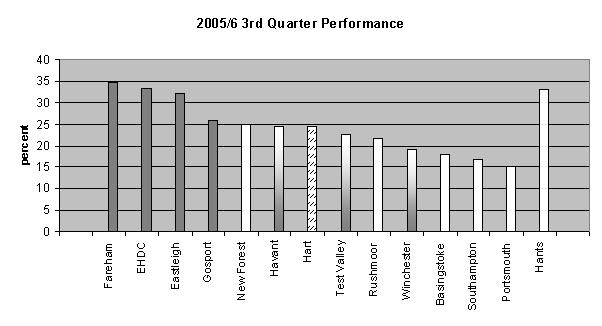
APPENDIX 2 - Review of Existing Constitution | |
The Constitution will need to be amended to reflect the new emphasis on clusters and the waste to resource agenda. It is also proposed that the revised constitution will subsume the remaining aspects of the Memorandum of Understanding. The Existing Board have expressed a wish to do this for some time. The Constitution will therefore form part of a trio of core documents which must be approved by the constituent authorities: _ The Constitution _ The JMWMS _ The 5 year Action Plan New Constitution headings: · Background and Purpose · Vision, aims and objectives (including cross reference to the Joint Municipal Waste Management Strategy) · Functions and Composition of the Board · Role of Board members · Decision making · Action plan (formally Business plan) · Role of Policy Review and Scrutiny Committee · Executive Officer and Professional Support · Conduct and Expenses of Members Supplementary Documents to the Constitution These would include the following: Legal opinion is being sought on whether these would need to be referred to each individual authority for modification. 1. Intra authority payments 2. Joint Campaigns (eg Recycle for Hampshire) 3. MRF materials input specification 4. Delivery points. 5. Executive Officer job description |
Appendix Nine
Proposal for Thematic Scrutiny Review
Report of the Chief Executive
Contact: Philippa Smart ex 7336
e-mail:[email protected]
1.Purpose:
The following Thematic Scrutiny Review has been proposed by the Environment and Transport PRC and requires approval from this Committee to be allocated resources as part of the overall work programme for scrutiny.
2. Proposed Review:
The proposed review is as follows:
1. Name of Proposer: |
Environment and Transport PRC (Councillor Hutcheson leading) |
2. Subject of Review |
Transport in the Community |
3. Aim and Objectives |
Aim: To assess the effectiveness of passenger transport services in Hampshire in meeting community needs, and to make recommendations for improvements. Objectives: · to review the range of transport services provided by the County Council and other transport agencies and bodies to enable the identification of gaps · to examine customer needs and the quality of service provided to establish whether the quality of service could be improved to meet customer needs more closely · to consider the cost effectiveness of the delivery of services to ensure that best use is made of the County Council's limited resources to support passenger transport services · to identify the scope for better co-ordination of existing vehicles and services and for greater clarification of the diversity of responsibilities across multiple agencies in Hampshire · to consider the impact of service changes on the journey to work, particularly for those on lower incomes |
4. Type of scrutiny: |
Policy Development / Policy Review |
5. Factors prompting the topic: |
The County Council meeting on the 22nd February 2006 resolved that a member / officer working group would be established to review transport in the community. This was endorsed at the Environment and Transport PRC on the 25th May. A small scoping group has met on several occasions to firm up this proposal. |
6. Outcomes to be achieved: |
- Identification of gaps in the range of transport services in Hampshire in relation to community needs - Identification of areas for improvement in the quality of services provided - Proposals for improvements to the cost effectiveness of services - Actions to improve the co-ordination of existing vehicles and services - Achievable steps to arrive at greater clarity about the diversity of provision - Improved understanding about the impact of service changes on the journey to work for those on lower incomes and suggestions to mitigate any impacts identified |
7. Proposed methodology: |
The approach to scrutiny will be evidence based, allowing a variety of stakeholders to contribute to the debate, additional work to be commissioned on specific topics, within financial constraints, and conclusions to be drawn. It is proposed that a planning sub group of the Environment and Transport PRC will meet in the new year, to determine membership of a review steering group, to draft terms of reference, to identify a time frame, any priority areas, and to map out a programme of meetings and activities relating to the work to be undertaken to achieve the stated objectives. The style of approach will be along the lines of a select committee. |
8. Resourcing: |
Support to the review will come from the Policy Unit Scrutiny Team, and from Democratic Services; in addition, project management support will be provided by the Environment Department. |