
Archived decisions
Hampshire County Council Executive Lead Member - Children's Services 15 December 2006 Non County Placements & Independent Fostering Provider Placements Report of the Director of Social Services |
Contact: |
Kate Hart |
Ext: |
7107 |
E-mail: |
1 Summary
1.1 This report sets out to explain the criteria for Hampshire County Council's use of Non-County Placements (NCP's) and Independent Fostering Provider Placements (IFP's). It explains the pressures that have caused the usage of these placements to increase in recent months, and sets out some activity data which clarifies the detail of some of those pressures.
1.2 The report also explains why even though numbers of placements have been stable, costs have risen significantly. Finally the report addresses actions which are planned or in progress which are designed to control and reverse this trend. This report does not, however, address the impact of the Green Paper `Care Matters', on potential future actions in any detail.
1.3 During 2006, Treasurer's Consultancy have been reviewing the issues relevant to children with disabilities placed in NCP's. Key factors have been incorporated into this report, and its recommendations are also addressed here in part.
2 Introduction
2.1 Children looked after are a very significant responsibility of all local authorities in respect of whom they act as a corporate parent. Numerous regulations apply to the way in which their care is planned and managed. Currently, there is particular focus on the needs of this group of children through the recent publication of the Green Paper "Care Matters". A number of events are taking place with Members, staff and young people in order to inform Hampshire's response to the consultation.
2.2 Hampshire is a registered fostering provider and runs a family placement service which seeks to meet the needs of all Hampshire's children looked after who have been assessed as needing foster care. For some years, it has been the case that Hampshire's fostering service has not had the capacity to meet all the needs identified, and additional placements have been purchased from registered independent providers.
2.3 Hampshire also runs a residential service for children looked after, which is currently registered for 53 children and young people. It provides accommodation in 8 units with an occupancy of 6, and 5 in the 9th. Currently a review is underway in respect of one unit, and stakeholders are being consulted on a number of options. On occasion, there is no vacancy for a young person who has been assessed as needing the residential service; on other occasions the young person's particular assessed needs has led to a decision to purchase an alternative specialist residential placement from the independent sector.
2.4 Hampshire has three respite care units for children with disabilities, but has no provision for those children whose level of disability and family situation has led to the conclusion that they require long term residential accommodation.
2.5 All provision for children looked after has to be registered according to legislation and regulations and it is regularly inspected by the Commission for Social Care Inspection (CSCI). Registration for both foster homes and residential units includes clear specification of numbers of placements available, age range and gender of child who might be admitted, and the nature of the service to be provided (short or long term care, emergency placements, respite care). It is not possible for placements to be made outside the limits which have been established as part of the registration process - the registration has first to be changed through a formal process.
3 Placement Needs
3.1 Hampshire's children's social care service includes in its remit the accommodation of children whose parents are prevented from caring for them, and children who are abandoned. It also includes the responsibilities of a corporate parent for children who are subject to Care Orders following a court process, and the protection of children from harm will regularly lead officers to seek Care Orders from the Courts which will enable children to be removed from home and cared for in a safer environment. Young people can also be remanded to the care of the local authority following a Youth Court (criminal proceedings) process.
3.2 Needs can in many cases be planned for, particularly for those children for whom the authority seeks a Care Order and has a care plan which involves long term care away from home. However, many needs cannot be predicted so clearly on a case by case basis, although the knowledge of the system means that the need for placements to be available at short notice is factored into recruitment, provision and registration criteria. Situations leading to unplanned or unpredicted emergency placement needs include: abandonment; unaccompanied asylum seekers newly arrived; emergency protection orders; police protection orders; remands to local authority care.
3.3 Other situations can generate demands for urgent placement provision for children who are already looked after, and whose placement is no longer available to them. Reasons can include: placement breakdown, where foster carers can no longer manage difficult behaviour; allegations against carers where the child could be at risk; safety issues where the child's behaviour may put the foster carer or their children or other members of the public at risk; safety issues when the young person is a risk to themselves.
4 Numbers of Children Looked After
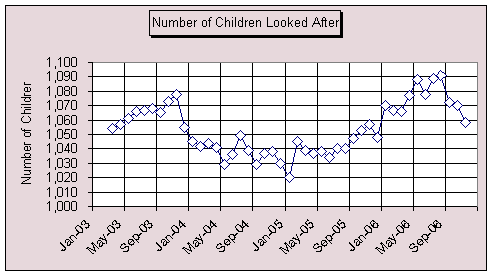
4.1 Hampshire's numbers have seen a slow but steady increase in recent years, although at the same time numbers of children cared for and supported in other ways have also increased (adoption, Residence Orders and kinship care).
Special Guardianship Orders were introduced in 2006 and are a further option.
Hampshire County Council Full Time CLA Numbers for selected dates between 2003 and 2006
Jan/2003 |
Jan/2004 |
1,045 |
Jan/2005 |
1,020 |
Jan/2006 |
1,070 | |
Feb/2003 |
Feb/2004 |
1,042 |
Feb/2005 |
1,045 |
Feb/2006 |
1,067 | |
Mar/2003 |
1,054 |
Mar/2004 |
1,044 |
Mar/2005 |
1,039 |
Mar/2006 |
1,066 |
Apr/2003 |
1,057 |
Apr/2004 |
1,041 |
Apr/2005 |
1,037 |
Apr/2006 |
1,077 |
May/2003 |
1,061 |
May/2004 |
1,029 |
May/2005 |
1,038 |
May/2006 |
1,088 |
Jun/2003 |
1,066 |
Jun/2004 |
1,036 |
Jun/2005 |
1,034 |
Jun/2006 |
1,078 |
Jul/2003 |
1,067 |
Jul/2004 |
1,049 |
Jul/2005 |
1,040 |
Jul/2006 |
1,089 |
Aug/2003 |
1,068 |
Aug/2004 |
1,039 |
Aug/2005 |
1,040 |
Aug/2006 |
1,091 |
Sep/2003 |
1,065 |
Sep/2004 |
1,029 |
Sep/2005 |
1,047 |
Sep/2006 |
1,072 |
Oct/2003 |
1,073 |
Oct/2004 |
1,037 |
Oct/2005 |
1,053 |
Oct/2006 |
1,070 |
Nov/2003 |
1,078 |
Nov/2004 |
1,038 |
Nov/2005 |
1,057 |
Nov/2006 |
1,058 |
Dec/2003 |
1,055 |
Dec/2004 |
1,030 |
Dec/2005 |
1,048 |
Dec/2006 |
|
4.2
 The numbers of children looked after in Hampshire per 10,000 population have been lower than for England as a whole. While this remains the case there have been an increase in the numbers of looked after children in Hampshire. Hampshire's position as regards comparator shire counties following this increase will not be clear until March 2007 when new official data becomes available.
4.3 The reasons for the increase in Hampshire are two-fold. Nationally authorities have become more risk averse since the report of the death of Victoria Climbié. However more significantly improved inter-agency working locally has led to better identification of needs which has led to more children becoming looked after.
5 Capacity of Hampshire's Fostering Service
5.1 Hampshire has maintained a very strong campaign to recruit foster carers and there was a significant increase in carers two years ago.
Registered Carers
April 2004 |
April 2005 |
April 2006 |
August 2006 | |
General Foster Carers |
253 |
315 |
310 |
303 |
Family + Friends Foster Carers (usually named child only) |
120 |
145 |
148 |
146 |
Respite Foster Carers* (provide Respite only) |
42 |
34 |
29 |
27 |
* staff try to encourage registration for more than one category to maximise flexibility and capacity.
5.2 There are a number of issues which impact on overall numbers. Recruitment continues successfully, but the age profile of Hampshire foster carers is such that a number of carers are retiring; others maintain their commitment to children placed with them through long term options outside the looked after system (Residence Orders, Adoption and now Special Guardianship). This takes them out of the general pool of foster carers while they provide a permanent home for children who were previously fostered by them. There remains a regular turnover of foster carers who resign because they may move away, have to care for elderly relatives, have health problems, have marital difficulties, or who have to prioritise the needs of their own children.
6 NCP and IFP Numbers
6.1 Although NCP and IFP numbers have overall been fairly stable for some years, recent months have seen a significant increase in some areas of provision.
NCP Placements |
NCP Placements for Children with Disabilities (CwD) |
IFP Placements |
Total | |
31.03.03 |
27 |
56 |
100 |
183 |
31.03.04 |
20 |
52 |
116 |
188 |
31.03.05 |
21 |
48 |
125 |
194 |
31.03.06 |
19 |
50 |
111 |
180 |
31.04.06 |
20 |
49 |
120 |
189 |
31.05.06 |
21 |
46 |
119 |
186 |
31.06.06 |
20 |
46 |
127 |
193 |
31.07.06 |
20 |
46 |
140 |
206 |
31.08.06 |
20 |
46 |
142 |
208 |
30.09.06 |
19 |
45 |
141 |
205 |
6.2 From March 31, 2006 to September 30 2006, there was an increase of 30 in the number of IFP placements, and a reduction of 5 NCP placements. The reasons which have led to these changes in placement numbers are different for different types of placement, and thus will be addressed separately.
7 Factors Impacting on Use of Non County Placements
7.1 For children with disabilities (CwD), the numbers are very stable, but the turnover within these numbers is also low, reflecting placements made after detailed long term planning and decision making processes. These children typically are mid teens and have previously been supported with high level family support packages. They are likely to need residential care until adulthood and in most cases beyond the age of transition to Adult Services provision.
7.2 The key driver for the work of Treasurer's Consultancy was that NCP's for CwD represent 6% of the number of active cases but 42% of the costs, hence the need to explore options for appropriate local care at lower cost.
7.3 Treasurer's Consultancy looked at a range of national research. A survey found that 60% of families with children with profound and multiple disabilities spent in excess of over 10 hours a day on basic physical care, with a third of these providing 24 hour care. This has a significant impact on the family's ability to work, resulting in employment limitations and extra costs. These families are thus at greater risk of both stress and poverty.
7.4 For non-disabled children in non-county placements, while the numbers have been fairly stable, the turnover has been quite high, and the length of stay will in some cases be months only and in most cases between 1-2 years maximum.
7.5 The numbers in NCP's generally can be affected by capacity in Hampshire's own provision, and demand and assessed need for residential provision does fluctuate. While the fluctuation may involve small numbers, the cost of residential provision is such that even 3 additional NCP's can add a pressure of approximately £500,000 per annum to the budget.
7.6 Hampshire's own residential provision can in turn be affected by capacity in the fostering service. Recent analysis in one unit has shown that most admissions in the course of a year would have gone to in-house foster care if it had been available. Young people whose needs have been assessed as requiring more specialist residential provision include: those who have serious sexually abusive behaviour to other young people; those with a history of serious fire setting; those with high risk self harming behaviour; those requiring treatment for drug addiction; and those whose challenging, risky or violent behaviour cannot be managed in groups as large as 6 young people.
8 Factors Impacting on IFP Usage
8.1 In a very small number of cases, (about 5 children currently) there has been a positive decision to use an IFP, due to either the therapeutic support that can be provided to the child in placement, or to geography: to enable children to be placed near family members for contact. Other decisions have been led purely by the issue of lack of capacity in Hampshire's own provision.
8.2 Hampshire seeks to use its provision as effectively as possible. Carers are registered for as wide an age range as is reasonable and as many children as they can reasonably be expected to manage and as is appropriate for their accommodation. The regulatory maximum is 3 (other than in exceptional circumstances). To reduce the spend on IFP placements, Hampshire uses as many vacancies in its own system as is possible, and it is regularly effectively full. At any one time, some carers are unavailable (through illness, family crisis, allegations being investigated, moving house etc). Similarly it is not possible to use some vacancies for specific children, for example to place an older girl in a vacancy which would involve sharing a bedroom with an older boy; a teenager in a vacancy registered only for a child aged 0 - 5 years.
8.3 Other factors can impact on the use of IFP's. Contact arrangements ordered by the courts for babies and children subject to care proceedings can be up to 5 or 6 times a week. If a Hampshire carer is available but is at the opposite end of the County, the travelling and staff costs of providing the contact can be in excess of the weekly cost of an IFP close to the child's home. Carers who have work or family commitments may not be able to care for a child who does not have a full time school place; school exclusion can disrupt a foster placement.
8.4 If a sibling group is subject to care proceedings, there will be a strong presumption in favour of placing the siblings together. Hampshire's use of its own placements to capacity could well mean that no such placement with 2 or 3 vacancies together is available. Once children are placed, care proceedings can take several months or even a year or more to come to a conclusion. Courts are very critical of decisions to move children for financial reasons, if they are settled and progressing well in their IFP. Children's Guardians can, and have, taken Hampshire to Judicial Review over a decision to make such a move, so moving children from an IFP to a Hampshire vacancy is not always straightforward.
8.5 Finally, research and experience are both clear that moves of children to different placements which involve a change of school have an adverse effect on their educational progress and achievement.
9 Independent Fostering Provider Placements for Children with Disabilities
9.1 In many cases and for most children a fostering placement will be preferable to a residential placement as it will most closely meet their needs. However identification of fostering placements for these children is difficult: their behaviour may require attention day and night which would be a contra-indicator to a foster home. Similarly, mobility and equipment needs can make it very expensive to adapt a foster home to be suitable to meet the needs of a young person who is a wheelchair user, who needs ground floor accommodation, or who needs help with lifting. Hence Hampshire has few children with disabilities placed with its own carers.
9.2 Hampshire has slowly managed to increase the numbers placed with IFP's but the total is only 11 and it remains an area for further development, and will be addressed as part of an overall commissioning strategy.
10 Increased Costs
10.1 The area that has been analysed particularly through the Treasurer's Consultancy is the area of non-county placements for children with disabilities. Numbers have been very stable but costs have gone up significantly. The overall cost of the current cohort for Children's Services was £6m as at January 2006. Actual expenditure increased by £1.4m on 2003/04 figures for approximately the same number of children. Because placements are planned over a long period and are usually made to last for 2-4 years (providing it remains appropriate) placements now ending have been made some 3 to 4 years earlier. Costs have risen significantly in the independent sector over the past 3 to 4 years. Similarly, Hampshire is seeking to support children at home whenever possible.
10.2 It is recognised that the Health contribution to the costs of CwD is low and work has begun with the new PCT to re-establish a new and more robust protocol on shared funding arrangements.
10.3 The needs of young people going to residential care have thus similarly increased over the same period. Some young people's needs have been so complex and challenging that in 4 or 5 cases, 30 to 40 residential units approached have felt unable to meet their needs, until one unit has finally been found at the end of a lengthy search. Needs will require waking night staff, high levels of supervision at all times and care across the whole year, with consistency of approach between the education and care components of the service.
10.4 The cost of new placements is therefore not "like for like" with those that are ending; even though the overall numbers may be the same, the new placements are at a higher cost to reflect these needs.
11 Action taken to date
11.1 Hampshire has two contracts with IFP's with whom the majority of IFP placements are made. The basis of the contractual arrangements are being reviewed but they have been negotiated to provide preferential rates for high levels of usage.
11.2 Hampshire has joined a regional consortium in relation to its purchase of non-county placements. The consortium has arrangements in place which monitor for quality and which also operate to manage pricing levels and inflation cost increases. It is looking at developing more robust preferred provider arrangements.
11.3 Hampshire has (in 2005) entered into a contract with Stonham for provision of supported lodgings. This provides a small number of high intensity supported placements to facilitate the return of young people (aged 16+) from NCPs to appropriate supported accommodation in Hampshire. The development of capacity within this service has taken longer to achieve than was originally planned. This is being addressed with the provider. Consequently, the 2006/07 savings target of £440,000 will not be achieved, only savings of £100,000 are predicted to be achievable. Looking ahead to 2007/08, where savings were originally expected to increase to a total of £590,000, the forward budget strategy currently being developed is likely to amend this projected saving target to be £100,000. The care leavers service continues to make maximum cost effective use of this provision, subject to its availability.
11.4 Additional investment in the fostering service in 2005/06 (£166,000) was made to enhance support to carers and to develop additional in house placements with carers through provision of a professional fee. This enabled 9 children in the year to either move back to Hampshire from external placements or to be cared for without recourse to an IFP. Although it was designed to be a self funding scheme, the increase in activity as children looked after numbers have increased, means that the in-house fostering and the IFP placements budgets both are currently projecting end of year overspends.
11.5 Treasurer's Consultancy has run a workshop on the needs of CwD, looking at alternative strategies to residential care and priorities for the development of local services that would act to limit the demand for expensive external placements.
11.6 A new short life panel was set up in September 2006 to bring further focus to bear on the requirements of some young people in NCP's, in order to plan alternative in house provision. It is necessary for this to be planned and resourced with other agencies as these young people have complex needs which require a co-ordinated multi-disciplinary approach. Achieving a placement alongside a full time school place and therapeutic / psychological support can involve a complex set of negotiations and is hard to achieve as a package, hence an additional focus on this activity.
12 Further Action to be Taken
12.1 Work has begun to develop a comprehensive commissioning strategy for looked after children. This will allow for detailed consideration of possible changes to the service which would enable Hampshire to manage some of the needs which it currently has to purchase from other providers.
12.2 Now that the Green Paper, Care Matters, has been published, any consideration of arrangements and services for children looked after will need to reflect the Green Paper, and any subsequent proposals or amendments once the consultation has closed in January 2007.
12.3 Further contracting arrangements are being negotiated with IFP's on a cost and volume basis to reduce costs to the authority.
12.4 Hampshire's fostering service continues to work hard to recruit foster carers and to support those it already has in order to retain their services. Other reports have identified a range of initiatives being developed to enhance and develop Hampshire's own foster care capacity. In particular, the development of a Level 5 skills fee for carers offers a comparable remuneration to carers to that on offer from IFP's, and other initiatives - some of which have been in place for some time - provide good support and training opportunities.
12.5 Hampshire Children's Services managers are reviewing the criteria for bringing care proceedings and are reviewing those circumstances under which children are accommodated at parents' request, with a view to even tighter gatekeeping of this service. Policy and practice require that a Family Group Conference is held, and that if a placement is required it is provided by family members wherever possible.
12.6 Hampshire continues to broker and support the use of other options to provide care and security for children. Consequently, it has seen increase in the use of kinship care and Residence Orders is increasing; adoption is sought wherever appropriate, and Hampshire is now supporting the use of Special Guardianship Orders. Further oversight of care planning arrangements has been put in place to ensure that they are sufficiently robust.
12.7 For the past 3 years, a Placement Forum has operated within social care at District and County level to review all children in NCP and IFP placements and to gatekeep and consider all potential new placement requests. The County Forum has also monitored the capacity in Hampshire's fostering and residential provision, and makes decisions to use the available capacity to best effect county wide.
12.8 Arrangements are planned from January 2007 to bring together the social care and special educational needs County fora so that there is early joint consideration of the needs of young people with special needs or disabilities. This will maximise planning and provision of Hampshire's own resources and ensure that there is joint decision making about expensive, specialist provision when there is no other alternative.
12.9 Treasurer's Consultancy workshop brought together a range of staff who made a number of proposals for improving local and community based provision. Some of these represent best practice and staff will be reminded of these and encouraged to make maximum use of the opportunities that these present.
12.10 A need for greater consistency across the County was identified to ensure that all children with disabilities have equitable access to service provision and that professional judgement does not lead to differential arrangements.
12.11 Proposals for the use of the LPSA 1 reward grant money include plans to invest in children looked after (to the value of £625,000); to reduce pressures on the purchasing budgets by more robust scrutiny of contracts; more detailed county wide management of fostering vacancies to maximise the use of in-house provision, and contracting with IFPs to increase in house foster care provision. Further work is underway to evaluate the potential savings from this investment.
12.12 Due to the nature of services required by children with complex needs, it is agreed that a priority area for joint commissioning with the new PCT would be a range of cost effective services to support children in their own families. This will be subject to further consideration in the near future.
13 Legal Implications
13.1 There always remains the potential for legal challenge on individual cases basis in respect of placement decisions for looked after children.
14 Financial Implications
14.1 Recommendations are designed to reduce future spending to be contained within the budget even with an increasing number of children to look after. The financial implications will be considered further in the forward budget consideration at Executive Member meeting in January 2007.
15 Personnel Implications
15.1 None.
16 Impact Assessment
16.1 Race and Equality Impact Assessment has been considered in the development of this report and no adverse impact has been identified.
17 Crime Prevention Issues
17.1 None.
18 Views of the Local County Councillor
18.1 N/A
Recommendations
1. That the Executive Member for Children's Services endorses the action being taken to manage the placement needs of children looked after.
LINK(S) TO CORPORATE STRATEGY | ||
Yes |
No | |
Hampshire safer and more secure for all |
|
|
Maximising well-being |
|
|
Enhancing our quality of place |
| |


Section 100 D - Local Government Act 1972 - Background Documents
The following documents discuss facts or matters on which this report, or an important part of it, is based and have been relied upon to a material extent in the preparation of this report.
NB the list excludes:
1. Published works
2. Documents which disclose exempt or confidential information as defined in the Act