
Archived decisions
Hampshire County Council | ||
Cabinet |
Item 10 | |
18 December 2006 | ||
Adult Services Modernisation Strategy | ||
Report of the Director of Adult Services | ||
Contact: Rea Mattocks (01962) 847200 email: [email protected]
Nicky Pendleton (01962) 847275 email: [email protected]
With the concurrence of the Chairman under Section 100B (4) (b) of the Local Government Act 1972, this matter has been included on the agenda to enable the Cabinet to make early decisions on the operational and financial strategy for the Adult Services Department during 2007/8.
1. Summary
1.1 The purpose of this report is to set out the strategic direction for Adult services for the next five years, outlining the current context and key drivers, which include financial recovery, government requirements and performance imperatives.
1.2 To gain Cabinet support for the strategy and timetable for implementation.
1.3 This report supports the Corporate Strategic objectives of maximising well-being in that it outlines how the department will support individuals to maintain and improve their well-being and independence and Hampshire safer and more secure for all through use of telecare for appropriate individuals..
2. Introduction
2.1 There are a number of key drivers which have been considered in developing this strategy. These are:
2.1.1 Demography
By 2011 it is estimated that the number of people aged 50 and over in the UK, will increase by 1.9 million, from 20 million in 2003 to 22 million, and will reach 25.5 million by 2021. The most significant increases will occur in the number of people aged 80 and over, who are expected to double in number between 2001 and 2031, from 2.4 million to 4.9 million.1.
In Hampshire the implications of an ageing population are already a reality as the Office of National Statistics estimate that between 2004 and 2005 the number of people aged 75 and over had increased by 5,500. By 2012 this will increase by 11% which is 12,000 more people over the age of 75.
2.1.2 Recent policy documents which include-
_ Independence well-being and choice
_ Our health our care our say
_ Strong and prosperous communities
_ Choosing health
_ National Service Frameworks - for Older people, Mental health, Long term conditions, Valuing people
2.1.3 The themes of recent policy are:
_ Promoting social inclusion and well-being
_ Developing sustainable, preventative services
_ Marshalling of resources across local authorities, NHS and other agencies to address well-being
_ Developing local leadership and enabling co-operation across statutory agencies
_ Aligning commissioning, performance and inspection mechanisms
_ Empowering citizens to have greater influence over services through a stronger "voice" and greater choice and control.
3. Local drivers
3.1 Over the last year the department has been managing the financial recovery programme in response to demographic and performance pressures. This has resulted in the development of a modernisation strategy for Adult Services in Hampshire, which will meet the needs of vulnerable residents in the 21st century.
3.2 Cabinet will be aware of the importance of maintaining the reputation of Hampshire County Council as a provider of high quality and constantly improving Adult services as part of the CPA process. The current two star rating was achieved on the basis of performance last year, when the financial recovery plan was not in place. Next year's rating is dependent on current performance which is challenged by the need to balance achievement of key performance indicators and financial recovery when modernisation of services as set out in this paper have not been implemented. These indicators require the department to provide high quality, timely services with a greater percentage of people supported at home than in residential settings.
3.3 The County Council has a responsibility to provide community leadership, which includes a specific legal power to promote wellbeing (Local Government Act 2001) The Director of Adult services role in leading the well-being agenda was defined in guidance following "Independence, Wellbeing and Choice" and "Our health, our care, our say."
3.4 The Director's and Lead Member's responsibilities for well-being were further confirmed in "Strong and Prosperous Communities". In Hampshire this is being led by the Director, in partnership with the Hampshire Primary Care Trust working with a jointly appointed Director of Public Health.
3.5 Increasingly, service users expect to have their needs met in a person-centred way, retaining autonomy and independence and choosing how services will be provided to meet their needs. The patterns of provision are already changing in Hampshire, driven by service users' aspirations. Consequently the department needs to respond differently in future and services need to change to reflect this. This can be complicated by anxiety created by change leading to a reluctance to accept the need to modernise.
4. The Strategy
4.1 The framework for the modernisation of adult social care is set out in the Green Paper "Independence Wellbeing and Choice" published in March 2005. This paper outlined seven key outcomes for social care:
i) Improved Health
ii) Improved Quality of Life
iii) Making a positive contribution
iv) Exercise of choice and control
v) Freedom from discrimination or harassment
vi) Economic Well-being
vii) Personal Dignity
4.2 As a result, the emerging vision for Hampshire County Council is to shift the balance from dependency to independence, and the focus from illness services to preventative services by promoting the well being agenda through healthy communities. Adult services will focus targeted services and resources on those people who meet their eligibility criteria, but will work in partnership with other services to meet the wider agenda of improving well-being. The diagram in table 1 of the "Rainbow" of well-being shows the interventions and services that deliver healthy communities and individual well being, and where the targeted services assessed and arranged through Hampshire County Council Adult services fit in that spectrum.
4.3 The County Council is already taking a lead in adopting maximising well-being as a major strategic theme, and work is underway across the county council departments and through the LAA to develop implementation plans to ensure delivery.
4.4 Table 1
Our responsibility | ||||
Not an inevitable journey through life | ||||
Healthy communities |
Wellbeing services |
Preventative services |
Targeted social care services |
Illness services |
- Public health capacity bldg Social capital - Nutrition - Clean and safe |
- Housing - Education - Access to work |
- HCC - Health - Private - Vol orgs |
- HCC -Health - Private -Vol orgs |
- Acute hospitals - Hospices |
4.5 To illustrate how Adult services is responding to the needs of vulnerable people who meet critical and substantial eligibility criteria a number of brief case studies are set out in Appendix 1.
5. Supporting people within their own homes
5.1 In Hampshire, service users are increasingly expressing a preference to remain in their own homes wherever possible and this is the thrust of central government policy. As a result, the Adult services strategy is to keep people independent in their own homes as a first choice, while ensuring high quality end of life care. To support the strategy of independence at home the following service modernisation is required:
5.2 Home Care service will need to be remodelled, and integrated with care management. The future model will be for service users to receive their initial home care assessment and up to six weeks intervention from trained in-house staff who will aim to maximise independence and reduce or eliminate the need for on- going support if possible . At the end of this time both service user and home care/care manager can be confident of the right level of home care needed and purchase in the most cost effective way from the most appropriate service provider.
5.3 A new meals service will need to be provided through a contractual framework ensuring key standards are met. The service will consist of a hot meals service for short term (emergency)needs and a frozen meal service for those with long term needs. Where a frozen meal is provided the service includes provision of a small microwave and freezer where the service user needs one. The frozen meal service will be re-tendered through County Supplies, in partnership with Essex and West Sussex. The contractual framework will include smaller providers to meet minority ethnic and other special needs. A further option to enable vulnerable people who do not meet eligibility criteria to benefit by purchasing from the same supplier is also being explored as part of the re-tendering exercise which will support the wellbeing agenda, and will be cost neutral.
5.4 Individuals will be supported to gain further control over how their care is provided. The Department will build upon its success with Direct Payments and will explore developing individualised budgets which allow even greater choice and control for the individual over how their needs will be met. This will require a new model of finance management building on learning about Direct Payments. The department is trialling this with a small number of service users through the future builders pilot project. An example in Appendix 1 shows how this is different from traditional care.
5.5 The benefits of Tele-care will be maximised. This equipment enables remote monitoring of vulnerable people and is a key component of the strategy to keep people safe within their own homes. Implementation is being managed with District council and other partners through the Local Area Agreement.
6. Providing improved options for accommodation and care
6.1 Across the country, local authorities have been working in partnership with other agencies, such as Registered Social Landlords, to develop better options for people who require accommodation and care support. A very popular option is proving to be the provision of ExtraCare Housing, which many service users find preferable to moving into residential care. ExtraCare Housing is seen by many people to provide the security and reassurance of residential care, whilst still allowing the individual to maintain their privacy, independence and dignity through a tenancy, shared-ownership or full ownership of a one or two-bedroom flat. This preference applies to individual service users from all the traditional Adult services care groups. New models of extra care are demonstrating needs can be met more efficiently and effectively at lower unit cost than residential care, for most people (See examples within Appendix 1).
6.2 The approach taken will be to increase the availability of Extra care housing where the department has sole nomination rights. This will enable the department to provide care at home for the physically frail who might previously have had little choice but to enter residential care. This strategy will provide an increased supply of up to date accommodation in extra care housing, and will be implemented by working in partnership with others including the Housing Corporation and District councils to invest in extra care housing schemes.
6.3 The county council will therefore no longer invest in re-providing or modernising Residential care homes which have reached the end of their useful life. Currently there are 32 residential and nursing units providing 1324 beds. By the end of 2009 there would be 28 such units providing 1189 beds and 180 extra care tenancies where Adults services has sole nomination rights, giving a total of 1369 beds. This will increase capacity and additional beds will be purchased from the independent sector or through tenancies in local authority extra care schemes as necessary.
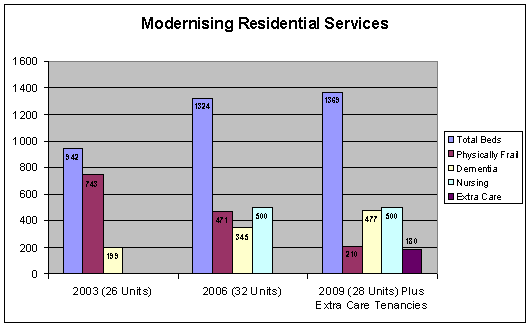
6.4 Occupancy rates in our in house residential are running at a high percentage in order to maximise the use of already committed internal costs. Purchasing residential beds in the independent sector has consequently decreased, and the independent sector will, therefore, have capacity into the future for people who have a preference or need for residential care over and above internal provisions. However, we are clear that some of those people currently in our residential homes would have chosen extra care housing as their first option had that resource been available.
6.5 The retained in-house residential care will specialise in dementia care for which there is a clearly identified growth in need and less capacity in the independent sector. Over time, the department will need to balance in-house and other service provision, to take into account demographic issues facing the county council.
6.6 Choice has already been enhanced as a result of the County Council investment in Nursing Homes which has seen an increase in 500 beds in 10 state of the art modern nursing homes in the last three years. This ensures dignity and high quality end of life care for those unable to remain at home because of their very high care needs which can no longer be managed at home or in an extra care scheme. A small number of service users resident in the nursing homes will recover and with rehabilitation will be cared for in more appropriate settings.
7. Providing improved day opportunities
7.1 Day opportunities have traditionally provided care away from home. They have been separate from mainstream activities and whilst they may provide effective respite for carers they have not promoted social inclusion and access to universal activities available to most citizens and have resulted in a segregated community of vulnerable people .An example of our piloting work through the Dynamite project is given in Appendix 1 and illustrates how we are modernising services.
7.2 In future, the strategy will be for day centres to be transformed into well-being centres for all care groups where appropriate, targeting those who meet Hampshire's eligibility criteria and aiming to build up confidence and new skills. Service users will be supported to access universal services which meet their aspirations and needs, so promoting social inclusion. It is anticipated that the Contact centre will assist in diverting those who do not meet our eligibility criteria into universal services by having access to comprehensive information about what community services are available.
7.3 Younger adult service users have indicated a strong preference for a focus on assisting them with access to work and the Adults services will work with the Hampshire "Own Grown" project to become an exemplar for this, together with developing opportunities to promote employment opportunities with other partners across the Local Area Agreement.
7.4 The department recognises the need to retain some traditional day services particularly for those with dementia where respite for older carers is a key factor. However this will not exclude researching and piloting other models of respite, such as respite at home which will increase choice for specific circumstances.
7.5 The department will need to work very closely with the Voluntary sector to enable further research and development of innovative modern solutions for service users. The grants programme will be used to pump prime this work, which once implemented will be subject to contracts with detailed specification for service provision.
8. How modernisation supports the financial position and achieving performance targets
8.1 The last financial year was the most difficult one faced by the Service, with an unprecedented demand which resulted in an overspend. The main pressures during the financial year were due to increasing numbers of vulnerable people and increasing complexity of need amongst those eligible for services. This is a continuing challenge as a result of longer life expectancy and higher survival rates brought about by NHS modernisation, and is a trend both at a County level and nationally.
8.2 It is recognised that there is an imperative to provide services within budget and meet statutory responsibilities for increasing numbers of people with rising expectations about how services will be delivered. There are also risks to the reputation of the County Council because of the impact of Adult services performance on the Comprehensive Performance Assessment.
8.3 This Adult services modernisation strategy will enable the County Council to make the best use of the resources available for vulnerable people eligible for targeted services and is essential to delivering the Adult services financial recovery programme. This is targeted with bringing the budget back on line by the end of the financial year 2007/08
8.4 The unit costs of providing care at home, including in extra care sheltered housing schemes are significantly cheaper than residential care provision for the county council. This is because there is greater clarity about the service users needs and the costs of care to meet those needs. The costs of housing, maintenance, utilities and food, together with health costs, including home nursing, are funded from other revenue streams. In addition there is the important benefit that the service user retains their tenancy or home ownership and is less likely to have use all their capital. The service users independence can be retained, with the support of their established network in their community so reducing the need for care and improving the outcome for the individual.
8.5 New models of extra care are demonstrating needs can be met more efficiently and effectively at lower unit cost than residential care, for most people. See Appendix 1 for an example.
8.6 The cost of in house home care and residential care is substantially higher than can be purchased from the independent sector and costs are set to increase as the council implements equal pay legislation. The exception is for dementia care.
8.7 Developing extra care sheltered housing where the department has exclusive nomination rights will be funded in part through closure of four of Hampshire County Council Older Persons Residential homes by 2009. These homes are reaching the end of their useful life and it will be increasingly difficult to meet regulatory standards including those set up the Commission for Social Care Inspection. The residential care beds will be replaced by purchasing the care in extra care sheltered housing schemes. Aligning strategic commissioning of extra care jointly between Adult services and Supporting People will enable greater efficiencies in service provision and maximise the resources available.
8.8 Tendering the new contract for the meals service will improve the quality and choice and will include realistic charges for the service.
8.9 Day centres will be rationalised over time as the model moves to supporting service users to access universal services. This will mean other funding streams are used such as use of mobility allowances for transport and maximising the use of leisure and community facilities.
8.10 In future the small grants programme available in Adult services will be used to develop new services through pump priming the voluntary sector and formalising contract arrangements once the development work has been done.
8.11 The 2007/08 budget includes initial estimates both for financial recovery and efficiency savings which start to implement these proposals as well as bringing the budget back into line with current expenditure. If Cabinet approves the direction of travel and the budget is approved, implementation of the strategy can commence immediately.
8.12 This is a challenging modernisation programme for Adult services at a time of change for all sectors of the County Council. Other key partners such as the Primary care Trust are also changing.
8.13 The capacity to deliver this modernisation programme and financial balance will be challenging. The department has benefited from the Leaders Governance Group which have provided support and guidance as well as scrutiny of detailed plans and it is proposed that this group will continue this role over the next financial year.
Recommendations
1. That cabinet approves the strategic direction for adult services modernisation which will be delivered over the next five years.
2. That the Leader's Governance group continues to provide advice, support and scrutiny as plans are developed, which will be implemented following Executive member for Adult Social Care approval. Such approval will take into account the outcomes of any consultation processes which will be undertaken in appropriate circumstances.
LINK(S) TO CORPORATE STRATEGY | ||
Hampshire safer and more secure for all |
Yes |
|
Maximising well-being |
Yes |
|
Enhancing our quality of place |
No |
|
Section 100 D - Local Government Act 1972 - background documents
The following documents discuss facts or matters on which this report, or an important part of it, is based and have been relied upon to a material extent in the preparation of this report.
NB: the list excludes:
1. Published works
2. Documents which disclose exempt or confidential information as defined in the Act.
None
Appendix 1
1. Examples of new models of working in home care:
1.1 Mr S had a triple heart by-pass and needed assistance with his personal care, dressing and food preparation. Our enablement home care service on Mr S on 10.01.06, and within four weeks it was obvious that he was managing all the tasks by himself so monitoring continued via phone checks for two more weeks before closing the case.
1.2 Mrs H had a knee replacement and required assistance with personal care, dressing and undressing. Home care enablement started with two visits per day, morning and afternoon, then reduced to afternoon only and finally after ten weeks ceased when help was no longer needed.
1.3 Mrs J was referred to home care following hospital discharge following a fall and collapsed lung. She started with 8 hours home care which reduced steadily as she became able to manage. By week 5 she was needing 1.75 hours a week to help her into bed, which was referred on to an agency to provide.
2. Examples of benefits of tele-care:
2.1 A bed bound client (Mrs B) aged 100 living with her daughter, who is her main carer in their large private house. Mrs B was frequently trying to get out of bed at night and falling. As a result her daughter was becoming exhausted with constantly climbing the stairs to check and becoming anxious when finding her on the floor or balanced in a precarious position about how long she might have been in that position. As a result she was considering admission to nursing care for her mother. A package of OT equipment and Tele-care products was tried. This included a bed lever to support Mrs B to get into a sitting position and pressure mat to alert her daughter that she had put her feet to the floor, and a pager and pillow sensor enabled constant monitoring from the ground floor. As a result Mrs B is able to remain at home and the stress levels for her daughter significantly reduced such that she is happy to continue to care for her mother.
2.2 A 68 year old disabled lady (Mrs C) living alone in an adapted bungalow, widowed a year ago and previously dependent on her husband of 20 years for all care tasks. She was managing following intensive rehabilitation with a care package, support from a friend, with a life-line alarm system. Unfortunately a new neighbour with mental health problems started to frighten her by knocking on the door at night and had tried to get in to her bungalow through a window. As a result she began to feel she should move into residential care. Various tele-care items were fitted including a bogus caller alarm, window protection, and her smoke detector was connected to the life-line. This latter item is essential because Mrs C cannot get out of bed without using a hoist and now has the reassurance that in the event of a fire detected by the smoke alarm, assistance will be summoned. Mrs C is delighted with her "gadgets" and is no longer considering residential care.
3. Examples of Extracare housing:
3.1 Mr and Mrs F lived with their daughter and son- in- law. Both clients had health problems and deterioration led to a family breakdown. A referral to the department in August 2006 requested assessment for possible Residential Care. Following a Care Management Assessment the Social Worker felt their needs could be met by the Extra Care Housing scheme. This would enable them to remain independent at the same time receive the level of care needed. An application was made to the housing department of the local authority, and the clients moved in at the end of October 2006.
The cost of residential care is £654.08 per week. The care package is now £75.00 per week, and the couple have been able to re-establish a home together.
3.2 Mr W had moved into residential care several months previously because of difficulties he was having managing at home with the onset of dementia. He was referred to the care management team because he was desperate to return home. Joint work with home care, his family and voluntary services resulted in a plan to enable this to be tried. Following a home visit, intensive support consisting of four visits a day was set up and reviewed weekly. Over the following ten weeks the package was steadily reduced to three visits a day with day activities on two days a week. At this point the care package was considered to be the optimum needed to keep him safe at home and the care was transferred to an agency to provide. The costs of residential care in a dementia care home were £385 per week. The intensive home care during the enablement period cost £303.00 per week and the day care costs are £42 per day. Once care was transferred to the agency the costs reduced to £196.56 per week
4. An Example of a person centred approach to very complex care needs
4.1 A pilot project called future builders is working with younger people with learning disability at transition. Historically costs would have been in the order of £7,000 per week for institutional care. Under this programme the service users and family are working with the department to develop a person centred specification which includes an individualised "own home" solution provided by a registered social landlord negotiated through the local authority and individualised care. Tenders have attracted over 30 expressions of interest from care providers.
5. Examples of improving day opportunities:
5.1 Two young men with Autism had needs which could not be met by traditional day services. Their families, working with the department and a specialist Trust have developed a programme using support workers which meets their aspirations in an individual way providing them with access to activities of their choice in the community. The young men have very complex behaviour which is different each day and therefore the activities can be matched on a daily basis. Activities might include swimming, going for walks or visiting shops, or just "being" but constantly supported by the support staff.
5.2 In Adult mental health Service users have benefited from appointment of Recovery workers who work with a small group of service users, meeting in community café's and jointly planning programmes with the service users which make use of universal services and include training, skill development and access to work experience opportunities where possible.