
Archived decisions
Looking After Hampshire, Looking Out for You
The Corporate Business Plan
Introduction - Why do we need a Corporate Business Plan?
Hampshire County Council is a top performing 4* authority - and our ambition must be not just to keep it that way but to continually improve our performance in the interests of the communities we serve. The Corporate Business Plan is a key tool for helping us to achieve that goal.
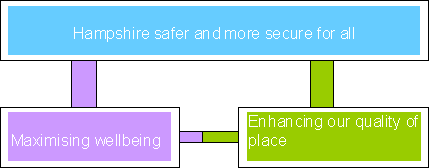
It sets out how we will give practical effect to the Corporate Strategy - `Looking after Hampshire, looking out for you' which was developed by Cabinet and agreed by Council as part of out Policy Framework in July 20006. The Corporate Strategy is a clear statement of the political direction and revised priorities for the life of the current administration and identifies one overarching and two supporting priorities:
· Hampshire safer and more secure for all
· Maximising wellbeing
· Enhancing our quality of place
The Corporate Strategy built on the previous six aims and was shaped by a wide variety of information, including the results of the MORI 2004/05 residents' survey and the countywide Community Strategy. There is therefore a close match with the aims we share with our key partners that are expressed in the Children and Young People Plan and the Hampshire Local Area Agreement, as well as our Local Public Service Agreement with Government.
Our values
Cabinet also re-confirmed their support for a set of values which explain the way in which we aim to work:
· removing barriers to opportunities and improving choice for all
· responding to the improvements that people say they want
· planning for and investing in the future
· encouraging partnership, participation and contribution
As part of our commitment to these values and as a role model for all our plans and strategies, this business plan has been equality and diversity impact assessed and had a sustainability appraisal.
The Corporate Business Plan - what it means for you
The Corporate Strategy is supported by this Corporate Business Plan, which identifies the key projects and activities which will deliver the priorities set out in the political vision. It is therefore a key tool to be used by managers when developing Departmental and Service Plans and ultimately these priorities should find their way into IPPs. This is how we will ensure that there is a `golden thread' linking the political vision and priorities set by Cabinet, through the work of Departments and Services right down to the level of individual members of staff.
The Business Plan will also provide Cabinet and CMT with a framework for managing the performance of the authority as a whole against the priorities which have been set:
· Broadly performance management will happen on an exception basis, so that energies are focused on addressing areas for improvement. However, this will be balanced when there are benefits to celebrating significant achievements.
· Results against the performance indicator targets will be reported regularly to the Executive Members and departmental management teams on a portfolio basis. In some cases responsibility will cross departmental boundaries and there will be a need for the identified Members and officers to work proactively to co-ordinate activity in these cases.
· DMTs will identify areas of concern and action to be taken to address any impending problems and add an appropriate commentary to the performance results. Where appropriate the Executive Member will take action to address them.
· Cabinet and the Corporate Management Team will receive twice yearly summaries of performance results, which highlight areas of concern and proposals to address them.
· At least once a year, information comparing Hampshire results with those of other top tier authorities will provide a context for benchmarking progress with our own local priorities.
·
Although the corporate strategy will remain until the elections in 2009, the business plan will be reviewed and updated annually.
Structure of the Business Plan
The Business Plan is intended to be a useable tool - something that managers get to know and refer back to. It is arranged in four sections. The first three relate to each of the corporate priorities i.e:
· Hampshire safer and more secure for all
· Maximising wellbeing
· Enhancing our quality of place
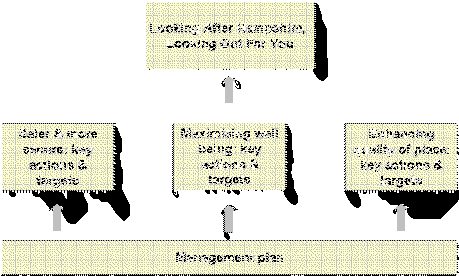
The fourth section, called the Corporate Management Plan, is where we identify the key outcomes which relate more to internal projects and activities than to external service delivery. These are the things which ensure that we are a well-run organisation and are well-equipped to maintain and improve performance. So, for example, this is where things like the Pay & Benefits project, our Risk Management strategy and our staff development plans are picked up.
Outcomes
Under each of the four sections we have identified a number of outcomes which tell us what it is that we are aiming to achieve and how we will know that we have got there.
For example, the first outcome under `Hampshire safer and more secure for all' is
· There is a reassuring, visible uniformed presence
We have also identified the Cabinet Member and Chief Officer who has overall responsibility for ensuring the deliver of each outcome. Very often this will mean working across departments and with external partners to achieve a common goal.
Performance Indicators
To give us a bit more detail, and to help with performance management, we have identified the performance indicators that we will use to judge our progress. There are a small number of performance indicators which relate directly to the corporate priorities and which will help Cabinet and CMT to performance manage the authority as a whole.
For example, the performance indicators for `Hampshire safe and secure for all' are
· Fear of crime
· Actual Crime
At a more detailed level we have identified performance indicators to judge our progress against each of the outcomes.
For example, the performance indicator for `There is a reassuring, visible uniformed presence' is
· Percentage of people stating that ACSOs and PCSOs have made a difference in making the area a safer place to live.
Wherever possible we have aligned targets and performance indicators with those that relate to our key partnerships such as the Local Area Agreement and the Children's and Young People's Partnership.
We have shown a benchmark of current performance and a target for the progress we want to make. In most cases we are looking for performance improvement in each year, but where we have set long-term targets we have also identified milestones so that we can monitor whether we are on track. Targets are reviewed annually.
Activities
At a greater level of detail again we have identified what key activities or projects we will undertake to support the deliver of the outcomes. Again we have identified which manager is responsible for leading the project or activity and again in many cases they will need to work closely with managers in other departments or with partners in other organisations who are also making a contribution.
For those projects that attract new or specific funding it is increasingly possible to identify the financial resources that are allocated. In other cases, development of new activities often requires managers to re-focus their energies or explore new ways of working.
Our capacity to deliver
There is sustained pressure on our financial resources arising from:
· low levels of Government funding
· high expectations of delivering national efficiency targets
· higher than inflation cost increases for some activities
· increasing demands for services for vulnerable people
· the need to maintain moderate levels of council tax to protect the interests of Hampshire taxpayers
This means that we cannot do everything we would like to do. Our focus on a clear set of priorities helps us to decide where our resources should be directed. In setting the budget guidelines for 2007/08 we have recognised the impact of major change programmes underway in the organisation:
· the development of Hantsdirect - a contact centre to deliver improved call handling services
· the Pay and Benefits programme to address equal pay issues and modernise the Council's pay framework
· the Adult Services recovery and modernisation programme.
These significant projects are reflected in the Corporate Business Plan, along with others that have attracted new or redirected funding, enabling us to identify direct costs.
Other improvement activity is dependent on managers reprioritising workloads or activities, so that improvements can be made within existing resources. We anticipate that over time, we will be able to clearly identify when these decisions are made, so that risks to our overall programme of activity are easily anticipated and minimised.
It is a key presumption in the delivery of the business plan that essential services that are not currently prioritised continue to be delivered to high standards. This seeming contradiction is based on the expectation that managers will continue to review their services to ensure they achieve value for money and deliver efficiency gains. In this way, our day-to-day services contribute indirectly to our priorities by avoiding becoming an additional drain on the overall budget.
One way in which we have been able to increase our capacity is to work in partnership with others. By pooling resources, facilities or skills we are able to achieve more than we would do on our own.