
Archived decisions
Appendix 1
Local Government Finance Settlement 2007/08
Headlines
The Government confirmed its local government finance settlement on 18 January 2007. There are no significant changes to the provisional national totals published by the Government on 28 November 2006 for consultation.
This the second year in the Government's first multi-year finance settlement in which it announced, in December 2005, grant figures for both 2006/07 and 2007/08. Most of the national totals for 2007/08 are unchanged from those published in December 2005.
Apart from some individual specific grants, Hampshire County Council's figures for 2007/08 are also unchanged, both from the provisional figures announced in January 2006 and the consultation figures of 28 November 2006.
The key points of the national settlement for 2007/08 are:
· 3.7% increase in formula grant nationally, after adjusting for function and funding changes,
· this confirms the £508m additional formula grant for 2007/08, compared with previous spending plans, as announced by the Government twelve months ago
· 5.8% increase in the ring-fenced Dedicated Schools Grant (DSG) for schools
· continued use of floors to limit general grant losses - and to dampen losses in the children's and younger adults personal social services formulae
· continued threat of capping for "excessive" increases in council taxes, with an expectation that the average increase will be less than 5%.
Further details of the national and local grant settlements are attached.
The contents of this Appendix listed on the following page.
Contents
page 3: |
The Four-Block Model |
page 4: |
Relative Needs Formulae 2007/08 - percentage increases for England and Hampshire County Council |
page 4 |
Why Hampshire's Relative Needs Formulae have increased in 2007/08 |
page 5 |
Floors for Formula Grant 2007/08 |
page 6 |
Floors in the Relative Needs Formulae for Children and Younger Adults Personal Social Services 2007/08 |
page 6 |
Business Rates 2007/08 |
page 7 |
Analysis of Government Support 2007/08 - England and Hampshire County Council |
page 8 |
Formula Grant increases 2007/08 by Class of Authority |
page 9 |
Formula Grant increases 2007/08 by Region |
page 10 |
County Councils' Formula Grant for 2007/08 |
page 11 |
Specific Grants 2007/08 - England total |
page 12 |
Specific Grants 2007/08 for Education and Children's Services |
page 13 |
Specific Grants 2007/08 for Adult Services |
page 13 |
Specific Grants 2007/08 for Environmental, Protective and Cultural Services |
page 14 |
Hampshire local authorities' Formula Grant for 2007/08 |
page 15 |
Calculating Hampshire County Council's council tax for 2007/08 |
page 16 |
The Government's reserve capping powers |
page 17 |
Glossary of terms used in the Revenue Grant Distribution system |
Annex 1: (page 23) |
The County Council's letter of response to the Government's consultation on the provisional settlement, 3 January 2007 |
Annex 2: (page 27) |
The Department for Communities and Local Government's reply, 9 January 2007 |
The Four-Block Model
The Government has continued to use the `four-block model', introduced in 2006/07, to distribute formula grant between local authorities. The four blocks are:
· relative needs - intended to equalise local authorities' need to spend. Assessed through relative needs formulae (RNF), similar to formula spending shares (FSS) but expressed for each local authority as tiny fractions of total assessed need in England, instead of as monetary values
· relative resources - intended to equalise local authorities' resources from the council tax. Assessed using the council tax base and expressed as a negative amount so that higher resource areas, such as Hampshire, receive less grant
· central allocation - the remainder of the available formula grant after needs and resources have been equalised, allocated on a per capita basis
· floor damping - to make sure that all authorities receive a minimum percentage increase in grant, financed by scaling back the grant of authorities that are above the floor.
The national totals for 2007/08 are shown below, compared with 2006/07.
England |
2006/07 adjusted |
2007/08 |
Increase | ||
£m |
% |
£m |
% |
% | |
Relative needs amount |
14,821 |
71.4 |
15,337 |
71.0 |
+3.5 |
Relative resource amount |
-5,130 |
-24.7 |
-5,308 |
-24.6 |
+3.5 |
Central allocation |
11,186 |
53.8 |
11,576 |
53.6 |
+3.5 |
Floor damping |
0 |
0.0 |
0 |
0.0 |
0.0 |
Adjustments |
-106 |
-0.5 |
0 |
0.0 |
-100.0 |
---------- |
---------- |
---------- |
---------- |
||
Total excluding police grant |
20,771 |
100.0 |
21,605 |
100.0 |
+4.0 |
---------- |
---------- |
||||
Police grant |
3,936 |
4,028 |
+2.3 | ||
---------- |
---------- |
||||
Total formula grant |
24,707 |
25,633 |
+3.7 | ||
---------- |
---------- |
||||
Relative Needs Formulae 2007/08 - England and Hampshire County Council
The percentage increases in RNFs for each service fall within a fairly tight range, with the exceptions of the higher increases for Youth and Community and Capital Financing, and the unchanged allocation for Highway Maintenance.
Overall, Hampshire's increase in RNF factors is similar to the national increase.
England |
Hampshire | ||
Increase |
Increase | ||
2007/08 |
2007/08 | ||
% |
% | ||
Adult Social Services |
|||
Older People |
+3.7 |
+4.7 | |
Younger Adults |
+4.2 |
+2.7 | |
Total Adult Services |
+3.9 |
+3.9 | |
Children's Services |
|||
Youth and Community |
+6.0 |
+6.2 | |
LA Central Education Functions |
+3.1 |
+3.2 | |
Children's Social Care |
+4.3 |
+4.1 | |
Total Children's Services |
+4.0 |
+3.8 | |
Highway Maintenance |
0.0 |
0.0 | |
Environmental, Protective and Cultural Services |
+3.8 |
+3.8 | |
Capital Financing |
+6.4 |
+6.7 | |
Total excluding Police and Fire |
+3.9 |
+3.9 | |
Police |
+4.6 |
||
Fire |
+3.3 |
||
Total all services |
+4.0 |
||
Why Hampshire's Relative Needs Formulae have increased in 2007/08
% | |
Change in national control totals |
+3.6 |
Offset by reduction in damping on Children's and Younger Adults RNFs |
-0.1 |
Data changes: |
|
Hampshire's 65+ population growing at a faster rate than the England average |
+0.2 |
Changes in other population age groups relative to England |
- |
Capital financing: above average share of the increase in borrowing allocations |
+0.2 |
|
-------- |
Total increase |
+3.9 |
-------- | |
Data changes have an impact on the County Council's Relative Needs Formulae if the rate of change in Hampshire is different from the rate of change in the totals for England, eg, if Hampshire's population age groups are growing faster or slower than England's population. | |
Floors for Formula Grant 2007/08
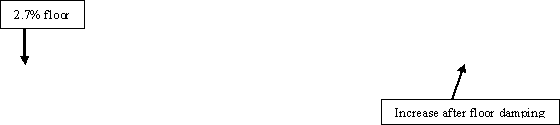
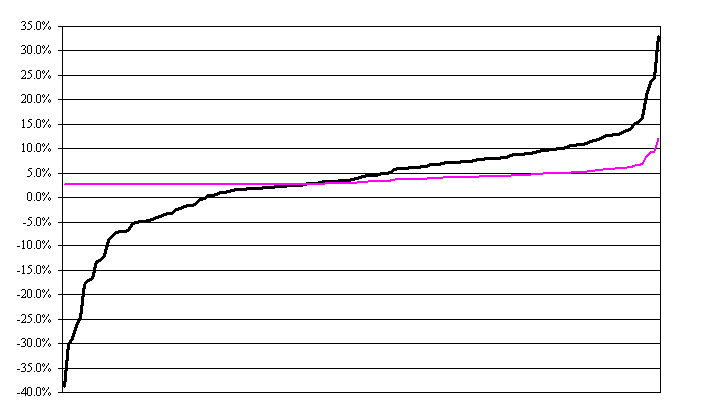
The floors scheme for 2007/08 provides a 2.7% increase in grant for county councils, such as Hampshire, that are subject to the floor. This is slightly more than the 2.0% increase in 2006/07.
Floor |
Scaling of other LAs * | ||||||
% |
No of LAs affected |
% |
No of LAs affected | ||||
Education and social services authorities |
+2.7 |
60 |
-68.8 |
90 | |||
Police authorities |
+3.6 |
21 |
-97.9 |
17 | |||
Fire authorities |
+2.7 |
8 |
-91.1 |
23 | |||
District councils |
+2.7 |
64 |
-38.4 |
174 | |||
* the scheme is self-financing for each group of authorities. The cost of giving additional grant to authorities that are below the floor, such as Hampshire County Council, is financed by scaling back the above-floor increases in grant for all other authorities by the percentages shown. The scaling back required continues to be severe. Education and social services authorities that are above the floor lose 68.8% of their grant above the floor. For police authorities, it is 97.9% which restricts the range of grant increases for police authorities from 3.6% to 3.8%. | |||||||
Education and Social Services Authorities' Formula Grant Increases 2007/08

Floors in the Relative Needs Formulae for Children and Younger Adults Personal Social Services 2007/08
|
||||
Floor |
Scaling of other LAs * | |||
% |
No of LAs affected |
% |
No of LAs affected | |
Children |
+2.7 |
46 |
-70.0 |
104 |
Younger Adults |
+2.7 |
70 |
-83.5 |
80 |
For Children's Services, Hampshire County Council is subject to scaling, losing grant in 2007/08 of £2.2m. | ||||
For Younger Adults, the County Council is at the floor, receiving additional grant in 2007/08 of £16.7m to reach the floor level. | ||||
The net amount of grant at risk when the Personal Social Services floor scheme, based on the provisional grant settlement for 2007/08, is unwound is £14.5m. | ||||
Business Rates 2007/08
The rate in the £ is normally increased by the Government in line with the change in the Retail Price Index in September each year. The RPI increase in September 2006 was 3.6%.
This practice has been followed by the Government for the rate in the £ for 2007/08 for smaller businesses, as the table below shows. The increase rounds down to 3.5%.
The lower rate for smaller businesses is financed by a supplement charged to larger businesses paying the standard rate in the £. This supplement of 0.7p generated a surplus in 2005/06 and 2006/07. The Government has decided to return this surplus to larger businesses by reducing the supplement for 2007/08 from 0.7p to 0.3p. This reduces the increase for the standard rate in the £ for 2007/08 from 3.6% to 2.5%.
2006/07 |
2007/08 |
Increase | |
p |
p |
% | |
Rate in £ |
|||
Standard |
43.3 |
44.4 |
+2.5% |
Small businesses |
42.6 |
44.1 |
+3.5% |
Analysis of Government Support 2007/08 - England
2006/07 |
2007/08 |
Change | |||
adjusted |
|||||
£m |
% |
£m |
% |
% | |
Dedicated schools grant |
26,576 |
42.4 |
28,119 |
42.8 |
+5.8 |
Police grant |
3,936 |
6.3 |
4,028 |
6.1 |
+2.3 |
Other specific grants |
11,364 |
18.1 |
11,984 |
18.2 |
+5.5 |
--------- |
-------- |
--------- |
-------- |
||
Total specific grants |
41,876 |
66.8 |
44,131 |
67.1 |
+5.4 |
Revenue support grant |
3,335 |
5.3 |
3,163 |
4.8 |
-5.2 |
--------- |
-------- |
--------- |
-------- |
||
Total Government grants |
45,211 |
72.1 |
47,294 |
71.9 |
+4.6 |
Business rates |
17,500 |
27.9 |
18,500 |
28.1 |
+5.7 |
--------- |
-------- |
--------- |
-------- |
||
Total Government support |
62,711 |
100.0 |
65,794 |
100.0 |
+4.9 |
--------- |
-------- |
--------- |
-------- |
||
Includes Formula grant: |
|||||
Revenue support grant |
3,335 |
5.3 |
3,163 |
4.8 |
-5.2 |
less for specified bodies |
-65 |
-0.1 |
-58 |
-0.1 |
-10.8 |
Business rates |
17,500 |
27.9 |
18,500 |
28.1 |
+5.7 |
Police grant |
3,936 |
6.3 |
4,028 |
6.1 |
+2.3 |
--------- |
-------- |
--------- |
-------- |
||
Total Formula grant |
24,706 |
39.4 |
25,633 |
38.9 |
+3.7 |
--------- |
-------- |
--------- |
-------- |
||
Analysis of Formula Grant 2007/08 - Hampshire County Council
2006/07 |
2007/08 |
Change | |||
adjusted |
|||||
£m |
% |
£m |
% |
% | |
Revenue support grant |
18.595 |
15.6 |
17.631 |
14.4 |
-5.2 |
Business rates |
100.871 |
84.4 |
105.061 |
85.6 |
+4.2 |
------------- |
-------- |
------------- |
-------- |
||
Formula grant |
119.466 |
100.0 |
122.692 |
100.0 |
+2.7 |
------------- |
-------- |
------------- |
-------- |
||
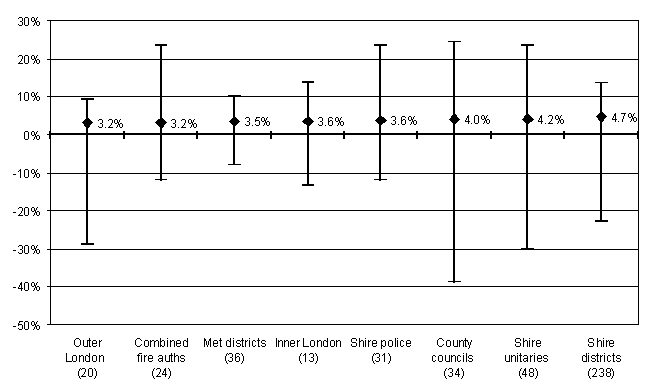
Formula grant increases 2007/08 by class of authority
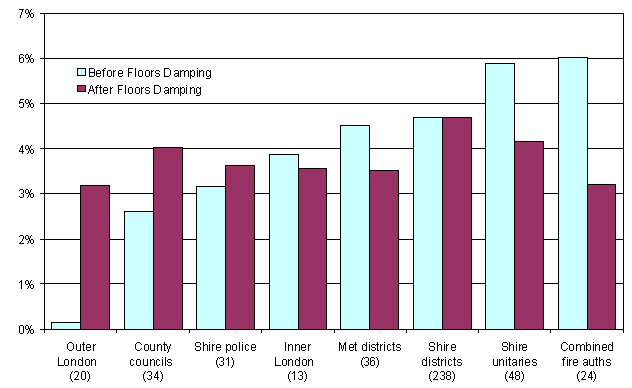 The number of authorities in each class are shown at the foot of the graph
Formula grant increases 2007/08 by class of authority
This diagram shows the range of increases in formula grant for each class of authority before the floor damping arrangements, together with the average increases after floors.
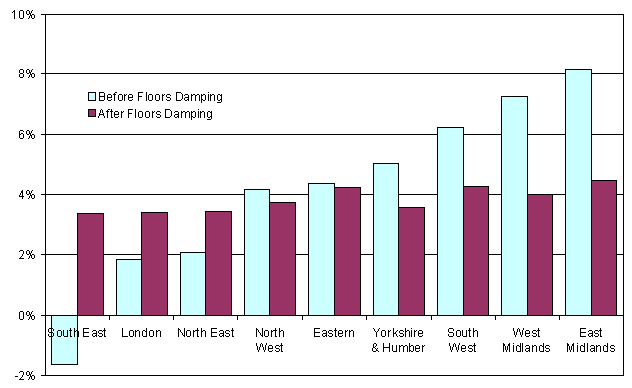
Formula grant increases 2007/08 by region - England average +3.7%
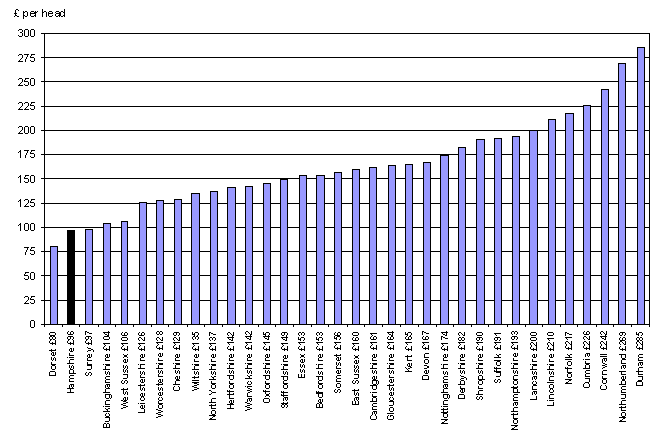
County Councils' Formula Grant 2007/08 per head - after floor damping
County Councils' Formula Grant increases 2007/08
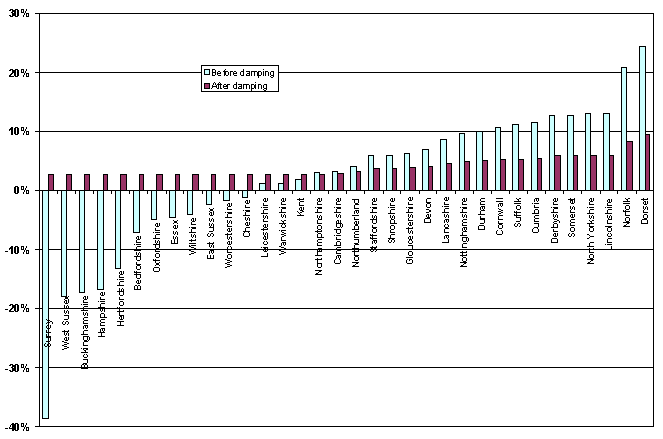
County councils' average: before floor damping +2.6%, after floor damping +4.0%
Specific Grants 2007/08 - England
Above average increases in specific grants for Education and Children's social care services.
2006/07 |
2007/08 |
Increase | |
adjusted |
|||
£m |
£m |
% | |
Education |
|||
Dedicated Schools Grant |
26,576 |
28,119 |
+5.8 |
Other Education Grants |
4,042 |
4,367 |
+8.0 |
Personal Social Services |
|||
Children |
1,331 |
1,416 |
+6.4 |
Adults |
1,589 |
1,615 |
+1.6 |
Police |
|||
Principal Grant |
3,936 |
4,028 |
+2.3 |
Other Police Grants |
539 |
628 |
+16.4 |
Fire |
1 |
1 |
- |
Environmental, Protective and |
|||
Cultural Services |
875 |
867 |
-0.9 |
Capital Financing - PFI |
503 |
595 |
+18.3 |
Other |
|||
Neighbourhood Renewal |
525 |
525 |
- |
Greater London Authority |
38 |
38 |
+1.0 |
Local PSA Reward Grant |
196 |
196 |
- |
Supporting People |
1,685 |
1,696 |
+0.7 |
Supporting People Admin |
40 |
40 |
- |
----------- |
----------- |
||
Total Specific Grants |
41,876 |
44,131 |
+5.4 |
----------- |
----------- |
||
Note: the percentage increases in these tables are calculated from the underlying unrounded figures.
Specific Grants 2007/08 for Education
England |
2006/07 |
2007/08 |
Increase |
adjusted |
|||
£m |
£m |
% | |
Dedicated schools grant |
26,576 |
28,119 |
+5.8 |
School development |
1,993 |
2,040 |
+2.4 |
School standards |
1,232 |
1,427 |
+15.8 |
Ethnic minority achievement |
169 |
181 |
+7.1 |
Targeted primary strategy |
137 |
169 |
+23.4 |
Targeted secondary strategy |
105 |
130 |
+23.8 |
Music services |
62 |
82 |
+33.2 |
Extended schools |
76 |
78 |
+1.7 |
Targeted school meals |
50 |
50 |
- |
School meals |
30 |
30 |
- |
Aimhigher |
34 |
30 |
-11.8 |
Secondary: LA co-ordination |
35 |
30 |
-14.3 |
Primary strategy: LA co-ordination |
30 |
28 |
-7.9 |
School intervention |
15 |
15 |
- |
School improvement partners |
7 |
15 |
+113.7 |
14-19 flexible funding pot |
15 |
14 |
-3.3 |
Secondary: behaviour and attendance |
14 |
14 |
-1.7 |
Education health partnerships |
11 |
11 |
- |
Playing for success |
12 |
8 |
-29.3 |
Fresh start and partnership |
8 |
8 |
- |
School travel advisers |
7 |
7 |
-6.2 |
--------- |
--------- |
||
Education specific grants |
30,618 |
32,486 |
+6.1 |
--------- |
--------- |
Specific Grants 2007/08 for Children's Social Care
England |
2006/07 |
2007/08 |
Increase |
adjusted |
|||
£m |
£m |
% | |
General sure start grant |
1,048 |
1,067 |
+1.8 |
Children's services |
153 |
202 |
+32.2 |
Positive attitudes for young people |
39 |
39 |
- |
Teenage pregnancy support |
30 |
30 |
- |
Information sharing index project |
30 |
30 |
- |
Youth opportunity |
11 |
30 |
+179.6 |
Unaccompanied asylum seeking children |
12 |
12 |
- |
Treatment foster care |
3 |
3 |
- |
Parenting support |
5 |
3 |
-42.1 |
------- |
------- |
||
Children's PSS specific grants |
1,331 |
1,416 |
+6.4 |
------- |
------- |
||
Specific Grants 2007/08 for Adult Services
England |
2006/07 |
2007/08 |
Increase |
adjusted |
|||
£m |
£m |
% | |
Access and systems capacity |
546 |
546 |
- |
Preserved rights |
297 |
275 |
-7.5 |
Carers |
185 |
185 |
- |
Mental health |
133 |
133 |
- |
National training strategy |
108 |
108 |
- |
Delayed discharge |
100 |
100 |
- |
Child/adolescent mental health |
90 |
90 |
- |
Human resources development strategy |
50 |
50 |
- |
Preventative technology |
30 |
50 |
+66.7 |
Partnerships for older people projects |
20 |
40 |
+100.0 |
Aids support |
16 |
16 |
- |
Mental capacity |
7 |
15 |
+125.5 |
Individual budget pilots |
6 |
6 |
- |
Commission for social care inspection |
1 |
1 |
- |
------- |
------- |
||
Adults PSS specific grants |
1,589 |
1,615 |
+1.6 |
------- |
------- |
||
Specific Grants 2007/08 for Environmental, Protective and Cultural Services
England |
2006/07 |
2007/08 |
Increase |
adjusted |
|||
£m |
£m |
-% | |
Housing & council tax benefit admin |
470 |
471 |
+0.4 |
Waste performance and efficiency |
105 |
110 |
+4.8 |
Planning delivery |
104 |
92 |
-11.5 |
Rural bus subsidy |
54 |
56 |
+2.4 |
Homelessness strategies |
49 |
47 |
-3.7 |
De-trunking roads |
41 |
44 |
+7.3 |
Enforcement of smoke-free legislation |
29 |
30 |
+2.8 |
Bus challenge and kickstart |
18 |
12 |
-33.3 |
Beacons |
5 |
5 |
- |
------- |
------- |
||
EPCS specific grants |
875 |
867 |
-0.9 |
------- |
------- |
||
Hampshire local authorities' Formula Grant for 2007/08
2006/07 |
2007/08 |
Variation |
||
adjusted |
||||
£m |
£m |
% |
||
Hampshire County Council |
119.466 |
122.692 |
+2.7 |
at the grant floor |
Hampshire Police Authority |
||||
Formula grant |
77.389 |
81.589 |
+5.4 |
|
Police grant |
113.020 |
115.702 |
+2.4 |
|
---------- |
---------- |
|||
Total |
190.409 |
197.291 |
+3.6 |
|
---------- |
---------- |
|||
Hampshire Fire and Rescue |
26.810 |
27.595 |
+2.9 |
|
Portsmouth City Council |
77.490 |
79.582 |
+2.7 |
at the grant floor |
Southampton City Council |
87.774 |
90.144 |
+2.7 |
at the grant floor |
Hampshire district councils |
||||
Basingstoke and Deane |
9.126 |
9.415 |
+3.2 |
|
East Hampshire |
5.872 |
6.031 |
+2.7 |
at the grant floor |
Eastleigh |
7.069 |
7.420 |
+5.0 |
|
Fareham |
5.741 |
6.055 |
+5.5 |
|
Gosport |
6.857 |
7.110 |
+3.7 |
|
Hart |
3.615 |
3.713 |
+2.7 |
at the grant floor |
Havant |
9.366 |
9.619 |
+2.7 |
at the grant floor |
New Forest |
10.657 |
11.187 |
+5.0 |
|
Rushmoor |
6.569 |
6.822 |
+3.9 |
|
Test Valley |
6.225 |
6.531 |
+4.9 |
|
Winchester |
6.634 |
6.813 |
+2.7 |
at the grant floor |
---------- |
---------- |
|||
Total |
77.731 |
80.716 |
+3.8 |
|
---------- |
---------- |
|||
Calculating Hampshire County Council's council tax - based on the recommendations for 2007/08
£/Band D | |
Council tax implied by the Government's grant distribution system |
892.33 |
Effect of spending above the level implied in the Government's grant |
|
distribution system, by 5.2% |
+59.07 |
Deduct surplus on council tax collection funds from previous years |
-8.35 |
Add effect of district councils' assumptions about losses on council tax |
|
collection in 2007/08 |
+12.57 |
---------- | |
Council tax for 2007/08 |
955.62 |
---------- | |
The Government's reserve capping powers - procedure and timetable 2007/08
Late March 2007 |
The Secretary of State for Communities and Local Government decides whether to invoke capping powers, taking account of the budgets set for 2007/08 by councils and police and fire authorities. The Secretary of State publishes the criteria to be used for the capping limits for different categories of local authorities. Criteria must include a comparison with budgets of a previous year and may include a comparison with a previous year's council tax. |
The Secretary of State also publishes the proposed capping limit for the 2007/08 budget for any individual authorities that the Government intends to cap. In addition, a further budget `target' may be set for the authority to reach in a future year. | |
Local authorities have 21 days in which to challenge their capping limits. | |
Late June or July 2007 |
The Secretary of State decides whether to proceed with imposing capping limits. If so, the Secretary of State lays an Order before Parliament setting the maximum budgets for the local authorities to be capped. |
If the Secretary of State decides not cap an authority in 2007/08 after all, the Secretary of State may accept its budget for 2007/08 and, instead, `nominate' it for possible capping in 2008/09. Alternatively, the Secretary of State may accept the budget for 2007/08 for the purposes of setting the council tax for 2007/08 but can then set a lower notional budget for 2007/08 that can be used to measure increases in future years for capping purposes. The Secretary of State would inform the authorities of the decisions in such cases in writing. Both alternatives avoid the costly re-billing of council tax payers. | |
If the capping limits for 2007/08 are approved by Parliament, each capped authority must recalculate its budget. Major precepting authorities including the County Council and the Fire and Police Authorities must re-set their precepts. Billing authorities must reissue the council tax bills. | |
Late November / early December 2007 |
The Secretary of State confirms the `nomination' and sets a capping limit for 2008/09 or a `target' for the authority's budget to reach by a specified future year. |
nb All dates are approximate and are based on the actual timetable for the Government's capping of budgets in 2006/07. | |
Glossary of Terms used in the Revenue Grant Distribution System
Aggregate External Finance (AEF)
The total level of support the Government provides to local authorities. This support is normally made up of Revenue Support Grant, police grant, specific formula and ring-fenced grants such as the Dedicated Schools Grant and the amount redistributed from business rates.
Amending Report
May be issued by the Government to correct errors subsequently discovered in the data used in the Local Government Finance settlement. Only one Amending Report may be issued for each settlement year.
Area Cost Adjustment (ACA)
The top-up factor applied to Relative Needs Formulae (RNF) to reflect higher costs, mostly pay. Originally applied to authorities in London and the South East but, since 2003/04, extended to other areas of England with higher costs.
Billing authorities
These are the 353 authorities that collect Council Tax - district councils, London
boroughs, and unitary authorities.
Budget requirement
This is the amount each authority estimates as its planned spending, after deducting
any income it expects to raise from fees and charges for services and specific grants from the Government and any funding from reserves. The budget requirement is set before the beginning of the financial year and financed from general Government grant (Revenue Support Grant), business rates and the council tax.
Business rates
These rates, called the National Non-Domestic Rates (NNDR), are the means by which local businesses contribute to the cost of providing local authority services. All business rates are paid into a central pool. The pool is then divided between local authorities, along with the Revenue Support Grant, as part of the Formula Grant. Prior to 2006/07, NNDR was allocated per head of resident population in each authority's area.
Capping
This is the term used when the Government limits a local authority's budget requirement, and hence the council tax that the local authority sets.
Central Allocation
A component of the Four-Block Model introduced by the Government in 2006/07, allocated between local authorities on a per capita basis. It represents the balance of the national total for Formula Grant after Relative Needs and Relative Resources have been equalised.
Collection Fund Surplus or Deficit
Billing authorities such as the district councils maintain a collection fund into which they pay all the council taxes they collect in their area and from which they pay precepts to the precepting authorities such as the County Council, fire and police authorities. If they collect more or less than they expected at the start of the year, the surplus or deficit is shared with the precepting authorities in proportion to their council taxes. These surpluses or deficits have to be returned to the council taxpayer in the following year through lower or higher council taxes. They may not be used to finance additional spending.
Control Totals
Prior to 2006/07, the Government published the national control totals for Formula Spending Shares for each major service area. Under the Four-Block Model introduced in 2006/07, these control totals are hidden in the system's methodology.
Council Tax
A local tax on domestic property set by local authorities in order to meet their budget
requirement.
Council Tax base
The Council Tax base of an area is the number of band D equivalent properties. The number of properties in each of the eight council tax bands A to H are counted. The totals are then converted to an equivalent number of band D properties. For example, one band H property is equivalent to two band D properties, because the taxpayer in a Band H property pays twice as much council tax. The ratios between the council tax bands are shown in the table below. The amount of revenue which could be raised by the council tax in an area is calculated allowing for discounts and exemptions but, for the purpose of the Formula Grant calculation, assuming that everyone pays.
Council Tax bands
There are eight Council Tax bands. How much Council Tax each household pays
depends on the value of their home. The bands are set out in the following table.
Council Tax bands
Value of home estimated at April 1991 |
Proportion of the tax due for a band D property | |
Band A |
under £40,000 |
66.7 % (ie, 6/9ths) |
Band B |
£40,001 - £52,000 |
77.8 % (7/9ths) |
Band C |
£52,001 - £68,000 |
88.9 % (8/9ths) |
Band D |
£68,001 - £88,000 |
100.0 % (9/9ths) |
Band E |
£88,001 - £120,000 |
122.2 % (11/9ths) |
Band F |
£120,001 - £160,000 |
144.4 % (13/9ths) |
Band G |
£160,001 - £320,000 |
166.7 % (15/9ths) |
Band H |
over £320,001 |
200.0 % (18/9ths) |
Council Tax discounts and exemptions
Discounts are available to people who live alone (25%) and owners of dwellings that are not anyone's main home. Billing authorities have been able to reduce the discount for second homes from 50% to a minimum of 10% from 1 April 2004. Council Tax is not charged for certain classes of properties, such as those occupied only by students.
Damping
Damping is used by the Government to phase the impact of changes to the revenue grant distribution system, to give stability in funding for individual local authorities. It limits the effect these changes have on Council Tax levels and is intended by the Government to give authorities more time to adjust their spending following the changes. Damping of grant is achieved by setting a minimum floor level for the percentage increase in grant, with the cost of providing this additional level of grant met by scaling back the grant allocated to authorities whose percentage increase in grant is above the floor minimum. Prior to 2005/06, ceilings limited the maximum increase, but were removed to allow fast growing authorities to receive greater benefit from increases in grant. Damping has also been introduced in 2006/07 in the Relative Needs Formulae (RNF) for children's services and younger adults personal social services to limit losses as a result of introducing new RNF methodologies.
Dedicated Schools Grant
A ring-fenced specific grant introduced in 2006/07 that provides most of the Government's funding for schools. It covers the same provision as the former Formula Spending Shares for schools.
Distributable Amount
This is the estimated total amount in the business rate pool that is available to be
distributed to local authorities. The business rates are collected by local authorities
and paid into a national pool and then redistributed to all authorities.
Environmental, Protective and Cultural Services (EPCS)
The RNF block for all other services, ie, excluding adult services, children's services, police, fire, highway maintenance and capital financing costs.
Fixed Costs
There is a separate RNF allocation for each authority's fixed costs, which are defined by the Government as the element of an authority's costs which does not vary with the size of the authority. This mainly consists of the costs of the corporate and democratic core of an authority, sometimes described as "the costs of being in business, not the costs of doing business". For county councils, the amount included within RNFs for fixed costs is £325,000.
Floor Damping )
Floors and Ceilings ) see Damping
Formula Grant
Comprises Revenue Support Grant, redistributed business rates and, for police authorities, the police principal grant.
Formula Spending Shares (FSS)
Between 2003/04 and 2005/06, FSSs were used by the Government to provide a basis for distributing its Formula Grant between local authorities. Formulae were used to calculate each authority's share of the national Control Totals for seven main service blocks: education, personal social services, police, fire, highway maintenance, capital financing and environmental, protective and cultural services. Typically, each formula includes a basic amount per client, topped up for deprivation and the Area Cost Adjustment. From 1990/01 to 2002/03, Standard Spending Assessments (SSA) were used instead of FSSs. With the introduction of the Four-Block Model in 2006/07, the Government replaced FSSs with Relative Needs Formulae (RNF).
Four-Block Model
The system for calculating Formula Grant introduced by the Government in 2006/07, consisting of four block for Relative Needs, Relative Resource, Central Allocation and Floor Damping.
Indicators
In this context, information used in the calculation of Relative Needs Formulae, such as population, number of school children, number of elderly people or lengths of road.
Local Government Finance Settlement
The Local Government Finance Settlement is the annual determination of Formula Grant distribution by the Government and approved by Parliament. It includes:
· the totals of Formula Grant;
· how that grant will be distributed between local authorities; and
· the support given to a number of other local government bodies.
The provisional settlement is announced by the Government for consultation in late November or early December. The consultation period ends in early January and the final settlement figures are announced in late January.
Net Revenue Expenditure (NRE)
This represents an authority's budget requirement and use of reserves.
Non-Domestic Rates
See business rates.
Precept
This is the amount of Council Tax income that precepting authorities (see below) need to provide their services. These authorities request the billing authorities to raise these amounts from council tax payers by issuing a formal precept. The amounts for all local authorities providing services in an area appear on one Council Tax bill, which is issued by the billing authority (district councils, unitary authorities, London boroughs and metropolitan districts).
Precepting authority
This is an authority which sets a precept to be collected by billing authorities through
the Council Tax bill. County councils, police authorities, the Greater London Authority, combined fire authorities and parish councils are all precepting authorities.
Receiving authorities
These are the 432 authorities that are eligible to receive Revenue Support Grant.
Relative Needs Formulae (RNF)
One component of the Four-Block Model introduced by the Government in 2006/07, intended to equalise spending needs between local authorities. Formulae similar to those previously used in Formula Spending Shares (FSS) are used to assess the local authorities' relative need to spend. The results, however, are expressed as fractions of total spending in England, instead of as monetary values. For example, the County Council's RNF for social services for older people for 2007/08 is 0.002104997791731. The formulae used to calculate the RNF factors are based on an amount per client with top-ups for deprivation and other additional costs including the Area Cost Adjustment.
Relative Resource Amount
A component of the Four-Block Model introduced by the Government in 2006/07, intended to equalise resources between local authorities. It reflects the different capacity of local authorities to raise income from the Council Tax. It is a negative amount in the calculation of the Four-Block Model, with those authorities with higher levels of Council Tax resources having a higher negative Relative Resource Amount.
Reserves
This is a council's accumulated surplus income (in excess of expenditure) which can be used to finance future spending.
Resource Equalisation
The way in which the formula grant distribution system takes account of councils'
relative ability to raise council tax. Councils with a higher taxbase, because properties in their area are more highly valued, are able to raise more income from each £1 of council tax. "Resource equalization" has also been used by the Government to describe its action in uplifting its service Control Totals for FSS (in 2003/04) and RNFs (in 2006/07) to the national levels of actual spending by local authorities. This has the effect of transferring Formula Grant from areas of `lower need and higher resources' such as the South East to areas of `higher need and lower resources' such as the North and Midlands.
Revenue Expenditure
Expenditure financed by Aggregate External Finance (AEF) grants, council tax and the use of reserves.
Revenue Support Grant (RSG)
A Government grant forming part of the Formula Grant alongside the redistributed business rates and the police principal grant.
Ring-fenced grant
A grant paid to local authorities which has conditions attached to it that restrict the
purposes for which it may be spent.
Second homes discount
Billing authorities have been able to reduce the council tax discount given to owners of second homes from 50% to a minimum of 10% from 1 April 2004. The additional council tax income raised is shared between local authorities in the area in proportion to their precepts.
Specific and Special Grants
Specific formula grants, targeted or ring-fenced grants are sometimes referred to as
specific or special grants. A specific grant is paid under a specific legislative power
whereas a special grant uses a general power to pay grants to councils.
Specific Formula Grant
A grant which is distributed outside the formula grant distribution system but with no
conditions attached as to how it is spent.
Specified Body
This is the term used for bodies (such as the Improvement and Development Agency for Local Government and the Employers' Organisation for Local Government) that are directly funded from Revenue Support Grant and provide central services for local government as a whole.
Standard Spending Assessment (SSA)
Between 1990/01 to 2002/03, SSAs were used by the Government to divide its general revenue grants between local authorities. This is now done by the Relative Needs Formulae (RNFs).
Targeted grant
A type of ring-fenced grant which has conditions attached which specify a broad
outcome.
Total Assumed Spending (TAS)
Prior to the introduction of the Four-Block Model in 2006/07, this was the amount of spending by local government as a whole which the Government assumes in its spending plans. An equivalent figure is not published by the Government in the Four-Block Model.
Total Formula Spending (TFS)
Prior to the introduction of the Four-Block Model in 2006/07, this was the total of Formula Spending Shares.
i:\. . . .\ian\docs\rsg app 2007-08 9feb2007a.doc 05 February 2007
Annex 1 | |
Hampshire County Council | |
County Treasurer's | |
The Castle, Winchester, Hampshire SO23 8UB | |
Ms Nikki Hinde |
Telephone 01962 841841 . |
Communites and Local Government |
Fax 01962 847644 . |
Zone 5/H3, Eland House |
|
Bressenden Place |
|
LONDON |
|
SW1E 5DU |
|
Enquiries to Jon Pittam |
My reference CT/CF/IH/rsg response 200708 |
Direct line 01962 847400 |
Your reference . |
Date 3 January 2007 |
E-mail [email protected] |
Dear Ms Hinde
Revenue Support Grant for 2007/08 and Related Matters
The County Council's Cabinet considered the Government's proposals for the Revenue Support Grant settlement for 2007/08 at their meeting on 18 December 2006. They asked me to make the following response to the consultation.
Overall settlement and grant floors
The County Council is disappointed that the Council's formula grant will increase by only 2.7% in 2007/08. This does not cover inflation, let alone meet the additional demands for services such as adult and children's social care and waste management.
This low increase in formula grant is even more damaging because it follows an increase of only 0.2% in 2006/07, after taking account of the Government's abolition of the grants for safeguarding children and access and system capacity. In addition, the County Council's grant for Supporting People for 2007/08 has been frozen at just below the level for 2006/07.
Together these grant allocations for 2007/08 are not sufficient to meet the rising costs and open-ended demand for adult care and children's services and the higher costs of dealing with household waste or increased demand for any of the County Council's other services. Even after making ongoing efficiency savings, the Council faces a stark choice of cutting services by up to £10m whilst asking council tax payers for the maximum increase in council tax permitted by the Government's threats of capping limits.
Whilst the County Council is committed to keeping within the lowest quartile of the council taxes levied by county councils in England, it is unreasonable for the Government to provide a grant increase of only 2.7% and expect the council tax increase to be kept
within 5% without serious consequences for services. The County Council opposes the imposition of capping limits in this way and urges the Government to use the forthcoming report of the Lyons Inquiry into Local Government as an opportunity to abandon its reserve capping powers.
Ministers have drawn attention to a 39% real terms increase in funding for local authorities nationally since 1997/98 but, over that period, spending has had to increase by 50% in response to the Government's spending plans and service pressures. According to research by the Local Government Association, funding from the Government for services other than schools and other specific grant funded Government priorities has increased by only 14% in real terms, compared with a 90% increase in the National Health Service. Local government in general, and Hampshire County Council in particular, has not had a fair deal from the Government.
Twelve months ago, the Government promised to work with local authorities to take action on spending pressures including those arising from new burdens, pay and pensions, adult social services and waste management. No tangible benefits of this promise are apparent in the grant settlement for 2007/08, which is disappointing. Those pressures are real and are here now. If the Government is deferring action until next year's Comprehensive Spending Review, it is essential that local government services receive a significant uplift in funding so that they are placed on a proper financial footing for the future.
Grant floors
The extent of damping within the County Council's grant settlement for 2007/08 represents a major risk in the County Council's medium term financial strategy, with the uncertainty about when the damping regime will be unwound.
In addition to £23m provided by the general grant floor in 2007/08, a further £15m of the County Council's formula grant is dependent on the damping arrangements in the formulae for children's and younger adults' services.
Altogether £38m or 30% of the County Council's formula grant for 2007/08 of £123m is at risk and this undermines some of the certainty provided by multi-year grant settlements. I welcome your colleague Amer Shoib's comment in his letter to me of 9 February 2006 that the grant floor should be regarded as a permanent part of the formula grant allocation system. The County Council asks for confirmation that this commitment still stands and that the £38m of formula grant will never be taken away from the County Council in any future grant settlement.
Four block model
The County Council urges the Government to abandon the four block model used to distribute formula grant to local authorities. Its lack of transparency and increased complexity has resulted in a local government finance system that is even more difficult to explain to council tax payers and other stakeholders.
The model's lack of credibility, along with the underlying formulae, is brought into sharp focus by the extent of damping required in the County Council's grant. The basic methodologies are so unfit for purpose that an overlay of an additional 30% of damping grant is required to deliver even the wholly inadequate 2.7% increase in grant for 2007/08.
In particular, the County Council urges the Government to commission fresh research into the relative needs formulae for children, older people and younger adults personal social services. These formulae are based on inadequate research using limited and unrepresentative data samples.
Funding for deprivation
The Government should also reduce the funding for deprivation within all the relative needs formulae. Providing adequate funding for the basic needs of services in all areas should take priority over funding unmet needs in areas with higher levels of deprivation. The basic amounts should be funded in full in the first instance with any residue, only, used to fund deprivation costs. Such costs are already heavily subsidised by specific grants including the Neighbourhood Renewal Fund.
Schools funding
The County Council also asks the Government to reverse the transfer of funding for schools from general formula grant to the ring-fenced dedicated schools grant (DSG), which was introduced in 2006/07. The switch to DSG has increased the proportion of the Government's revenue support for local authorities provided as ring-fenced specific grants to over 50%, contrary to the Government's previous commitments to reduce the proportion.
Waste management
The County Council believes that the Government should introduce a separate relative needs formula for waste management costs, to be allocated according to resident population. An overwhelming case for a separate waste formula, in terms of the size of spending and its distributional impacts, was published in research by the Society of County Treasurers.
The County Council also urges the Government to accept that the Council's private sector contract for waste management services should be recognised for grant support, either through the capital financing relative needs formula or the specific grant for the private finance initiative (PFI) schemes. The County Council's contract pre-dates the Government's introduction of funding arrangements for PFI schemes but it has the characteristics of a PFI scheme.
Area cost adjustment
The County Council is disappointed that the Government continues to link Hampshire with the Isle of Wight for area cost adjustment (ACA) purposes. There is no justification for artificially reducing Hampshire's ACA factor, and therefore its grant, simply to direct grant to the Isle of Wight to reflect its higher costs as an island, despite its lower wage levels.
The County Council urges the Government to end this link in the final settlement for 2007/08, as had been proposed in the options published in the review of formula grant distribution in July 2005.
Capital adjustment in the floor damping mechanism
The Government's abolition of the capital adjustment in the general grant floor damping calculation has resulted in the County Council, as a floor authority, receiving no additional revenue grant towards debt charges arising from `Government supported' borrowing allocations. The County Council is disappointed that the Government has not responded to widespread pressure from local government to reconsider this change.
Without the additional revenue grant, the cost of servicing such borrowing at the margin falls directly on the council tax payer. Reluctantly, the County Council has had to decide not to take up approximately 30% of the borrowing allocations for 2007/08 amounting to £12.5m, in order to limit the effect on the council tax. This particularly affects the borrowing allocations for capital expenditure on schools and the local transport programme.
The County Council urges the Government to reinstate an effective capital adjustment in the floor damping mechanism or provide all its support for capital investment as capital grant from 2007/08 onwards.
Educational psychologists
The decision to transfer the funding for the training of educational psychologists from the top-sliced Revenue Support Grant (RSG) for specified bodies to RSG payable to individual local authorities represents a funding change for Education authorities in 2007/08. The County Council urges the Government to incorporate an adjustment to reflect this in the calculation of the adjusted grant for 2006/07 used to calculate the formula grant floor.
Comprehensive Spending Review
The County Council considers the issues raised in this letter to be urgent and significant. Action is required by the Government in 2007/08 if the impact on services and the council tax is to be mitigated.
If the Government insists on ignoring these effects in 2007/08 in order to maintain its two-year grant settlement, it is essential that the Government uses the opportunities provided by the Comprehensive Spending Review and the Lyons Inquiry into Local Government to introduce the changes required in 2008/09, as the current basis of grant distribution is unsustainable.
Further information
Please let me know if you require further information. I look forward to your positive response to the specific points raised in this letter.
Yours sincerely
Jon Pittam
County Treasurer
County Treasurer Hampshire County Council The Castle Winchester Hampshire SO23 8UB |
Dear Mr Pittam
Thank you for your letter of 3 January 2007 to Mrs Nikki Hinde in response to the Government's proposals for the funding of local authorities' revenue expenditure in 2007-08.
Ministers will carefully consider the points you make, alongside all others received during the consultation period, as they take final decisions on the Local Government Finance Settlement 2007-08.
Yours sincerely
Nigel Harrison