Archived decisions
Hampshire County Council Cabinet 26 February 2007 Barker Review of Land Use Planning - County Council Response Report of the Director of Environment |
Item 8 |
Contact: Les Herbert, ext 6768 email: [email protected]
1. Executive Summary
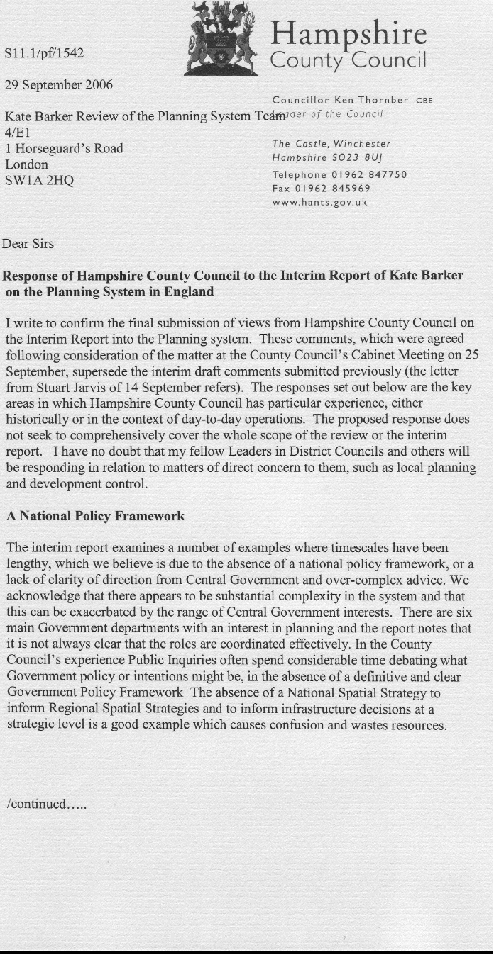
1.1 In 2005 economist Kate Barker was commissioned to review the planning system in England. Following an interim report in July 2005 the County Council submitted comments. Now that the Final Report has been published the Government has asked for comments on her recommendations. This paper sets out the main features of her recommendations and provides a commentary to enable the County Council to respond and thereby seek to influence the Government's decisions.
1.2 The planning system is an important mechanism for enhancing quality of place. This decision seeks to influence the outcome of the Government's deliberations on Kate Barker's recommendations by submitting Hampshire County Council's views on her proposals for:
(i) improving the speed and quality of decision-making (paragraphs 5.1, 5.3 and 5.4);
(ii) providing a less centrally regulated regime (paragraph 5.2);
(iii) direct community goodwill payments (paragraph 5.5);
(iv) an independent Planning Commission to decide major infrastructure projects (paragraphs 5.6 and 5.7);
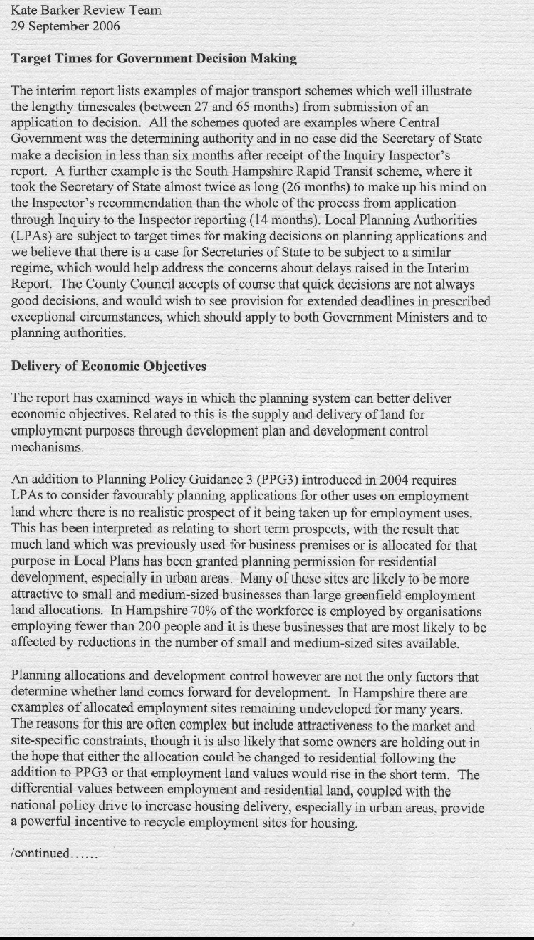
(v) improving the responsiveness to economic considerations (paragraph 5.8);
(vi) the role of green belt (paragraph 5.9); and
(vii) joint working by local authorities across administrative boundaries (paragraph 5.10).
2. Recommendation
That the County Council responds to the Government's consultation on the Kate Barker Final Report on the basis of the commentary in this report.
3. Background
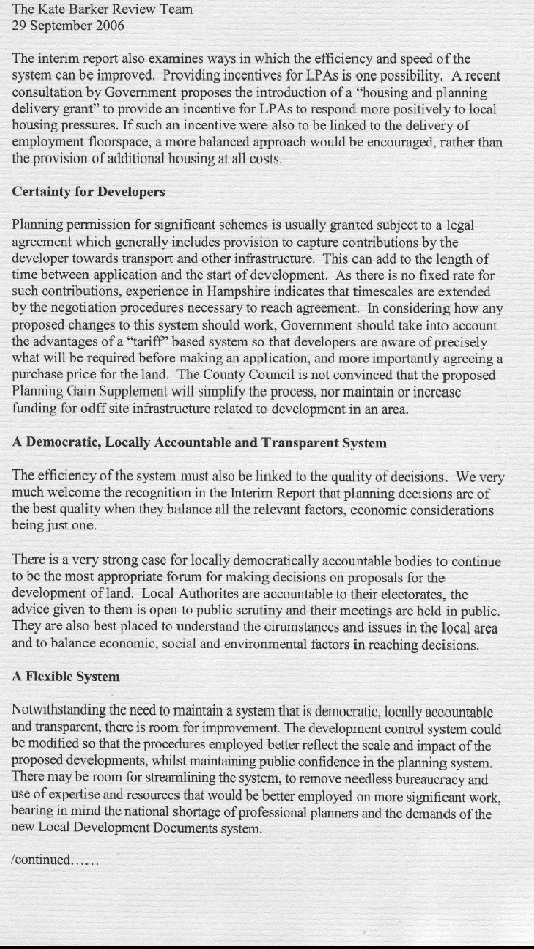
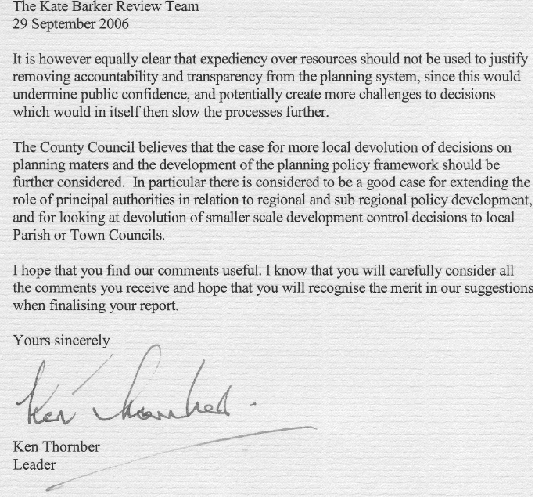
3.1 In December 2005 the Chancellor and the Deputy Prime Minister commissioned the economist Kate Barker to undertake a review of the Land Use Planning System, focussing on the link between planning and economic growth. An Interim Report was published in July 2006, which was considered by the County Council's Cabinet in September 2006 and comments submitted (see attached appendix).
3.2 The Final Report was published on 5 December 2006. It is 213 pages long and contains 32 main recommendations. The Government has asked for comments on the report by 5 March 2007.
4. Introduction
4.1 This report summarises the recommendations of the Final Report with a commentary, and proposes responses which seek to influence Government decisions. For the Government to implement the recommendations it would be necessary, in most cases, for national policies and procedures to be amended. Some legislative change would also be required.
4.2 This report does not propose that the County Council should comment on every proposal in the Final Report. Some of the Barker recommendations are on detailed matters which relate directly to the planning procedures followed by District Councils.
5. Barker's Recommendations: Commentary
5.1 Kate Barker has recognised the importance of a plan-led approach and is supportive of the role that the planning system performs in balancing social, economic and environmental goals. The recommendations include enhancing the skills and status of professionals and elected Members, and proposals to improve the resourcing of the system, including making more resources available to the Planning Inspectorate. This would be achieved by more funding, more support staff and by introducing a mediation service to act as an alternative dispute mechanism. High design standards are recognised as being important. These recommendations are to be welcomed.
5.2 Kate Barker has clearly taken on board representations which have pointed to the way Government directs the system and involves itself in decision making. The recommendations seek to remove excessive control by Government and to provide a less centrally-regulated regime. They include:
(i) an end to the practice where more than one minister is required to decide an application;
(ii) a limitation of ministerial decisions to national or more than local issues;
(iii) a reduction in the number of applications referred to a minister or `called in' by a minister;
(iv) a substantial reduction in the volume of Planning Policy Guidance; and
(v) time limits for ministerial decision making.
These recommendations are to be welcomed and should remove unnecessary restrictions on local planning authorities; it would be helpful if ministers sought to limit the creation of additional restrictions flowing from European legislation.
5.3 Many recommendations are concerned with the detail of the planning process, at both national and local level. These are designed to streamline processes to increase speed in plan and decision making and to provide greater clarity and certainty in advice and guidance. They include:
(i) streamlining local development scheme processes;
(ii) changing the community involvement process by removing the need for examination of the process itself;
(iii) speeding up arrangements for producing supplementary planning documents;
(iv) removing the requirement for the plan process to restart if challenged whilst in progress; and
(v) speeding up the final stages of planning decisions by, inter alia, using a tariff system to secure developer contributions.
5.4 On the face of it there is much to be welcomed in principle but some recommendations are too lacking in detail to provide any real indication of how they might work in practice. Interestingly, the latter recommendation on tariffs is at variance with the Government's seeming intent to proceed with a Planning-gain Supplement, as discussed elsewhere on this agenda.
5.5 There is a suggestion that business should make use of `direct community goodwill payments' voluntarily as this "may help to facilitate development". In practice, this already occurs to some extent through the existing planning obligations system, but is outside the formal framework. Opinions differ as to whether there would be a positive effect or whether it would speed the process.
5.6 To improve the decision-making framework for major infrastructure projects, such as energy, transport and waste, a new body is proposed, an independent `Planning Commission'. This would be an `expert' body with streamlined public enquiry powers. Its decisions would be based on national statements of strategic objectives prepared by ministers and other plans and local considerations.
5.7 This proposal at first sight may have merit in terms of quality of decision making and efficiency. It will, however, be important that there is an opportunity for local people to have their say and for decision makers to be properly accountable. The detail would need to be seen on how consultation in a fast track inquiry process and democratic accountability would be secured to ensure the system would be `fair, transparent and even-handed'. In the absence of further detail, a very cautious approach is recommended to this proposal.
5.8 Barker has made a number of recommendations which seek to give more weight to economic benefits and make planning more responsive to economic circumstances. The report recognises the importance of a plan-led approach and is supportive of the role that the planning system performs in balancing social, economic and environmental goals. However, it recommends updating national policy on economic development to strengthen the consideration given to economic factors. It proposes better integration of Regional Spatial Strategies and Regional Economic Strategies, and calls for a stronger link between plans and infrastructure provision to inspire confidence that large developments will have the necessary infrastructure in place. This advice in particular chimes well with the stance of Hampshire County Council.
5.9 A review of Green Belt boundaries is proposed, alongside recommendations that the quality of other green space is protected and enhanced. The `green wedge' approach is commended and should be supported. In South Hampshire the development of green wedges is being actively pursued. Green Belts are an established and well understood aspect of the planning system, whilst a green wedge approach produces an urban environment with greater access for all to usable green space, which may be particularly valuable in areas like South Hampshire and complement green belt policy overall.
5.10 The report proposes that local authorities should be encouraged to work together on Local Development Frameworks and decision making where there are issues that cross administrative boundaries. This recommendation is welcomed and South Hampshire local authorities have already taken this forward through voluntary partnership arrangements. However, there is also a recommendation that consideration should be given to applying strategic decision-making powers `elsewhere'. Hampshire County Council may wish to support the principle of strategic decision-making being more appropriate, in some circumstances, above district council level. However, this proposed control would not be attractive if it merely meant increased decision-making at regional level.
6. Impact Assessments
6.1 Assessment of the Race Relations (Amendment) Act has been considered in this response but no adverse impact has been identified in terms of race, creed or gender.
7. Conclusion
7.1 The Commentary in this report provides the basis upon which Hampshire County Council can respond to the Government's call for comments on the Kate Barker Review of Land Use Planning - Final Report. The Recommendation is framed to allow a response based on the views of the Cabinet.
LINK(S) TO CORPORATE STRATEGY | ||
Yes |
No | |
Hampshire safer and more secure for all |
||
Maximising well-being |
||
Enhancing our quality of place |
_ |
|
Section 100 D - Local Government Act 1972 - background papers | |
The following documents disclose facts or matters on which this report, or an important part of it, is based and has been relied upon to a material extent in the preparation of this report. | |
NB the list excludes: | |
1. |
Published works. |
2. |
Documents which disclose exempt or confidential information as defined in the Act. |
TITLE |
LOCATION |
None |
1202Rpt/LH