
Archived decisions
Hampshire County Council Buildings, Land and Procurement Panel 20 March 2007 Proposed Highway Contract Strategy Principles Report of the Director of Environment |
Item 8 |
Contact: Philip Samms, ext 7072 email: [email protected]
1. Summary
1.1 On 11 July 2006 a report entitled `Construction Related Procurement Initiatives within the Environment Department' was considered by the Buildings, Land and Procurement Panel. That report set out the way ahead for construction-related procurement in the Environment Department, with a view to improving procurement efficiency in line with the Gershon Report, enhancing service delivery and the management of performance.
1.2 This report summarises the work completed on the subsequent review of procurement within the Department and sets out the contract strategy now being implemented for highway-related procurement, using a combination of a new multi-disciplinary Term Highways Contract for highway maintenance and a supporting Improvement Works Framework for the delivery of the capital improvement works and other programmes.
2. Recommendation
That the Buildings, Land and Procurement Panel considers the proposals contained in this report and supports the way forward.
3. Background
3.1 The Environment Department is constantly striving to ensure that it delivers a high quality highways service for the people of Hampshire within current and future budget constraints. To this end, the Department is regularly reviewing procurement as a key factor in the search for enhanced value for money services.
3.2 The existing Highways Term Maintenance Contract was potentially available to be extended by up to a further two years. Recent discussions with the supplier (Balfour Beatty Infrastructure Services Limited) however, have highlighted significant problems relating to the contract variation of price clauses. Following consultation with the Chief Executive and County Treasurer regarding these issues and the new contract strategy proposed in this report, it has been agreed not to extend this contract beyond its current end date of 30 April 2008.
3.3 The Professional Services Contract was established in 2006 with a view to considering the possibility of amalgamation with other contracts in 2008. Having reviewed the matter, however, the Department feels that the design service offered by this arrangement does not sit well with other, more works-orientated, contracts. In addition the new contract is performing well, and it is anticipated that the two potential one-year extensions may well be taken up (subject to continuing good performance and the approval of the Executive Member for Environment) in order to ensure continued benefits from an ongoing relationship.
3.4 In addition, the County Council has also been involved in discussion with the Highways Agency with a view to establishing closer links with its Area 3 commission, which is also due for renewal in 2008. A scoping study has recently been completed, identifying service and efficiency benefits from such arrangements.
4. The New Contract Strategy
4.1 In considering the potential contract strategy and management options for the new arrangements, extensive consultation has been carried out with other local authorities delivering similar services. The key findings of these consultations are summarised in Appendix 1. These findings were incorporated into the review of procurement and have ultimately assisted in shaping the new contract strategy.
4.2 An internal review of existing contracts was also undertaken, with a view to identifying potential areas for combining services within larger contracts. Whilst several more general services have been identified for combination, there are a number of specialist contracts operated by the Department that would not benefit from being part of a larger contract. It is therefore proposed to retain some services as at present, but to incorporate others within the new arrangements.
4.3 A wide range of contract strategies was considered for the new procurement arrangements, in order to balance a number of key factors. The options considered were:
(1) The Existing Arrangement (for benchmarking);
(2) Direct Labour Organisation;
(3) Term Highways Contract with supporting Framework;
(4) Term Maintenance and Term Capital Works Contracts;
(5) Term Highways Contract;
(6) Area Highways Contract (North/South split); and
(7) Managing Agent Contract.
These options are summarised and compared in Appendix 2.
4.4 Following extensive internal consultation on the options stated above, it has been agreed that the new contract strategy will draw on a combination of the above Options (3) and (5), and consist of two main elements:
(i) a new Term Highways Contract; and
(ii) a new Improvement Works Framework.
4.5 The new Term Highways Contract will cover all the services currently offered by the existing highways term maintenance contract, with the addition of main road surface dressing and environmental bridge maintenance. It will also seek to build upon existing performance-based clauses, to encourage a more outcome-focused approach.
4.6 The new Improvement Works Framework will provide a replacement for both the existing Framework Arrangement for Highway Works and the majority of individually tendered schemes carried out by the Department, up to the European Union's limit for works of approximately £3.6 million. This will provide a more streamlined and efficient system for the delivery of the Integrated Transport, Structural Maintenance and other key programmes.
4.7 The new contracts are proposed to be operated over longer timescales than currently, with the new Term Highways Contract being put in place for seven years, with the option to extend by a further three single years, subject to satisfactory performance. This period has been considered in light of informal discussions with a number of key suppliers, who have indicated that seven years is optimum for investment in the various items of plant and equipment required to operate such a multi-disciplinary contract. The Improvement Works Framework will operate for a four year period, the maximum permitted under the European Union Procurement Directives.
4.8 Initial investigations into savings attributable to the proposed contract strategy indicate direct procurement costs to the Department will be reduced by approximately £250,000 per year. It is likely that indirect costs would also be reduced; however these are difficult to predict at this time.
5. Management Arrangements
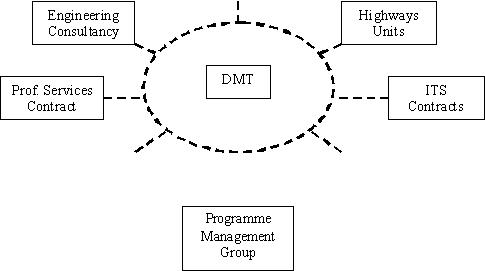
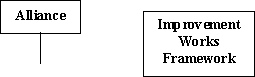
5.1 It is proposed to operate the Term Highways Contract and Improvement Works Framework closely alongside each other, as an overlap of services will be provided to support the delivery of the highways service by the most appropriate means. In order to achieve this it is recognised that an overarching performance management framework, supported by a combined management system, is required.
5.2 It is therefore intended that the two contracts, plus others operated by the Department, will be managed through an alliance, as indicated in the diagram below:
Term Highways Contract

5.3 If a move towards a more performance/outcome-focused service is to be achieved, the means of managing performance must be enhanced. As well as the more output-focused measures currently employed, it is felt desirable to link new contracts into more strategic outcomes for the Department and County Council as a whole. In this way, it is hoped that suppliers will become more attuned to the County Council's key drivers, and focus on ensuring that these are delivered for the benefits of Hampshire's residents. The new contracts are being progressed on this basis.
6. Collaboration Opportunities
6.1 In addition to the actual strategy for contracts, the Group has been considering the potential advantages and implications of collaborating with various other parties on future arrangements. Whilst there are certainly benefits to collaboration from such arrangements, it is felt by the Group that formalised joint contracts with others are not necessarily advantageous for Hampshire County Council. There are also few opportunities, due to the timing of other adjacent authority contracts.
6.2 Discussions were ongoing with the Highways Agency for most of 2006 about the potential for collaboration on its Area 3 commission, which is due for renewal in August 2008. Whilst the work carried out on a joint scoping study identified numerous benefits to closer working, the formalised combination of contracts has been ruled out. Every effort is being made to maximise the collaboration between future Highways Agency and County Council contracts, through both the procurement process and ongoing management.
6.3 The ability to make Hampshire's contracts available for other Local Authorities to use in the future is also important for Hampshire's own District Councils. The existing Term Maintenance Contract and Framework Arrangement for Minor Highway Works are already made available for them; however it is envisaged that this facility will be expanded upon with the new contract strategy, thus also providing Districts with potential savings in procurement costs.
7. Programme
7.1 In order to meet the requirements of the European Union Procurement Directives, a contract notice has already been published for the new Term Highways Contract and Improvement Works Framework. Contract documentation is currently being prepared along the principles set out above. A number of working groups have been established to progress the various sections required, and input is being sought into this process from across the Department and County Council as a whole. In particular, a decision is required regarding the use of existing depot facilities, and whether to make them available to the new term contractor. It is proposed to present a separate report on this matter for a key decision by the Executive Member for Policy and Resources shortly.
7.2 Political approvals for the new contracts are planned for a formal decision by the Executive Member for Environment in May 2007. It is intended that the final recommendations contained within the formal decision will incorporate any comments from the Buildings, Land and Procurement Panel.
7.3 Tendering for the Term Highways Contract will take place during the summer, with a contract awarded before Christmas 2007. It is expected that the tenders will be assessed in terms of both price submitted and quality, the latter being assessed through a written submission, interviews and visits to comparable contracts.
7.4 Mobilisation of the Term Highways Contract will take place between January and April 2008, with the contractor taking over control of the contractual requirements on 1 May 2008.
7.5 Tendering for the Improvement Works Framework will take place late in 2007, as less time is required for mobilisation of this type of contract. The start date for the new framework will also be 1 May 2008.
8. Impact Assessments
8.1 The new contract strategy has been developed considering the impact on the environment and equalities at all stages.
8.2 For all construction works and services delivered through the new Term Highways Contract and Improvement Works Framework, particular emphasis will be placed on developing safe approaches to temporary works and traffic management. The opportunity to develop earlier contractor involvement under the new arrangements will be used to suitably influence this and the design of the permanent works.
9. Conclusions
9.1 It is proposed that a 7 + 3 year Term Highways Contract with supporting four year Improvement Works Framework for capital improvement works be progressed as the core strategic approach to highway construction contract for the Environment Department.
9.2 The new contract/agreement will be written to allow for a flexible approach in terms of services, collaboration with others, funding levels and pricing/payment mechanisms. In particular, collaboration opportunities with the Highways Agency shall be progressed, subject to programme constraints.
9.3 The new contract/agreement will incorporate a robust performance management framework aligned with key strategic objectives for the Environment Department and the County Council as a whole.
Section 100 D - Local Government Act 1972 - background papers | |
The following documents disclose facts or matters on which this report, or an important part of it, is based and has been relied upon to a material extent in the preparation of this report. | |
NB the list excludes: | |
1. |
Published works. |
2. |
Documents which disclose exempt or confidential information as defined in the Act. |
TITLE |
LOCATION |
None. |
1185/PS
APPENDIX 1
Summary of Local Authority Consultations
The following key issues summarise the findings of a questionnaire circulated to 14 local authorities seeking information and views on the way that they delivered highway related services, their internal organisational structure and how they felt that their arrangements actually performed.
Organisational Structure and Processes:
(i) Local Government Review (LGR) and Compulsory Competitive Tendering (CCT) have generally defined the current arrangements.
(ii) Those authorities which retained in-house services generally still do so.
(iii) Those authorities which externalised services generally still do so, although more client-orientated functions have been returned to in-house delivery in several instances.
(iv) Political processes vary significantly, with most authorities benefiting from approved programme arrangements, rather than individual schemes.
Contractual Arrangements:
(i) All local authorities operate some form of external supply of professional services (eg top-up for in-house, or fully externalised).
(ii) Significant move towards larger and longer duration contracts.
(iii) Specialist services often procured separately, in order to retain focus (eg Intelligent Transport Systems (ITS), surface dressing).
(iv) Widespread combination of capital improvement and maintenance works, with various thresholds.
Contract Management:
(i) Significant use of New Engineering Contract (NEC) forms of contract.
(ii) Collaboration with suppliers and supply chain widespread.
(iii) Improvements in performance management techniques.
(iv) Clear move towards incentivisation of suppliers.
(v) Target costing of works becoming established.
APPENDIX 2
APPENDIX 2