
Archived decisions
Hampshire County Council River Hamble Harbour Board 23 March 2007 Harbour Master's Report Report of the Director of Environment |
Item 6 |
Contact: Tony Clatworthy, tel 01489 576387
email: [email protected]
1. Summary
1.1 This report summarises the activities and events on the River from 24 January 2007. Any incidents taking place after this report is published will be the subject of a separate Annex to be distributed at the meeting.
2. Recommendation
That the report be noted.
3. Reason
3.1 This report promotes safe navigation on the River Hamble.
4. Report
4.1 The River has been patrolled daily by the Duty Harbour Master from 0700 hours through to 1830 hours.
5. Incidents
5.1 The incidents reported below reflect those that may have affected the Safety Management System; other matters concerning day-to-day harbour operations are not recorded in this report. The annual report of incidents due to be published in April 2007 will list and categorise all incidents. The report will be presented to the Harbour Board at the earliest opportunity after that date.
5.2 24 January: Patrol moored two vessels on mid-stream piles after finding them with lines parted. Owners contacted.
5.3 28 January: Patrol attended to a mid-stream moored boat the lines of which had parted. Lines replaced and adjusted and owner contacted.
5.4 3 February:
(i) Patrol assisted man in small tender with broken outboard engine.
(ii) Patrol assisted yacht aground on Hamble Spit.
5.5 12 February: Report of a collision between a boat transiting the river and a yacht moored mid-stream. The incident was fully investigated to ensure there was no impact on the Safety Management System. Owner contacted and given full details and matter in the process of being settled.
5.6 15 February: Patrol assisted yacht with broken gearbox linkage. Escorted to mooring.
5.7 21 February: A connecting bolt on the Fisherman's Jetty failed which required immediate replacement. The contractor who built the jetty replaced the bolt which was sent away for inspection. The location and type of shear failure was unusual. All other bolts now undergoing inspection.
5.8 24 February: Patrol assisted yacht that had neaped itself on the Warsash scrubbing piles. Patrol pulled the yacht off with lines to the mast, healing the boat over to help reduce its draft.
6. Fisherman's Jetty
6.1 In response to the actions raised in the Port Marine Safety Code Compliance Audit of 19 December 2006, the Harbour Master has produced an updated Risk Assessment for the Fisherman's Jetty, which is attached as an appendix.
7. Impact Assessments
7.1 This report provides a position statement only, therefore an impact assessment, in terms of the Race Relations (Amendment) Act, has not been undertaken.
Section 100 D - Local Government Act 1972 - background papers | |
The following documents disclose facts or matters on which this report, or an important part of it, is based and has been relied upon to a material extent in the preparation of this report. | |
NB the list excludes: | |
1. |
Published works. |
2. |
Documents which disclose exempt or confidential information as defined in the Act. |
TITLE |
LOCATION |
None. |
1299/TC

RIVER HAMBLE HARBOUR AUTHORITY
PORT MARINE SAFETY CODE
RISK ASSESSMENT REPORT
Fisherman's Jetty
Warsash
Original written 5 June 2006
Updated December 2006
Updated March 2007
1. INTRODUCTION
The Government looks to all Harbour Authorities to implement the requirements of the Port Marine Safety Code (The Code). The Code is intended to apply to all Harbour Authorities to the extent that they have duties and powers relating to marine safety.
It is particularly directed at Harbour Authorities and to Directors, Commissioners or Trustees who are members of the boards of such Harbour Authorities. The Code is not optional it applies to ports of all sizes, irrespective of resources or levels of traffic.
The Code represents the national standard against which policies, procedures and performance of Harbour Authorities may be measures. It is obligatory for the purpose of meeting the standard in the Code that measures are taken to reduce all risks associated with port marine operations to As Low As Reasonably Practical (ALARP).
1. SCOPE
The Code does not apply to duties and powers other than those related to marine operations. Marine operations are those that facilitate the safe use of a harbours by vessels. They include the direction of shipping and the regulation of safety of navigation in a harbour and the maintenance of aids to navigation within the jurisdiction of a harbour.
2. BACKGROUND
a. As the Jetty is very close to a public slipway and is very prominent at the entrance to the harbour, the Harbour Authority has deemed it necessary to complete a formal risk assessment.
b. The risks to vessels in the main channel and the fishermen are set out in a risk assessment that was completed by Sea Fish and is attached to this report as Annex A.
c. Attached at Annex B are various comments from members of the public, each comment has a reply from the Harbour Master.
d. Annex A and B have been taken into consideration in the updating of this risk assessment.
e. Attached at Annex C is the final report to the Executives Member's Group 2004.
3. RISK ASSESSMENT
The Code requires that each Harbour Authority assess risks associated with marine operations and manages those risks to reduce them to As Low As Reasonably Possible (ALARP). Risk assessment is an ongoing process to this end the risk assessment has been carried out by the Harbour Master to consider the risks associated with the Fisherman's Jetty at Warsash.
4. DEFINITIONS
For the purpose of this report the following definitions will apply:
A hazard is anything that can cause harm to a person, property or the environment;
A risk is the chance, high or low, that a person, property or the environment will be harmed by the hazard.
5. METHODOLOGY
To assess risks in The River Hamble 4 steps are followed:
1. Hazards are identified;
2. The consequence of the hazard materialised are assessed;
3. The risk and existing precautions are evaluated;
4. The findings are recorded.
It is also recognised that provision must be made to review and revise this assessment as necessary.
The aim of the risk assessment is to ensure that all of the significant hazards (potential accidents) associated with marine operations are identified and quantified in terms of risk to people, property and/or the environment.
This information provides an essential input to the continual development of The River Hamble Harbour Authority Safety Management System and will be used by the Harbour Authority as a rational basis on which to decide priorities and to set objectives for eliminating hazards and or reducing risks to As Low As Reasonably Practical.
The risk assessment identifies each hazard and then categorises them as either a collision, contact, grounding or a swamping hazard:
Collision: Collision between two or more vessels which are underway, regardless of whether the vessel(s) are not under command or disabled in any way but excluding wrecks.
Contact: A vessel striking, or being struck by, an external object or a vessel that is not underway (e.g. anchored or moored), excluding the sea bed.
Grounding: A vessel coming to rest on, or riding across, underwater features or objects.
Swamping: The excessive ingress of water over the gunwale of a vessel such that it becomes waterlogged and may sink.
An estimated degree of risk is assigned to each identified hazard to provide a relative rating between risks. The following scoring system has been applied:
LIKELIHOOD OF OCCURRENCE
SCORE: | |
Very Likely |
5 |
Probable |
4 |
Possible |
3 |
Remote |
2 |
Improbable |
1 |
To People: |
To Property: |
To Environment: |
Score: |
Fatal |
Catastrophic |
Major |
5 |
Major Injury |
Major damage |
Serious |
4 |
3 day + injury |
Severe damage |
Moderate |
3 |
Minor injury |
Minor damage |
Minor |
2 |
Accident/incident |
Negligible |
Negligible |
1 |
Each hazard has been assigned a score of 1 to 5 for the "likelihood of occurrence" and a score of 1 to 5 for "consequence". The "risk rating" has then been obtained by multiplying the two scores together giving a maximum rating of 25. The higher the rating the more serious the potential consequences. Rating risks help to give an indication of their significance.
As a guide it is considered that any "risk rating" of 12 and above, is not ALARP and therefore additional precautions should be implemented to ensure compliance with the Code.
RISK ASSESSMENT FOR THE PROPOSED DEVELOPMENT OF STONE PIER YARD
Serial: |
Hazard: |
Likelihood: |
Consequences: |
Highest Risk Rating: | ||||
People |
Property |
Environment |
||||||
01 |
Members of the public walking or using the jetty to fish or sunbath could possibly be involved in an incident. |
4 (3) |
2 2 |
1 1 |
1 1 |
8 (6) | ||
The figures in ( ) indicate the risk after the introduction of precautions: Signage and attention by Harbour Authority staff. Fitting a Man-Over-Board ring on the jetty hammerhead. Fitting an emergency ladder to assist anyone falling in to climb out of the water. Members of the public will have access to the jetty but have to go through a gate and also step across a gap to reach the pontoon. There are signs warning them and explaining that they are not permitted entry. This should control incidents of entry by the public. Action by the Harbour Staff also reduces incidents of unauthorised access by members of the public. During warm summer days families have used the jetty to fish for crabs. The Harbour Authority has been unable to police this activity at all times but believe that if adults are with the children, they are safe. This worked very well during the Summer of 2006. The Harbour Staff found it difficult to remove families from the jetty during these activities but with regular visits to ensure sensible behaviour it was considered safe to allow the activity to continue. A sign will be erected warning of the danger and giving priority to the fisherman. During the summer of 2006 the Harbour staff did attempt to keep the jetty clear of members of the public but this was found to be extremely difficult and family groups were allowed to continue using the jetty for crabbing with their children. Youths acting dangerously, by jumping from the jetty were removed as soon as possible. Signage on the jetty covers all these points. For overcrowding of the jetty, see below. |
02 |
Danger to members of the public during unloading of the catch by the fishermen. |
3 (1) |
2 (1) |
1 |
1 |
6 (1) |
The figures in ( ) indicate the risk after the introduction of precautions. The fishermen have looked at this problem and fully understand that they must request the public to move off the jetty before commencing unloading operations. Should there be any difficulties the Harbour staff can be called to assist in removing any difficult persons. A sign will be erected giving fishermen priority to unload there catch and members of the public will have to leave the jetty.
|
03 |
Dinghies and other vessels using the pontoon to assist in launching or recovery on the slipway. |
2 |
2 |
1 |
1 |
4 |
Dinghies and other sports boats have used the jetty for a complete summer period without getting into difficulties or having a confrontation with the fishermen. In difficult tides and winds small boats are taken to the hammerhead for pushing off. Those launching often moor the boat for a short period while they put away their trolley then come back immediately to depart. Good signage has ensured that there has not been conflict between them and the fishermen. There were two incidents involving RIB's during the build of the jetty (2006). Both RIB's were trapped under the walkway and suffered damage to their boats. At that time the jetty was incomplete and unsuitable for use because the barge boards had not yet been fitted. Barge boards have now been fitted and no further incidents have been recorded. |
04 |
Small boats being swept under the jetty |
2 |
1 |
1 |
1 |
2 |
There have been two incidents of boats being swept under the jetty. Both incidents were beyond the second special mark. Both incidents occurred before the build was complete. Barge boards have now been fitted which prevent boats from being swept under the jetty. Above the second special mark the training wall appears to prevent such situations. There is also signage to warn users of the underwater obstruction. There have been no further reported incidents. |
05 |
Incidents involving children or youths diving or swimming from the jetty |
3 |
3 |
1 |
1 |
6 |
There have been incidents involving children which have been difficult to manage and on those occasions the police have been called to assist the Harbour staff. Extra signage and diligence by the Harbour staff helped to reduce the incident level significantly after the first two weeks of the summer break. |
5. RESULT OF RISK ASSESSMENT AND RISK MANAGEMENT
Of the 5 identified hazards none obtained risk ratings that would indicate that they would not at present be ALARP. The use of the jetty during the summer period and the lack of incidents has given considerable confidence in the procedures already in place.
Signage and observation by the Harbour Staff are the main factors in controlling the occurrence of any incidents. As a result, the signage will be kept up to date and policing of the jetty will continue to be kept at a high level during peak periods.
The Harbour Authority will continue to monitor the situation and also ensure the signage is sufficient and fit for purpose.
6. ONGOING RISK ASSESSMENTS
The assessments of risks is an ongoing process. This risk assessment will be regularly reviewed and updated and/or amended as appropriate. New risks that emerge as conditions or the use of the harbour change will be given immediate attention.
Risk assessment and the management of risks is a continual process.
AG Clatworthy
Harbour Master
1 March 2007
Annex A
Risk Assessment
Fisherman's Jetty
Sea Fish Industry Authority
Technology Division
Report on Landing Facilities for Commercial Fishing Vessels
at Warsash on the River Hamble, Hampshire
M Myers 11th April 2003
Seafish
Added comments by Tony Clatworthy, Harbour Master
The Sea Fish Industry Authority
Technology Division
Report on Landing Facilities for Commercial Fishing Vessels
at Warsash on the River Hamble
1) Introduction
The River Hamble Harbour Authority has requested (through their Harbour Master) that the Sea Fish Industry Authority examine and report on landing facilities provided for a small fleet of local inshore fishing vessels, with particular regard to safe operation within the harbour. The Harbour Authority is considering the construction of a fisherman's jetty at Warsash and its funding.
The Authority's Safety Management Policy commits it to ensuring that the harbour is operated efficiently and safely so as to safeguard the harbour, its users, the public and the environment. In doing so, the Harbour Authority aims to comply with all legal requirements and the national Port Marine Safety Code.
This brief report was prepared following a site meeting with the Harbour Master on 20th March 2004 and subsequent communication with the representative of the local fishermen.
2) Existing Facilities and Local Fleet
The local fleet consists of six full-time boats that fish mostly for oysters during the winter months and then go potting for crabs, whelks and cuttles or trawling for skate, sole and bass etc during the spring and summer. All the boats are less than 12 metres and draw approximately 1 metre, with the exception of one boat that draws nearly 2 metres. One boat is worked single-handed and the others by a skipper and crew of one or two. The boats generally undertake day trips only.
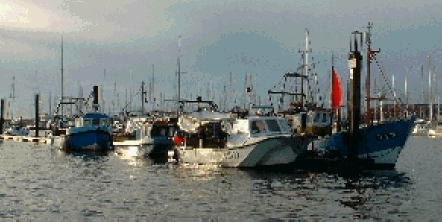
On return from the fishing grounds the boats tie-up at a floating pontoon in mid-river shown in figure 1. The catch is then transferred, using a small dinghy (either rowed or powered by outboard) to a slipway downriver of the harbour office, a distance of 350 metres. On occasions the fishermen may drop bags of shellfish at the slip at high water and retrieve them later at low water. Individual landings by boats may be in excess of 1 tonne that require more than one return trip between the pontoon and the slip.
3) Safety Management
In a recent public consultation on the River Hamble Moorings Plan, safety was reported to be one of the major concerns of users. The report on the consultation commented `that crowded and congested channels endanger navigational safety' and that `the use of so many tenders (often over-loaded) is a significant contributor to safety risks'.
In the summer season there can be as many as 4,000 boats on the River Hamble, many of which will use the main navigational channel, (that lies between the fishermen's floating pontoon and the slip), on journeys to or from moorings upstream.
Transfer of catches and gear etc between the mid-water pontoon and the slip during the hours of daylight and in good weather conditions using small dinghies poses no major risk to fishermen, or other harbour users, provided sensible precautions are undertaken. During winter months however the operations are often undertaken in darkness and weather conditions cannot be guaranteed at any time of the year (the harbour is vulnerable from southerly winds). There are risks of capsizing, swamping or being run-down and with safe access to and from the dinghies.
4) Statutory Duties
Every harbour authority has a legal duty to manage safety and should have a safety management system for marine operations in its waters, developed after a formal risk assessment. Under Health and Safety legislation employers have a duty to ensure, so far is reasonably practicable, the health, safety and welfare at work of all their employees, and under section 4 of the 1974 Act, of persons not in their employment but who may be affected as a consequence of their undertakings.
In the marine sector Health and Safety is complex and is administered by the Health and Safety Executive and the MCA. The principle relevant legislative acts are:
· Health and Safety at Work Act 1974
· Management of Health and Safety at Work Act 1999
· The Loading and Unloading of Fishing Vessels Regulations 1988
The author is not a legal or safety expert but the Harbour Authority may wish to consider its statutory duty with regard to the safety of fishermen and other river users in the landing operations between the pontoon and slip facilities provided by the Harbour Authority. There is a responsibility however which overrides any statutory duty and that is moral responsibility.
5) Risk Assessment
To put risks in some sort of perspective it is perhaps worth stating that the fishing industry is the most dangerous industry in the UK. Statistics show that each year one fisherman in every 750 fishermen will be killed. This is ten times for example the death rate in mining.
In an attempt to reduce risks to fishermen, Seafish with the help of the UK Fishing Federations, has produced standard risk assessment forms for the industry. They are published in `The Fishing Vessel Safety Folder' Issue 1 (Sept. 1999) and are endorsed by the Coastguard Agency (MCA). They are designed for self-assessment by fishermen and cover all aspects of fishing operations, including the use of dinghies and the boarding and leaving of the vessel (sheets C2-C3 are reproduced in Appendix I).
Risk factors are calculated simply by the product of the likelihood that harm may occur (F/G) and the severity of the harm caused (S). The likelihood of capsizing, swamping or being run-down in a dinghy or falling into the harbour is regarded as `unlikely' (scored 2) but is potentially `very dangerous' (scored 3). The risk factor therefore is rated at 6 and must be attended to.
6) Proposed Fishermen's Jetty
The proposed jetty would consist of floating sections supported by piles and would be located alongside the existing slip currently used by the fishermen as shown in figure 1. It would extend from the shore approximately 103 metres following the line of the slip to provide depth of water suitable for the unloading of fishing boats at any state of tide. The jetty head would be `L' shaped and facilitate two boats (one on each side). It would be serviced with power for lighting and small hand-tool use and with potable water and necessary life-saving equipment. There would be signage restricting the use of the facility to agreed parties.
It would be suitable for use with a two or four-wheeled hand-drawn trolley that should be fitted with a brake. If a four-wheeled trolley is used it should be of the `track-rod' type (not turntable) as it gives better support on turning and is less liable to tip over.
7) Recommendations
It is recommended that the risks to fishermen and other river users are reduced by the following actions on the part of both the fishermen and the Harbour Authority.
By the fishermen:
· to use a buoyancy device when operating a dinghy between the pontoon and the slip.
· to ensure adequate lighting of the dinghy in the hours of darkness
· not to overload the dinghy.
· that dinghies powered by outboard motor carry a spare set of oars in the event of motor failure.
By the Harbour Authority:
· to provide a dedicated fishermen's jetty at the slip to which fishermen could land their catches before tying-up at the mid-river pontoon (there is lack of alternative existing facility that might be used and the mixing of fishing and leisure interests is not recommended for reasons of safety and hygiene).
· that the facility be equipped with services of power and water and life saving equipment to meet operational and statutory requirements.
8) Funding
Initial estimates by the Harbour Master indicate that the capital cost of the jetty would be in the order of £40,000 which would be eligible for grant funding of up to 50% under the FIFG scheme administered by DEFRA (MAFF). Seafish could give assistance in the preparation of an application.
Running costs would be limited to any maintenance, costs of services and insurance. Insurance costs could be provided by the Local Authority self-insurance scheme and services metered and charged to the fishermen. Fishermen currently pay £600/annum for moorings and are willing for this to be increased by a reasonable amount to cover costs. It is estimated that an increase of £100/annum per fisherman would probably cover these costs.
9) Insurance and Administration
The jetty will be administered by the Harbour Authority for safety, maintenance and the collection of dues. Dues will be collected from the resident vessels annually and from visiting vessels either by contract or as and when. These moneys will be set aside for the maintenance and safety equipment replacement.
The Authority will also be responsible for including the operation of the jetty into the Harbour Safety Management System.
The jetty should be included within the Hampshire County Council self insurance scheme and also to be included within the Hampshire County Council maintenance contract.
The number of visiting vessels may increase during the oyster season therefore providing more revenue for the maintenance fund. Should the number of vessels requiring to land their catch increase beyond the safe capacity a conflict may occur between local and visiting vessels. This will have to be managed by the Authority and an agreement drawn up between the authority and local vessels to include a priority system. Visiting vessels will be made aware of this system.
The fishermen will undertake quarterly maintenance such as power washing and replacement of water hoses. Such actions will give the local vessels ownership and lead to a better maintenance regime during daily use.
Vessels will be able to lay alongside to complete maintenance and repairs.
The fishermen will also moor their tenders on the jetty therefore freeing space on the Harbour Masters Jetty at Warsash.
Annex B
Fisherman's Jetty
Letter 1
Member of Warsash Sailing Club
1a. Obstruct vessels launching on a rising tide in the prevailing south-westerly wind.
Vessel would be able to `fetch' or sail off the hard as they currently do. If the wind was from due west then difficulties would occur as is the current situation. With the wind in the west, decisions would have to be made on the correct location to launch, or in some cases not to launch, as is the current situation.
1b. Fishing Boats would obstruct launching of boats.
Not the case as fishing boats will not be moored on or near the launching area, only on the hammerhead of the jetty. Fishing boats or the tenders of the fishermen will not be moored on the slipway side of the pontoon. I expect the fishermen to use the slipway but not to moor vessels on the downstream side of the proposed pontoon.
1c. Loss of amenity for other River users and for people using the existing public decking area.
There will be no need for access onto the public decking area for fisherman or their catch. No loading or unloading will take place on the public decking or the walkway at Warsash. The current loading areas will not change. All loading will take place on the slipway as is the current situation.
Letter 2
Commodore Warsash Sailing Club
2a. A strong flood tide and an onshore wind will mean sailing dinghies will not be able to work clear of the jetty.
See 1a.
The training wall.
The training wall runs along the entire upstream side of the slipway. Its main purpose is to stop the tide and waves from eroding the slipway and causing longshore drift. The wall helps keep the gravel in place on the slipway. The wall rises to approximately one third of a metre at its highest point on the slipway side and the upstream side falls away about three quarters of a metre. The wall makes it very difficult to sail a dinghy away from the slipway upstream as the dagger board or keel can not be lowered until clear of the wall.
There are many factors to be taken into account when launching a dinghy at this slipway:
How high is the tide?
At some states of the tide the slipway does not have any significant slope therefore it is difficult to get the launching trailer into deep enough water to allow the dinghy or boat to float off.
State of the tide, is it flooding or ebbing?
This has an effect on which direction the boat is forced before wind power takes effect.
Is it deep enough to get the dagger board or keel down?
Getting the dagger board or keel down allows the boat to make forward movement and stops the dinghy falling away off the wind. Before this can be achieved the water must be deep enough to allow it. Sailing over the training wall might cause damage to the dagger board or keel or even cause damage to the hull.
The direction of the wind and how it affects possible ways of sailing off the slipway.
A dinghy is unable to sail directly into the wind. On an average, before it is able to gather speed it will only be able to make headway at about 45 to 50 degrees off the wind as it picks up headway it will be able to sail closer to the wind at about 40 to 45 degrees depending on the wind speed and type of vessel.
Storage of the trailers and launching trolleys.
Holding the boat in position while the trailer is parked is an important requirement that needs planning.
Dinghy sailors must make decisions every time they launch and the first one to be made is: `Do I launch at this location or at the Club slipway which might be a safer option?'
2b. Dinghies with `racks' in particular have no way of fending off without risk of capsize and being driven under the pontoon by the tide.
Racks are mountings that extend each side of the hull allowing helm and crew to shift their weight outboard to help keep the boat upright. These types of boats tend to be unstable at low speeds. They can be seen doing 10 to 15 knots then coming to a halt to turn and immediately capsizing (falling over) because they are so unstable and the crew have not reacted quickly enough by shifting their position in the boat. Dinghies of this type already have difficulty in launching and avoiding the training wall in some conditions of wind and tide. As a result, it is very unlikely that these types of boats will be any worse off with the Fisherman's jetty in place. Decisions regarding launching can only be the responsibility of the boat owner/skipper. The launching of any dinghy from the Warsash slipway will be difficult in a westerly wind and at mid-tide. With the Fisherman's jetty in place, dinghy sailors will have the benefit of being able to walk their boat down the length of the jetty and sail it off the hammerhead of the jetty - a vast improvement over the present situation.
2c. The Club launch `Lobster' will have great difficulty in getting in and out of her berth on Shore House jetty.
The gap from the Warsash Sailing Club jetty to the proposed Fisherman's jetty will be 28 metres. This is ample room for a 7 metre motor boat to manoeuvre in. If the boat was berthed in a marina it would be likely to have 20 metres or less, on average, to manoeuvre into its berth.
2d. Is there a rule stating how many fishing boats can go alongside the jetty.
Fishing boats will only be moored on the hammerhead and on the inside of the hammerhead. Fishing boats will not moor in the area of the slipway and will not be allowed to be moored in that area.
2e. Vessels being made fast alongside the slipway and drying out on the slipway will block the slipway.
This will not be allowed and will not occur and would contravene the Bye-laws.
See 2d.
2f. We would prefer to see the jetty 10 metres shorter, only one boat at a time to use the jetty, signs on the slipway side saying no mooring, and allowing dinghy crews to use the jetty when required.
The jetty must extend to the planned area to ensure it is available at all states of the tide with sufficient depth of water.
Signs are not required as the local fishermen fully understand the limitations.
Dinghy crews will be able to use the jetty during periods that it is not being used by the fishermen for unloading their catch. Conflicts will be dealt with by the Harbour staff.
Letter 3
Practical Boat Owner magazine
3a. Loss of public amenity
See 1a, 1c and 2b.
There is not any loss to `public amenity' and `thousands of people' will not be compromised by the needs of only six small fishing boats. I would suggest that this is, to say the least, overstated.
3b. Threat to public safety
The jetty will not be connected to the public walkway and there is no direct access for members of the public. The River Hamble has numerous such jetties and pontoons throughout its length, in constant use by the public. Should it be decided to put some form of restriction on this jetty as a result of advice in this letter, those restrictions would have to be placed on all jetties and pontoons throughout the Hamble (a total of over 28,000 metres).
3c. Hazardous to the Fishermen
This is an overstatement as the trolley will not be capable of carrying anything like a tonne of fish. It will have a maximum safe working load which will ensure that it is manageable. Those operating the trolley have a vast experience of working in difficult conditions, managing loads and lifting within safe limits.
3d. Alternative solutions are available
During the two years that this project has been under consideration many alternatives have been explored. All of the suggestions offered in this letter have been closely looked at and discarded for various reasons.
I would mention that the fishermen's moorings were moved by the Crown Estate (the owners of the moorings), not the Harbour Authority. Wherever the fishermen are moored, they would still have to transit the River at night with their catch. Not many dinghies are launched or recovered from the slipway in the dark.
3e. Other important points
The Editor of Britain's largest boating magazine displays a woeful lack of knowledge of the local fishing industry. Local fishermen venture as far south as mid-channel and along the coast to Sussex and Dorset.
Seafish are the National representatives of the fishing industry and their risk assessment must not be taken lightly and swept aside with such remarks.
3f. More Consideration is required
See 3d.
The fishermen have been involved at all stages of planning this project and are fully behind the scheme.
The scheme was presented at the Warsash Improvements Plan Working Group at a meeting on the 19 November 2003. Warsash Sailing Club and other stakeholders were part of this group. No objections were raised.
The scheme was presented to the Executive Members Advisory Group on the 13 May 2004. No one put forward any suggested changes to the scheme at that meeting.
The scheme was given consent by the Executive Member at a public decision day on the 12 October 2004. No requests for deputations or letters against the development where received.
The scheme improves navigational safety for all River users and ensures that the main channel is free from the dangers of a collision caused by small tenders loaded with the fishermen's catch. During the winter this activity normally takes place in the dark.
Letter 4
Member of Warsash Sailing Club
The letter does not give any specific reasons neither does it highlight any dangers or activities that might be affected by the proposed development. The jetty is not in the main fairway. The jetty does not encroach into the access channel and I fail to see the relevance of Stone Pier Yard which is an entirely different situation and was not, in any case, turned down on grounds of `Navigational Safety'.
Letter 5
Member of Management Committee and Warsash Sailing Club
5a. The training wall running alongside the slipway will cause vessels to capsize and dinghies will be damaged by the wall.
The training wall has been in place for many years and already represents some danger to dinghies and other small craft. Even though the wall is marked with two yellow special marks (`X') boats still manage to hit it at some states of the tide. On the downstream side, the slipway side of the wall rises only about one third of a meter but on the upstream side it is up to three quarters of a metre deep. This is the side that catches people out and this is the side that the pontoon will be hit, totally eliminating the problem.
The Harbour Authority has been experimenting with signage and concluded that a strip sign sitting under the walkway but very visible to approaching boats is the solution. The sign is made up of red lettering on a white background with lettering approximately 4 inches high and stating " Danger underwater obstruction close alongside this jetty". The sign is repeated along the underside of the walkway. Local sailors will be aware of this obstruction and those that launch will also be aware of it during their launching process. Two yellow special marks (`X') will remain in place, which is the standard navigational warning for such navigational obstructions. Dinghies very rarely, if at all, approach this slipway in the dark.
5b. The Harbour Master was reluctant to pay a further £750 from his budget on a revised application.
This is a misunderstanding by the letter writer. I was not willing to apply to have the jetty located on the slipway because:
a. It would virtually block off the slipway at the concrete hard-standing pinch point. At this point, the slipway is only 8 metres wide which allows two boats to pass side-by-side. A pontoon 2 metres wide, plus the width of the piling, would reduce the slipway to about 5 metres - enough room for only one boat at a time.
b. It would dramatically reduce areas of the slipway available to members of the public.
c. It would not allow space for fishermen's tenders to be stored on the upstream side of the jetty.
d. Locating the jetty on the downstream side would readily allow members of the public greater and easier access, creating a safety problem.
5c. Loading of the catch into the lorries.
Unfortunately the letter writer has totally misunderstood the proposed method of loading lorries. There will be no change from the current procedures. Lorries will use the slipway, reversing up against the training wall and loading directly from the proposed jetty. Fishermen will not enter or use the public boardwalk area and lorries will not have to use the public car park.
If the letter writer checks he will discover there is already a gate that opens onto the training wall with steps down to it. I would emphasise that this route will not be available for fisherman to load their catch.
5d. The River users will pay 50% of the capital costs
The River users will pay 25% of the cost of the jetty, which is £3.70 each (less than the price of two pints of beer), in return for which they will see a significant improvement in safety, both for themselves and for the fishermen.
5e. Alternative Proposal
Also see 5b.
The suggestion would block the slipway by approximately three metres. At the pinch point by the concrete hard-standing for the scrubbing piles, this restriction would not be acceptable.
As explained before, lorries will not need to enter the car park and neither will the fishermen.
5f. Further Benefits to the public.
As already explained, the jetty is for the loading and unloading of the fishermen's catch. Some use will be made of the hammerhead for fishing boats to lay there during repairs. Members of the public who launch boats may use the jetty when not in use by the fishermen, and they will be able to walk their boats out into deeper water for a safer launch and departure.
If the jetty was built on the downstream side of the training wall, the fishermen would lose control of the jetty as it would be in regular use by members of the public.
The statement regarding river users making a contribution to the maintenance costs is incorrect. The maintenance of the jetty will be budgeted from fees received from the fishermen.
Letter 6
Member of Warsash Sailing Club
6a. There are only four places over the full navigable length of the River where boats can be launched off trailers.
There are twenty one slipways in the River Hamble, of which nine are public slipways. These are:
College slipway
Warsash Sailing Club slipway
Warsash village slipway (public slipway)
Swanwick (public slipway)
River Hamble Boatyard
Eastlands Boatyard
Bark store at Botley Quay (public slipway)
YMCA Manor Farm
Riverside Boatyard
Cabin Boatyard
Upstream A27 road bridge (public slipway)
Downstream A27 road bridge (public slipway)
Elephant boatyard
Lands End hard (public slipway)
Mercury Yacht harbour
Mercury gardens (public slipway)
Hamble village (public slipway)
RAFYC slipway
Royal Southern Yacht Club slipway
Hamble fore-shore slipway (public slipway)
Point Hamble Marina
6b. Difficulty in Sailing off the slipway.
See 1a, 1c and 2b.
6c. Risk Assessment to include the general public.
The original risk assessment was written by SEAFISH and highlighted the dangers to the fishermen in transporting their catch across the main channel in small tenders in the dark. It mentioned the need to avoid passing vessels and to overcoming difficulties in lifting and loading the small boats.
Jetties and pontoons in any location on the River have associated hazards which are managed under the Safety Management System to reduce the risk to as safe a level as possible. As can be seen from the photographs supplied by the writer, youths will venture onto any structure. This youngster appears to have ridden his bicycle along the narrow and slimy training wall. The photograph shows a strong tide running and the children might be in some danger. This occurs on the River every day and, in particular, on the pubic jetties at Warsash and Hamble, access to which is freely available 24 hours a day. There are many hazards associated with this but they are managed to make the risks as low as reasonably practicable. The hazards and risks associated with the proposed Fisherman's Jetty will be no different and will be managed in the same way.
Clearly, the Harbour Authority is not able to supervise every pontoon on the River continuously and would not wish to do so.
See also 3b.
6d. Safety of Fishermen.
See also 3c.
The fishermen have been involved throughout the design process for the jetty. Transportation along the pontoon will be by the use of a trolley. The catch will then be placed/loaded into trucks parked on the slipway, as is the current practice.
6e. Damage to the Pontoon.
A cost benefit analysis was presented to the Harbour Authority and was prepared with the assistance of the pontoon manufacturer.
6f. Moorings Allocation.
See 3d.
6g. Improve the Fishermen's Tenders.
This is a matter for the fishermen and their own business plan. I would suggest that once the constant use of the tenders for transporting catches ceases, the quality of their tenders will improve.
6h. Re-site the pontoon.
This suggestion has been fully explored during the investigation and two year consultation period. It is impracticable because the only alternative area is the designated clean-up area for oil spill response. There is no other viable location for this vital activity and placing a pontoon at this location would completely undermine the oil spill response plan.
It is worth noting that lorries will not be able to back up to the small fisherman's slipway in the car park, because there is insufficient room for them to turn.
The small fisherman's slipway has not fallen into disuse but is used regularly by many of the fishermen on the River.
Annex C
Hampshire County Council River Hamble Executive Member's Group 26 July 2004 Fishermen's Jetty, Warsash Report of the Director of Environment |
Item 4 |
Contact: Tony Clatworthy, tel 01489 576387
email: [email protected]
1. Summary
1.1 This report seeks a decision on the construction of a fisherman's jetty at Warsash and the process by which its construction and funding can be progressed and its future maintenance financed. Attached to this report is a brief of the proposed project written by the Sea Fish Industries Project Management Adviser.
2. Corporate Strategy
2.1 The decision supports Aims 1, 2, 3 and 5 of the Corporate Strategy (Maximising Life Opportunities, Stewardship of the Environment, Building Strong and Safe Communities and Improving Services) by contributing to the statutory duties entailed in the management of the River Hamble.
3. Background
3.1 The River Hamble supports six fishing boats all under 12 metres which are moored mid-stream on a pontoon off Warsash. Their main catch depends on the season but varies from netting white fish to cockles, mussels, whelks, oysters, crabs and squid. The working fleet in the Hamble has declined over the last ten years in line with the trend shown with this type of vessel working in the Solent. The Solent is the largest natural oyster bed in Europe and has witnessed the decline in vessels of the kind operating from Hamble. The Department for the Environment, Food and Rural Affairs' (DEFRA) Shellfish Licensing Scheme is now encouraging longevity of the fleet.
3.2 The facilities for landing this type of catch at Warsash are minimal and create a risk for the fishermen and other River users with the current methods used. The transfer of the catch is normally carried out in the dark with minimal lighting aboard the small tenders used by the fishermen. The risk of collision, swamping or sinking is very high and mainly occurs during the transfer of the catch by tender to the slipway at Warsash from the mid-stream fisherman's pontoon, a total distance of 350 metres. On occasion nets of shellfish are dumped on the slipway at high tide from the boats and retrieved later at low water. During the transfer and landing of the catch the danger to navigation and the risk to the fishermen is unacceptably high; these dangers increase after dusk.
3.3 A proposed landing jetty at Warsash would improve the facilities available for fishermen and also reduce the risk of collision, swamping or sinking of the vessels during the transfer of the catch. It would also improve the quality of the product as it would not be handled as frequently.
3.4 Fishing vessels constantly use the Harbour Master's (HM) jetty to lay alongside for repairs and maintenance, taking up space on the outside of the jetty. The storage of fishermen's tenders on the inside of the HM jetty takes space from other users. This area has become overcrowded and is causing damage to tenders and the jetty.
4. Project Information
4.1 The project would be the subject of a formal consents application following the confirmation of funding for the facility being in place. The supply and installation of the jetty has been estimated at £40,000. This estimate has not been the subject of a tender process and is thought to be correct within £5,000.
4.2 The Sea Fish Industry Authority has indicated that it would recommend to seek a grant of 50% of the cost of the project from European Funding. The grant would be applied for under the `Improving of Fishing Port Facilities' and aid will be available for "capital investments which are of collective interest to fishermen using the port". The project must contribute to the development of the port and represent an improvement of services offered to fishermen. Investments may be single projects or parts of an overall harbour development and must comprise, in respect of the port concerned, coordinated investment designed to bring about a lasting improvement in conditions for the landing and initial sale of fish, and contribute to lasting economic benefits or improve safety conditions. Projects must be substantiated on the basis of the benefits to the fishing industry and priority will be given to projects which:
(i) contribute to the general development of the port and to the improvement of services offered to fishermen;
(ii) improve the conditions under which fishery products are landed, handled and stored in ports;
(iii) support fishing vessels activities (provision of repair and maintenance of vessels); and
(iv) improve jetties with a view to improving safety during the landing or loading of products.
4.3 Projects undertaken for the collective good of the fishing industry could qualify for a Financial Instrument for Fisheries Guidance (FIFG) grant at a rate of 25% to 50%. The balance of the project costs would have to be met by a public authority. DEFRA will not be providing national back-up funding for this measure. The South East Fishing Development Agency has advised a 50% grant would be available if the County Council provided a matching 50% funding. The possibility of a bid against the Coastal Budget (Policy and Resources) is in the process of being investigated during the period of the production of this report.
4.4 The Sea Fish Industry Authority has offered assistance in preparing the grant application and would take responsibility for its completion. Should this application for a jetty to be built be successful, a fund should be set up within the Harbour Authority Budget for future maintenance.
4.5 The jetty would be managed by the Harbour Authority and, for insurance purposes, fall within the County Council's self-insurance scheme.
5. Options
5.1 The manufacture and installation of a fishermen's jetty upstream against the training wall of the slipway at Warsash.
5.2 Partnership funding of approximately £40,000 between Hampshire County Council (Coastal Budget) and EU Fisheries Grants in England.
5.3 Such an installation would conform to the County Council's Corporate Strategy. The installation would:
(i) allow fishing vessels to land their catch;
(ii) provide a facility to bring alongside vessels that require repair or maintenance as well as to moor the tenders of the fishermen;
(iii) eliminate the risky operation of transferring the catch from midstream to Warsash and the dangers involved with that operation;
(iv) relieve the HM jetty at Warsash of fishing vessels and tenders; and
(v) benefit the local community.
5.4 The jetty would become a responsibility of the Harbour Authority for safety and continuing repair. The Harbour Dues of the home port fishing boats would be increased to help provide a fund for maintenance and repair, and revenue could be collected from vessels, which are not River Hamble based, that land their catch at the facility.
5.5 The project would be subject to a tendering process under the County Council's Standing Orders.
6. Financial Implications
6.1 The estimated total cost for the provision and installation of a 103 metre jetty including a 10 metre "L" landing section, supported with four piles, has been estimated at a capital cost of £40,000, plus or minus £5,000 This figure would be confirmed following an invitation to tender under Standing Orders. The project would be eligible for a grant of 50% under the FIFG scheme administered by DEFRA.
6.2 The estimated cost of maintenance and repair would be covered by an increase of £100 to the Harbour Dues paid annually by the six fishermen based on the river. Revenue could also be collected from visiting fishing vessels which land their catch at Warsash. Running costs would be limited to any maintenance, costs of services and insurance. It may be possible to cover insurance costs by the Hampshire County Council self-insurance scheme and services metered and charged to the fishermen. However, the issue of insurance is still under discussion and still needs to be resolved and may therefore prove a barrier to this project. Fishermen currently pay £600 per annum for moorings; this could be increased by a reasonable amount to cover costs.
6.3 It is estimated that an increase of £100 per annum per fisherman would probably cover these costs. The income from dues collected would be in the region of £1,000 annually. Maintenance to the structure would not be required within the first 24 months, therefore a working fund would be established for future work.
7. Insurance and Administration
7.1 The jetty would be administered by the Harbour Authority for safety, maintenance and the collection of dues. Dues would be collected from resident vessels annually and from visiting vessels either by contract or periodically. These monies would be set aside for maintenance and safety equipment replacement.
7.2 Electricity would be metered to individual vessels, by either tokens or a swipe card system.
7.3 Fresh water would be supplied by mains and delivered to the jetty head by a pipe and controlled tap. The cost of the water supply is still under investigation, including the location of the source mains supply.
7.4 The Authority would also be responsible for including the operation of the jetty into the Harbour Safety Management System.
7.5 It would be prudent to include the jetty within the Hampshire County Council self-insurance scheme and also the Hampshire County Council maintenance contract (Planned Maintenance Scheme).
8. Sea Fish Industry Report and Risk Assessment
8.1 A report written by the Sea Fish Industry Authority Technology Division is attached. This deals with the risk assessment and the statutory duties of the Harbour Authority.
9. Oil Boom
9.1 Consultations have taken place with Oil Spill Response Limited to ensure the oil boom containment plan will continue to operate safely following the installation of the Fishermen's Jetty. Confirmation was given by Oil Spill Response Limited that the plan would continue to operate safely.
Recommendation
That the Executive Member for Environment be advised to approve the principles of a Fishermen's Jetty development at Warsash, subject to the necessary consultation and consents.
Section 100 D - Local Government Act 1972 - background papers | |
The following documents disclose facts or matters on which this report, or an important part of it, is based and has been relied upon to a material extent in the preparation of this report. | |
NB the list excludes: | |
1. |
Published works. |
2. |
Documents which disclose exempt or confidential information as defined in the Act. |
TITLE |
LOCATION |
None. |
8838/AC