
Archived decisions
Hampshire County Council
Executive Member for Adult Social Care Item 1
30 March 2007
Integrated Community Equipment Services - Future Service Recommendations Report of the Director of Adult Services
|
Contact: Frances Farrar Ext: 7147 Email: [email protected]
Steve Garnett Ext: 7272 Email: [email protected]
Kevin Armstrong Ext: 7139 Email: [email protected]
Approved by:...................................... Date:.....................
Councillor Patricia Banks
Executive Member for Adult Social Care
Hampshire County Council | |
Executive Member for Adult Services Item 1 | |
30 March 2007 | |
Integrated Community Equipment Services - Future Service Recommendations | |
Report by the Director of Adult Services |
Contact: Frances Farrar Ext: 7147 Email: [email protected]
Steve Garnett Ext: 7272 Email: [email protected]
Kevin Armstrong Ext 7139 Email: [email protected]
1. Summary
1.1 This report presents options for the future delivery of Integrated Community Equipment Services (ICES) for Hampshire. The report analyses the costs and benefits of four options for the service. As a result of this analysis, this report proposes the implementation of a county-wide service in partnership with Hampshire Primary Care Trust (PCT).
1.2 The Service supports the three new corporate priorities; Hampshire safer and more secure for all, Maximising well-being & Enhancing our quality of place. It does so through the timely provision of equipment to disabled, frail and elderly citizens. The range of equipment purchased and stocked is essential to enable people to remain within their own homes or within a community based setting. Most of the equipment is recycled and re-issued. It promotes independence and wellbeing and is central to safe and timely hospital discharges. The service prevents hospital, residential or nursing home admissions by minimising the risks of falls, immobility and breakdown of formal or informal care arrangements.
2. Impact Assessment
2.1 In compiling this report account has been taken of the requirements of the Corporate Equalities Plan and Race Scheme. The recommendation does not have an adverse impact upon minority groups. A full Impact Assessment of Occupational Therapy and Equipment services has started and the completion date is estimated as 31 March 2007.
3. Background
3.1 The Interim Assistant Director Wellbeing and Community Services commissioned a review of all options for the provision of the ICES within Hampshire. This was in response to the following challenges facing the service:
a) Demographic changes resulting in a significant and sustained increase in requests for equipment in particular expensive items such as profiling beds, high risk pressure relieving mattresses and hoists.
b) Rising costs of decontamination and recycling of equipment
c) The key role equipment services will play in promoting the prevention agenda as outlined in national policy initiatives, such as the White Paper "Our Health, Our Care, Our Say"
d) The need to enter into a Section 31 agreement with Hampshire Primary Care Trust and to pursue further partnership working in this area
e) The termination of the lease for the Basingstoke ICES premises in August 2007 and the need to ensure equity and consistency of service across Hampshire
f) The need for service modernisation in response to Adult Services' financial recovery, its duty to secure Value for Money and requirements to meet national performance targets relating to efficiency, quality and timeliness of service.
g) The development of the new Adult Services and Children's Services Departments.
3.2 Within Hampshire there are two equipment services, one situated in Basingstoke and the other in Portsmouth.
3.2.1 The Basingstoke service was established in 1997 and is managed by Hampshire County Council. It provides a service to the former PCT areas of Blackwater Valley & Hart, Mid Hants, North Hants, New Forest and Eastleigh & Test Valley South. The population served is approximately 900,000.
3.2.2. Portsmouth ICES is managed by Portsmouth City PCT and covers Portsmouth City, Portsmouth City PCT and the former PCT areas of East Hants and Fareham & Gosport. The population served is approximately 545,000, of which 325,000 live within Hampshire.
3.3 Basingstoke and Portsmouth supply a broadly similar range of equipment eg bathing and toileting equipment, mobile and ceiling track hoists, profiling beds, pressure relieving mattresses, moving and handling equipment.
3.4 The main difference between the two ICES is the service provided under the Lifting Operations and Lifting Equipment Regulations 1998 (LOLER) and the Provision and Use of Work Equipment Regulations 1998 (PUWER).
3.4.1 Under LOLER and PUWER, items of equipment should be inspected and maintained on a regular basis. Basingstoke ICES have 6 Technicians who undertake this service, which is not provided by Portsmouth ICES.
3.5 Table 1 summarises the overall cost of the two services and their funding arrangements.
Table 1 - Total Projected Costs and Funding for 2006-07.
Basingstoke JES |
Portsmouth JES |
Total | |
COSTS: |
£000s |
£000s |
£000s |
Running Costs |
1,368 |
626 |
1,994 |
Purchase of Equipment & Adaptations |
502 |
828 |
1,330 |
Total Costs |
1,870 |
1,454 |
3,324 |
Population served |
900,000 |
545,000 |
1,445,000 |
Cost/head of population |
£2.08 |
£3.20 |
£2.30 |
FUNDED BY: |
£000s |
£000s |
£000s |
Hampshire County Council |
1,182 |
263 |
1,445 |
Hampshire PCT |
688 |
816 |
1,504 |
Portsmouth PCT/ Portsmouth City Council |
0 |
375 |
375 |
Total Funding |
1,870 |
1,454 |
3,324 |
A full analysis of costs and funding can be found in Appendix A.
4. Demand pressure at Basingstoke ICES
4.1 Demand for equipment has risen steadily since the service was established in 1996/7. The graph below shows the year on year increase in the number of items delivered and collected by the equipment service since it was commissioned, rising from around 8,000 in 1996/97 to over 80,000 in 2005/06.
Graph 1 Number of items of equipment delivered and collected each year, between 1996 and 2006.
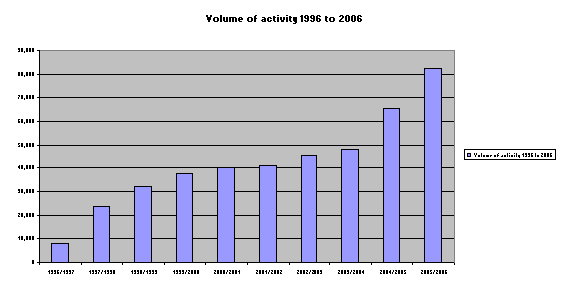
4.2 Not only has demand increased, but equipment is remaining within the community for longer and is therefore not available for recycling and re-issue. In addition, demand for the higher value items (profiling beds, high risk pressure relieving mattresses, hoists etc) has risen. The increase in demand is to be expected given the numerous initiatives in both health and social care which rely on the timely provision of equipment and the changing service models which have led to an increasing number of frail and dependent service users being supported in the community.
It is anticipated that with the preventative ethos incorporated in the Wellbeing Agenda, the upward trend looks set to continue in the future.
5. Decontamination and recycling of equipment
The recycling of equipment is a key factor within the service to maintain levels of stock..
5.1 To comply with infection control requirements and the increased volume of equipment recycling, a major review of the existing processes and contract arrangements is underway for Basingstoke ICES.
Initial findings indicate that a considerable potential for annual savings and service efficiencies can be achieved through providing an in house decontamination unit within the new Basingstoke ICES premises.
5.2 Portsmouth have stated their intention to recover full costs for all elements of their equipment service. In relation to decontamination costs the combined figure for Hampshire Adult Services and the former SE Hampshire PCTs has risen from £38,000 for 2005/06 to £168,000 for 2006/07.
5.3 The comparative costs using the same external provider are £6.26 per item for Basingstoke and £13.78 for Portsmouth ICES.
6. Legislative change
6.1 Building on a number of recent government initiatives to promote community care, a new direction for the whole Health and Social care system is set out in the White Paper, published in January 2006, entitled ` Our health, our care, our say: A new direction in community services'
6.2 The four key themes of the paper are:
Providing better prevention services with earlier intervention
Giving users more choice and influence
Tackling inequalities and improving access to community services
Providing more support for people with long term needs
6.3 The White Paper identifies collaboration between local health services and adult services departments as a cornerstone for service delivery.
6.4 These themes emphasise the importance of the ICES model and achieving a robust S31 agreement.
7. The development of the new Adult & Children's Services Departments.
7.1 Children's Services have confirmed their wish to centralise the commissioning/delivery/storage/recycling of paediatric equipment and to include this service within the existing Hampshire ICES. This will be agreed through a Service Level Agreement (SLA) and achieve overarching service efficiencies.
7.2 The requirements of the paediatric equipment service have been incorporated when determining the specification for the new Basingstoke premises.
8. Review of Current Service
8.1 The expiry of the lease on the current Basingstoke site in August 2007 presented a good opportunity to consider how ICES should be provided in order to meet the future challenges presented by its changing environment.
8.2 In order to inform the evaluation of how any proposal would meet the strategic
position a list of essential service benefits were identified by the Department as the following:
_ Consistency/equity across Hampshire in terms of:
* application of eligibility criteria
* procurement and stock control practices
* quality monitoring
* management arrangements
* meeting regulations covering the maintenance of equipment
_ A focus on promoting the best interests of Hampshire clients
_ Flexibility to respond rapidly and effectively to future changes in demand and nature of service provision
_ Rapid and effective distribution system
_ Consistent budget strategy and financial management processes
_ A high level of recycling in a cost effective manner
8.3 These future service benefits form the key service criteria against which all the available options have been appraised.
8.4 Considerable progress in partnership working has been made in the current financial year between the new Hampshire PCT and Hampshire Adult Services:
· Agreement has been reached on the overall size of the ICES budget to ensure the sustainability of the service and to meet national performance targets.
· Both partners are committed to securing the agreed additional funding to achieve this integrated budget and to complete a S31 agreement.
· The ICES Pooled Budget Group agreed that funding will be split on a 50/50 basis.
· The Hampshire PCT have confirmed their support for a one, Hampshire wide service, to be managed by Hampshire Adult Services.
9. Re-provision Options
9.1 Four possible models for future service delivery have been identified.
These are:
Option 1 - No change, continue with existing provision.
Option 2 - Commission one Hampshire wide ICES, managed by HCC and withdraw from the Portsmouth service..
Option 3 - Commission one Hampshire wide ICES from Portsmouth City PCT.
Option 4 - Commission one Hampshire wide ICES from an external provider.
9.2 Each option was examined using :
· A Strengths, Weaknesses, Opportunities and Threats (SWOT) analysis (Full details can be found in Appendix B)
· A service benefits analysis (Full details can be found in Appendix C)
· A financial analysis, including full cost analysis and budget position. (Appendices D and E)
10. Summary of Analyses
10.1 Summary of SWOT Analysis
From the four options considered, Option 2 Commission one Hampshire wide ICES managed by HCC provides the best option.
Specifically it offers :
_ Best value in terms of staffing and overheads through the development of the new service model.
_ Consistency of service delivery and policy implementation. Service discrepancies which currently exist between Basingstoke and Portsmouth ICES will be removed, enabling the implementation of a Hampshire wide service specification, agreed by both HCC and Hampshire PCT. Additionally, it will facilitate the harmonisation of the role of other complementary services across the county, in particular, Red Cross.
_ Consistency of monitoring arrangements and performance data.
_ Reduced risk through not being dependant on the priorities of other local authority and PCT providers.
_ Transparency, flexibility and quality.
10.2 Summary of Service Benefit analysis
10.2.1 From the service benefit analysis it appears that neither Option 1 or Option 3 can satisfy the essential service benefits as they perpetuate the deep-seated differences in approaches between the services run by Hampshire County Council and those run by Portsmouth PCT. This appears to mitigate against the need for consistency in both service access and delivery for Hampshire clients as well the management and operating of the stores.
10.2.2 Options 2, 3 and 4 appear to offer more potential for further consolidation of equipment and the potential for economies of scale. However, only Option 2 and 4 ensure that the service fully complies with legal regulations relating to the maintenance of equipment. Portsmouth ICES has adopted a strategy to compliance with the regulations which is not supported by HCC.
10.2.3 The main concern with Option 4 (the contracted-out approach) is that this is a dynamic service and the flexibility required to respond to changes will be constrained by the tight contract agreement likely to be required by the external service provider.
10.2.4 Options 2 and 4 will require disinvestment from the Portsmouth service which will need to be carefully project managed.
10.3 Summary of Ongoing Revenue Costs
Table 2 below details the ongoing revenue costs of the four options .
An analysis of the net costs demonstrates that Option 2 will deliver the lowest ongoing revenue costs, at £2,823K per annum.
In comparison, this is £126K below Option 1, £1,137K below Option 3 and £2,177K below Option 4.
Table 2: Overall ongoing revenue costs:
Option 1 |
Option 2 |
Option 3 |
Option 4 | |
£000s |
£000s |
£000s |
£000s | |
Running Costs |
1,994 |
1,743 |
Detail not available |
Detail not available |
Equipment & Adaptation purchase |
1,330 |
1,080 |
Detail not available |
Detail not available |
Total Costs |
3,324 |
2.823 |
3,960 |
|
Less Portsmouth PCT funding |
-375 |
N/A |
N/A |
N/A |
Net Costs |
2,949 |
2,823 |
3,960 |
5,000 |
10.4 Summary of financial analysis
On the basis of the SWOT, cost benefit analysis and ongoing revenue costs, Option 2 appears to offer the best fit in terms of meeting desired future service benefits as outlined in 8.2, providing the best financial return for the partners and offering the most flexibility to meet likely future changes to service provision.
11. Risk Analysis based on approving Option 2
11.1 Financial Risk - actual cost and savings may be different from projected even beyond the plus/minus 15% margin of error contained in the sensitivity analysis if some of the economies of scale do not materialise.
11.2 Partnership Risk - this option will entail disinvestment from Portsmouth service which has yet to be explored in depth with Portsmouth PCT and Portsmouth City Council.
This will be addressed by developing a comprehensive decommissioning strategy with Portsmouth City PCT.
Portsmouth City PCT have indicated that they will continue to provide a service to Portsmouth City residents irrespective of whether HCC continues to commission a service from them.
11.3 Implementation Risk - a new site has to be sourced, fitted out and stock transferred whilst still maintaining a viable service. In contrast , the Portsmouth option offers an pre-existing site and operational infrastructure.
However, there will be no requirement to consult with users because equipment already on loan will remain with the user following decommissioning and service users will continue to receive their assessments for equipment in the same manner.
11.4 TUPE Risk - Costs could be higher due to the need to transfer staff from the Portsmouth store, for example, the 3 Specialist Advisers employed by the former SE Area PCTs would add £125k to the projected costs assuming the worst case scenario.
Hampshire PCT are actively addressing this issue.
11.5 Stock Risk - Additional stock may have to be purchased if the identification of HCC/Hampshire PCT stock held at Portsmouth cannot be agreed upon.
A project group has been identified to negotiate a detailed, equitable re- provision programme with Portsmouth and manage and monitor the implementation of the proposed future service.
12 Recommendations
a) That Hampshire County Council establishes a single Integrated Community Equipment Service located in Basingstoke
b) That Hampshire County Council and Hampshire PCT terminate their partnership agreement with Portsmouth City PCT and Portsmouth City
c) That the potential costs associated with the premises move are met by prioritising the existing capital budget.
d) That a Section 31 Agreement is entered into with Hampshire PCT incorporating a robust funding strategy to meet the demands on the service and including the Technician Service.
e) That a cost benefit analysis is carried out on incorporating an in-house decontamination unit into the new premises, in place of the current external contracting arrangement.
APPENDICES TO COMMUNITY EQUIPMENT REPORT APPENDIX A (i) | ||||||
ICES Analysis of Budget & Source of Funding - 2006/07 Basingstoke | ||||||
£000s |
£000s | |||||
2006-07 |
2006-07 | |||||
Running Costs: |
||||||
Employee Costs |
740 |
|||||
Premises |
157 |
|||||
Transport |
108 |
|||||
Spares & Recycling |
358 |
|||||
Supplies & Services |
5 |
|||||
1,368 | ||||||
Equipment & Adaptation Purchase |
168 | |||||
1,536 | ||||||
Additional One-Off Equipment Purchase |
334 | |||||
Total Budget |
1,870 | |||||
FUNDED BY: |
||||||
Recurrent Funding: |
||||||
Hampshire PCT |
654 |
|||||
Hampshire County Council |
882 |
|||||
|
||||||
1,536 | ||||||
Non-Recurrent Funding: |
||||||
HCC Capital (yr1 of 4) |
100 |
|||||
Hampshire PCT match funding for above*** |
34 |
|||||
HCC Contingency |
200 |
|||||
334 | ||||||
Total Funding |
1,870 | |||||
Source: base budget per HCC accounting system plus | ||||||
agreed additional investments |
||||||
Notes |
||||||
*** HCC/PCT match funding split £134k Basingstoke; £66k Portsmouth. | ||||||
APPENDIX A(ii) |
||
ICES Analysis of Budget & Source of Funding - 2006/07 Portsmouth | ||
£000s |
£000s | |
2006-07 |
2006-07 | |
Running Costs: |
||
Allocation from Portsmouth PCT |
501 |
|
Specialist Advisers * |
125 |
|
626 | ||
Equipment & Adaptation Purchase ** |
742 | |
1,368 | ||
Additional One-Off Equipment Purchase |
86 | |
Total Budget |
1,454 | |
FUNDED BY: |
- |
|
Recurrent Funding: |
||
Hampshire PCT |
750 |
|
Hampshire County Council** |
243 |
|
Portsmouth PCT & PCC |
375 |
|
1,368 | ||
Non-Recurrent Funding: |
||
HCC Capital (yr1 of 4yrs) |
- |
|
Hampshire PCT match funding for above*** |
66 |
|
HCC Contingency |
20 |
|
86 | ||
Total Funding |
1,454 | |
Source: SAP base budget plus agreed additional investments and 2006-07 projections from Portsmouth PCT | ||
Notes |
||
* Estimated cost of 3 Specialist Advisers attached to Portsmouth but paid for by SE Area PCTs, not required in the all-Hampshire model. | ||
**Equipment purchase & HCC funding includes £62k held in Area Office | ||
*** HCC/PCT match funding split £134k Basingstoke; £66k Portsmouth. Assumes projected 06/07 overspend of £267k picked up by host partner as additional spending not authorised by HCC or Hampshire PCT - including the 3 specialist advisers detailed above. | ||
APPENDIX B
SWOT Analysis of the four service model options.
Option 1. Continue with existing provision
Strengths |
Weaknesses |
Service Continuity Maintain stable staffing position Continue with relocation plans for ICES in/around Basingstoke |
Service inconsistency Danger of postcode service Duplication of contract monitoring arrangements Existing non-extendable lease for Basingstoke premises expires in August 2007 requiring a change of location. Funding for this relocation to be shared on a 50/50 basis with Hampshire PCT. |
Opportunities |
Threats |
Further development of existing partnership arrangements with Portsmouth |
Failure to achieve best value through not optimising economies of scale when purchasing equipment Potential strategic weakness if we remain dependent on another authority e.g. policy towards balanced budget Remaining with two service providers may result in differing PAF D54 performance outcomes Portsmouth ICES staffing costs do not include three specialist advisors. If included, these would have a significant impact on unit costs. |
Option 2. Commission one Hampshire wide ICES, managed by HCC
Strengths |
Weaknesses |
Consistency of: · service delivery across Hampshire/new PCT. · performance and performance information · LOLER and PUWER technician provision across Hampshire Best value will be achieved in staffing and overheads through developing a new service model Larger premises will offer potential economies of scale. |
Notice period required to terminate Portsmouth service. Significant decommissioning activity required to determine ownership of equipment. Project plan for exit strategy required. Issue of data transfer |
Opportunities |
Threats |
Best value commissioning opportunities to be achieved through increased purchasing power. A Hampshire wide service will be able to focus fully on the existing provision and future service developments for Hampshire users. Achieve best value by introducing in-house decontamination service and refurbishment. |
Loss of key support service staff if ICES is relocated outside Basingstoke. Funding for relocation to be shared on a 50/50 basis with Hampshire PCT Potential political issues as a result of terminating partnership with Portsmouth Identify potential TUPE issues. |
Option 3. Commission Portsmouth ICES to provide a service across Hampshire
Strengths |
Weaknesses |
Existing low overhead costs of Portsmouth ICES premises. Outsource all operational responsibilities Consistency of: · service delivery across Hampshire and Portsmouth · performance and performance information |
Staffing/employment costs associated with closing Basingstoke ICES. Penalties associated with terminating lease vehicle contract. Geographical position of Robinson Way in relation to the rest of Hampshire - effect on travel costs. No provision for fulfilling responsibilities under LOLER and PUWE Regulations |
Opportunity |
Threats |
Avoids relocation and initial fitting out costs for Basingstoke premises. One single contract and monitoring arrangement. Best value commissioning opportunities to be achieved through increased purchasing power. |
Risks concerning contract compliance ie overspend. Potential loss of control over service development through dependence on another authority. Portsmouth ICES may be unable to deliver Hampshire wide service before Basingstoke lease expires IT - potential costs of implementing Portsmouth electronic referral system across Hampshire. |
Option 4. Commission one Hampshire wide service from an external provider
Strengths |
Weaknesses |
No operational service responsibilities. No additional investment in premises or IT. No relocation and fitting out costs. Efficient warehousing and logistics operation. |
Staffing/employment costs associated with closing Basingstoke ICES. Penalties associated with terminating lease vehicle contract. Incompatibility of IT systems, provider system will be stand-alone and not interface with HAS system. Lack of appreciation by the provider of the pivotal role of equipment in community care provision. |
Opportunities |
Threats |
Reduce our level of direct service provision. Contract for a consistent county-wide service. Supporting development of third sector. |
Reliance on provider for information/data limits commissioners ability to accurately monitor performance. Very few "players" in provider market capable of bidding and providing such a large service. The lack of providers in a competitive tender process has resulted in significant cost increases for other authorities who have outsourced their service. Need for detailed, clear contract specification. Contract variations can be extremely expensive. Difficulty in securing provider flexibility to changed strategic priorities. Once outsourced, difficult and costly to revert back to in-house service. |
APPENDIX C
Analysis of essential service benefits
Service Benefit: |
Option 1 |
Option 2 |
Option 3 |
Option 4 |
Flexibility to adapt to change |
Potential for response to change being delayed by negotiation amongst the 4 partners and their conflicting priorities and local demands |
Simpler partnership agreement with 2 partners committed to the same population. |
Potential for response to change being delayed by negotiation amongst the 4 partners and their conflicting priorities and local demands |
As Option 2 at a strategic level. However, variations to contracts, will attract a charge from the external provider |
Consistency of Procurement, Management, Quality, Stock Control |
Maintains the significant differences between Portsmouth and Basingstoke service procurement ethos and stock range and lack of clarity over ownership of stock |
Promotes greater consistency in procurement process and stock range and promotes greater clarity of ownership |
Will provide a more consistent procurement process/stock range but there will still be potential for difficulty in getting agreement on these issues from all partners. |
As Option 2. |
Consistent application of eligibility criteria |
Maintains the current difference in interpretation of eligibility between the two services |
Promotes a greater consistency in application between the 2 partners. |
Maintains the current difference in interpretation of eligibility between the two services |
As Option 2. However, there is concern that with the external provider the screening undertaken by managers will be lost. |
Focus on best interests of Hampshire clients |
Harder to achieve with 4 partners 2 of which serve different populations |
Promotes a greater focus on the needs of Hampshire clients |
As Option 1 |
As Option 2 |
VFM (overheads, consolidation, purchasing power) |
Limited potential economies of scale |
Does allow for potential economies of scale including potential for consolidating OT Technician stores, Children's Equipment stores and bringing Decontamination processes in-house |
As Option 2 |
As Option 2 |
Consistency of meeting legal regulations |
Different interpretations of regulations between Portsmouth and Basingstoke stores |
With the one store and additional technician support this Option will achieve consistency |
Different interpretations of regulations between Portsmouth and Basingstoke stores |
Will be part of the service specification |
APPENDIX D
Full cost analysis |
|||||||
Analysis of costs against projected 2006/07 outturn of base Option 1 |
|||||||
Option 1 (Projected outturn) |
Option 2 |
Option 3 |
Option 4 | ||||
£000s |
£000s |
£000s |
£000s | ||||
RUNNING COSTS: |
|||||||
Direct Staff Costs |
790 |
944 |
|||||
Premises Related |
136 |
183 |
|||||
Vehicles & Transport |
139 |
173 |
|||||
Other Costs |
37 |
48 |
3750 |
5000 | |||
Hoist/Breakdown service |
75 |
100 |
|||||
Spares |
50 |
75 |
|||||
Recycling Costs |
141 |
220 |
|||||
Portsmouth costs |
626 |
||||||
|
|
|
| ||||
1,994 |
1,743 |
3,750 |
5,000 | ||||
EQUIPMENT & ADAPTATIONS: |
|||||||
Equipment Cleaning Supplies |
10 |
10 |
|||||
Equipment Purchase |
1,320 |
1070 |
|||||
0 |
|
|
|
| |||
1,330 |
1080 |
0 |
0 | ||||
|
|
|
| ||||
TOTALS |
3,324 |
2,823 |
3,750 |
5,000 | |||
Less Portsmouth PCT & Portsmouth City Council |
-375 |
0 |
0 |
0 | |||
|
|
|
| ||||
TOTALS |
2,949 |
2,823 |
3,750 |
5,000 | |||
Notes on Option 1: |
|||||||
Basingstoke projection based on outturn 06/07 plus adjustments for the following items: | |||||||
Health & Safety/Uniforms +£6k to reflect need to maintain stock of uniforms and safety wear. | |||||||
Training:+£5k reflects need for ongoing training on equipment of HCC & PCT staff |
|||||||
Portsmouth projection based on outturn 06/07 provided by Portsmouth PCT Jan07 | |||||||
|
|||||||
APPENDIX E Budget Position
The outturn projections for 2006/07 and the associated funding in Table 1 included additional funding of £100,000 from Hampshire County Council (HCC) being the first tranche of a 4-year agreement to use a capital equipment budget for ICES. This will be matched by £100,000 from Hampshire PCT. Additionally, Hampshire County Council recently invested another £220,000 into ICES from contingency in order to meet Key Performance Indicators set by the government. There are no plans to repeat the investment from contingency. However, there is £200,000 of recurrent funding earmarked for ICES in the 2007/08 budget preparation plus further planned recurrent increases of £100,000 in 2008/09 and £50,000 in 2009/10. It is anticipated that the PCT will fund a further recurrent investment of £184,000 from 2007/08. The impact of this is set out in Table 3.
Table 3: Impact of Budget Strategy on ICES cashflow
|
2006/07 |
2007/08 |
2008/09 |
2009/10 |
2010/11 |
|
£000s |
£000s |
£000s |
£000s |
£000s |
Opening funding position |
0 |
Included in Base Option |
384 |
484 |
534 |
|
|
| |||
HCC capital equipment |
100 |
|
|
|
-100 |
Match funding by Hants PCT |
100 |
|
|
|
-100 |
HCC Contingency |
220 |
|
|
|
|
HCC Budget Strategy |
0 |
200 |
100 |
50 |
|
PCT investment |
0 |
184 |
|
|
|
Net movement in funding |
420 |
384 |
100 |
50 |
-200 |
|
|
||||
Closing funding position |
Included in Base Option |
384 |
484 |
534 |
334 |
On the basis of the above analysis only Option 2 is affordable in the short or long-term as from year 1 both Option 3 and Option 4 require more additional funding than is currently deemed to be affordable. Indeed, Option 2 appears to generate some savings which can be recycled into meeting some of the other longer term pressures on the ICES budgets in terms of stock replacement programme and IT upgrades.