
Archived decisions
Fraud and Irregularity
Investigation Procedures

Index
Page | ||
1 |
Introduction |
2 |
2 |
Responsibility |
2 |
3 |
Definitions |
2 |
4 |
Allegations/suspicions |
2 |
5 |
Discovery during audit |
3 |
6 |
Notification of potential irregularity |
3 |
7 |
Control of investigations |
3 |
8 |
Confidentiality |
4 |
9 |
Documenting the evidence |
4 |
10 |
Preliminary inquiries |
4 |
11 |
Carrying out a full investigation: |
|
- Planning |
6 | |
- Establishing facts: |
||
- Interviews |
7 | |
- Seized documents |
8 | |
- Evaluating |
9 | |
- Reporting |
9 | |
12 |
Police referral |
10 |
Appendices
A |
Contact List |
12 |
B |
Investigators Code of Conduct |
13 |
C |
Fraud and Irregularity Work Programme |
15 |
D |
Conducting and Recording Interviews |
16 |
E |
Computer Seizure - Initial Steps |
17 |
F |
Statement of Witness |
18 |
G |
Aide Memoire for Taped Interviews |
19 |
H |
Notice to Persons being Interviewed |
20 |
I |
Aide Memoire for Explaining the Caution |
21 |
1. Introduction
1.1 The purpose of these procedures is to ensure consistency of approach when investigating suspected theft, fraud, corruption or irregularity (henceforth summarised as fraud and irregularity). Evidence will be gathered and facts established in a thorough and objective manner, which ensures the fair and equitable treatment of the person or persons being investigated.
2. Responsibility
2.1 It is management's responsibility to prevent and detect fraud and irregularity by the operation of effective internal control. However, it is the role of internal audit to oversee the investigation of all suspected and alleged acts of fraud and irregularity. Appropriately trained staff shall undertake these investigations in a professional and sensitive manner.
3. Definitions
Theft is "the dishonest taking of property belonging to another person with the intention of permanently depriving the owner of its possession"
Fraud is "the intentional distortion of the financial statements or other records by a person internal or external to the organisation which is carried out to conceal the misappropriation of assets or otherwise for gain"
Corruption is "the offering, giving, soliciting or acceptance of an inducement or reward which may influence the action of another person"
Irregularity may also include failure to comply with Financial Regulations, Standing Orders, national and local codes of conduct, Health and Safety Regulations and any other relevant laws and legislation that result in an avoidable loss to the County Council.
4. Allegations/suspicions
4.1 All employees have a duty to report suspected fraud and irregularity in relation to the County Council's property, resources or systems. (http://intranet.hants.gov.uk/hrintranet/employmentguide/subjectguide/your-job/conduct-index/hrguide-concerns-home.htm) In accordance with these guidelines all instances of a suspected fraud and irregularity must be reported to a line manager, chief officer or directly to internal audit. The contact details for the Investigations Team within internal audit and other key contacts can be found at Appendix A.
4.2 Line managers/chief officers must immediately pass on their concerns or concerns raised promptly to the Investigations Team and take no further action until it is agreed otherwise by internal audit, as this may alert the individual or persons against whom the allegations have been made and adversely effect the investigation.
4.3 Following notification to the Investigations Team, and pending the investigation, it may be necessary for line managers/chief officers, or the Investigations Team to take immediate action to prevent further loss by securing records and other documentation, including the removal of access permissions to computer data. Human Resources' representatives should also be consulted upon where the suspension of staff needs to be considered.
4.4 If the matter relates to the theft of County Council assets by external parties, the theft should be reported directly to the Police and a crime number obtained. The appropriate claims should then be submitted to the Chief Executives department (Legal Assistant, Insurance). The theft should also be reported to the Investigations Team who will log details of the incident in the Theft Register in order to monitor recurring themes and to highlight any control implications. However, investigative work will not normally be undertaken once a referral has been made to the police.
5. Discovery during audit
5.1 Any matters of a suspicious nature revealed during the course of internal audit work must be reported to the Investigations Team, the Audit Manager/Group Audit Manager, or, the Chief Internal Auditor. Auditors on site should not raise the matter with the Client but should attempt to secure relevant documents or information that might provide evidence and assist with a future investigation. An appropriate course of action will then be agreed as set down in these procedures.
6. Notification of potential irregularity
6.1 All allegations/suspicions of fraud or irregularity received by the Investigations Team should be immediately recorded on the Official Notification of Potential Irregularity form (AS21). An initial indication should be given of the nature, scale and seriousness of the allegation and the name and contact details of the individual reporting the irregularity. If the information is being provided anonymously this should also be clearly stated on the form.
6.2 All notifications of potential irregularities should be given a unique reference number and recorded in the Reported Irregularities Register.
7. Control of investigations
7.1 The Chief Internal Auditor is responsible for the management and control of all investigations, including any decision to involve the Police. Control is exercised through compliance with the County Council's "Investigators Code of Conduct" (Appendix B).
7.2 Appropriately trained staff will undertake investigations in a professional and sensitive manner. Investigations staff must declare prior to the commencement of any investigation if any personal conflict, financial interest or family connection exists in relation to the investigation being considered, and where such an interest is declared, the Chief Internal Auditor will decide whether the interest precludes the member of staff from involvement in the investigation.
7.3 The Investigating Team will comply with the County Council's policies and directives and all other relevant legal requirements. In particular, the Team will have regard to:
· the Equal Opportunities Policy
· Data Protection Act (http://hantsnet2000.hants.gov.uk/TC/cxdatapro/policy.html)
· observance of the Police and Criminal Evidence Act (PACE), where those suspected of committing a criminal act will be advised of their rights and evidence will be obtained, collated and secured in accordance with the Act
· conducting surveillance in accordance with the County Council's policy on surveillance to comply with the Human Rights Act 1998 and Regulation of Investigatory Powers Act 2000 (RIPA). (http://hantsnet2000.hants.gov.uk/TC/cxdatapro/ripa/index.html)
8. Confidentiality
8.1 Details of all potential frauds and irregularities should be clearly held on the Investigations Team Reported Irregularities Register with access appropriately restricted to relevant staff i.e. Investigations Team, Audit Managers, Group Audit Managers and Chief Internal Auditor. All investigations should be treated as confidential and information about an investigation should only be released on a `need to know basis'.
8.2 All working papers, including rough notes (contemporaneous notes), supporting documentation and reports relevant to each investigation should be stored securely in the locked cabinet accessed only by the Investigations Team.
9. Documenting the Investigation
9.1 It is essential that that there should be a clear audit trail in place to support all findings and recommendations identified during an investigation. The use of the fraud and irregularity work programme identified at Appendix C should ensure that:
· the chronology of key events can be recorded and cross referenced to more detailed working papers
· evidence is recorded of Audit Manager/Group Audit Manager review at key stages throughout the investigation
10. Preliminary inquiries
10.1 The Investigations Team will initially undertake preliminary enquiries into the allegations being made in order to ascertain if there is any prima facie evidence which could potentially lead to disciplinary action and/or criminal prosecution. The Investigations Team will then report their findings to the Chief Internal Auditor/Group Audit Manager to agree the action required. The Audit Manager of the department affected by the investigation should also be informed. Throughout the investigation, advice will also be sought from other agencies such as Hampshire Police or the County Council's Head of Corporate and Legal Services as required.
10.2 At the preliminary stage allegations will not have been substantiated and it is not necessary to inform any suspected individual of the inquiry or suspend them from duties. Furthermore, each case should be considered on its merits as to whether it is necessary to notify the Head of Service that investigative work is being undertaken within their area. No guilt should be assumed at this stage and no individual will be disadvantaged if the preliminary inquiries shows that there is no case to answer.
10.3 Any persons making an allegation should be interviewed where appropriate by the Investigations Team to record the nature of the case. Notes should be taken at the time of the interview and these should be signed by both parties, dated and placed on the investigation file. Where it is felt necessary, a summary of the interview should be drawn up and also placed on file.
10.4 The results of the preliminary inquiry should be recorded in the investigation file and if it appears that there is a case to answer an Investigation Plan will be prepared and an Investigating Auditor nominated. The matter will be reported to the appropriate Head of Service when it is considered appropriate and necessary to do so.
10.5 The Employment Practice Advice Unit should be consulted at this stage and throughout the investigation as required to assess the potential courses of disciplinary action open to the County Council. In exceptional circumstances it may be necessary to suspend an employee whilst an investigation takes place. A careful assessment should be made and documented as to whether suspension is actually necessary and suspension should not take place unless reasonable and proper grounds have been established.
10.6 Suspension of an employee should be considered appropriate under the following circumstances:
· gross misconduct appears to have taken place
· the employee could seriously put at risk or compromise the investigation
· there is reason to believe the employee is in a position to cause further damage to the County Council and there are grounds to believe that they might do so.
10.7 If a decision is made to suspend an employee, the employee should attend a meeting at which they will be informed (normally by their line manager) of the decision to suspend them from work. At this meeting the employee will be told of the allegations being made against them, why management feel it necessary to suspend them, that suspension is a precautionary measure only and that it is not a disciplinary sanction, in other words, it is "without prejudice" and that they will receive full pay in accordance with their contract of employment. The employee should also receive a copy of, or access to, the disciplinary procedure. For further information, refer to: http://intranet.hants.gov.uk/hrintranet/employmentguide/policydocs/disciplinary-home/disciplinary-policy2/disciplinary-mgrsguide/disciplinary-guideintro.htm#susp
10.8 Where it is agreed that the Investigating Auditor will undertake the investigation, a key contact (Investigating Officer) within the department under investigation should be nominated in order that the Investigating Auditor may report to them on the progress of the investigation and agree action required. However, where the investigation is undertaken by management, the Investigations Team should be kept informed on progress and outcome so that advice can be provided on control issues where necessary.
10.9 No statements will be made to the press by persons other than authorised officers of the Press Office. Any such statement will be agreed internally by the relevant parties. Freedom of Information requests, where made, will also have to be carefully considered in consultation with the internal audit FOI adviser. http://hantsnet2000.hants.gov.uk/TC/cxdatapro/cxfoi/index1.html
10.10 Resignations by employees, where there are grounds to dismiss them for dishonesty will be accepted, however, it should be made clear to the employee upon resignation, that by offering their resignation, this will not prevent or prohibit the Investigations Team from completing their investigation and taking actions deemed to be appropriate.
11. Carrying out a full investigation
11.1 Full Investigations should be conducted in four stages:
Planning
Establishing facts
Evaluation
Reporting.
Planning
11.2 A standard Investigation Plan should be prepared by the Investigating Auditor to define parameters and ensure the investigation is focussed on the allegations made. The plan should include the following sections:
· the allegation
· law, legislation, regulations or code of conduct allegedly broken
· documentary evidence needed
· a summary of how the Investigating Auditor intends gathering the information needed, including witnesses to be interviewed and sites to be visited
· risk assessment
· initial assessment of resources needed and target date for completion.
11.3 The Investigation Plan should take into account the value and seriousness of the allegation and the likely outcome e.g. an internal disciplinary hearing requiring fact finding proved "on the balance of probabilities" or a potential criminal prosecution requiring "proof beyond reasonable doubt". The Investigation Plan should be reviewed by the Audit Manager and approved by the Chief Internal Auditor or Group Audit Manager.
Establishing facts
Interviews
11.4 Information should be gathered as identified as relevant in the Investigation Plan and written statements obtained from witnesses. The Investigating Auditor should aim to interview a witness only once. Where it is likely that further interviews will be required, this should be made clear at the initial interview. In most cases, the person who is the subject of the investigation should be interviewed after gathering all existing known information.
11.5 In the case of a face to face interview with the individual under investigation, a date, time and venue should be agreed in advance with details being confirmed in writing. The interviewee should be offered the right to be represented by their legal/union representative if the interview is to be treated as a disciplinary one. The representative may advise the interviewee on matters pertaining to the interview, but cannot answer questions of facts directed to the interviewee.
11.6 If the interview is solely fact-finding, no representative is necessary. However, the interviewee may be offered the opportunity of bringing along a friend to the interview for support.
11.7 The procedures for conducting and recording interviews are at Appendix D.
11.8 To ensure interviews are conducted in an effective manner, the following principles should be followed:
· be clear about the nature of the information you are seeking: questions should be planned in advance and the interviewer should be aware of the benefits of using both open and closed questions
· the interview process should be explained to the interviewee
· where relevant, documents are to be made available
· the interviewee should be offered regular breaks
· ensure that the interview is adequately recorded
11.9 Hearsay is usually not considered sound evidence in Courts of Law and therefore should not be relied upon to prove a fact.
Seized Documents
11.10 In circumstances where it becomes necessary to seize records as part of an investigation, it is essential that continuity of evidence is maintained. At the point at which records are handed over to the Investigating Auditor, an exhibit label should be completed identifying a reference which clearly highlights the building the records are being removed from, a room number (if applicable) and the initials of the person removing the records. A description of the records and the date and time seized should also be recorded on the exhibit label. The records should be placed in a secure bag with the numbered tag being attached. A receipt for the records being removed should be recorded in the Investigating Auditor's receipt book together with the tag number and signed by both the Investigating Auditor and the individual from whom the records are being seized. A copy of the receipt should be left with the individual for reference purposes. All seized records should be held securely in a locked cabinet with access being restricted to the Investigating Team. In any circumstances arising where the tag needs to be broken to access the records for examination purposes, a clear explanation as to who and why the tag has been broken and what work has been undertaken should be clearly recorded. Once this exercise has been completed, the records should be re-bagged and tagged with another numbered tag being attached and a record taken of the tag number.
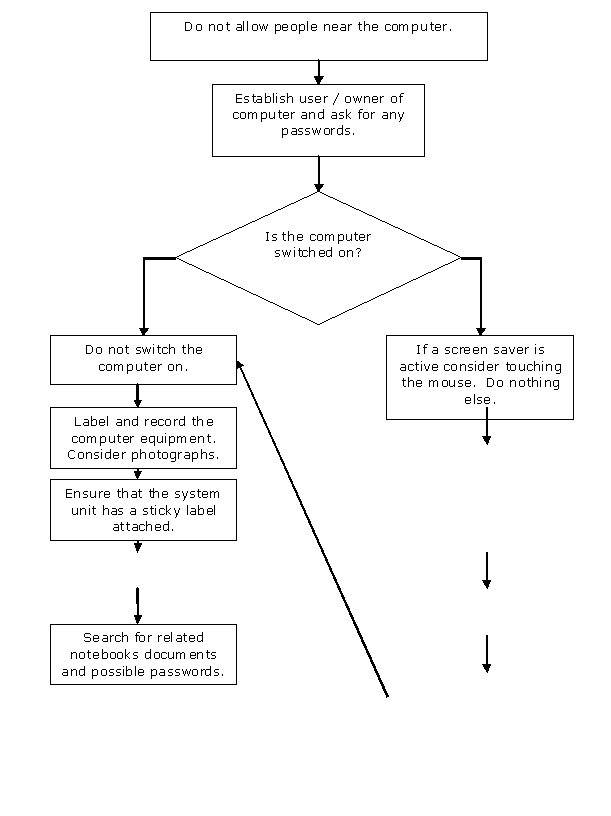
11.11 In other circumstances where it is suspected that PCs/laptops have been used inappropriately e.g. accessing pornographic websites, the equipment should be seized and secured as quickly as possible by the Investigating Auditor. The individual reporting the concern should, where at all possible, be required to secure the PC/laptop and told not to allow anyone to switch it on, as doing so would corrupt the evidence, which may cause disciplinary or legal action to fail. The initial steps to follow regarding computer seizure are at Appendix E. On seizing the asset, the Investigating Auditor should record the details of the asset e.g. model and serial number on the exhibit label and then bag and tag the asset. The tag number together with the details of the asset being seized should be recorded in the Investigating Auditor's receipt book and signed by both the Investigating Auditor and the individual from whom the asset is being seized. A copy of the receipt should be left with the individual for reference purposes. All seized assets should be held securely in a locked cabinet with access being restricted to the Investigating Team. In any circumstances arising where the tag needs to be broken to access the asset for examination purposes, a clear explanation as to who and why the tag has been broken and what work has been undertaken should be clearly recorded. Once this exercise has been completed, the asset should be re-bagged and tagged with another numbered tag being attached and a record taken of the tag number.
11.12 The decision as to whether a PC/laptop should be forensically checked or just examined by the Investigations Team should be taken jointly by the Investigating Auditor, Audit Manager/Group Audit Manager after consideration of the facts obtained and the preliminary enquiry. Where it is decided that the asset should be forensically checked, arrangements should be made with the appropriate staff at either the New Forest District Council or Portsmouth City Council to undertake this task under contract. The asset should be delivered by the Investigating Auditor who should obtain a receipt confirming the asset has been appropriately handed over. Once the work has been completed a report on the examination will be produced and the asset may then be collected by the Investigating Auditor and again stored securely in a locked cabinet. However, where a decision is taken to examine the asset internally, the examination should be undertaken by two suitably experienced computer audit staff who should clearly record the process they are undertaking in order that a clear audit trail of events is evidenced e.g. record `key word' searches. Should any unlawful material be discovered, the examination should cease immediately and the Hi Tec Crime Unit within Hampshire Police contacted for advice.
11.13 Searches are best left to the Police. Investigating Auditors only have the power to search County Council properties. Investigating Auditors should never search a person, private car or private property unless the person has given their consent to do so. (This consent would need to be recorded and a signature obtained) When conducting a search, if possible, ensure that both the suspect and an independent witness are present. This process should be documented and appropriate signatures obtained.
Evaluating
11.14 Prior to reporting, the Investigating Auditor should review the documentation and other evidence gathered for its adequacy as a basis for concluding and reporting. The Investigating Auditor will need to consider as a result of this review, whether any further work is required. Sufficiency of evidence will be dependent on the nature of the investigation and whether the outcome is a disciplinary, civil law or prosecution matter i.e. the `burden of proof' required.
11.15 As part of the evaluation process, the Investigating Auditor is responsible for ensuring that each investigation file is compiled in accordance with the internal audit's Quality Audit Process (QAP). All supporting paperwork should be clearly cross-referenced both during and at the conclusion of the investigation.
Reporting
11.16 At the end of the investigation, a draft report should be issued where the investigation is considered to be complex or where it is likely that facts may be disputed. Where this is not likely to be the case, final reports should be issued. It is for the Investigation Officer within the relevant department (where appointed) to decide, after consultation with Human Resources (HR) and the Chief Internal Auditor, upon the nature and extent of a disciplinary action that may be considered appropriate. The Investigation Officer should also seek advice and comment from the relevant member of the Department's Management Team (DMT). Comments should also be sought from DMT in the circumstances where no Investigation Officer has been appointed.
11.17 The Investigation Officer or relevant member of DMT should present the case at a hearing in accordance with the County Council's Disciplinary Procedures where required. The Investigating Auditor will give evidence at this hearing on the basis of the facts determined by the investigation work.
11.18 The case for circulation of draft/final reports needs to be carefully considered and should be agreed by the Investigating Auditor/Audit Manager/Group Audit Manager. It is important that a formal response to each report is agreed and completed to ensure that appropriate action is taken.
11.19 The report should include:
· confidential marking and whether the report is to be treated as a draft or final and clear guidance on who the report will be circulated to
· date
· legislation etc. under which the investigation is being undertaken
· summary of the allegation
· findings of fact and evidence
· the reasoning and conclusion
· recommendations for actions relating to the allegations made
· any background documents and summary information in appendices.
11.20 The Chief Internal Auditor will require a formal response to the recommendations made in any investigations report from the Chief Officer of the Department in which the irregularity has taken place.
11.21 A separate report highlighting any weaknesses in management, financial or other controls that may have contributed to the fraud/irregularity happening should be issued to managers identifying required improvements in control. A formal response to these reports will be required from managers confirming the action that has been taken.
11.22 Any findings which identify a significant financial loss to the County Council should be reported to the Section 151 Officer (County Treasurer). Under Audit Commission rules, if the value of the suspected fraud/irregularity is over £10,000, the Audit Commission should also be informed. A special form (Audit Commission Fraud Report) held by internal audit is available for this purpose. Furthermore, the Audit Commission should be informed, via the above form, of any corrupt practices identified.
11.23 The Head of Corporate and Legal Services should be informed of any significant irregularities in the context of any impact the investigation report may have on the compilation of the County Council's Statement of Internal Control (SIC), or on other corporate governance arrangements. The County Council's Governance Committee should also be informed of any significant irregularities at the discretion of the Chief Internal Auditor and the Head of Corporate and Legal Services.
12 Police referral
12.1 Where the results of the investigation has produced evidence of fraud and irregularity of a substantial nature, prosecution of the offender(s) should be considered in accordance with the County Council's Prosecution and Recovery Policy which is an appendix to the Anti-Fraud and Corruption Strategy. http://intranet.hants.gov.uk/ctdept/auditservices.htm
12.2 It is the County Council's public duty to consider prosecution in all cases where there is clear evidence that a criminal act has occurred. The decision whether to prosecute should be taken by the Chief Internal Auditor in consultation with other relevant officers including the Monitoring Officer. It may also be appropriate at this stage, depending upon the seriousness of the matter to inform the Chief Executive, the Leader of the Council and any other relevant Leading Members.
12.3 Referrals to the Police may occur at any stage of an investigation. If this action is taken, where clear evidence of criminal activity has been identified as part of an investigation, a clear liaison process between the Investigations Team and the Police should be agreed upon. Where the handover of files is required, a receipt confirming the safe handover of any files should be completed and signed by the Investigating Auditor and police representative.
Appendix A
Hampshire County Council
Contact List
Investigations Team
Ejner Knudsen, Chief Internal Auditor 01962 847403
Wendy Lucas, Audit Manager 01962 846689
Karen Shaw, Group Audit Manager 01962 846072
Andy Payne, Senior Auditor 01962 846689
Other Key Contacts
Jeff Pattison, Head of Corporate and Legal Services 01962 847321
Jeanette Buckman, Legal Assistant (Insurance) 01962 847327
Christine Buckett, Head of Litigation of Procurement 01962 847313
Ron Kane, Human Resources 01962 813917
Kirsty Gunner, Press Office 01962 847110
Money Laundering Unit, Hampshire Police 023 80 745229
Computer Forensic Testing:
Steve Cranston, New Forest District Council 02380 285 786
Malcolm Chesworth, Portsmouth City Council 023 92 834697
Hi-Tec Crime Unit, Hampshire Police 023 80 745 134
Appendix B
Investigators Code of Conduct
1 Introduction
1.1 Hampshire County Council (The Authority) expects all officers undertaking investigative assignments (hereafter called Investigators) to conduct themselves in an appropriate manner at all times in accordance with this Code of Conduct. Failure to comply with the requirements given below, may lead to action being taken under the Authority's Disciplinary Procedure.
2. Requirements of the investigators code of conduct
2.1 Relevant Legislation
· Investigators follow at all times the Police and Criminal Evidence Act 1984, Codes of Conduct when carrying out fraud investigations.
· Investigators follow, where appropriate, requirements of the Criminal Procedures and Investigations Act 1996.
· Investigators ensure that information held by the Council is only disclosed in accordance with the Data Protection Act 1998 and the rules concerning confidentiality.
2.2 Professional and Unbiased Manner
· Investigations are carried out in a professional and unbiased manner. It is the duty of the Investigators to establish the facts of the case and not make conclusions based upon intuition and supposition
2.3 Respect and Courtesy
· All persons accused or suspected of fraud are treated with respect and courtesy at all times, the individual's rights are respected and all investigators observe the County Council's policies on equal opportunities and Customer Care in the conduct of their work.
2.4 Reporting to a Responsible Officer
· Investigators report to a responsible officer all cases referred for investigation in which they may have an interest. An interest is defined as having a personal relationship with the person(s) being investigated, ownership of property relating to the investigation or any other circumstance which may prejudice an objective and impartial investigation.
2.5 Improper Advances
· Investigators immediately inform a senior officer of any improper advance made to them by any person in the course of an investigation.
2.6 Integrity
· Investigators do not risk their integrity and that of the Council by carrying out unaccompanied visits or interviews of certain categories of customers or those suspected of fraudulent activity. The investigator will seek advice from a senior officer prior to carrying out an unaccompanied visit or interview in the following circumstances:
- visits to men or women living alone
- visits after dark
- visits to hostels or accommodation providing care in the
community
- visits to young persons
- interview at a place not considered ethical for the purpose e.g.
public house
- interview of a person suspected of fraud or irregularity.
· The Investigator must at all times be aware of the potential for violence from persons under investigation and should not place themselves in a situation where there is a risk of attack. In particular the Investigator should check all records available within the Authority e.g. records held on individual computer systems etc to see if a person is registered as potentially violent prior to an interview or visit. The Investigator should not carry out unaccompanied interviews or visits to potentially violent persons. The involvement of the Police in such visits should also be considered.
Date |
Summary of action |
W.P. ref |
AM review |
Is there evidence of |
W.P. ref | |
F/I (Y/N) |
Control weakness(Y/N) 1.2 | |||||
Appendix D
Conducting and Recording Interviews
Where notes are taken of the interview, the interview shall be timed, dated and signed by the auditors. All questions and responses are to be recorded at the time they are asked and answered. At the conclusion of the interview a Witness Statement (Appendix G) shall be completed with all pages being signed by all parties present and any alterations initialled. Should the interviewee refuse to sign the statement, then the reasons for doing so should be recorded by the investigating team on the final page of the interview record.
Where a tape recorder is used for interview purposes, permission to tape record should be agreed with the interviewee in advance (refer to Appendix H). If it is not possible to record an interview, notes must be taken by a colleague. If it is believed that an offence has been committed and the person interviewed may be prosecuted, or, after commencing an interview, facts emerge of an offence, the interview should only continue after the Notice To Persons Being Interviewed, at Appendix I, has been completed and signed. A formal caution is necessary if the interview is to be used as evidence in a criminal prosecution. The Investigating Auditor should endeavour to collect evidence according to the Police and Criminal Evidence Act 1984 (PACE) rules should it be required as admissible at a later date. Where the giving of a caution has been deemed necessary, it must be given as soon as there are reasonable grounds for suspecting that an offence has been committed. The precise wording of the caution must be followed in accordance with PACE rules:
You do not have to say anything but it may harm your defence if you do not mention when questioned something which you later rely on in Court. Anything you do say may be given in evidence (refer to Appendix J for an explanation of the caution)
The Investigating Auditor does not have the power of arrest and so should ensure that any person being cautioned is clearly informed of this. The caution should therefore be preceded with the following words:
You are not under arrest and you are not obliged to remain here. However, you are now being cautioned.....
Appendix E
Computer Seizure - Initial Steps

Appendix F
STATEMENT OF WITNESS
(CJ Act 1967, s.9; MC Act 1980, ss.5A(3) (a) and 5B; MC Rules 1981, r.70)
STATEMENT OF .................................................................................
AGE ............... OCCUPATION ...........................................................
This statement, consisting of pages signed by me, is true to the best of my knowledge and belief and I make it knowing that, if it is tendered in evidence, I shall be liable to prosecution if I have wilfully stated in it anything, which I know to be false or do not believe to be true.
(Signed) .................................................................................
Dated the day of 2007
SIGNATURE
STATEMENT TAKEN BY
Appendix G
Hampshire County Council
Aide Memoire for Taped Interviews
Unwrap tapes and load recorder in presence and sight of suspect
"This interview is being tape recorded"
"I am ________________________, auditor of Hampshire County Council. The other officer present is (allow other officer to state his name) ___________. We are in interview room _______ in ___________ offices."
"I am interviewing (ask suspect to state his full name) ________________." "Also present is (ask legal/representative to state his name and status ___________" OR "There are no other persons present."
"The date is __________ and the time is _________" (note time on seal)
"You are not under arrest. You are fee to go at any time."
If no legal adviser present: "You may obtain legal advice if you wish. Do you wish so?"
"This tape recorded interview may be given in evidence if your case is brought to court. Here is a Notice explaining what will happen to the tapes." (hand over notice)
Caution
"You do not have to say anything, but it may harm your defence if you do not mentioned when questioned, something which you later rely on in court. Anything you do say may be given in evidence."
"Do you understand?" Explain if suspect does not understand - turn to the Aide Memoire for explaining the Caution.
Conduct the interview
Conclude the interview
"Do you wish to say anything further or to clarify anything you have told me?"
Then turn back to the Aide Memoire
"This interview is concluded at ________ hours." Note times on seal
Turn off tape recorder, remove tapes, complete labels and seal master tape.
Appendix H
Hampshire County Council
Notice to Person being Interviewed
1. This interview is to enable you to offer an explanation of the facts, though should evidence of an offence emerge, you may be prosecuted
2. "You do not have to say anything unless you wish to do so, but it may harm your defence if you do not mention when questioned, something which you later rely on in court. Anything you do say may be given in evidence"
3. You are not under arrest and may leave, or ask me to leave
4. You have the right to legal representation and advice, including the right to have a Solicitor present or to speak to a solicitor on the telephone. You may also have an interpreter present if you wish. In this event the interview will be suspended until another interview can be arranged
5. You may have a friend with during the interview
6. You are entitled to read the Police and Criminal Evidence Act 1984 Codes of Practice if you wish
Will you now please read these notes:
Have you read notes 1 to 6? ____________________________________
(Reply to be written by the person being interviewed)
Do you understand notes 1 to 6? ________________________________
(Reply to be written by the person being interviewed)
7. Do you require Legal advice or a Solicitor present? __________________
(Reply to be written by the person being interviewed)
If the person being interviewed waives his right to legal advice the reason should be recorded:
I have been given a copy of this notice which I have read and understand.
Signed (Person being interviewed) _________________________________
Signed (Other person present) _________________________________
Signed (Interviewing Officer) _________________________________
Date _______________________ Time _____________________
Appendix I
Hampshire County Council
Aide Memoire for Explaining the Caution
There are three parts to the caution:
"You do not have to say anything
But it may harm your defence if you do not mention when questioned
something which you later rely on in court
Anything you do say maybe given in evidence."
Explain each part to the suspect:
1. This is your right to silence. You cannot be made to incriminate yourself. Each time I ask a question, you can choose not to answer. You always have the right to say nothing.
2. If you are prosecuted, a court may draw inferences from you silence if:
In the court you try to rely on something that you didn't mention during the interview
And
The court thinks that in the circumstances, you should have mentioned it in interview; that is, there was no good reason why you didn't.
Then the court can draw its own conclusions as to how much weight to give this new information. It might, for example wonder why an apparent innocent explanation was not given earlier, so as to give the investigating officers a chance to check it out.
3. Any answers you do give will be recorded. This record may later be played or read out in court.