Archived decisions
Hampshire County Council
Health Overview and Scrutiny Committee Item 7
11 April 2007
Health Review Programme: Update on the Care at End of Life Review
Report of the Chief Executive
Contact: Martin Combs [email protected] 01962 847479
1. Background
1.1. The final report of the Care at End of Life Review was taken to the Committee on 30 January 2007. At that meeting Members agreed the report's recommendations, including the timetable for responses.
1.2. Full details of the Recommendations and the response received as at 3 April are attached at Appendix One.
1. Responses
2.1. Responses requested for the 27 March 2007 Health Overview and Scrutiny Committee meeting (subsequently postponed until 11 April 2007), were expected to:
a. Confirm acceptance and commitment of the organisation of the identified issues, and
b. Give an indication of how the issues might be taken forward and when more detailed plans would be developed.
2.2. Hampshire County Council
Responses from the Chief Executive of the County Council, including the Adult Services Department are included as Appendix Two.
2.3. Hampshire Primary Care Trust
The initial response from the Chief Executive of Hampshire Primary Care Trust are included as Appendix Three. This is a first draft and lacks direct reference to the recommendations. This information will be provided at the meeting.
2.4. South Central Strategic Health Authority
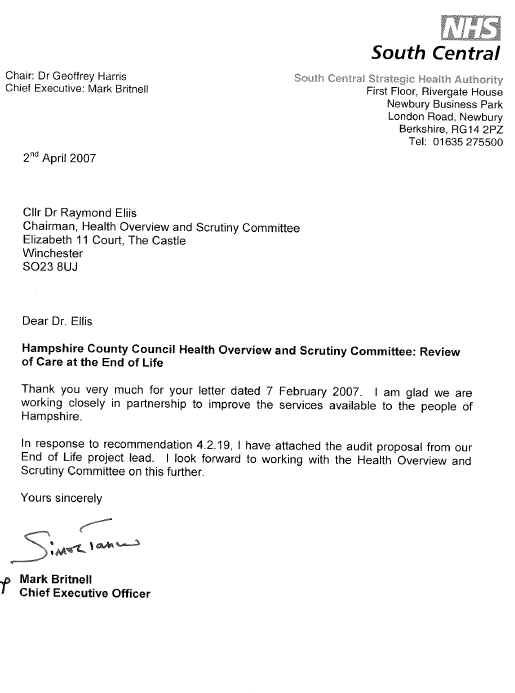
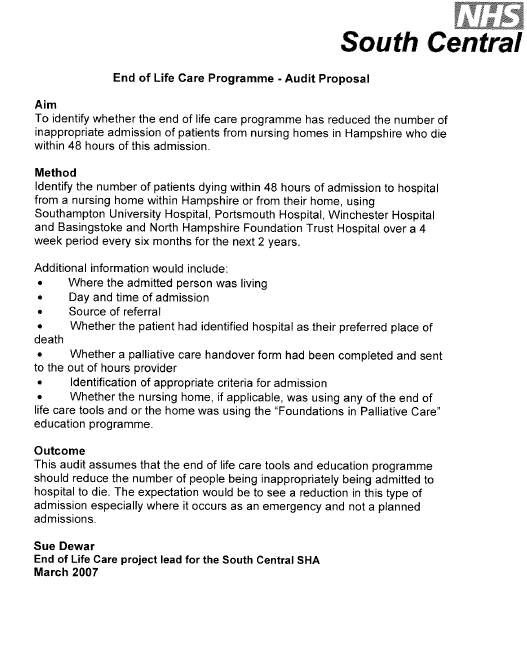
Response from the Chief Executive of South Central Strategic Health Authority is attached as Appendix Four
3. Care at End of Life Research Project
3.1. Following approval of the Committee at the 30 January meeting, two meetings have been held with Professor Julia Addington-Hall to prepare and progress the research project (Recommendation 4.2.20). The project is now being co-ordinated from the University by a research project manager, Amanda Young, and from the County Council by Martin Combs.
3.2. Funding
Currently, funding for the research project has been committed by Hampshire Primary Care Trust and by the Leader of Hampshire County Council. It is hoped that the project may attract additional funding from national interests, however the confirmed amounts are:
£9,000 Hampshire Primary Care Trust
£4,500 Hampshire County Council
In Addition the County Council is providing significant project management support to this work in order to ensure that costs are kept to a minimum.
3.3. Current activities
· The University is approaching the Office of National Statistics for a random sample of prospective bereaved families or carers to approach
· The University research ethics committee is being informed about the project and will evaluate its aims and methods
· Active approaches are underway to gain background information and advice relevant to the project
· Copy has been received and is being reviewed for the Hampshire Now edition to be published in July
3.4. Steering Group/Committee
The University and the County Council are each giving consideration as to who might be approached to be part of the Steering Group/Committee. As a minimum, the Steering Group would include representation from all collaborating partners.
4. Recommendations
4.1. That Members determine if they are satisfied with the responses provided to the following recommendations:
No |
Recommendation |
4.2.5 |
Hampshire PCT and Hampshire County Council shall agree a lead co-ordinator for CaEoL services across the County of appropriate seniority to effectively influence service delivery across Hampshire and begin to develop a single unified model of care. This person shall work collaboratively and in partnership with the private and third sectors to progress the recommendations made in this report and shall be identified as soon as possible |
4.2.11 |
Hampshire PCT shall review the pattern of community/district nursing/allied health professional cover available across the County to ensure that it is consistent and accessible to people requiring care in their own homes or other community settings 24 hours a day, 7 days a week. This shall include identification of lead individuals for co-ordinating care in local settings and confirmation of the support to be provided to nursing homes. |
4.2.12 |
Hampshire PCT, working with all other care providers, shall ensure that information about the services and support available to people who are in the last year or months of life is readily accessible in appropriate formats to formal carers, informal carers and patients. |
4.2.13 |
Current access to specialist equipment is not acceptable and this issue needs to be addressed as a matter of urgency. Hampshire County Council and Hampshire PCT shall agree a way forward to ensure that there is appropriate funding and availability of equipment from the County Council and NHS in order to meet patient's needs in a timely, appropriate and cost effective manner. |
4.2.14 |
Timely communication and sharing of information across all care providers, both formal and informal shall be addressed as a key part of the roll-out of a Hampshire wide approach to out of hours care. Learning from work already underway with the Ambulance Service in south west Hampshire shall inform this to ensure that patients' needs and preferences for care are met. |
4.2.15 |
Arrangements for accessing appropriate pharmacy support (including controlled drugs) both in and out of hours shall be reviewed to identify and implement good practice to ensure that the needs of patients in their homes or other community settings are responded to in a timely and appropriate manner. |
4.2.16 |
Access to specialist palliative care advice and support shall be identified across all areas and effectively communicated to formal and informal carers, including those providing OOH services. |
4.2.17 |
Hampshire PCT shall review the needs for specialist palliative care across all care settings to ensure that an appropriate level of service is commissioned and resourced to support people living in their own homes or the community and reduce avoidable admission to hospital. Best practice in hospice services and other partnership working across Hampshire shall inform this work. |
4.2.18 |
Hampshire PCT, working with South Central Ambulance, Adult Services, hospice services, Care Homes and OOH services as appropriate shall ensure clear protocols are in place to respond to patients requiring transfer who may be in the final stage of their illness. This shall include specific protocols to ensure that there is clarity about the resuscitation status of the patients and to avoid inappropriate interventions or admission to hospital. Mechanisms to communicate these protocols to GPs and other front line staff shall be identified. |
4.2.19 |
The comparative audit of patients admitted from nursing homes to hospital at the end of their life planned by the SHA shall take account of the appropriateness of admission and the wishes of the patient. Additionally consideration shall be given to extending this audit to include patients admitted through the OOH and emergency services. |
4.2.20 |
Hampshire HOSC, working with Southampton University, shall identify the costs associated with obtaining feedback from patients and carers about CaEoL services. |
4.2.21 |
The Director of Adult Services shall provide information on the way in which informal carers' assessments are requested, who conducts these and any timescales that support this process as well as the means by which the client's satisfaction is evaluated (linked with Recommendation at 4.2.10). |
4.2.24 |
Hampshire PCT, working with Hampshire County Council and other providers of CaEoL, shall confirm funding and arrangements for the continued roll-out of the GSF, LCP and other training programmes that support the delivery of general and specialist end of life care |
4.2. That any additional information required by members is communicated to the relevant lead officers, including timescales for providing this to the Committee
Appendix One: Responses to Recommendations
No |
Recommendation |
Response |
Responding Organisation/Department Lead organisation only |
4.2.5 |
Hampshire PCT and Hampshire County Council shall agree a lead co-ordinator for CaEoL services across the County of appropriate seniority to effectively influence service delivery across Hampshire and begin to develop a single unified model of care. This person shall work collaboratively and in partnership with the private and third sectors to progress the recommendations made in this report and shall be identified as soon as possible |
To be determined |
Hampshire Primary Care Trust |
4.2.11 |
Hampshire PCT shall review the pattern of community/district nursing/allied health professional cover available across the County to ensure that it is consistent and accessible to people requiring care in their own homes or other community settings 24 hours a day, 7 days a week. This shall include identification of lead individuals for co-ordinating care in local settings and confirmation of the support to be provided to nursing homes. |
To be determined |
Hampshire Primary Care Trust |
4.2.12 |
Hampshire PCT, working with all other care providers, shall ensure that information about the services and support available to people who are in the last year or months of life is readily accessible in appropriate formats to formal carers, informal carers and patients. |
To be determined |
Hampshire Primary Care Trust |
4.2.13 |
Current access to specialist equipment is not acceptable and this issue needs to be addressed as a matter of urgency. Hampshire County Council and Hampshire PCT shall agree a way forward to ensure that there is appropriate funding and availability of equipment from the County Council and NHS in order to meet patient's needs in a timely, appropriate and cost effective manner. |
Equipment services - All palliative care patients are priority 1 for equipment. This means that they take priority over all other requests. We get this equipment out as and when it is required, if we have the item in stock. We have, at times when the situation is critical, managed to get a fully profiling bed, mattress, hoist, slings etc out to the patient within 1hr of receiving the request. However, we acknowledge that we have had situations where we have 3 terminally ill people and only 1 bed, and thus the speed depends on stock and staffing levels. We are in the process of creating a single new joint site in Basingstoke in conjunction with the PCT. This will enable us to respond more efficiently to requests for equipment at the end of life as both organizations have agreed further investment in this service. |
Hampshire County Council |
4.2.14 |
Timely communication and sharing of information across all care providers, both formal and informal shall be addressed as a key part of the roll-out of a Hampshire wide approach to out of hours care. Learning from work already underway with the Ambulance Service in south west Hampshire shall inform this to ensure that patients' needs and preferences for care are met. |
To be determined |
Hampshire Primary Care Trust |
4.2.15 |
Arrangements for accessing appropriate pharmacy support (including controlled drugs) both in and out of hours shall be reviewed to identify and implement good practice to ensure that the needs of patients in their homes or other community settings are responded to in a timely and appropriate manner. |
To be determined |
Hampshire Primary Care Trust |
4.2.16 |
Access to specialist palliative care advice and support shall be identified across all areas and effectively communicated to formal and informal carers, including those providing OOH services. |
To be determined |
Hampshire Primary Care Trust |
4.2.17 |
Hampshire PCT shall review the needs for specialist palliative care across all care settings to ensure that an appropriate level of service is commissioned and resourced to support people living in their own homes or the community and reduce avoidable admission to hospital. Best practice in hospice services and other partnership working across Hampshire shall inform this work. |
To be determined |
Hampshire Primary Care Trust |
4.2.18 |
Hampshire PCT, working with South Central Ambulance, Adult Services, hospice services, Care Homes and OOH services as appropriate shall ensure clear protocols are in place to respond to patients requiring transfer who may be in the final stage of their illness. This shall include specific protocols to ensure that there is clarity about the resuscitation status of the patients and to avoid inappropriate interventions or admission to hospital. Mechanisms to communicate these protocols to GPs and other front line staff shall be identified. |
To be determined |
Hampshire Primary Care Trust |
4.2.19 |
The comparative audit of patients admitted from nursing homes to hospital at the end of their life planned by the SHA shall take account of the appropriateness of admission and the wishes of the patient. Additionally consideration shall be given to extending this audit to include patients admitted through the OOH and emergency services. |
To be determined |
South Central Strategic Health Authority |
4.2.20 |
Hampshire HOSC, working with Southampton University, shall identify the costs associated with obtaining feedback from patients and carers about CaEoL services. |
See section 3 in this paper |
Hampshire County Council |
4.2.21 |
The Director of Adult Services shall provide information on the way in which informal carers' assessments are requested, who conducts these and any timescales that support this process as well as the means by which the client's satisfaction is evaluated (linked with Recommendation at 4.2.10). |
Carers - support for carers is crucial at the end of life and we have a duty to assess carer need regardless of the needs of the person dying. We know that supporting carers through assessment and service planning offers support to the caring situation, assists in preventing carer breakdown and decreases the use of emergency, unplanned services. We acknowledge that an investment in assessments and information at earlier stages of the caring process often lead to significant resource savings elsewhere. Thus we are actively exploring current response mechanisms to ensure that carers get the support they need. We may look at the possibility of commissioning this support from existing groups and / or our dedicated in-house staff as part of our work in developing the Carers Strategy with partners. We are also ensuring there is clarity on guidance for staff about their responsibility to care for the carer even if the person they care for is in receipt of fully funded NHS continuing care. The rights to need assessments are for carers in their own right. The duty to undertake needs assessments of carers remains where: · The person with care needs (community care user) declines their own assessment. · The person with care needs does not meet the Adult Services Department eligibility criteria for the provision of services. Therefore, the duty to undertake needs assessment of carers is not dependent upon ASD assessment/service provision to the person with care needs (whether they be a health or social care service user). However, Health partners also have a duty to consider ASD requests for support in developing a care package for carers. This will need further discussion with Health colleagues in the light of specific policy and legislative initiatives such as the Delayed Discharge legislation, NSF frameworks for Older People and in Mental Health and from GP's under the GP Contract which awards points for carer registration. The White Paper has signaled updates in the National Carers Strategy and the development of a range of new services for carers including an emergency respite care service. Inspection of carers grant spending by Local Authorities is being considered as part of the review of the Strategy. Our revised guidance to care mangers will look at how a preliminary screening assessment for carers can be incorporated within the community care assessment, enabling joint assessments of carers with the needs of the service user. This is even more essential in terms of effective and timely intervention at the end of life. We need to scope the potential impact of this change in practice on our resources and are currently undertaking this. |
Adult Services |
4.2.24 |
Hampshire PCT, working with Hampshire County Council and other providers of CaEoL, shall confirm funding and arrangements for the continued roll-out of the GSF, LCP and other training programmes that support the delivery of general and specialist end of life care |
To be determined |
Hampshire Primary Care Trust |
Appendix Two: Hampshire County Council Responses

Councillor R Ellis Chairman, Health Overview and Scrutiny Committee |
RM/hd | ||
Dear Councillor Ellis
Re - Care at the End of Life
I am pleased to take this opportunity of reporting back on the work we are involved with to deliver better quality support to people at the end of life.
The HOSC report has been extremely useful in highlighting key areas which will make a significant difference and many of them are an extension of the way we have begun developing services recently.
It is clear that joint working with the PCT is essential and to that end we have been meeting to discuss the outcomes of the report and identify exactly what both organisations can do to make the difference.
In terms of our ASD specific responsibilities -
4.2.5 - Leadership - We appointed a new service manger last year as a member of the Strategic Commissioning Team, part of whose remit is to lead for ASD on the end of life care agenda. Clare Hooke is already working closely with PCT colleagues to address some of the issues you raise and is committed to fully supporting the Lead identified by the PCT and will work closely with them
4.2.10 - Care Coordination -we are part of the county wide steering group on Continuing Care and there are a number of issues which are already being addressed by the group that directly impact on care at the end of life.
The needs and wishes of people who are dying have also been woven into the new guidance we have produced for our Care Managers - we will be happy to share these guidelines with you once they are finalised
/Continued...
Page 2
Councillor R Ellis
4.2.13 - Equipment services - All palliative care patients are priority 1 for equipment. This means that they take priority over all other requests. We get this equipment out as and when it is required, if we have the item in stock. We have, at times when the situation is critical, managed to get a fully profiling bed, mattress, hoist, slings etc out to the patient within 1hr of receiving the request. However, we acknowledge that we have had situations where we have 3 terminally ill people and only 1 bed, and thus the speed depends on stock and staffing levels.
We are in the process of creating a single new joint site in Basingstoke in conjunction with the PCT. This will enable us to respond more efficiently to requests for equipment at the end of life as both organizations have agreed further investment in this service.
4.2.21 - Evaluation - Chandra McGowan and Denise Holden are going to investigate the way in which Southampton University can support us to explore the effectiveness and sensitivity of the care we give to people who are dying. We hope to have a project brief agreed within the next 2 months and will of course send you a copy.
4.2.22 - Carers - support for carers is crucial at the end of life and we have a duty to assess carer need regardless of the needs of the person dying. We know that supporting carers through assessment and service planning offers support to the caring situation, assists in preventing carer breakdown and decreases the use of emergency, unplanned services. We acknowledge that an investment in assessments and information at earlier stages of the caring process often lead to significant resource savings elsewhere.
Thus we are actively exploring current response mechanisms to ensure that carers get the support they need. We may look at the possibility of commissioning this support from existing groups and / or our dedicated in-house staff as part of our work in developing the Carers Strategy with partners.
We are also ensuring there is clarity on guidance for staff about their responsibility to care for the carer even if the person they care for is in receipt of fully funded NHS continuing care. The rights to need assessments are for carers in their own right. The duty to undertake needs assessments of carers remains where:
· The person with care needs (community care user) declines their own assessment.
· The person with care needs does not meet the Adult Services Department eligibility criteria for the provision of services.
Therefore, the duty to undertake needs assessment of carers is not dependent upon ASD assessment/service provision to the person with care needs (whether they be a health or social care service user).
However, Health partners also have a duty to consider ASD requests for support in developing a care package for carers. This will need further discussion with Health colleagues in the light of specific policy and legislative initiatives such as the Delayed Discharge legislation, NSF frameworks for Older People and in Mental Health and from GP's under the GP Contract which awards points for carer registration.
The White Paper has signaled updates in the National Carers Strategy and the development of a range of new services for carers including an emergency respite care service. Inspection of carers grant spending by Local Authorities is being considered as part of the review of the Strategy.
Our revised guidance to care mangers will look at how a preliminary screening assessment for carers can be incorporated within the community care assessment, enabling joint assessments of carers with the needs of the service user. This is even more essential in terms of effective and timely intervention at the end of life. We need to scope the potential impact of this change in practice on our resources and are currently undertaking this.
I trust this answers adequately your specific questions to this department and assure you that the commissioning of effective and sensitive services at the end of life is a top priority for us.
Yours sincerely
Rea Mattocks
Director of Adult Services
cc Councillor Patricia Banks, Executive Member for Adult Social Care
Richard Ellis, Assistant Director, Commissioning Partnerships and Provisions

Appendix Three: Hampshire PCT Response
Health Overview and Scrutiny Committee 12th April 2007
Update Report `Care at the End of Life' in Hampshire
Progress Report, 28th March 2007 |
Introduction Hampshire County Council Health Overview and Scrutiny Committee (HOSC) undertook a review of Care at the End of Life during Autumn 2006, which was presented and approved by the HOSC on 30th January 2007. Recommendations Supported by PCT The final report was presented to and approved by the Hampshire PCT on 22nd February 2007 at the PCT Board Meeting, paper PCT07/022. The PCT Board agreed: · To note the conclusions and recommendations of `A Review of Care at the End of Life in Hampshire'; · To note that Hampshire PCT and Hampshire County Council will work together to develop an implementation plan for the two organisations; · To note that the Implementation Plan will be received and approved by the Interim Professional Executive Committee (PEC) of the PCT, with an update on progress presented to the PCT Board in July 2007. Development of Implementation Plan (first draft) In March 2007 the PCT appointed an Interim Project Director to develop the first draft of the Implementation Plan. To date comments and suggestions have been sought from a number of key individuals within the PCT, these are currently being collated. The first draft of the Implementation Plan will be presented to the Interim PEC in April/May 2007 and the HOSC on 29th May 2007 (next HOSC). Approval and Monitoring Arrangements The Interim PEC will have responsibility within the PCT for agreeing this Implementation Plan and monitoring progress. Regular update reports on the agreed Implementation Plan will be provided to the HOSC. Allocation of Lead PCT Director Having made the majority of its directors' appointments Hampshire PCT has now been able to allocate responsibility to a lead director, namely, Yvonne le Brun, Area Director of Care Services (Hampshire PCT - West).
|
Actions Requested |
The HSCO is asked to note this report.
|
Lead Director: |
Yvonne Le Brun, Area Director of Care Services (Hampshire PCT - West). |
Date: |
28th March 2007 |
Appendix Four: South Central SHA Response