Archived decisions
Hampshire County Council | |||
Cabinet |
Item 7 | ||
23 April 2007 |
|||
2007/08 Annual Efficiency Statement: Forward-look | |||
Report of the County Treasurer | |||
Contact: Jon Pittam, (01962) 84 7400; [email protected]
1 Introduction
1.1 This report sets out the 2007/08 forward look efficiency plan statement for approval by the Cabinet.
1.2 The indicative cumulative efficiency target previously reported to Cabinet is 7.5% of the County Council's 2004/05 outturn, £43.7m by 2007/08.
1.3 As part of its 2007/08 Annual Efficiency Statement, the County Council is required to report to Communities and Local Government (CLG) its proposals showing how the 2007/08 target will be met in a forward-look efficiency plan by 12 April 2007. The Leader approved the submission which was largely based upon the 2007/08 budget decisions, subject to formal ratification at this meeting.
1 Recommendation
1.1 To approve the efficiency improvements for 2007/08 and to ratify the submission of the annual efficiency statement.
2 2007/08 Annual Efficiency Statement
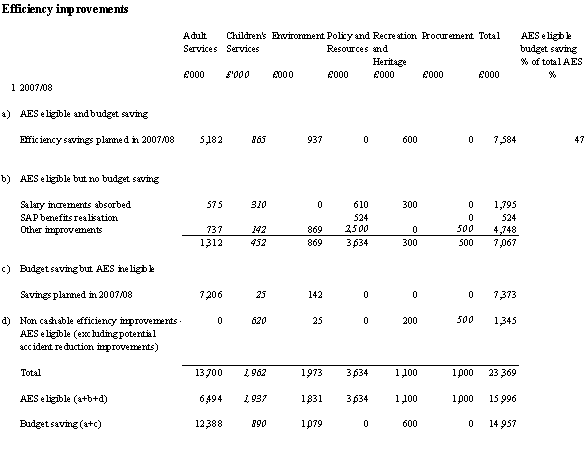
2.1 CLG has provided an electronic template for completion, and this has been used to present the return for the County Council as shown in Appendix 1 to this report. A paper copy of the plan was signed as required by the Leader of the Council, Chief Executive and County Treasurer.
2.2 In the forward-look the County Council is required to outline its strategy for securing efficiency gains and key actions to be taken during the year to make sure the savings are achieved. In addition CLG require councils to quantify total eligible efficiencies and the cashable gains expected for each service area as defined by the template. Where the efficiency gains are considered to be cross-cutting the template invites councils to categorise them in `workstreams' as follows: corporate services; procurement; productive time and transactions.
2.3 The budgeted efficiency gains eligible for the Annual Efficiency Statement, as reported to Cabinet on 9 February 2007 have been used, updated as appropriate. Key actions have been added to clarify the expectations of each service.
2.4 Table 1 summarises the gains reported in 2004/05 and 2005/06, the estimated gains for 2006/07 which will be reported in more detail in the backward look submission in June, together with the gains of £16.0m planned in 2007/08.
Table 1 summary of Efficiency gains
£m |
% of Baseline | |
2004/05 |
12.4 |
2.1 |
2005/06 |
17.9 |
3.1 |
2006/07 Estimate |
15.5 |
2.7 |
2007/08 Estimate |
16.0 |
2.7 |
61.8 |
10.6 |
2.5 The estimated cumulative total is £61.8m by the end of 2007/08, above the target set by CLG. This is appropriate, both to allow for any possible underachievement and because the highest Comprehensive Performance Assessment (CPA) rating requires that the 2.5% target is exceeded.
2.6 Cabinet will recall that definitions of efficiency savings which are "cashable" and "non-cashable" differ between savings made in the budget and eligible for the annual efficiency statement. The real cash efficiency savings in the budget were £7.6m. Other efficiency improvements in 2007/08 are identified which do count towards the annual efficiency statement. They do not reduce the budget in cash terms (although they may be counted as "cashable" in the annual efficiency statement) but they are costs which are avoided or would otherwise have been incurred if no action had been taken to improve efficiency.
2.7 The total efficiency improvements recorded in the 2007/08 budget summary were £12.5m (£7.6m cash savings included in the budget plus £4.9m other efficiency savings identified at that time). The total now shown is £16.0m. The main differences are additional efficiency improvements eligible for the statement from corporate procurement (£1m) and the generation of capital receipts (£2.5m). Cabinet will also note that the template is not directly aligned with the Council's budget in service terms. Appendix 2 represents a revised statement of the budget summary.
3 Impact assessment
The proposals in this report are the result of efficiency planning carried out in accordance with the County Council's financial management policy. This policy applies equally to all services and ensures consistent financial management decisions across all services. The proposals in this report are not considered to be discriminatory.
Links(s) to Corporate Strategy | ||
Yes |
No | |
Hampshire safer and more secure for all |
||
Maximising well-being |
||
Enhancing our quality of place |
||
Corporate Management Plan |
||
Section 100 D - :Local Government Act 1972 - background documents
The following documents discuss facts or matters on which this report, or an important part of it, is based and have been relied upon to a material extent in the preparation of this report.
NB: the list excludes:
1. Published works
2. Documents which disclose exempt or confidential information as defined in the Act.

 Annual efficiency statement - forward look
Strategy for period to 2008/09
Efficiency improvements are a mainstream component of the County Council's established planning processes. Each department produces regular Service Plans which feed into workforce and financial planning. The framework for these plans incorporates the need to produce efficiency measures and to identify areas for efficiency review. This fits in with the review mechanisms which the Council already has in place and which typically pick up efficiency issues: corporate reviews (mainly cross cutting areas) which complement the service planning process; business plans for trading parts of the organisation; and consultancy reviews. Executive Members and Chief Officers as appropriate are given targets which they are expected to meet through such "normal processes".
The Council has given a strong emphasis to value for money which is built into budget, procurement and routine decision making by Cabinet and Executive Members. Business plans are required for all new service developments demonstrating how performance will be improved and value for money achieved.
In addition there are several overall themes and approaches which inform service plans and may also provide scope to generate additional crosscutting efficiency gains:
· "good housekeeping" rules built into the budget process, principally the requirements that the net cost of increments will be absorbed and that where inflation in specific areas exceeds the corporate inflation allocation, this too will be absorbed so far as possible.
· exploiting the potential offered by the continuing phased implementation of an Enterprise Resource Management System (SAP). This leads to significant efficiency improvement opportunities in finance (by reducing double handling of data, automating processes and re-engineering procedures in-line with the new system), human resources (achieving economies of scale by electronically based centralisation of processes, especially recruitment), procurement (by better capture of all purchasing power to feed into corporate contracts) and IT (by ending the use of the mainframe and adopting a "thin client" technology).
· Hants direct a new customer contact centre is being launched in 2007 with the aim of providing a clear and easy way to contact Hampshire County Council by telephone.
· exploiting the potential offered by the implementation of the performance management System CorVu. This will provide performance information to inform service reviews, value for money and workforce planning, providing evidence for the quality cross-check performance measures.
· exploiting opportunities for corporate working and partnership, in particular with Health (through existing work focusing on adults and older persons and increasingly in children's services with progress from the Children Act). Police and Probation (eg crime and disorder partnerships and youth offending teams). District Councils (joint provision of services, with particular opportunities from extending the current waste disposal partnership arrangements to cover waste collection) and with all public bodies across the County through local strategic partnership and the second generation of local public services agreements and the local area agreement.
· movement to a new pay framework which will seek to provide stronger links between contribution and pay in the expectation that by better targeting rewards, it will be possible to achieve efficiencies.
· a business-driven approach to capital spending, emphasising the opportunities for "invest to save".
· "bottom up" processes such as suggestion schemes and crosscutting working groups to complement the "top-down" style of analysis stemming from the Gershon Report.
· the results of this activity will be assessed through the budget monitoring process, and verified by internal audit. Eventual efficiencies achieved will be reported on following the year end.
Key actions in 2007/08
Key actions are included with each service.
|
Expected annual efficiency gains (£) |
...of which cashable (£) |
Related links | |
Adult social services |
5,757,000 |
5,757,000 |
· People · Projects | |
Strategy: In line with overall strategy | ||||
Key actions: More effective purchasing and service provision: £1.7m More efficient administration and savings in management costs: £0.4m More cost effective placements and keen price negotiation: £3.1m Absorption of additional staff costs arising from increments: £0.6m
| ||||
Children's services |
1,035,000 |
735,000 |
· People · Projects | |
Strategy: In line with overall strategy | ||||
Key actions: Family Group Conference savings: £0.1m More effective contract negotiations: £0.1m. Market supplement equalisation: £0.1m. Review of residential provision: £0.3m. Increments and re-grading of staff: £0.2m. Management structure review: £0.2m. Control of staff budgets without impacting on service outcomes is expected to achieve efficiencies from the absorption of increments and re-grading costs. The Social Care budget also contains efficiency measures based around replacing more expensive agency staff, streamlining administration and reducing unit costs through reprovision of uneconomic services. Other gains are anticipated from Family Group conferences - these are efficiencies from moving the service provision to be delivered internally rather than more expensive external provision. | ||||
Culture and sport |
1,100,000 |
900,000 |
· People · Projects | |
Strategy: In line with overall strategy | ||||
Key actions: Redirection of Policy Fund: £0.2m Absorption of staff costs arising from increments within existing budgets: £0.3m. Service efficiency savings: £0.6m | ||||
Environmental services |
499,000 |
474,000 |
· People · Projects | |
Strategy: In line with overall strategy | ||||
Key actions: Improved recycling performance: 0.1m. Materials recovery Facility: £0.1m. Spatial strategy to save against budgets: £0.02m. Staff savings: £0.1m Administration efficiencies: £0.14m Capital programme - reduced fees from new working practices: £0.03m | ||||
Local transport (highways) |
1,332,000 |
1,332,000 |
· People · Projects | |
Strategy: In line with overall strategy | ||||
Key actions: Traffic Management advertising efficiency and Intelligent Transport systems: £0.1m. Area and HQ staff savings: £0.3m. Highways unit scheme designs: £0.1m. Developers contributions avoiding capital borrowing: £0.9m | ||||
Local transport (non-highways) |
0 |
0 |
· People · Projects | |
Strategy: | ||||
Key actions: | ||||
LA social housing (capex) |
0 |
0 |
· People · Projects | |
Strategy: | ||||
Key actions: | ||||
LA social housing (other) |
0 |
0 |
· People · Projects | |
Strategy: | ||||
Key actions: | ||||
Non-school educational services |
902,000 |
582,000 |
· People · Projects | |
Strategy: In line with overall strategy | ||||
Key actions: Early years - inflation absorbed by providers: £0.2m. Absorption of staff costs arising from increments and re-grading within existing budgets: £0.1m. Early years - extra support for 3 year olds: £0.02m. Support services review: £0.1m. Family Group conferences: £0.03m. Management structure review: £0.1m. Non cashable increments and re-grading: £0.3m. | ||||
Supporting people |
737,000 |
737,000 |
· People · Projects | |
Strategy: In line with overall strategy | ||||
Key actions: Contract review savings: £0.7m | ||||
Homelessness |
0 |
0 |
||
Strategy: | ||||
Key actions: | ||||
Other cross-cutting efficiencies not covered above | ||||
Corporate services |
3,634,000 |
3,634,000 |
· People · Projects | |
Strategy: In line with overall strategy | ||||
Key actions: Absorption of staff costs arising from increments within existing budgets £0.6m. SAP benefit realisation: £0.5m. Capital receipts £2.5m.
| ||||
Procurement |
1,000,000 |
500,000 |
· People · Projects | |
Strategy: In line with overall strategy | ||||
Key actions: It is planned to develop cashable benefits from reduced costs. By completing procurement reviews it is expected to hold back costs and produce cashable savings particularly where the County Council can reshape the market. | ||||
Productive time |
0 |
0 |
· People · Projects | |
Strategy: | ||||
Key actions: Covered elsewhere | ||||
Transactions |
0 |
0 |
· People · Projects | |
Strategy: | ||||
Key actions: Covered elsewhere | ||||
Miscellaneous efficiencies |
0 |
0 |
||
Strategy: | ||||
Key actions: Covered elsewhere | ||||
Total |
15,996,000 |
14,651,000 |
| |