
Archived decisions
Hampshire County Council Health Overview and Scrutiny Committee Item 5 29 May 2007 Proposals to Develop or Vary NHS Services Report of the Chief Executive |
Contact: Denise Holden ex 7338
e-mail: [email protected]
1. Summary and Purpose
1.1. The purpose of this report is to alert Members to proposals from the NHS to vary or develop health services provided to people living in the area of the Committee.
1.2. Proposals that are considered to be substantial in nature will be subject to formal public consultation. The nature and scope of this consultation should be discussed with the Committee at the earliest opportunity.
1.3. The response of the Committee will take account of the Framework for Assessing Substantial Change and Variation in Health Services agreed by the Hampshire, Isle of Wight, Portsmouth and Southampton Joint Committee in March 2005. This places particular emphasis on the duties imposed on the NHS by Section 11 of the Health and Social Care Act 2001.
1.4. This Report is presented to the Committee in 2 parts:
_ Items for information: these alert the Committee to forthcoming proposals from the NHS to vary or change services. This provides the Committee with an opportunity to determine if the proposal would be considered substantial and assess the need to establish formal joint arrangements
_ Items for action: these set out the actions required by the Committee to respond to proposals from the NHS to substantially change or vary NHS services.
1.5. This report and recommendations provide members with an opportunity to influence and improve the delivery of health services in Hampshire and therefore
support the delivery of the Corporate Strategy aim of maximising well being.
Items for Information
2. South East PCT Cluster: Maternity Services in South East Hampshire
2.1. The PCT has confirmed that it will be developing proposals for maternity services in south east Hampshire in collaboration with key stakeholders. The Hampshire and Portsmouth Health Overview and Scrutiny Committee will receive an up-date on progress with this work at a meeting on 6 June.
Recommendation
2.2. Members are kept up-dated on the progress of the Joint Committee, taking account of the SHA review
3. South West PCT Alliance/SUHT: Closure of Maternity Beds and Review of Maternity Services in South West Hampshire
3.1. SUHT has confirmed that, due to a delay in the rehabilitation services moving from the Ashurst site the opening of the new centre will be delayed. It is anticipated that the building work required will commence at the end of June.
Recommendation
3.2. Members are apprised of the anticipated opening date of the new Birth Centre at Ashurst.
4. South Central SHA: Review of Community Hospitals
4.1. South Central SHA has signalled that it will be reviewing community hospitals in its area during 2007/08 and that it wishes to engage HOSCs in determining the criteria by which these facilities are evaluated.
4.2. At a meeting of South Central HOSCs chaired by Hampshire on 15 May a number of concerns were expressed about the way in which this work related to the decision making by PCTs and the need to develop proposals with local people and key stakeholders. This is attached at Appendix One.
Recommendation
4.3. That the Committee is kept apprised of progress with this work
Items for Action
5. Hampshire Partnership NHS Trust: Mental Health Services for Older People in the wider Southampton Area
5.1. The response of the HOSC to proposals from Hampshire Partnership NHS Trust to modernise services for older people in the Southampton area reflected both the views expressed by members and comments received after the last Committee meeting from adult services. This is attached at Appendix Two.
5.2. The Trust has provided a written response (attached at Appendix Three) and will be attending the meeting to answer any additional questions raised by members. Adult services, the relevant P&PIF and Eastleigh Borough Council have been appraised of the issues of concern raised by the HOSC and invited to provide any additional feedback they consider appropriate for Members to consider at their meeting.
5.3. Specific points that Members may wish to consider include:
· Is there clarity about the changes being made and the reasoning behind these?
· The needs analysis for the services affected given our aging population and the fact that there is a going proportion of our population that will be affected by dementia.
· The impact that the move will have on access, particularly for people in the area of Eastleigh and Southern Parish
· Is there clarity about the impact of the changes proposed on other service providers, including adult services?
Recommendations
5.4. That the Committee determines if it is satisfied with the response from the Trust, taking account of any feedback from the stakeholders included at 5.2. Specific areas of interest are the consultation process and the impact of the changes on the population affected.
5.5. That the Committee highlights any additional action that the Trust should consider in taking the proposals forward.
6. South East England SHA: Acute Service Reconfiguration
6.1. West Sussex HOSC and PCT have formally been apprised of the views of the Committee about the potential for the changes to acute service reconfiguration to have a significant impact on the population and health services in Hampshire. No additional clarification has yet been provided by the PCT about patients flows.
6.2. The most recent up-date from West Sussex PCT is available at http://www.westsussexpct.nhs.uk/about-us/creating-an-nhs-fit-for-the-future/ebulletin/
6.3. The Chairman received a letter from PHT on 16 April setting out the Trusts views of the impact of some of the changes under consideration. This differs considerably from the figures previously provided by West Sussex PCT and has been shared with the PCT.
6.4. HOSC officers will meet on 30 May to confirm the formal Terms of Reference for a Joint Committee. It is likely that Hampshire will have two member places allocated.
Recommendation
6.5. Members agree two nominees to represent Hampshire on the Joint Committee established to consider these proposals.
Section 100 D - Local Government Act 1972 - background papers
The following documents disclose facts or matters on which this report, or an important part of it, is based and has been relied upon to a material extent in the preparation of this report.
NB the list excludes:
1. Published works
2. Documents that disclose exempt or confidential information as defined in the Act.
File Location
None
Appendix One: letter to South Central SHA on behalf of South Central HOSCs- 21 May 2007.
Community Services in South Central SHA
I am writing further to the meeting of South Central HOSCs that took place last Tuesday. Please pass our thanks to Diane Hedges for getting the additional information to us in time for this event. It was helpful in informing our debate about how we collectively get the most out of our meeting on the 8 June.
Our understanding is that, due to the fact you are due to take up you new role as Director General of Commissioning and System Reform on 1 June you may not be able to attend this meeting. Please accept our congratulations on what we are sure will be a pivotal appointment for the NHS but a loss for South Central. If your new commitments preclude your attendance at the meeting it would be helpful to know who will be taking the lead for this work in your absence.
I think it would be fair to say that the up-date provided by the SHA generated some lively discussion around the table, particularly in the context of the most effective way that South Central HOSCs could jointly inform this work. We remain keen to contribute to this process and move away from the information giving that characterised the last meeting so that we may have a more meaningful dialogue.
It was disappointing to note the timetable for accessing the capital funding for PCT sponsored schemes. This seems to cut across the opportunity for us to contribute to the development of assessment criteria to inform the proposals being drawn up by PCTs and we noted that the SHA definition of `investment grade community hospitals' remained as outlined at the last meeting. We were not clear if the bids for capital funding are the principle interest of the SHA (in which case we need to be clear about how we usefully inform this prescribed time limited process) or if you envisage that this will be just one part of a wider review of community services that will provide a context in which the strategic planning work currently underway in PCTs can take place. In either case it would be helpful to have the following points of clarification prior to our meeting;
· Our understanding is that PCTs as commissioners for services in their respective areas, will have the autonomy to determine how they commission the services provided to local people and will relate to HOSCs and others as appropriate in shaping these proposals and taking them forward. What is the role of the SHA in this process
· How will priorities for funding be assessed and what weighting will be applied
· Who will make the final decision about the allocation of capital funding available
· If there is to be a wider review how will the views of local people and other key stakeholders inform this work and what is the timeframe for taking this forward.
We are assuming that, as with the last meeting PCTs will be appropriately represented on the 8 June. Hopefully this, together with the information requested above, will enable us to move quickly to a participative discussion of the key issues and build a better understanding of the way in which we can most effectively deliver our respective roles.
Appendix Two: Letter to Hampshire Partnership NHS Trust. 24 April 2007
Dear Sir
Getting the Balance Right: Response to Consultation
I am writing on behalf of Hampshire County Council's Adult Services and Health Overview and Scrutiny Committee (HOSC) in response to the above document.
The specific comments from Adult Services and the HOSC are attached at Appendices One and Two respectively. Having reviewed these I feel that we do need to flag our concerns about this proposal progressing in its current form. The reasons for this are as follows:
· The document makes no reference to the work currently in hand to develop joint Older Persons Mental Health Strategy. This is due to be completed in the summer and it is not clear why these changes are being taken forward ahead of this important work.
· There is no assessment of need underpinning the case of need for change put forward and we are particularly concerned that there is no clear information about the reinvestment to be made in providing community services, or the form that this will take.
· Hampshire Adult Services have not been involved in the formulation of the proposals and we have no information on the impact the changes may have on adult social care provision
Given these points we would ask that the Trust considers deferring moving forward with these changes, pending action to address the points outlined above and in the attached Annexes. Please do not hesitate to contact me should you wish to discuss this further.
cc |
Cllr Mrs Patricia Banks HOSC Members Gareth Cruddace Martin Barkley |
Annexe One
HAMPSHIRE PARTNERSHIP TRUST
"GETTING THE BALANCE RIGHT" CONSULTATION
Response from Hampshire County Council Adult Services Department
Summary of key points
· The document makes no mention of the current development of a joint Older People's Mental Health (OPMH) Commissioning Strategy. This is an agreed joint priority for Hampshire County Council Adult Services Department (HCCASD), Hampshire Partnership Trust (HPT) and Hampshire Primary Care Trust (HPCT) for 2007 and is to be completed by Aug/Sept. Why these changes have been proposed ahead of the overarching strategy and where the changes fit in the context of the broader health and social care system across the rest of Hampshire, is not at all clear.
· There has been no involvement of Hampshire Adult Services in the formulation of this proposal and the first real opportunity to comment has been when the document has gone out for consultation, even though several references are made to the potential impact on social care services.
· Whilst we support a focus on community provision and avoiding unnecessary admission to hospital it is very difficult to lend support to, or oppose, this proposal when the case is not clear. The analysis of need for services is rather thin with more emphasis on other drivers for change, such as making savings and the need to move Allington Ward to release land.
· There is a lack of underpinning information about the anticipated benefits of the changes for some of the statements made, for example
o Page 4- Reduced demand for beds
o Page 3 -Community teams under pressure
o Page 6 5.1.a,- How timeliness and responsiveness will be improved
· The document does not spell out what the impact on Adult Services will be, neither does it give any detail regarding planned community reinvestment. What options have been considered for this? The document suggests there will be more of the same provision, but have other innovative service developments been considered and if so, where is the option appraisal for these?
· Page 4 states that investment will be redirected from beds to reduce pressures in the community on health and social care. How will the proposed changes reduce pressures on social care?
· It is not at all clear how the loss of beds reduces to a net loss of one bed (p8).
o Maintaining occupancy levels at over 90% ( page 6) is a very high expectation.
o Page 8 states that bed usage in the Southampton area is already 15% higher than the rest of the county.
o Re-designating a bed at the Becton Centre for respite does not reduce the loss of one bed....a bed is then lost from the Becton.
· Is the level of disinvestment in services (20% of released funds) justified given the points outlined above? It is concerning that, if the overall aim is to redirect resources from beds, which are no longer needed, to community provision, in the context of predicted large increases in demand due to demographic changes, both HPCT and HPT choose to take 20% of released funds out as savings.
· It would be helpful if it could be confirmed that respite provision for the Hampshire PCT area remains the same. It is not clear whether the impact is the same for Southampton PCT and Hampshire PCT in terms of respite. It is important to note that criteria for in-patient care are not the same as criteria for NHS funded respite. Health respite provision should not only be provided in a hospital setting.
· There is a shortage of CPN input for the East Forest and it is not clear how this will be addressed by these changes. Day time support for many people in New Forest whose needs are clearly outside ASD framework have all but disappeared.
· What is is the level of resource available for Hampshire residents in terms of assessment input & support within the main Acute sites (SGH & Lymington). This is lacking at present and has been having a considerable impact on discharge arrangements.
Annexe Two
Health Overview and Scrutiny Committee: Hampshire Partnership NHS Trust `Getting the Balance Right': Services for Older People with Metal Health Problems
Summary of Key Points:
· Overall the document is not clear about the changes being made and the reasoning behind these. It suggests that it is closing a ward at the Western, but in fact is setting out the case for moving Allington West from Moorgreen to that facility. Section 4 highlights that that the move of the ward could release land for sale.
· There does not appear to be any analysis of the need for the services affected given our aging population and the fact that there is a going proportion of our population that will be affected by dementia.
· There is no assessment of the impact that the move will have on access, particularly for people in the area of Eastleigh and Southern Parishes
· Section 9 refers to an impact on adult services then seems to place the responsibility for addressing this with the PCTs.
· There is reference to respite care, which is to be welcomed, but there is no indication of the need for these services, e.g. whether short term respite is always available , how carers needs are assessed etc. It is not clear what facility for respite will be in the area of Eastleigh and Southern Parishes. Willow ward would only be providing rehabilitation services for people with complex physical and mental health problems
· There is no substantive information underpinning some of the statements made- e.g. section 10 refers to the implications for primary care. Section 5.1.a suggests that community services are under pressure but this is not qualified and there is no indication of how timeliness and responsiveness will be improved.
· Section 6 setting out the impact on beds suggests that through increased occupancy the overall reduction of 14 beds will be reduced a net effect of just 1 bed for Older Peoples' Mental Health.
Appendix Three: Getting the Balance Right: Hampshire Partnership NHS Trust Response
Dear Cllr Dr Raymond
Getting the Balance Right
Thank you for your feedback with regard to the consultation paper "Getting the Balance Right". I am pleased to be able to attach a paper addressing the points raised. This includes a paper issued as part of the consultation called "Questions and Answers", which was issued at the beginning of April.
Following your feedback, I have had detailed discussions, in particular, Adult Services, who, I believe, have been reassured about the proposals and I hope that you will have received some direct feedback with regard to this.
I would like to, in addition to the paper attached, directly address your three points outlined in your letter.
Point 1 - Older Person's Strategy
Hampshire Partnership NHS Trust (HPT) and Hampshire Primary Care Trust (HPCT) are members of the project group developing the strategy which is due for completion in the autumn. The proposals within the consultation document have been significantly informed by national thinking particularly from documents such as "Everybody's Business" (DOH 2006), which advocates the need for strengthening of community services. We are confident therefore that the proposals will not undermine any future agreement but will support its outcomes and we have agreed with Adult Services that we will work over the next three to six months to ensure that the increase in investment in the community supports the proposed strategy.
The consultation also affects services in Southampton which have already developed and agreed a strategy which is compatible with the proposals.
Point 2 - Reinvestment
The reinvestment being made into community services was not outlined in detail in the original consultation paper and to rectify this we issued a further set of Questions and Answers that included more details, for Hampshire this is approximately £160,000. We believe the case is clear i.e. that there are significant resources being wasted in under-utilised beds. The demand and complexity in the community has risen and according to population figures will continue to do so. In order to address this we need to redirect money that is currently being wasted in under-utilised beds into community services.
One of the purposes of the consultation was to gain views on the nature of the community services. Over the last few weeks we have been working with Hampshire Adult Services to resolve this position and we have now agreed a way forward which will enable us to agree the details in the light of public feedback and the developing strategy.
Point 3 - Adult Services involvement
Although we did inform Hampshire Adult Services of our intention to consult on a proposal to reduce beds and invest in community services prior to consultation, we accept that not enough pre-consultation took place with Hampshire Adult Services. This point is well made and we acknowledge the lessons in this. It was hoped that during the earlier stages of the consultation we would be able to engage with adult Services department to discuss the proposals in detail; however, due to significant change in the organisations in Hampshire this was more challenging than anticipated.
An initial meeting has now taken place with Adult Services at which we acknowledged the learning from this and we have an accepted process to agree the details of community investment. We will ensure discussions take place at an earlier stage in any future changes.
Finally, may I take this opportunity to thank you for providing this useful feedback; our Chief Executive Martin Barkley and a senior representative of Hampshire Primary Care Trust will be attending your next committee meeting to answer any further questions that may arise.
Yours sincerely
Martin Robinson
Director of Operations - Older People's Mental Health
Consultation Lead
encs
HAMPSHIRE PARTNERSHIP NHS TRUST
"GETTING THE BALANCE RIGHT" CONSULTATION
Q1. "The document makes no mention of the current development of a joint Older People's Mental Health (OPMH) Commissioning Strategy. This is an agreed joint priority for Hampshire County Council Adult Services Department (HCCASD), Hampshire Partnership Trust (HPT) and Hampshire Primary Care Trust (HPCT) for 2007 and is to be completed by Aug/Sept. Why these changes have been proposed ahead of the overarching strategy and where the changes fit in the context of the broader health and social care system across the rest of Hampshire, is not at all clear."
A. Hampshire Partnership NHS Trust (HPT) and Hampshire Primary Care Trust (HPCT) are members of the project group developing the strategy which is due for completion in the autumn. The proposals within the consultation document have been significantly informed by national thinking, particularly from documents such as "Everybody's Business" (DOH 2006), which advocates the need for strengthening of community services. We are confident therefore that the proposals will not undermine any future agreement but will support its outcomes and we have agreed with Adult Services that we will work over the next six months to ensure that the increase in investment, in the community, supports the proposed strategy.
The consultation also affects services in Southampton, who have already developed and agreed a strategy which is compatible with the proposals.
Q2. "There has been no involvement of Hampshire Adult Services in the formulation of this proposal and the first real opportunity to comment has been when the document has gone out for consultation, even though several references are made to the potential impact on social care services."
A. Although we did inform Hampshire Adult Services of our intention to consult on a proposal to reduce beds and invest in community services prior to consultation, we accept that not enough pre-consultation took place with them. This point is well made and we acknowledge the lessons in this. It was hoped that during the earlier stages of the consultation we would be able to engage with Adult Services department to discuss the proposals in detail; however, due to significant change in the organisations in Hampshire, this was more challenging than anticipated.
An initial meeting has now taken place with Adult Services at which we acknowledged the learning from this and we now have an accepted process to agree the details of community investment which will ensure discussions take place at an earlier stage in any future changes.
Q3. "Whilst we support a focus on community provision and avoiding unnecessary admission to hospital it is very difficult to lend support to, or oppose, this proposal when the case is not clear. The analysis of need for services is rather thin with more emphasis on other drivers for change, such as making savings and the need to move Allington Ward to release land."
A. We apologise if the paper gave an impression that savings and the move of Allington East Ward were dominant drivers, as this is absolutely not the case. It was felt important to provide sufficient detail in these areas, as experience has shown that proposals involving savings or service moves often receive further queries.
The basis of the proposal is that we have empty beds whilst community services are increasingly stretched.
Table 1 below shows estimated population growth over the period 2005-2011. As people get older their chance of having dementia increases and therefore the demand for services will increase. These figures back up
health's experiences of increasing demand. Adult Services have also experienced increasing demand for community based services.
Table 1
Age |
2005 Population |
2011 Population |
Increase in Population | |
No. |
% | |||
65 - 70 |
59,057 |
67,721 |
8,664 |
+14.67 |
70 - 80 |
92,876 |
97,509 |
4,633 |
+4.99 |
80 and over |
59,448 |
64,282 |
4,834 |
+8.13 |
Total 65+ |
211,381 |
229,512 |
18,131 |
8.58 |
Hampshire Population Change 2005-2011 (Source:HCC)
The graph shown below (table 2) shows the level of occupancy across our dementia wards. In summary these show that we have a significant number of beds empty at any one time (around 20-25% of our capacity). The proposal is to remove these unused beds and better utilise these resources.
Table 2
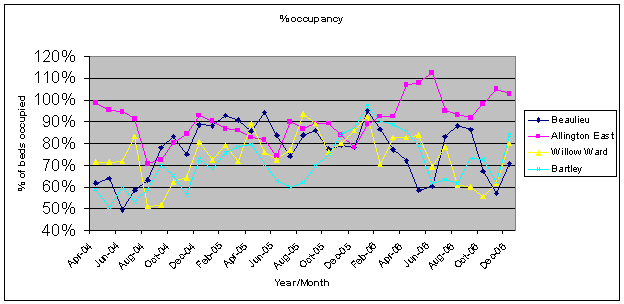
Table 3
Area (may serve more than one locality) |
No of beds per over 65 |
Current Population Over 65 |
Ratio beds to population |
Proposed new no of beds |
Ratio beds To Popn. |
Population Growth 2005 - 2011 |
Ratio in 2011 To Popn. |
Southampton |
100 |
57 921 |
1 : 580 |
82 |
1 : 706 |
10 % |
1 : 776 |
Mid Hants |
27 |
29 430 |
1 : 1090 |
27 |
1 : 1090 |
10 % |
1 : 1199 |
North Hants |
37 |
50 000 |
1 : 1351 |
37 |
1 : 1351 |
4 % |
1 : 1405 |
Table 3 above shows the current provision of beds in the area affected by the changes - it is much better resourced than any other area in Hampshire. This explains why bed occupancy is under-used and why there is opportunity to withdraw some capacity.
The population in Eastleigh, Romsey and Southampton is expected to grow by 10% between 2001 and 2011. The population of the over 65's will grow from 58,000 to 63,800 in this area.
The plan is to close 18 beds in Southampton giving a ratio of 1: 707 and with a population growth of 10% there will be a ratio of 1:776, which is still significantly better than any other area in HPT and explains why there has been such under occupancy of beds in this area. Other treatments are now preferred to admission to hospital. Occupancy of beds in Southampton has been low for many years and commissioners and providers are not able to ignore this.
Q4. There is a lack of underpinning information about the anticipated benefits of the changes for some of the statements made:
a) Demand for Beds
Our best measure of the demand for beds is the level of use, referred to as occupancy. The graph shown in table 2 shows that even over a long period the level of occupancy in the dementia wards have left empty beds which we want to better utilise.
b) Community teams under pressure and c) timeliness and responsiveness
Over the past 10 years there has been very little growth in the community teams as most additional funding has been focused in the field of new drugs and memory assessment - therefore the staff teams have remained very static. Although long term data is not available for all teams, available information indicates that the number of referrals to the teams has grown but significantly the complexity of the work also has. The members of community teams have typical caseloads of 55 patients as of 31st March 2007 and the RCN recommends caseloads of 35 patients per qualified nurse. Some of these pressures have been addressed over the last 2 years by increasing the skill mix in teams to allow qualified staff to concentrate on the more complex work.
HPT have worked hard to maintain and improve the timeliness and responsiveness of services, such as time to first assessment - which is under 7 weeks for routine referrals. To maintain and improve this position, in the light of predicted increased demand in the community, it is important to ensure appropriate levels of staffing and responsible caseloads are in place.
Q5. The document does not spell out what the impact on Adult Services will be, neither does it give any detail regarding planned community reinvestment. What options have been considered for this? The document suggests there will be more of the same provision, but have other innovative service developments been considered and if so, where is the option appraisal for these? AND " Page 4 states that investment will be redirected from beds to reduce pressures in the community on health and social care. How will the proposed changes reduce pressures on social care?"
A. We believe there will be minimal impact on Adult Services by reducing bed numbers. We will still be able to admit all patients requiring admission, although we would expect that in time they would remain with us for a shorter period. If this is the case there may be a small impact on the care management budget as patients will return to the community earlier. However, this is difficult to predict and a likely outcome of the national drive towards increased care in the community. HPT are starting work that we hope will minimise lengths of stays in our wards and Adult Services have been invited to be part of this work.
In the community, an increase in investment is likely to have a more positive effect on Adult Services who, like health, are also experiencing increased demand against a tight financial framework. Our work overlaps and therefore it can be argued that investment in our community services will equally assist both organisations.
As part of recent discussions arising following your letter, we have agreed to work over the coming few months with Hampshire Adult Services to develop a detailed plan for utilising the community resources realised, which is approximately £160,000 for Hampshire.
Q6 "It is not at all clear how the loss of beds reduces to a net loss of one bed (p8).
¬ Maintaining occupancy levels at over 90% ( page 6) is a very high expectation.
¬ Page 8 states that bed usage in the Southampton area is already 15% higher than the rest of the county.
¬ Re-designating a bed at the Becton Centre for respite does not reduce the loss of one bed....a bed is then lost from the Becton.
A. The calculation on paper attempted to demonstrate that given the improved usage of existing empty beds (to around 90% occupancy) and the opening of more capacity on existing wards, the net effect is we will have only very marginally reduced our ability to admit.
We believe that working with occupancy levels at around 90% is realistically achievable. On a ward of 20 beds 90% occupancy would mean, on average, at any one time, 2 beds were always free, although naturally there are variations over a period of time.
At any one time up to 25% of beds in use are occupied by individuals whose discharge is delayed and as outlined previously we are undertaking a major piece of work to decrease lengths of stay which we believe will decrease delayed discharges and keep occupancy levels down.
Bed usage is around 15% higher in Southampton City and bordering areas compared to the rest of the County. The reasons for this are complex but include how beds are or are not being utilised. We believe that this also shows scope to reduce length of stay and occupancy levels to norms experienced in other areas.
The re-designation of a bed in the Becton Centre is one bed. However, this is a bed that is on average not used and by utilising it we are making more efficient use of the limited resources available to us.
Q7. Is the level of disinvestment in services (20% of released funds) justified given the points outlined above? It is concerning that, if the overall aim is to redirect resources from beds, which are no longer needed, to community provision, in the context of predicted large increases in demand due to demographic changes, both HPCT and HPT choose to take 20% of released funds out as savings.
A. All Trusts have to make ongoing efficiency savings and this is similar to GERSHON. The reduction in the use of beds is an opportunity to make some small savings with no impact on service levels. These savings are mandatory in the NHS and would have to be made from one element of our services whatever the decision related to this project, therefore, we are, in part, protecting other valuable therapeutic services. It is generally accepted that demographic changes will increase demands for services and this is exactly the reason we want to increase the provision in community services. These savings represent only 0.0053% of the Older Persons Mental Health budget.
Q8. It would be helpful if it could be confirmed that respite provision for the Hampshire PCT area remains the same. It is not clear whether the impact is the same for Southampton PCT and Hampshire PCT in terms of respite. It is important to note that criteria for in-patient care are not the same as criteria for NHS funded respite. Health respite provision should not only be provided in a hospital setting.
A. The level of respite provision will not change. All clients from Hampshire currently assessed as requiring health respite will continue to receive it. This provision will be available to other new referrals when no longer required by existing service users. A bed has been identified for any new assessments that are needed.
Q9. There is a shortage of CPN input for the East Forest and it is not clear how this will be addressed by these changes. Day time support for many people in New Forest whose needs are clearly outside ASD framework have all but disappeared.
A. Benchmarking of services supports this view and initial discussions to inform the financial costs included qualified & unqualified nursing time in this area. We have agreed to form detailed proposals over the next few months in conjunction with Adult Services and we believe this should be reflected in any agreement.
Q10. What is the level of resource available for Hampshire residents in terms of assessment input & support within the main Acute sites (SGH & Lymington). This is lacking at present and has been having a considerable impact on discharge arrangements.
A. Currently there is very limited liaison commissioned by the PCT. We are very happy for this to form part of the discussions referred to in Q9.
Q11. Section 9 refers to an impact on adult services then seems to place the responsibility for addressing this with PCTs
A. Section 9 acknowledges that we are inter-dependent and any changes have a knock on effect, even if this is as simple as changes to when and where meetings are held. We are all committed to working together and keeping each other informed. This is one of the reasons why a shared older people's mental health strategy is important.
Q12. Overall the document is not clear about the changes being made and the reasoning behind these. It suggests that it is closing a ward at the Western, but in fact is setting out the case for moving Allington East from Moorgreen to that facility. Section 4 highlights that the move of the ward could release land for sale.
A. There are excess beds currently in the system, which consume resources that are needed elsewhere. Please refer to table 3 for the justification for the changes proposed.
The movement of Allington East Ward is opportunistic as these proposals will free an existing ward for alternative use. The current environment in Allington East Ward is poor and we would like to utilise the modern purpose built ward to improve this. There are plans to sell some land at Moorgreen as the space is no longer needed for health care and the buildings earmarked therein are sub standard.
Q.13 There does not appear to be any analysis of the need for the services affected given our aging population and the fact that there is a growing proportion of our population that will be affected by dementia.
A. The report summarises the analysis which basically indicates growing demand due to an ageing population. Table 4 below is based on population growth and prevalence rates of dementia:
Prevalence Trends - Dementia
· Age 65-70 1 in 50
· Age 70-80 1 in 20
· Age 80+ 1 in 5
Source: Alzheimer's Society Prevalence Rates
Table 4. Dementia Trend for Hampshire 2005 - 2011
Age |
2005 Population with Dementia |
2011 Population with Dementia |
Increase | |
Number |
% | |||
65 - 70 |
1181 |
1354 |
173 |
14.65 |
70 - 80 |
4644 |
4875 |
231 |
4.97 |
80 and over |
11890 |
12856 |
966 |
8.12 |
Total |
17715 |
19085 |
1370 |
7.73 |
Considerable pressure is starting to appear in community services and this is why the proposal focuses a significant proportion of released resources into community services.
Q14. There is no assessment of the impact that the move will have on access, particularly for people in the area of Eastleigh and Southern Parishes.
A. We have examined the postcodes of current service users of Allington East Ward. This indicates that a significant proportion of people live nearer to the relocated ward. This is because the ward serves the East of the New Forest as well as Southampton, Eastleigh and the Southern Parishes. It is more difficult to estimate the impact on visitors but on the basis of location the relocated ward is more central to its catchment ward. The race impact assessment also picked up that access would potentially be improved for some ethnic groups due to its improved transport links.
Q15. There is reference to respite care, which is to be welcomed, but there is no indication of the need for these services, e.g. whether short term respite is always available, how carers needs are assessed etc. It is not clear what facility for respite will be in the area of Eastleigh and Southern Parishes. Willow ward would only be providing rehabilitation services for people with complex physical and mental health problems
A. Social respite is the main responsibility of councils whilst health respite is the responsibility of health. The eligibility criteria for mental health respite, is, broadly, for complex physical and mental health problems and there are no plans to change this. For Eastleigh and Southern Parishes it is planned that respite admissions would normally go to Beaulieu Ward based at Western Community Hospital.
Q.16 Section 6 setting out the impact on beds suggests that through increased occupancy the overall reduction of 14 beds will be reduced a net effect of just 1 bed for Older Peoples' Mental Health.
A. This has been picked up in question 6.
All other points have been picked up within other questions
Glossary
Caseload - number of patients a member of staff is currently providing care for
Delayed Discharge - an individual who is ready for discharge but due to a delay (such as agreement on funding) they are still in hospital
HPT - Hampshire Partnership NHS Trust
HPCT - Hampshire Primary Care Trust
% Occupancy -The percentage of available beds in use