
Archived decisions
Hampshire Fire and Rescue Authority 6 6 2007
Appendix A to
SE FRS RMB Update
SOUTH EAST REGIONAL HR STRATEGY
1. INTRODUCTION
The Fire & Rescue Authorities in the South East have joined together under the umbrella of the South East Regional Management Board (SE RMB) to develop a Human Resources Strategy for the South East Region, which will be reviewed and up-dated as required on a biennial basis in the future.
The Fire & Rescue Service faces many challenges in achieving its key objective of reducing death, injury and damage as a result of fire and other emergencies. Fire & Rescue personnel are the key to current and future success.
Within the context of Chief Fire Officers Association's (CFOA)'s national UK Fire & Rescue Human Resources Strategy, this South East Regional HR Strategy will provide a regional framework for the development of policies, procedures and plans for managing the people employed by South East Fire & Rescue Authorities in order to deliver their respective Integrated Risk Management and Corporate Plans.
It will cover all aspects of people management, including personnel management, employee relations, learning and development, organisational development, diversity and equality and employee health and wellbeing.
Although published as a separate document, the South East RMBs Diversity and Equality Strategy forms part of its overall Human Resources Strategy.
2. PURPOSE
Whilst each Fire & Rescue Authority and Service in the South East is an independent body, they face many of the same challenges, a major one of which is to deal successfully with the Government modernisation agenda. This applies across all areas of activity including human resource management where there is a wide ranging modernisation agenda.
Key themes running through this strategy are:
· Modernising and developing leadership at all levels.
· Improvement through performance management and development.
· Developing effective partnership working with trade unions.
· Increasing diversity and delivering equality.
· Increasing people management capacity through line managers and HR specialists.
· Embedding the F&RS Core Values in the way we do business.
· Ensuring the health, safety and well-being of Fire & Rescue staff.
This strategy seeks to identify areas of human resource management where action on a regional basis will `add value' for each Fire & Rescue Authority and Service by enhancing capacity, avoiding duplication, addressing common challenges together and as a result increasing organisational efficiency in its widest sense.
This strategy will enable the Fire & Rescue Authorities in the South East to meet the Government's expectation expressed in the Fire & Rescue National Framework 2006-08 that they, through the South East Regional Management Board, draw up a Regional HR Strategy by the Autumn of 2006.
It will also provide a framework to facilitate decisions about the most appropriate service model for the provision of the range of people management services for Fire & Rescue Services in the South East.
3. CONTEXT
This Strategy seeks to bring together the elements of the national Fire & Rescue Service HR agenda into focus for South East Fire & Rescue Services alongside the human resources issues arising from their Integrated Risk Management and other corporate plans to enable them to be addressed on a regional or sub-regional basis where this adds value for each service.
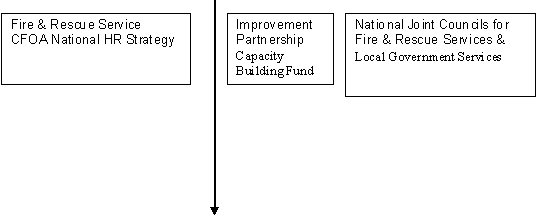
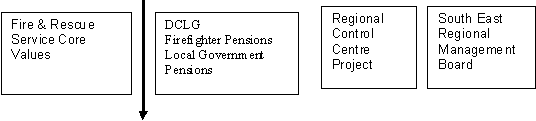
The following diagram seeks to place this Strategy in its wider context.
SOUTH EAST FIRE AUTHORITIES REGIONAL HUMAN RESOURCES STRATEGY CONTEXT
Revitalisation of Health & Safety HSE
FIRE & RESCUE SERVICES ACT 2004


NATIONAL FRAMEWORK DOCUMENT
Chapter 2 - Working together - The Regional Approach
Chapter 5 - Fire and Rescue Service staff
Chapter 6 - Workforce Development

Comprehensive Performance Assessment by Audit Commission
Operational Assurance



SOUTH EAST REGIONAL HUMAN RESOURCES STRATEGY
HR Strategies from other Regions



South East Equality & Diversity Strategy




Action Plan


INTEGRATED RISK MANAGEMENT PLANS
Employee Resourcing Work stream
Rank to Role,Retained Duty Systems


HUMAN RESOURCE STRATEGIES AND PLANS


4. NATIONAL FRAMEWORK EXPECTATIONS
The Government is responsible for setting out priorities and objectives for the Fire & Rescue Service. The Government achieves this via the Fire & Rescue Service National Framework Document by making clear:
· the Government's expectations for the Fire & Rescue Service.
· what the Fire & Rescue Authorities are expected to do.
· what support the Government will provide.
At the heart of the Framework is recognition that the Fire & Rescue Authorities most important asset is their staff. The Framework indicates that it is essential that people from all backgrounds and with many different skills and specialisms are:
· encouraged to join the Service.
· are used as effectively as possible.
· are offered a rewarding and flexible career.
The Framework deals with this by defining what action should be taken by individual Fire & Rescue Authorities and Regional Management Boards across the areas of fair and effective management of staff, including equality and diversity issues and workforce development. The Framework is reviewed on a regular basis and the most recent version for the period 2006- 2008 was published in April 2006.
The Human Resource issues identified in the Fire & Rescue Service National Framework 2006-2008 (Chapter 5 Fire and Rescue Staff and Chapter 6 Workforce Development) are: | |
Equality and Diversity Learning and Development Health and Safety Opportunity to Work Flexibly Sickness Management/Ill health Occupational Health Improving Opportunities |
Integrated Personal Development System Leadership Pensions Recruitment Discipline Mobility Human Resource Management |
5. FIRE & RESCUE SERVICE CHIEF FIRE OFFICERS ASSOCIATION NATIONAL HR STRATEGY OBJECTIVES
Published in July 2006, the F&RS CFOA National HR Strategy seeks to ensure that local authority Fire & Rescue Services have the right number of people in the right place at the right time to deliver more `customer focused' front line services that drive down risk to life. The strategy is designed to enable the Fire & Rescue Service to achieve its primary purpose, live up to its core values and to deliver its vision and in addition the Strategy embraces and translates the requirements of the National Framework. These objectives are to be delivered through six priority areas. The priority areas are set out below.
1. Develop leadership capacity.
2. Developing the organisation.
3. Developing the skills and capacity of the workforce.
4. Resourcing the Fire & Rescue Service.
5. Recognition and reward.
6. Developing the capacity of HR.
Each of these priority areas provides a number of key aims, which are set out below.
Fire & Rescue Service Chief Fire Officers Association National Human Resources Strategy Aims: | |
Support and develop the leadership capacity of the Fire & Rescue Service's senior managers and elected members Change organisational culture and manage productivity and performance effectively Raise performance and skills across all Fire & Rescue Service functions to meet Service needs Build a diverse workforce Attract and retain talented people Influence future pay and reward strategies Provide terms and conditions framework to support delivery of service Strengthen the contribution of the HR profession to the Fire & Rescue Service Maximise the contribution of HR |
Attract and develop leaders at all levels Build and maintain effective employee relations Build capacity to meet Service needs Manage effective recruitment and progression Deliver effective Workforce Planning Develop pay arrangements which recognise the contribution of all employees Develop an effective employment package Strengthen people management practice Develop HR professionals |
6. SOUTH EAST HUMAN RESOURCES DEVELOPMENT GROUP (SE HRDG)
The purpose of the SE HRDG is to facilitate and co-ordinate the development and implementation of all matters relating to the management and development of people in the Fire & Rescue Services (F&RSs) of the South East Region. In addition, and as a secondary objective, it considers issues of strategic importance relating to HR matters and develops a unified view enabling regional influence on national policy making.
The SERMB has identified lead Chief Fire Officers for Human Resources and Learning and Development who work closely with the Regional Management Board (RMB) and SE HRDG to progress human resources issues within the South East Region through this strategy.
How is this achieved?
Specifically the HRDG facilitates collaboration between Fire & Rescue Services within the region by sharing of information, documentation and, where appropriate, other resources with the aim of maximising effectiveness, efficiency and consistency.
It provides a forum for problem solving and addressing issues relating to HR matters, as identified by the RMB. It is also responsible for co-ordinating, managing and delivering work relating to HR issues against the objectives of the Chief Fire Officers Association National HR Strategy.
What does it achieve?
The role of HRDG is to contribute to the final outcome of having the right people in the right place with the necessary skills to save life and build safer and stronger communities. An integrated and regional approach to human resource management enables each F&RS to draw on, and share, best practice and resources in a planned and practical way.
The responsibility for negotiation and consultation in relation to issues affecting policy and the management of employees within each F&RS will remain with that employer. However, there may be merits in developing joint protocols for consultation regarding issues having a regional impact at a regional level. This will include press and publicity matters.
Work undertaken by the SE HRDG is divided into a number of work streams with the following remits:
Employee Resourcing
· To ensure that plans are in place so that the right people with the right skills are employed at the right place in order to deliver the demands of individual service Integrated Risk Management Plans (IRMP). This will be achieved through proper consideration of employment legislation, best practice.
· Full implementation of the Integrated Personal Development System (IPDS) and other drivers for change.
Employee Relations
· To align professional HR support to managers and the strategies of the respective F&RSs, driving through change, modernising working practices and culture and promoting partnership working.
· To provide robust and unified HR policies, procedures and guidelines, ensuring best employment practice and consistency of application through out the South East region.
Employee Development
· To work with F&RS managers, representative bodies, elected members and other F&RS interest groups to develop products and to support their understanding with regard to all people and organisational matters.
· To work with external stakeholders, eg EdExcel, SQA, Audit Commission etc. to support their understanding of the Services current status to enable them to effectively undertake quality assurance of service delivery and to support continuous improvement.
Equality and Diversity
· To ensure that the equality and diversity work programme is delivered on behalf of the RMB.
· To provide progress reports to HRDG & RMB of achievements against the action plan and advise of any areas where there is an identified need for improvement in performance.
· To benchmark performance against other F&RS' within the SE region and to disseminate best practice.
South East HR Partnership
· Project manage the establishment of collaborative Assessment and Development Centres and Firefighter Selection Tests to meet the business needs of the F&RS in the South East Region, whilst ensuring compliance with the National Framework Document and any other relevant documents.
· To identify and deliver any cost savings where possible. Actively promote the National Core Values ensuring that these are central to all aspects and activities of the project.
7. SOUTH EAST HUMAN RESOURCE PRIORITIES
The currently identified Human Resource Priorities for the South East are set out in the Appendix to this Strategy. South East Human Resources Development Group will be responsible for maintaining their currency over the period of this Strategy.
8. PROJECT AND PERFORMANCE MANAGEMENT
Each F&RS in the South East retains `employer responsibility' for its staff and will access the outcomes of this strategy as required to meet its Fire Authority's Integrated Risk Management and other corporate plans.
Where the strategy generates discrete regional projects these will either be managed directly by the RMB through its established performance management process or by SE HRDG and its work streams through their performance management processes.
9. REVIEW
The lead Chief Fire Officers for Human Resources and Learning and Development, together with SE HRDG will be responsible for seeking the RMB's approval to amendments to this Strategy. Given its high level focus it will be formally reviewed on a two yearly basis, the first review taking place in the Autumn of 2008.
Annex 1 To
Appendix 1
1. SOUTH EAST HUMAN RESOURCE PRIORITIES
Recruitment and Retention
The Region will promote the use of fair and transparent recruitment processes at all levels for all employee groups providing support to joint initiatives to the mutual benefit of member Fire & Rescue Services in the Region.
Planned Outcomes
· Joint promotion of recruitment initiatives, eg Retained Duty System (RDS), positive action to address under-representation.
· Share experiences of legislation impacting on F&RS and, where possible, agree joint standards in areas such as health and safety, occupational health, age discrimination, equality and diversity, etc.
· Agree where possible a standard regional succession planning process and multi level entry and fast tracking scheme with opportunities across the Region to support this.
2. South East HR Partnership - National Firefighter Selection (NFS) and Assessment and Development Centre (ADC) Project
The members of the South East HR Partnership will establish collaborative arrangements for the implementation of Assessment and Development Centres and National Firefighter Selection to meet the business needs of the F&RS in the South East Region.
Planned Outcomes
· To ensure compliance with the National Framework Document and relevant Fire Service Circulars and all legislative requirements ensuring robust, valid and legally defensible processes which will enable fair, justifiable and consistent assessment of potential for development and selection of personnel for recruitment or promotion.
· To consider the resourcing options available and ensure the selected option delivers best value.
· To develop policies and procedures to support regional implementation and collaboration over ADC's and NFS.
· To develop Memorandums of Understanding to formalise the collaborative approach to ADC's and NFS.
· To analyse, prepare and implement the business case for a regional coordinator and/or a regional team for ADC and NFS.
3. Learning and Development
To support the joint working and provision of learning and development and Performance Management across the Region.
Planned Outcomes
· To support initiatives that enable the skills, abilities and potential of all employees to be recognised.
· To support initiatives under Performance Management to enable employees to develop their skills and reach their potential to improve the effectiveness of Regional Fire Service provision.
· To support the implementation of the outcomes of the review of facilities and resources within the Region commissioned from external learning and development consultants (Atmaana).
· To share advice and experiences on Continuous Professional Development (CPD) initiatives.
· Support leadership development within the National Leadership Framework by identifying and supporting opportunities within the Region, for example, job swaps, secondments, shadowing, mentoring etc.
4. Regional Control Centre
To support the transition to a Regional Control Centre (RCC) within the South East Region.
Planned Outcomes
· To contribute to the management of the impact on existing control centres by joint working and potentially creative use of employee retention/pooling of resources.
· To share experiences and provide support to maintain staff morale in existing control centres.
· To assist, where possible, in any employee redeployments arising across the Region.
· To ensure consistent and co-ordinated responses to the HR issues arising from the RCC Project, including convergence and out-of-scope work.
5. Equality and Diversity
The Region will support partners enabling all employees and the community to be treated fairly and afforded equality of opportunity.
Planned Outcomes
· To support joint initiatives to promote development of employees in a way in which takes account of differing needs of the individual to support more community focused service delivery.
· To encourage the development of innovative opportunities for the use of flexible working within Fire & Rescue terms and conditions.
· To champion the raising of the profile of the F&RS as a career choice for under represented groups and its standing in the community.
· To assist each F&RS to work towards the achievement of levels defined in the Local Government Standard for Equality, and the embedding of Equality Impact Assessments into day-to-day decision making and activities.
6. Health, Safety and Well Being
To promote and support initiatives to assist in the provision of health, safety and well being services for the benefit of employees and service performance and efficiency.
Planned Outcomes
· Consider the provision of shared Occupational Health Services and/or the agreement of a model contract for services that individual F&RSs can adopt.
· Consider the range of occupational health opportunities that can be provided to support rehabilitation and well being at work. To include the provision of a list of agreed service providers for F&RSs to utilise as required.
· To share Health and Safety advice, policies and procedures to assist in a Regional approach and/or reducing duplication of effect within F&RSs.
· Agree approaches to support F&RSs in meeting Central Government targets for sickness absence.
· Share Working Time Directive work to assist F&RSs in meeting their statutory obligations whilst minimising any impact on service delivery and costs.
7. Retained Duty System (RDS)
South East F&RSs will work together to meet the current challenges facing the Retained Duty System (RDS), ensuring members contracts and working practice's will accommodate the differing needs or aspirations of people from a range of backgrounds. The priority will be to overcome current recruitment and retention problems, recognise and maximise the contribution of staff working the RDS and facilitate flexibility between contracted working patterns (particularly the RDS) as much as possible in line with the National Framework.
Planned Outcomes
· The review of the expectations laid down in the National Framework Document.
· To work in partnership across the region, sharing existing best practice in recruitment and retention of RDS staff.
· Develop strategies for the recruitment and retention on the RDS, raising awareness amongst employers to the benefits of their staff involvement.
· Review and devise new policy taking account of the 35 (of 51) recommendations in the National Retained Review Team's document identified as being under the control of Fire & Rescue Service's.
· Ensure the IRMPs recognise and access the benefits that staff on the RDS may bring.
· Ensure staff working the RDS have access to training & development opportunities that are commensurate with their colleagues working other duty systems within the IPDS framework.
8. Partnership Working
To promote partnership working as the preferred model of employee relations within all Fire & Rescue Services in the region.
Planned Outcomes
· To actively promote a positive relationship between employees, Trade Unions and management based on recognition of common interest, which promotes the quality and efficiency of the Fire & Rescue Service and improves the quality of the work environment for employees.
· Increase employee, commitment and involvement in the work of the Fire & Rescue Service in the South East.
· Facilitate the implementation of change as required by IRMPs and the Fire Service Modernisation agenda.
9. Reward
The region will support the development and provision of a range of pay and benefits that support IRMPs through sharing of advice and experiences.
Planned Outcomes
· Explore opportunities to develop non pay aspects of the employment package to support recruitment, retention and well being of Fire & Rescue Service employees in the Region.
· To share advice in relation to the introduction of CPD payments and Additional Responsibility Allowances.
· Co-ordinate and support the delivery of equal pay audits in Fire & Rescue Services in the Region.
Secretarial/WP/Corporate/HFRA HFRA 6 6 07 SE RMB Update Appendix A CM/25/5/07