
Archived decisions
Hampshire Fire and Rescue Authority Human Resources Committee Item 7 15/03/200515 June 2007
Error! Bookmark not defined.Equal Pay Audit HFRS Stages 1-7 Report of the Chief Officer |
Contact: Susan Templeton, Deputy Head of Human Resources Tel : 023 80 644 000 Email: [email protected] |
7.2 |
This took account of the following constraints: · The Grey and Green Book pay and terms and conditions of employment are negotiated by 2 separate negotiating bodies. · Trade union constraints on partnership working and agreements on equal pay. · Financial implications of equal pay gaps. · Risk of concurrent and future equal pay claims via an employment tribunal including only completing part of an equal pay audit. · Time to renegotiate terms and conditions of employment to provide equality. · Resources to complete a full equal pay audit. | ||||
7.3 |
With the following objectives: · To work under equal pay legislation and equal opportunities commission guidance. · To establish an equal pay policy in agreement with representative bodies. · To research equal pay issues in the United Kingdom to inform the Service's decision making approach and risk management. · To establish a methodology to provide a comparison between Grey and Green Book pay as currently determined by Grey and Green Book job evaluation schemes without undermining either scheme. · To support work by sustainable pay modelling software to enable changes in pay and rewards, job evaluation, structured re-organisations etc to be easily recalculated/reviewed. · To undertake an equal pay audit in stages in line with the EOC 5 steps in conducting an equal pay audit. · Calculate and set a budget to cover consultant fees, training, employment tribunal claims, equal pay gaps, etc. · Establish a process for dealing with equal pay claims. · Establish a communications plan to inform employees and members. · Ensure processes are open and transparent and in line with core values and subjected to audit and external scrutiny. | ||||
8 |
Outline Deliverables | ||||
8.1 8.2 |
Complete HFRS Stages 1 to 4 of the equal pay audit, with a recommended action plan, by September 2007. Produce a recommendation for the completion of HFRS Stages 5 to 7 of the Equal Pay Audit by May 2007. | ||||
9 |
Review of Job Evaluation Systems | ||||
Job Evaluation | |||||
9.1 |
The Service has 2 robust job evaluation schemes; the National Joint Council Scheme for Green Book posts and a Grey Book scheme based on the Office of the Deputy Prime Minister (now Department for Local Government and Communities). | ||||
9.2 |
The problem was both schemes addressed job sizing (how much a post is worth hierarchically) in different ways leading to: | ||||
Grey Book Posts Job Evaluation |
· |
Hay Job Evaluation |
_ |
Green Book Posts NJC Job Evaluation | |
500 Apples |
_ |
300 Oranges |
· |
600 Pears | |
9.3 |
To overcome this the Service appointed, after a tendering process, Hay consultants, a market leader in job evaluation and pay and grading with other Fire Service evaluation experience. | ||||
9.4 |
This resulted in circa 100 benchmark jobs being evaluated (by managers and Trade union representatives specially trained in the Hay scheme) under the Hay scheme, and point score, for the evaluated posts, Green and Grey Book, under one evaluation method (the oranges above). | ||||
Slotting In | |||||
9.5 |
A list of all post holders and their posts as at 1 January 2007 was produced by HR Management Information team, with Hay providing a chart of the point levels to slot into. The master panel then worked through the list of around 1800 posts and, where comfortable using the benchmark posts slotted in posts. However during this exercise it was felt that, approximately a further 150 jobs needed more information. A further 6 panels were held during February and March 2007 to include these posts. This also included a full review of all administrative posts (including a requirement for the managers of these posts to review the job descriptions prior to the panel) as it was felt these needed to be examined as a batch using an up to date job description. This exercise culminated in all jobs bar exclusions (see 9.6 below) being allocated a Hay point level. | ||||
Post Exclusions | |||||
9.6 |
Throughout the exercise the Service has continued to undergo substantial change, including restructure, post starters and leavers, grade changes etc. With such a moving feast the only pragmatic way to deal with this was to take a point in time, deemed to be the production of the master list as at 1 January 2007. Despite this there were some groups of posts and odd posts for which there was no merit in evaluating or slotting in or that were being addressed in a different way. These included: Service Management Team members and all roles at Area Manager or above. These posts formed part of the member led review of the senior management structure and were subject to a separate equal pay audit. Control employees. As a result of a corporate business decision not to move these employees from rank to role they were excluded. USAR. This area is under review and externally funded so there was no point in assessing them currently. Business Education Unit. This group was undergoing a radical review during April 2007 and the consensus was it was unrealistic to review the posts currently. External Secondments - Some posts. Where these were shown on the master list they were reviewed and where deemed not appropriate to evaluate or slot in they were deleted. Odd Posts. There were a handful of posts, such as the Chaplain that fell outside the parameters. Note: Clearly these posts could be included subsequently as issues arise. | ||||
Caveats | |||||
9.7 |
The master panel and others have been as thorough as practicable. There is always though potential for error in an exercise like this and/or another employee or manager or groups of such having a different view. To counter this the following main steps have been taken: · Use of an international job evaluation process which is well embedded with the UK and is one of the market leaders in this field. It is an analytical scheme which reduces subjectivity to a minimum. · Training in the hay scheme, for our own employees to gain the local knowledge of the Service, posts duties and responsibilities, with support during the first week of panel evaluations by a hay consultant. · Ensuring there was a master panel from the outset which did the core jobs and was then used thereafter to ensure consistency of application. · Full inclusion and exposure to all aspects of Equal Pay, the processes and issues, both positive and negative, to the Trade Union representatives in particular, FBU, RFU and UNISON. · Repeated revisiting of evaluation/slotting in where an anomaly seemed to arise. · Raised concerns that weighting of points to physical and environmental factors was low and could result in a distortion for lower skilled posts with a high exposure in these areas. · Extending the benchmarking and review of posts in accordance with hay, managers, Trade Union and master panel concerns. · Management of the process by the pay and rewards project board. · Ensuring managers vetted and amended job descriptions and/or were called in to the panels to explain posts to enable a fuller picture for evaluation. NOTE: this exercise only covers HFRS stages 1-4 as agreed by the pay and rewards project board that is basic pay. Some allowances are being covered by the rewards project and the further stages as identified by the PID, have been time lined (see Appendix B). | ||||
Likely Issues Identified to Date | |||||
9.8 |
The master panel have identified, from the process and results that the following are likely to result from the process to date (these are impressions and would need to be confirmed once hay analysis results are fed back): · Green Book pay scales will need amending and may need to unlock and revisit the NJC Pay Model to allow re-alignment across the Grey and Green Book pay scales. · Green and Grey Book role and post grades have not clustered together thus evaluations under the two existing schemes do not always match the hay evaluations. · There is a wide variance in administrative roles and GDA's. Job descriptions for many Green Book and some Grey Book posts/roles need review. This is programmed in now as a result of the hay process and a new job description and person specification format drawn up to make any job evaluation easier. · Because SMT and Area Managers were not part of the process this has potentially artificially capped the evaluations done. · Some managers seem to have little grasp and/or currency of what their teams and employees within them are actually employed for. · Current post hierarchies and structures may be affected where posts have been evaluated at different levels. Some at the same point as their current manager or above other posts in the group currently at a higher level. · Some employees may be happy but others will not be comfortable with where the hay evaluation has placed the size of their post/role. There is a danger, as alluded to above, that other employees and managers, particularly regarding their own post/role and patch, will have a different view. This may require an appeal process. | ||||
10 |
Statistical Analysis of Payroll and Employee Records Data | ||||
10.1 |
The master list as at 1 January 2007 with the following information: · Personnel/Service number · Name · Post held · Grade/role · Department · National condition (Green or Grey) · Salary (basic) · Ethnicity · Date of birth · Age (as at 1 1 07) · Length of service HFRS (as at 1 1 07) · Length of continuous Local Government service (as at 1 1 07) · Disability (yes/no) · Gender (male/female) was sent to Hay, early April 2007. They will, using their software programmes, analyse the data for any pay anomalies and will also look at if there are any equality stream issues: not just gender but age, length of service, ethnicity etc. | ||||
10.2 |
The results including options for dealing with any anomalies will then be discussed with the service and the project board and ultimately members will need to make decisions. A further report will be brought to a subsequent HR committee. | ||||
11 |
A Review of the HR Policies Relating to Terms and Conditions |
11.1 |
As part of HFRS Stages 5 - 7 of the equal pay audit there will be a review of other pay and rewards including terms and conditions of employment. As this links with the pay analysis it has been decided to bring this forward alongside the pay analysis. Results and options will be presented to a later HR Committee. |
12 |
Contribution to Corporate Aims and Objectives |
12.1 |
Meets IRMP 2007/10 |
· MR1 - Achieving our vision by empowering our workforce · MR2 - Cultural change and living our values · MR4 - Investors in People and is a requirement to achieve equality standard level 3. | |
13 |
Risk Analysis |
13.1 |
There are some clear risks associated with undertaking an equal pay audit. These main ones are: |
13.2 |
Financial |
A clear financial picture, with pay modelling options will be available once the Hay analysis is complete. Budget provision has been allocated for final year 2007/08. | |
13.3 |
Morale |
In any assessment of pay, in particular via job evaluation, there are employees who will go up or down in grading or stay the same, many of the latter two categories may not be as supportive of the process and outcomes as the former category. Whilst the equal pay audit aims to assess and recommend ways to address any pay and other terms and conditions of employment anomalies inevitably it encompasses wider implications with its findings. | |
13.4 |
Trade Unions Not Signing a Collective Agreement |
If the Trade Unions will not sign a collective agreement (prompted by the Allan v GMB case 2004) the Service would have to conclude all agreements on new structures pay, grades and compensation with each employee and, with no easy way to deal with an employee who refuses to reach agreement. | |
13.5 |
Breach of Contract of Implied Equality Clause |
Potentially an equal pay audit not completed by March 2007 is a breach of an employee's contract of employment. However, it is thought an Employment Tribunal would accept as a defence an organisation proactively working towards completion of an equal pay audit. Also the Local Government Employers reported in February 2007 that "they had obtained legal advice which suggests that the deadline is not contractually enforceable". | |
14 |
Resource Implications |
14.1 |
Human Resources |
As noted above 23 employees, including Trade Union Representatives have been involved in the process directly. They have all fitted this work in with their other duties. The ongoing needs will be for an implementation project team reporting to the Pay and Rewards Project Board and ultimately the HR and Finance Committees. | |
14.2 |
Physical Resources |
None | |
14.3 |
Information and Communications Technology Resources |
The Service has utilised its existing databases to supply data to Hay for their software to undertake the analysis. Pay modelling has been included in the specification for the Strategic Workforce Information System Project but is not seen as critical and hence not a priority. | |
14.4 |
Financial Implications |
See Item 13 above. | |
15 |
Equality Impact Assessment |
15.1 |
This is attached as Appendix. As the equal pay audit is aimed at addressing inequalities across gender and other quality streams the outcomes, if applied within the Service, should be positive for all equality streams. |
15.2 |
The proposals within this report are considered compatible with the provisions of the European Convention on Human Rights, the Human Rights Act 1998, and the Race Relations (Amendment) Act 2000. |
16 |
Consultation |
16.1 16.2 16.3 |
As a result of the Allan v GMB case 2006 whereby the GMB signed a collective agreement on an equal pay deal that covered both a new pay structure and backdating of equal pay claims, including grading and protection arrangements, which perpetuated inequality and provided for inadequate compensation for the buying out of their potential entitlement to backdated equal pay. All Trade Unions are now very cautious of agreeing collective equal pay outcomes, indeed many public sector organisations have found the Trade Unions will not participate in an equal pay process. In HFRS the Trade Unions have been invited into the process from the outset of the development of the process and have been included in all positive and negative issues equally with management, including an initial legal workshop. Trade Union representatives have also fully participated in the process to date as part of the Hay panels and the 3 key Trade Unions the FBU, RFU and Unison have been part of the master panel. The GMB and FOA, due to resource issues, have requested to be kept informed of key points. There is no guarantee the Trade Unions will sign any equal pay collective agreement as a result of the case but certainly, to date, the work has been on a partnership basis and it is intended this should continue. |
17 |
Conclusion |
17.1 |
Equal pay can be seen as complex where equal work / work of equal value is applied rather than a straight forward comparison of the same job being done by a male and female. However, the use of a common job evaluation scheme makes the comparison scientific and justifiable. |
17.2 |
Once pay and rewards are brought into play, employees' emotions understandably may escalate but again tied back to a scientific process that is common to all, most employees accept the rationale with challenges reduced. |
17.3 |
HFRS have sought to apply legislation and good practice to its equal pay audit in order to identify anomalies and plan to address these. Until the analysis is available it is impossible to identify, other than likely key issues, the exact nature, size and options that may be needed. |
Background Information (Section 100D of Local Government Act 1972) | |
The following documents disclose the facts or matters on which this report, or an important part of it, is based and has been relied upon to a material extent in the preparation of the report: Substantial reference material from the Local Government Employers, Equal Opportunities Commission, Thomson/Gee and Chartered Institute of Personnel Development have been referenced to support the project. Note: The list excludes: (1) published works; and (2) documents that disclose exempt or confidential information defined in the Act. | |
cehC/H/HFRA HR 15 6 07 Equal Pay Audit
17 May 2007
Appendix A
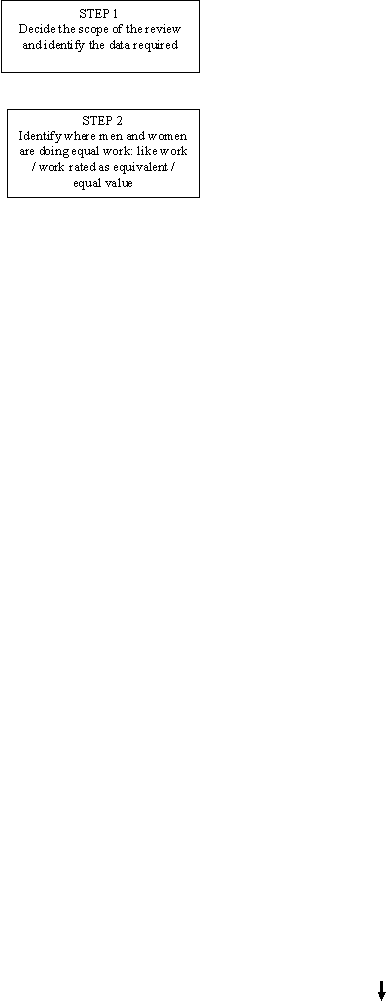
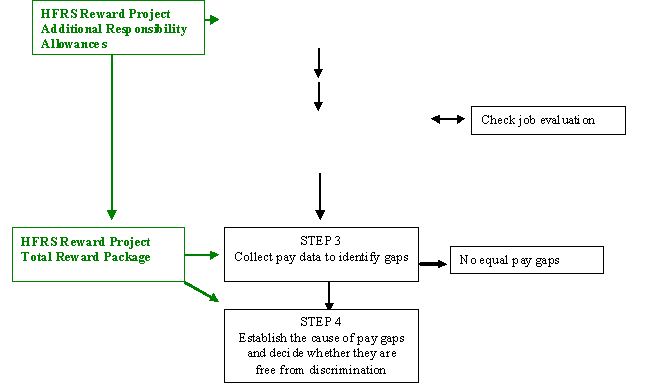
A Step-by-Step Guide to Equal Pay (EOC)






gmgP/G/PayRewardsReview
17 December 2006