
Archived decisions
Hampshire County Council
Culture and Communities Policy Review Committee
Library and Information Services Review
Select Committee Meeting Tuesday 19 June 2007
Agenda
Time |
Witness |
Notes |
1:30 - 2:00 |
John Parry: Research Manager, Gosport Discovery Centre |
Appendix One Appendix Two |
2:00 - 2:30 |
John Sadden: Librarian (Union Representative) - Gosport |
|
2:30 - 3:00 |
Darryl Sheppard: Participation Development Youth Worker/Youth Council |
Appendix Three |
3:00 - 3:30 |
Sue Greenfield: Head of Library Performance and Tim Wills: Group Manager, Fareham and Gosport |
|
3:30 - 4:00 |
Yinnon Ezra: Director Recreation and Heritage |
|
Unable to attend |
Janet Holden: Assistant Head of Service, Norfolk Library and Information Service Emailed and in touch |
Appendix Four |
Appendix One: John Parry
Gosport Discovery Centre
Residential Postal Consultation
Questionnaire Findings 2006
John Parry
Principal Research Consultant Recreation & Heritage Department
Hampshire County council
February 2007
Contents
Page
Introduction
Background 3
Objectives 4
Methodology 5
Summary & Conclusions
Summary of the main findings 7
Conclusions of the main findings 9
Main Findings
Library card ownership 16
Visiting patterns 18
Image 20 Facilities and Services
Residents Priorities - what is important 22
What visitors used within GDC 26 Improvements 29
Barriers 32
Learning 34
Appendices 40
The Questionnaire
Literal responses
Background
As part of the preparation work for Gosport Discovery Centre a number of consultations were carried out. They were part of a five-stage consultation:
Stage 1
Scoping Exercise among HCC and funding partners to firm up the Discovery Centre concept
Stage 2
Shaping Research - qualitative research among key community opinion leaders to inform on the needs in the locality of Gosport
Stage 3
Public Forum - to encourage direct feedback to provisional proposals for the Gosport Discovery Centre development [held in Gosport Library]
Stage 4
Postal Questionnaire - sent to a systematic random sample of 10% of all households in Gosport
Stage 5
Post Operative monitoring and evaluation - a three year programme of observation, monitoring, and evaluation.
This survey forms a part of stage 5. It is intended to provide information of how well the Discovery Centre is serving the residents of Gosport. It is essentially a repeat of the stage four questionnaire. By comparing this survey with that of 2004, we should be able to see whether attitudes, views or the needs of the local community may have developed since the opening of Gosport Discovery Centre.
It should be noted that this survey forms only part of the post operative evaluation, and that this report relates to the survey itself and is not intended to be a post operative evaluation report.
Objectives
This particular survey is a follow-up to one conducted prior to Gosport Discovery Centre in March 2004 - one year after opening. The objectives are thus as in 2004, but one year after opening.
The essential aim is, by consulting a wide range of residents of Gosport to gain an understanding of how they would like to see the Gosport Discovery Centre developed - thereby more closely meeting the needs of the local community.
Specifically, the research intends to:
~ Find out which facilities and services residents would like to see provided in the Gosport Discovery Centre
~ Gain an understanding of the potential interest for learning in the Gosport Discovery Centre
~ Gain a greater understanding of the demographic nature of potential users of the Gosport Discovery Centre
~ Explore views on a range of specific issues such as those relating to access and inclusion
Methodology
A total of 3,200 questionnaires were sent out to a random sample of named residents of Gosport [for the purposes of this survey, the postcodes PO12 and POP13 serve as parameters for Gosport]
The questionnaires were sent out by post. Only one person in each household was selected to receive the questionnaire, the recipient being aged 18+. The households were selected using systematic random sampling methods.
The sample size of 3,200 was chosen for three reasons:
1) Firstly on the basis that a 10% return would deliver an effective sample of 320 - (providing a plus/minus tolerance of 5.5%)
2) Secondly because it would embrace 10% of all households in Gosport
3) Thirdly to match the sample chosen for the 2004 consultation to facilitate back comparisons.
The number of questionnaires returned in 2006 was 365. Excluding any statistical error attributable to non-response, the sample is representative to a statistical significance +/- 5.13% at the 95% confidence level. The returns were down on the numbers in 2004 (when talk of the DC was a `hot issue' in the local press etc.)
The statistical difference between the two surveys is 6.24% at the 95% confidence level that is to say that the difference would need to be more than 6.24% to be statistically significant.
Robust sub-samples have been used during the analysis to produce findings in this report to provide a high degree of statistical confidence (unless specifically mentioned otherwise). Further nested analysis is possible subject to sub-sample sizes being adequate - I can advise on these on a case by case basis.
The returned questionnaires have been weighted by age to more closely reflect that of the Gosport resident population. (Note: weights below re-adjusted for 18+)
Age Band |
Weighting Applied |
18 - 34 |
2.3754 |
35 - 44 |
1.2465 |
45 - 54 |
0.9269 |
55 - 64 |
0.6808 |
65+ |
0.5881 |
The three youngest age groups in the questionnaire have been amalgamated to form one new age band (18 - 34) in order to ensure a robust sub-sample for analysis purposes. Similarly, the two oldest age groups in the questionnaire have been amalgamated to form a new age band (65+) for the same reason.
For reference, the population figures from the 2001 census:
Age |
Numbers |
% Adults |
% Whole population |
18 - 34 |
18,262 |
30.88 |
23.90 |
35 - 44 |
11,661 |
19.72 |
15.26 |
45 - 54 |
9,442 |
15.97 |
12.36 |
55 - 64 |
7,392 |
12.50 |
9.67 |
65+ |
12,382 |
20.93 |
16.20 |
Sub-total |
59,139 |
100.00 |
- |
0-17 |
17,275 |
- |
22.61 |
Total |
76,414 |
- |
100.00 |
Allowing for the migration of people sampled (i.e. prospective respondents likely to have moved address prior to receiving the questionnaire), the overall effective sample rate was 13%.
The fieldwork for this survey was conducted during April 2006. The research was designed and managed throughout by Hampshire County Council's Recreation and Heritage Department.Summary and Conclusions
Summary of Main Findings
Library Card ownership
72% of respondents own a library card (down from 76% in 2004)
Most likely to own a library card if: female, age either 35-44 or 65+, from PO12
Least likely to own a library card if: male, age 18-34 or 45-54, from PO13
Visiting Patterns
53% of respondents claim to have been regular visitors to Gosport Discovery Centre (up from the 48% who claimed to be regular visitors to Gosport Library in 2004)
Respondents, who have visited the Discovery Centre do so more frequently than the Gosport Library in 2004
Regular visitors are more likely to be female and from PO12. In terms of age, regular visitors are most likely to be aged 35-44 or 65+
The largest increase in number of users can be found in the 18-34 age group
Image
The adjectives respondents most strongly concurred with for Gosport Discovery Centre were: modern and accessible. Welcoming, family friendly, and different were also adjectives used to describe the Discovery Centre.
Users had a more positive image of the Discovery Centre than did non-users
Residents (users and non-users) under the age of 45 had a more positive image than did residents above this age
Facilities and Services
Residents broadly agree what facilities and services it is important to provide. Top of the list comes; books for loan, staff available to help, reference books, quiet areas to read/study/think, and an enquiry/research service.
Of 36 aspects of service listed, 24 were considered `very important', while a further 11 were considered `important' - these figures are much higher than those seen in the 2004 survey (before residents had the opportunity to see Gosport Discovery Centre)
There are no significant differences in the ratings between users/non-users, or age groups - unlike 2004, when users/non-users and different age groups had very different ideas about what the Discovery Centre should include.
There remain gender differences, with females providing much higher ratings overall than their male counterparts.
Services used by the majority of Discovery Centre visitors or their children include: books for loan, staff help, and reference books.
Improvements
Most prominent improvements suggested by residents were:
The range and number of books
Improved publicity
Improved loan periods
Controlling noise and unruly behaviour
Barriers
Most common reasons given for not having visited Gosport Discovery Centre were:
Work commitments/lack of time
Cost of car parking or bus fares
Lack of awareness
Use local branch library or go to Fareham
Did not feel the need to visit.
Learning
The majority of residents were unaware that courses were run in the Discovery Centre - even among regular users, the awareness was only 48%
Young adults (18-34) were least aware that courses were available
Less than a third of residents were aware that Gosport Discovery Centre houses a LearnDirect Centre - again, 18-34 years olds were least aware.
83% of respondents felt that learning or adult education opportunities should be provided in the Discovery Centre.
The highest level of interest was shown by 15-34 year olds, females, and regular visitors. The least interest was shown by males, 55+, and non-visitors.
Greatest interest appears to be for IT specific learning and for family and local history courses.
The largest number of open suggestions for courses tended to be technology related - including cameras and digital imagery.
The most common reasons given for not taking up learning opportunities include: lack of time, lack of awareness, and transport issues (including parking).
Conclusions from the findings
Facilities and Services
The residents survey in 2004 showed that while there was general agreement of the most important facilities and services to include in the planned Discovery Centre, there was little agreement between the then current users of Gosport Library and non-users of what other services and facilities to include. In short, users were not keen on services beyond that of a traditional library, while non-users of the library indicated a desire for many more services and facilities to be made available. The underlying message seemed to be that if more facilities and services were made available, it would encourage more and a wider range of residents to visit Gosport Discovery Centre.
Now, in the 2006 survey, we see that both users and non-users of Gosport Discovery Centre agree, not only on what are the most important services and facilities that should be included, but also that a very wide range of services and facilities should be provided (beyond that simply shown by increased visiting numbers).
Every single service or facility given an importance rating in 2004 (i.e. How important it is to provide that service) has received a higher rating in 2006 - providing strong endorsement to the strategy of broadening the range of services available.
The top ratings for services and facilities continue to be similar to those indicated in the earlier 2004 report:
Books for loan
Staff help
Reference books
Quiet areas to read/study/think
Enquiry/research service
It should be re-assuring for many users of the old library that with these service aspects coming to the fore, the focus for Gosport Discovery Centre is likely to retain many of the best attributes associated with a traditional library service.
In total, 35 of the 36 services and facilities were considered either important or very important to be provided by almost every sub-group analysed (users/non-users, all ages, and both genders). The only service not quite reaching a score of 3 or above (out of 5) was the shop, which managed a respectable 2.83 overall.
Note: The purpose of asking an `importance' question rather than a `usage' question was to encourage the respondent to think holistically and not just for themselves. This was particularly important bearing in mind that the questionnaire was being sent only to residents aged 18+.
Given that the rating scores are almost all high, it would seem that the range of facilities and services is probably well balanced for the resident population. This does not mean that other services should not be offered, rather that the current range is well regarded.
In terms of age, those most in agreement with the current range of services and facilities on offer are those aged under 35 followed by those aged 35-44. The increased attraction of the Discovery Centre is now being reflected in the increasing number of visitors from these age groups.
Those least in agreement with the current range of services and facilities are aged 45-54. Although numbers of visitors from this age group have been increasing, they are still disproportionately low compared with the resident population, pointing to the need to make more efforts to provide services and facilities to meet the needs of this age group.
The 65+ age group saw the largest increase in importance ratings overall between 2004 and 2006 (+19%). This indicates that the current users of Gosport Discovery Centre are generally happier with the range on offer than the users of the old library from this age group had feared they might be.
There is a need for some caution in interpretation here as, it is possible that while the simple demographic (i.e. 65+) may be the same, the Discovery Centre may be appealing to a different section of the 65+ age group than was using the old library.
The balance between males and females remains as it was in 2004 - with females giving much higher ratings than males, however both sexes are giving higher ratings than before.
The majority of Gosport residents said they or their children have used the books for loan facility and have asked staff for help. A majority of Discovery Centre visitors have also used reference books. These are clearly core aspects of service for the community.
It should be noted however, that this survey does not explore the frequency of use - merely that they claimed they or their children had used the facility during the past year.
While the majority of services were used by the respondents themselves, some services and facilities were perceived to be used more by their children. Included among those are express internet access and DVD/Video loans. It does seem possible that these services might benefit from having a broader target market.
Visiting and Library Card ownership
Library card ownership appears to have declined slightly, though not by a statistically significant amount*.
The majority of the resident population already claim to own a Discovery Centre/ Library card (72%) while the vast majority of visitors to Gosport Discovery Centre have a card (86%).
Given that there are essentially two reasons for owning a library card - to borrow a book and to use the people's network computer terminals, it is difficult to envisage any increase in the percentage of visitors who would hold a library card.
Many of the new services and facilities that go to make up the Discovery Centre are not dependant upon owning a library card; there is little reason to expect a correlation between library card ownership and increased visiting numbers.
Any increase in library card ownership will thus have to come from attracting more current non visitors to come to the Discovery Centre to either take out books or use the internet.
*Unfortunately, the residents postal survey did not sample residents under 18 (i.e. children and young teenagers), so will not have picked up the largest increase in any possible library card ownership - that of internet users. Further, though the sample has been weighted by age, the weighting does not adequately reflect the poor response from residents just over the age of 18 who are also likely to have increased their library card ownership for the same reasons.
______________
With the proportion of residents having visited Gosport Discovery Centre more than 3 times in the 13 months since opening 10% higher than the comparable figure for having visited the old Gosport Library* the venue has succeeded in attracting a greater number of local residents to make regular visits.
* Note: the fieldwork for the survey in this report was conducted in April 2006 (13 months after the opening of Gosport Discovery Centre). The previous survey in 2004 asked residents about the number of visits they had made during a 12 month period.
There has been a drop off in the number of infrequent visitors (i.e. those visiting between 1 and 3 times during the year), however this is due to the fact that many of these previously infrequent visitors are now visiting regularly.
The age profile of visitors is changing.
The largest increases in this survey of adults, come from those aged 18-34 and 35-44. These age groups have not only seen significant increases in absolute numbers of visitors, but the 18-34 age group has also seen a huge shift from infrequent visitors (1-3 times a year) to regular and frequent visitors (more than 3 times a year).
One age group that has seen a marked decline in the number of regular visitors (between 4 and 9 times a year) is the 55-64 age group. They have not stopped visiting altogether however, many now visit infrequently (1-3 times a year). It would seem that many people in this age group no longer feel they have the same motivation to visit as frequently as before. It may be reasonable to suppose this could be related to the changes in the traditional library to which many were attached. A challenge is thus presented as to how to provide these people with the service they were comfortable with previously - within the concept of a Discovery Centre.
Barriers to overcome and Improvements to make
With around 30% of residents not having visited the Discovery Centre at all (not even for a `curiosity visit'), there is clearly a need to understand why and what can be done to encourage a visit.
Work commitments and lack of time was a popular refrain. There were a number of ideas for increasing the opening hours - particularly for Sunday opening to be considered.
Cost of car parking came up repeatedly as a reason for not visiting the Discovery Centre. This should not necessarily be accepted at face value because the fieldwork for this survey was conducted not long after car park charges were introduced, and may well have unduly biased the findings.
The third most prominent barrier issue raised was that of awareness. Given the amount of publicity and press coverage that there has been about Gosport Discovery Centre before and since opening, general awareness among residents is not likely to be lacking. The issue of awareness is much more likely to be one of what actually goes on, what activities and events are happening. The obvious conclusion is that future marketing should be very specific - targeted to particular residents telling them about particular activities and events most likely to be of interest to them.
Many of the most common suggestions for improvements centred around better notification and information of activities and events within the Discovery Centre itself.
The fourth most prominent barrier expressed by non-visitors was that of not visiting Gosport Town itself. It would appear that the centre of Gosport is not an attractive destination. If residents wanted to use a library other than their own local branch library, they would prefer to do so while visiting Fareham - as much for the town as for the library itself.
One other significant issue raised as a barrier is that of not having the `need' to visit. The needing or not needing to visit is an issue which appears to be uniquely associated with public libraries among the cultural sector. The concept of need does not appear when people are asked about visiting the arts, museums, or other cultural venues. The fact that the issue is raised as a reason for not visiting the Discovery Centre, suggests that more may be required in order to separate the idea of a Discovery Centre from that of a traditional library.
Suggested Improvements:
Beyond overcoming the barriers to visiting by non-visitors, there were many suggestions for improvements. The fact that they so varied (which made it hard to pick out common themes) can be taken as a good sign that there is little obviously wrong with the current offering in the Discovery Centre.
Of the suggested improvements, the one about improving publicity (particularly connected with informing about activities and events) has been made above.
A further three issues raised appear to relate to the central discussion about traditional library versus a Discovery Centre (improving range of books, increasing loan periods, and controlling noise). There is a need to address these issues as part of normal good management practice.
Note: Suggested areas of improvement are just that - suggestions. This survey should not be used as the sole basis for action. Consideration should be given to whether further research is required. A full list of suggestions can be found in the appendices.
Learning
A very large proportion of residents (83%) would like to see learning or adult education opportunities provide at the Discovery Centre. This would appear to suggest that associating Gosport Discovery Centre with learning would not only be welcome, but also would not be difficult in terms of branding. Indeed, to do so would most likely enhance the values of the Discovery Centre brand.
Those wanting to see more learning provided at the Discovery Centre include; under 35s, females, who live nearby - the very people the venue is beginning to attract. Increasing the message and actuality of learning is likely to result in a strengthening of the relationship with the new core visitors.
Increasing the message and general actuality of learning may not however have quite as much impact on older residents or males. For these groups the offer will need to be much more specific to their needs in order to attract them to use the venue for this purpose.
From the list prompted, IT specific courses (including extended IT interests such as digital cameras) have the best chance of attracting reluctant males, while IT specific courses and family/local history courses would appear to interest older people most.
Of course saying what they think should be available and actually signing up to attend a learning course are not one and the same. However, it would be reasonable to assume that there is a certain level of interest that can be tapped into.
There is one clear problem that needs to be overcome if learning is to become a greater part of the Discovery Centre experience, and that is awareness.
Despite the fact that a number of learning courses are provided in the Discovery Centre, only one third of residents are aware of this. Even among regular and frequent visitors to the Discovery Centre, less than half are aware that courses are available.
Clearly, there is an urgent need to increase not only awareness but also increase the association of Gosport Discovery Centre with learning courses and opportunities. Learning and learning opportunities need to be synonymous with the Discovery Centre as much as the other core brand values.
Image
The image of Gosport Discovery Centre is generally positive. Overall, it is seen as modern, accessible, welcoming, family friendly, and different.
While both users and non-users generally have a positive image, there are some key differences. Non-users are more inclined than users to feel that the Discovery Centre is irrelevant, boring, and confusing. These would appear to be the negative messages to address in order to attract the current non-users. Generally positive images to which non-users feel less strongly include; accessibility, family friendliness, and the venue being `a place for me'. There is the possibility that by reinforcing these images, non-users may be attracted to visit the Discovery Centre.
Aside from users and non-users, there is a split between residents in terms of age at around 45 years. With residents under that age having a far more positive image of the venue than residents above the age of 45. This should not be seen as surprising in light of the Discovery Centre concept.
Appendix Two: John Parry
Gosport Discovery Centre
2006 Survey of Users
John Parry (MMRS)
Principal Research Consultant
Recreation & Heritage
Hampshire County Council
February 2007Contents
Page
Key Findings 3
Executive Summary 5
Background, methodology and limitations of the research 13
Primary reasons for visiting the Gosport Discovery Centre 15
What visitors did during their visit 18
What visitors think about Gosport Discovery Centre 25
Impressions visitors have of Gosport Discovery Centre 31
Views on how the Discovery Centre can be improved 35
Who are the visitors to Gosport Discovery Centre? 40
How many visitors? 44
Appendices 46
Key Findings
# The number of visitors has increased by 7% during the year (up a total of 59% since 2003)
# The profile of visitors to Gosport Discovery Centre has moved closer to matching the profile of the local community* - by 16% since 2005, and by 28% since 2003. (* as measured by age, gender, and occupation)
# Overall satisfaction has increased by 13% since 2005
# Books are still the most prominent reason for visiting Gosport Discovery Centre
# However, they are declining in importance - less than 40% of respondents indicated books were their main reason for visiting
# Internet/computers are increasingly important as the primary reason for visiting
# The number of visitors borrowing books has declined by 5% during the past year
# The number of internet/computer users has increased significantly - particularly among under 35 and 55+ age group visitors
# Dwell time has increased, with half staying longer than 30 minutes (compared with one third in 2005)
# User impressions of Gosport Discovery Centre as `welcoming, modern and accessible have been confirmed and strengthened
# The crude average frequency of visits made (per visitor) has declined by 4% during the year
# The number of visitors' aged 35 to 44 has increased by 103% over the year
# The number of visitors aged 65 and over has declined by 36% during the year.
# More than 20% of respondents visit the café during a visit - same as last years survey
# Under 35s and 55+ age groups most satisfied. Little change in satisfaction among middle-aged visitors (35-54)
# Among under 35s, internet/computers are more significant than books as a driver of visits to the venue
# Among all visitors, under 35s are least likely to borrow books
# `Browsing' as an activity has declined significantly during the year
# `Seeking information / finding something out' remains a significant activity
# `Sitting to study/work/read' has increased by a third
# The Gosport Discovery Centre is associated with `learning opportunities & advice' and being a `comfortable place to visit' - though the learning association has weakened since the previous survey in 2005
# Satisfaction in `signs& guiding' and `layout and arrangement' have increased significantly. `Books & materials' along with `computers' have also seen increases in customer satisfaction.
#There have been significant increases in satisfaction levels for the ranges of DVDs and CDs. Internet facilities have also seen a large increase in customer satisfaction.
# Significant decreases in customer satisfaction apply to the CD listening station, range of PlayStation games and range of audio books
# There was little agreement about which, if any, improvements respondents wanted to see - with half the respondents declining to make any suggestions for improvements.
# The most common call for improvements centred around a greater focus on books or a return to a traditional library - though these sort of comments were made by less than 10 percent of respondents.
Executive Summary
Visitor numbers and profile:
The number of visitors has increased and the visitor profile more closely matches that of the local resident population.
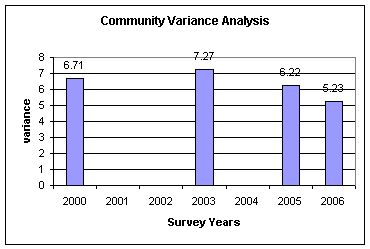
Community Variance Analysis is the variance of visitor profile
to resident population profile (based on age, gender, and occupation)
The number of visitors to Gosport Discovery Centre has increased by 7% during the year. Overall there has been a 59% increase in visitors since 2003, when the buildings were a separate library and museum.
There has been a further significant increase in the number of middle-aged visitors, particularly of those aged 35-44. While the Discovery Centre has continued to attract visitors under the age of 20, there has been a decline in the number of 20-24 year olds visiting the venue. The year has also seen a further significant decline in the number and proportion of people aged 65 and over visiting.
As expected, in line with the lower number of visitors aged 65 and over, the number of people visiting who class themselves as retired has declined significantly, bringing the proportion of retired visitors much more in line with that of the local resident population.
The year has seen an increase in the number of; full-time employees, part-time employees, unemployed, and part-time students visiting the Discovery Centre. Full-time students, home carers, and the sick/disabled have seen a marginal decline in visitor numbers.
Overall taking age, gender, and occupation into account, the demographic profile of visitors to Gosport Discovery Centre more closely matches that of the local resident profile - improving by 16% over the year, and by 28% since 2003. This reverses the trend seen previously, where the visitor profile was becoming increasingly disproportionate to the local resident population [see Community Variance Analysis chart above].
Why visitors are visiting and what they do during their visit:
The most common main reason visitors gave for visiting Gosport Discovery Centre concerns books - whether borrowing, returning or simply choosing. However, books are no longer the majority reason for visiting. Whilst in 2005, 53% of respondents indicated books were the main reason for their visit; this figure has now fallen to 39%.
The `attraction driver' (i.e. the main reason why people visited Gosport Discovery Centre) showing the greatest increase during the year is Internet /computers. These are now the main reason for 28% of the visits to the Discovery Centre - up from just 12% in 2005.
Between them, books and the Internet/computers drive two thirds of all visits to the Discovery Centre - co-incidentally the same proportion as in 2005, but the balance between the two factors has changed significantly. Among visitors under the age of 35, the internet/computers is a more prevalent driver of visits than books.
The next two most significant `main reasons' for visiting given by respondents are: the children, and café/lunch. Both have increased since last year.
While visitors may have been attracted initially to visit for a primary reason, once inside the Discovery Centre they also tend to use many of the other facilities and services on offer.
As a proportion of all activities; borrowing, returning or renewing a book has continued to decline. Just 49% of respondents actually borrowed/returned/renewed a book during their visit in 2006, compared with 55% in 2005 and 71% in 2003. Unlike 2005, when the proportion of book borrowers was masked by the increase in overall number of visitors to the Discovery Centre (resulting in a 15% increase in the total number of book borrowers), in 2006 we can see a decline of 5% in the actual number of book borrowers using Gosport Discovery Centre.
It should be noted however, that books remain an important secondary activity for many visitors, with 23% of respondents, who gave non-book reasons as the main reason for visiting, actually borrowing, returning or renewing a book during their visit. This ironically contrasts with 78% of respondents, who gave books as the primary reason for their visit, actually borrowing, returning, or renewing a book during their visit.
In the 2005 survey, we saw a huge increase in the number of visitors `browsing'. It was assumed that `browsing' related in part to browsing of books, and in part to browsing of the new facilities - thus explaining the apparent increase. This year, 2006, has seen a dramatic fall in the number of respondents who said they browsed during their visit (down from 58% to just 10%). The lessening focus on books, as a proportion of activity, and familiarisation with the Discovery Centre are likely causes for this decline.
Other major activities in the Discovery Centre (`major' meaning a fifth or more of visitors actively engaging with during a visit), include: seeking out information, sitting to study/work/read, reading a newspaper or magazine, and visiting the café. All these activities have seen an increase in use during the year.
While the bulk of visitors may still be drawn to the Discovery Centre for reasons associated with that of a `traditional library' (I am including internet/computers in that description), clearly they are engaging in many other activities during their visit. Using the original Public Library User Survey list of 15 categories, the average number of activities rose in 2005 to 2.39 per visit from a 2003 level of just 2.06. The 2006 survey shows a fall back in the average number of activities to 2.29 per visit.
Generally, there is little evidence of impulse activity with regard to the two primary reasons people visit Gosport Discovery Centre - books and internet/computers. They come for that purpose and they generally take part in that activity, though this does vary a little - older visitors are more inclined to pick up a book even though this was not their primary reason for visiting, than other age groups. Many of the other activities, especially the café for example, benefit from a great deal of impulse motivation.
The drop-off in the average number of activities can be seen among the under 35s and 35-54 age groups while the average number of activities per visit among those aged 55+ has increased - though it still lags behind that of the other two age groups. The under 35s are still the most active users when they visit the Discovery Centre.
Beyond the simple number of activities visitors interact with during a visit, another indicator of engagement is how long they stay during a visit - dwell-time. This has increased significantly during the year. More than half of visits now last longer than 30 minutes, compared with one-third of visits a year ago. Older visitors (55+) in particular have significantly increased the length of time they spend in the Discovery Centre from that of a year ago. Perhaps reflecting their use of computer terminals, the under 35s have the longest dwell time, with more than a quarter staying longer than 2 hours on a visit. Middle-aged visitors spend significantly less time in the venue than other users.
The local studies centre, being in a separate building, probably requires a separate piece of research to really understand the relationship with its visitors properly. However, from this rather sketchy research (in so far as the local studies centre goes) it appears that in addition to people engaging in local and family history, a number of its visitors go there after finding a lack of computers available in the main building. Others simply visit because they find it a nice quiet space in contrast to the atmosphere in the main building.
The museum display area appears to have seen only a marginal increase in numbers who explicitly visit. Further research is likely to be required in order to fully appreciate the role the museum display and exhibits may play in the experience of visiting the Discovery Centre.
As with the 2005 survey, and with reference to the point made in the previous paragraph, many of the `new' facilities and services do not appear to be used by large numbers of visitors [this is not to say they are not well used or appreciated, rather the survey indicates they are not used by large numbers of different visitors].
What visitors think of Gosport Discovery Centre:
Gosport Discovery Centre is still seen as "welcoming, modern and accessible". Indeed, these adjectives have been re-affirmed even more strongly than a year ago. The venue is also seen as "family-friendly and interesting".
As in the previous survey, respondents disagreed that the Discovery Centre was either old fashioned or boring.
Just under half of visitors associate the Discovery Centre with `learning opportunities and advice'. This is marginally down on the number in 2005 - primarily due to a decline in this association being made by visitors aged less than 35 years - the young are least likely to associate the Discovery Centre with `learning opportunities and advice'.
Two thirds of visitors associate the Discovery Centre with being `a comfortable place to visit or spend time'. However, middle-aged visitors were far less inclined than other age groups to view the Discovery Centre in this way.
Getting on for half of visitors (43%) associate the venue with `finding out about the local community (incl. activities and events)'. This figure has risen since last year, and is particularly true for visitors age 55+.
On the issue of noise; views remain polarised, as they were in the previous years survey, though overall most visitors do not feel noise is a problem.
Satisfaction:
Respondents were asked to rate various facilities and services. Overall, 93% of visitors rate the Discovery Centre as either `good' or `very good'. This is up from 85% in the 2005 survey.
It is worth remembering here that measuring satisfaction is not a static science - all measures of satisfaction are to a greater or lesser degree related to people's expectations. Just as the product service offer changes so do the expectations of visitors. Further, in this instance the profile of visitors has also been subject to change. This makes comparison with previous surveys difficult and requiring an element of caution.
With the settling-in of the new wider user profile, reflecting the product service offering of the Discovery Centre, the satisfaction levels overall have largely recovered to the levels of 2003. This increase in the overall satisfaction level has largely been driven by increased satisfaction among adults under the age of 35 and over the age of 55. Despite the largest increase in visitors being middle-aged, it is this group that is least satisfied with Gosport Discovery Centre.
All traditionally measured aspects of service are rated `good' or above. The three service aspects rated below `good' in last years survey (signs& guiding, layout & arrangement, and books & other materials) have all improved.
In terms of new product services, the overall satisfaction level appears similar to the 2005 level. The satisfaction levels for individual services are all in positive territory with some falling into the category `OK to good' and others into the `good to very good' category. Areas for concern (i.e. only rating `Ok to good' and having declined since 2005) are: the shop, self-issue machine, meeting facilities, CD listening station, range of fiction, range of non-fiction, range of audio books, and range of PlayStation games.
With regard to `books and other materials', it is worth noting that satisfaction among the older visitors has risen significantly during the year (up 63%). Younger adults are also more satisfied than last year, however middle-aged visitors are less pleased, their satisfaction rating has declined by 13% during the year.
Improvements visitors would like to see:
Respondents were invited to suggest improvements they would like to see in Gosport Discovery Centre. This open invitation to write whatever they wished (i.e. without any further prompting) was split into four parts: Books and other materials to borrow, Layout and other facilities e.g. seating/computers, Customer service / staff, and Anything else.
Around half of respondents made no suggestions, while another 15-20% made only positive comments about how much they liked the service! Fortunately, around a third of respondents did use the section for the purpose intended and make some suggestions for improvements.
Many of the suggestions made related to having more or a better range of books and returning the Discovery Centre to a `traditional library'. It should be noted that such suggestions, in numerical terms were made by around 20% of respondents.
The fact that there is a long list of varied and disparate ideas rather than a few major ones is no doubt, reflective of the wide range of visitors the Discovery Centre now attracts.
With consultative information of this kind, a certain validity lies within each and every individual suggestion, not merely in the number of times an idea is put forward. It is important for managers to read through all the many and varied suggestions - conducting further research or market testing those with a possibility of taking forward or responding to any good ideas.
Overall:
To sum up, Gosport Discovery Centre has continued to broaden the range of people visiting. It is seen as modern, welcoming and accessible. The visitor profile now much more closely resembles that of the local resident population. The number of visitors has continued to increase, though at a slower rate than seen during the first few months of opening.
In the 2005 Survey of Users, I wrote that while the venue is still clearly a library, it "appears to be broadening people's perception of what a library is". From this 2006 survey, it would appear that Gosport Discovery Centre may be able to claim to be less a library, but more a new kind of community facility - albeit one which contains a library.
Many more young people use the Discovery Centre than used the previous library, and they use it in a different way. This seems particularly driven by the adoption of internet/computer areas as social spaces. There are inevitably knock-on consequences for other users - the atmosphere being quite different from that of a traditional library. While this may appeal to a wider spectrum of the community, some of the users of the traditional library that was previously there are less happy.
The proportion of visitors who are above the age of 55 has fallen considerably, which further helps to create a much different atmosphere than that found previously. Since last year, allied to a drop in the number of older people visiting the Discovery Centre, it appears that those continuing to use it, do so in a different way than before. They are more inclined to use the computers, they stay longer, and they do more different activities during each visit - the Discovery Centre is clearly more than books for these users. The middle-aged visitors have continued to return.
The young adults clearly like the services and facilities on offer - they like the range of books, the internet, and all the other services on offer.
The past year has seen a big rise in satisfaction among visitors aged 55+ with all of what might be termed traditional library service facilities receiving a rating of `good' or above.
The least satisfied are the middle-aged group - although increasing numbers are now visiting the Discovery Centre, they tend to want a better service than they are currently receiving.
While borrowing, returning, or renewing a book remains the primary activity of many visits, it is an activity practiced by less than half of visitors to the Gosport Discovery Centre. The relationship between visitors and Gosport Discovery Centre is different from that with the old library, with a larger proportion and more widely balanced profile of visitors. The indications are that the Discovery Centre is well placed to continue to meet the needs of the local community in future years.
Challenges:
The Discovery Centre is forging a new identity, which is different from that of a traditional library. While the majority of indicators are clearly pointing in a positive direction - in line with the original aims and objectives, there is still room for improvement.
Key challenges for the future stemming from this survey appear to be:
~ Continue to recognise that each different group of users have their own needs and want to find their own space. While some improvements seem to have been made in this regard in terms of layout and arrangement, it is not really enough to make all visitors feel comfortable.
Further consideration should be given as to how to physically separate areas of the building better, creating more quiet areas, and areas to study and work.
The concept of `emotional signposting' raised in the 2005 survey report needs to be given practical expression. Areas such as the T-Zone should again be reviewed - it clearly is not the hangout space for teenagers as originally envisaged if it is used by more people over the age of 35 than under!
~ Recognise that different sections of users wish to relate to the Discovery Centre in different ways. While this survey reveals what certain groups of visitors are using, it does not adequately reveal the nature of that use. There is a need to target specific groups, and identify what are their specific needs.
For example, while more middle-aged visitors are beginning to use the venue, many are in and out very quickly and are far less inclined to feel comfortable - we need to pick-up on what their needs are and how they can best be met. Thus, in this survey we know that the middle-aged were less enamoured with the range of books than the younger adults - have we got the right balance and selection to meet the needs of this particular group of users?
~ A number of older visitors no longer visit the Discovery Centre. Whilst this may have been expected in light of the change from a library to a Discovery Centre, we still need to find a way of making the venue a place for them too. Books, activities, events aimed at them may all contribute to enticing their return, though most powerful means is likely to stem from bringing these together with better separation of areas and thus creating the `emotional space' which they can identify with.
~ A key challenge I raised in the 2005 survey was the danger that the number of repeat visits would probably begin to decline as the primary driver - books, became a smaller part of the whole Discovery Centre experience. The 2006 survey shows this may have started to happen. The internet/computers are encouraging repeat visits to some extent, but it is difficult to be sure how long this will remain the case. The importance of maintaining repeat visits cannot be over-emphasised.
~ There is a drop-off in average number of activities, while it is only small (-4%) and probably reflects a settling-down in the relationship between visitors and the Discovery Centre it is something, which will need to be carefully monitored in the future.
~ If the Discovery Centre is to firm up its image as a new kind of community facility, it will need to re-emphasise key aspects of service-product beyond just the two of books and internet/computers.
A number of key services need to be better promoted. In particular courses related to learning and developing new skills should have a higher profile.
Promoting events and activities which focus on community engagement will all serve to enhance the value placed on Gosport Discovery Centre by local residents.
~ Promotion and marketing should continue to promote and reinforce the values residents are now beginning to associate with the Discovery Centre brand.
~ If the Gosport Discovery Centre is to build upon the start it has made to present a new kind of facility for the community it will need to continue to develop in ways reflective of the changing needs of a community which is not standing still.
The management will need to continue to introduce new events, activities, and ways of doing things - having achieved so much, the biggest challenge of all is to keep achieving.
Note: Full versions of both of these papers can be found on the Library Review website under Key Documents http://www3.hants.gov.uk/scrutiny/scrutiny-committees/culture-communities/libraryreview.htm
Appendix Three: Darryl Sheppard
Contact: [email protected], ext 07815 069 080
Background
Having made contact with Anne Marley and Lis Ricketts of Library Services a discussion of young people's involvement in library services - planning, refurbishing and mystery shoppers, led to the proposed development of a working group of young people to commence these and take them forward.
_ Anne and Lis were interested in young people becoming more involved with their local libraries. Possible roles could include:
· Groups of young people becoming involved in projects to refurbish libraries or to create new areas for teenagers. At the moment there are refurbishment projects at Winchester and Romsey and new libraries being planned at Bursledon and Whitchurch. Other libraries are looking to create teenage areas.
· Young people to undertake `Mystery Shopper' projects with libraries to give us feedback on customer service.
· Young people to advise on book stock, magazines and in the development of a specific teen website for the library service.
The starting point was agreed as undertaking a `Mystery Shopper' project.
Darryl Sheppard of Children's Services - County Youth Service agreed to look into the possibility of establishing a working group from years 7-10 from one Secondary School for ease of contact and getting young people together for meetings and other events. Proposed as a pilot it could be reproduced on a district level in the future.
Anne and Lis were also interested in training library staff to become more aware of young people as customers and hoped that the `Mystery Shopper' project would help identify specific areas of need. Discussion was held with Lisa Smith, Development and Training Officer, Children's Services-County Youth Service and a possible training programme was identified which could be based on the subsequent findings.
Successful dialogue with Toynbee School, Eastleigh enabled a working group of 5 Young people identified from years 7-9 to undertake the `Mystery Shopper' project. As it was exam times it was a Toynbee decision/request to not include years 10-11.
The project expresses the contribution of Toynbee School in enabling the young people to participate during school hours.
Public Libraries - Destination Unknown?
The participants were informed of an invitation for two of them to attend the above conference in London 19 June 2006 as part of the project. Two young people volunteered.
The theme of the conference was making the Public Library a destination of choice (The launch of a research report that reviews what 14-35 year olds think of libraries). It would take place prior to commencing the `Mystery Shopper' Project.
As part of the conference the two young people supported by Lynne Meechan Children's Services-County Youth Service engaged in a young persons slot to discuss and inform on what they liked or disliked about Public Libraries, whether they used them, what would make them use them and to share their interests.
Outcomes were a range of views that identified generic ideas for libraries, motivation to visit and use them and barriers for young people.
Generic ideas were:
· Link with English Teachers to provide educational sessions
· Appoint teenagers to `work' there not just stack shelves
· Teenagers delivering books/DVD's for a small fee
· Get local people and authors to give talks etc
· Sessions on First Aid, Young Mums, Self Confidence
· Careers Guidance (Connexions Personal Advisors)
Motivation ideas were:
· Public Libraries an alternative environment from school for Study Support
· Information Technology
· Guidance
· Free downloads when you join
· Music
· Displays
· Practical Workshops
Barriers for young people were:
· Nothing there for them
· No up to date stock
· Not allowed to talk
`Mystery Shopper' Project
Anne and Lis had identified the following Public Libraries for the project:
1. Thursday 06 July - Hedge End - 2.45pm to 3.45pm
2. Saturday 08 July - Fleet - 9.55am to 11.05am
3. Saturday 08 July - Aldershot - 11.15am to12.00pm
4. Monday 10 July - Portchester - 10.00am to 10.50am
5. Monday 10 July - Gosport - 12.10pm to 1.30pm
6. Thursday 13 July - Chandler's Ford - 1.10pm to 2.00pm
The project participants had been briefed by Anne, Lis and Darryl on what to look for, what to ask and a range of methods and/or tasks that would enable the young people to do so.
An evaluation sheet for completion as soon as they left a library (appendix 1) would enable the young people to note their immediate thoughts, observations and perceptions and would assist them in further reflection and evaluation later.
Each participant was asked to refresh their memory before entering a library by reading the evaluation form and then asked about what methods they would be employing to achieve their aims.
The young people entered libraries and undertook a range of tasks either individually, in pairs, threes or en-masse.
Darryl and Lynne would enter after a period of time so as not raise suspicion from staff and observed interactions from a distance.
The feedback from the completed evaluations forms provides the following information:
Hedge End Library (Visited by one young person)
Did you find the library a welcoming place to be?
Yes, the staff were very pleasant
What was good and bad?
The service was good but the computers were quite slow.
How friendly and helpful were the staff?
They were very helpful when I required assistance.
Q. Did the staff explain things clearly?
Yes and it was very easy to understand.
How easy did you find it to:
Borrow something?
Very easy. They offer you the option of setting it aside if you want to.
Find out something?
Very easy. The staff were very helpful.
Use the computers?
Very easy but they were quite slow.
What was there in the library for you and your age group?
Novels and books that would appeal to young people of my age.
Was there anything that would make you come in and use it?
Yes. The fact that they had everything I asked about.
What did you like about the library and what did you dislike?
I liked the fact that they had everything I asked about, especially for a small
Library.
The service was quite slow at one point.
How could it be improved?
More than two staff members would come in handy when the library becomes busy.
Any other comments about this library? None.
Fleet Library (Visited by 3 young people)
Did you find the library a welcoming place to be?
Not really welcoming, but a comfortable café.
It was quite welcoming but smelt a bit.
Not entirely.
What was good and bad?
The range of books were good but the staff weren't entirely pleasant.
Good service, bad look, fairly good overall.
Different areas of the library were clearly marked so you knew where to go.
Were you treated differently if you went in with a larger group or on your own/with a friend?
There was no difference.
Were boys and girls treated differently?
There was no difference.
How friendly and helpful were the staff?
They were very helpful and very nice about joining etc.
Most staff were helpful but not very friendly.
The staff were nice and didn't moan about us.
Q. Did the staff explain things clearly?
Yes quite clearly.
Yes, very clear.
How easy did you find it to:
Borrow something?
Easy and very helpful. Long waiting times to check out .
Not very easy.
Find out something?
Very easy. The staff were very helpful.
Relatively easy.
Use the computers?
It was quite difficult to use the computers as the password had changed.
There were lots of computers.
You have to sign-up to use them.
What was there in the library for you and your age group?
There was a teen's section upstairs.
Quite a lot. Computers, books, comics, CD's and DVD's.
Was there anything that would make you come in and use it?
I would come and use the computers and read the comics.
Not really.
No.
What did you like about the library and what did you dislike?
I liked the range of books and films in the library.
I liked the idea of the `teen zone' although it was not welcoming as it was occupied by adults and old people. Also there was no modern music, only `Folk Music'.
Helpful staff. Library needs to be up to date.
How could it be improved?
Slightly more friendly service.
Modern look. Advertise books.
The teen area could be only for teens to go in and new music could be bought.
Any other comments about this library?
A better teens section because there wasn't a single kid in the teen zone and a lot of the music was for older age group.
Overall the library was OK, but it could have been better. The staff were nice and the other people in the library were too.
Aldershot Library (Visited by 3 young people)
Did you find the library a welcoming place to be?
Very welcoming, nice atmosphere.
Yes the staff were helpful and nice.
What was good and bad?
Bad staff, nice selection.
There was a good computer room and a lot of books, CD's and DVD's.
The service and selection was good.
Were you treated differently if you went in with a larger group or on your own/with a friend?
There was no difference.
Were boys and girls treated differently?
There was no difference.
How friendly and helpful were the staff?
The staff I talked to were helpful and polite.
They were very friendly and very helpful when I asked questions.
Not very friendly and unhelpful. No real effort.
Did the staff explain things clearly?
No. Did not wish to help.
Yes. They were nicer than the staff at Fleet.
Yes. They were very informative.
How easy did you find it to:
Borrow something?
Easy and extremely quick.
Did not borrow.
Find out something?
Easy again. The staff were helpful and so was the computer.
Quick and easy.
Hard. Poor staff.
Use the computers?
Needed permission.
I didn't use them, but tried to find a book on the `Help Computer' and it was easy.
What was there in the library for you and your age group?
Not much, no teen area and not many teenage books.
Poor choice for teens.
Was there anything that would make you come in and use it?
No, the staff drove me away.
Computers and CD's were better than Fleet although there were less videos and DVD's.
Not really.
What did you like about the library and what did you dislike?
I liked the computers and book section.
I liked their service but I disliked their range of books for our age group.
I hated a staff member.
How could it be improved?
Better training of staff.
A bigger selection of books for teens.
More signs toward library and more teen stuff.
Any other comments about this library?
More signs to find your way to the library.
Portchester Library (Visited by 5 young people)
Did you find the library a welcoming place to be?
Yes. The Librarians were very nice and helpful and there wasn't anything that looked old or tacky.
No.
No. It looked really bleak but there was a good selection.
Yes, quite welcoming.
What was good and bad?
The staff made time to help me.
The selection of videos and DVD's and computers were good, although there were not many teen books only old people books.
The service was good but not enough staff.
Bad look, nice selection, nice lighting.
There was quite a lot of computers. The Librarians were nice and helpful.
Could be a bit brighter in areas.
Were you treated differently if you went in with a larger group or on your own/with a friend?
There was no difference.
Were boys and girls treated differently?
There was no difference. Both were treated fairly and pleasantly.
How friendly and helpful were the staff?
They were very helpful.
A friend.
Gave ideas of other ways to look for a specific subject. They were sorry if they weren't able to help. They took you to the books and not just told you where they were.
Happy to help.
They not only answered questions, but showed you books and areas of the library.
Did the staff explain things clearly?
Yes. They were able to explain what books there were and how they were similar to the books we were looking for.
Yes. I got full and helpful answers.
How easy did you find it to:
Borrow something?
Easy.
More simple than 1+1
Find out something?
Very easy. The staff were very helpful.
It was easy to find out where the books were and they even recommended books and said that we could reserve or they could get books for us if we needed them to.
Use the computers?
You had to have a library card to use the computers so it wasn't that easy.
Hard to get permission.
The library catalogue was easy to use.
What was there in the library for you and your age group?
There was leaflets to advertise things in that area. There was an area for children to read.
Quite a large selection for teens.
Not much for teens.
Story tapes and DVD's.
Computers.
Was there anything that would make you come in and use it?
The books for my age, DVD's, CD's and videos to rent out.
The staff.
Not really. There wasn't enough for my age group.
What did you like about the library and what did you dislike?
I liked the Children's Area. It was quite bright and appealing and the Librarians were very nice.
I didn't like some of the areas. They were quite dark and gloomy.
I liked the staff, but not a very nice feel.
Lack of teens books/areas.
I liked the service.
I did not like the old people smell.
How could it be improved?
Make it more modern. Give it a better look.
More teen books or even a teen section.
By adding brighter colours to the dark areas.
More staff.
Air fresheners.
Any other comments about this library?
Very small.
I liked the staff. They were really helpful.
Gosport Discovery Centre (Visited by 5 young people)
Did you find the library a welcoming place to be?
Yes. It had very bright colours and it was very welcoming because it looked like a fun to be and it looked friendly.
Nice atmosphere. Welcoming places to read.
Entrance was very colourful and inviting.
What was good and bad?
There was lots of books and different varieties. There was lots of things to do.
The machines were good.
Books were easy to find. Open Spaces. Not a very large selection.
Everything was good. The range of books, the service and the overall impression.
The good things were that there was stuff to do i.e. like activities. It looked really modern. There was somewhere to eat, lots of books. New and updated CD's and DVD's. The machines to take your books out.
Were you treated differently if you went in with a larger group or on your own/with a friend?
There was no difference.
We were treated well.
Were boys and girls treated differently?
Yes. Girls were treated more seriously.
How friendly and helpful were the staff?
They were very helpful in ways of helping to find a certain subject.
The staff were OK, but had short non-explanatory answers.
Friendly.
Polite.
Did the staff explain things clearly?
Yes. They explained how things work very clearly.
No. Short answers.
Friendly.
Polite.
How easy did you find it to:
Borrow something?
Easy. Self service and easy to use.
Quick.
OK. Especially using the machines.
Find out something?
Very easy and simple.
Hard. Staff were not approachable
Use the computers?
All the computers were taken during the time there so no young people were able to access them.
What was there in the library for you and your age group?
Large places to socialise.
Large teen area.
Teen books, audio books.
Lots! You can listen to music, sit in comfy chairs, read magazines, go on computers and look out things (History) upstairs.
Seating areas to chill. Lots of books for teens and younger children.
Was there anything that would make you come in and use it?
Yes! The books were very up to date as were DVD's, CD's and videos.
Yes. The most modern library.
Yes. The service, the range of books and the whole library.
Everything.
What did you like about the library and what did you dislike?
I liked the size but it smelt like animals.
I liked it all and it appealed to me a lot.
Staff were OK and a nice atmosphere.
I liked the seating areas and the music areas and I liked the variety of books.
How could it be improved?
Better staff.
Make more libraries like it.
Any other comments about this library?
It's a really nice place to be.
I think people would spend more times in libraries if they were all like Gosport.
Chandler's Ford Library (Visited by 4 young people)
Did you find the library a welcoming place to be?
Yes it was OK.
Yes, open space
What was good and bad?
The range of books was good and so was the service.
The glass entrance was good.
Nasty smell.
Friendly staff.
Were you treated differently if you went in with a larger group or on your own/with a friend?
There was no difference.
Were boys and girls treated differently?
No.
I don't think so. We asked some questions and were treated the same.
How friendly and helpful were the staff?
Very helpful.
Very friendly and so was the year 10 on work experience.
Did the staff explain things clearly?
Yes, very clearly.
No.
Yes. The woman showed me where the books were and asked some more questions of me.
Yes. They printed off some things for me.
How easy did you find it to:
Borrow something?
Very easy even if you don't have your card.
Yes. I didn't have my card. I was asked my full name and post code.
Find out something?
Very easy.
Use the computers?
All the computers were taken during the time there so no young people were able to access them.
The Help Computer was easy.
What was there in the library for you and your age group?
There was an area upstairs for teens.
A good sitting area and comics and magazines for teens. An area of 11 up books and children's computers.
A lot of graphic novels.
Books, videos and DVD's.
Was there anything that would make you come in and use it?
Yes. It was quite pleasant apart from the smell.
Teen area and computers.
No. Poor atmosphere.
What did you like about the library and what did you dislike?
I liked the range but the layout was quite confusing.
I liked the teen area.
Liked the staff. Didn't like the smell.
It smelt like gone-off milk.
How could it be improved?
Maybe all the computers could be in the same area.
Extractor fans.
Any other comments about this library?
It was good although it smelt a bit.
Having completed the visits for the `Mystery Shopper' project and the School Summer Break upon us, Anne, Lis and Darryl met with the young people at Toynbee School to discuss sections of their evaluations and anything extra they wished to add at this stage.
The Summer break would enable the evaluation forms to be collated and it was agreed with Toynbee School that Darryl would re-visit the young people in September to present the initial findings, check with the young people on accuracy and give them a final opportunity to add to or discuss any matters arising.
The following are the results of the meeting:
21 September - 9.00am to 9.50am - Toynbee School, Eastleigh
Darryl presented the findings from the collated evaluation forms which were agreed by the young people.
The Aldershot visit was raised as an incident with a member of staff and one of the young people occurred and the group felt it was important for the learning outcomes of the Library Service for it to be recorded fully.
Aldershot Library (Observed by Darryl)
A young person (male), approached a staff member at their desk and enquired about Harry Potter audio books.
While looking in a general direction the staff member said `Over there'.
Watching the young person go to the general direction that was portrayed, and then start to look where the audio books might be, the staff member still at their desk is heard to say `Not in that bit stupid' and then goes over to the young person.
They then said ` What is it you're looking for?'
The reply was `One of the Harry Potter audio books.'
The staff member said `Well it doesn't look like there is any' and went to walk away.
The young person asked `Can you reserve or order one?
The staff member very abruptly replied `Well! If you want to do that, you need to decide what one you want' and walked away back to her desk.
The above situation effected the non-participation of the young person from that point on relating to the Aldershot visit.
Other views and issues were raised from further discussion as follows;
· The first library you go into sets your perception of all libraries and could put you off going to others.
· With the exception of Gosport Discovery Centre, none of the group felt that they or many young people would want to use libraries as they are. They believe that concepts from the Discovery Centre could be applied to existing provision.
· It was unanimously felt that Gosport Discovery Centre was a contemporary provision and that staff in uniform was a really good idea for identification purposes.
· Groups of children, young people and adults from around Hampshire should be taken to see the Discovery Centre and then given license to sit down with architects, designers and planners to re-design their existing libraries or new provisions. It was suggested that design competitions would be a good idea with children, young people and adults each submitting designs for their respective areas in their libraries. This way they would be catering for local and community needs not Hampshire generic ones.
· The two young people who attended the conference in London, indicated that a lot of lessons could be learned from the Power House in Manchester.
· The group felt from their experiences that most libraries in Hampshire would be the same. Dull and un-inviting.
· They wanted to know if libraries had extra rooms as these could be used as activity rooms which catered specifically for identified needs of young people and could keep some of them from getting into trouble. Darryl did inform the group that this is the case in some libraries and that they are being made available for use for youth group activities.
· Advertising and clear signposting of libraries needs to be drastically improved as the group strongly felt that you wouldn't know they were there unless someone told you.
The young people were asked to share what they thought of participating in the project to date:
· `I learnt a lot about the Library Service.'
· `Some libraries have hidden qualities because they are hidden away.'
· `Not embarrassed to ask for anything anymore.'
· `It gave us a voice.'
· ` It was a new and challenging experience.'
· `I learnt that you can get something from libraries.'
· `It was fun and a good experience.'
· `I want people to take notice of what we have done and said.'
Phase 2
This report will be distributed to Anne and Lis to peruse, discuss and comment upon. The same will be done by Darryl, Lisa and Lynne and then discussion will be held to identify training needs and to develop or utilise existing programme to address them.
Toynbee School will be informed of all progress and the young people will be consulted and participate in the design and delivery of the training programme at times that will not require them to miss any further schooling.
Appendix Four: Janet Holden
Culture and Communities PRC
General Comments
1. Important to determine where the library service fits into the ambition of the council as a whole
2. Important for library staff at all levels and locations to know what role they are expected to have in relation to above
3. Should have a question about the role of mobile libraries in service development/delivery
Questions for library review
What do people want? [books, accessibility, building/environment, information, other services, incl internet, informal learning...crèche]
· How does the service engage with the public and/or library users in order to understand what the public/users are looking for:
o What types of books users/potential users like? RESPONSE: In Norfolk we actively engage customers in materials selection for the library, customers can suggest titles via our website, plus other stock suggestions schemes we regularly carry out surveys of customer needs and wants
o How far would people walk, say, from the main shopping area to a library facility - eg. for convenience, as far as they would walk to get a coffee? RESPONSE: It depends what there is to attract them at the library - make the library a destination, have a good quality café in the library
What type of place/environment would they want, with what facilities, eg. toilet? Café? RESPONSE: We carry out consultation on new facilities, but needs and wants very according to the group - older people recently asked for: A comfortable, informal resource, such as a café, for use by all people in the community, hopefully with a separate quiet area without music.
Other informal areas for arts and craft work
Accessible communal rooms where we could hold our meetings, equipped with accessible learning technology
Rooms that could be used for one to one interviews and consultations
A larger area for dissemination of information in various formats
A large, accessible conference/ exhibition space
An area where people could try out such things as videos,
An area where people could use the internet, especially to interact with statutory sector websites and take part in consultations, with computers with assistive technology. Of course, we would need the whole place to be well equipped with toilets and have wheelchair access to all parts of the building, loop systems throughout, a few staff who could sign, clear signage throughout, fully accessible lifts, resources for people with learning difficulties.
o What kind of information might they want?
o What kind of use would they typically want to make of the internet? RESPONSE: What ever is feasible on the internet - social networking is the next big thing
o Would they think of coming to courses - hobbies, skills...and what sort if yes? RESPONSE: Yes.. depends where you position your library in the learning agenda locally. In Norfolk we are looking at first rung learning
What kind of help they would appreciate from library staff RESPONSE: Depends on the ability/needs of the individual. Again depends on which segment of your community you are marketing your service to.
· How much information about customer habits/preferences (particularly re books) is provided by the library information/mgt system? RESPONSE: At present in Norfolk we do not use data mining or other technologies to deliver this
· How much trialling has been done to determine the most/least busy periods for libraries? RESPONSE: We robustly operate a system called WAIL (workload assessment in libraries) which matches all elements of our work load (of which opening hours is an element) to staffing levels - this was first implemented in 2006 and is part of the NLIS efficiency programme. This has been applied in all libraries and significant savings/workload adjustment have been made
· How can a library service know what its community/catchment wants? RESPONSE: Through community profiling, through consultation and through local knowledge/discussions with stakeholders. One size does not fit all and the general service needs adapting to meet local needs. Need to take into consideration the aim of the library service in general
· What active measures does the service take to address:
o Competition from bookshops, if greater disposable income implies more people are buying books than previously? RESPONSE: Marketing, partnerships with bookshops rather than competition. Taking good practice from the book trade and other retail sectors and applying to the library situation
o Competition from other leisure pursuits, ie. that give less time or incentive for people to read? RESPONSE: By making reading exciting and fun, this means that back office things like book supply times (ie ensuring materials are available on the day of publication in sufficient quantity) must be addressed
o Technology competition such as newer technologies than DVDs or CDs and increased take-up of broadband?
_ Fight - complement - ignore? RESPONSE: NLIS are currently investigating how we respond to changes as we currently rely heavily on our income from DVDs
· What role do, or could, libraries play in serving and nourishing communities by providing resources fit for their life aspirations? RESPONSE: I am including a copy of the NLIS social inclusion policy. Its not just about libraries working alone, its about genuine partnerships with local people/stakeholders
· What role do, or could, libraries play in enhancing the quality of life experience in communities, such as through `informal education' opportunities for children and adults? RESPONSE: Through family learning, through a cradle to grave approach - it's the first rung learning that is often ignored. Libraries offer huge opportunities for informal learning - a quick example is a knitting group that meets at a branch library in Norwich - sounds very simple, but we had a group of women who wanted to learn how to knit and we had a group of women who knew how to knit and we facilitated their meeting in a local library. Many more examples in Norfolk like this.
· What, in the words of the House of Commons committee, would you consider to be the core functions of libraries in Hampshire? RESPONSE: In Norfolk our core functions are supporting reading and learning for the whole community
· What are the main things you would expect of libraries/discovery centres in your area? RESPONSE: Things that deliver the above
Availability of book and information services
· If people cannot find the types of books they are interested in, they may be put off libraries, how do you decide what types and ranges of books to stock? RESPONSE: Through what's popular, through links with education providers, through our general product knowledge
· How do you match the range and quantity of books to the interests of people in the natural catchment area of each library? RESPONSE: We have a formula - very difficult to match stock to needs... we regularly rotate stock and we have `dynamic stock' which means that if a book is returned to a particular library it stays there until it is returned by another customer elsewhere. We regard our stock as county stock. Each library has a stock profile which serves as the work plan for the year for that library
· Audit Commission inspectors believe that the book stock in many libraries is biased towards older people, could they come to that conclusion if they were to visit Hampshire libraries? RESPONSE: Don't know, Not true in Norfolk.
· What procurement policy or guidelines does the Library Service have with respect to providing a `reasonable' range of books such that the interest of borrowers and potential borrows is triggered and maintained? RESPONSE: In Norfolk we have Materials Policy which sets out our intentions in this area
· To what extent do you attempt to stimulate interest in books, by for example, promoting best sellers, or books from different genres? RESPONSE: Hugely - that's why our issue figures are high. We have best sellers on standing orders, we have recently introduced one week loans on items in the Top 20 fiction and non fiction lists
· How do you determine what information services are provided via terminals or internet access points in libraries? RESPONSE: Through judgement and regular monitoring of use of subscriptions
· Local libraries often acquire books and other material about the area, and some libraries have built up extensive resources, and librarians extensive knowledge about local historical links with, for example, nearby army or naval bases, how will these, often unique resources be exploited as the service evolves in Hampshire?
· How do you monitor the interests and usage of the internet by users vis-à-vis the potential for misuse, or providing added value for legitimate users such as by running short courses or seminars on searching, or interest areas? RESPONSE: Not sure what you mean here
Accessibility: opening times, location, physical access
· The argument about opening times hinges around convenience for the public, particularly with a view to attracting more people to use libraries. What principles do you use to determine what the optimum hours might be for each library? RESPONSE: We have a formula linked to size of community, business (and our budget capacity)
· What do your visitor sensors and the library management system tell you about patterns of library usage? RESPONSE: This is monitored as part of our WAIL - lunch times and Saturdays seem to be the busiest times in town libraries - means that we have had to alter our staffing provision at these times to meet demand
· How do you estimate whether the location of a library is `convenient'? RESPONSE: Through local knowledge and through consultation
· Do you think it would be fair to say that if a library is further away from the main shopping area, or other busy place, than a shopper might go for a cup of coffee, then it might be considered too far to be convenient? RESPONSE: It depends whether parking facilities are available - in a recent consultation parking came out as particularly important for our customers
· What is your view of the value of extending opening hours for libraries? RESPONSE: It depends on the WAIL, consultation has shown that extended opening hours on Saturdays and Sundays are what our customers would like.
· What approach is taken to monitoring the local environment with respect to shifts in demographic mix within the catchment area, transport and parking, and the locus of main areas for shopping or pedestrian traffic? RESPONSE: Demography via community profiling and though profiling our membership - libraries in Norfolk because we ask for ethnic background and language spoken are good barometers for sensing demographic changes. Local knowledge is important for the latter - and inclusion in local management meetings eg traders meetings
Improving the experience: making libraries a welcoming space
· What is the Library Service strategy in terms of either upgrading or potentially re-locating libraries across Hampshire? RESPONSE: In Norfolk we have a refurbishment programme that aims to deal with all libraries over a certain period
· Some commentators have suggested that libraries could benefit and bring benefit by being collocated with other public services. What benefits or drawbacks might attach to this approach?
· Innovation tends to see modern libraries as multi-purpose buildings that may include cafés and areas allocated for various purposes, as a consequence the footprint for traditional functions such book stock for lending have shrunk; what does this say about the role that libraries believe they have in their communities? RESPONSE: This is not the case at the Norfolk and Norwich Millennium Library
· How does the Library Service engage with its users and potential users in the community when considering a library upgrade and/or relocation? RESPONSE: Through consultation and public engagement programmes
· Library users tend to rate their experience of receiving help and guidance from library staff, highly. What consideration has been given to ensuring that the experience of those with specialist knowledge, as well as generalist library staff are provided equitably across the service? RESPONSE: In Norfolk we no longer have subject specialists - all our librarians are community librarians whose first aim is to develop audiences
Raising awareness
· The Audit Commission inspections suggest that libraries may be complacent or passive with respect to promoting themselves. How does the library service go about promoting itself, such as:
· Signposting people to buildings? - RESPONSE: signposting programme/resigning programme using new corporate identity - some planning issues still to be resolved
· Promoting and advertising local services? RESPONSE: We have a marketing strategy which has segmented our customers - our promotion and advertising is predicated on this
· Publicising opening times?
· Inviting local comment or involvement? RESPONSE: Consultation is essential, and part of our service offer. All community librarians have been trained in a range of accessible consultation techniques
· If the library is collocated, is the library promoted alongside other services?
· Where and how do local libraries advertise themselves, books, or other activities in the library? RESPONSE: See above for marketing strategy
· What categories of potential reader do libraries target when advertising the types or genres of books for loan? RESPONSE: See above for marketing strategy
· How does the library get its message to the public that it wants to be responsive to their interests and preferences? RESPONSE: Through actions, we have an active customer comments and suggestions scheme
Standards
· The House of Commons Select Committee believes that the standards suggest rather "limited ambitions", however even against these limited ambitions, Hampshire passed five of the ten. What do you consider that these results say about the library service?
· What monitoring criteria would be useful and relevant given the challenges before libraries today?
· What standards would you suggest that libraries/library services should be measured against?
Value for Money
· What data are used by the library service to support development of libraries, for example in relation to, for example:
Area |
Data |
Stock |
Issues, stock counts, new stock, relocated stock, withdrawals, losses, donations, income, reservations, vendor performance etc |
People's Network |
Usage figures by users, machine usage, staff time to support etc |
Visitors |
Borrowers and types, Library users, Lapsed users, busy times etc. RESPONSE: New members, ethnic background of members |
Services |
Requests: type/number/supply time/where from etc |
Customers |
RESPONSE: Mystery shopping - by different communities on both access to service, ambience and quality of information provided PLUS survey |
· The PKF report and the MLA's report on `Efficiency and Stock Supply Chain Review' in public libraries address, in their different ways the issue of stock procurement and suggest that this is an area in which efficiencies may be gained. What approach has the Library Service adopted with respect to stock acquisition, what savings have been identified, and what potential would you see for further gains? RESPONSE: We already do much of what has been identified in the PKF report, the next big challenge for Norfolk is the role that RFID can play in supply chain efficiencies
· Has it been possible to find savings by reducing handling and shortening the supply chain, and if so what future benefits will result? RESPONSE: Yes, librarians no longer spend hours selecting materials
· Are you satisfied that ICT systems are providing enough relevant evidence/information to support strategy development and management decision making? RESPONSE: No,
· What is your public or user engagement strategy to inform: RESPONSE: we have the county councils engagement strategy and this is linked to our community profiling and marketing strategy
o Policy/strategy development?
o Relevance of local services and communication?
o What works, or not, locally?
· How are staff engaged in reviewing and informing service delivery, or rewarded for good suggestions? RESPONSE: Through regular staff meetings and team planning meetings - each branch library has an annual meeting where the plan their area manager, a community librarian and their relevant Assistant Head of Service. We have recently introduced ask Jennifer/tell Jennifer for staff - staff email points of concern to the library management team and we get back to them within 24 hours with a response. We have recently introduced `jute' bags instead of plastic carrier bags for the public as a result of this. The library service has won an environmental award for this .
· We also have a branch incentive scheme - when branches reach certain targets they are given money to spend on their branch - last year one of my branches won £200 and used it to incentivise greater DVD borrowing locally which means that they are well on the way to meeting this years targets.
Links
· Local Government White Paper
· Sustainable Communities - what role do, or could, libraries play in serving and nourishing communities by providing resources fit for their life aspirations?
· Well-being agenda - what role do, or could, libraries play in enhancing the quality of life experience in communities, such as through `informal education' opportunities for children and adults?