
Archived decisions
Hampshire County Council
June 2007
Contents
Section Page
Foreword by the Leader of the Council, Councillor Ken Thornber CBE i
1. Introduction 2
1.1 Introduction 2
2. Position to date 3
2.1 Hampshire County Council's `Green Travel Plan' 3
2.2 Current promotion of sustainable travel 4
2.2.1 Car sharing 4
2.2.2 Public transport 4
2.2.3 Cycling 4
2.2.4 Walking 5
2.2.5 Business Travel 5
Review of the `Green Travel Plan' 5
3. Survey results 7
3.1 Survey description 7
3.2 Survey results and analysis - Commuter Travel 7
3.2.1 Sole car use 7
3.2.2 Car sharing 8
3.2.3 Public transport use 8
3.2.4 Cycling 8
3.2.5 Walking 9
3.2.6 Staff car parking 9
3.3 Survey results and analysis - Business Travel 9
4. Corporate Travel Strategy 12
5. Strategic aims and targets 14
5.1 Aims of the Corporate Travel Strategy 14
5.2 Summary of all targets 14
5.3 Car based commuting 14
5.4 Public transport 16
5.5 Cycling 17
5.6 Walking 18
5.7 Business Travel 19
5.7.1 Pool and lease cars 19
5.7.2 Procurement 19
5.7.3 Car club 20
5.7.4 Other methods 20
5.7.5 Site specific recommendations 20
5.7.6 General recommendations 20
5.8 Additional general recommendations 22
6. Management and delivery of the Corporate Travel Strategy 22
6.1 The Corporate Travel Strategy Coordinator 22
6.2 Funding 23
6.3 Partnerships 23
6.4 Marketing 23
6.5 Monitoring 24
6.6 Use of the strategy by others 24
7. Travel Plans 25
7.1 What is a travel plan? 25
7.2 What are the benefits of a Travel Plan? 25
7.3 Site Specific Travel Plans 26
7.4 Ashburton Court Travel Plan 26
Appendix 1: Summary of Corporate Travel Strategy Measures 27
Appendix 2: Policy context 33
Appendix 3: Corporate links 35
References and sources 37
List of Figures
Figure 1: Proportion of all staff using the train and bus 8
List of Tables
Table 1: Changes in Parking Location 99
Table 2: Corporate Travel Strategy Targets 1414
Foreword by the Leader of the Council, Councillor Ken Thornber CBE
(To be agreed)
Hampshire County Council has a responsibility to lead the way and set an example to others in all areas of work. The County Council employs around 39,000 staff. This is approximately six percent of the total working population of Hampshire. Improving the way our staff (and Councillors) travel is very important to us.
Travel plans provide a process to help businesses achieve their travel goals. The economic and environmental benefits are wide-ranging, including reductions in traffic congestion, noise pollution and poor air quality. There are also benefits in terms of reduced travel costs, lost time, and missed opportunities. Travel plans can improve accessibility for employees, suppliers and customers, and can increase efficiency without affecting recruitment and retention.
By creating the right conditions we can develop an effective travel plan. The measures and initiatives contained in this document are both feasible and realistic and could be beneficial for other businesses to consider as part of their travel plans.
Our Vision
"A County Council where all employees understand the impact of their personal, commuting and business travel, and feel able to make informed travel choices".
1.
2. Introduction
Within the UK there is an increased reliance on motorised transport, particularly the private car. This has led to growing levels of congestion on strategic and local road networks, and has an impact on air quality and noise pollution. For the people living, working in and visiting Hampshire there is a direct effect on health and wellbeing. The business economy is affected through slower journeys and stress to drivers; and at the global level pollution from transport contributes to climate change.
Hampshire County Council employs 39,000 staff, operating and based throughout the County, involved in many different work types and patterns. Providing County Council services requires staff to travel to and from work, and in many cases travel is an essential part of daily work as well. County Council work therefore generates a significant number of car journeys, which increase the pressure on the transport network.
As a transport authority we have a responsibility to encourage all major employers to adopt travel plans. It is helpful if the County Council sets an example to other organisations, and leads the way for Hampshire. The Corporate Travel Strategy will provide the means to enable the County Council to reduce its own journeys, and influence the behaviour of many others.
The Corporate Travel Strategy helps to protect the environment and support economic prosperity, and supports Hampshire County Council's Corporate Strategy, which aims to maximise wellbeing, and enhance our quality of place.
There are a number of challenges which the Corporate Travel Strategy will tackle. The Strategy aims to:
· improve alternative methods of travel in order to reduce the reliance on private cars;
· promote flexible and mobile working to reduce the need to travel;
· raise the profile of travel initiatives and ensure staff are fully informed of travel choices, and
· ensure the County Council continues to provide first class services whilst minimising the impact of travel on the local and global environment.
In order to achieve these aims the strategy has set the following targets to reach by 2011:
· reduce the proportion of sole occupancy car trips to and from work by 2%;
· increase car sharing for commuting by 3%;
· halt the decline of bus use to and from work and return to 2005 levels;
· increase cycle usage levels for commuting from 3% in 2005 to 4%;
· increase the percentage of staff walking to and from work by 2%, and
· achieve savings of at least 5% in business travel claims.
In order that the Corporate Travel Strategy realises these aims it is necessary to develop close partnerships with all key stakeholders, both outside and within the County Council, and also to create ownership and commitment amongst staff members.
The Corporate Travel Strategy provides a corporate approach to tackling travel issues. However, it is necessary to understand the diverse needs of the different sites and services provided when implementing any initiative. This will be achieved through the use of tailored travel plans, which will incorporate the aims of the Corporate Travel Strategy.
The following sections provide proposals for the Corporate Travel Strategy, including management and delivery of the strategy. Background information on travel plans and the County Council's previous Green Travel plan are described. Headline results from staff travel surveys are also provided. Information on policy context and corporate links are provided in Appendices.
3. Position to date
3.1 Hampshire County Council's `Green Travel Plan'
In 1999, the County Council carried out a travel survey of staff based in Winchester to establish travel patterns. This resulted in the development of a `Green Travel Plan' for Winchester-based staff later that year. This had the primary aim of reducing the overall proportion of staff travelling to work alone in their cars by 10% by June 2002.
Although this target was not achieved, the plan did succeed in achieving a 4% reduction. This was achieved by introducing a number of initiatives, including the installation of a secure bicycle room with changing and locker facilities and later on, shower facilities in Ashburton Court basement, Winchester.
County-wide initiatives included the introduction of a web-based car share scheme (Hantscarshare.com), which is available to everyone living and working in Hampshire, and interest free loans for bicycles and public transport season tickets.
3.2 Current promotion of sustainable travel
A number of tools are already used to promote car sharing in Hampshire. They include:
· a staff car sharing scheme, established in 1999/2000. There has been a relatively low uptake over the years due to poor promotion, but more recent promotion through the intranet, stop press items and department newsletters has had an impact. The scheme also offers a guarantee ride home for registered car sharers;
· promotion of car sharing national campaigns, for example, car share day.
Public transport use by staff is being encouraged through a number of means including:
· interest-free loans for the purchase of season tickets on both modes;
· provision of travel information including personalised journey planning advice;
· promotion and travel awareness raising;
· investment in rail interchanges, bus services and bus infrastructure across Hampshire, particularly on Quality Bus Partnership routes;
· staff discounts on public transport annual season tickets, which include:
o 25% discount on South West Train season tickets to Winchester.
o 25% discount on Stagecoach Megarider Gold tickets;
o 25% discount on Stagecoach Winchester Megarider tickets, and
o 10% discount on Solent Blue Line All Zones, Southampton and Eastleigh Freedom tickets.
Cycling has been encouraged by the provision of:
· showers, lockers and changing facilities at Headquarters in Winchester;
· a 10p per mile cycle allowance (for business journeys only);
· interest-free loans, to facilitate the purchase of bikes;
· discounts on bikes and spares, negotiated with several retailers, and
· pool bicycles in Winchester for business use (although these have been poorly promoted in the past and have been difficult to book).
The travel strategy measures have largely been restricted to the promotion of walking benefits through travel awareness measures such as "Walk to Work Week" or through personalised travel planning.
Hampshire County Council currently has a number of ways to influence business travel. These include the availability of:
· pool cars;
· lease cars;
· rail warrants, and
· driver training.
Review of the `Green Travel Plan'
It is now necessary to review the Green Travel Plan for a number of reasons:
· the Green Travel Plan is over five years old and only relevant to Winchester offices;
· it needs to be bought up to date so it is in line with current best practice;
· it should comply with national and local policy on travel planning, particularly with the publication of the national `Smarter Choices' agenda in July 2005 and more recently the County's second Local Transport Plan 2006 - 2011;
· the County Council can have an impact as one of the major employers in Hampshire, and
· the County Council can be more influential as the highway authority who secures other organisations' travel plans, and as the planning authority responsible for controlling and ensuring there is mitigation in place for new developments, if it leads by example.
3.2.6 How has the review been carried out?
Staff travel surveys were undertaken using Hantsnet in 2002 and 2005. The 2005 survey was also made available as a postal survey so that those staff without access to Hantsnet could participate. The results from these surveys are described in Section 3 below.
In July 2004, the County Council took advantage of free site-specific advice from a consultant appointed by the Energy Savings Trust1. They produced a report which included recommendations to encourage the use of sustainable travel modes.
The Environment Department appointed a temporary Staff Travel Co-ordinator in June 2005 to oversee the review of the Green Travel Plan and promote measures already in place.
3.2.7 The outcome of the review
As a result of this review, the Green Travel Plan will be superseded by the Corporate Travel Strategy. This strategy will serve as a policy document as well as a framework for the development and funding of County Council site-specific travel plans across Hampshire.
4. Survey results
In 2002, a staff travel survey was undertaken using Hantsnet. This allowed all staff with access to Hantsnet the opportunity to take part. A further staff travel survey was undertaken in September 2005. This was also undertaken using Hantsnet and advertised in a `Stop Press' Hantsnet news item with a message of support from the Leader of the County Council and the Chief Executive. Those who did not have access to the intranet were able to complete the survey by post.
A total of 2113 people (5% of Hampshire employees) completed the 2005 survey which was available online and by paper across all County Council sites. The respondents were mainly based in Winchester offices. The results below are compared with the 2002 survey results. Results are presented for the commute to work and for business travel. The low level of response to the surveys, the focus on Winchester staff, and the lack of comparable data between the surveys means the figures are not statistically significant, but give a general indication of travel behaviour. A further staff travel survey is planned for 2008, which will provide additional information.
The results from both surveys have provided the evidence base for measures and the setting of the targets within this strategy.
This chapter provides a brief analysis of the key travel areas and complements the targets and measures identified in the plan. It is split into two categories:
· Commuter journeys
· Business journeys
4.2 Survey results and analysis - Commuter Travel
The sole occupancy car is the most common form of transport used for commuter journeys and accounts for 62% of all journeys.
Alternatives, for example train, bus, cycling and walking, are used more occasionally. There is potential to reduce car commuting journeys without any significant investment in alternative modes.
The survey shows some key headline car commuting facts:
· 71% of staff employed by Hampshire County Council arrive to work in a car;
· the proportion of staff driving to work alone declined from 64% in 2002 to 62% in 2005;
· car sharing increased from 6% to 9% as a proportion of all trips over the same time period.
Although regular car sharing already accounts for 9% of staff journeys to work, it is also used on a more infrequent basis by 13% of staff. This suggests good potential to increase the proportion of people car sharing regularly.
Figure 1 shows that between 2002 to 2005 use of bus and rail modes declined. Bus use slipped from 7% to 5%. Train use fell from 11% to 9%. However, there are likely to be local variations which should be examined in greater detail.
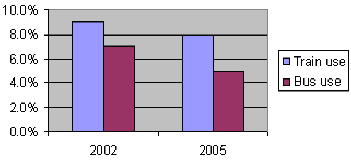
Figure 1: Proportion of all staff using the train and bus
Both bus and rail services are often used as occasional options when the car is not available. The bus is occasionally used by 19% of respondents and the train by 18%. As alternatives to the car they offer by far the greatest potential for achieving a shift in travel mode.
There has been a very slight rise in the use of cycling for commuter travel to 3% of staff. This is contrary to national trends, which are declining. As an occasional mode cycling is a considered alternative for 6% of staff reflecting the influence of weather for this mode. Around 28% of staff live within five miles of their place of work, a distance which is easily cycled.
The survey suggests that investment in cycle facilities has some potential to increase journeys by bicycle, although the percentage changes are likely to be small. By way of illustration, a 1% increase in cycling equates to approximately 390 staff cycling who previously did not. A good proportion of these will have previously driven and the potential reduction in parking demands could be as high as 250 spaces through a moderate increase in cycle use.
There was no measurable change in the number of people walking to work between 2002 and 2005. 9% of staff regularly walks to work (11% in Winchester). 18% of County Council staff lives within 2 miles of work, which is within walking distance.
Staff parking locations also appear to have changed over the last few years, as illustrated in Table 1 below. The reasons for, and statistical significance of, these trends are unknown, but further investigation and development of parking management policies and practices is required.
Parking location |
2002 |
2005 |
Workplace |
59% |
63% |
Pay and Display |
27% |
18% |
Park and Ride |
8% |
10% |
Other |
6% |
9% |
Table 1: Changes in Parking Location
4.3 Survey results and analysis - Business Travel
The 2002 survey did not ask questions relating to business travel; therefore the results described below are from the 2005 survey alone. A further staff travel survey is planned for 2008, which will provide additional information.
4.3.1 Main business travel mode of transport
The percentages of frequent or normal mode of business travel in response to the 2005 survey were as follows:
· 76% of people using their own (or shared a colleague's) car;
· 8% used a lease car;
· 3% used a pool car;
· 6% used the train;
· 2% used the bus, and
· 4% of people walked.
The most commonly used form of transport for business travel is the private car, with 76% of staff using it as a first choice. This probably reflects the business needs of the organisation as many services are delivered by the County Council direct to the customers' door. However, the wider impact may be that as a result the customer does not then need to travel to obtain a service. Therefore the net impact on the transport system is minimal.
Although a high rate of car use rate might be expected, there is room for some reduction. The survey does not reveal where this will be. Alternative means of assessing business travel trips will be developed as part of the Corporate Travel Strategy. The first step will require a review of the different ways in which different departments manage travel demands.
4.3.2 Occasional business travel mode
The percentages for mode of transport occasionally used were as follows:
· 30% used the train;
· 21% used their own (or shared a colleague's) car;
· 20% of trips were made by people walking;
· 8% used the bus;
· 7% used a pool car;
· 4% used a lease car;
· 3% used a bicycle;
· 3% used a taxi, and
· around 4% used another form of transport.
In the occasionally used travel mode, rail and walking account for 50% of these alternatives. Whilst business needs will play an overriding role in what is appropriate, supporting and facilitating business travel by these modes may be of considerable benefit.
Data was not available on the percentage of people car sharing. This will be addressed in future surveys.
The use of pool cars is currently very low as a preferred option and may reflect the high mileage rate for use of a private car on council business, as well as the inconvenience of booking pool cars, taking them out of the county and returning home with them in the evening. Private vehicles may be more polluting vehicles than pool cars which have been purchased because of the low emission and fuel efficiency ratings. This requires further investigation to obtain a better understanding.
Other sources of data exist including the 2003 `Motorvate' study. This looked at mileage claims and ways of reducing expenditure and is in addition to the County Treasurers department and departmental division data. Data from mileage forms is collected but needs to be reviewed to allow a more meaningful analysis of mode choice and opportunities for efficiency savings.
The indications suggest there is a need to undertake a review of the monitoring and management of business travel. The opportunity for efficiency savings should be fully investigated as they appear to be significant.
5.
6. Corporate Travel Strategy
The Corporate Travel Strategy has been developed to reduce the impact of journeys made in the delivery of County Council services. Providing County Council services requires staff, councillors and visitors to travel to and from places of work. In many cases travel is also an essential part of delivering services. The County Council will be more influential if it sets a good example to other Hampshire organisations on how to move to more sustainable travel.
There are a number of challenges which the Corporate Travel Strategy will tackle. The Strategy will aim to:
· improve alternative methods of travel in order to reduce the reliance on private cars;
· promote flexible working to reduce the need to travel;
· raise the profile of travel initiatives and ensure staff are fully informed of travel choices, and
· ensure the County Council continue to provide first class services whilst minimising the impact of travel on the local and global environment.
The strategy provides a corporate approach to tackling travel issues. However, it is necessary to understand the diverse needs of the different sites and services provided when implementing any initiative. This will be achieved through the use of tailored travel plans, which will incorporate the aims of the Corporate Travel Strategy. Even the most basic travel plans can achieve 3-5% reductions in the numbers of employees travelling alone in a car to work. More ambitious plans can achieve reductions of 15-30%, or even more.2 These reductions have many significant benefits, including reduced congestion, less parking pressure, improved accessibility and increased travel choice.
There are a wide range of measures that can be used to start to reduce car use, including improved bus services, walking and cycling facilities, and car share schemes. However, in order to make alternative travel options as attractive as single-occupancy car use it is necessary to offer staff a genuine reason to change. The most successful travel plans tend to have two key factors: financial incentives or disincentives, and parking restraint. The Strategic Property Review (2006-09) could provide a valuable tool in selecting new premises, or modifying existing premises, which support alternative modes of travel and reduce reliance on private car use.
Parking restraint can use parking restrictions, parking charges, or a combination of the two. The revenue from parking charges can provide useful revenue for alternative travel options. Financial incentives can include paying staff not to drive to work, to give up a parking space, or providing discounts on public transport fares. Financial incentives can have an impact alone, but are most successful when combined with parking restraint. Even more effective is the combination of parking restraint, financial incentives, and a high number of measures to support sustainable travel.
For the Corporate Travel Strategy to succeed it will be necessary to:
· engage management and elected Members commitment and ensure adequate resources are available to implement the Strategy;
· assess working practices and implement changes to working practices that both support sustainable travel and meet travel needs;
· involve Human Resources Department in proposed policies to ensure equity, legal and strategic staff considerations are covered;
· develop supportive partnerships between County Council departments;
· maintain strong partnerships with public transport operators;
· fully assess individual sites in order to effectively tailor travel plans;
· gain staff ownership and commitment for the Strategy and tailored travel plans;
· use a combination of measures to reduce reliance on car use, and support sustainable transport methods;
· develop a comprehensive marketing plan, to research key groups of staff in order that messages can be effectively targeted;
· use imaginative publicity and promotion of travel initiatives, and
· implement a programme of surveys and research to assess the impact of individual strategies.
The following section provides a detailed description of the aims and targets of the Corporate Travel Strategy, and recommendations for how these can be achieved.
7. Strategic aims and targets
7.1 Aims of the Corporate Travel Strategy
This section summarises the targets of the Corporate Travel Strategy and provides details of the aims and how these can be achieved.
A summary of all recommendations in this chapter is included in Appendix 1.
Table 2 provides an overview of the targets set by the Corporate Travel Strategy.
Car use (commuting) |
A 2% reduction in the proportions of sole occupancy car trips by 2011 |
A 3% increase in car sharing by 2011 | |
Public transport (commuting) |
An upturn in the use of rail from 8% in 2005 to 9% or higher by 2011 |
Halt the rate of decline in bus use and a return to a level of 5% by 2011 | |
Cycling (commuting) |
To increase cycle usage levels from 3% in 2005 to 4% by 2011 |
Walking (commuting) |
To increase the percentage of staff walking to work from 9% in 2005 to11% by 2011 |
Business travel |
To achieve savings of at least 5% in business travel claims by 2011 |
The aim for car based commuting is:
· to reduce the need to travel by car.
Reducing sole car use can be partially achieved by making alternative travel modes more attractive or by making car use less attractive. The latter can be achieved by increasing the cost of motoring or restricting the supply of parking. It is worth noting that the relative cost of motoring has declined in recent years compared with public transport.
The motivation behind parking management and policy is driven by the need to maximise efficiency and operational needs. Management of on-site parking needs to respond to site-specific issues, in particular public transport availability, issues of parking supply and demand, more accessible and flexible pool cars, use of flexible working and video conferencing, and local air quality. Any parking strategy should:
· be equitable to all staff;
· accord with the County Council's Corporate Strategy and emerging objectives of the revised Corporate Travel Strategy;
· ensure the continued operational effectiveness of the organisation; and
· be beneficial towards the environment.
The outcomes of the Strategic Property Review, completion of Ashburton Court refurbishment and the delivery of a South Winchester Park and Ride site are significant change points for the future. The details of appropriate workplace parking management will vary from site to site and will be important factors in the success of site-specific travel plans.
There is good potential to increase the proportion of people car sharing regularly. A staff car sharing scheme was established in 1999/2000, but awareness and take up of the scheme could be increased through improved promotion.
Flexible working also provides the potential to reduce travel to work considerably, or help to reduce congestion at peak times. Flexible working involves adapting working patterns to suit the needs of the individual, and can include:
· part-time working;
· flexi-time;
· mobile working;
· annualised hours;
· compressed hours;
· staggered hours;
· term time working;
· job sharing, and;
· home working.
These can be combined to produce the most appropriate solution for employee and employer.
7.3.1 Site-specific recommendations
· Review of site-specific parking management in line with the County Council guidance on parking standards;
· consider implementation of a variety of parking management systems with revenue ring-fenced for staff travel initiatives, for example, discounts on public transport;
· promote flexible and mobile working;
· implementation of low emission vehicle, car share or pool car only spaces, and
· regular review of parking permit allocation schemes.
· Develop a Corporate policy on the allocation and issuing of car parking permits, which takes into consideration operational need and site specific circumstances.
· Improve operation and licensing of car sharing scheme and marketing of its benefits.
· Actively promote flexible working.
The aim for public transport is:
· to increase the use of public transport for journeys to and from work.
There is a need to address the declining use of public transport by staff. Promotion of services and the increased availability of information can be very effective. Direct marketing is particularly effective when appropriately targeted.
The current trend will be for bus and rail modes to decline yet further. The train use target reflects in particular the impact of securing discounted rail travel for staff. Expense was one of the biggest barriers to train use. The current discount with South West Trains is due to be reviewed in Spring 2007, and we will push for the discounts to be continued, and even extended to other locations. Should this occur we would expect a rise in use. We anticipate this will reach 9% in 2011.
The target for bus use is less optimistic but a new South Winchester Park and Ride service (expected to be delivered before 2011), combined with more proactive provision of public transport information and direct marketing should result in increased use.
The Winchester based personalised travel planning pilot project showed that targeting people who live close to key public transport corridors and who therefore have good public transport options available to them could be very effective. In Basingstoke a similar project called InfoMotion illustrated that 20% of people who were targeted for such marketing either began or increased their use of public transport. It also showed significant increases in satisfaction with bus services suggesting a perception gap exists for many people between what they believe to be the quality of a public transport service and the actual quality available. |
7.4.1 Site specific recommendations
· Promotion of real time public transport information to desktops and mobile phones, and
· site-specific public transport information provision.
· As part of the policy development for flexible working, consideration should be given to allowing staff to claim time spent working whilst on public transport as formal working hours;
· further negotiation of staff discounts on public transport;
· continued improvement of local bus services;
· more active promotion of the interest-free season ticket loans and a simplified application procedure, and
· travel issues to be included in new staff induction material.
The aim for cycling is:
· to provide facilities that will encourage the levels of cycling to continue to increase.
Analysis suggests that cycling is an option available to more people than currently choose to make this their main mode. If the following recommendations are implemented then an increase may occur.
Legislation now allows employers to provide a bicycle and bicycle safety equipment to employees as part of a `Cycle to Work' scheme where the bicycle is to be mainly used to cycle to their place of work. It operates as a salary sacrifice scheme which in turn reduces tax and National Insurance contributions for both staff and employer. Use of this scheme will be encouraged as a means to reduce commuting and business travel by car. |
7.5.1 Site specific recommendations
· Create and coordinate Bicycle User Groups as the starting point;
· review provision of facilities, such as lockers, showers and parking facilities, as detailed in the Strategic Property Review (2006-09);
· introduce a regular program of either free or reduced cost maintenance;
· invest in local accessibility improvements where highlighted;
· join the `Cycle to Work' scheme which allows discounted purchase of bicycles and equipment;
· extend the availability of low-cost loans for bicycle purchase;
· provide spaces for cycle and motorcycle parking, and
· provide local cycle maps and information.
· Track the cycle mileage rate against any increase in the car mileage rate i.e. 50.2p per mile;
· increase the bicycle interest free loan from the current maximum of £500 (set in 1999) to £1,500;
· provide information, undertake promotional campaigns, and
· provide free adult cycle training.
The aim for walking is to:
· encourage more staff to walk to work.
By implementing the following recommendations it is expected that a modest increase in people walking to work could be achieved.
7.6.1 Site specific recommendations
· Pedestrian and mobility audit of access points and key routes to site and identification of list of access issues, and
· consider car park management systems role in encouraging walking.
· Provide information undertake promotional campaigns to encourage walking, and
· invest in local accessibility improvement where the need is justified (as identified in site specific travel plans).
The aim for business travel is to:
· increase the use of alternative modes of transport to the car for business journeys, and
· improve management of business travel across the organisation.
Although rail warrants provide train travel free at the point of use, there are many occasions when a car is necessary to provide the flexibility that a train cannot. The pool and lease cars are provided to offer both fuel and emissions efficient vehicles that provide operational savings to the user, the County Council and the environment. The use of these should be encouraged for travelling to business meetings on environmental and cost-saving grounds, for both the user and the County Council.
This process will need to be made easier by ensuring there is a simpler web-based booking system. It should also be easier for staff to take pool cars home without tax implications. However, this would require Government to be lobbied for changes to become law.
Large savings can be realised through bulk purchasing. The fleet purchasing review is investigating ways to improve the County Council's bargaining power, which will potentially highlight the possibility to extend discounts to staff. This ensures both parties get a favourable discount on environmentally friendly vehicles with low running costs.
Pool cars are only required by staff during the working day. During the evening and at weekends, they represent a potential resource to both staff and to local residents, as well as a source of income to the County Council. Through development of a car club, this resource could be made available to staff and to the public helping to ensure that the vehicles that they drive are efficient and that the County receives an additional income stream.
Business travel needs can also be managed through the use of:
· mileage allowance, for various modes of travel;
· awareness raising, and
· active management of travel needs.
The current car mileage allowance offers an incentive to use the private car for business use. If a higher rate was paid for bicycle mileage, or remittance was received prior to travel when using public transport, this may have an impact on some car drivers.
This could be combined with more active management by managers on how staff carry out this business mileage, for example, by encouraging car sharing and by raising awareness of the possibilities of using alternative modes of travel. This may include considering the purchase of a lower emission lease car for those incurring high mileage. This could be combined with greater purchasing power achieved through the Fleet Procurement Review, whereby discounts for lease cars could be made available on more environmentally friendly vehicles. There will also be an active process of ensuring the pool car fleet are the most efficient vehicles.
7.7.5 Site specific recommendations
· Regularly review site-specific parking policies and practice at key offices, and
· provide pool bicycles/electric bicycles.
· Promote sustainable fleet procurement policy and practice;
· provide pool cars in all major office sites;
· review fleet procurement policy and practice, in order to combine purchasing power with other departments, organisations and individual staff members to negotiate higher discounts on vehicles, particularly low emission and fuel efficient ones;
· review booking system for pool cars and develop online, web based system;
· investigate the development of a car club, to extend use of pool cars outside of working hours, for staff and local residents;
· lobby for legislation change to allow staff to take home pool cars without incurring tax penalties;
· encourage the purchase of a low-emission of fuel efficient lease car for those incurring regular high mileage, or review why they have high mileage;
· review mileage allowance policy including:
o introduce higher mileage allowances for those who take passengers;
o review of bicycle mileage to track car mileage rate;
o preferential or higher mileage allowances for fuel efficient cars, and
o discriminatory mileage rate for higher polluting cars;
· review of travel claims monitoring systems including standardisation of claim forms across all departments, and ability to gather good quality data to avoid the need for further surveys on staff travel;
· actively manage business travel by providing guidance to managers on how to do so;
· departments to set internal and fixed travel budgets;
· promotion of staff training on use of dual fuel vehicles or other low emission vehicles;
· trial introduction of "section" season tickets;
· provide individualised journey planning for high-mileage drivers with a view to providing a report to their manager on ways to minimise travel expenditure and maximise business efficiency, and
· undertake review of travel expenditure by all departments with view to set fixed travel budgets. This will be via Departmental Sustainability Action Teams.
7.8 Additional general recommendations
In order to deliver the above recommendations a Corporate Travel Strategy Coordinator is needed. This is also a requirement of the planning consent for Ashburton Court West. Their role would be to ensure the Corporate Travel Strategy, and any subsequent site-specific travel plans, are implemented. The coordinator would also liaise with other stakeholders to secure discounts, assist in personal enquiries and be the `Champion' for staff travel needs. In addition, greater marketing and promotion of the various discounts and travel options available to staff is required. These are presently under-used and many staff are unaware, for example, that 25% discount on South West Trains annual season tickets can be obtained.
7.8.1 Site specific recommendations
· The Corporate Travel Coordinator could support local needs and work with staff to support site-specific plans.
· Employment of a Corporate Travel Strategy Coordinator, and
· overall marketing of discounts/travel options available to staff.
8. Management and delivery of the Corporate Travel Strategy
To ensure the proposed targets are met an action plan has been developed to implement measures and initiatives.
The action plan itself has been extensively consulted upon through various groups including the Corporate Sustainability Development Steering Group, the Union Joint Consultative Group and Corporate Staff Travel Working Group. Conversations have also taken place with individual colleagues where initiatives may have an impact on their roles. Some of the recommended measures will require limited additional staff resources and changes to procedures and systems; notably in Property, Business and Regulatory Services and in the County Treasurer's Department, where staff will be involved in additional administration and accounting.
8.1 The Corporate Travel Strategy Coordinator
The implementation of the Corporate Travel Strategy action plan recommendations will be overseen by a dedicated Corporate Travel Strategy Coordinator. The Coordinator will develop and work with a Corporate Staff Travel Working Group and other departmental contacts within the County Council. The coordinator will act as the main contact between the Corporate
Sustainability Development Steering Group (CSDSG) and the Departmental Sustainable Action Teams (DSATs) and provide regular progress updates of the measures being implemented across the County. DSATs will also be tasked with setting staff travel actions and targets and reporting these to the CSDSG. The coordinator will provide advice and some survey and assessment services to the DSATs as requested by them.
Funding is required to ensure the delivery of the measures and initiatives and to enable the promotion and marketing of sustainable travel for all journeys. It is estimated that if all the measures included in the action plan were implemented, then much of the expenditure would be recovered through efficiency savings.
It is important that the County Council maintains its relationships with the various public transport operators and establishes further relationships with other providers, including Travelwise, South East Travel Planners, South West Travel Planners, and Association for Commuter Transport, to develop the strategy and make it beneficial to all staff.
It would also be of benefit to engage with other large employers throughout the county and participate in commuter forums to be able to exchange ideas, successes and discuss any problems that arise.
A cross-departmental project group was established to consider the proposed actions and act as consultees for the whole strategy. It is also important to have the continuous support from the Trade Unions who have been actively involved throughout the consultation process. Both the cross-departmental group and the Trade Unions will continue to play an important role in the development and implementation of the Corporate Strategy.
One of the clearest factors in the success of any initiative or strategy is the combination of information provision with the marketing of alternatives to car travel. There are already a number of staff incentives and facilities available, but these have not necessarily been utilised to their full potential. This could be due to a lack of awareness among staff, especially those new to the organisation. This was highlighted by the results and comments of the staff survey undertaken in September 2005 as an issue.
It is important to develop a proactive marketing strategy at the outset, which will involve a programme of market research, and a staged communications programme to raise awareness of the problem(s), generate acceptance for the need for change, and provide sustained information on initiatives/ schemes to staff. The marketing strategy should be reviewed on a regular basis in order that it can be revised appropriately. It is also important that the market research is used to segment the market and develop more effective, targeted campaigns.
Stop Press, Staff News items, and departmental newsletters on the intranet are an inexpensive and effective way of reaching a wide audience. However, some staff may not have access to a computer and should not be excluded from the incentives and benefits available. This can be addressed by cascading information through the management/team meetings, and using, for example, leaflet and poster campaigns. It would also be of benefit to organise Corporate Travel Strategy road shows to visit main County Council sites to promote the offers and incentives available.
It is also important to investigate the application of an incentive-based approach to promotion using things such as the commuter challenge, sustainable travel miles scheme and where possible, produce promotional and appropriate gifts, however this will be subject to financial support.
One of the initial tasks will be to develop a dedicated Staff Travel website which will provide links to all the benefits available, the season ticket loans, car share scheme etc, and will also provide progress information on the implementation of the Corporate Travel Strategy. It will also contain links to the Sustainability and Work Place activities pages within Hantsnet to promote the environmental and health benefits attached to using alternative travel modes.
This will be achieved via full staff travel surveys, which will be carried out in September 2008 and September 2011, and through other reviews such as the Strategic Property Review and Fleet Procurement Review. By this latter date it is perceived that the site-specific travel surveys would have been developed and therefore will provide good evidence on whether the targets have been met through the implementation of the measures and initiatives within the action plan. More details on the nature of the surveys will follow, as part of the remit of the Corporate Travel Strategy Coordinator's role.
Corporate Management Team, the Corporate Sustainability Development Steering Group and departmental action teams will receive regular updates on the progress of the measures within the action plan. Progress reports will also be provided by the Coordinator on a regular basis via the website.
Site-specific travel plans will be developed by carrying out staff, location and building surveys initially in all County Council business locations over a threshold size of 50 Staff. For smaller office locations, a scaleable and practical approach will be taken.
8.6 Use of the strategy by others
As well as providing a document for use in writing site-specific travel plans for Hampshire County Council offices, it is also planned that this Travel Strategy is used as an exemplar for other travel plans within Hampshire. It is hoped it can provide insight into best practice with regard to successful measures that may be replicated elsewhere.
9. Travel Plans
A travel plan, as described by the Department for Transport, is typically a package of practical measures to encourage staff to choose alternatives to single-occupancy car-use, and to reduce the need to travel to work and for business.
Workplace travel plans can help to change the way people travel to work. Travel plans can address the issues of cost, convenience and comfort, all of which influence our decisions about the journeys we take. By improving bus services, making it easier and more attractive to cycle or walk, or by matching partners through a car-sharing service it is possible to influence how people travel. Discounts and financial incentives support these improvements, and car park restrictions and charges help to discourage solo car journeys. Changes to working practices also play an important role, including flexible working and video conferencing.
A plan should be tailored to a particular site and include a range of measures which will make a positive impact at that site. The idea is to make the alternatives more feasible and more attractive to employees and employers. A travel plan contains clear objectives, targets and measures designed to reduce the overall demand for travel.
The success of a travel plan is often based on successful partnerships, informed by a staff survey and regular monitoring. In bringing together key parts of the organisation internally (for example, building managers, fleet managers, personnel managers, business managers) much more can be achieved within a plan. Also, working with local transport operators is important if effective changes are to be made. Finally, teaming up with neighbouring organisations will give added value to many of the measures introduced in the plan.
9.2 What are the benefits of a Travel Plan?
The Gershon Review (2004) requires public authorities to seek ways of finding 2.5% efficiency gains over the three year period from 2005-06 to 2007-08 inclusive. A travel plan provides opportunities to contribute to these efficiency savings.
Even the most basic travel plans can achieve 3-5% reductions in the number of employees travelling to work by car. More ambitious plans can see reductions of 15-30%.3 This can benefit the organisation and its employees, the local community, and can help to cut carbon emissions which are contributing to climate change. A travel plan may help to relieve local parking or congestion problems or improve public transport connections across the area. It may also relieve stress on employees through reducing delays or providing the opportunity to cut their travel commitments by working from home on occasion.
9.3 Site Specific Travel Plans
These site-specific travel plans will be developed by carrying out staff, location and building surveys initially in all County Council business locations over a threshold size of 50 Staff. From the results of the surveys, local actions and measures suited to the individual location will be developed into a site-specific travel plan. For smaller office locations, a scalable and practical approach will be taken. In most cases this could result in the provision of tailored local travel information, as well as cycle parking provision and promotion of the existing car-share scheme.
The measures and actions suggested have arisen following close consideration of current good policy and practice, through examples from other county councils and large employers, and as a direct response to the staff travel survey results and enquiries and comments from County Council staff. From this, realistic and evidence based outcomes and targets have been set to monitor our progress. To enable the measures to be managed and the targets to be achieved an action plan is included in Appendix 1, with an implementation timescale in Appendix 2.
9.4 Ashburton Court Travel Plan
As a condition of the planning application for the repair, refurbishment and extension of Ashburton Court, Winchester, a full travel plan needs to be prepared before re-occupation. The key purpose is to seek to influence travel choices to and from Ashburton Court, leading to more sustainable travel behaviour. This will be developed as one of the site specific travel plans, as described above.
Appendix 1: Summary of Corporate Travel Strategy Measures
This table identifies potential corporate and site-specific measures for the travel strategy. Not all site-specific policy recommendations will be appropriate for each site. Further work is needed to quantify the costs and benefits of each action, and alignment with delivery of the wider property strategy, before prioritising and phasing these actions.
Recommendation |
Responsibility/Ownership |
Environmental impact |
Cost |
Car based commuter- Corporate/County-wide |
|||
Licensing and marketing of the existing car share scheme |
CTS Coordinator |
__ |
££ |
Develop an equitable Corporate Policy on how car-parking permits are allocated and issued |
CTS Coordinator/PBRS/HR |
_ |
£ |
Promote flexible working |
CTS Coordinator/HR/Smarter Choices Coordinator |
_ |
£ |
Promotion of Liftshare Day and In Town Without My Car Day |
CTS Coordinator |
_ |
£ |
Car based commuter - Site Specific |
|||
Review of current site parking management and parking permit allocation |
CTS Coordinator/PBRS |
_ |
£ |
Review of site parking for new locations |
CTS Coordinator/PBRS |
_ |
£ |
Provision of low emission/car share/pool car spaces |
CTS Coordinator/PBRS |
_ |
££ |
Consider parking management systems |
CTS Coordinator/PBRS |
_ |
£ |
Parking charges/parking restraint |
CTS Coordinator/PBRS/County Treasurers |
_ |
££ |
Public Transport commuter - County-wide |
|||
Promotion of existing public transport interest-free loans |
CTS Coordinator |
_ |
£ |
Development and promotion of staff discounts (negotiations with PT operators) |
CTS Coordinator |
_ |
£ |
Web-based site-specific information as part of induction material |
CTS Coordinator/HR/IT |
_ |
£ |
Working while on public transport to be included as work time |
Where appropriate and agreed by management |
_ |
£ |
Promotion of real time public transport information to desktops and mobile phones |
CTS Coordinator/IT/ITS |
_ |
££ |
Public Transport commuter -Site specific |
|||
Promotion of real time public transport information to desktops and mobile phones |
CTS Coordinator/IT/ITS |
_ |
££ |
Site-specific public transport information provision |
Carried out already |
_ |
££ |
Cycling/walking commuter - County-wide |
|||
Review provision of current facilities |
CTS Coordinator |
_ |
£ |
General promotional campaigns to encourage walking/cycling |
Workplace Activities Officer/CTS Coordinator |
_ |
£ |
Introduction of cycle to work scheme, which benefits both HCC and staff members through tax savings |
CTS Coordinator/ County Treasurers/Tax Adviser/HR Pay and Benefits |
_ |
£ |
Extension of bicycle interest free loan to £1.5K |
CTS Coordinator/ County Treasurers |
_ |
£ |
Provision of adult cycle training including maintenance |
CTS Coordinator/Hampshire Cycle training |
_ |
££ |
Cycling/walking commuter - Site specific |
|||
Pedestrian/mobility/cyclist access audit of all key routes |
CTS Coordinator/PBRS |
_ |
££ |
Invest in local accessibility improvements where highlighted |
HCC/district authorities |
_ |
£ - £££ |
Review of current lockers, shower and parking facilities for major sites (over 50 staff) and installation where feasible |
CTS Coordinator/PBRS (input to property review) |
_ |
£ - ££ |
Consider car park management systems role in encouraging walking |
CTS Coordinator/PBRS |
_ |
£ |
Develop web based provision of local cycle/walking route maps |
CTS Coordinator/ District Councils |
_ |
££ |
Coordinate or create bicycle user groups where appropriate |
CTS Coordinator |
_ |
£ |
Business Travel - All |
|||
Managers to target those within the highest business mileage bracket |
Manager's responsibility/ CTS Coordinator/ County Treasurers (possibly DPA Representative) |
_ |
£ |
Managers to implement journey planning and direct marketing initiatives, including the use of pool cars/public transport for business meetings |
TP Coordinator/SMTs/HTM |
_ |
£ |
Purchase of Personalised Journey Planning package for all staff |
CTS Coordinator/IT |
_ |
£££ |
Undertake review of travel expenditure by all departments with view to set fixed travel budgets, via Departmental Sustainable Action Teams |
CTS Coordinator/ CMT |
_ |
£ |
Review travel claims monitoring systems, including standardisation of claim forms across all departments |
County Treasurers/CTS Coordinator/ CMT |
_ |
£ |
Production of business travel guidance for managers |
CTS Coordinator/ HR/CMT |
_ |
£ |
Encourage the purchase of a lease car for those incurring regular high mileage |
CTS Coordinator/County Treasurers/ HTM |
_ |
£ |
Review of fleet procurement and guidance including: · centralised purchasing · merging of lease car and pool car purchasing power |
HTM/CTS Coordinator |
_ |
£ |
Promotion of staff training on use of dual fuel vehicles or other low emission vehicles |
CTS Coordinator/ HTM |
_ |
£ |
Further provision of pool cars in all major office sites |
HTM/CTS Coordinator |
_ |
£££ |
Development of a car club to extend use of pool cars as hire vehicles outside of working hours, for staff and local residents |
HTM/CTS Coordinator/Smarter Choices Coordinator |
_ |
£££ |
Review of booking system for pool cars and development of new system i.e. online web based |
HTM/CTS Coordinator/Smarter Choices Coordinator |
_ |
££ |
Lobby for legislation change to allow staff to take home pool cars without incurring tax penalties |
CTS Coordinator/County Treasurers |
_ |
£ |
Provision of pool bicycles/electric bicycles |
CTS Coordinator (HTM to maintain) |
_ |
££ |
Investigate potential to reward fuel efficient car users claiming mileage |
CMT/County Treasurers |
_ |
££ |
Review of bicycle mileage to track car mileage rate (50.2p/mile currently, bicycle mileage currently 8.9p/mile) |
HR/CTS Coordinator/County Treasurers |
_ |
££ |
Introduce additional mileage allowances for those who take passengers at a rate of 7p per passenger per mile |
County Treasurers/CTS Coordinator |
_ |
££ |
Trial introduction of "section" season tickets |
CTS Coordinator/County Treasurers |
_ |
££ |
General Recommendations |
|||
Overall marketing of discounts/travel options available to staff |
CSP Coordinator/HR (remuneration and benefits) |
_ |
£ |
Corporate Travel Strategy Coordinator |
CSP Coordinator |
_ |
£££ |
Appendix 2: Policy context
Policy context
The Department for Transport (DfT) report `Making Smarter Choices Work' signals continued Government support for a range of soft measures including workplace and school travel plans, travel awareness campaigns, car sharing initiatives, and individualised travel marketing. These measures are advocated by the DfT as having a positive contribution to promoting a wider degree of travel choice.
Planning Policy Guidance Note 13: Transport (ODPM, 2001)
Published by the Government in March 2001, PPG13 states the Government's commitment to the promotion of travel plans amongst business, schools, hospitals and other organisations. The Government considers that travel plans should be submitted alongside planning applications which are likely to have significant transport implications.
South East England Regional Transport Strategy
The regional transport strategy promotes the rebalancing the use of the transport system in favour of more sustainable travel. This is to be achieved through a "tool kit" of mobility management measures. Policy T13 specifically supports the provision of travel plans through the development control process where there are major travel generating developments.
Hampshire Local Transport Plan (2006-2011)
The County Council's Local Transport Plan (2006-2011) (LTP) includes a target to increase the uptake of travel plans within Hampshire and for them to cover 15% of employees of Hampshire by 2011. Its core philosophy is to address transport issues by a process of `reduce, manage and invest'. This will be achieved by:
Reduce - To reduce the need to travel, and when necessary, provide alternatives to the car for commuter and business use by introducing flexible and mobile working practices.
Manage - By promoting the benefits, facilities and discounts already provided to staff and to investigate further possibilities. This should be combined with monitoring and awareness of process/policy changes.
Invest - To provide additional infrastructure, such as cycle parking, pool vehicles and on-road facilities, to greater facilitate the use of alternative modes of travel to the sole-occupancy car.
The objectives within Hampshire's Local Transport Plan (2006-2011) most relevant to this strategy are to:
· reduce the impact and effect of congestion;
· widen travel choice;
· contribute towards improvements in air quality;
· support wider quality of life objectives, and
· encourage value for money and efficient asset management.
Appendix 3: Corporate links
The Aalborg Commitments
The County Council is bound by The Aalborg Commitments (June 2004(, to provide a framework to measure and improve its corporate sustainability performance. There are a total of fifty separate Commitments, split under ten themes (full list available at www.aalborgplus10.dk). The County Council's Baseline Review against the Aalborg Commitments, completed in September 2006, gave the organisation an overall score of 2.02 out of 4. The score for Theme 6 - Better Mobility, Less Traffic - was 1.6 out of 4. The actions and targets set out in the Corporate Travel Strategy will help ensure the score improves over the coming years.
Gershon Review
The Gershon Review (2004) requires public authorities to seek ways of finding 2.5% efficiency gains per annum over the three year period from 2005-06 to 2007-08 inclusive. The Corporate Travel Strategy also provides opportunities to make efficiency savings.
Corporate Initiatives
MATISSE which stands for Mobile and Teleworking Initiative for a Smarter South-East is a partnership project led by Hampshire County Council and funded by SEEDA (South-East England Development Agency) that seeks to better understand the economic, social and environmental benefits of mobile and home working.
The project initially involved a six-month pilot study that tested and quantified these benefits as well as the anticipated productivity benefits of increased home or mobile teleworking amongst 100 volunteers, around half from Hampshire County Council. The initial analysis has showed some very positive results as follows:
· managers had reported 87% of participants with increased personal productivity;
· participants had saved up to £80 per week in commuting costs and business mileage claims had reduced for 40% of participants;
· personal well-being was much improved with 47.5% post-pilot strongly agreeing their work-life balance was good (pre-pilot the figure was 12%);
· of great significance in terms of retaining or recruiting staff was the statistic that showed the 'very satisfied' in their job percentage rise from 18.8% to 57.1% post-pilot;
· in excess of £2.75 million per month would be saved in fuel costs;
· driving time would be reduced by around 4 million hours per month;
· 21 million miles of commute travel would be saved (NB 95% of MATISSE participants travelled at peak-times prior to the pilot), and
· carbon dioxide emissions would be cut by 8750 tonnes per month.
The initial analysis also showed that region-wide savings could be created. The figures were based on the MATISSE pilot findings that showed:
· 70% of participants travelled by car (in-line with other similar research). The analysis computed the SE region-wide savings were the current 380,000 home based workers to double in line with Government aims over the next three to five years
Transforming Through Technology (TTT)
This project is being carried out by an internal working group. One of the strands of this work will be looking at mobile and flexible working, which will certainly lead to a reduction in travel requirements. This also ties in with the above work being undertaken by the MATISSE project. Through the staff travel surveys it was clear that many more staff would consider alternative working/smarter working practices. The conclusions and recommendations of the TTT group will add to those of this strategy when completed.
The Workplace Activities scheme
The Hampshire County Council Workplace Activities Scheme aims to increase physical activity levels of Hampshire County Council's staff. This is intended to increase morale and reducing absenteeism through stress-related illness. It is recognised that many of the 39,000 staff do not carry out the minimum recommended level of activity and so to attempt to increase this, subsidised sport and leisure activities are offered. There are plans to increase the scope and breadth of the scheme in the coming years to make it attractive to more staff.
Grey Fleet Review
At the time of writing the Grey Fleet Review being conducted by the consultants to the Treasurers' Department is not complete at present. The findings from this will be fed into the recommendations from the Corporate Travel Strategy. These outcomes will be assessed and any duplications will be removed from list of proposals contained here.
References and sources
Aahlborgplus10 (2006) The Aalborg+10 and Aalborg Commitments Homepage available at: http://www.aalborgplus10.dk./ (accessed 29/12/2006)
Addenbrooke's NHS Trust (2006) Travel for staff available at: http://www.addenbrookes.org.uk/directions/staff.html (accessed 29/12/2006)
Bristol City Council / University: information through private conversations.
Buckinghamshire County Council (2006) Own Travel Plan available at: http://www.buckscc.gov.uk/bcc/content/index.jsp?contentid=-1941094488 (accessed 29/12/2006)
Camden Borough Council (2006) Scheme for the Payment for Member's Allowances available at: http://www.camden.gov.uk/ccm/content/council-and-democracy/who-represents-you/camdens-councillors/scheme-for-the-payment-of-members-allowances-.en;jsessionid=bhKo2npuuxb_ (accessed 28/12/2006)
Commission For Integrated Transport (2007) 10 Year Transport Plan: second assessment report available at: http://www.cfit.gov.uk/docs/2003/10year/second/02.htm (accessed 10/1/2007)
Doncaster Borough Council (2003) Payment of Cycle Mileage for Business Travel available at: http://www.doncaster.gov.uk/about/chamber/default.asp?Nav=Report&ReportID=4695 (accessed 28/12/2006)
DfT (2002) Walk in to Work Out London: MHSO
DfT (2005) Making Campaigning for Smarter Choices Work: Guidelines for Local Authorities available at: http://www.dft.gov.uk/stellent/groups/dft_susttravel/documents/page/dft_susttravel_039102.pdf (accessed on 28/12/2006)
DfT (undated) Wycombe District Council available at: http://www.dft.gov.uk/stellent/groups/dft_susttravel/documents/page/dft_susttravel_504127.pdf (accessed 29/12/2006)
Durham County Council (2002) Durham County Council Travel Plan: Progress Report available at: www.durham.gov.uk/.../0/1c5ce213affac91680256bc8004d645a/$FILE/DCC%20Travel%20Plan%20Progress%20Report.doc (accessed 28/12/2006)
Hampshire County Council (2006) Corporate Strategy and Performance available at: www.hants.gov.uk/corporatestrategy (accessed 29/12/2006)
Hampshire County Council (2006) Transforming Through Technology: Hampshire County Council's e-Government & ICT Strategy available at: http://www.hants.gov.uk/egovernment/ictstrategy/ (accessed 29/12/2006)
Hampshire County Council (2006) Local Transport Plan 2 available at: http://www3.hants.gov.uk/transport/local-transport-plan.htm (accessed on 28/12/2006)
Hampshire County Council (2006) Matisse available at: http://www3.hants.gov.uk/matisse (accessed on 29/12/2006)
HM Treasury (2004) Releasing Resources for the Frontline: Independent Review of Public Sector Efficiency available at: http://www.hm-treasury.gov.uk/spending_review/spend_sr04/associated_documents/spending_sr04_efficiency.cfm (accessed on 2/12/2006)
Leeds City Council information available via their website http://www.leeds.gov.uk (accessed 29/12/2006)
Nottinghamshire county Council (undated) Bike to Work Schemes: examples of best practice from the Midlands available at: http://www.thebikezone.org.uk/cycletowork/mm-notts1.html (accessed 28/12/2006)
ODPM (Office of the Deputy Prime Minister) (2001) Planning Policy Guidance 13: Transport available at: http://www.communities.gov.uk/index.asp?id=1144015 (accessed 28/12/2006)
South East England Regional Assembly (2006) South East England Regional Transport Strategy available at: http://www.southeast-ra.gov.uk/publications/ strategies/transport.html (accessed 28/12/2006)
Hampshire County Council would like to acknowledge the following authorities who helped provide information:
Suffolk County Council
Surrey County Council
West Sussex County Council