
Archived decisions
Hampshire County Council Cabinet 25 June 2007 Best Value Performance Indicators, Local Area Agreement & Performance Report - 2006/07 year end results Report of the Chief Executive |
Item 5b |
Contact: Gary Smith, ext 7402 email: [email protected]
1. Summary
1.1 This report summarises key performance issues from the 2006/07 year and presents the end of year corporate performance results for 2006/07 in relation to the Best Value Performance Indicators and the Local Area Agreement.
1.2 It proposes that extracts from this corporate performance summary are published as part of the Performance Plan website by 30 June 2007 and that the areas for improvement identified help to inform the further development of the Corporate Business Plan in 2008/09 and the development of the new Local Area Agreement in 2008/09.
1.3 This report should be read in conjunction with the `Corporate Business Plan Progress/Baseline' sister paper which together form the 2006/07 year-end results.
1 Recommendations
1 That extracts from the BVPI, LAA and Performance Report and the outturn results are published as part of the Performance Plan website by 30 June 2007.
2 That strong progress made during the year and the work by staff to achieve improved results is recognised and that any risks/areas for improvement are noted and remedial action taken.
2 Purpose of the Report
2.1 While progress with specific initiatives is reported and considered separately throughout the year, the aim of this performance reporting process is to collate progress with the headline issues, to highlight areas of progress against targets, to draw out the areas of risk and improvement areas and summarise the key performance issues that arise from them.
2.2 The BVPI results have been compiled by departments. It has been a challenge, in some cases, for departments to meet the deadline for the return of data because of the collection and calculation mechanisms for some PIs (performance indicators) as well as having to meet other statutory reporting deadlines. This has been compounded this year as the year-end reporting coincided with the Corporate Assessment. There has also been the additional requirement to report progress on the key activities in the Corporate Business Plan for the first time. This has meant that a full set of data is therefore not yet available. It is important to note that the late arrival of some items of information mean that it has been difficult to confirm the accuracy of all the data.
2.3 Departments have also been required to produce a full departmental performance statement, a value for money statement, a list of the major achievements and details of accreditations held and awards received during the year. These have in previous years been reported to CMT and Cabinet as part of the end of year reporting process. However, it is proposed that as these have already been shared and discussed with Executive Members, that these reports be used in the compilation of a publication for circulation to Members on performance across all departments.
3 Corporate Performance Summary
Performance of Best Value Performance Indicators (BVPIs) 2006/07
3.1 For the BVPI year end data 2006/07, 43% of all measurable BVPIs showed better performance, while 9% stayed the same and 29% showed worse performance than their 2005/06 results. 19% of the BVPIs were either not applicable (i.e. does not indicate progress or have a direction of travel) or the data is not yet available. This compares with 54% of 2005/06 BVPIs showing better performance, 11.1% staying the same and 29.2% showing worse performance than the 2004/05 results.
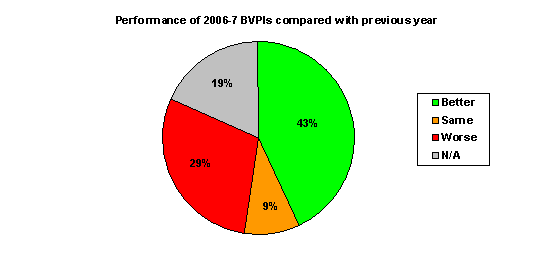
3.2 If the unavailable results are excluded, of those BVPI for which full data is available, 53% achieved a better result than last year, 11% remain the same and 36% show a worse performance than 2005/06. It is worth noting that of the 11% of indicators that `stayed the same', 40% (four indicators) were actually achieving 100% levels - a level from which it is not possible to achieve better performance.
3.3 The following areas in which notable performance was achieved in the BVPI results for 2006/07 include the following, many of these link to the Corporate Business Plan priority outcomes;
_ Adult Services despite a difficult financial year achieved further improvement against five of the national indicators for adult social care on the previous year. The implementation of the Adult Services modernisation and recovery plan has achieved this very positive outcome in improved performance in the set of BVPIs.
_ Children's Services indicators show continued improvement in educational attainment by young people in National Curriculum Key Stage tests and GCSE examinations, set against already high levels of performance compared with national averages and statistical neighbours.
_ Visits to museums have increased mostly due to an increase in website use and the increased numbers of school children attending formal learning sessions in our museums.
_ There has been an improvement in levels of road safety on Hampshire's roads with a 6.3 % reduction in the number of those slightly injured and an 18 % reduction in the number of children killed. The number of people killed and seriously injured (a key target within the CPA and LAA) has also continued to reduce and exceed targets.
_ Satisfaction levels with complaint handling by the Council has improved. Satisfaction with libraries from the Public Library User Survey held up with a drop of only 1% in a difficult year, although the questions context in a redesigned questionnaire has changed from the previous year.
_ Improved performance was achieved in waste management where, as a result of the investment in energy from waste plant the percentage of waste sent to landfill fell again from 19 % to 15.5 % during the year.
_ There has also been an increase in the percentage and tonnage of household waste sent to recycling and to composting exceeding the targets set for both these indicators. This is a CPA indicator and improved performance is therefore very important. Although Hampshire's performance in the management of waste continues to remain high and Hampshire remains a national leader in this area, the weight per head of population of household waste disposed continues to increase. Further campaign work and collection schemes, monitoring and improved management of Household Waste Recycling Centres are planned to keep waste growth to a minimum in the future as costs continue to rise.
3.4 Areas of weaker BVPI performance in 2006/07 and some of the actions already being taken to address these issues include the following:
_ Levels of resident satisfaction with council services from the BVPI residents survey have declined although a change in methodology (enforced use of the postal questionnaire from face to face used previously) means that direct comparisons cannot be made. Satisfaction with cultural services, bus services and overall satisfaction with council services all fell. As this is a triennial survey and with the current proposals for changes to the national indicator set, a direct comparison with these results may not be possible at the next survey.
_ The Social Services Direct Payments scheme (BV201) underwent a major change with the service offering in 2006/07 to bring Hampshire's scheme in line with other authorities. This led to many clients who were no longer able to make a fixed contribution to care payments declining to transfer to the new scheme, resulting in a reduction in client numbers. However, the increase in the number of people now choosing to live independently of Adult Services support can be viewed positively in the context of national policy on promoting independence and wellbeing. Direct Payments is a matter of user choice and in 2007/08 the department plans to have the resources in place to support an extra 103 people (960 in total) to use the Direct Payments scheme in order to achieve our target of 96 per 100,000 population.
_ Although the number of household burglaries has fallen by 7% the reported violent offences and vehicle crimes have both increased. Violent offences by a stranger have increased by 8.3% and violent offences in public places have increased by 11.4%. The new requirement for the police to issue fixed penalty notices for all incidents mean that the reporting of these incidents has increased. Some of those now officially reported may have previously been successfully diffused. However, this is a key Corporate and LAA priority.
_ There was a slight improvement in the percentage of children with three or more foster placements during 2006/07 but the target was not achieved. Figures for care leavers in education, training and employment also showed poorer results again than those for 2005/06. This area has been recognised as an area of concern and is a key priority within LPSA2, ensuring that attention is focussed on it.
_ The percentage of footways judged as 'easy to use' has reduced by 13% and has missed the target set for 2006-7 which is concerning as the performance of this indicator (BV 178) feeds into our CPA score. The percentage of signalled pedestrian crossings with facilities for disabled people has deteriorated markedly from the 96.2% reported last year to only 76% as a result of data quality issues uncovered through audit. Although remedial action is being carried out to bring crossings up to standard, this level of performance is currently only one percentage point above the lower threshold for the CPA refresh.
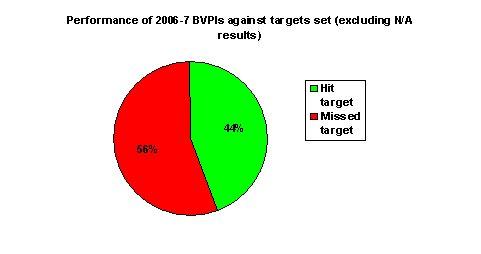
3.5 Regarding performance against target, 44% of the indicators which presently have full data reported equal or better than target, a slight decrease on results for 2005/06 when 55% of indicators were equal or better than target. This will be revised when all the year end data has been received.
Comparative BVPI Performance of the County Council in 2005/06
3.6 The Council aims to have a high percentage of its national performance indicator (BVPI) results in the top quartile compared with other county councils. For 2005/06, 44% of indicators were in the top quartile, an increase on the 40% in the top quartile in 2004/05 and 36% in the 2003/04 performance results. While the percentage in the bottom quartile has increased slightly from 17% in 2004/05 to 21% in 2005/06 there were fewer indicators in the third quartile with only 15%. Overall the percentage in the top two quartiles has improved slightly on the previous year.
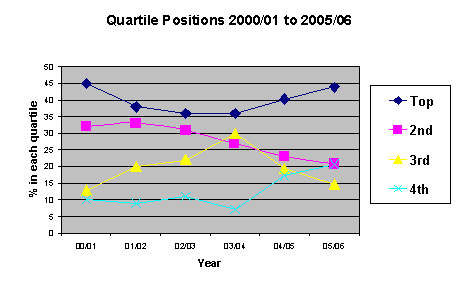
3.7 The Executive Member for Performance, Efficiency and Communications will continue the programme to review areas that fall or remain in the bottom quartile.
Performance of LAA Activities
3.8 Of the 118 indicators within the Local Area Agreement in 2006/07, 37.3% were `green' and regarded as being at low risk of missing target, 17.8 % were `amber' with a medium risk of missing target and 10.2% were 'red' and at high risk of missing target. (There was no data for 34.7% of the indicators - these are largely survey based where a survey had not been undertaken during the year).
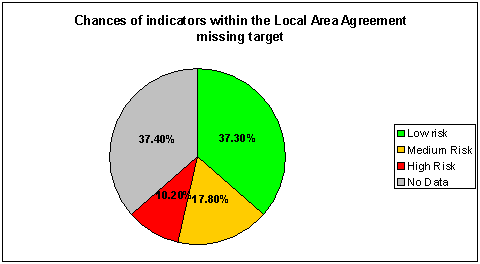
3.9 There have been many areas of strong performance improvement for example towards achieving the outcomes of Priority G, many of the areas relating to Priority F `Health and Well Being' and Priority E in relation to reassuring the public by reducing the fear of crime.
3.10 Areas needing improvement (high risk) are shown in `red' on the LAA summary charts (see appendix two) and include the GCSE results of Looked After Children, access to two hours per week of sporting activity per pupil in school, absences from a group of 11 secondary schools, overall crime figures and deliberate fires - the latter three showing falls during 2006/07 but not enough to meet agreed targets.
3.11 Full LAA performance results, consisting of progress towards each target, together with information about progress made during the year, arrangements in place, good practice examples and `issues' are available on the LAA website at http://www3.hants.gov.uk/localareaagreement.htm .
Key Areas For Action
3.12 In May 2006 Chief Officers identified a selection of key areas for corporate action during 2006/07, based on the performance results for 2005/06 and their plans for 2006/07. These have informed the development of the Corporate Business Plan in the current year and for 2008/09.
3.13 A number of front-line and back-office areas of activity had been identified as key areas where Chief Officers felt the organisation needed to focus in order to achieve improved performance and to modernise and transform the organisation to enable it to deliver better services in the future. Most of the areas identified were subsequently incorporated in the Business Plan 2007/08 which now sets the definitive outcome priorities for the Council. Therefore it has been decided not to report specifically against those actions in this report.
4 Annual Audit issues
4.1 The 2006 Annual Audit and Inspection Letter, presented to Cabinet in March 2007, highlighted a number of areas for improvement and made six specific recommendations. An action plan relating to these recommendations was approved by Cabinet at the same meeting and this and other areas for improvement have been highlighted to Departments. Specific people have been named in relation to the action plan and progress will be monitored against this.
4.2 There has been a significant improvement this year with only one indicator of the 97 Best Value Performance Indicators reported in 2005/06 `reserved' by the District Auditor. This compares with three that were `reserved' in 2004/05 and continues the improvement in the accuracy of our performance reporting from 2001/02 levels, when the auditors `reserved' 18 out of 87 indicators reported.
4.3 The one BVPI reserved by the auditor in 2006 was BV165, pedestrian signal-controlled crossings with disabled facilities. In response, every crossing in Hampshire was re-surveyed between October 2006 and March 2007. A total of 85 of 369 signal controlled pedestrian crossings were found to no longer meet the required standard for BV165, and the reported performance has been adjusted to reflect this. Hampshire has contested the lack of flexibility in application of this BVPI, as these crossings are not deficient, unsafe or unuseable, and is working with local disability groups to consider appropriate measures for disabled crossing access within the available resources. Processes for the data collection of this PI have been tightened.
4.4 Under the existing CPA methodology, any reserved or missing BVPIs (and non-BVPI data items) are scored as being below the lower threshold preventing the achievement of a four star in the Service blocks. It remains very important that the accuracy of our performance reporting is maintained.
5 Future reporting of performance
5.1 The Local Government White Paper, Strong and Prosperous Communities, set out changes to the performance framework for local government. There will be a reduction in the burden of inspection and number of performance indicators with a national set of 200 indicators (plus 19 education indicators) and 35 priority targets within the Local Area Agreement playing a key role in this structure. These will replace the current BVPIs.
5.2 A new performance framework is currently being consulted on to replace CPA (Comprehensive Performance Assessment) with CAA (Comprehensive Area Assessment). CAA will take a forward looking risk based approach to assessment which will replace the CPA service blocks. However, Use of Resources and Direction of Travel assessments will remain part of the new performance structure.
5.3 The statutory requirement to publish an annual Performance Plan will be removed, but it is likely that it will be required next year. The DCLG has just notified authorities of the deletion of 9 BVPIs for 2007-8, although only two of these applied to county authorities.
5.4 The implementation of the county's own performance management software system, CorVu, during 2007-8 alongside these changes, is intended to provide more `live' reporting, remove the pressure on half and full year-end reporting deadlines at the corporate level and enable more real-time strategic decision-making within departments to achieve the Corporate Strategy priority outcomes. It is intended that the CorVu package will be operational in all departmental performance teams in time for the next half year performance results in October 2007.
6 Public reporting of performance
6.1 The performance messages from this report will be published in the Performance Plan by the statutory deadline of 30 June alongside summaries of progress and activities on the Corporate Business Plan priorities, the LAA performance report, the Council's CPA results and residents' survey findings.
6.2 The above corporate summary plus the departmental reports will also form the basis of the publication of the summary Performance Plan supplement in Hampshire Now.
8 Conclusion
8.1 While progress with specific initiatives is reported and considered separately throughout the year, the aim of this performance report is to collate progress with the headline issues, to highlight areas of progress against targets, to draw out the areas of risk and improvement areas and summarise the key performance issues that arise from them.
8.2 Overall performance is strong in relation to the BVPIs and the LAA with good progress being made. The major areas for improvement have been identified and actions are being taken to address these.
8.3 The final results of the Corporate Assessment are due at the end June. This will help inform an improvement plan and feed into the further development of the Corporate Business Plan.
LINK(S) TO CORPORATE STRATEGY | ||
Yes |
No | |
Hampshire safer and more secure for all |
x |
|
Maximising well-being |
x |
|
Enhancing our quality of place |
x |
|
Section 100 D - Local Government Act 1972 - background papers | |
The following documents disclose facts or matters on which this report, or an important part of it, is based and has been relied upon to a material extent in the preparation of this report. | |
NB the list excludes: | |
1. |
Published works. |
2. |
Documents which disclose exempt or confidential information as defined in the Act. |
TITLE |
LOCATION |
Departmental returns of performance results |
Held by the Corporate Performance Team and by departmental performance contacts |