
Archived decisions
Hampshire County Council |
|||
Cabinet Item 5a | |||
25 June 2007 |
|||
Corporate Business Plan Progress/Baseline - 2006/07 year end | |||
Report of the Chief Executive | |||
Contact: Gary Smith, ext 7402/ Chris Tee ext 7677
1 Summary
1.1 On 13 July 2006 three new Corporate Strategy priorities1 were approved. Following this, in conjunction with DMTs (Department Management Teams), the Corporate Business Plan2 was developed to interpret these political visions into specific areas for action. Together these constitute the Council's Corporate Strategy.
1.2 The Corporate Strategy provides the Council with a clear direction and identifies the specific priority areas for improvement. With this in mind, the organisations performance monitoring processes need to focus on these improvement priorities; reporting progress against these and highlighting areas of risk to allow remedial action to be taken. This report is the first attempt at this. This approach, in terms of content and format, will continue to develop.
1.3 This report should be read in conjunction with the `BVPI, LAA & Performance' sister paper which provides the 2006/07 BVPI and LAA results. Together these two reports form the 2006/07 year-end results. The Local Government White Paper outlined the creation of a smaller national set of 200 performance indicators and the phasing out of BVPIs. However, the Council is still required to report against BVPIs and Members will want to note the generally very strong performance. This is the reason for two sister reports and it is hoped this helps to distinguish between these two separate areas and to help focus on local priorities through the Corporate Business Plan.
2 Recommendations
1. That extracts from the Corporate Business Plan progress/baseline report and the results are published as part of the Performance Plan website by 30 June 2007.
2. That strong progress made during the year and the work by staff to achieve improved results is recognised and that any risks/areas for improvement are noted.
3 Purpose of the Report
3.1 The aim of this report is to provide Executive Members and Chief Officers a progress update against the Corporate Strategy and establish a clear baseline. This report intends to show the extent to which the Corporate Business Plan has been and is being achieved and the following graphs provide an update for each priority by outcome. This approach will be refined for future reports.
3.2 It is accepted that the Corporate Strategy priorities were introduced part way through the 2006/07 financial year and the Corporate Business Plan formally relates to the 2007/08 financial year. In practice, it is recognised there have been many contributions to the new priorities during the 2006/07 financial year and this report enables these to be noted and a baseline to be drawn.
3.3 While progress with specific initiatives is reported and considered separately throughout the year, this report and accompanying compendium collates progress against the priorities into a single document so that it can be used as a tool to manage competing demands on resources and capacity by enabling a strategic view of the areas of risk and areas for improvement.
3.4 The information contained in this report concern the 2006/07 financial year. Contributions towards and progress against outcomes is based on returns from departments and these have then been used to assess whether the activity is on target to be achieved or at risk (green to red - see below for full explanation). These have then been presented as graphs to show the RAG status for each priority by outcome - this provides an easy to use indication of which outcomes are progressing better than others. It should be noted that this approach is only able to give an indication of current performance; more work is needed to make the process robust enough for closer scrutiny. In future years movement will also be made towards reporting key financial and workforce information alongside these priorities as well as adopting a more robust risk based approach.
RAG Colour Code |
Risk level |
On track - low risk of non achievement | |
To watch - medium risk of non achievement | |
Action needed - high risk of non achievement |
3.5 It has been a challenge, in some cases, for departments to meet the deadlines for the return of data because of the collection and calculation mechanisms for some PIs (performance indicators) as well as other statutory reporting deadlines. This has been compounded this year by the fact year-end reporting coincided with the Corporate Assessment. This has meant that a full set of data is therefore not yet available. It is also important to note that the late arrival of some items of information mean that it has been difficult to confirm the accuracy of all the data and summaries within the body of this report and appendix one which contains the Corporate Business Plan performance indicator results.
3.6 It is proposed that extracts from this report and sister paper are published as part of the Performance Plan website by 30 June 2007. In addition any risks and areas for improvement identified should inform the further development of the Corporate Business Plan in 2008/09 and the development of the new Local Area Agreement in 2008/09.
4 Corporate Business Plan Performance Summary
Performance in relation to Corporate Strategy priorities and targets 2006/07
4.1 The Corporate Business Plan, published in February 2007, is now the key performance management reporting mechanism and sets out:
_ Specific outcomes with key activities to deliver
_ Performance measures with targets
4.2 The following summaries provide overall progress against and contributions towards the corporate priorities - more detailed information against each key activity are available from the Corporate Performance Team on request. At the strategic level the picture is very positive but there are a few specific areas of risk/areas for improvement.
Hampshire safer & more secure for all
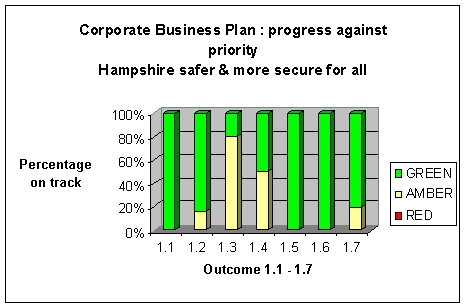
Summary of overall progress against this priority
PBRS continue to expand and develop both the ACSO visible uniformed presence, building on their early success, and the `Buy with Confidence' and `No Cold Calling Zone' initiatives relating to Trading Standards helping to protect consumers and especially Hampshire's more vulnerable residents from doorstep criminals. The successful introduction of the non-Emergency 101 telephone number took place as did the establishment of the Local Safeguarding Children Board between the council and its partners.
£1 million has been invested to implement thirty five Safer Routes to School schemes to encourage sustainable travel to schools and improve road safety for vulnerable road users. Youth Inclusion Support Panels have been established in four districts with the ambition to expand to county-wide coverage later in 2007 to help reduce re-offending rates of Children In Our Care. The development of programmes to particularly reduce re-offending amongst violent offenders is also underway.
Road accident casualties continue to show a reduction in numbers injured. Less polluting fuel is now being used for our transport fleet with the switch over the last year to bio-diesel for all our diesel powered vehicles and £50,000 has been allocated to improve training and communications for "first on scene" emergency services operatives across the County.
The highly public contribution of our Emergency Planning and Adult Services staff to the safe and successful relocation of residents during the removal of underground World War 2 pipe mines from the former naval air station, HMS Daedalus, Lee-on-Solent, last autumn is also worthy of note.
Risks/Area for improvement: The Council is not yet fully compliant with requirements of the Civil Contingencies Act 2004, however, significant progress has been made (and continues to be made) to achieve compliance and it is anticipated that plans will be in place for our most critical services by March 2008.
Maximising wellbeing
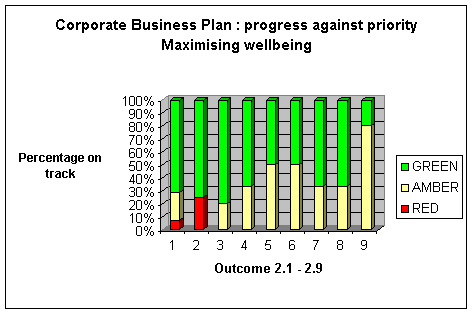
Summary of overall progress against this priority
A joint appointment was made between the County Council and the NHS of Hampshire's first Joint Director of Public Health. Adult Services is now working closely with the postholder to produce joint Strategic Needs Assessments. Particular progress has been made in relation to the provision of care and treatment of vulnerable adults and children as well as senior citizens generally, with a number of initiatives set in motion to improve the services and opportunities in place for these Hampshire residents. Our Supporting People team were inspected by the Audit Commission and awarded their highest category, three star status, making Hampshire the first Council to receive this accolade in the country.
Community engagement has featured highly as an area of activity with the HATs teams and scrutiny staff establishing and further developing their roles with Members, staff, partners and residents. Age Concern, Microsoft and BT made the County Council their first ever `Silver Surfer Council of the Year'. Inspired by National Silver Surfer Day, Hampshire's Silver Surfer Week ran from 20-26 May 2006 with the aim of encouraging older people to experience the advantages of using the internet.
The value of our school improvement procedures was endorsed in the 2006 Annual Performance Assessment (APA) judgement on Children's Services. Although an overhaul was not required, a series of specific actions have been implemented to ensure a wider choice, better local partnerships and improved outcomes. A `14-19 Executive' to deliver the 14-19 age group strategy and diploma arrangements has been established with senior officers from the County Council, the Learning and Skills Council, and Connexions driving forward actions from an agreed strategy to develop 14-19 education and training as a single phase.
There has been success in the development of the Creative Hampshire programme in schools across the county. Evaluation of projects found that teachers reported an increase in positive attitudes and behaviours from across a range of abilities and pupils demonstrated more confidence in their creative ability and a consequent pride in themselves. As a result, £120,000 funding from Arts Council South East has been awarded for the project to continue over the next three years. Work is also underway to improve performance in relation to Children In Care school attendance, school place stability and to reduce exclusions through the establishment of a Children in Care Project Group.
A variety of approaches have been adopted in relation to transport, including maintaining support for community transport schemes and essential bus services to ensure that people have a fair and equal access to services in the face of declining revenues in real terms.
Risks/Area for improvement: The mechanisms for the Joint Commissioning of services with the Primary Care Trusts has become a key challenge in order to better manage resources pooled through the LAA. A working group is now looking at how best to proceed with a number of priority areas including children in our care where we need to improve our performance.
The Partnership for Older People bid was unsuccessful in 2006. A further bid will be made in 2007/08. Hampshire's proposal involves investment in the voluntary and community sector to help it form an integrated framework of community support for vulnerable older people. Adult Services have not yet made progress with outcome 2.2 to develop a consultation programme but have begun work on a departmental consultation policy and procedure.
Enhancing our quality of place
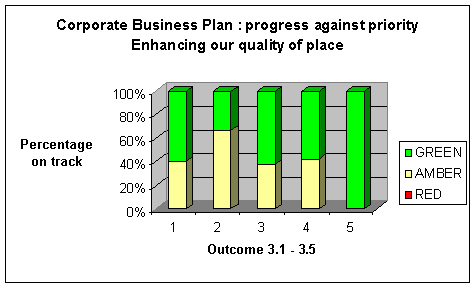
Summary of overall progress against this priority
85% of all household waste is now diverted from landfill, 37% to recycling and composting and 48% to energy recovery. An increase in recycling and composting of just under 38,000 tonnes has taken place due mainly to changes in the pattern of weekly collections and improvements to the Household Waste Recycling Centre network keeping Hampshire in the vanguard of local authorities for this.
Ninety two school travel plans were approved, bringing the total percentage of schools with a travel plan to fifty one per cent. A Yellow school bus pilot scheme was launched in Basingstoke to reduce school run congestion and change attitudes and behaviours towards transport for schoolchildren.
A programme of improvements to provide dropped pavement crossings on identified routes in every district continued and a programme of bridge maintenance and improvement works of over £3 million was delivered, including the replacement of Knights Little Bridge (A339 Headley), and installed new footbridges at Hawley, Little London, Bishopstoke, Emsworth and Rockbourne.
Work has been carried out with the Highways Agency and district/borough councils affected by declared Air Quality Management Areas to develop Action Plans and funds have been allocated in the Local Transport Plan.
As part of the Regeneration of Older Urban Areas Initiative, significant environmental improvement schemes have been implemented in Yateley and, in partnership with Eastleigh Borough Council, at Hamble. A brand new multi-million pound sustainable development is also underway at Merton Rise in Basingstoke. Work is well underway on the development which brings together planners, developers, architects, designers, and local authorities to create an innovative, vibrant, and sustainable community which will set new standards for 21st Century living. The 53 hectare site, owned by Hampshire County Council, has outline planning consent for 950 homes, 26% of which will be affordable. £40million is also being invested in primary infrastructure, including drainage, roads, landscaping and a new community college for 750 pupils, before the house-building starts. Other infrastructure, such as play areas, shops, recreational facilities and a neighbourhood centre will also be built for the newly arriving residents.
The recent announcement in relation to the proposed redevelopment of Rowner in Gosport has also shown that the Council is helping to lead the way on private/public partnerships within the County. The Cabinet at its meeting on 21 May 2007 approved a report from the Director of Property, Business & Regulatory Services that set out a ten year strategy for major land development within the Council's ownership in four strategic areas of the County Council. This decision will allow the County Council to both control the speed and location of new development, but more importantly help shape their new development as it takes place and as the freehold owner influence directly the quality of design of new communities emerging in Hampshire within the next decade.
Recent investment in infrastructure has resulted in higher volumes of waste being recycled and composted and, as a consequence, reduced volumes being landfilled. The 2008 LPSA2 targets are already largely being met. To maintain progress it is important to ensure that Hampshire's residents are kept well informed and engaged and the provision of effective public information to include the work of our partner authorities will be essential.
In that respect the Council is aware that although recycling levels have increased there has been a reduction in the customers' satisfaction with waste recycling facilities, although the overall level of satisfaction remains high (84%). The reasons for any dissatisfaction will need to be addressed.
Management Plan
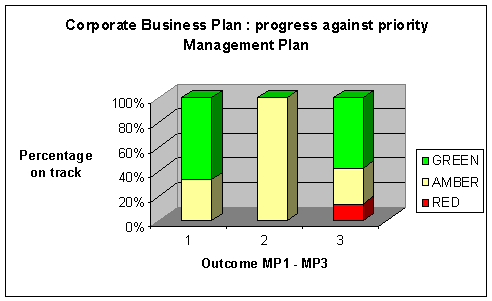
Summary of overall progress against this priority
Although not strictly part of the political vision and priorities, the Management Plan element of the Corporate Business Plan was created in order to encompasses all the `back office' activities and strategic projects which are needed to contribute to and support achievement of the three Corporate priorities. Activities undertaken within this section include the Transformation Through Technology corporate project. This contains a number of business change programmes enabled by IT. The development of the Contact Centre (Hantsdirect) is also underway. The Hantsdirect team will be trained to answer questions and facilitate services so that a high proportion of queries (target 80%) can be answered in the first call; and if not, callers will be passed to a specialist who will be able to help them.
The Adult Services Financial Recovery and Modernisation plan has successfully completed year one and target savings were exceeded. Work in year two will be more challenging as it continues to focus on financial recovery, but also begins planned modernisation of services. Equality impact assessment work across departments has progressed well, but the introduction of the new Pay & Grading structure is still awaiting trade union agreement.
The Council published a revised Corporate Procurement Strategy in September 2006 and held a number of awareness raising events in support of this. The Council has developed extensive collaborative arrangements in procurement and has established a close relationship with the South East Centre of Excellence, particularly in relation to the construction workstream which it is leading. The Council's progress on doing business electronically is evidenced by a 'virtual' implementation of the Government Procurement Card for catering supplies, work on an electronic Hampshire Marketplace and extended links with a small number of key suppliers.
Risks/Areas for improvement: The financial recovery plan underway within Adult Services will continue to need to be carefully managed and monitored to ensure that it remains on track to deliver its intended outcomes. In addition, as part of embedding a performance management culture across the organisation, the successful introduction and use of the CorVu performance management system will be key.
The Corporate Governance audit is currently being finalised (by Internal Audit) and is planned to provide a baseline of awareness across the Council and departmental responses to the use of statutory duties under Section 17 of the Crime and Disorder Act 1998.
5 Corporate Business Plan Performance Indicator Progress
5.1 Results where obtained do show that there is generally good progress being made in many areas, such as recorded violent crime in public places, but a small drop in the percentage of young people leaving care with one GCSE at Grade A*-G is reported.
5.2 These corporate business plan performance indicator year-end results have highlighted a number of issues. A number of the indicators are not SMART3 which links to the following:
_ Baselines - a number of PIs still need benchmark data (eg 1.6a and 1.6b).
_ Outturns - there is limited outturn data available against many of these indicators and in the case of some (eg 1.1 and Cabinet/CMT 4c): there will not be any further measurement of their results before 2009.
_ Targets - very few indicators have targets beyond 2007/08.
_ Responsibility - none of the Cabinet/CMT owned indicators have named data collectors and it has proven difficult to obtain data in respect of these.
5.3 As the Corporate Business Plan develops the PIs will need to be made more SMART compliant which will help to address the issues above and improve the quality of performance management data.
6 Conclusions
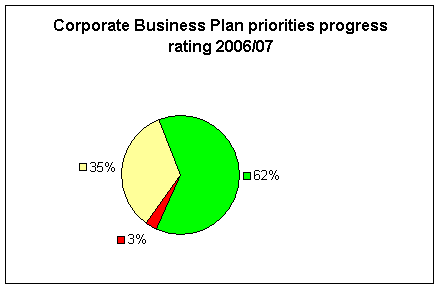
6.1 Overall the results are positive and progress against the Corporate Strategy priorities good with well over half `on track' with a low risk of non-achievement. Of the remaining key activities 35% have been rated as a medium risk of non-achievement but in many cases these are already being monitored carefully or remedial action already taken. There are, however, a small number of specific areas (3%) which should be monitored carefully and further action taken to address the risk of non-achievement.
6.2 The methods used in this report relating to risk and the monitoring of the extent to which the Corporate Strategy and Corporate Business Plan have been achieved will be improved. They are given here in good faith to give you a sense of the progress made but it is recognised that this process needs further refinement.
LINK(S) TO CORPORATE STRATEGY | ||
Yes |
No | |
Hampshire safer and more secure for all |
x |
|
Maximising well-being |
x |
|
Enhancing our quality of place |
x |
|
Section 100 D - Local Government Act 1972 - background papers | |
The following documents disclose facts or matters on which this report, or an important part of it, is based and has been relied upon to a material extent in the preparation of this report. | |
NB the list excludes: | |
1. |
Published works. |
2. |
Documents which disclose exempt or confidential information as defined in the Act. |
TITLE |
LOCATION |
Departmental returns of performance results |
Held by the Corporate Performance Team and by departmental performance contacts |