
Archived decisions
Contact: Paula Crompton Ext: 5454 email [email protected]
Table 1 Risk Heading Capital Expenditure 2006/7 Proposed Capital Budget 2007/08 £000 £000 Fire including arson 1,104 800 Condition of building fabric 4,264 4,150 Failure to manage contractors 0 0 Asbestos disturbance 1,511 750 Electrical services failure 762 1,000 Swimming pool plant failure 162* 253* Detection of Legionella 37 190 Glazing and window safety 55 25 High Level access for maintenance to plant or buildings 78 150 Mechanical services failure 1,220 1,169 Structural collapse and temporary buildings 759 600 Other CRA priorities 2,201 Total 10,412 10,135 |
||||||
* This is a revenue budget |
||||||
2.3 |
The capital repairs allocation for 2007/8 will deliver the Strategy for the Built Estate considered by the Panel at its meeting on 20 March 2007 which includes: · The direction of resources to the highest and most significant liabilities across the built estate and to continue to develop long term strategies (Test and Invest) to address the backlog of maintenance liabilities · To maximise opportunities for planned maintenance regimes as opposed to reactive `patch and mend' programmes · To ensure that buildings are accessible and safety to occupy through the programmes of work agreed by the strategic risk management strategy. |
|||||
2.4 |
The biggest challenge is to respond to risk improvement programmes for the highest risks whilst continuing to manage risk and thus performance in other lower risks. This has lead to the development of a `Test and Invest' risk management strategy described in section 5 of this report. This provides an example from the Corporate Business Planhttp://www3.hants.gov.uk/corporate-strategy-home/cmt-text-with-picture-right-3/corpstrat_outcometargmeasure.htm where `Resources follow Priorities'. |
|||||
2.5 |
Table 1 (Para 2.2) represents the optimum position to enable compliance with statutory inspections balanced against essential maintenance programmes, although high priority maintenance programmes, improvements and capital schemes in non-education buildings will have to be deferred due to the impact of the Dedicated Schools Grant (DSG) on the resources available to the non-education estate. |
|||||
3 |
Risk Management Strategy 2006/07 |
|||||
3.1 |
The strategic risk assessment and performance framework for the Built Estate for 2006/07 is attached at Appendix 2, with a commentary on each risk category to demonstrate progress. Members should note that the corporate programme requires the risk assessment to be subject to annual review in October each year, hence the current risk register is dated 2006/07, funded largely by resources available during the financial year 2007/08. |
|||||
3.2 |
During 2005/06, nineteen strategic risks were ranked with a detailed risk assessment and risk management programme for each strategic risk. The number of strategic risks has increased by one to twenty during 2006/07 since the risk covering grounds management and mature trees was separated for clarity and to ensure adequate resource allocation and management for the related risks. Risk scores for Condition of Building fabric were increased to illustrate the increasing liability to Non-education buildings as discussed in paragraph 2.4 above. Following the implementation of the Work at Height Regulations in 2005, the strategic risk associated with `High Level Plant and Building Components' was reclassified and renamed, moving up 7 places to become the third highest risk with appropriate risk management programmes planned during 2007/08. |
|||||
3.3 |
Across twenty strategic risks, there are 13 green and 7 amber performance ratings illustrating the risk management programmes are achieving positive outcomes, with sustained improvement year on year. |
|||||
3.3 |
Key actions completed in 2005/06 included the following: | |||||
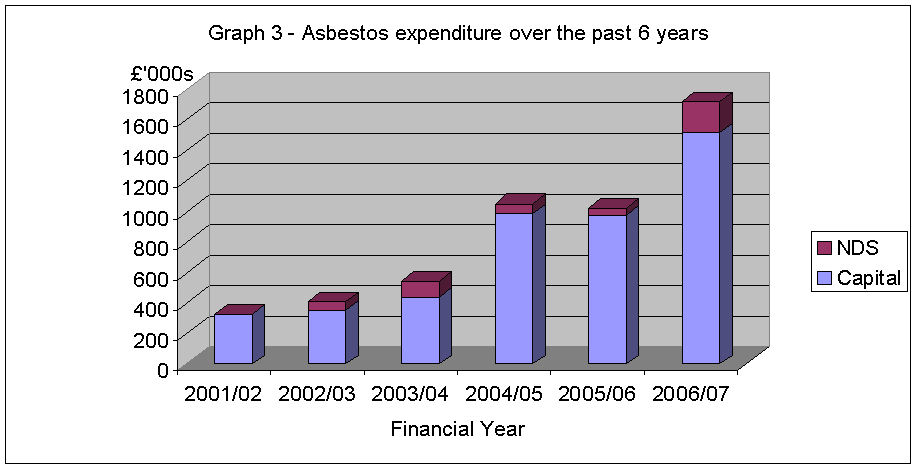
| · Implementation of structural fire precaution improvements to high priority residential buildings was successfully completed by April 2007 to include fire alarm and emergency lighting upgrading at Nightingale Lodge, Bulmer House, Cornerways, Cherry Orchard and Cranleigh Paddock. Competitive prices were negotiated for early contracts providing a procurement platform for the remainder. Subject to the future delivery of services at Linden House and Newman Bassett, a limited range of fire precautions have been completed following a fire risk assessment. · Revision and reissuing of fire safety guidance to local managers following implementation of Fire Reform Order expected October 2007. · Implementation of annual action plan developed in partnership with Hampshire Fire and Rescue Service (HFRS) under the joint working agreement to include the following actions: o A Corporate response to the Fire Reform Order agreed with departments o A corporate training programme developed for Council staff o Joint auditing programme for high priority residential buildings with HFRS and property managers o Arson reduction visits to all school in Basingstoke o Regulation meeting to co-ordinate fire safety management between departments led by Property Services with HFRS. · Improved quality and reliability of asset management data for non-education buildings to inform programmes of work in 2006/7. · Renewal of term engineering maintenance contracts commencing 1 August 2007, which is a key feature of the new SLA with schools. It is anticipated that the new contract arrangement will offer better value for money in the provision of these services. · Development of the test and investment strategy to support innovation in risk handling and well managed risk taking to improve performance and provide best value, subject to Executive Member for Policy and Resources approval: o Consultation to develop a risk-based asbestos reinspection programme o Development of a revised electrical test and inspection programme o Development of a revised structural inspection programme linked to asset management plans o Development of test and inspection programmes for safety valves for pressurised systems. · Implementation of asbestos survey programme commencing April 2006 through appointment of Asbestos Surveying Consultancy Partners. (Appendix 1, graph 3 illustrates the expenditure over the past 5 years, where the budget has increased year on year to 2004/5 commensurate with the high risk rating.) · Development and launch of new health and safety services to schools as part of the Service Level Agreements implemented from April 2007 · Establishment of a term contract for minor building repairs and maintenance works · Report to Members on the number and condition of swimming pools at schools (January 2007). | ||||||
3.4 |
Key performance indicators for 2006/07 include: | |||||
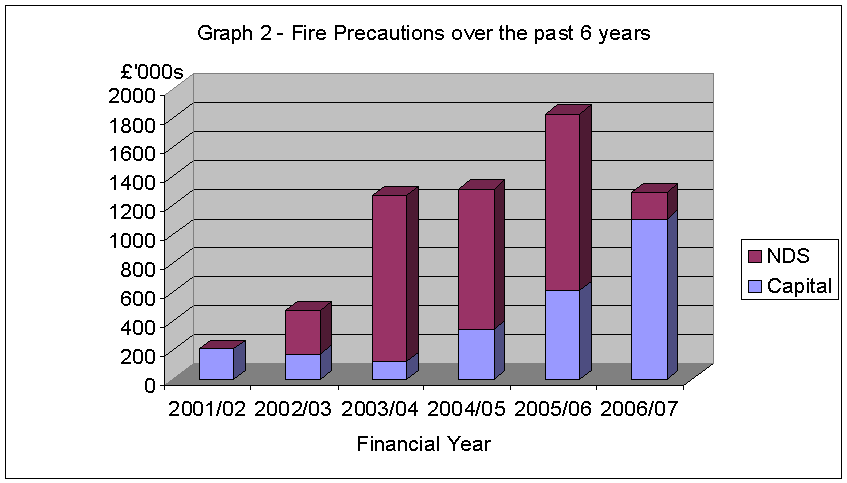
· Significant capital resources, £800,000 has been directed at fire precautions during 2007/08 largely within the non-education estate. This level of investment will enable a number of key improvements in Older Persons Residential homes, assessed as the highest risk category of buildings to be completed. (Appendix 1, graph 2 illustrates the expenditure over the past 5 years, where until recently the budget has increased year on year commensurate with the highest risk to address the high priority structural fire precautions across the estate.) | ||||||
· Work is advanced to launch the Fire Safety Manual to include new guidance explaining how to implement the Fire Reform Order 2005, introduced by the ODPM. Consultation with Trade Unions is planned in June 2007. | ||||||
· The Partnership Agreement with Hampshire Fire and Rescue Service is ensuring best practice structural fire precautions are considered for all capital projects. Implementation of the annual fire action plan is helping to bring further improvements to fire risk assessments associated with new build and refurbishment projects. | ||||||
· Currently there is a five yearly structural survey programme completed by Engineers. In addition, Building Surveyors carry out a five yearly inspection to assemble repair and maintenance data. These inspection regimes are being combined subject to formal approval, to improve efficiency, whilst still gathering important data about the building estate. | ||||||
· New Construction, Design and Management Regulations were implemented in April 2007 which require revision to working practices to ensure continued compliance. | ||||||
· Implementation of test and investment strategies following Member approval (see section 5). | ||||||
· It was intended to replace the wet cooling tower in Three Minsters House during 2005/06 with a dry cooler located on the roof. Planning objections to the scheme have required an alterative solution to be developed with phase 1 of the implementation to be delivered during summer 2007. Discussions are advanced with the Hampshire Courts Management Committee to fund the replacement of the wet cooling towers to Winchester Law Courts. | ||||||
· The Ashburton Court Project will, subject to Member approval, accommodate a new computer suite with improved resilience arrangements to prevent loss of IT2000 services. The project team is investigating options with whole life costs. | ||||||
· Implementation of the agreed Swimming Pool Strategy subject to consultation with Head teachers and Members. | ||||||
4 |
Fire Safety Strategy | |||||
LINK(S) TO CORPORATE STRATEGY | ||
Yes |
No | |
Hampshire safer and more secure for all |
√ |
|
Maximising well-being |
√ | |
Enhancing our quality of place |
√ | |
Section 100 D - Local Government Act 1972 - background papers
The following documents disclose facts or matters on which this report, or an important part of it, is based and has been relied upon to a material extent in the preparation of this report.
NB the list excludes:
1 Published works
2 Documents which disclose exempt or confidential information as defined in the Act
BL&PP0607C
Appendix 1
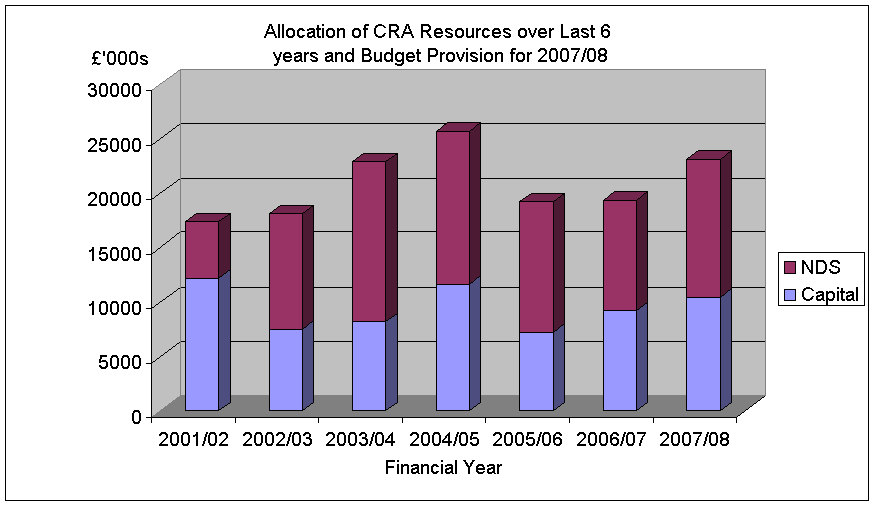
Appendix 2
Property Services Strategic Risk Register 2006/07
Summary of ten highest risks WITH controls in priority order also illustrating current performance
Level of risk |
Area of risk |
Risk Owner |
Position |
Traffic light to illustrate performance |
High |
Fire including arson |
M Kent |
1 |
Amber |
High |
Condition of building fabric including vandalism |
M Fitch |
2 |
Amber |
Med |
Access for maintenance to plant or buildings |
M Fitch |
3 |
Amber |
Med |
Failure to manage contractors & supply chain |
D Corcoran |
4 |
Green |
Med |
Asbestos disturbance |
P Crompton |
=5 |
Green |
Med |
Electrical services failure |
S Hall |
=5 |
Green |
Med |
Swimming pool plant failure |
S Hall |
=7 |
Green |
Med |
Detection of Legionella |
S Hall |
=7 |
Green |
Med |
Mechanical engineering service failures |
S Hall |
9 |
Green |
Med |
Loss of damage associated with trees |
M Fitch |
10 |
Green |
Also providing a commentary on risk 18: Structural collapse and temporary buildings
NB Glazing and window safety was ranked in 6th place in 2005/06 and is now in 13th place due to reclassification of risk and improved management of risk.
Summary of performance criteria:
Red - reactive performance. Resources (people time or money) required to significantly improve risk management controls. Urgent action required.
Amber - proactive and reactive performance. Progress is being made but specific improvement required.
Green - Meeting best practice. Issues require little managerial attention until next review.
Fire including arson | |||
Fire including arson has been ranked the top risk to the built estate over the past four years. Older buildings do not meet current benchmark standards and these must be considered in the local fire management plan. Improving fire safety across the built estate is inextricably linked to the local management of fire, delegated to service departments and specifically each manager in control of the building. Current performance for the landlord is assessed as amber, since technical fire information has been provided to local managers for residential buildings. The new risk-based approach will assist with the gathering of technical fire information to inform landlord's annual programmes of work and local manager's fire plans. It is anticipated that a green performance will be achieved in a few years, subject to the level of resources being made available. | |||
Agreed Improvements 2005/06 Outcomes 2005/06 Implement agreed programmes of structural fire precautions work to residential buildings Elderly persons homes remain the highest risk category of buildings, followed by the other residential buildings. Modern fire alarms and emergency lighting have now been installed in all core Elderly persons homes. A risk assessed programme of fire precaution improvements has been completed in the homes under possible consideration for reprovision. Publish strategic fire risk profile for all buildings in priority order This remains an on going programme to follow the work completed in the Secondary Sector. Develop and publish an arson reduction policy and good design guide An arson reduction strategy was agreed in December 2005 with HFRS for implementation during 2006. Arson reduction visits to all schools in the agreed highest risk area (Basingstoke) where conducted by the seconded officer from HFRS and a report sent to each school. Develop and publish new fire safety guidance for local managers A work to develop a new manual is well advanced and is anticipated in October 2007. |
|||
For the financial year 2006/07, a fire precaution budget of £1.2m was agreed of which £300,000 was set aside to respond to enforcement actions. This provided a planned capital programme of £900,000 within older persons homes including Bishops Waltham House, fire alarm and emergency lighting upgrading to five homes and risk assessed improvements to a further two elderly persons homes. A budget of £650k is proposed for 2007/08 will enable the installation of a sprinkler system to Basingstoke Library and an allowance of £300k for responding to HFRS enforcement and audit action. The balance will be focused on further improvements to the structural fire precautions in the Elderly Persons Homes. Proposed improvement 2007/08 to include: · Report to building users advising on impact of Fire Reform Order and new guidance to be published in October 2007. · Corporate compliance plan for implementation of Fire Reform Order to be followed. New joint action plans with the HFRS and a PBRS action plan to be prepared in October 2007. It is anticipated the joint audit programme with HFRS will begin to focus on the highest risk buildings on the school sites. |
|||
Condition of building fabric | |||
Ranked in second place, as a high risk, with an amber performance rating, this risk covers many issues relating to the maintenance and improvement to both internal and external parts of buildings. Where a separate heading features, for example electrical services, these risks are excluded from the assessment. The risk has increased to illustrate the increasing liability associated with the built estate, especially in offices and community buildings which have not benefited from NDS investment or the DSG. Asset Management Plans (AMP) have been used to generate £56m NDS funding over the past 4 years, and the liability can be quantified. Equivalent data is available for the non-education estate which ensures that annual programmes of work are directed at the highest priorities. Agreed Improvements 2005/06 Outcomes 2005/06 Develop and implement asset management strategy for Community buildings (75%) 43% of community buildings surveyed and remainder programmed by April 2007. Continue delivery of asset management strategy for primary schools (20%) Programme delivered according to plan ie 20% of schools per annum. Annual Report to members regarding AMP outputs Annual reports to Panel. Last report October 2006. Implement agreed programme of work to both schools and community buildings NDS and capital programme of works approved by members in April 2006 and delivered. Investment programmes for SCOLA recladding, external redecorations, reroofing etc all serve to reduce liabilities associated with condition of school buildings. The extensive knowledge and management framework with the schools sector finds the performance at green, subject to future allocations of resources. Notwithstanding the current investment, there is an outstanding maintenance liability within schools of £291m required to bring building to a full state of repair. The non-education Sector comprising Adult care, children's residential buildings, Recreation and Heritage and Office accommodation, the maintenance backlog is estimated over £100m. Current levels of capital investment for repair and maintenance work are 1 to 2% of this total and therefore is not possible to achieve a green performance rating in the near future. Unless there are major changes to investment or the number of buildings, the County Council is unable to prevent the decline of the building stock and will retain an increasing risk for this sector. To reflect the excellent and ongoing progress made within schools, it is proposed that this risk is split into two categories during the annual review planned autumn 2007. A green performance assessment for the non-education sector is not anticipated in the next 5 years unless significant resources can be made available. Proposed improvement 2006/07 to include: · Completion of AMP surveys on the Non-education Sector and greater utilization of data to prioritize future Capital Programmes · Delivery of 20% of repeat surveys within Schools sector to update asset data. · Subject to member approval, the deliver of a combined condition and structural survey programme to ensure best use of resources. · As part of the above the development of a risk register to identify buildings in need of inspection or repairs. · Participation in the Strategic Property review across all sectors with focus on the Non-education sector with a view to rationalising the portfolio. |
|||
High level access for maintenance of plant and building components | |||
Assessed in third place with an amber performance rating, this risk describes safe systems of work for accessing plant rooms and other parts of the building for regular maintenance activities. Plant rooms are traditionally located on the roof, often with no fixed ladder or stair to access them by contractors. Following the introduction of the Work at Height Regulations 2005, a survey of high level plant rooms has been undertaken and 55 high priority situations identified, and over 200 items on the schedule with an estimated value of £1.44m to address all working at height issues. During 2006/07 £200k has been allocated to this risk so that 5 locations can be improved to reduce the risk associated with access by contractors. Despite improvement made, the risk score was increased during the annual review in October 2006 to highlight that additional resources need to made available to secure improvement. | |||
Agreed Improvements 2005/06 Outcomes 2005/06 Maintain database to record the location and hazards associated with buildings and plant rooms where regular access is required for maintenance. New hazards are added to the database when identified by staff or contractors to update the rank order for future action. Arrangements now in place to ensure that Contractors accessing plant carry out appropriate risk controls to protect staff from high level falls. Implement annual programme of work subject to available capital resources. Programme of work was delivered to address £200k worth of improvements to about 5 locations. Develop practice note to confirm safe system of work at height and inform design of buildings to assist future maintenance programmes. Practice note under development to provide guidance to staff and contractors employed by Property Services. |
|||
Currently, this risk is assessed as a medium threat to the Council with an amber performance rating. With the current level of investment a green performance rating is not anticipated for many years and the Council has to manage the risk and liability associated with the known hazards. |
|||
Proposed improvement 2006/07 to include: · Deployment of £150k to eliminate the highest priorities identified on the database. · Consultation with contractor involved in repairs and maintenance of high level plant to identify and agree best practice. · Finalise the Practice Notice for staff using best practice ideas gathered from contractors. |
|||
Contractor and supply chain | |||
Failure of contractors and supply chains represents a significant risk and is ranked fourth place on the risk register for 2006/07. The construction industry encompasses a wide range of activities, hazards, materials, techniques, employment patterns and contractual arrangements. Nationally, many people are injured on construction sites or have their health damaged by construction work. Despite robust checks on the competence and resource of all approved contractors, the understanding of health and safety by construction workers is limited. This coupled with poor planning and communications with occupiers and sub-contractors, provides a potential liability for the County Council as client. | |||
Agreed Improvements 2005/06 Outcomes 2005/06 Revise and reissue working practice for managing contractors following implementation of new Construction , Design and Management Regulations expected April 2006. New Construction, Design and Management Regulations expected April 2006 have been deferred until April 2007. Arrangements are advanced to prepare for the changes but the finalize launch of revised working practice was deferred until 2007. Review procurement arrangements to identify continuous improvements A separate report on the procurement initiatives completed by Property Services, together with a review of building cost trends and efficiencies was presented to this Panel. Develop key performance indicators to measure performance of contractors and key supply chains. Implement health and safety training in line with industry standards e.g national card certification. Costed training programme assessed at £10.2k during 2005/06 was delivered. Proposed improvement 2006/07 to include: · Revised working practice, forms, templates and training seminars · Develop CDM-C role and competency among Property Staff to enhance risk skills during design. · Develop risk register for capital projects to demonstrate risk treatment and management. Significant improvements have been made over the past five years and emphasis is now being placed on consolidating arrangements to maintain current performance, and the identification of minor improvements. |
|||
Asbestos disturbance | |||
Ranked in equal fifth place (4th in 2003/04 & 2nd in 2004/05) as a medium risk with a green performance rating for 2005/06. Significant achievement in the management of asbestos over the past 12 months has recommended a reduced risk score and rank order. New asbestos survey programme by competent contractors is now in place with the first of a five year programme being completed. However the first round of surveys has identified a problem with asbestos containing materials in boiler houses coupled with new stricter guidance from the Health and Safety Executive, which requires a programme of asbestos repairs to ensure boiler room are safe to enter for maintenance of engineering plant. The table below summarises achievements and improvements to corporate performance: Agreed Improvements 2005/06 Outcomes 2005/06 Establish asbestos surveyor partners to facilitate removal, repair, survey and inspection arrangements Asbestos surveyor partners appointed and first year of survey programme completed Implement asbestos removal programmes Limited asbestos removal programme planned to target areas subject to high vandalism or regular maintenance. A phased asbestos removal programme has commenced in Sports hall and changing rooms in secondary schools. Improve monitoring of asbestos removal contractors Staff resources directed at monitoring performance of asbestos contractors to ensure that planned safe systems of work are followed. Develop and implement risk based inspection programme commencing September 2006. Risk based inspection programme being implemented leading to more effective use of resources. Further efficiency savings are planned in 2006/07 with the implementation of a risk-based inspection programme, although these will not offset the additional expenditure required to support asbestos removal programmes eg Three Minsters House , Ashburton Court and The Law Courts Proposed improvement 2006/07 to include: · Asbestos survey programme to focus on boiler rooms in year 2 of 5. · Deliver asbestos repairs programme to boiler rooms · Further reductions in re-inspection program as statistics and history become available. · Programme of works in key areas of risk e.g. sports-halls. |
|||
Electrical Services Failure | |||
Ranked as equal fifth on the register with a green traffic performance assessment and previously at similar position for the past 3 years. The risk describes fixed electrical installations across the estate, where the greatest threat is associated with vandalism or accidental damage to sockets and fittings. Two fires have been reported to be due to electrical failure (Nightingale and Harriet Costello schools) amounting to more than £1m loss of asset for each fire. | |||
Agreed Improvements 2005/06 Outcomes 2005/06 Implement quinquinnial testing and inspection programme. Second cycle of 5 year testing programme due for completion May 2006. Second year of second cycle work was tendered June 2006. Execute remedial work programme arising from 2005/06 T & I programme High priority remedial works to the value of £100k completed. Funding within 2006/07 budget to continue the programme of work. Undertake Capital work programme subject to available capital and NDS resources Capital programme completed illustrated by expenditure of £353k during 2005/06. Capital programme prepared 2006/07 and funding secured for NDS 2006/07. Relocation of computer suite with improved backup arrangements to prevent loss of IT2000 services. Feasibility work currently underway with IT Services and the Ashburton Court Project team. Service improvements to meet with best practice and maintain current green performance assessment for 2006/07 are listed below: Proposed improvement 2006/07 to include: · Revised improvement testing and inspection regime with investment strategy for electrical infrastructure. · Programmes of work through NDS and capital funding to improve the electrical infrastructure. · Landlord's capital programme developed to deliver more investment in replacement and refurbishment of the electrical infrastructure. |
|||
Swimming Pool Plant Failure | |||
Limited resources allocated to the repair and maintenance and upgrading of swimming pools, to meet current standards, historically has seen an overall deterioration in condition illustrated by seventh position and amber performance assessment (moved from 9th position in 2003/04 to =5th position in 2004/05). Funding delegated to schools was part of the former Education department Committee's revenue budget. Until the outcomes from the Swimming Pool Strategic Review are implemented the Council remains vulnerable to accidents and liability from pool users, especially vulnerable people such as those with a disability, babies and young children, and older persons. The likely outcomes of the Strategic Property Review will be to identify a small number of retained swimming pools for use by a defined cluster of schools to deliver the swimming curriculum to Key stage 2 pupils. Pools not included on the retained list will not benefit from central funding and investment and will be the responsibility of the Head Teacher to maintain fit for use. All pools likely to be retained, have been surveyed to identify the costs to bring each one up to a satisfactory standard. These costs will be significant and require additional capital resources in order to implement the necessary improvements. Members requested a report on the number of swimming pools at schools and their condition and this is being prepared for a future meeting of the Panel. The report will also consider the outcomes of the review mentioned above. Agreed Improvements 2005/06 Outcomes 2005/06 Introduce log books for each pool to provide active recording of maintenance activities All pools have step by step operating instruction on a wall mounted panel showing how the plant works and what needs to be done to facilitate operation of pool plant. Survey outdoor pools subject to approval of strategy by members and head teachers Survey deferred subject to Swimming Pool Strategic Review. Review resourcing of pool repairs and maintenance and find ways of charging back to establishment Work on hold subject to Swimming Pool Strategic Review Implement annual programme of work Work on hold subject to Swimming Pool Strategic Review Proposed improvement 2006/07 to include: Improvement plan to be developed depending on the outcome of the Swimming Pool Strategic Review. |
|||
Detection of Legionella | |||
Assessed as a medium risk in equal seventh position, with a green performance rating, there has been significant achievement since Autumn 2003 to meet with best practice. This risk covers the growth of Legionella bacteria with the potential to cause ill health and infection to building users, especially the elderly, infirm, the very young or those with health problems. Capital programme works to older persons homes through ENHANCE and other projects have replaced hot and cold water systems to current benchmark standards, removing dead legs and reducing the risk. Agreed Improvements 2005/06 Outcomes 2005/06 Complete replacement of wet cooling towers for Three Minsters House and Law Courts. Discussion are advanced with the Her majesty's Courts Service to fund replacement of wet cooling towers to Winchester Law Courts. Planning objections have required the roof mounted dry cooling plant to be reviewed for a local cassette cooling system to each room within Three Minsters House. Phase 1 of the cooling system will take place during summer 2007. Implement specific risk control improvements following survey and risk assessment Programme of remedial work drawn up with priorities and implemented, subject to funding allocated, in 2006/07. Publish web-based risk assessment form and Log book for local managers. Risk assessment tool and log book under development to be web-enabled later this year following a successful pilot programme Wet cooling towers are being effectively managed at Hampshire Scientific Services building in Southsea pending a long term decision on the lease and relocation of services. Proposed improvement 2006/07 to include: · Web-based risk assessment for local managers to undertake self-assessment to be launched in September 2007. · Independent review of PBRS management procedures to be undertaken by an independent consultant during summer 2007. |
|||
Mechanical Services Failure | |||
Ranked in ninth position (10th in 2005/06) with an green performance rating, this risk describes mechanical engineering plant which has the potential for fire and explosions associated with failures, and bring about closure of operational buildings. During the past 12 months, two major projects were undertaken to replace pressure system safety valves and update oil tanks to meet with new regulations. A budget of £500k was allocated for this work in 2005/06. The new term Engineering contractor is expected to provide improved value for money. Agreed Improvements 2005/06 Outcomes 2005/06 Complete asset management survey programme to ensure validity of plant records. Plant records update is now substantially complete although data on some smaller items of plant eg RPZ valves or water systems is still being gathered. Confirm inspections made by supplier for LPG All suppliers of LPG equipment have been contacted to remind them of statutory duties and responsibilities. Database is currently being compiled. Complete replacement programme of safety valves Safety valve programme is 90% complete with visits planned to sites where access was denied in 2005. Programme will be completed in 2006. Consideration is being given to the funding, safety and asset management of this risk to improve performance over the next 12 months through the new Test and invest strategy for risk management.. Proposed improvement 2006/07 to include: · New integrated database to cover plant details and servicing to ensure better and more consistent data is held. · Risk register is complied for oil tanks in unsuitable locations that do not fully comply with current regulations. · Risk register of decommissioned plant is developed to ensure safety checks are provided as part of plant management arrangements. |
|||
Loss or damaged associated with trees | |||
Ranked in tenth position with an green performance rating, this risk describes. A budget of £100k was allocated for this work in 2006/07. Agreed Improvements 2005/06 Outcomes 2005/06 Continue planned inspection of trees Record outcomes on database to inform programmes of work. Review use of database to improve understanding of data and inform programmes of work. Priority actions adopted as for other strategic risks ie P1. P2, P3 with definitions of each category. Purchase of a new specialize database has require migration of data into the new system called Easy TREEV. Consideration is being given to the funding, safety and asset management of this risk to improve performance over the next 12 months through the new Test and Invest strategy for risk management.. Proposed improvement 2006/07 to include: · Review of data following migration into the new database, Easy TREEV and integration with environment department who is also using the database. · Continued proactive management of tree defects to prevent failures before they occur. · Further training of staff to achieve the professional Tree inspection qualifications to ensure the highest standards of inspection and safety is achieved. |
|||
Glazing and Window Safety | ||||
Ranked in thirteenth position with an amber performance rating, this risk describes window failure or damage to glazing which can create injury to building users or contractors. The following table confirms the key actions and performance during 2005/06: Agreed Improvements 2005/06 Outcomes 2005/06 Develop term contract with specialist glazing firms, window manufacturers and installers Glazing work has been included in the building maintenance framework contract currently being negotiated with interested firms and reported to Panel in April 2006. Facilitate local risk assessment for community buildings through communication strategies. Letter sent to building managers to confirm legal responsibilities and duties. Implement agreed programmes of work including upgrading glass and associated remedial work Programme of work to Castle Complex buildings following recent survey by consultants. NDS programme provides glazing and window repairs in schools. |
||||
Civil claims within schools have raised awareness of the importance of risk assessment and associated repairs and maintenance to windows. Schools are performing better than in the remaining estate where communication strategies are now implemented to encourage improved performance among local managers occupying community buildings. During 2006, risk assessment were completed and high priority works delivered in Register offices and other office buildings. Property Services managers provided technical support and guidance to building users to help complete risk assessments and then address the highest priority programmes of work. The risk was subsequently reduced in the annual review to illustrate the progress made. Proposed improvement 2006/07 to include: · Failures to SCOLA fanlight windows have required investigation and advice to building users and planned remedial work to secure the glazing to the frame. · Future investment to windows in the historic buildings in the Castle Complex. |
||||
Structural collapse and temporary buildings | |||
Ranked in eighteenth position (7th in 2003/04, and 13th between 2004and 2006) with a green performance rating, this risk delivers surveys of permanent and temporary buildings, ensuring buildings remain safe to occupy, reducing the risk of collapse and injury to building users. Comparing the rank order over the past 4 years there is clear evidence that risk management programmes have been very effective leading to reduced risk and positive improvement. | |||
Agreed Actions 2005/06 Outcomes 2005/06 Deliver year 1 of 5 year programme - SCOLA repairs. Rollout of phase 1 of SCOLA wall tie remedial work will be a priority for 2006. Commence year 2 of SCOLA repairs programme in April 2006 In view of all progress against Year 1, Year 2 will be deferred with future programmes subject to the allocation of sufficient funding Develop and implement strategy for removal of temporary buildings from the non-education sector Strategy is being revised for communication to departments to facilitate removal of temporary buildings. Review strategy for removal of temporary buildings in schools The use of capital resources to remove poor condition, temporary buildings in the next four years will reduce the cost of inspections and eliminate risk in the foreseeable future. Having made considerable improvements in the past eighteen months, it is proposed to maintain current performance at green using in-house resources. Development of an integrated building inspection and AMP survey programme is expected to deliver efficiencies in the management of this risk, details of which are outlined in section 5 of this report. Proposed improvement 2006/07 to include: · Development of an integrated building inspection and ANMP Programme for member approval. · Implementation of the second phase of SCOLA wall tie replacement. |
|||