
Archived decisions
Contact: Jos Creese [email protected] , ext 7436
1. Introduction/Summary
1.1. A full Member led scrutiny of IT was undertaken by Members in the latter part of 2005/06 (see Appendix A for list of meetings). From this several areas emerged for more detailed investigation, and a review was undertaken by the Member `e-Champion', Councillor Baulk. His report was presented to P&R PRC on 31 October 2006.
1.2. At the P&R PRC meeting in December 2006 three areas remained incomplete:
· Aspects of performance of internal IT consultancy and projects;
· Scope for merging the IT Services and the Education IT (EdICT) Help Desks;
· Wider opportunities for consistency in local and central IT delivery.
1.3 This report covers those topics, and a few general questions raised at the previous P&R PCR meeting.
2. Recommendations:
· That this report be noted;
· That Members identify any further work they would wish undertaken;
· That the Member e-Champion, Councillor Baulk, is asked to continue to pursue these topics on behalf of P&R PRC as detailed in this report.
3. IT Help Desks
3.1 Following the report of Councillor Baulk, Members took the view that unless there were strong reasons, the two separate IT Help Desks should be merged in the interests of efficiency and joined-up service provision. It was agreed an assessment would be undertaken of how this could be achieved at lowest cost and risk, using external consultancy to ensure objectivity and an independent challenge. The study was commissioned by the Corporate IT manager and the terms of reference were agreed by IT Services and Children's Services, (see Appendix B).
3.2 This work is now nearing completion. The initial report indicates that the Help Desks could merge, although noting that this will not be without challenge and costs of change, and that it is unlikely to succeed without total commitment of both departments. The draft consultancy report has been made available to Councillor Baulk, but requires further work to strengthen the business case.
3.3 It is proposed that this work continues, with involvement from Councillor Baulk on behalf of the Committee.
4. Internal IT Projects & Consultancy
4.1 The Business Solutions Manager in IT Services has been working with departments to develop an improvement plan for internal IT projects and consultancy. This has become wider than the original Scrutiny findings and a formal report has been presented to the IT Development Group (the membership of which includes the heads of the departmental IT functions). This has been endorsed by this group as an appropriate basis for improvements.
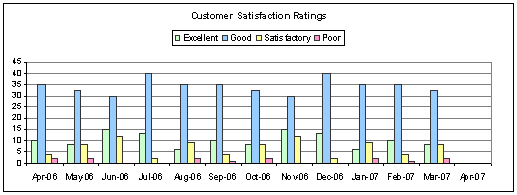
4.2 Although the volume of IT projects delivered to departments has been reducing over time, there are still a large number under way at any time. In 2006/07 well over 200 projects were delivered. The following graph identifies the volume by ratings:
4.3 Equal Access to Quality - There is a perception that smaller departments sometime receive a quicker response or a better service than larger departments, and that there is a `lottery' in terms of the experience that can be expected. It is true that large departments tend to have more larger IT programmes and projects and are therefore more likely to end up with dedicated IT professionals supporting their requirements. It is also now felt to be an historical issue as there are very few junior consultants in IT Services. However, where problems are identified, IT Services will work closely with departments to resolve the issues. It is also worth noting that all junior IT professionals are `mentored' by experienced consultants during their initial assignments, and their work is quality reviewed.
4.4 Not Charging for Estimates - There were concerns that IT Services charge for quotations for IT projects, unlike many commercial businesses, and also that estimates tend to be given rather than quotations, with risks lying more with the IT clients than the central IT supplier. Work is now nearing completion in defining a set of activities that will be non chargeable, including a no charge as part of project start-ups, and this will taken to the IT Development Group for endorsement. In addition, IT Services now provide warranties that cover a 12 month period for all work undertaken.
4.5 Framework for External IT Consultancy - IT Services has been working with County Supplies to develop a framework for external consultancy services which can be used by all departments. This will provide greater competition, evidence of benchmarked costs and easier procurement of external IT consultants. The process has included advertising in the European Journal, and over 100 organisations have responded. The framework will be in place by Autumn 2007.
4.6 Performance Reporting - IT Services has been working with departments to provide management information on project performance. This is part of IT Services on-going drive to ensure transparency of performance and costs in all areas. Metrics include:
· number of projects underway, with identification of their status;
· number of project delivery date or budget changes in a month to identify slippage or cost over-runs;
· customer satisfaction ratings on project sign-off.
In addition, the IT Services' Management Team review the status of all priority projects on a monthly basis to ensure that any problems or issues are identified early and dealt with. Furthermore, IT Services benchmarks performance generally with public and private sectors. Two independent reviews have been undertaken in the last six months and a report of findings is being drafted. Initial findings continue to show Hampshire has an exceptionally low cost base for IT.
5. IT Arrangements - Local and Central IT
5.1 Councillor Baulk, in his review, noted that the various arrangements for IT in departments varied, and should not operate as `mini IT Services departments'. He recommended that the relationship between local and central IT groups should be reviewed.
5.2 Work is now underway to look at improved ways of working between central and local IT, and in particular whether efficiencies can be achieved. The Business Improvement & IT Steering Group, chaired by Andrew Smith with representation at senior levels across the organisation, has identified specific areas of improvement for review:
· Addressing the interface between IT and the business, including the central/local IT;
· Core delivery around Projects & Consultancy (as mentioned already);
· Issues associated with a more `joined up' IT Group with consistency in IT professionalism, opportunities, training and skills;
· Review of financial arrangements for IT and the funding of corporate programmes.
5.2 This will be concluded by the Autumn, and is being led by officers from different departments. In addition, the planned Fundamental Service Review will consider detailed benchmarking around IT costs.
5.3 It is essential that IT is seen to be performing in an optimum way in the organisation, centrally and locally. The contribution of IT to organisational efficiency is being picked up as one of the main themes in the Corporate `Transforming Through Technology' strategy.
6. Other Matters
There are a number of other matters which P&R PRC Members asked about:
6.1 Joint Equipment Store - A meeting has now been arranged in July to consider an outline business case for replacing and enhancing systems to support and revise business process and to decide whether from this to commission further work. This is part of prioritisation of programmes and projects within Adult Services.
6.2 Volumes of emails and `Spam' - Members raised concern over the volumes of email. This is a general (global) and growing problem. The County Council received nearly 90 million emails last year of which nearly 70 million were successfully filtered as `Spam'.
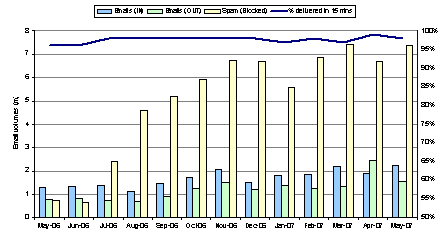
IT Services have put in place with departments, on-line training (Learn.IT) and policies to encourage effective use of email, and continue to look at refinements to `Spam' filtering.
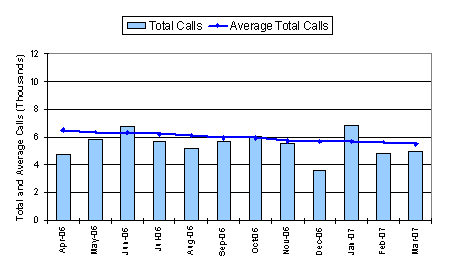
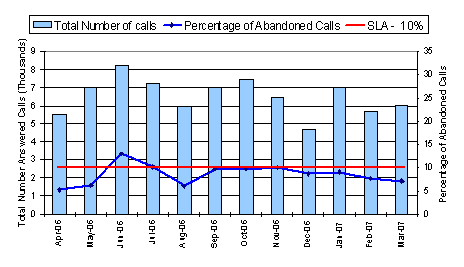
6.3 IT Help Desk Responsiveness - One Member asked about the responsiveness of the central IT Help Desk and call waiting times. The Help Desk receives over 78,000 calls each year, and its service quality and costs are benchmarked. With those volumes of calls things cannot always be perfect, but those benchmarks indicate an exceptionally strong service, which is available outside normal office hours.
6.4 Delivering Savings from IT - Members asked about certain savings from IT reported in the P&R monitoring report earlier this year. The specific savings were within the PBRS department as a result of rationalising IT equipment. This is an important activity in all departments, each looking at ways to make IT resources stretch further. Additionally, IT Services is making substantial savings in costs year on year, which have enabled investment in a range of new technologies agreed by Members to be made without recourse to new resources.
Furthermore, the role of IT in contributing to organisational efficiency is a work stream of the `Transforming through Technology' corporate strategy.
7. Conclusion
7.1 The Scrutiny review of IT has taken 18 months and has looked at every aspect of IT operation, beginning with 13 topic areas in December 2005. This report aims to conclude that process.
7.2 However, IT in any organisation is constantly changing and must continue to respond to the changing needs of the services it supports. Planned activities for 2007/08 include:
· Areas being reviewed by BIT-SG described in section 5.2;
· The need to reduce costs and deliver new efficiencies through IT, a specific theme of the `Transforming Through Technology' strategy;
· The Fundamental Service Review of support services;
· Improvement plan from the analysis of benchmarking of performance, costs and customer satisfaction recently undertaken.
7.3 IT Services will continue to work closely with the Member `e-Champion' for IT, Councillor Baulk, to ensure that IT performance is monitored and improved in an open and a transparent way.
Appendix A
Background to ICT Scrutiny Review Meeting
Meeting |
Report |
Date |
Scrutiny Panel - ICT |
Review of Annual Performance Report, ICT Seminar for Members, Plan for Scrutiny |
12/09/05 |
Scrutiny Panel - ICT |
Review Meeting (8 areas covered) |
06/10/05 |
Scrutiny Panel - ICT |
Review of Social Care System and SWIFT |
31/10/05 |
Scrutiny Panel - ICT |
Review Meeting (3 areas covered) |
31/10/05 |
Scrutiny Panel - ICT |
Review of Education IT (EdICT) |
25/11/05 |
Scrutiny Panel - ICT |
Interim report of the Chief Executive |
14/12/05 |
Scrutiny Panel - ICT |
Report of Inquiry Panel Chairman, Councillor Baulk |
24/01/06 |
Scrutiny Panel - ICT |
Report of the Head of IT and detailed challenge of Senior IT Team |
11/07/06 |
P&R PRC |
ICT Overview - Scope and Role |
11/09/06 |
P&R PRC |
Report on ICT Scrutiny by Inquiry Panel Chair, Councillor R Baulk |
31/10/06 |
P&R PRC |
ICT Scrutiny - Report of the Head of IT |
04/12/06 |
Hantsnet Reports - http://intranet.hants.gov.uk/information-technology/itservices/its-staff/hoits/its-hoits-it-scrutiny.htm
Appendix B
IT Services & EdICT Help Desks
Terms of Reference
Consultancy Study
Overview
1. For many years Hampshire County Council has run two separate IT help desks. There is a corporate IT Help Desk covering the majority of IT queries and support, and there is a specific Education ICT Help Desk focussed on schools. Other IT help desks (Surveyors, Social Services) have merged with the Central IT Help Desk)
2. Whilst this has worked well in the past in terms of ensuring a dedicated focus on schools for support, there has been growing concern from Members of the County Council that this may not be the most efficient way of operating. A Scrutiny of ICT in 2005/06 identified this as an area for further investigation, and Members have concluded that they wish to see a merging of the two help desks.
3. Business analysis undertaken through the earlier part of 2006 identified potential business case for merging, with savings up to £63k pa identified at that time. However, there have been concerns raised by the Children's Services Department (formerly Education Department), about the potential hidden costs of change - integrating systems, potential redeployment costs, etc.
4. The purpose of this assignment is to identify ways in which the merging of the two Help Desks can happen in such a way that:
· savings are maximised;
· disruption to schools during the transition are minimised;
· overall service quality improvements are targeted over time;
· an appropriate timescale is identified taking account of issues such as systems integration and communications;
· risk and other factors are identified in a high level implementation plan.
5. It is expected that the assignment will take no more than one week,. It will be commissioned by the Head of IT for Hampshire County Council. The report and findings will be available to the Children's Services' Department, the IT Services' Department and members.
Opportunities for a wider merging of IT supply functions which have been identified as desirable and by Members are outside the scope of this assessment, but where there are clear links of further opportunities, observations to that effect should be made.
6. It is expected that the Consultant will interview:
· the Head of IT;
· the Corporate IT Manager for the County Council;
· the Head of IT for Children's Services;
· the Help Desk Manager for IT Services;
· the manager of the Education ICT `Supplier' Service;
· the Head of Resources for Children's Services;
· Member e-Champion;
· an opportunity be given to both the County Treasurer and the Director of Children's Services for comment.
7. Output from the assignment will be a report to the Head of IT and Director of Children's Services to guide swift and clean implementation. The report will include a clear restatement of business case for change, issues and implementation plan.